<?xml version="1.0" encoding="ISO-8859-1"?><article xmlns:mml="http://www.w3.org/1998/Math/MathML" xmlns:xlink="http://www.w3.org/1999/xlink" xmlns:xsi="http://www.w3.org/2001/XMLSchema-instance">
<front>
<journal-meta>
<journal-id>1677-3225</journal-id>
<journal-title><![CDATA[Brazilian Journal of Oral Sciences]]></journal-title>
<abbrev-journal-title><![CDATA[Braz. j. oral sci.]]></abbrev-journal-title>
<issn>1677-3225</issn>
<publisher>
<publisher-name><![CDATA[Faculdade de Odontologia de Piracicaba, UNICAMP]]></publisher-name>
</publisher>
</journal-meta>
<article-meta>
<article-id>S1677-32252012000200006</article-id>
<title-group>
<article-title xml:lang="en"><![CDATA[Aging and thermocycling effects on adhesion of fiber posts to human radicular dentin]]></article-title>
</title-group>
<contrib-group>
<contrib contrib-type="author">
<name>
<surname><![CDATA[Abu-Naba'a]]></surname>
<given-names><![CDATA[LA]]></given-names>
</name>
<xref ref-type="aff" rid="A01"/>
</contrib>
<contrib contrib-type="author">
<name>
<surname><![CDATA[Abu-Rujai]]></surname>
<given-names><![CDATA[M]]></given-names>
</name>
<xref ref-type="aff" rid="A02"/>
</contrib>
</contrib-group>
<aff id="A01">
<institution><![CDATA[,Taibah University Department of substitutive oral sciences Prosthodontics]]></institution>
<addr-line><![CDATA[ ]]></addr-line>
</aff>
<aff id="A02">
<institution><![CDATA[,Jordan University of Science and Technology Department of Prosthodontics ]]></institution>
<addr-line><![CDATA[ ]]></addr-line>
</aff>
<pub-date pub-type="pub">
<day>00</day>
<month>06</month>
<year>2012</year>
</pub-date>
<pub-date pub-type="epub">
<day>00</day>
<month>06</month>
<year>2012</year>
</pub-date>
<volume>11</volume>
<numero>2</numero>
<fpage>106</fpage>
<lpage>111</lpage>
<copyright-statement/>
<copyright-year/>
<self-uri xlink:href="http://revodonto.bvsalud.org/scielo.php?script=sci_arttext&amp;pid=S1677-32252012000200006&amp;lng=en&amp;nrm=iso"></self-uri><self-uri xlink:href="http://revodonto.bvsalud.org/scielo.php?script=sci_abstract&amp;pid=S1677-32252012000200006&amp;lng=en&amp;nrm=iso"></self-uri><self-uri xlink:href="http://revodonto.bvsalud.org/scielo.php?script=sci_pdf&amp;pid=S1677-32252012000200006&amp;lng=en&amp;nrm=iso"></self-uri><abstract abstract-type="short" xml:lang="en"><p><![CDATA[AIM: This in vitro study evaluated the effect of different aging periods and thermocycling on the adhesion of fiber posts to human dentin at different depths. METHODS: Twenty teeth were cleaned, decoronated, and endodontically treated. After one week, root filling was removed and a 10-mm post space was prepared. Posts (RelyX&#8482; Fiber size 2) were cemented with a self-adhesive resin cement (RelyX&#8482; Unicem) and light cured. Specimens (n=4, each) were stored in 100% humidity (0 day, 7 days, 1 month, 3 months) or thermo-cycled (at 7 days, 10,000 cycles, 5-55C°, 30 s). Four 1-mm-thick sections were obtained from each tooth and a push-out test was performed and results compared. RESULTS: There was a significant difference (ANOVA p<0.05) between the means of push-out test results (MPa ± SE) at different storage periods: 24 hours: 15.2 ± 1.4; 7 days: 16.8 ± 1.5; 1 month: 20.3 ± 1.8; and 3 months: 12.5±2.0. Shear strength was significantly different (Chi-square, p<0.05) at the different slice positions. Apical sections had an increase in strength at 7 days and 1 month, but without statistical significance. The coronal section increased significantly between 0 and 7 days. All sections had reduced strengths between 1 and 3 months, but only the apical sections decreased significantly (ANOVA, p<0.05). There was no significant difference in shear strength between thermally cycled and non-cycled samples (MPa/SE 16.7± 5.9, MPa/SE 16.0 ± 9.3)(p&gt;0.05). CONCLUSIONS: Long-term storage of test samples affected the bond strength of fiber posts to radicular dentin variably, and should be considered as part of invitro testing.]]></p></abstract>
<kwd-group>
<kwd lng="en"><![CDATA[adhesion]]></kwd>
<kwd lng="en"><![CDATA[fiber post]]></kwd>
<kwd lng="en"><![CDATA[push-out test]]></kwd>
<kwd lng="en"><![CDATA[radicular dentin]]></kwd>
<kwd lng="en"><![CDATA[storage]]></kwd>
<kwd lng="en"><![CDATA[thermocycling]]></kwd>
</kwd-group>
</article-meta>
</front><body><![CDATA[ <p align="right"><font face="Verdana, Arial, Helvetica, sans-serif" size="2"><b>ORIGINAL    ARTICLE</b></font></p>     <p>&nbsp;</p>     <p><font face="Verdana, Arial, Helvetica, sans-serif" size="4"><a name="top"/><b>Aging and thermocycling effects on adhesion of fiber posts to human radicular dentin</b></font></p>     <p>&nbsp;</p>     <p>&nbsp;</p>     <p><font face="Verdana, Arial, Helvetica, sans-serif" size="2"><b>Abu-Naba'a LA<sup>I</sup>; Abu-Rujai M<sup>II</sup></b></font></p>     <p>&nbsp;</p>     <p><font face="Verdana, Arial, Helvetica, sans-serif" size="2"><sup>I</sup>BDS, PhD, MFDRCS, Assistant Professor of Prosthodontics, Department of substitutive oral sciences, Taibah University, KSA, Formerly:   Jordan University of Science and Technology, Jordan<br/> <sup>II</sup>Master's degree student, Department of Prosthodontics, Jordan University of Science and Technology, Irbid, Jordan </font></p>     <p><font face="Verdana, Arial, Helvetica, sans-serif" size="2"><a href="#back">Correspondence</a></font></p>     <p>&nbsp;</p>     ]]></body>
<body><![CDATA[<p>&nbsp;</p> <hr noshade size="1">     <p><font face="Verdana, Arial, Helvetica, sans-serif" size="2"><b>ABSTRACT</b></font></p>     <p><font face="Verdana, Arial, Helvetica, sans-serif" size="2"><b>AIM:</b> This in vitro study evaluated the effect of different aging periods and thermocycling on the   adhesion of fiber posts to human dentin at different depths.<br/>   <b>METHODS:</b> Twenty teeth were cleaned,   decoronated, and endodontically treated. After one week, root filling was removed and a 10-mm   post space was prepared. Posts (RelyX&trade; Fiber size 2) were cemented with a self-adhesive   resin cement (RelyX&trade; Unicem) and light cured. Specimens (n=4, each) were stored in 100%   humidity (0 day, 7 days, 1 month, 3 months) or thermo-cycled (at 7 days, 10,000 cycles, 5-55C&deg;,   30 s). Four 1-mm-thick sections were obtained from each tooth and a push-out test was performed   and results compared.<br/>   <b>RESULTS:</b> There was a significant difference (ANOVA p&lt;0.05) between   the means of push-out test results (MPa &plusmn; SE) at different storage periods: 24 hours: 15.2 &plusmn; 1.4;   7 days: 16.8 &plusmn; 1.5; 1 month: 20.3 &plusmn; 1.8; and 3 months: 12.5&plusmn;2.0. Shear strength was significantly   different (Chi-square, p&lt;0.05) at the different slice positions. Apical sections had an increase in   strength at 7 days and 1 month, but without statistical significance. The coronal section increased   significantly between 0 and 7 days. All sections had reduced strengths between 1 and 3 months,   but only the apical sections decreased significantly (ANOVA, p&lt;0.05). There was no significant   difference in shear strength between thermally cycled and non-cycled samples (MPa/SE 16.7&plusmn;  5.9, MPa/SE 16.0 &plusmn; 9.3)(p&gt;0.05).<br/>   <b>CONCLUSIONS:</b> Long-term storage of test samples affected the   bond strength of fiber posts to radicular dentin variably, and should be considered as part of invitro   testing.</font></p>     <p><font face="Verdana, Arial, Helvetica, sans-serif" size="2"><b>Keywords:</b>    adhesion, fiber post, push-out test, radicular dentin, storage, thermocycling.</font></p> <hr noshade size="1">     <p>&nbsp;</p>     <p>&nbsp;</p>     <p><font face="Verdana, Arial, Helvetica, sans-serif" size="3"><b>Introduction</b></font></p>     <p><font face="Verdana, Arial, Helvetica, sans-serif" size="2">Damaged tooth structure get support and retention from various post materials   and methods with emphasis on esthetic demands<sup>1</sup>. Many in vitro tests of fiber   post material analyze dentin-cement-post system behavior under proposed clinical   situations. These tests were reviewed and reasons for the variability of strength   results were indicated<sup>2-6</sup>: 1. Tests were done on full-root samples (as pull-out and   fracture compressive load), or root sections (as micro-push-out or hourglass- and   rectangular stick-shaped microtensile testing); 2. As the method of force application   differed, values of adhesion reported varied; 3. Pull-out of a whole post from full   roots had highest values of bond strength, followed by push-out tests from root   sections; 4. Failures and high standard deviations of strengths reduce the reliability   of test values. A large number of premature failures (during specimen preparation)   occur with hourglass and stick tensile tests; 5. Full root sample testing was dependent on the morphology of radicular dentin; 6. The push-out test of thinperpendicular root sections showed advantages over other testing methods: strength measurements were more consistent, stress distribution was more homogenous (finite element analysis), strength values were less variable, flaws were distributed uniformly and finely throughout the material (this is called a higher Weibull modulus), fewer premature failures were found (confined mainly to root samples not embedded in resin blocks), and finally, there was differentiation of regional differences in bond strength; 7. Moisture, heat and fatigue stresses interplay and reduce the longevity of fiber posts clinically, and were standardized conditions added to samples before testing. These were applied either to whole teeth (which best mimics the clinical situation), but other studies concluded from applying them to dentin powder, isolated dentin sections of coronal dentin, or unsealed samples with an enamel-bonded margin, or bovine teeth; 8. Variability also resulted because tests were applied to different cements, adhesives, posts, dentin substrates and irrigant materials.</font></p>     <p><font face="Verdana, Arial, Helvetica, sans-serif" size="2">The study reported here applies some of these clinical   conditions to intact human roots that received fiber bonded   posts and were tested by push-out tests with different storage   periods and thermocycling. The null-hypothesis states that   no difference will be detected after different aging periods   and thermocycling of intact roots on the adhesion of fiber   posts to radicular dentin at different root section locations.</font></p>     <p>&nbsp;</p>     ]]></body>
<body><![CDATA[<p><font face="Verdana, Arial, Helvetica, sans-serif" size="3"><b>Material and    methods</b></font></p>     <p><font face="Verdana, Arial, Helvetica, sans-serif" size="2"><b>Sample selection</b></font></p>       <p><font face="Verdana, Arial, Helvetica, sans-serif" size="2">Twenty, caries and crack-free human maxillary central   incisors and canines with straight 14-mm-long roots and   mature apices were selected. A single canal was verified by 2-angled radiographs.</font></p>     <p><font face="Verdana, Arial, Helvetica, sans-serif" size="2"><b>Ethical approvals</b></font></p>       <p><font face="Verdana, Arial, Helvetica, sans-serif" size="2">This study was supported by grant no. 149/2009, by   Jordan University of Science and Technology, Jordan. The   study was independently reviewed and approved by the   Research Committee, (Deanship of Research) and the   Institutional Research Board (IRB), specialized in humanresearch ethics, (Faculty of medicine).</font></p>     <p><font face="Verdana, Arial, Helvetica, sans-serif" size="2"><b>Sample preparation</b></font></p>       <p><font face="Verdana, Arial, Helvetica, sans-serif" size="2">Debris were cleaned and the intact teeth were disinfected   (30 min, 3% sodium hypochlorite sonic bath; Sultan chemists,   300 Pro. Sonic, Branson Ultrasonics) and stored in thymol solution until the time of testing.</font></p>     <p><font face="Verdana, Arial, Helvetica, sans-serif" size="2"><b>Root Canal Treatment</b></font></p>       <p><font face="Verdana, Arial, Helvetica, sans-serif" size="2">The crowns were removed 2 mm above the buccal   cementoenamel junction (0.5 mm diamond wafering blade;   Isomet, Buehler Ltd, Lake Bluff, IL, USA) under copious   water cooling. A #15 K-type file was inserted until it could   be seen at the apical foramen, and then 1 mm was subtracted   from this length to determine the working length. Crowndown   technique prepared canals for root canal filling (S1,   S2, S3, F1, F2 and F3 ProTaper files on X-smart handpiece;   Dentsply Maillefer, Switzerland). Irrigation (1 mL of 1%   NaOCl solution; PD, Dentaires SA, Switzerland,) and File-Eze (18% EDTA, Ultradent, South Jordan, UT, USA,) were   used between files. A final rinse (5 mL distilled water) and   drying (ProTaper Paper Points, Ref A 022W; Dentsply   Maillefer, Switzerland) were done, then AH26 resin sealer   (Dentsply Deterey, Konstanz, Germany) was applied using a lentulo spiral onto the dry canal.</font></p>     <p><font face="Verdana, Arial, Helvetica, sans-serif" size="2">Cold lateral condensation technique was used to   obturate the canals (gutta-percha cone and fine accessory   points, ProTaper Gutta Percha Points, Dentsply Maillefer,   Switzerland). The coronal part, 2 mm below the orifice, was   cleaned and sealed (Cavit-G; 3 M ESPE, Seefeld, Germany).   The root tips were immersed in saline solution in a closed   container to ensure high humidity. The container was stored   in an incubator at a 37&deg;C to allow setting of the sealer for at   least 7 days.</font></p>     ]]></body>
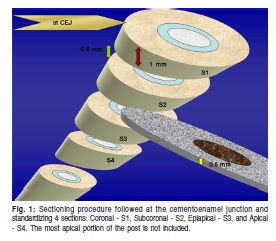
<body><![CDATA[<p><font face="Verdana, Arial, Helvetica, sans-serif" size="2"><b>Post Space Preparation</b></font></p>       <p><font face="Verdana, Arial, Helvetica, sans-serif" size="2">Root filling was removed (Gates-Glidden, Gates,   Dentsply Maillefer, Switzerland) and a 10-mm post space   was prepared, leaving at least 3 mm of the root filling apically   (universal burr, Size 2 drill, RelyX&trade; fiber post kit; t, 3M   ESPE, Seefeld, Germany). Posts (RelyX&trade; Fiber size 2, 3M   ESPE, Seefeld, Germany) were cleaned with alcohol, tried   for the fit (binding was excluded) and protected from any   further contamination. The post space was irrigated with   normal saline and then 5 mL of distilled water. Canals were   dried with paper points (ProTaper Paper Points, Dentsply Maillefer, Switzerland).</font></p>     <p><font face="Verdana, Arial, Helvetica, sans-serif" size="2"><b>Cementation of the post</b></font></p>       <p><font face="Verdana, Arial, Helvetica, sans-serif" size="2">The self adhesive resin cement (RelyX&trade; Unicem, 3M   ESPE, Seefeld, Germany,) was activated, mixed (15 s capsule   mixer, Italy), and then applied into canal (Elongatin tips,   3M ESPE, Seefeld, Germany) according to the manufacturer's   recommendation. The post was seated immediately, slightly   twisted, and moderate pressure was applied to hold the post   in its position while removing excess and during   polymerization (600 mW/cm2, 40 s through the post, 20 s cervical, buccal and lingual surfaces).</font></p>     <p><font face="Verdana, Arial, Helvetica, sans-serif" size="2"><b>Aging and storage</b></font></p>       <p><font face="Verdana, Arial, Helvetica, sans-serif" size="2">Specimens (n=4, each) were either stored in 100%   humidity for different periods (0 days, 7 days, 1 month, 3   months) or thermocycled after 1 week of storage (5-55C&deg;, 10,000 cycles, 30-s soaking, 12-s intervals).</font></p>     <p><font face="Verdana, Arial, Helvetica, sans-serif" size="2"><b>Sectioning</b></font></p>       <p><font face="Verdana, Arial, Helvetica, sans-serif" size="2">After the storage period, the teeth were mounted in molds   of polyester resin (HM 190 unsaturated polyester resins,   intermediate petrochemicals industries, Jordan) for the ease   of handling and sectioning. The specimens were then sectioned in a Isomet sectioning machine (Buehler Ltd, LakeBluff, IL, USA) with a 0.5 mm diamond wafering blade under copious water cooling, and loss between each slice was measured to be 0.6 mm. Four 1-mm-thick sections were obtained from each tooth and identified as coronal (S1), sub-coronal (S2), epiapical (S3) and apical (S4) (<a href="#fig01">Figure 1</a>).</font></p>     <p>&nbsp;</p>     <p><a name="fig01"></a></p>     ]]></body>
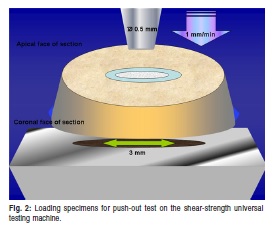
<body><![CDATA[<p>&nbsp;</p>     <p align="center"><img src="/img/revistas/bjos/v11n2/a06fig01.jpg"></p>     <p>&nbsp;</p>     <p><font face="Verdana, Arial, Helvetica, sans-serif" size="2"><b>Bond strength Test</b></font></p>       <p><font face="Verdana, Arial, Helvetica, sans-serif" size="2">A push-out test was performed in a (Universal Testing   Machine, Jinan testing equipment corporation, PRC). The   sample mounted on the testing machine on a table with a 3-mm-diameter central opening to allow the escape of the debonded   post. An indenter with a diameter of 0.5 mm was   used to apply the force on the post in an apico-coronal   direction at a crosshead speed of 1 mm/min until the post was dislodged (<a href="#fig02">Figure 2</a>).</font></p>     <p>&nbsp;</p>     <p><a name="fig02"></a></p>     <p>&nbsp;</p>     <p align="center"><img src="/img/revistas/bjos/v11n2/a06fig02.jpg"></p>     <p>&nbsp;</p>     ]]></body>
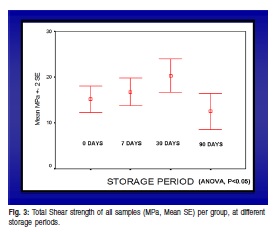
<body><![CDATA[<p><font face="Verdana, Arial, Helvetica, sans-serif" size="2"><b>Statistical analysis</b></font></p>       <p><font face="Verdana, Arial, Helvetica, sans-serif" size="2">The retentive strength of the post segment was expressed   in MPa, by dividing the load at failure (Newton) by the   interfacial area of the post fragment (SL). The latter, being   the lateral surface of a truncated cone, was calculated by the   formula: SL = &eth; (R+ r) .&#91;(h2 (R - r) 2&#93; 0.5, Where &eth;= 3. 14,   R: coronal post radius, r: apical post radius and h: root slice   thickness. The differences between groups were tested using   ANOVA to compare means of tested groups. Chi square and   Tukey's HSD test were used to test the results in terms of slice position (p&lt;0.05).</font></p>     <p>&nbsp;</p>       <p><font face="Verdana, Arial, Helvetica, sans-serif" size="3"><b>Results</b></font></p>     <p><font face="Verdana, Arial, Helvetica, sans-serif" size="2"><b>Effect of storage period</b></font></p>     <p><font face="Verdana, Arial, Helvetica, sans-serif" size="2">There was a significant difference between the means of   push-out test results at different storage periods (ANOVA   p&lt;0.05) (<a href="#fig03">Figure 3</a>). Shear strength was significantly different   at 1 and 3 months of storage (Tukey HSD, p&lt;0.05). Immediate   or baseline values were considered testing samples at baseline   (24 hours of storage) and comparison with 1-week of storage   showed that stored samples had a slight increase in test values   (0 day: 15.2 &plusmn; 1.4; 7 day: 16.8 &plusmn; 1.5 MPa/SE). Then the   strength increased reaching the maximum at 1 month (20.3  &plusmn; 1.8 MPa/SE), then reduced to its lowest value at three months (12.5&plusmn;2.0 MPa/SE).</font></p>     <p>&nbsp;</p>     <p><a name="fig03"></a></p>     <p>&nbsp;</p>     <p align="center"><img src="/img/revistas/bjos/v11n2/a06fig03.jpg"></p>     ]]></body>
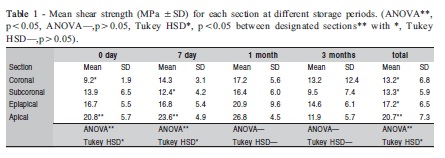
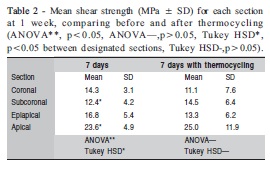
<body><![CDATA[<p>&nbsp;</p>     <p><font face="Verdana, Arial, Helvetica, sans-serif" size="2"><b>Effect of slice position</b></font></p>     <p><font face="Verdana, Arial, Helvetica, sans-serif" size="2">Shear strength was significantly different at different slice   positions (Chi-square, p&lt;0.05). Apical and epiapical sections   had an increase in strength at 7 days and 1 month but without   statistical significance. Coronal sections had a significant   increase in strength between 0 and 7 days. All sections had   reduced strengths between 1 and 3 months, but apical section   decreased significantly between 1 and 3 months (ANOVA, p&lt;0.05) (<a href="#tab01">Table 1</a>).</font></p>     <p>&nbsp;</p>     <p><a name="tab01"></a></p>     <p>&nbsp;</p>     <p align="center"><img src="/img/revistas/bjos/v11n2/a06tab01.jpg"></p>     <p>&nbsp;</p>     <p><font face="Verdana, Arial, Helvetica, sans-serif" size="2"><b>Effect of thermal cycling at 1 week</b></font></p>     <p><font face="Verdana, Arial, Helvetica, sans-serif" size="2">The number of cycles used here are 10,0000 and performed over 10 days. There was no significant difference   in shear strength between the two conditions for the whole   samples (16.7&plusmn; 5.9 and 16.0 &plusmn; 9.3 MPa/SE)(p&gt;0.05).   Subcoronal and apical sections had a non-significant increase,   while coronal and epiapical sections had a non-significant decrease of stress values (<a href="#tab02">Table 2</a>).</font></p>     ]]></body>
<body><![CDATA[<p>&nbsp;</p>     <p><a name="tab02"></a></p>     <p>&nbsp;</p>     <p align="center"><img src="/img/revistas/bjos/v11n2/a06tab02.jpg"></p>     <p>&nbsp;</p>     <p><font face="Verdana, Arial, Helvetica, sans-serif" size="3"><b>Discussion</b></font></p>     <p><font face="Verdana, Arial, Helvetica, sans-serif" size="2"> A five-year survival rates for fiber posts are considered   satisfactory<sup>7-8</sup> and depend on the location of the tooth   restored, type of final restoration, presence of proximal   contacts from adjacent teeth, presence of a ferrule, remaining   coronal structure and occlusal loads<sup>9-11</sup>. Nevertheless, the   failure mode is usually a restorable de-bonding of resin   bonded fiber posts, and can be enhanced by using various pretreatment procedures<sup>12</sup>.</font></p>     <p><font face="Verdana, Arial, Helvetica, sans-serif" size="2">In vitro studies have tried to test dentin bonding   behavior from tests applied to dentin sections and not   endodontically and post-restored intact teeth. Testing the   radicular dentin-bond-cement-post system could be proposed   to have different results than testing sections or non-sealed   dentin surfaces<sup>2-6</sup>. Even in this closed system, more   standardization is needed.</font></p>     <p><font face="Verdana, Arial, Helvetica, sans-serif" size="2">This study standardized the taper of endodontic   preparation, endodontic filling, post space preparation,   irrigation, cement, post placement, coronal seal, and light   curing for all study samples. Test variables - storage and   thermocycling - have been subjected to intact and sealed   roots. Then, resin-block addition, around these root samples,   aimed to only facilitate the sectioning procedure.   Standardizing the cement in this study, and using only RelyX   Unicem, was essential. It had similar flexural strength to the   conventional resin cements. Even higher strength and   modulus of elasticity were evident when light cured. Its low   initial pH is characterized by a more rapid rise to neutrality   than other cements, regardless to the curing method<sup>11</sup>.   Although criticized, not being able to effectively remove   the thick smear layer<sup>12</sup>, the cement formed sporadic resin   tags and hybrid layers, and it had the highest bond strengths   when compared to other conventional cements<sup>6,13</sup>. In addition,   this higher chemical interaction between the cement and   hydroxyapatite caused no displacement of the resin   components across the dentin tubules<sup>12</sup>. Its strength was not   affected if present in thicker cement layers<sup>13</sup>. And when test   samples were examined for failure modes, it was the only   one to show an adhesive-cohesive mixed fracture<sup>14-16</sup>.</font></p>     <p><font face="Verdana, Arial, Helvetica, sans-serif" size="2"><b>The effect of storage</b></font></p>     ]]></body>
<body><![CDATA[<p><font face="Verdana, Arial, Helvetica, sans-serif" size="2">Storage of bonded restorations caused deterioration by   infusion of fluid into its matrix, from periodontioum, coronal   and apical ends of the restorations. If no peripheral failure is   observed in restorations, this leakage is confined to fluids   and not to macromolecules and microbial products. Later, a   progressive disintegration of the fibrilar network of the   collagen occurs in hybrid layer. Matrix metalloproteinase   (MMPs) bind to dentin matrix and become activated or come   from pulp tissue, odontoblasts, saliva or microbial macromolecules<sup>2-6</sup>. Further expression of their activity is produced   by acidic challenges to dentin tissue during bonding   procedures<sup>17</sup>. Another effect of fluid ingression during storage   is the plasticizing of resin bond and cement materials.   However, a study, using multiple cements, concluded that   3-month storage of intact samples in deionized water had   no influence on the hardness of 3 common post-cements,   with the exception of RelyX Unicem. It had a significant increase in the hardness values after storage<sup>18</sup>.</font></p>     <p><font face="Verdana, Arial, Helvetica, sans-serif" size="2"><b>Comparing strength values at different slice depth</b></font></p>     <p><font face="Verdana, Arial, Helvetica, sans-serif" size="2">It could be proposed that the restored canal system   behaves differently at different depths from the   cementoenamel. One difference between layers is the   adaptation of the post to canal walls, increasing adhesion   forces, and friction, while reducing the low cohesive strength, fluid ingression and flaws relevant to the cement layer<sup>19</sup>.   Apical portions expected to be closer and could be matched   in size with the post, by custom-post preparation burs. If a   close fit is produced, by post relining for example, higher   retention values were obtained than non-relined post, in all   thirds, along with disappearance of differences among various   depths<sup>19</sup>. When precise fitting was reached, RelyX Unicem   had similar or higher strength values, compared with other   cements, after water storage and thermocycling.</font></p>     <p><font face="Verdana, Arial, Helvetica, sans-serif" size="2">In oversized post space, it was second after Build-It,   SuperBond and Panavia<sup>13,20-21</sup>, in comparison with 3 other   different cements with thermocycling only. Fracture modes   were shown by other cements to be mainly adhesive at the   post surface or cohesive for precisely fitting posts and to   occur between post and composite, except for RelyX Unicem   with cohesive fractures, for the oversized spaces. Finite   element model found that indirect and direct restorations   produced both strain and stress, off the scale in the middle   third of the buccal aspect of the root surface. While minimum   values were noticed at the level of both the apical portion of   the post and the root apex<sup>22</sup>. In vitro studies not including   the previous clinical conditions have shown the contrary.</font></p>     <p><font face="Verdana, Arial, Helvetica, sans-serif" size="2">Cervical (coronal sections) regions have higher strength   values than middle and apical thirds, respectively<sup>2-6</sup>. The   preference of light curing to easily accessible cervical regions   could be one reason for this result. RelyX Unicem showed   the same result in a previous study<sup>23</sup>. The reason could have   been the amount of non-homogenous cement that was less   in the cervical than in the middle and apical levels. The   application tip used in this study significantly reduced these   failures, but they were still more predominant in apical areas<sup>24</sup>.</font></p>     <p><font face="Verdana, Arial, Helvetica, sans-serif" size="2">Another problem was that the brush used to coat   adhesives accessed cervical regions with more material,   leading to better resin tag morphologies<sup>25</sup>. Using the unique   application tip, then inserting the post in it, excluded the   formation of air inhibited layers in the cement. Finally,   contamination of apical regions with remnants of sealing   material is more prominent in apical regions<sup>26</sup>. This final   limitation was excluded from this study as the last 1.4 mm   of the post was not included in the sections. This study was   persistent with the results of the first group; apical sections   were stronger than other sections that gradually decreased   up to the coronal. The apical even benefitted to some extent   from thermocycling, in the same way as observed in a   previous study<sup>16</sup>, but was significantly affected by the storage,   leading it to comply more with the second group<sup>27</sup>. Studies   that have shown a thermocycling effect used a larger number   of cycles, 40,000, and were subjected to exposed sections,   not intact teeth<sup>28</sup>.</font></p>     <p><font face="Verdana, Arial, Helvetica, sans-serif" size="2">Within the limitations of this study, it was observed   that intact and sealed roots produced different fiber post   bonding results in comparison with other studies applying   these conditions to dentin sections, powder or un-sealed   restorations. Such variation should be taken into account   when planning in vitro studies which test and conclude on   the behavior of the radicular dentin-cement-post system on   the long-term and at different regions within the root.</font></p>     <p>&nbsp;</p>     <p><font face="Verdana, Arial, Helvetica, sans-serif" size="3"><b>Acknowledgements</b></font></p>       <p><font face="Verdana, Arial, Helvetica, sans-serif" size="2">This study was supported by grant no. 149/2009, by   Jordan University of Science and Technology, Jordan. The   study was independently reviewed and approved by the   Research Committee, (Deanship of Research) and the   Institutional Research Board (IRB), specialized in humanresearch ethics, (Faculty of medicine).</font></p>     ]]></body>
<body><![CDATA[<p>&nbsp;</p>     <p><font face="Verdana, Arial, Helvetica, sans-serif" size="3"><b>References</b></font></p>     <!-- ref --><p><font face="Verdana, Arial, Helvetica, sans-serif" size="2">1. Cagidiaco MC, Garc&iacute;a-Godoy F, Vichi A, Grandini S, Goracci C, Ferrari   M. Placement of fiber prefabricated or custom made posts affects the 3-year survival of endodontically treated premolars. Am J Dent. 2008; 21: 179-84.    &nbsp;&nbsp;&nbsp;&nbsp;&nbsp;&nbsp;&nbsp;&nbsp;[&#160;<a href="javascript:void(0);" onclick="javascript: window.open('/scielo.php?script=sci_nlinks&ref=043214&pid=S1677-3225201200020000600001&lng=','','width=640,height=500,resizable=yes,scrollbars=1,menubar=yes,');">Links</a>&#160;]<!-- end-ref --></font></p>     <!-- ref --><p><font face="Verdana, Arial, Helvetica, sans-serif" size="2">2. Bitter K, Kielbassa AM. Post-endodontic restorations with adhesively luted   fiber-reinforced composite post systems: a review. Am J Dent. 2007; 20:   353-60.    &nbsp;&nbsp;&nbsp;&nbsp;&nbsp;&nbsp;&nbsp;&nbsp;[&#160;<a href="javascript:void(0);" onclick="javascript: window.open('/scielo.php?script=sci_nlinks&ref=043216&pid=S1677-3225201200020000600002&lng=','','width=640,height=500,resizable=yes,scrollbars=1,menubar=yes,');">Links</a>&#160;]<!-- end-ref --></font></p>     <!-- ref --><p><font face="Verdana, Arial, Helvetica, sans-serif" size="2">3. Saskalauskaite E, Tam LE, McComb D. Flexural strength, elastic modulus,   and pH profile of self-etch resin luting cements. J Prosthodont .2008; 17:   262-8.    &nbsp;&nbsp;&nbsp;&nbsp;&nbsp;&nbsp;&nbsp;&nbsp;[&#160;<a href="javascript:void(0);" onclick="javascript: window.open('/scielo.php?script=sci_nlinks&ref=043218&pid=S1677-3225201200020000600003&lng=','','width=640,height=500,resizable=yes,scrollbars=1,menubar=yes,');">Links</a>&#160;]<!-- end-ref --></font></p>     <!-- ref --><p><font face="Verdana, Arial, Helvetica, sans-serif" size="2">4. Goracci C, Sadek FT, Fabianelli A, Tay FR, Ferrari M. Evaluation of the   adhesion of fiber posts to intraradicular dentin. Oper Dent. 2005; 30: 627-35.    &nbsp;&nbsp;&nbsp;&nbsp;&nbsp;&nbsp;&nbsp;&nbsp;[&#160;<a href="javascript:void(0);" onclick="javascript: window.open('/scielo.php?script=sci_nlinks&ref=043220&pid=S1677-3225201200020000600004&lng=','','width=640,height=500,resizable=yes,scrollbars=1,menubar=yes,');">Links</a>&#160;]<!-- end-ref --></font></p>     ]]></body>
<body><![CDATA[<!-- ref --><p><font face="Verdana, Arial, Helvetica, sans-serif" size="2">5. Wrbas KT, Kampe MT, Schirrmeister JF, Altenburger MJ, Hellwig E.   .&#91;Retention of fiber posts dependent on different resin cements&#93; Schweiz   Monatsschr Zahnmed. 2006; 116: 18-24.    &nbsp;&nbsp;&nbsp;&nbsp;&nbsp;&nbsp;&nbsp;&nbsp;[&#160;<a href="javascript:void(0);" onclick="javascript: window.open('/scielo.php?script=sci_nlinks&ref=043222&pid=S1677-3225201200020000600005&lng=','','width=640,height=500,resizable=yes,scrollbars=1,menubar=yes,');">Links</a>&#160;]<!-- end-ref --></font></p>     <!-- ref --><p><font face="Verdana, Arial, Helvetica, sans-serif" size="2">6. Bitter K, Paris S, Pfuertner C, Neumann K, Kielbassa AM. Morphological   and bond strength evaluation of different resin cements to root dentin. Eur J   Oral Sci. 2009; 117: 326-33.    &nbsp;&nbsp;&nbsp;&nbsp;&nbsp;&nbsp;&nbsp;&nbsp;[&#160;<a href="javascript:void(0);" onclick="javascript: window.open('/scielo.php?script=sci_nlinks&ref=043224&pid=S1677-3225201200020000600006&lng=','','width=640,height=500,resizable=yes,scrollbars=1,menubar=yes,');">Links</a>&#160;]<!-- end-ref --></font></p>     <!-- ref --><p><font face="Verdana, Arial, Helvetica, sans-serif" size="2">7. Signore A, Benedicenti S, Kaitsas V, Barone M, Angiero F, Ravera G.   Long-term survival of endodontically treated, maxillary anterior teeth restored   with either tapered or parallel-sided glass-fiber posts and full-ceramic crown   coverage. J Dent. 2009; 37: 115-21.    &nbsp;&nbsp;&nbsp;&nbsp;&nbsp;&nbsp;&nbsp;&nbsp;[&#160;<a href="javascript:void(0);" onclick="javascript: window.open('/scielo.php?script=sci_nlinks&ref=043226&pid=S1677-3225201200020000600007&lng=','','width=640,height=500,resizable=yes,scrollbars=1,menubar=yes,');">Links</a>&#160;]<!-- end-ref --></font></p>     <!-- ref --><p><font face="Verdana, Arial, Helvetica, sans-serif" size="2">8. Piovesan EM, Demarco FF, Cenci MS, Pereira-Cenci T. Survival rates of   endodontically treated teeth restored with fiber-reinforced custom posts and   cores: a 97-month study. Int J Prosthodont .2007; 20: 633-9.    &nbsp;&nbsp;&nbsp;&nbsp;&nbsp;&nbsp;&nbsp;&nbsp;[&#160;<a href="javascript:void(0);" onclick="javascript: window.open('/scielo.php?script=sci_nlinks&ref=043228&pid=S1677-3225201200020000600008&lng=','','width=640,height=500,resizable=yes,scrollbars=1,menubar=yes,');">Links</a>&#160;]<!-- end-ref --></font></p>     <!-- ref --><p><font face="Verdana, Arial, Helvetica, sans-serif" size="2">9. Naumann M, Blankenstein F, Kiessling S, Dietrich T. Risk factors for failure   of glass fiber-reinforced composite post restorations: a prospective   observational clinical study. Eur J Oral Sci. 2005; 113: 519-24.    &nbsp;&nbsp;&nbsp;&nbsp;&nbsp;&nbsp;&nbsp;&nbsp;[&#160;<a href="javascript:void(0);" onclick="javascript: window.open('/scielo.php?script=sci_nlinks&ref=043230&pid=S1677-3225201200020000600009&lng=','','width=640,height=500,resizable=yes,scrollbars=1,menubar=yes,');">Links</a>&#160;]<!-- end-ref --></font></p>     ]]></body>
<body><![CDATA[<!-- ref --><p><font face="Verdana, Arial, Helvetica, sans-serif" size="2">10. Naumann M, Reich S, Nothdurft FP, Beuer F, Schirrmeister JF, Dietrich   T. Survival of glass fiber post restorations over 5 years. Am J Dent. 2008;   21: 267-72.    &nbsp;&nbsp;&nbsp;&nbsp;&nbsp;&nbsp;&nbsp;&nbsp;[&#160;<a href="javascript:void(0);" onclick="javascript: window.open('/scielo.php?script=sci_nlinks&ref=043232&pid=S1677-3225201200020000600010&lng=','','width=640,height=500,resizable=yes,scrollbars=1,menubar=yes,');">Links</a>&#160;]<!-- end-ref --></font></p>     <!-- ref --><p><font face="Verdana, Arial, Helvetica, sans-serif" size="2">11. Dorriz H, Alikhasi M, Mirfazaelian A, Hooshm, T. Effect of ferrule and   bonding on the compressive fracture resistance of post and core   restorations. J Contemp Dent Pract. 2009; 10: 1-8.    &nbsp;&nbsp;&nbsp;&nbsp;&nbsp;&nbsp;&nbsp;&nbsp;[&#160;<a href="javascript:void(0);" onclick="javascript: window.open('/scielo.php?script=sci_nlinks&ref=043234&pid=S1677-3225201200020000600011&lng=','','width=640,height=500,resizable=yes,scrollbars=1,menubar=yes,');">Links</a>&#160;]<!-- end-ref --></font></p>     <!-- ref --><p><font face="Verdana, Arial, Helvetica, sans-serif" size="2">12. de Souza Costa CA, Hebling J, Randall RC. Human pulp response to   resin cements used to bond inlay restorations. Dent Mater. 2006; 22:   954-62.    &nbsp;&nbsp;&nbsp;&nbsp;&nbsp;&nbsp;&nbsp;&nbsp;[&#160;<a href="javascript:void(0);" onclick="javascript: window.open('/scielo.php?script=sci_nlinks&ref=043236&pid=S1677-3225201200020000600012&lng=','','width=640,height=500,resizable=yes,scrollbars=1,menubar=yes,');">Links</a>&#160;]<!-- end-ref --></font></p>     <!-- ref --><p><font face="Verdana, Arial, Helvetica, sans-serif" size="2">13. Huber L, Cattani-Lorente M, Shaw L, Krejci I, Bouillaguet S. Push-out   bond strengths of endodontic posts bonded with different resin-based luting cements. Am J Dent. 2007; 20: 167-72.    &nbsp;&nbsp;&nbsp;&nbsp;&nbsp;&nbsp;&nbsp;&nbsp;[&#160;<a href="javascript:void(0);" onclick="javascript: window.open('/scielo.php?script=sci_nlinks&ref=043238&pid=S1677-3225201200020000600013&lng=','','width=640,height=500,resizable=yes,scrollbars=1,menubar=yes,');">Links</a>&#160;]<!-- end-ref --></font></p>     <!-- ref --><p><font face="Verdana, Arial, Helvetica, sans-serif" size="2">14. Garcia LD, Naves LZ, Correr-Sobrinho L, Consani S, Pires-De-Souza FD.   Bond strength of a self-adhesive resinous cement to root dentin irradiated   with a 980-nm diode laser. Acta Odontol Scand. 2010; 68: 171-9.    &nbsp;&nbsp;&nbsp;&nbsp;&nbsp;&nbsp;&nbsp;&nbsp;[&#160;<a href="javascript:void(0);" onclick="javascript: window.open('/scielo.php?script=sci_nlinks&ref=043240&pid=S1677-3225201200020000600014&lng=','','width=640,height=500,resizable=yes,scrollbars=1,menubar=yes,');">Links</a>&#160;]<!-- end-ref --></font></p>     ]]></body>
<body><![CDATA[<!-- ref --><p><font face="Verdana, Arial, Helvetica, sans-serif" size="2">15. Wrbas KT, Kampe MT, Schirrmeister JF, Altenburger MJ, Hellwig E.   .&#91;Retention of fiber posts dependent on different resin cements&#93; Schweiz Monatsschr Zahnmed. 2006; 116: 18-24.    &nbsp;&nbsp;&nbsp;&nbsp;&nbsp;&nbsp;&nbsp;&nbsp;[&#160;<a href="javascript:void(0);" onclick="javascript: window.open('/scielo.php?script=sci_nlinks&ref=043242&pid=S1677-3225201200020000600015&lng=','','width=640,height=500,resizable=yes,scrollbars=1,menubar=yes,');">Links</a>&#160;]<!-- end-ref --></font></p>     <!-- ref --><p><font face="Verdana, Arial, Helvetica, sans-serif" size="2">16. Dimitrouli M, G&uuml;nay H, Geurtsen W, L&uuml;hrs AK. Push-out strength of fiber   posts depending on the type of root canal filling and resin cement. Clin   Oral Investig. 2011; 15: 273-81.    &nbsp;&nbsp;&nbsp;&nbsp;&nbsp;&nbsp;&nbsp;&nbsp;[&#160;<a href="javascript:void(0);" onclick="javascript: window.open('/scielo.php?script=sci_nlinks&ref=043244&pid=S1677-3225201200020000600016&lng=','','width=640,height=500,resizable=yes,scrollbars=1,menubar=yes,');">Links</a>&#160;]<!-- end-ref --></font></p>     <!-- ref --><p><font face="Verdana, Arial, Helvetica, sans-serif" size="2">17. De Munck J, Van den Steen PE, Mine A, Van Landuyt KL, Poitevin A,   Opdenakker G, et al. Inhibition of enzymatic degradation of adhesivedentin interfaces. J Dent Res. 2009; 88: 1101-6.    &nbsp;&nbsp;&nbsp;&nbsp;&nbsp;&nbsp;&nbsp;&nbsp;[&#160;<a href="javascript:void(0);" onclick="javascript: window.open('/scielo.php?script=sci_nlinks&ref=043246&pid=S1677-3225201200020000600017&lng=','','width=640,height=500,resizable=yes,scrollbars=1,menubar=yes,');">Links</a>&#160;]<!-- end-ref --></font></p>     <!-- ref --><p><font face="Verdana, Arial, Helvetica, sans-serif" size="2">18. Pedreira AP, Pegoraro LF, de G&oacute;es MF, Pegoraro TA, Carvalho RM.   Microhardness of resin cements in the intraradicular environment: effects   of water storage and softening treament. Dent Mater. 2009; 25: 868-76.    &nbsp;&nbsp;&nbsp;&nbsp;&nbsp;&nbsp;&nbsp;&nbsp;[&#160;<a href="javascript:void(0);" onclick="javascript: window.open('/scielo.php?script=sci_nlinks&ref=043248&pid=S1677-3225201200020000600018&lng=','','width=640,height=500,resizable=yes,scrollbars=1,menubar=yes,');">Links</a>&#160;]<!-- end-ref --></font></p>     <!-- ref --><p><font face="Verdana, Arial, Helvetica, sans-serif" size="2">19. Faria-e-Silva AL, Pedrosa-Filho Cde F, Menezes Mde S, Silveira DM,   Martins LR. Effect of relining on fiber post retention to root canal. J Appl   Oral Sci. 2009; 17: 600-4.    &nbsp;&nbsp;&nbsp;&nbsp;&nbsp;&nbsp;&nbsp;&nbsp;[&#160;<a href="javascript:void(0);" onclick="javascript: window.open('/scielo.php?script=sci_nlinks&ref=043250&pid=S1677-3225201200020000600019&lng=','','width=640,height=500,resizable=yes,scrollbars=1,menubar=yes,');">Links</a>&#160;]<!-- end-ref --></font></p>     ]]></body>
<body><![CDATA[<!-- ref --><p><font face="Verdana, Arial, Helvetica, sans-serif" size="2">20. Schmage P, Pfeiffer P, Pinto E, Platzer U, Nergiz I. Influence of oversized   dowel space preparation on the bond strengths of FRC posts. Oper Dent.   2009; 34: 93-101.    &nbsp;&nbsp;&nbsp;&nbsp;&nbsp;&nbsp;&nbsp;&nbsp;[&#160;<a href="javascript:void(0);" onclick="javascript: window.open('/scielo.php?script=sci_nlinks&ref=043252&pid=S1677-3225201200020000600020&lng=','','width=640,height=500,resizable=yes,scrollbars=1,menubar=yes,');">Links</a>&#160;]<!-- end-ref --></font></p>     <!-- ref --><p><font face="Verdana, Arial, Helvetica, sans-serif" size="2">21. Naumann M, Preuss A, Frankenberger R. Load capability of excessively   flared teeth restored with fiber-reinforced composite posts and all-ceramic   crowns. Oper Dent. 2006; 31: 699-704.    &nbsp;&nbsp;&nbsp;&nbsp;&nbsp;&nbsp;&nbsp;&nbsp;[&#160;<a href="javascript:void(0);" onclick="javascript: window.open('/scielo.php?script=sci_nlinks&ref=043254&pid=S1677-3225201200020000600021&lng=','','width=640,height=500,resizable=yes,scrollbars=1,menubar=yes,');">Links</a>&#160;]<!-- end-ref --></font></p>     <!-- ref --><p><font face="Verdana, Arial, Helvetica, sans-serif" size="2">22. Sorrentino R, Salameh Z, Apicella D, Auriemma T, Zarone F, Apicella A,   et al. Three-dimensional finite element analysis of stress and strain   distributions in post-and-core treated maxillary central incisors. J Adhes   Dent .2007; 9: 527-36.    &nbsp;&nbsp;&nbsp;&nbsp;&nbsp;&nbsp;&nbsp;&nbsp;[&#160;<a href="javascript:void(0);" onclick="javascript: window.open('/scielo.php?script=sci_nlinks&ref=043256&pid=S1677-3225201200020000600022&lng=','','width=640,height=500,resizable=yes,scrollbars=1,menubar=yes,');">Links</a>&#160;]<!-- end-ref --></font></p>     <!-- ref --><p><font face="Verdana, Arial, Helvetica, sans-serif" size="2">23. Boff LL, Grossi ML, Prates LH, Burnett LH, Shinkai RS. Effect of the   activation mode of post adhesive cementation on push-out bond strength   to root canal dentin. Quintessence Int. 2007; 38: 387-94.    &nbsp;&nbsp;&nbsp;&nbsp;&nbsp;&nbsp;&nbsp;&nbsp;[&#160;<a href="javascript:void(0);" onclick="javascript: window.open('/scielo.php?script=sci_nlinks&ref=043258&pid=S1677-3225201200020000600023&lng=','','width=640,height=500,resizable=yes,scrollbars=1,menubar=yes,');">Links</a>&#160;]<!-- end-ref --></font></p>     <!-- ref --><p><font face="Verdana, Arial, Helvetica, sans-serif" size="2">24. Watzke R, Blunck U, Frankenberger R, Naumann M. Interface   homogeneity of adhesively luted glass fiber posts. Dent Mater. 2008; 24:   1512-7.    &nbsp;&nbsp;&nbsp;&nbsp;&nbsp;&nbsp;&nbsp;&nbsp;[&#160;<a href="javascript:void(0);" onclick="javascript: window.open('/scielo.php?script=sci_nlinks&ref=043260&pid=S1677-3225201200020000600024&lng=','','width=640,height=500,resizable=yes,scrollbars=1,menubar=yes,');">Links</a>&#160;]<!-- end-ref --></font></p>     ]]></body>
<body><![CDATA[<!-- ref --><p><font face="Verdana, Arial, Helvetica, sans-serif" size="2">25. Vichi A, Grandini S, Ferrari M. Comparison between two clinical   procedures for bonding fiber posts into a root canal: a microscopic   investigation. J Endod. 2002; 28: 355-60.    &nbsp;&nbsp;&nbsp;&nbsp;&nbsp;&nbsp;&nbsp;&nbsp;[&#160;<a href="javascript:void(0);" onclick="javascript: window.open('/scielo.php?script=sci_nlinks&ref=043262&pid=S1677-3225201200020000600025&lng=','','width=640,height=500,resizable=yes,scrollbars=1,menubar=yes,');">Links</a>&#160;]<!-- end-ref --></font></p>     <!-- ref --><p><font face="Verdana, Arial, Helvetica, sans-serif" size="2">26. Serafino C, Gallina G, Cumbo E, Ferrari M. Surface debris of canal   walls after post space preparation in endodontically treated teeth: a scanning   electron microscopic study. Oral Surg Oral Med Oral Pathol Oral Radiol   Endod. 2004; 97: 381-7.    &nbsp;&nbsp;&nbsp;&nbsp;&nbsp;&nbsp;&nbsp;&nbsp;[&#160;<a href="javascript:void(0);" onclick="javascript: window.open('/scielo.php?script=sci_nlinks&ref=043264&pid=S1677-3225201200020000600026&lng=','','width=640,height=500,resizable=yes,scrollbars=1,menubar=yes,');">Links</a>&#160;]<!-- end-ref --></font></p>     <!-- ref --><p><font face="Verdana, Arial, Helvetica, sans-serif" size="2">27. Ma S, Nakajima KF, Nishiyama N. Effects of storage temperature on the   shelf life of one-step and two-step self-etch adhesives. Oper Dent. 2009;   34: 472-80.    &nbsp;&nbsp;&nbsp;&nbsp;&nbsp;&nbsp;&nbsp;&nbsp;[&#160;<a href="javascript:void(0);" onclick="javascript: window.open('/scielo.php?script=sci_nlinks&ref=043266&pid=S1677-3225201200020000600027&lng=','','width=640,height=500,resizable=yes,scrollbars=1,menubar=yes,');">Links</a>&#160;]<!-- end-ref --></font></p>     <!-- ref --><p><font face="Verdana, Arial, Helvetica, sans-serif" size="2">28. Mazzoni A, Marchesi G, Cadenaro M, Mazzotti G, Di Lenarda R, Ferrari   M, et al. Push-out stress for fibre posts luted using different adhesive   strategies. Eur J Oral Sci. 2009; 117: 447-53.    &nbsp;&nbsp;&nbsp;&nbsp;&nbsp;&nbsp;&nbsp;&nbsp;[&#160;<a href="javascript:void(0);" onclick="javascript: window.open('/scielo.php?script=sci_nlinks&ref=043268&pid=S1677-3225201200020000600028&lng=','','width=640,height=500,resizable=yes,scrollbars=1,menubar=yes,');">Links</a>&#160;]<!-- end-ref --></font></p>     <p>&nbsp;</p>     <p>&nbsp;</p>     ]]></body>
<body><![CDATA[<p><font face="Verdana, Arial, Helvetica, sans-serif" size="2"><a name="back"/></a><a href="#top"><img src="/img/revistas/bjos/v11n2/seta.jpg" border="0" align="absmiddle"/></a>    <b>Correspondence:</b> <br/>   Layla Abu-Naba'a    <br>   Assistant Professor of Prosthodontics,    <br>   Department of substitutive Dental Sciences    <br>   Faculty of Dentistry, Taibah University    <br>   p.o.box 2898, Madinah Munawarah - KSA<br/>   E-mail: <a href="mailto:fredsampaio@yahoo.com.br">laylanabaa@hotmail.com</a></font></p>     <p><font face="Verdana, Arial, Helvetica, sans-serif" size="2"><b>Received for    publication:</b> December 04, 2011<br/> <b>Accepted:</b> April 18, 2012</font></p>      ]]></body>
<back>
<ref-list>
<ref id="B1">
<label>1</label><nlm-citation citation-type="journal">
<person-group person-group-type="author">
<name>
<surname><![CDATA[Cagidiaco]]></surname>
<given-names><![CDATA[MC]]></given-names>
</name>
<name>
<surname><![CDATA[García-Godoy]]></surname>
<given-names><![CDATA[F]]></given-names>
</name>
<name>
<surname><![CDATA[Vichi]]></surname>
<given-names><![CDATA[A]]></given-names>
</name>
<name>
<surname><![CDATA[Grandini]]></surname>
<given-names><![CDATA[S]]></given-names>
</name>
<name>
<surname><![CDATA[Goracci]]></surname>
<given-names><![CDATA[C]]></given-names>
</name>
<name>
<surname><![CDATA[Ferrari]]></surname>
<given-names><![CDATA[M]]></given-names>
</name>
</person-group>
<article-title xml:lang="en"><![CDATA[Placement of fiber prefabricated or custom made posts affects the 3-year survival of endodontically treated premolars]]></article-title>
<source><![CDATA[Am J Dent]]></source>
<year>2008</year>
<volume>21</volume>
<page-range>179-84</page-range></nlm-citation>
</ref>
<ref id="B2">
<label>2</label><nlm-citation citation-type="journal">
<person-group person-group-type="author">
<name>
<surname><![CDATA[Bitter]]></surname>
<given-names><![CDATA[K]]></given-names>
</name>
<name>
<surname><![CDATA[Kielbassa]]></surname>
<given-names><![CDATA[AM]]></given-names>
</name>
</person-group>
<article-title xml:lang="en"><![CDATA[Post-endodontic restorations with adhesively luted fiber-reinforced composite post systems: a review]]></article-title>
<source><![CDATA[Am J Dent]]></source>
<year>2007</year>
<volume>20</volume>
<page-range>353-60</page-range></nlm-citation>
</ref>
<ref id="B3">
<label>3</label><nlm-citation citation-type="journal">
<person-group person-group-type="author">
<name>
<surname><![CDATA[Saskalauskaite]]></surname>
<given-names><![CDATA[E]]></given-names>
</name>
<name>
<surname><![CDATA[Tam]]></surname>
<given-names><![CDATA[LE]]></given-names>
</name>
<name>
<surname><![CDATA[McComb]]></surname>
<given-names><![CDATA[D]]></given-names>
</name>
</person-group>
<article-title xml:lang="en"><![CDATA[Flexural strength, elastic modulus, and pH profile of self-etch resin luting cements]]></article-title>
<source><![CDATA[J Prosthodont]]></source>
<year>2008</year>
<volume>17</volume>
<page-range>262-8</page-range></nlm-citation>
</ref>
<ref id="B4">
<label>4</label><nlm-citation citation-type="journal">
<person-group person-group-type="author">
<name>
<surname><![CDATA[Goracci]]></surname>
<given-names><![CDATA[C]]></given-names>
</name>
<name>
<surname><![CDATA[Sadek]]></surname>
<given-names><![CDATA[FT]]></given-names>
</name>
<name>
<surname><![CDATA[Fabianelli]]></surname>
<given-names><![CDATA[A]]></given-names>
</name>
<name>
<surname><![CDATA[Tay]]></surname>
<given-names><![CDATA[FR]]></given-names>
</name>
<name>
<surname><![CDATA[Ferrari]]></surname>
<given-names><![CDATA[M]]></given-names>
</name>
</person-group>
<article-title xml:lang="en"><![CDATA[Evaluation of the adhesion of fiber posts to intraradicular dentin]]></article-title>
<source><![CDATA[Oper Dent]]></source>
<year>2005</year>
<volume>30</volume>
<page-range>627-35</page-range></nlm-citation>
</ref>
<ref id="B5">
<label>5</label><nlm-citation citation-type="journal">
<person-group person-group-type="author">
<name>
<surname><![CDATA[Wrbas]]></surname>
<given-names><![CDATA[KT]]></given-names>
</name>
<name>
<surname><![CDATA[Kampe]]></surname>
<given-names><![CDATA[MT]]></given-names>
</name>
<name>
<surname><![CDATA[Schirrmeister]]></surname>
<given-names><![CDATA[JF]]></given-names>
</name>
<name>
<surname><![CDATA[Altenburger]]></surname>
<given-names><![CDATA[MJ]]></given-names>
</name>
<name>
<surname><![CDATA[Hellwig]]></surname>
<given-names><![CDATA[E]]></given-names>
</name>
</person-group>
<article-title xml:lang="en"><![CDATA[Retention of fiber posts dependent on different resin cements]]></article-title>
<source><![CDATA[Schweiz Monatsschr Zahnmed]]></source>
<year>2006</year>
<volume>116</volume>
<page-range>18-24</page-range></nlm-citation>
</ref>
<ref id="B6">
<label>6</label><nlm-citation citation-type="journal">
<person-group person-group-type="author">
<name>
<surname><![CDATA[Bitter]]></surname>
<given-names><![CDATA[K]]></given-names>
</name>
<name>
<surname><![CDATA[Paris]]></surname>
<given-names><![CDATA[S]]></given-names>
</name>
<name>
<surname><![CDATA[Pfuertner]]></surname>
<given-names><![CDATA[C]]></given-names>
</name>
<name>
<surname><![CDATA[Neumann]]></surname>
<given-names><![CDATA[K]]></given-names>
</name>
<name>
<surname><![CDATA[Kielbassa]]></surname>
<given-names><![CDATA[AM]]></given-names>
</name>
</person-group>
<article-title xml:lang="en"><![CDATA[Morphological and bond strength evaluation of different resin cements to root dentin]]></article-title>
<source><![CDATA[Eur J Oral Sci]]></source>
<year>2009</year>
<volume>117</volume>
<page-range>326-33</page-range></nlm-citation>
</ref>
<ref id="B7">
<label>7</label><nlm-citation citation-type="journal">
<person-group person-group-type="author">
<name>
<surname><![CDATA[Signore]]></surname>
<given-names><![CDATA[A]]></given-names>
</name>
<name>
<surname><![CDATA[Benedicenti]]></surname>
<given-names><![CDATA[S]]></given-names>
</name>
<name>
<surname><![CDATA[Kaitsas]]></surname>
<given-names><![CDATA[V]]></given-names>
</name>
<name>
<surname><![CDATA[Barone]]></surname>
<given-names><![CDATA[M]]></given-names>
</name>
<name>
<surname><![CDATA[Angiero]]></surname>
<given-names><![CDATA[F]]></given-names>
</name>
<name>
<surname><![CDATA[Ravera]]></surname>
<given-names><![CDATA[G]]></given-names>
</name>
</person-group>
<article-title xml:lang="en"><![CDATA[Long-term survival of endodontically treated, maxillary anterior teeth restored with either tapered or parallel-sided glass-fiber posts and full-ceramic crown coverage]]></article-title>
<source><![CDATA[J Dent]]></source>
<year>2009</year>
<volume>37</volume>
<page-range>115-21</page-range></nlm-citation>
</ref>
<ref id="B8">
<label>8</label><nlm-citation citation-type="journal">
<person-group person-group-type="author">
<name>
<surname><![CDATA[Piovesan]]></surname>
<given-names><![CDATA[EM]]></given-names>
</name>
<name>
<surname><![CDATA[Demarco]]></surname>
<given-names><![CDATA[FF]]></given-names>
</name>
<name>
<surname><![CDATA[Cenci]]></surname>
<given-names><![CDATA[MS]]></given-names>
</name>
<name>
<surname><![CDATA[Pereira-Cenci]]></surname>
<given-names><![CDATA[T]]></given-names>
</name>
</person-group>
<article-title xml:lang="en"><![CDATA[Survival rates of endodontically treated teeth restored with fiber-reinforced custom posts and cores: a 97-month study]]></article-title>
<source><![CDATA[Int J Prosthodont]]></source>
<year>2007</year>
<volume>20</volume>
<page-range>633-9</page-range></nlm-citation>
</ref>
<ref id="B9">
<label>9</label><nlm-citation citation-type="journal">
<person-group person-group-type="author">
<name>
<surname><![CDATA[Naumann]]></surname>
<given-names><![CDATA[M]]></given-names>
</name>
<name>
<surname><![CDATA[Blankenstein]]></surname>
<given-names><![CDATA[F]]></given-names>
</name>
<name>
<surname><![CDATA[Kiessling]]></surname>
<given-names><![CDATA[S]]></given-names>
</name>
<name>
<surname><![CDATA[Dietrich]]></surname>
<given-names><![CDATA[T]]></given-names>
</name>
</person-group>
<article-title xml:lang="en"><![CDATA[Risk factors for failure of glass fiber-reinforced composite post restorations: a prospective observational clinical study]]></article-title>
<source><![CDATA[Eur J Oral Sci]]></source>
<year>2005</year>
<volume>113</volume>
<page-range>519-24</page-range></nlm-citation>
</ref>
<ref id="B10">
<label>10</label><nlm-citation citation-type="journal">
<person-group person-group-type="author">
<name>
<surname><![CDATA[Naumann]]></surname>
<given-names><![CDATA[M]]></given-names>
</name>
<name>
<surname><![CDATA[Reich]]></surname>
<given-names><![CDATA[S]]></given-names>
</name>
<name>
<surname><![CDATA[Nothdurft]]></surname>
<given-names><![CDATA[FP]]></given-names>
</name>
<name>
<surname><![CDATA[Beuer]]></surname>
<given-names><![CDATA[F]]></given-names>
</name>
<name>
<surname><![CDATA[Schirrmeister]]></surname>
<given-names><![CDATA[JF]]></given-names>
</name>
<name>
<surname><![CDATA[Dietrich]]></surname>
<given-names><![CDATA[T]]></given-names>
</name>
</person-group>
<article-title xml:lang="en"><![CDATA[Survival of glass fiber post restorations over 5 years]]></article-title>
<source><![CDATA[Am J Dent]]></source>
<year>2008</year>
<volume>21</volume>
<page-range>267-72</page-range></nlm-citation>
</ref>
<ref id="B11">
<label>11</label><nlm-citation citation-type="journal">
<person-group person-group-type="author">
<name>
<surname><![CDATA[Dorriz]]></surname>
<given-names><![CDATA[H]]></given-names>
</name>
<name>
<surname><![CDATA[Alikhasi]]></surname>
<given-names><![CDATA[M]]></given-names>
</name>
<name>
<surname><![CDATA[Mirfazaelian]]></surname>
<given-names><![CDATA[A]]></given-names>
</name>
<name>
<surname><![CDATA[Hooshm]]></surname>
<given-names><![CDATA[T]]></given-names>
</name>
</person-group>
<article-title xml:lang="en"><![CDATA[Effect of ferrule and bonding on the compressive fracture resistance of post and core restorations]]></article-title>
<source><![CDATA[J Contemp Dent Pract]]></source>
<year>2009</year>
<volume>10</volume>
<page-range>1-8</page-range></nlm-citation>
</ref>
<ref id="B12">
<label>12</label><nlm-citation citation-type="journal">
<person-group person-group-type="author">
<name>
<surname><![CDATA[de Souza Costa]]></surname>
<given-names><![CDATA[CA]]></given-names>
</name>
<name>
<surname><![CDATA[Hebling]]></surname>
<given-names><![CDATA[J]]></given-names>
</name>
<name>
<surname><![CDATA[Randall]]></surname>
<given-names><![CDATA[RC]]></given-names>
</name>
</person-group>
<article-title xml:lang="en"><![CDATA[Human pulp response to resin cements used to bond inlay restorations]]></article-title>
<source><![CDATA[Dent Mater]]></source>
<year>2006</year>
<volume>22</volume>
<page-range>954-62</page-range></nlm-citation>
</ref>
<ref id="B13">
<label>13</label><nlm-citation citation-type="journal">
<person-group person-group-type="author">
<name>
<surname><![CDATA[Huber]]></surname>
<given-names><![CDATA[L]]></given-names>
</name>
<name>
<surname><![CDATA[Cattani-Lorente]]></surname>
<given-names><![CDATA[M]]></given-names>
</name>
<name>
<surname><![CDATA[Shaw]]></surname>
<given-names><![CDATA[L]]></given-names>
</name>
<name>
<surname><![CDATA[Krejci]]></surname>
<given-names><![CDATA[I]]></given-names>
</name>
<name>
<surname><![CDATA[Bouillaguet]]></surname>
<given-names><![CDATA[S]]></given-names>
</name>
</person-group>
<article-title xml:lang="en"><![CDATA[Push-out bond strengths of endodontic posts bonded with different resin-based luting cements]]></article-title>
<source><![CDATA[Am J Dent]]></source>
<year>2007</year>
<volume>20</volume>
<page-range>167-72</page-range></nlm-citation>
</ref>
<ref id="B14">
<label>14</label><nlm-citation citation-type="journal">
<person-group person-group-type="author">
<name>
<surname><![CDATA[Garcia]]></surname>
<given-names><![CDATA[LD]]></given-names>
</name>
<name>
<surname><![CDATA[Naves]]></surname>
<given-names><![CDATA[LZ]]></given-names>
</name>
<name>
<surname><![CDATA[Correr-Sobrinho]]></surname>
<given-names><![CDATA[L]]></given-names>
</name>
<name>
<surname><![CDATA[Consani]]></surname>
<given-names><![CDATA[S]]></given-names>
</name>
<name>
<surname><![CDATA[Pires-De-Souza]]></surname>
<given-names><![CDATA[FD]]></given-names>
</name>
</person-group>
<article-title xml:lang="en"><![CDATA[Bond strength of a self-adhesive resinous cement to root dentin irradiated with a 980-nm diode laser]]></article-title>
<source><![CDATA[Acta Odontol Scand]]></source>
<year>2010</year>
<volume>68</volume>
<page-range>171-9</page-range></nlm-citation>
</ref>
<ref id="B15">
<label>15</label><nlm-citation citation-type="journal">
<person-group person-group-type="author">
<name>
<surname><![CDATA[Wrbas]]></surname>
<given-names><![CDATA[KT]]></given-names>
</name>
<name>
<surname><![CDATA[Kampe]]></surname>
<given-names><![CDATA[MT]]></given-names>
</name>
<name>
<surname><![CDATA[Schirrmeister]]></surname>
<given-names><![CDATA[JF]]></given-names>
</name>
<name>
<surname><![CDATA[Altenburger]]></surname>
<given-names><![CDATA[MJ]]></given-names>
</name>
<name>
<surname><![CDATA[Hellwig]]></surname>
<given-names><![CDATA[E]]></given-names>
</name>
</person-group>
<article-title xml:lang="en"><![CDATA[Retention of fiber posts dependent on different resin cements]]></article-title>
<source><![CDATA[Schweiz Monatsschr Zahnmed]]></source>
<year>2006</year>
<volume>116</volume>
<page-range>18-24</page-range></nlm-citation>
</ref>
<ref id="B16">
<label>16</label><nlm-citation citation-type="journal">
<person-group person-group-type="author">
<name>
<surname><![CDATA[Dimitrouli]]></surname>
<given-names><![CDATA[M]]></given-names>
</name>
<name>
<surname><![CDATA[Günay]]></surname>
<given-names><![CDATA[H]]></given-names>
</name>
<name>
<surname><![CDATA[Geurtsen]]></surname>
<given-names><![CDATA[W]]></given-names>
</name>
<name>
<surname><![CDATA[Lührs]]></surname>
<given-names><![CDATA[AK]]></given-names>
</name>
</person-group>
<article-title xml:lang="en"><![CDATA[Push-out strength of fiber posts depending on the type of root canal filling and resin cement]]></article-title>
<source><![CDATA[Clin Oral Investig]]></source>
<year>2011</year>
<volume>15</volume>
<page-range>273-81</page-range></nlm-citation>
</ref>
<ref id="B17">
<label>17</label><nlm-citation citation-type="journal">
<person-group person-group-type="author">
<name>
<surname><![CDATA[De Munck]]></surname>
<given-names><![CDATA[J]]></given-names>
</name>
<name>
<surname><![CDATA[Van den Steen]]></surname>
<given-names><![CDATA[PE]]></given-names>
</name>
<name>
<surname><![CDATA[Mine]]></surname>
<given-names><![CDATA[A]]></given-names>
</name>
<name>
<surname><![CDATA[Van Landuyt]]></surname>
<given-names><![CDATA[KL]]></given-names>
</name>
<name>
<surname><![CDATA[Poitevin]]></surname>
<given-names><![CDATA[A]]></given-names>
</name>
<name>
<surname><![CDATA[Opdenakker]]></surname>
<given-names><![CDATA[G]]></given-names>
</name>
</person-group>
<article-title xml:lang="en"><![CDATA[Inhibition of enzymatic degradation of adhesivedentin interfaces]]></article-title>
<source><![CDATA[J Dent Res]]></source>
<year>2009</year>
<volume>88</volume>
<page-range>1101-6</page-range></nlm-citation>
</ref>
<ref id="B18">
<label>18</label><nlm-citation citation-type="journal">
<person-group person-group-type="author">
<name>
<surname><![CDATA[Pedreira]]></surname>
<given-names><![CDATA[AP]]></given-names>
</name>
<name>
<surname><![CDATA[Pegoraro]]></surname>
<given-names><![CDATA[LF]]></given-names>
</name>
<name>
<surname><![CDATA[de Góes]]></surname>
<given-names><![CDATA[MF]]></given-names>
</name>
<name>
<surname><![CDATA[Pegoraro]]></surname>
<given-names><![CDATA[TA]]></given-names>
</name>
<name>
<surname><![CDATA[Carvalho]]></surname>
<given-names><![CDATA[RM]]></given-names>
</name>
</person-group>
<article-title xml:lang="en"><![CDATA[Microhardness of resin cements in the intraradicular environment: effects of water storage and softening treament]]></article-title>
<source><![CDATA[Dent Mater]]></source>
<year>2009</year>
<volume>25</volume>
<page-range>868-76</page-range></nlm-citation>
</ref>
<ref id="B19">
<label>19</label><nlm-citation citation-type="journal">
<person-group person-group-type="author">
<name>
<surname><![CDATA[Faria-e-Silva]]></surname>
<given-names><![CDATA[AL]]></given-names>
</name>
<name>
<surname><![CDATA[Pedrosa-Filho]]></surname>
<given-names><![CDATA[Cde F]]></given-names>
</name>
<name>
<surname><![CDATA[Menezes]]></surname>
<given-names><![CDATA[Mde S]]></given-names>
</name>
<name>
<surname><![CDATA[Silveira]]></surname>
<given-names><![CDATA[DM]]></given-names>
</name>
<name>
<surname><![CDATA[Martins]]></surname>
<given-names><![CDATA[LR]]></given-names>
</name>
</person-group>
<article-title xml:lang="en"><![CDATA[Effect of relining on fiber post retention to root canal]]></article-title>
<source><![CDATA[J Appl Oral Sci]]></source>
<year>2009</year>
<volume>17</volume>
<page-range>600-4</page-range></nlm-citation>
</ref>
<ref id="B20">
<label>20</label><nlm-citation citation-type="journal">
<person-group person-group-type="author">
<name>
<surname><![CDATA[Schmage]]></surname>
<given-names><![CDATA[P]]></given-names>
</name>
<name>
<surname><![CDATA[Pfeiffer]]></surname>
<given-names><![CDATA[P]]></given-names>
</name>
<name>
<surname><![CDATA[Pinto]]></surname>
<given-names><![CDATA[E]]></given-names>
</name>
<name>
<surname><![CDATA[Platzer]]></surname>
<given-names><![CDATA[U]]></given-names>
</name>
<name>
<surname><![CDATA[Nergiz]]></surname>
<given-names><![CDATA[I]]></given-names>
</name>
</person-group>
<article-title xml:lang="en"><![CDATA[Influence of oversized dowel space preparation on the bond strengths of FRC posts]]></article-title>
<source><![CDATA[Oper Dent]]></source>
<year>2009</year>
<volume>34</volume>
<page-range>93-101</page-range></nlm-citation>
</ref>
<ref id="B21">
<label>21</label><nlm-citation citation-type="journal">
<person-group person-group-type="author">
<name>
<surname><![CDATA[Naumann]]></surname>
<given-names><![CDATA[M]]></given-names>
</name>
<name>
<surname><![CDATA[Preuss]]></surname>
<given-names><![CDATA[A]]></given-names>
</name>
<name>
<surname><![CDATA[Frankenberger]]></surname>
<given-names><![CDATA[R]]></given-names>
</name>
</person-group>
<article-title xml:lang="en"><![CDATA[Load capability of excessively flared teeth restored with fiber-reinforced composite posts and all-ceramic crowns]]></article-title>
<source><![CDATA[Oper Dent]]></source>
<year>2006</year>
<volume>31</volume>
<page-range>699-704</page-range></nlm-citation>
</ref>
<ref id="B22">
<label>22</label><nlm-citation citation-type="journal">
<person-group person-group-type="author">
<name>
<surname><![CDATA[Sorrentino]]></surname>
<given-names><![CDATA[R]]></given-names>
</name>
<name>
<surname><![CDATA[Salameh]]></surname>
<given-names><![CDATA[Z]]></given-names>
</name>
<name>
<surname><![CDATA[Apicella]]></surname>
<given-names><![CDATA[D]]></given-names>
</name>
<name>
<surname><![CDATA[Auriemma]]></surname>
<given-names><![CDATA[T]]></given-names>
</name>
<name>
<surname><![CDATA[Zarone]]></surname>
<given-names><![CDATA[F]]></given-names>
</name>
<name>
<surname><![CDATA[Apicella]]></surname>
<given-names><![CDATA[A]]></given-names>
</name>
</person-group>
<article-title xml:lang="en"><![CDATA[Three-dimensional finite element analysis of stress and strain distributions in post-and-core treated maxillary central incisors]]></article-title>
<source><![CDATA[J Adhes Dent]]></source>
<year>2007</year>
<volume>9</volume>
<page-range>527-36</page-range></nlm-citation>
</ref>
<ref id="B23">
<label>23</label><nlm-citation citation-type="journal">
<person-group person-group-type="author">
<name>
<surname><![CDATA[Boff]]></surname>
<given-names><![CDATA[LL]]></given-names>
</name>
<name>
<surname><![CDATA[Grossi]]></surname>
<given-names><![CDATA[ML]]></given-names>
</name>
<name>
<surname><![CDATA[Prates]]></surname>
<given-names><![CDATA[LH]]></given-names>
</name>
<name>
<surname><![CDATA[Burnett]]></surname>
<given-names><![CDATA[LH]]></given-names>
</name>
<name>
<surname><![CDATA[Shinkai]]></surname>
<given-names><![CDATA[RS]]></given-names>
</name>
</person-group>
<article-title xml:lang="en"><![CDATA[Effect of the activation mode of post adhesive cementation on push-out bond strength to root canal dentin]]></article-title>
<source><![CDATA[Quintessence Int]]></source>
<year>2007</year>
<volume>38</volume>
<page-range>387-94</page-range></nlm-citation>
</ref>
<ref id="B24">
<label>24</label><nlm-citation citation-type="journal">
<person-group person-group-type="author">
<name>
<surname><![CDATA[Watzke]]></surname>
<given-names><![CDATA[R]]></given-names>
</name>
<name>
<surname><![CDATA[Blunck]]></surname>
<given-names><![CDATA[U]]></given-names>
</name>
<name>
<surname><![CDATA[Frankenberger]]></surname>
<given-names><![CDATA[R]]></given-names>
</name>
<name>
<surname><![CDATA[Naumann]]></surname>
<given-names><![CDATA[M]]></given-names>
</name>
</person-group>
<article-title xml:lang="en"><![CDATA[Interface homogeneity of adhesively luted glass fiber posts]]></article-title>
<source><![CDATA[Dent Mater]]></source>
<year>2008</year>
<volume>24</volume>
<page-range>1512-7</page-range></nlm-citation>
</ref>
<ref id="B25">
<label>25</label><nlm-citation citation-type="journal">
<person-group person-group-type="author">
<name>
<surname><![CDATA[Vichi]]></surname>
<given-names><![CDATA[A]]></given-names>
</name>
<name>
<surname><![CDATA[Grandini]]></surname>
<given-names><![CDATA[S]]></given-names>
</name>
<name>
<surname><![CDATA[Ferrari]]></surname>
<given-names><![CDATA[M]]></given-names>
</name>
</person-group>
<article-title xml:lang="en"><![CDATA[Comparison between two clinical procedures for bonding fiber posts into a root canal: a microscopic investigation]]></article-title>
<source><![CDATA[J E]]></source>
<year>2002</year>
<volume>28</volume>
<page-range>355-60</page-range></nlm-citation>
</ref>
<ref id="B26">
<label>26</label><nlm-citation citation-type="journal">
<person-group person-group-type="author">
<name>
<surname><![CDATA[Serafino]]></surname>
<given-names><![CDATA[C]]></given-names>
</name>
<name>
<surname><![CDATA[Gallina]]></surname>
<given-names><![CDATA[G]]></given-names>
</name>
<name>
<surname><![CDATA[Cumbo]]></surname>
<given-names><![CDATA[E]]></given-names>
</name>
<name>
<surname><![CDATA[Ferrari]]></surname>
<given-names><![CDATA[M]]></given-names>
</name>
</person-group>
<article-title xml:lang="en"><![CDATA[Surface debris of canal walls after post space preparation in endodontically treated teeth: a scanning electron microscopic study]]></article-title>
<source><![CDATA[Oral Surg Oral Med Oral Pathol Oral Radiol Endod]]></source>
<year>2004</year>
<volume>97</volume>
<page-range>381-7</page-range></nlm-citation>
</ref>
<ref id="B27">
<label>27</label><nlm-citation citation-type="journal">
<person-group person-group-type="author">
<name>
<surname><![CDATA[Ma]]></surname>
<given-names><![CDATA[S]]></given-names>
</name>
<name>
<surname><![CDATA[Nakajima]]></surname>
<given-names><![CDATA[KF]]></given-names>
</name>
<name>
<surname><![CDATA[Nishiyama]]></surname>
<given-names><![CDATA[N]]></given-names>
</name>
</person-group>
<article-title xml:lang="en"><![CDATA[Effects of storage temperature on the shelf life of one-step and two-step self-etch adhesives]]></article-title>
<source><![CDATA[Oper Dent]]></source>
<year>2009</year>
<volume>34</volume>
<page-range>472-80</page-range></nlm-citation>
</ref>
<ref id="B28">
<label>28</label><nlm-citation citation-type="journal">
<person-group person-group-type="author">
<name>
<surname><![CDATA[Mazzoni]]></surname>
<given-names><![CDATA[A]]></given-names>
</name>
<name>
<surname><![CDATA[Marchesi]]></surname>
<given-names><![CDATA[G]]></given-names>
</name>
<name>
<surname><![CDATA[Cadenaro]]></surname>
<given-names><![CDATA[M]]></given-names>
</name>
<name>
<surname><![CDATA[Mazzotti]]></surname>
<given-names><![CDATA[G]]></given-names>
</name>
<name>
<surname><![CDATA[Di Lenarda]]></surname>
<given-names><![CDATA[R]]></given-names>
</name>
<name>
<surname><![CDATA[Ferrari]]></surname>
<given-names><![CDATA[M]]></given-names>
</name>
</person-group>
<article-title xml:lang="en"><![CDATA[Push-out stress for fibre posts luted using different adhesive strategie]]></article-title>
<source><![CDATA[Eur J Oral Sci]]></source>
<year>2009</year>
<volume>117</volume>
<page-range>447-53</page-range></nlm-citation>
</ref>
</ref-list>
</back>
</article>