<?xml version="1.0" encoding="ISO-8859-1"?><article xmlns:mml="http://www.w3.org/1998/Math/MathML" xmlns:xlink="http://www.w3.org/1999/xlink" xmlns:xsi="http://www.w3.org/2001/XMLSchema-instance">
<front>
<journal-meta>
<journal-id>1677-3225</journal-id>
<journal-title><![CDATA[Brazilian Journal of Oral Sciences]]></journal-title>
<abbrev-journal-title><![CDATA[Braz. j. oral sci.]]></abbrev-journal-title>
<issn>1677-3225</issn>
<publisher>
<publisher-name><![CDATA[Faculdade de Odontologia de Piracicaba, UNICAMP]]></publisher-name>
</publisher>
</journal-meta>
<article-meta>
<article-id>S1677-32252012000300015</article-id>
<title-group>
<article-title xml:lang="en"><![CDATA[Functional activity of neutrophils and systemic inflammatory response of Down's syndrome patients with periodontal disease]]></article-title>
</title-group>
<contrib-group>
<contrib contrib-type="author">
<name>
<surname><![CDATA[Freire]]></surname>
<given-names><![CDATA[Isabelle Rodrigues]]></given-names>
</name>
<xref ref-type="aff" rid="A01"/>
</contrib>
<contrib contrib-type="author">
<name>
<surname><![CDATA[Aguiar]]></surname>
<given-names><![CDATA[Sandra Maria Herondina Coelho Ávila]]></given-names>
</name>
<xref ref-type="aff" rid="A02"/>
</contrib>
<contrib contrib-type="author">
<name>
<surname><![CDATA[de Oliveira]]></surname>
<given-names><![CDATA[Sandra Helena Penha]]></given-names>
</name>
<xref ref-type="aff" rid="A03"/>
</contrib>
</contrib-group>
<aff id="A01">
<institution><![CDATA[,UNESP School of Dentistry of Araçatuba Graduate student in Pediatric Dentistry]]></institution>
<addr-line><![CDATA[São Paulo SP]]></addr-line>
<country>Brazil</country>
</aff>
<aff id="A02">
<institution><![CDATA[,UNESP School of Dentistry of Araçatuba Department of Pediatric and Community Dentistry]]></institution>
<addr-line><![CDATA[São Paulo SP]]></addr-line>
<country>Brazil</country>
</aff>
<aff id="A03">
<institution><![CDATA[,UNESP School of Dentistry of Araçatuba Department of Basic Sciences]]></institution>
<addr-line><![CDATA[São Paulo SP]]></addr-line>
<country>Brazil</country>
</aff>
<pub-date pub-type="pub">
<day>00</day>
<month>09</month>
<year>2012</year>
</pub-date>
<pub-date pub-type="epub">
<day>00</day>
<month>09</month>
<year>2012</year>
</pub-date>
<volume>11</volume>
<numero>3</numero>
<fpage>422</fpage>
<lpage>427</lpage>
<copyright-statement/>
<copyright-year/>
<self-uri xlink:href="http://revodonto.bvsalud.org/scielo.php?script=sci_arttext&amp;pid=S1677-32252012000300015&amp;lng=en&amp;nrm=iso"></self-uri><self-uri xlink:href="http://revodonto.bvsalud.org/scielo.php?script=sci_abstract&amp;pid=S1677-32252012000300015&amp;lng=en&amp;nrm=iso"></self-uri><self-uri xlink:href="http://revodonto.bvsalud.org/scielo.php?script=sci_pdf&amp;pid=S1677-32252012000300015&amp;lng=en&amp;nrm=iso"></self-uri><abstract abstract-type="short" xml:lang="en"><p><![CDATA[Periodontal disease (PD) is characterized as an inflammatory process that compromises the support and protection of the periodontium. Patients with Down's syndrome (DS) are prone to develop PD. Neutrophils (NE) are the first line of defense against infection and their absence sets the stage for disease. AIM: To compare the activity and function of NE in the peripheral blood from DS patients with and without PD, assisted at the Center for Dental Assistance to Patients with Special Needs affiliated with the School of Dentistry of Araçatuba, Brazil. METHODS: Purified NE were collected from peripheral blood of 22 DS patients. NE were used to detect the 5-lypoxigenase (5-LO) expression by RT-PCR. Plasma from peripheral blood was collected to measure tumor necrosis factor-a (TNF-&#945;) and interleukin-8 (IL-8) by ELISA and nitrite (NO3) using a Griess assay. RESULTS: Data analysis demonstrated that DS patients with PD present high levels of TNF-a and IL-8 when compared with DS patients without PD. However, there was no statistically significant difference in the levels of NO3 production between the groups. The levels of the inflammatory mediator 5-LO expression increased in DS patients with PD. CONCLUSIONS: According with these results, it was concluded that TNF-&#945; and IL-8 are produced by DS patients with PD. Furthermore, DS patients with PD presented high levels of 5-LO expression, suggesting the presence of leukotriene B4 (LTB4) in PD, thus demonstrating that the changes in NE function due to the elevation of inflammatory mediators contribute to PD.]]></p></abstract>
<kwd-group>
<kwd lng="en"><![CDATA[Down syndrome]]></kwd>
<kwd lng="en"><![CDATA[periodontal disease]]></kwd>
<kwd lng="en"><![CDATA[5-lypoxigenase]]></kwd>
<kwd lng="en"><![CDATA[tnf-a]]></kwd>
</kwd-group>
</article-meta>
</front><body><![CDATA[ <p align="right"><font face="Verdana, Arial, Helvetica, sans-serif" size="2"><b>ORIGINAL    ARTICLE</b></font></p>     <p>&nbsp;</p>     <p><font face="Verdana, Arial, Helvetica, sans-serif" size="4"><a name="top"/><b>Functional activity of neutrophils and systemic   inflammatory response of Down's syndrome patients with periodontal disease</b></font></p>     <p>&nbsp;</p>     <p>&nbsp;</p>     <p><font face="Verdana, Arial, Helvetica, sans-serif" size="2"><b>Isabelle Rodrigues Freire<sup>I</sup>; Sandra Maria Herondina Coelho &Aacute;vila Aguiar<sup>II</sup></sup>; Sandra Helena Penha de Oliveira<sup>III</sup></sup></b></font></p>     <p><font face="Verdana, Arial, Helvetica, sans-serif" size="2"><sup>I</sup>Graduate student in Pediatric Dentistry, School of Dentistry of Ara&ccedil;atuba, UNESP, S&atilde;o Paulo, SP, Brazil    <br> <sup>II</sup>Professor, Department of Pediatric and Community Dentistry, School of Dentistry of Ara&ccedil;atuba, UNESP, S&atilde;o Paulo, SP, Brazil    <br> <sup>III</sup>Professor, Department of Basic Sciences, School of Dentistry of Ara&ccedil;atuba, UNESP, S&atilde;o Paulo, SP, Brazil</font></p>     <p><font face="Verdana, Arial, Helvetica, sans-serif" size="2"><a href="#back">Correspondence</a></font></p>     ]]></body>
<body><![CDATA[<p>&nbsp;</p>     <p>&nbsp;</p> <hr noshade size="1">     <p><font face="Verdana, Arial, Helvetica, sans-serif" size="2"><b>ABSTRACT</b></font></p>     <p><font face="Verdana, Arial, Helvetica, sans-serif" size="2">Periodontal disease (PD) is characterized as an inflammatory process that compromises the   support and protection of the periodontium. Patients with Down's syndrome (DS) are prone to   develop PD. Neutrophils (NE) are the first line of defense against infection and their absence sets   the stage for disease.<br/>   <b>AIM:</b> To compare the activity and function of NE in the peripheral blood from   DS patients with and without PD, assisted at the Center for Dental Assistance to Patients with   Special Needs affiliated with the School of Dentistry of Ara&ccedil;atuba, Brazil.<br/>   <b>METHODS:</b> Purified NE   were collected from peripheral blood of 22 DS patients. NE were used to detect the 5-lypoxigenase   (5-LO) expression by RT-PCR. Plasma from peripheral blood was collected to measure tumor   necrosis factor-a (TNF-&alpha;) and interleukin-8 (IL-8) by ELISA and nitrite (NO3) using a Griess   assay.<br/>   <b>RESULTS:</b> Data analysis demonstrated that DS patients with PD present high levels of   TNF-a and IL-8 when compared with DS patients without PD. However, there was no statistically   significant difference in the levels of NO3 production between the groups. The levels of the   inflammatory mediator 5-LO expression increased in DS patients with PD.<br/>   <b>CONCLUSIONS:</b> According   with these results, it was concluded that TNF-&alpha; and IL-8 are produced by DS patients with PD.   Furthermore, DS patients with PD presented high levels of 5-LO expression, suggesting the   presence of leukotriene B4 (LTB4) in PD, thus demonstrating that the changes in NE function due   to the elevation of inflammatory mediators contribute to PD.</font></p>     <p><font face="Verdana, Arial, Helvetica, sans-serif" size="2"><b>Keywords:</b>    Down syndrome, periodontal disease, 5-lypoxigenase, tnf-a.</font></p> <hr noshade size="1">     <p>&nbsp;</p>     <p>&nbsp;</p>     <p><font face="Verdana, Arial, Helvetica, sans-serif" size="3"><b>Introduction</b></font></p>     <p><font face="Verdana, Arial, Helvetica, sans-serif" size="2">Down Syndrome (DS) is the most common chromosomal aberration resulting   from trisomy of the chromosome 21. This trisomy is present in 95% of the   phenotypic expression of the DS patients. The remaining cases are due translocation,   mosaicism and partial trisomy of the chromosome 21. This phenomenon occurs   during spermatogenesis, resulting in three copies of the chromosome 21. Several   functional disorders and physical stigmata, such as mental abnormalities,   susceptibility to infections, and hypotonic muscle function are associated with   this syndrome<sup>1-2</sup>. DS patients also present a T cell immunodeficiency causing   functional defects of polymorphonuclear leukocytes, reduced chemotaxis,   diminished phagocytic ability, defective oxidative response and abnormal bactericidal activity<sup>3</sup>.</font></p>     <p><font face="Verdana, Arial, Helvetica, sans-serif" size="2">DS individuals have an increased prevalence of   periodontal disease (PD) compared with otherwise normal,   age-matched control groups and other mentally handicapped   patients of a similar age<sup>4</sup>. Signs of alveolar bone loss can be   detected in a high percentage of children with DS<sup>5-6</sup>. The   severe periodontal destruction cannot be explained by poor   oral hygiene alone<sup>7</sup>. Meyle and Gonzales<sup>8</sup> (2001) described   the influence of DS on periodontitis in children and   adolescents. It has been suggested that endogenous factors   might contribute to the rapid progression of periodontal   breakdown such as inappropriate regulation of enzymes, lipid mediators, collagen biosynthesis or T cell immunodeficiency.</font></p>     ]]></body>
<body><![CDATA[<p><font face="Verdana, Arial, Helvetica, sans-serif" size="2">PD is highly prevalent and can affect up to 90% of the   worldwide population<sup>9</sup>. Periodontitis results in loss of   connective tissue and bone support and is a major cause of   tooth loss in adults. The oral cavity is continually exposed   to bacteria, their endotoxins and exototoxins, as well as   physical stress. This results in a complex microenvironment   within the periodontium, consisting of immune surveillance   response, cellular damage and repair, and the production of   cytokines, chemokines and other inflammatory mediators<sup>10</sup>.   In general, the host response to bacterial stimuli leads to a   cascade of inflammatory mediators such as cytokines (TNF-&alpha;),   chemokines (IL-8) as well as prostaglandins and leukotrienes,   which are metabolites from arachidonic acid.</font></p>     <p><font face="Verdana, Arial, Helvetica, sans-serif" size="2">The polymorphonuclear leukocyte-neutrophil is a key   cell type and an essential part of the host's inflammatory   response. The explanation for the advanced periodontal   destruction may include the disturbance in NE chemotaxis.   Its protective functions have been studied extensively in   relation to the pathogenesis of PD. These functions can be   categorized as adherence, chemotaxis, phagocytosis and   microbicidal activity<sup>3,11-12</sup>.</font></p>     <p><font face="Verdana, Arial, Helvetica, sans-serif" size="2">During the inflammatory response, resident cells can   release chemotactic mediators that induce neutrophil   accumulation and NE mediators' expression such as   cytokines, chemokines, lipids-derived mediators and reactive   nitrogen species. These molecules are potent stimulants of   NE chemotaxis and amplify NE-mediated tissue injury and   vascular permeability.</font></p>     <p><font face="Verdana, Arial, Helvetica, sans-serif" size="2">The objective of this study was to compare the activity   and function of NE in the systemic inflammatory response   of DS patients with PD and the levels of TNF-&alpha;, IL-8 and   NO3 as well as the expression of 5-LO activity released in   peripheral blood from DS patients with and without PD,   assisted at a center for dental care to special needs patients.</font></p>     <p>&nbsp;</p>     <p><font face="Verdana, Arial, Helvetica, sans-serif" size="3"><b>Material and    methods</b></font></p>     <p><font face="Verdana, Arial, Helvetica, sans-serif" size="2"><b>Participants</b></font></p>       <p><font face="Verdana, Arial, Helvetica, sans-serif" size="2">Peripheral blood was collected from 22 patients with   DS (10 male and 12 females, mean age &plusmn; 25.6 ears), being   14 with PD and 8 without, recruited from the patient   population of the Center for Dental Assistance to Patients   with Special Needs (CAOE-UNESP-FOA), affiliated with the   School of Dentistry of Ara&ccedil;atuba, UNESP, Ara&ccedil;atuba, SP,   Brazil, in accordance with the protocol approved by the Ethics   Committee for human subjects. The patients who participated   of this study were previously selected according to an accurate   diagnosis of DS by the medical staff, psychologists and   therapists who recorded all information regarding systemic   health and intellectual level of these patients. The dental   team performed the oral examinations and found only a small   number of DS patients with periodontal alterations because   most of them attended the CAOE-UNESP-FOA and present   excellent oral conditions. The peripheral venous blood was   collected from patients only after their parents or caregivers   receive the necessary information and signed a consent form.   The general health of subjects was good and care was taken   to ensure that none of them was under anti-inflammatory   medication for systemic conditions over the 12 months prior   to the study or exhibited any inflammatory process. The   patients were clinically diagnosed to evaluate the PD by the dentists of the CAOE-UNESP-FOA.</font></p>     <p><font face="Verdana, Arial, Helvetica, sans-serif" size="2"><b>NE isolation</b></font></p>     <p><font face="Verdana, Arial, Helvetica, sans-serif" size="2">Peripheral blood NE were isolated by Ficoll-PaqueTM   Premium (Invittogen BRL, Life Technologies, Rockville, MD,   USA) gradient. In brief, 20 mL of peripheral blood were   collected and diluted 1:1 in saline. Subsequently, the diluted   whole blood was laid on 15 mL of Ficoll-Paque TM Premium   and centrifuged at 450 g for 15 min at 4oC. Afterwards, plasma   was collected and contaminating erythrocytes were lysed and   NE were suspended in Trizol&acirc; (Invittogen BRL, Life Technologies).</font></p>     ]]></body>
<body><![CDATA[<p><font face="Verdana, Arial, Helvetica, sans-serif" size="2"><b>Determination of IL-8 and TNF-&alpha; by Enzyme Linked Immuno Sorbent Assay (ELISA)</b></font></p>     <p><font face="Verdana, Arial, Helvetica, sans-serif" size="2">Plasma from peripheral blood was collected for   ELISA in order to measure IL-8 and TNF-&alpha; production. Each   assay kit (R &amp; D Systems Inc., Minneapolis, MN, USA)   contained 96 wells with a microtiter plate coated in   monoclonal antibody to TNF-&alpha; or IL-8 in the base. Samples   were added to the wells and after 2 h, unbound proteins were   washed away and an enzyme-linked polyclonal antibody was   added to the wells; this antibody acted as a link between the   cytokine or chemokine and a dying agent. A color change   proportional to the amount of TNF-&alpha; or IL-8 was observed.   This was quantified by comparing the optical densities of   the samples to those of known dilutions using a plate reader   at 450 nm. The concentration of each TNF-&alpha; and IL-8 was calculated from a standard curve (from 4 to 4000 pg/mL).</font></p>     <p><font face="Verdana, Arial, Helvetica, sans-serif" size="2"><b>Expression of 5-LO by real-time reverse transcription-polymerase chain reaction (RT-PCR)</b></font></p>     <p><font face="Verdana, Arial, Helvetica, sans-serif" size="2">Cells were homogenized with 1 mL of Trizol&acirc;. RNA was   extracted with chloroform and centrifuged at 1300g at 4&deg;C   for 15 min; before being washed with isopropanol (500 mL)   and ethanol (500 mL) following protein precipitation   according to the manufacturer's instructions. Complementary   DNA (cDNA) was synthesized using 3 mg of RNA through a   reverse transcription reaction. Real-time PCR quantitative mRNA analyses were performed in a Rotor Gene 6 using theSYBR-green fluorescence quantification system (Corbett Research, Mortlake, Australia) for quantification of amplicons. The standard PCR conditions were 950C (15 min), and then 40 cycles of 95oC (20 s), 55oC (30 s), 72oC (30 s), and 72oC (1 min), followed by the standard denaturation curve. The sequences of the primers and the predicted amplicon sizes used were as follows: 5-LO sense CCC GGG GCA TGG AGA GCA, antisense GCG GTC GGG CAG CGT, which results in a 561 base pair (bp) amplification product; b-actin sense GGC GAC GAG GCC CAG A, antisense CGA TTT CCC GCT CGG C, which results in a 463 base pair (bp). PCR conditions for each target were thoroughly optimized with regard to primer concentration, absence of primer dimer formation and efficiency of amplification of target genes and housekeeping gene control. SYBR Green PCR Master Mix (Cobertt Research, Mortlake, Australia), 400 nM specific primes and 2.5 ng cDNA were used in each reaction. The positivity of real-time PCR was determined based on negative controls. The relative levels of gene expression were calculated according to the instructions by referring to the b-actin in the sample, using the cycle threshold (Ct) method. Briefly, Ct is the point at which the exponential increase in signal (fluorescence) crosses a somewhat arbitrary signal level (usually 10 times background). The mean Ct values from duplicate measurements were used to calculate the expression of the target gene, with normalization to bactin, and then compared with the target-internal control subjects to calculate the fold increase expression, using the 2- DCt formula. Negative controls without RNA and without reverse transcriptase were also performed. The results show one of three representative experiments.</font></p>     <p><font face="Verdana, Arial, Helvetica, sans-serif" size="2"><b>Determination of production of NO3</b></font></p>     <p><font face="Verdana, Arial, Helvetica, sans-serif" size="2">Plasma from peripheral blood was collected for nitrate   reduction assay in order to measure NO3 production. Serum   samples (40 mL) from DS patients with and without PD were   pipetted into the wells of flat-bottomed 96-well microtitration   plates, followed by the addition of 40 mL of freshly mixed   (500 mL) NADPH (5 mg/mL), 1000 mL KH2PO4, 50 mL nitrate   reductase (10 U/500 mL) and 450 mL H2O and left overnight   at room temperature. After that, an equal part of Griess   reagent was added to the well plates. The plates were shaken   for 5 min at room temperature, after which a purple color   developed in positive plates. The plates were read in a   microplate reader at 540 nm. The concentration of NO2 and   NO3 was determined from a standard curve (200 to 0.78 mM)   produced using 8 different concentrations of NaNO2 and NaNO3. The results were expressed as mM in triplicate samples.</font></p>     <p><font face="Verdana, Arial, Helvetica, sans-serif" size="2"><b>Chemotactic migration</b></font></p>     <p><font face="Verdana, Arial, Helvetica, sans-serif" size="2">NE were suspended in RPMI supplemented with 0.01%   bovine serum albumin at a concentration of 1x10⁶ cells/mL.   The cell suspension was placed in the upper compartment of   a modified Boyden chamber separated by a 5mm pore-size   micropore filter, while the lower compartment was loaded   with either the buffer solution or chemoattractant solutions   of fMLP (10-7M), LTB4 (10-8M) and IL-8 (10-9 M). The cell   migration response was evaluated by enumeration of cells   on the distal surface of the filter after one-hour incubation   in a 37oC humidified air chamber. Ten representative highpower   microscopic fields (x1,000) were counted for each of   triplicate filters. The chemotactic migration of NE from DS   patients with PD was expressed as an average of the calculated   percentage of the chemotactic migration of NE from matched healthy subjects.</font></p>     <p><font face="Verdana, Arial, Helvetica, sans-serif" size="2"><b>Statistical analyses</b></font></p>     <p><font face="Verdana, Arial, Helvetica, sans-serif" size="2">Student's independent t test (two-tailed) was used to   compare the means between the groups as well as the   correlation within the group. A general linear ANOVA test   was used when testing the correlation coefficients between   DS patients with PD and controls. The statistical program   PRISMA 3.0 was used. Statistical significance was considered as a two tailed p&lt; 0.05.</font></p>        ]]></body>
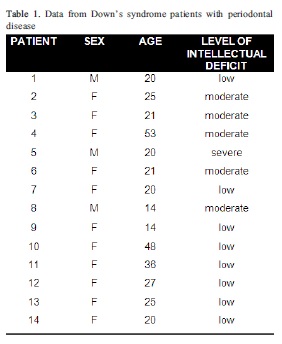
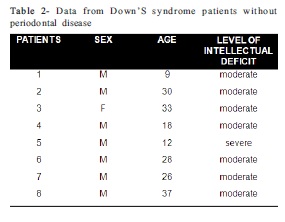
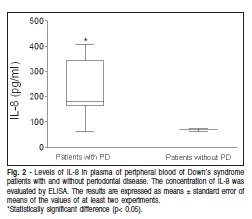
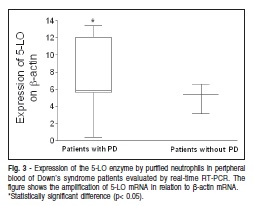
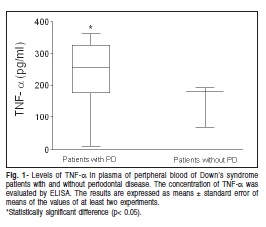
<body><![CDATA[<p><font face="Verdana, Arial, Helvetica, sans-serif" size="3"><b>Results</b></font></p>     <p><font face="Verdana, Arial, Helvetica, sans-serif" size="2">The subjects were divided into 2 groups and they were   classified by sex, age and intellectual disability. Periodontal   status was evaluated by the clinical parameters (Table <a href="#tab01">1</a> and  <a href="#tab02">2</a>). In <a href="#tab01">Table 1</a>, it was observed that DS patients with PD are   predominantly females, with a mean age of 25 years. However,   the patients without PD represented in <a href="#tab02">Table 2</a>, are predominantly males with a mean age of 24 years.</font></p>     <p><font face="Verdana, Arial, Helvetica, sans-serif" size="2">As far as the inflammatory mediators' production in the   present study, it was observed that patients with DS and PD   have a significantly higher TNF-&alpha; production when compared   with DS patients without PD (<a href="#fig01">Figure 1</a>). The same pattern of   IL-8 production was observed when comparing with DS   patients without PD (<a href="#fig02">Figure 2</a>).</font></p>     <p><font face="Verdana, Arial, Helvetica, sans-serif" size="2">The 5-LO expression by purified peripheral NE was   evaluated using real time RT-PCR in order to investigate   the participation of lipid mediators in the PD of patients   with and without DS. It was observed that DS patients with   PD showed a higher level of 5-LO expression than DS patientswithout PD (<a href="#fig03">Figure 3</a>). It has been demonstrated<sup>11</sup> that   leukotrienes are involved in the inflammatory process in   periodontitis.</font></p>     <p>&nbsp;</p>     <p><a name="fig01"></a></p>     <p>&nbsp;</p>     <p align="center"><img src="/img/revistas/bjos/v11n3/a15fig01.jpg"></p>     <p>&nbsp;</p>     <p><a name="tab01"></a></p>     ]]></body>
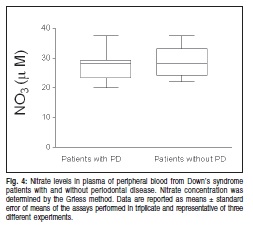
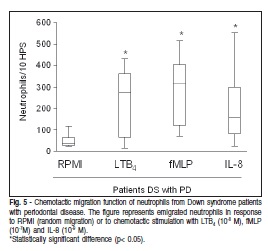
<body><![CDATA[<p>&nbsp;</p>     <p align="center"><img src="/img/revistas/bjos/v11n3/a15tab01.jpg"></p>     <p>&nbsp;</p>     <p><a name="tab02"></a></p>     <p>&nbsp;</p>     <p align="center"><img src="/img/revistas/bjos/v11n3/a15tab02.jpg"></p>     <p>&nbsp;</p>       <p><font face="Verdana, Arial, Helvetica, sans-serif" size="2">    <br>   In the next step, nitric oxide (NO) production by nitrate   level was assessed and it was found that no significant difference   was detected when comparing the NO3 level in DS patients with   and without PD (<a href="#fig04">Figure 4</a>).</font></p>     <p><font face="Verdana, Arial, Helvetica, sans-serif" size="2">The chemotaxis assay was used to analyze the functional   activity of NE in the DS patients, and it was observed that IL-8,   fMLP and LTB4 were chemotactic to NE migration in DS patients   in comparison with the control group RPMI (<a href="#fig05">Figure 5</a>).</font></p>     ]]></body>
<body><![CDATA[<p>&nbsp;</p>     <p><a name="fig02"></a></p>     <p>&nbsp;</p>     <p align="center"><img src="/img/revistas/bjos/v11n3/a15fig02.jpg"></p>     <p>&nbsp;</p>     <p><a name="fig03"></a></p>     <p>&nbsp;</p>     <p align="center"><img src="/img/revistas/bjos/v11n3/a15fig03.jpg"></p>     <p>&nbsp;</p>     <p><a name="fig04"></a></p>     ]]></body>
<body><![CDATA[<p>&nbsp;</p>     <p align="center"><img src="/img/revistas/bjos/v11n3/a15fig04.jpg"></p>     <p>&nbsp;</p>     <p><a name="fig05"></a></p>     <p>&nbsp;</p>     <p align="center"><img src="/img/revistas/bjos/v11n3/a15fig05.jpg"></p>     <p>&nbsp;</p>     <p><font face="Verdana, Arial, Helvetica, sans-serif" size="3"><b>Discussion</b></font></p>     <p><font face="Verdana, Arial, Helvetica, sans-serif" size="2"> An increase in susceptibility and prevalence of PD in DS patients has been the object of intense study in recent years, as can be observed in current literature<sup>12</sup>.</font></p>     <p><font face="Verdana, Arial, Helvetica, sans-serif" size="2">Some clinical and laboratory studies have suggested   that the genetic abnormalities of patients with DS can modify   the systemic response. It includes functional defects of the   polymorphonuclear and mononuclear leukocytes, which   contribute to the prevalence of PD2.</font></p>     ]]></body>
<body><![CDATA[<p><font face="Verdana, Arial, Helvetica, sans-serif" size="2">Oral hygiene is often used as a predictor of patients with   PD. Poor oral hygiene directly correlates to the degree of mental   retardation as do increased rates of oral diseases among those   populations. Limited access to care, limited manual dexterity   and lowered efficacy of self homecare, all of these factors   contribute to raising levels of gingivitis<sup>3</sup>. In the present study,   we evaluated DS patients of both sexes, ages and degrees of   mental abnormalities. Our results support the hypothesis that   DS patients with PD present high levels of TNF-&alpha; in the   peripheral plasma when compared with DS patients without   PD. These data strongly suggest that DS patients with   periodontitis present an inflammatory disease in due course.   These findings are consistent with those of previous studies   that reported that high levels of TNF-&alpha; were observed in the   serum samples of DS patients without periodontal<sup>13</sup>.</font></p>     <p><font face="Verdana, Arial, Helvetica, sans-serif" size="2">TNF-&alpha; is a pluripotent cytokine that plays a central   pathogenic role in inflammatory disease. This cytokine is   associated with stimulated bone resorption, fibroblast   proliferation as well as the production of matrix metalloproteinases   and prostaglandin E2   <sup>14</sup>. Its possible significance in   inflammatory PD has been subject of intense research<sup>15</sup>.</font></p>     <p><font face="Verdana, Arial, Helvetica, sans-serif" size="2">As far as IL-8 is concerned, it was observed that DS   patients with PD have a significantly higher level when   compared with DS patients without periodontitis. These data   are in accordance with literature showing that the mean   concentration of IL-8 was higher in the DS group than in the   control group<sup>14</sup>. IL-8 is a chemokine produced by a variety   of tissues and blood cells and is a potent inducer of NE   chemotaxis and activation<sup>16</sup>. This cytokine is produced early   in inflammation as a result of the interaction of host cells with bacterial stimuli such as lipopolysaccharides (LPS). In   inflammatory lesions, the interaction between IL-8 and other   inflammatory mediators leads to extravasation and   recruitment of NE. An increase in IL-8 expression in   periodontal tissue has been previously observed, thus   confirming its participation in the periodontitis process<sup>17</sup>. In   the present study, it was found that IL-8 is potentiated in DS   patients with PD when compared with literature data.</font></p>     <p><font face="Verdana, Arial, Helvetica, sans-serif" size="2">NO is a molecule that is involved in vascular regulation,   homeostasis, bone formation and resorption,   neurotransmission and immune function. In recent years, there   has been an increasing interest in NO in the pathogenesis of   oral and PDs. In the present study, there was no statistically   significant difference between the levels of NO in DS patients   with PD compared with patients without periodontitis. In   the data reported in literature, it is observed that when NO   production in the salivary and gingival tissue from patients   with periodontitis was measured, it was found to be lower   compared with that in healthy samples<sup>18</sup>. NO production in   PD is controversial since the production may be downregulated   by arginase<sup>19</sup>. Overproduction of NO can contribute to tissue   damage in periodontal tissues and has been implicated in PD   pathogenesis. NO in periodontal tissue is generated mostly via   iNOS which catalyze the oxidation of guanidine nitrogen   associated with L-arginine. Arginase also uses L-arginine and   can down-regulate NO production in saliva and in periodontal   tissue<sup>17</sup>. Since a large amount of NO is toxic to periodontal   tissues, arginase may prevent overproduction of NO.</font></p>     <p><font face="Verdana, Arial, Helvetica, sans-serif" size="2">The results of the present study showed that NE from   peripheral blood of DS patients with PD significantly express   5-lipoxygenase when compared with patients without   periodontitis. The data suggest that the NE from these patients   are able to produce leukotriene B4. LTB4 production during   the progression of periodontitis has been observed in literature.   Gingival tissue from DS subjects presents a high level of this   lipid mediator when compared with the control group<sup>20</sup>.</font></p>     <p><font face="Verdana, Arial, Helvetica, sans-serif" size="2">LTB4 is a proinflammatory mediator that plays an   important role in PD. Recently, LTB4 has been implicated as   having a role in host defense against microbial infection<sup>21</sup>.   This lipid mediator induces recruitment and activation of   NE, monocytes and eosinophils. It also stimulates the   production of a number of proinflammatory cytokines and   mediators indicating ability to augment and prolong tissue   inflammation<sup>22</sup>. The involvement of LTB4 in PD has been   observed in gingival crevicular fluid from subjects with   periodontitis<sup>23-24</sup>.</font></p>     <p><font face="Verdana, Arial, Helvetica, sans-serif" size="2">Defects in NE chemotaxis have also been identified in   DS patients<sup>25</sup>. In addition to the direct involvement of NE in   defense against invading pathogens, the NE role in mediating   tissue injury plays an important role in the exacerbation of   diseases. Under this new paradigm, comparing with our data,   the polymorphonuclear leukocyte is not "hypofunctional"  or "deficient", but rather "hyperfunctional". The increased   activity and the release of toxic products from the cell are   responsible, in part, for the tissue destruction in chronic   periodontal inflammation<sup>26</sup>. In our study, we observed that   the NE chemotactic activity of IL-8, LTB4 and fMLP is higher   when compared with control group. This may suggests that   NE is hyper-functional and activated in these DS patients.   During the inflammatory cell migration, the chemotactic   factors are essential for the beginning and regulation of the   increased inflammatory/immune response. In our study, TNF&aacute;  and IL-8 production as well as 5-LO mRNA expression are   more pronounced in DS patients with PD when compared   with DS patients without PD in literature data.</font></p>     <p><font face="Verdana, Arial, Helvetica, sans-serif" size="2">NE function may be altered in patients with PD. The   improvement in the activity of peripheral blood NE observed   in some study is consistent with observed associations   between periodontitis and overall health indicators. Intrinsic   defects in NE could result in compromised immune   conditions, as found in some syndromes. The NE in peripheral   blood from patients with PD are defective regarding the   production of some mediators of inflammation. The alteration   in function refers to an up-regulation of NE, a hyperfunctional   activity that may be responsible for the periodontal   chronic destruction.</font></p>     <p><font face="Verdana, Arial, Helvetica, sans-serif" size="2">In conclusion the changes in NE function due to the   elevation of inflammatory mediators contribute to PD.   According to the results of the present research, it may be   concluded that:</font></p>     <p><font face="Verdana, Arial, Helvetica, sans-serif" size="2">&bull; the NE chemotactic activity of IL-8, LTB4 and fMLP   was higher when compared with the control group;    ]]></body>
<body><![CDATA[<br>   &bull; the NE is hyper-functional and activated in DS patients;    <br>   &bull; the TNF-&beta; and IL-8 production as well as 5-LO mRNA   expression are more pronounced in DS patients with PD.</font></p>     <p>&nbsp;</p>     <p><font face="Verdana, Arial, Helvetica, sans-serif" size="3"><b>Acknowledgements</b></font></p>     <p><font face="Verdana, Arial, Helvetica, sans-serif" size="2">This project was supported by grants from the S&atilde;o Paulo   State Research Foundation (FAPESP- 2000/08506-0). The   authors are indebted to Giuliana Bertozi for her helpful   technical assistance and express their gratitude to Dr. Carlos   F Santos for his critical reading and suggestions to this   manuscript. We also acknowledge Yara Regina Bianchini  &Aacute;valos, Alba Val&eacute;ria Rodrigues Mantovani and Marlene   Aparecida Costa for taking care of the patients and collecting   peripheral blood samples at the Center for Dental Assistance to Patients with Special Needs (CAOE-UNESP-FOA).</font></p>     <p>&nbsp;</p>     <p><font face="Verdana, Arial, Helvetica, sans-serif" size="3"><b>References</b></font></p>     <!-- ref --><p><font face="Verdana, Arial, Helvetica, sans-serif" size="2">1. Forrester MB, Merz RD. Epidemiology of Down syndrome (Trisomy 21), Hawaii, 1986-97. Teratology. 2002; 65: 207-12.    &nbsp;&nbsp;&nbsp;&nbsp;&nbsp;&nbsp;&nbsp;&nbsp;[&#160;<a href="javascript:void(0);" onclick="javascript: window.open('/scielo.php?script=sci_nlinks&ref=047135&pid=S1677-3225201200030001500001&lng=','','width=640,height=500,resizable=yes,scrollbars=1,menubar=yes,');">Links</a>&#160;]<!-- end-ref --></font></p>     <!-- ref --><p><font face="Verdana, Arial, Helvetica, sans-serif" size="2">2. Khoshnood B, Wall S, Pryde P, Lee KS. Maternal education modifies the   age-related increase in the birth prevalence of Down syndrome. Prenat   Diagn. 2004; 24: 79-82.    &nbsp;&nbsp;&nbsp;&nbsp;&nbsp;&nbsp;&nbsp;&nbsp;[&#160;<a href="javascript:void(0);" onclick="javascript: window.open('/scielo.php?script=sci_nlinks&ref=047137&pid=S1677-3225201200030001500002&lng=','','width=640,height=500,resizable=yes,scrollbars=1,menubar=yes,');">Links</a>&#160;]<!-- end-ref --></font></p>     <!-- ref --><p><font face="Verdana, Arial, Helvetica, sans-serif" size="2">3. Frydman A, Nowzari H. Down Syndrome - Associated Periodontitis: A   critical review of the literature. Compendium. 2012; 33: 356-61.    &nbsp;&nbsp;&nbsp;&nbsp;&nbsp;&nbsp;&nbsp;&nbsp;[&#160;<a href="javascript:void(0);" onclick="javascript: window.open('/scielo.php?script=sci_nlinks&ref=047139&pid=S1677-3225201200030001500003&lng=','','width=640,height=500,resizable=yes,scrollbars=1,menubar=yes,');">Links</a>&#160;]<!-- end-ref --></font></p>     <!-- ref --><p><font face="Verdana, Arial, Helvetica, sans-serif" size="2">4. Amano A, Kishima T, Akiyama S, Nakagawa I, Hamada S, Morisaki I.   Relationship of periodontopathic bacteria with early-onset periodontitis in   Donws's syndrome. J Periodontol. 2001; 72: 368-73.    &nbsp;&nbsp;&nbsp;&nbsp;&nbsp;&nbsp;&nbsp;&nbsp;[&#160;<a href="javascript:void(0);" onclick="javascript: window.open('/scielo.php?script=sci_nlinks&ref=047141&pid=S1677-3225201200030001500004&lng=','','width=640,height=500,resizable=yes,scrollbars=1,menubar=yes,');">Links</a>&#160;]<!-- end-ref --></font></p>     <!-- ref --><p><font face="Verdana, Arial, Helvetica, sans-serif" size="2"> 5. Mod&eacute;er T, Barr M, Dahll&ouml;f G. Periodontal disease in children with Down's   syndrome. Scand J Dent Res. 1990; 98: 228-34.    &nbsp;&nbsp;&nbsp;&nbsp;&nbsp;&nbsp;&nbsp;&nbsp;[&#160;<a href="javascript:void(0);" onclick="javascript: window.open('/scielo.php?script=sci_nlinks&ref=047143&pid=S1677-3225201200030001500005&lng=','','width=640,height=500,resizable=yes,scrollbars=1,menubar=yes,');">Links</a>&#160;]<!-- end-ref --></font></p>     <!-- ref --><p><font face="Verdana, Arial, Helvetica, sans-serif" size="2">6. Sax&eacute;n L, Aula S. Periodontal bone loss in patients with Down's syndrome:   A follow-up study. J Periodontol. 1982; 53: 158-62.    &nbsp;&nbsp;&nbsp;&nbsp;&nbsp;&nbsp;&nbsp;&nbsp;[&#160;<a href="javascript:void(0);" onclick="javascript: window.open('/scielo.php?script=sci_nlinks&ref=047145&pid=S1677-3225201200030001500006&lng=','','width=640,height=500,resizable=yes,scrollbars=1,menubar=yes,');">Links</a>&#160;]<!-- end-ref --></font></p>     <!-- ref --><p><font face="Verdana, Arial, Helvetica, sans-serif" size="2">7. Ulseth JD, Hestnes A, Stavner LJ, Storhaug K. Dental caries and   periodontitis in persons with Down's syndrome. Spec Care Dent. 1991;   11: 71-3.    &nbsp;&nbsp;&nbsp;&nbsp;&nbsp;&nbsp;&nbsp;&nbsp;[&#160;<a href="javascript:void(0);" onclick="javascript: window.open('/scielo.php?script=sci_nlinks&ref=047147&pid=S1677-3225201200030001500007&lng=','','width=640,height=500,resizable=yes,scrollbars=1,menubar=yes,');">Links</a>&#160;]<!-- end-ref --></font></p>     <!-- ref --><p><font face="Verdana, Arial, Helvetica, sans-serif" size="2">8. Meyle J, Gonzales, J.R. Influence of systemic disease on periodontitis in   children. Periodontology 2000. 2001: 92-112.    &nbsp;&nbsp;&nbsp;&nbsp;&nbsp;&nbsp;&nbsp;&nbsp;[&#160;<a href="javascript:void(0);" onclick="javascript: window.open('/scielo.php?script=sci_nlinks&ref=047149&pid=S1677-3225201200030001500008&lng=','','width=640,height=500,resizable=yes,scrollbars=1,menubar=yes,');">Links</a>&#160;]<!-- end-ref --></font></p>     <!-- ref --><p><font face="Verdana, Arial, Helvetica, sans-serif" size="2">9. Albandar JM, Rams TE. Periodontol 2000 Global epidemiology of   periodontal diseases 29. Copenhagen, Denmark: Munksgaard   .Blackwells; 2002.    &nbsp;&nbsp;&nbsp;&nbsp;&nbsp;&nbsp;&nbsp;&nbsp;[&#160;<a href="javascript:void(0);" onclick="javascript: window.open('/scielo.php?script=sci_nlinks&ref=047151&pid=S1677-3225201200030001500009&lng=','','width=640,height=500,resizable=yes,scrollbars=1,menubar=yes,');">Links</a>&#160;]<!-- end-ref --></font></p>     <!-- ref --><p><font face="Verdana, Arial, Helvetica, sans-serif" size="2">10. Khocht A, Yaskell T, Janal M, Turner BF, Rams TE, Haffajee AD et al.   Subgingival microbiota in adult Down syndrome periodontitis. J Periodontal   Res. 2012; 47: 500-7.    &nbsp;&nbsp;&nbsp;&nbsp;&nbsp;&nbsp;&nbsp;&nbsp;[&#160;<a href="javascript:void(0);" onclick="javascript: window.open('/scielo.php?script=sci_nlinks&ref=047153&pid=S1677-3225201200030001500010&lng=','','width=640,height=500,resizable=yes,scrollbars=1,menubar=yes,');">Links</a>&#160;]<!-- end-ref --></font></p>     <!-- ref --><p><font face="Verdana, Arial, Helvetica, sans-serif" size="2">11. Carneiro MV, Bezerra AC, Guimar&atilde;es MD, Muniz-Junqueira MI. Effects   of periodontal therapy on phagocytic of peripheral blood neutrophilsevidence   for an extrinsic celular defect. Oral Health Prev Dent. 2012; 10:   195-203.    &nbsp;&nbsp;&nbsp;&nbsp;&nbsp;&nbsp;&nbsp;&nbsp;[&#160;<a href="javascript:void(0);" onclick="javascript: window.open('/scielo.php?script=sci_nlinks&ref=047155&pid=S1677-3225201200030001500011&lng=','','width=640,height=500,resizable=yes,scrollbars=1,menubar=yes,');">Links</a>&#160;]<!-- end-ref --></font></p>     <!-- ref --><p><font face="Verdana, Arial, Helvetica, sans-serif" size="2">12. Scott DA, Krauss J. Neutrophils in neutrophils inflammation. Front Oral   Biol. 2012; 15: 56-83.    &nbsp;&nbsp;&nbsp;&nbsp;&nbsp;&nbsp;&nbsp;&nbsp;[&#160;<a href="javascript:void(0);" onclick="javascript: window.open('/scielo.php?script=sci_nlinks&ref=047157&pid=S1677-3225201200030001500012&lng=','','width=640,height=500,resizable=yes,scrollbars=1,menubar=yes,');">Links</a>&#160;]<!-- end-ref --></font></p>     <!-- ref --><p><font face="Verdana, Arial, Helvetica, sans-serif" size="2">13. Komatsu T, Kubota M, Sakai N. Enhancement of matrix metalloproteinase   (MMP)-2 activity in gingival tissue a culture fibroblasts from Down's   syndrome patients. Oral Dis. 2001; 7: 47-55.    &nbsp;&nbsp;&nbsp;&nbsp;&nbsp;&nbsp;&nbsp;&nbsp;[&#160;<a href="javascript:void(0);" onclick="javascript: window.open('/scielo.php?script=sci_nlinks&ref=047159&pid=S1677-3225201200030001500013&lng=','','width=640,height=500,resizable=yes,scrollbars=1,menubar=yes,');">Links</a>&#160;]<!-- end-ref --></font></p>     <!-- ref --><p><font face="Verdana, Arial, Helvetica, sans-serif" size="2">14. G&oacute;rska DT, Gregorek H, Kowalski J, Laskus-Perendyk A, Syczewska   M, Madali&ntilde;ski K. Relationship between clinical parameters and cytokine   profiles in inflamed gingival tissue and serum samples from patients with   chronic periodontitis. J Clin Periodontol. 2003; 30: 1046-52.    &nbsp;&nbsp;&nbsp;&nbsp;&nbsp;&nbsp;&nbsp;&nbsp;[&#160;<a href="javascript:void(0);" onclick="javascript: window.open('/scielo.php?script=sci_nlinks&ref=047161&pid=S1677-3225201200030001500014&lng=','','width=640,height=500,resizable=yes,scrollbars=1,menubar=yes,');">Links</a>&#160;]<!-- end-ref --></font></p>     <!-- ref --><p><font face="Verdana, Arial, Helvetica, sans-serif" size="2">15. Yucel-Lindberg T, Twetman S, Skold-Larsson K, Modeer T. Effect of an   antibacterial dental varnish on the levels of prostanoids leukotriene B4,   and interlekin-1 beta in gingival crevicular fluid. Acta Odontol Scand.   1999; 57: 23-7.    &nbsp;&nbsp;&nbsp;&nbsp;&nbsp;&nbsp;&nbsp;&nbsp;[&#160;<a href="javascript:void(0);" onclick="javascript: window.open('/scielo.php?script=sci_nlinks&ref=047163&pid=S1677-3225201200030001500015&lng=','','width=640,height=500,resizable=yes,scrollbars=1,menubar=yes,');">Links</a>&#160;]<!-- end-ref --></font></p>     <!-- ref --><p><font face="Verdana, Arial, Helvetica, sans-serif" size="2">16. Galbraith GMP, Hagan C, Steed RB, Sanders JJ, Javed T. Cytokine   Production by oral and peripheral blood neutrophils in adult periodontitis.   J. Periodontol. 1997; 68: 832-8.    &nbsp;&nbsp;&nbsp;&nbsp;&nbsp;&nbsp;&nbsp;&nbsp;[&#160;<a href="javascript:void(0);" onclick="javascript: window.open('/scielo.php?script=sci_nlinks&ref=047165&pid=S1677-3225201200030001500016&lng=','','width=640,height=500,resizable=yes,scrollbars=1,menubar=yes,');">Links</a>&#160;]<!-- end-ref --></font></p>     <!-- ref --><p><font face="Verdana, Arial, Helvetica, sans-serif" size="2">17. Nelson PG, Kuddo T, Song YE, Dambrosia JM, Kohler S, Satyanarayana   G, et al. Selected neutrophils, neuropeptides, and cytokines: developmental   trajectory and concentrations in neonatal blood of children with autism or   Down syndrome. Int J Dev Neurosci. 2006; 24: 73-80.    &nbsp;&nbsp;&nbsp;&nbsp;&nbsp;&nbsp;&nbsp;&nbsp;[&#160;<a href="javascript:void(0);" onclick="javascript: window.open('/scielo.php?script=sci_nlinks&ref=047167&pid=S1677-3225201200030001500017&lng=','','width=640,height=500,resizable=yes,scrollbars=1,menubar=yes,');">Links</a>&#160;]<!-- end-ref --></font></p>     <!-- ref --><p><font face="Verdana, Arial, Helvetica, sans-serif" size="2">18. Shimauchi H, Takayama S, Narikawa-Kiji M, Shimabukuru Y, Okada   H. Production of Interleukin-8 and Nitric Oxide in Human Periapical   Lesions. J Endod. 2001; 27: 749-52.    &nbsp;&nbsp;&nbsp;&nbsp;&nbsp;&nbsp;&nbsp;&nbsp;[&#160;<a href="javascript:void(0);" onclick="javascript: window.open('/scielo.php?script=sci_nlinks&ref=047169&pid=S1677-3225201200030001500018&lng=','','width=640,height=500,resizable=yes,scrollbars=1,menubar=yes,');">Links</a>&#160;]<!-- end-ref --></font></p>     <!-- ref --><p><font face="Verdana, Arial, Helvetica, sans-serif" size="2">19. Garlet GT , Martins Jr. W, Ferreira BR , Milanezi CM, Silva JS. Patterns   of Chemokines and Chemokine receptors expression in different forms of   human periodontal disease. J. Periodont Res. 2003; 38: 210-17.    &nbsp;&nbsp;&nbsp;&nbsp;&nbsp;&nbsp;&nbsp;&nbsp;[&#160;<a href="javascript:void(0);" onclick="javascript: window.open('/scielo.php?script=sci_nlinks&ref=047171&pid=S1677-3225201200030001500019&lng=','','width=640,height=500,resizable=yes,scrollbars=1,menubar=yes,');">Links</a>&#160;]<!-- end-ref --></font></p>     <!-- ref --><p><font face="Verdana, Arial, Helvetica, sans-serif" size="2">20. Ugar-&Ccedil;ankal D,Ozmeric N. A multifaceted molecule, nitric oxide in oral   and periodontal disease. Clin Chim Acta. 2006; 366: 90-100.    &nbsp;&nbsp;&nbsp;&nbsp;&nbsp;&nbsp;&nbsp;&nbsp;[&#160;<a href="javascript:void(0);" onclick="javascript: window.open('/scielo.php?script=sci_nlinks&ref=047173&pid=S1677-3225201200030001500020&lng=','','width=640,height=500,resizable=yes,scrollbars=1,menubar=yes,');">Links</a>&#160;]<!-- end-ref --></font></p>     <!-- ref --><p><font face="Verdana, Arial, Helvetica, sans-serif" size="2">21. G&uuml;ll&uuml; C, Ozmeric N, Tokman B, Elg&uuml;n S, Balos K. Effectiveness of   scaling and root planning versus modified Wildman flap on nitric oxide   synthase and arginase activity in patients with chronic periodontitis. J   Periodont Res. 2005; 40: 168-75.    &nbsp;&nbsp;&nbsp;&nbsp;&nbsp;&nbsp;&nbsp;&nbsp;[&#160;<a href="javascript:void(0);" onclick="javascript: window.open('/scielo.php?script=sci_nlinks&ref=047175&pid=S1677-3225201200030001500021&lng=','','width=640,height=500,resizable=yes,scrollbars=1,menubar=yes,');">Links</a>&#160;]<!-- end-ref --></font></p>     <!-- ref --><p><font face="Verdana, Arial, Helvetica, sans-serif" size="2">22. Tsilingaridis G, Yucel-Lindberg T, Mod&eacute;er T. Enhanced levels of   prostaglandin E2, Leukotriene B4, and matrix metalloproteinase-9 in gingival   fluid from patients with Down syndrome. Acta Odontol Scand. 2003; 61:   154-8.    &nbsp;&nbsp;&nbsp;&nbsp;&nbsp;&nbsp;&nbsp;&nbsp;[&#160;<a href="javascript:void(0);" onclick="javascript: window.open('/scielo.php?script=sci_nlinks&ref=047177&pid=S1677-3225201200030001500022&lng=','','width=640,height=500,resizable=yes,scrollbars=1,menubar=yes,');">Links</a>&#160;]<!-- end-ref --></font></p>     <!-- ref --><p><font face="Verdana, Arial, Helvetica, sans-serif" size="2">23. Bailie MB, Standiford TJ, Laichalk LL, Coffey MJ, Strieter R, Peters-Golden M. Leukotriene-deficient mice manifest enhanced lethality from   Klebsiella pneumonia in association with decreased alveolar macrophage   phagocytic and bactericidal activities. J Immunol. 1996; 157: 5221-4.    &nbsp;&nbsp;&nbsp;&nbsp;&nbsp;&nbsp;&nbsp;&nbsp;[&#160;<a href="javascript:void(0);" onclick="javascript: window.open('/scielo.php?script=sci_nlinks&ref=047179&pid=S1677-3225201200030001500023&lng=','','width=640,height=500,resizable=yes,scrollbars=1,menubar=yes,');">Links</a>&#160;]<!-- end-ref --></font></p>     <!-- ref --><p><font face="Verdana, Arial, Helvetica, sans-serif" size="2">24. Crooks WS, Stockley AR. Leukotriene B4. Int J Biochem Cell Biol.   1998; 30: 173-8.    &nbsp;&nbsp;&nbsp;&nbsp;&nbsp;&nbsp;&nbsp;&nbsp;[&#160;<a href="javascript:void(0);" onclick="javascript: window.open('/scielo.php?script=sci_nlinks&ref=047181&pid=S1677-3225201200030001500024&lng=','','width=640,height=500,resizable=yes,scrollbars=1,menubar=yes,');">Links</a>&#160;]<!-- end-ref --></font></p>     <!-- ref --><p><font face="Verdana, Arial, Helvetica, sans-serif" size="2">25. Emingil G, Cinarcik S, Baylas H, Coker I, H&uuml;seyinov A. Levels of   leukotriene B4 in gingival crevicular fluid and gingival tissue in specific   periodontal disease. J Periodontol. 2001; 72: 1025-30.    &nbsp;&nbsp;&nbsp;&nbsp;&nbsp;&nbsp;&nbsp;&nbsp;[&#160;<a href="javascript:void(0);" onclick="javascript: window.open('/scielo.php?script=sci_nlinks&ref=047183&pid=S1677-3225201200030001500025&lng=','','width=640,height=500,resizable=yes,scrollbars=1,menubar=yes,');">Links</a>&#160;]<!-- end-ref --></font></p>     <!-- ref --><p><font face="Verdana, Arial, Helvetica, sans-serif" size="2">26. B&auml;ck M, Airila-Mansson S, Jogestrand T, S&ouml;der B, S&ouml;der PO. Increased   leukotriene concentrations in gingival crevicular fluid from subjects with   periodontal disease and atherosclerosis. Atherosclerosis. 2007; 193:   389-94.    &nbsp;&nbsp;&nbsp;&nbsp;&nbsp;&nbsp;&nbsp;&nbsp;[&#160;<a href="javascript:void(0);" onclick="javascript: window.open('/scielo.php?script=sci_nlinks&ref=047185&pid=S1677-3225201200030001500026&lng=','','width=640,height=500,resizable=yes,scrollbars=1,menubar=yes,');">Links</a>&#160;]<!-- end-ref --></font></p>     <p>&nbsp;</p>     ]]></body>
<body><![CDATA[<p>&nbsp;</p>     <p><font face="Verdana, Arial, Helvetica, sans-serif" size="2"><a name="back"/></a><a href="#top"><img src="/img/revistas/bjos/v11n3/seta.jpg" border="0" align="absmiddle"/></a>    <b>Correspondence:</b> <br/>   Sandra Maria Herondina &Aacute;vila Coelho Aguiar    <br>   Pediatric Dentistry and Social Department    <br>   School of Dentistry of Ara&ccedil;atuba, UNESP    <br>   Rua Jos&eacute; Bonif&aacute;cio, 1193 - Vila Mendon&ccedil;a -    <br>   CEP: 16015-050, Ara&ccedil;atuba-SP, Brasil<br/>   E-mail: <a href="mailto:saguiar@foa.unesp.br">saguiar@foa.unesp.br</a></font></p>       ]]></body>
<back>
<ref-list>
<ref id="B1">
<label>1</label><nlm-citation citation-type="">
<source><![CDATA[]]></source>
<year></year>
</nlm-citation>
</ref>
<ref id="B2">
<label>2</label><nlm-citation citation-type="journal">
<person-group person-group-type="author">
<name>
<surname><![CDATA[Khoshnood]]></surname>
<given-names><![CDATA[B]]></given-names>
</name>
<name>
<surname><![CDATA[Wall]]></surname>
<given-names><![CDATA[S]]></given-names>
</name>
<name>
<surname><![CDATA[Pryde]]></surname>
<given-names><![CDATA[P]]></given-names>
</name>
<name>
<surname><![CDATA[Lee]]></surname>
<given-names><![CDATA[KS]]></given-names>
</name>
</person-group>
<article-title xml:lang="en"><![CDATA[Maternal education modifies the age-related increase in the birth prevalence of Down syndrome]]></article-title>
<source><![CDATA[Prenat Diagn]]></source>
<year>2004</year>
<volume>24</volume>
<page-range>79-82</page-range></nlm-citation>
</ref>
<ref id="B3">
<label>3</label><nlm-citation citation-type="journal">
<person-group person-group-type="author">
<name>
<surname><![CDATA[Frydman]]></surname>
<given-names><![CDATA[A]]></given-names>
</name>
<name>
<surname><![CDATA[Nowzari]]></surname>
<given-names><![CDATA[H]]></given-names>
</name>
</person-group>
<article-title xml:lang="en"><![CDATA[Down Syndrome - Associated Periodontitis: A critical review of the literature]]></article-title>
<source><![CDATA[Compendium]]></source>
<year>2012</year>
<volume>33</volume>
<page-range>356-61</page-range></nlm-citation>
</ref>
<ref id="B4">
<label>4</label><nlm-citation citation-type="journal">
<person-group person-group-type="author">
<name>
<surname><![CDATA[Amano]]></surname>
<given-names><![CDATA[A]]></given-names>
</name>
<name>
<surname><![CDATA[Kishima]]></surname>
<given-names><![CDATA[T]]></given-names>
</name>
<name>
<surname><![CDATA[Akiyama]]></surname>
<given-names><![CDATA[S]]></given-names>
</name>
<name>
<surname><![CDATA[Nakagawa]]></surname>
<given-names><![CDATA[I]]></given-names>
</name>
<name>
<surname><![CDATA[Hamada]]></surname>
<given-names><![CDATA[S]]></given-names>
</name>
<name>
<surname><![CDATA[Morisaki]]></surname>
<given-names><![CDATA[I]]></given-names>
</name>
</person-group>
<article-title xml:lang="en"><![CDATA[Relationship of periodontopathic bacteria with early-onset periodontitis in Donws's syndrome]]></article-title>
<source><![CDATA[J Periodontol]]></source>
<year>2001</year>
<volume>72</volume>
<page-range>368-73</page-range></nlm-citation>
</ref>
<ref id="B5">
<label>5</label><nlm-citation citation-type="journal">
<person-group person-group-type="author">
<name>
<surname><![CDATA[Modéer]]></surname>
<given-names><![CDATA[T]]></given-names>
</name>
<name>
<surname><![CDATA[Barr]]></surname>
<given-names><![CDATA[M]]></given-names>
</name>
<name>
<surname><![CDATA[Dahllöf]]></surname>
<given-names><![CDATA[G]]></given-names>
</name>
</person-group>
<article-title xml:lang="en"><![CDATA[Periodontal disease in children with Down's syndrome]]></article-title>
<source><![CDATA[Scand J Dent Res]]></source>
<year>1990</year>
<volume>98</volume>
<page-range>228-34</page-range></nlm-citation>
</ref>
<ref id="B6">
<label>6</label><nlm-citation citation-type="journal">
<person-group person-group-type="author">
<name>
<surname><![CDATA[Saxén]]></surname>
<given-names><![CDATA[L]]></given-names>
</name>
<name>
<surname><![CDATA[Aula]]></surname>
<given-names><![CDATA[S]]></given-names>
</name>
</person-group>
<article-title xml:lang="en"><![CDATA[Periodontal bone loss in patients with Down's syndrome: A follow-up study]]></article-title>
<source><![CDATA[J Periodontol]]></source>
<year>1982</year>
<volume>53</volume>
<page-range>158-62</page-range></nlm-citation>
</ref>
<ref id="B7">
<label>7</label><nlm-citation citation-type="journal">
<person-group person-group-type="author">
<name>
<surname><![CDATA[Ulseth]]></surname>
<given-names><![CDATA[JD]]></given-names>
</name>
<name>
<surname><![CDATA[Hestnes]]></surname>
<given-names><![CDATA[A]]></given-names>
</name>
<name>
<surname><![CDATA[Stavner]]></surname>
<given-names><![CDATA[LJ]]></given-names>
</name>
<name>
<surname><![CDATA[Storhaug]]></surname>
<given-names><![CDATA[K]]></given-names>
</name>
</person-group>
<article-title xml:lang="en"><![CDATA[Dental caries and periodontitis in persons with Down's syndrome]]></article-title>
<source><![CDATA[Spec Care Dent]]></source>
<year>1991</year>
<volume>11</volume>
<page-range>71-3</page-range></nlm-citation>
</ref>
<ref id="B8">
<label>8</label><nlm-citation citation-type="journal">
<person-group person-group-type="author">
<name>
<surname><![CDATA[Meyle]]></surname>
<given-names><![CDATA[J]]></given-names>
</name>
<name>
<surname><![CDATA[Gonzales]]></surname>
<given-names><![CDATA[J.R]]></given-names>
</name>
</person-group>
<article-title xml:lang="en"><![CDATA[Influence of systemic disease on periodontitis in children]]></article-title>
<source><![CDATA[Periodontology]]></source>
<year>2000</year>
<volume>2001</volume>
<page-range>92-112</page-range></nlm-citation>
</ref>
<ref id="B9">
<label>9</label><nlm-citation citation-type="book">
<person-group person-group-type="author">
<name>
<surname><![CDATA[Albandar]]></surname>
<given-names><![CDATA[JM]]></given-names>
</name>
<name>
<surname><![CDATA[Rams]]></surname>
<given-names><![CDATA[TE]]></given-names>
</name>
</person-group>
<source><![CDATA[Periodontol 2000 Global epidemiology of periodontal diseases 29]]></source>
<year>2002</year>
<publisher-loc><![CDATA[Copenhagen ]]></publisher-loc>
<publisher-name><![CDATA[Denmark]]></publisher-name>
</nlm-citation>
</ref>
<ref id="B10">
<label>10</label><nlm-citation citation-type="journal">
<person-group person-group-type="author">
<name>
<surname><![CDATA[Khocht]]></surname>
<given-names><![CDATA[A]]></given-names>
</name>
<name>
<surname><![CDATA[Yaskell]]></surname>
<given-names><![CDATA[T]]></given-names>
</name>
<name>
<surname><![CDATA[Janal]]></surname>
<given-names><![CDATA[M]]></given-names>
</name>
<name>
<surname><![CDATA[Turner]]></surname>
<given-names><![CDATA[BF]]></given-names>
</name>
<name>
<surname><![CDATA[Rams]]></surname>
<given-names><![CDATA[TE]]></given-names>
</name>
<name>
<surname><![CDATA[Haffajee]]></surname>
<given-names><![CDATA[AD]]></given-names>
</name>
</person-group>
<article-title xml:lang="en"><![CDATA[Subgingival microbiota in adult Down syndrome periodontitis]]></article-title>
<source><![CDATA[J Periodontal Res]]></source>
<year>2012</year>
<volume>47</volume>
<page-range>500-7</page-range></nlm-citation>
</ref>
<ref id="B11">
<label>11</label><nlm-citation citation-type="journal">
<person-group person-group-type="author">
<name>
<surname><![CDATA[Carneiro]]></surname>
<given-names><![CDATA[MV]]></given-names>
</name>
<name>
<surname><![CDATA[Bezerra]]></surname>
<given-names><![CDATA[AC]]></given-names>
</name>
<name>
<surname><![CDATA[Guimarães]]></surname>
<given-names><![CDATA[MD]]></given-names>
</name>
<name>
<surname><![CDATA[Muniz-Junqueira]]></surname>
<given-names><![CDATA[MI]]></given-names>
</name>
</person-group>
<article-title xml:lang="en"><![CDATA[Effects of periodontal therapy on phagocytic of peripheral blood neutrophilsevidence for an extrinsic celular defect]]></article-title>
<source><![CDATA[Oral Health Prev Dent]]></source>
<year>2012</year>
<volume>10</volume>
<page-range>195-203</page-range></nlm-citation>
</ref>
<ref id="B12">
<label>12</label><nlm-citation citation-type="journal">
<person-group person-group-type="author">
<name>
<surname><![CDATA[Scott]]></surname>
<given-names><![CDATA[DA]]></given-names>
</name>
<name>
<surname><![CDATA[Krauss]]></surname>
<given-names><![CDATA[J]]></given-names>
</name>
</person-group>
<article-title xml:lang="en"><![CDATA[Neutrophils in neutrophils inflammation]]></article-title>
<source><![CDATA[Front Oral Biol]]></source>
<year>2012</year>
<volume>15</volume>
<page-range>56-83</page-range></nlm-citation>
</ref>
<ref id="B13">
<label>13</label><nlm-citation citation-type="journal">
<person-group person-group-type="author">
<name>
<surname><![CDATA[Komatsu]]></surname>
<given-names><![CDATA[T]]></given-names>
</name>
<name>
<surname><![CDATA[Kubota]]></surname>
<given-names><![CDATA[M]]></given-names>
</name>
<name>
<surname><![CDATA[Sakai]]></surname>
<given-names><![CDATA[N]]></given-names>
</name>
</person-group>
<article-title xml:lang="en"><![CDATA[Enhancement of matrix metalloproteinase (MMP)-2 activity in gingival tissue a culture fibroblasts from Down's syndrome patients]]></article-title>
<source><![CDATA[Oral Dis]]></source>
<year>2001</year>
<volume>7</volume>
<page-range>47-55</page-range></nlm-citation>
</ref>
<ref id="B14">
<label>14</label><nlm-citation citation-type="journal">
<person-group person-group-type="author">
<name>
<surname><![CDATA[Górska]]></surname>
<given-names><![CDATA[DT]]></given-names>
</name>
<name>
<surname><![CDATA[Gregorek]]></surname>
<given-names><![CDATA[H]]></given-names>
</name>
<name>
<surname><![CDATA[Kowalski]]></surname>
<given-names><![CDATA[J]]></given-names>
</name>
<name>
<surname><![CDATA[Laskus-Perendyk]]></surname>
<given-names><![CDATA[A]]></given-names>
</name>
<name>
<surname><![CDATA[Syczewska]]></surname>
<given-names><![CDATA[M]]></given-names>
</name>
<name>
<surname><![CDATA[Madaliñski]]></surname>
<given-names><![CDATA[K]]></given-names>
</name>
</person-group>
<article-title xml:lang="en"><![CDATA[Relationship between clinical parameters and cytokine profiles in inflamed gingival tissue and serum samples from patients with chronic periodontitis]]></article-title>
<source><![CDATA[J Clin Periodontol]]></source>
<year>2003</year>
<volume>30</volume>
<page-range>1046-52</page-range></nlm-citation>
</ref>
<ref id="B15">
<label>15</label><nlm-citation citation-type="journal">
<person-group person-group-type="author">
<name>
<surname><![CDATA[Yucel-Lindberg]]></surname>
<given-names><![CDATA[T]]></given-names>
</name>
<name>
<surname><![CDATA[Twetman]]></surname>
<given-names><![CDATA[S]]></given-names>
</name>
<name>
<surname><![CDATA[Skold-Larsson]]></surname>
<given-names><![CDATA[K]]></given-names>
</name>
<name>
<surname><![CDATA[Modeer]]></surname>
<given-names><![CDATA[T]]></given-names>
</name>
</person-group>
<article-title xml:lang="en"><![CDATA[Effect of an antibacterial dental varnish on the levels of prostanoids leukotriene B4, and interlekin-1 beta in gingival crevicular fluid]]></article-title>
<source><![CDATA[Acta Odontol Scand]]></source>
<year>1999</year>
<volume>57</volume>
<page-range>23-7</page-range></nlm-citation>
</ref>
<ref id="B16">
<label>16</label><nlm-citation citation-type="journal">
<person-group person-group-type="author">
<name>
<surname><![CDATA[Galbraith]]></surname>
<given-names><![CDATA[GMP]]></given-names>
</name>
<name>
<surname><![CDATA[Hagan]]></surname>
<given-names><![CDATA[C]]></given-names>
</name>
<name>
<surname><![CDATA[Steed]]></surname>
<given-names><![CDATA[RB]]></given-names>
</name>
<name>
<surname><![CDATA[Sanders]]></surname>
<given-names><![CDATA[JJ]]></given-names>
</name>
<name>
<surname><![CDATA[Javed]]></surname>
<given-names><![CDATA[T]]></given-names>
</name>
</person-group>
<article-title xml:lang="en"><![CDATA[Cytokine Production by oral and peripheral blood neutrophils in adult periodontitis]]></article-title>
<source><![CDATA[J. Periodontol]]></source>
<year>1997</year>
<volume>68</volume>
<page-range>832-8</page-range></nlm-citation>
</ref>
<ref id="B17">
<label>17</label><nlm-citation citation-type="journal">
<person-group person-group-type="author">
<name>
<surname><![CDATA[Nelson]]></surname>
<given-names><![CDATA[PG]]></given-names>
</name>
<name>
<surname><![CDATA[Kuddo]]></surname>
<given-names><![CDATA[T]]></given-names>
</name>
<name>
<surname><![CDATA[Song]]></surname>
<given-names><![CDATA[YE]]></given-names>
</name>
<name>
<surname><![CDATA[Dambrosia]]></surname>
<given-names><![CDATA[JM]]></given-names>
</name>
<name>
<surname><![CDATA[Kohler]]></surname>
<given-names><![CDATA[S]]></given-names>
</name>
<name>
<surname><![CDATA[Satyanarayana]]></surname>
<given-names><![CDATA[G]]></given-names>
</name>
</person-group>
<article-title xml:lang="en"><![CDATA[Selected neutrophils, neuropeptides, and cytokines: developmental trajectory and concentrations in neonatal blood of children with autism or Down syndrome]]></article-title>
<source><![CDATA[Int J Dev Neurosci]]></source>
<year>2006</year>
<volume>24</volume>
<page-range>73-80</page-range></nlm-citation>
</ref>
<ref id="B18">
<label>18</label><nlm-citation citation-type="journal">
<person-group person-group-type="author">
<name>
<surname><![CDATA[Shimauchi]]></surname>
<given-names><![CDATA[H]]></given-names>
</name>
<name>
<surname><![CDATA[Takayama]]></surname>
<given-names><![CDATA[S]]></given-names>
</name>
<name>
<surname><![CDATA[Narikawa-Kiji]]></surname>
<given-names><![CDATA[M]]></given-names>
</name>
<name>
<surname><![CDATA[Shimabukuru]]></surname>
<given-names><![CDATA[Y]]></given-names>
</name>
<name>
<surname><![CDATA[Okada]]></surname>
<given-names><![CDATA[H]]></given-names>
</name>
</person-group>
<article-title xml:lang="en"><![CDATA[Production of Interleukin-8 and Nitric Oxide in Human Periapical Lesions]]></article-title>
<source><![CDATA[J Endod]]></source>
<year>2001</year>
<volume>27</volume>
<page-range>749-52</page-range></nlm-citation>
</ref>
<ref id="B19">
<label>19</label><nlm-citation citation-type="journal">
<person-group person-group-type="author">
<name>
<surname><![CDATA[Garlet]]></surname>
<given-names><![CDATA[GT]]></given-names>
</name>
<name>
<surname><![CDATA[Martins Jr]]></surname>
<given-names><![CDATA[W]]></given-names>
</name>
<name>
<surname><![CDATA[Ferreira]]></surname>
<given-names><![CDATA[BR]]></given-names>
</name>
<name>
<surname><![CDATA[Milanezi]]></surname>
<given-names><![CDATA[CM]]></given-names>
</name>
<name>
<surname><![CDATA[Silva]]></surname>
<given-names><![CDATA[JS]]></given-names>
</name>
</person-group>
<article-title xml:lang="en"><![CDATA[Patterns of Chemokines and Chemokine receptors expression in different forms of human periodontal disease]]></article-title>
<source><![CDATA[J. Periodont Res]]></source>
<year>2003</year>
<volume>38</volume>
<page-range>210-17</page-range></nlm-citation>
</ref>
<ref id="B20">
<label>20</label><nlm-citation citation-type="journal">
<person-group person-group-type="author">
<name>
<surname><![CDATA[Ugar-Çankal]]></surname>
<given-names><![CDATA[D]]></given-names>
</name>
<name>
<surname><![CDATA[Ozmeric]]></surname>
<given-names><![CDATA[N]]></given-names>
</name>
</person-group>
<article-title xml:lang="en"><![CDATA[A multifaceted molecule, nitric oxide in oral and periodontal disease]]></article-title>
<source><![CDATA[Clin Chim Acta]]></source>
<year>2006</year>
<volume>366</volume>
<page-range>90-100</page-range></nlm-citation>
</ref>
<ref id="B21">
<label>21</label><nlm-citation citation-type="journal">
<person-group person-group-type="author">
<name>
<surname><![CDATA[Güllü]]></surname>
<given-names><![CDATA[C]]></given-names>
</name>
<name>
<surname><![CDATA[Ozmeric]]></surname>
<given-names><![CDATA[N]]></given-names>
</name>
<name>
<surname><![CDATA[Tokman]]></surname>
<given-names><![CDATA[B]]></given-names>
</name>
<name>
<surname><![CDATA[Elgün]]></surname>
<given-names><![CDATA[S]]></given-names>
</name>
<name>
<surname><![CDATA[Balos]]></surname>
<given-names><![CDATA[K]]></given-names>
</name>
</person-group>
<article-title xml:lang="en"><![CDATA[Effectiveness of scaling and root planning versus modified Wildman flap on nitric oxide synthase and arginase activity in patients with chronic periodontitis]]></article-title>
<source><![CDATA[J Periodont Res]]></source>
<year>2005</year>
<volume>40</volume>
<page-range>168-75</page-range></nlm-citation>
</ref>
<ref id="B22">
<label>22</label><nlm-citation citation-type="journal">
<person-group person-group-type="author">
<name>
<surname><![CDATA[Tsilingaridis]]></surname>
<given-names><![CDATA[G]]></given-names>
</name>
<name>
<surname><![CDATA[Yucel-Lindberg]]></surname>
<given-names><![CDATA[T]]></given-names>
</name>
<name>
<surname><![CDATA[Modéer]]></surname>
<given-names><![CDATA[T]]></given-names>
</name>
</person-group>
<article-title xml:lang="en"><![CDATA[Enhanced levels of prostaglandin E2, Leukotriene B4, and matrix metalloproteinase-9 in gingival fluid from patients with Down syndrome]]></article-title>
<source><![CDATA[Acta Odontol Scand]]></source>
<year>2003</year>
<volume>61</volume>
<page-range>154-8</page-range></nlm-citation>
</ref>
<ref id="B23">
<label>23</label><nlm-citation citation-type="journal">
<person-group person-group-type="author">
<name>
<surname><![CDATA[Bailie]]></surname>
<given-names><![CDATA[MB]]></given-names>
</name>
<name>
<surname><![CDATA[Standiford]]></surname>
<given-names><![CDATA[TJ]]></given-names>
</name>
<name>
<surname><![CDATA[Laichalk]]></surname>
<given-names><![CDATA[LL]]></given-names>
</name>
<name>
<surname><![CDATA[Coffey]]></surname>
<given-names><![CDATA[MJ]]></given-names>
</name>
<name>
<surname><![CDATA[Strieter]]></surname>
<given-names><![CDATA[R]]></given-names>
</name>
<name>
<surname><![CDATA[Peters-Golden]]></surname>
<given-names><![CDATA[M]]></given-names>
</name>
</person-group>
<article-title xml:lang="en"><![CDATA[Leukotriene-deficient mice manifest enhanced lethality from Klebsiella pneumonia in association with decreased alveolar macrophage phagocytic and bactericidal activities]]></article-title>
<source><![CDATA[J Immunol]]></source>
<year>1996</year>
<volume>157</volume>
<page-range>5221-4</page-range></nlm-citation>
</ref>
<ref id="B24">
<label>24</label><nlm-citation citation-type="journal">
<person-group person-group-type="author">
<name>
<surname><![CDATA[Crooks]]></surname>
<given-names><![CDATA[WS]]></given-names>
</name>
<name>
<surname><![CDATA[Stockley]]></surname>
<given-names><![CDATA[AR]]></given-names>
</name>
</person-group>
<article-title xml:lang="en"><![CDATA[Leukotriene B4]]></article-title>
<source><![CDATA[Int J Biochem Cell Biol]]></source>
<year>1998</year>
<volume>30</volume>
<page-range>173-8</page-range></nlm-citation>
</ref>
<ref id="B25">
<label>25</label><nlm-citation citation-type="journal">
<person-group person-group-type="author">
<name>
<surname><![CDATA[Emingil]]></surname>
<given-names><![CDATA[G]]></given-names>
</name>
<name>
<surname><![CDATA[Cinarcik]]></surname>
<given-names><![CDATA[S]]></given-names>
</name>
<name>
<surname><![CDATA[Baylas]]></surname>
<given-names><![CDATA[H]]></given-names>
</name>
<name>
<surname><![CDATA[Coker]]></surname>
<given-names><![CDATA[I]]></given-names>
</name>
<name>
<surname><![CDATA[Hüseyinov]]></surname>
<given-names><![CDATA[A]]></given-names>
</name>
</person-group>
<article-title xml:lang="en"><![CDATA[Levels of leukotriene B4 in gingival crevicular fluid and gingival tissue in specific periodontal disease]]></article-title>
<source><![CDATA[J Periodontol]]></source>
<year>2001</year>
<volume>72</volume>
<page-range>1025-30</page-range></nlm-citation>
</ref>
<ref id="B26">
<label>26</label><nlm-citation citation-type="journal">
<person-group person-group-type="author">
<name>
<surname><![CDATA[Bäck]]></surname>
<given-names><![CDATA[M]]></given-names>
</name>
<name>
<surname><![CDATA[Airila-Mansson]]></surname>
<given-names><![CDATA[S]]></given-names>
</name>
<name>
<surname><![CDATA[Jogestrand]]></surname>
<given-names><![CDATA[T]]></given-names>
</name>
<name>
<surname><![CDATA[Söder]]></surname>
<given-names><![CDATA[B]]></given-names>
</name>
<name>
<surname><![CDATA[Söder]]></surname>
<given-names><![CDATA[PO]]></given-names>
</name>
</person-group>
<article-title xml:lang="en"><![CDATA[Increased leukotriene concentrations in gingival crevicular fluid from subjects with periodontal disease and atherosclerosis]]></article-title>
<source><![CDATA[Atherosclerosis]]></source>
<year>2007</year>
<volume>193</volume>
<page-range>389-94</page-range></nlm-citation>
</ref>
</ref-list>
</back>
</article>