<?xml version="1.0" encoding="ISO-8859-1"?><article xmlns:mml="http://www.w3.org/1998/Math/MathML" xmlns:xlink="http://www.w3.org/1999/xlink" xmlns:xsi="http://www.w3.org/2001/XMLSchema-instance">
<front>
<journal-meta>
<journal-id>1677-3225</journal-id>
<journal-title><![CDATA[Brazilian Journal of Oral Sciences]]></journal-title>
<abbrev-journal-title><![CDATA[Braz. j. oral sci.]]></abbrev-journal-title>
<issn>1677-3225</issn>
<publisher>
<publisher-name><![CDATA[Faculdade de Odontologia de Piracicaba, UNICAMP]]></publisher-name>
</publisher>
</journal-meta>
<article-meta>
<article-id>S1677-32252012000400007</article-id>
<title-group>
<article-title xml:lang="en"><![CDATA[Dental caries-related quality of life and socioeconomic status of preschool children, Bauru, SP]]></article-title>
</title-group>
<contrib-group>
<contrib contrib-type="author">
<name>
<surname><![CDATA[Xavier]]></surname>
<given-names><![CDATA[Angela]]></given-names>
</name>
<xref ref-type="aff" rid="A01"/>
</contrib>
<contrib contrib-type="author">
<name>
<surname><![CDATA[de Carvalho]]></surname>
<given-names><![CDATA[Fábio Silva]]></given-names>
</name>
<xref ref-type="aff" rid="A01"/>
</contrib>
<contrib contrib-type="author">
<name>
<surname><![CDATA[Bastos]]></surname>
<given-names><![CDATA[Roosevelt da Silva]]></given-names>
</name>
<xref ref-type="aff" rid="A02"/>
</contrib>
<contrib contrib-type="author">
<name>
<surname><![CDATA[Caldana]]></surname>
<given-names><![CDATA[Magali de Lourdes]]></given-names>
</name>
<xref ref-type="aff" rid="A03"/>
</contrib>
<contrib contrib-type="author">
<name>
<surname><![CDATA[Bastos]]></surname>
<given-names><![CDATA[José Roberto de Magalhães]]></given-names>
</name>
<xref ref-type="aff" rid="A04"/>
</contrib>
</contrib-group>
<aff id="A01">
<institution><![CDATA[,University of São Paulo Bauru Dental School Orthodontics and Community Health Dentistry]]></institution>
<addr-line><![CDATA[Bauru SP]]></addr-line>
<country>Brazil</country>
</aff>
<aff id="A02">
<institution><![CDATA[,University of São Paulo Bauru Dental School Professor]]></institution>
<addr-line><![CDATA[Bauru SP]]></addr-line>
<country>Brazil</country>
</aff>
<aff id="A03">
<institution><![CDATA[,University of São Paulo Bauru Dental School Associate Professor]]></institution>
<addr-line><![CDATA[Bauru SP]]></addr-line>
<country>Brazil</country>
</aff>
<aff id="A04">
<institution><![CDATA[,University of São Paulo Bauru Dental School Professor]]></institution>
<addr-line><![CDATA[Bauru SP]]></addr-line>
<country>Brazil</country>
</aff>
<pub-date pub-type="pub">
<day>00</day>
<month>12</month>
<year>2012</year>
</pub-date>
<pub-date pub-type="epub">
<day>00</day>
<month>12</month>
<year>2012</year>
</pub-date>
<volume>11</volume>
<numero>4</numero>
<fpage>463</fpage>
<lpage>468</lpage>
<copyright-statement/>
<copyright-year/>
<self-uri xlink:href="http://revodonto.bvsalud.org/scielo.php?script=sci_arttext&amp;pid=S1677-32252012000400007&amp;lng=en&amp;nrm=iso"></self-uri><self-uri xlink:href="http://revodonto.bvsalud.org/scielo.php?script=sci_abstract&amp;pid=S1677-32252012000400007&amp;lng=en&amp;nrm=iso"></self-uri><self-uri xlink:href="http://revodonto.bvsalud.org/scielo.php?script=sci_pdf&amp;pid=S1677-32252012000400007&amp;lng=en&amp;nrm=iso"></self-uri><abstract abstract-type="short" xml:lang="en"><p><![CDATA[AIM: To evaluate oral health-related quality of life of preschool children of Bauru, State of São Paulo, Brazil, and associate it with socioeconomic profile of households. METHODS: The sample consisted of 229 preschool children between 3 and 5 years and the dmft (decayed, missing due to caries, filled teeth) index was adopted for assessment children's dental caries in accordance with the standards recommended by the World Health Organization. Questionnaires were used for evaluation oral health-related quality of life (Early Childhood Oral Health Impact Scale) and socioeconomic profile of parents or guardians of the preschool children. Statistical analysis was performed descriptively by relative and absolute frequencies and by Spearman's correlation and Kruskal-Wallis test (p <0.05). RESULTS: A dmft of 1.65 (± 2.87) and a Sic Index 4.88 (± 3.20) were found, indicating the polarization of dental caries in the studied group. It was verified low influence of oral health on quality of life of the children examined. With respect to socioeconomic classification, 66.38% of families were in the lower middle class. Linear and statistically significant correlation was found between dmft and oral health-related quality of life for the overall score and domains of the questionnaire (p<0.001). CONCLUSIONS: It was found low influence of oral health on quality of life of the preschool children and the assessment of socioeconomic conditions of the children's families may guide practices aiming to reducing inequalities in the distribution of dental caries in the population.]]></p></abstract>
<kwd-group>
<kwd lng="en"><![CDATA[quality of life]]></kwd>
<kwd lng="en"><![CDATA[dental caries]]></kwd>
<kwd lng="en"><![CDATA[oral health]]></kwd>
</kwd-group>
</article-meta>
</front><body><![CDATA[ <p align="right"><font face="Verdana, Arial, Helvetica, sans-serif" size="2"><b>ORIGINAL ARTICLE</b></font></p>     <p>&nbsp;</p>     <p><font face="Verdana, Arial, Helvetica, sans-serif" size="4"><a name="top"/><b>Dental caries-related quality of life and   socioeconomic status of preschool children, Bauru, SP</b></font></p>     <p>&nbsp;</p>     <p>&nbsp;</p>     <p><font face="Verdana, Arial, Helvetica, sans-serif" size="2"><b>Angela Xavier<sup>I</sup>; F&aacute;bio Silva de Carvalho<sup>I</sup></sup>; Roosevelt da Silva Bastos<sup>II</sup>; Magali de Lourdes Caldana<sup>III</sup>; Jos&eacute; Roberto de Magalh&atilde;es Bastos<sup>IV</sup></b></font></p>     <p><font face="Verdana, Arial, Helvetica, sans-serif" size="2"><sup>I</sup>PhD student, Department of Pediatric Dentistry, Orthodontics and Community Health Dentistry, Bauru Dental School, University of S&atilde;o Paulo, Bauru, SP, Brazil<br/> <sup>II</sup>PhD, Professor, Bauru Dental School, University of S&atilde;o Paulo, Bauru, SP, Brazil    <br> <sup>III</sup>Associate Professor, Bauru Dental School, University of S&atilde;o Paulo, Bauru, SP, Brazil    <br>   <sup>IV</sup>Professor, Bauru Dental School, University of S&atilde;o Paulo, Bauru, SP, Brazil</font></p>     <p><font face="Verdana, Arial, Helvetica, sans-serif" size="2"><a href="#back">Correspondence</a></font></p>     ]]></body>
<body><![CDATA[<p>&nbsp;</p>     <p>&nbsp;</p> <hr noshade size="1">     <p><font face="Verdana, Arial, Helvetica, sans-serif" size="2"><b>ABSTRACT</b></font></p>     <p><font face="Verdana, Arial, Helvetica, sans-serif" size="2">   <b>AIM:</b> To evaluate oral health-related quality of life of preschool children of Bauru, State of S&atilde;o   Paulo, Brazil, and associate it with socioeconomic profile of households.    <br>   <b>METHODS:</b> The sample   consisted of 229 preschool children between 3 and 5 years and the dmft (decayed, missing due to   caries, filled teeth) index was adopted for assessment children's dental caries in accordance with   the standards recommended by the World Health Organization. Questionnaires were used for   evaluation oral health-related quality of life (Early Childhood Oral Health Impact Scale) and   socioeconomic profile of parents or guardians of the preschool children. Statistical analysis was   performed descriptively by relative and absolute frequencies and by Spearman's correlation and   Kruskal-Wallis test (p &lt;0.05).<br/>   <b>RESULTS:</b> A dmft of 1.65 (&plusmn; 2.87) and a Sic Index 4.88 (&plusmn; 3.20) were   found, indicating the polarization of dental caries in the studied group. It was verified low influence   of oral health on quality of life of the children examined. With respect to socioeconomic classification,   66.38% of families were in the lower middle class. Linear and statistically significant correlation was   found between dmft and oral health-related quality of life for the overall score and domains of the   questionnaire (p&lt;0.001).<br/>   <b>CONCLUSIONS:</b> It was found low influence of oral health on quality of life   of the preschool children and the assessment of socioeconomic conditions of the children's families   may guide practices aiming to reducing inequalities in the distribution of dental caries in the population.</font></p>     <p><font face="Verdana, Arial, Helvetica, sans-serif" size="2"><b>Keywords:</b>    quality of life, dental caries, oral health.</font></p> <hr noshade size="1">     <p>&nbsp;</p>     <p>&nbsp;</p>     <p><font face="Verdana, Arial, Helvetica, sans-serif" size="3"><b>Introduction</b></font></p>     <p><font face="Verdana, Arial, Helvetica, sans-serif" size="2">The association between social and economic conditions and dental caries   prevalence has been observed in several studies<sup>1</sup>. Researchers have found that   people living in precarious socioeconomic conditions are more favorable to be   exposed to risk factors that influence oral health conditions, and this is directly   related to quality of life, not only in functional domains, but also in its social and   psychological ones<sup>2</sup>. The environment in which children live and grow up has   also been reported as influencing their health behaviors and their perception of oral health<sup>3</sup>.</font></p>     ]]></body>
<body><![CDATA[<p><font face="Verdana, Arial, Helvetica, sans-serif" size="2">Oral health problems has been increasingly recognized   as important factors causing a negative impact on daily   performance and quality of life because they influence how   people grow, enjoy life, speak, chew, taste food, and socialize<sup>4</sup>   Most studies on evaluation oral health status were carried   out using only clinical measures, however, oral health-related   quality of life (OHRQoL) instruments should be used in   conjunction with them<sup>5</sup>. Adults' and children's perception   of health conditions takes place in a different way and in   the case of children that accuracy varies with cognitive   capacity for each age group. This ability may vary according   to the stage of emotional development, language or social   environment of the child. Moreover, the socioeconomic and   cultural conditions in which children were born and grew up may also influence their perception<sup>6</sup>.</font></p>     <p><font face="Verdana, Arial, Helvetica, sans-serif" size="2">Thus, there may be a child's difficulty in answering   questions concerning the events in their health during a   previous period of time depending on the age, where a   questionnaire directed to 12-year-old children should not be   answered by a 5-year-old child. The capacity for abstraction   as well as comparisons of physical characteristics and   personality starts from 6 years of age, and temporal concepts   from 8 years of age. This mean that very young children as   those in preschool age have difficulties in providing accurate   information on the influence of oral health conditions on   quality of life and, thus, questionnaires geared to this age group are answered by parents or guardians of them<sup>7</sup>.</font></p>     <p><font face="Verdana, Arial, Helvetica, sans-serif" size="2">Based on the foregoing considerations, the main purpose   of this study was to evaluate the influence of oral healthrelated   quality of life of preschool children of Bauru, State   of S&atilde;o Paulo, Brazil, and associate it with socioeconomic   profile of households.</font></p>     <p>&nbsp;</p>     <p><font face="Verdana, Arial, Helvetica, sans-serif" size="3"><b>Material and    methods</b></font></p>     <p><font face="Verdana, Arial, Helvetica, sans-serif" size="2">The research protocol was approved by the Institutional   Review Board (IRB) of Bauru Dental School, University of   S&atilde;o Paulo, Brazil, (process no 156/2009), and the   authorization for conduction of study was obtained from the   municipal secretary education and directors of kindergartens.   Also, written informed consent was obtained from the parents/legal representatives prior to enrolment of the children.</font></p>     <p><font face="Verdana, Arial, Helvetica, sans-serif" size="2">To perform this cross-sectional observational research the   target population consisted of preschool children of public   Kindergartens in Bauru, State of S&atilde;o Paulo, Brazil, totaling   6502 preschool children. The municipality of Bauru has 60   public kindergartens<sup>8</sup> and the city was divided according to   five regions described as follows: north, south, east, west and   central region. Thus, the districts of each region were grouped   to perform a raffle which would be the research participant.   Likewise, schools of each district were grouped and randomly   selected for the survey. This way, six public kindergartens were randomly selected to be part of the research.</font></p>     <p><font face="Verdana, Arial, Helvetica, sans-serif" size="2">Sample calculation was made based on the error level&aacute;  = 0.05 and &acirc; error level of 0.20. For this calculation, was   established a correlation coefficient (R) of 0.20 finding an   amount of 198 children to be examined.</font></p>     <p><font face="Verdana, Arial, Helvetica, sans-serif" size="2">Six hundred thirty (630) consent forms were sent to the   five public kindergartens that were part of this research, and   there was a response rate of 36.35% allowing children to   participate in the study. The participating children were those   who were in kindergarten at the time of the survey and who   were allowed to participate in research through the informed   consent signed by parents/guardians, and who permitted   clinical examination. Therefore, 229 preschool children of   both genders between 3 and 5 years of age were examined.   However, this sample is not representative for preschool from   public kindergarten population.</font></p>     <p><font face="Verdana, Arial, Helvetica, sans-serif" size="2">Clinical examinations were performed by a calibrated   examiner and a recorder. An intra-examiner agreement of   0.92 was found. The preschool children were examined seated   on chairs under natural light and the materials used for the   clinical examinations were dental mirrors and CPI   (Community Periodontal Index) probes in order to remove   biofilm and to confirm visual evidence of caries. The clinical   examinations used for observation of the mean number of   decayed, missing due to caries or filled teeth (dmft index)   were performed according to the criteria established by the World Health Organization (WHO)<sup>9</sup>.</font></p>     ]]></body>
<body><![CDATA[<p><font face="Verdana, Arial, Helvetica, sans-serif" size="2">To assess oral health-related quality of life of the   preschool children was used the Early Childhood Oral Health   Impact Scale (ECOHIS). The ECOHIS was developed by   researchers of North Carolina University by the selection of   13 items from the 36 that comprise the questionnaire Child   Oral Health Quality of Life Instrument (COHQOLI). The   Brazilian version of the questionnaire was transculturally   adapted in Brazil and this version has 14 questions, being   10 issues relating to the child subscale and 4 in the family's   subscale. These items were considered most relevant to   measure the impact of oral health on quality of life of   preschool children and consider the experiences of the children's oral diseases and dental treatment<sup>10</sup>.</font></p>     <p><font face="Verdana, Arial, Helvetica, sans-serif" size="2">The ECOHIS is answered by the parents or guardians of   the children, assessing their perceptions about the influence of   oral health on quality of life of the children in preschool age.   The responses options are listed in codes ranging from   0 to 5, where code 0 = never, 1 = almost never, 2 =   sometimes 3 = frequently, 4 = very frequently 5 = do not   know. The amount scores and domains were calculated from   the sum of the reply codes. The responses "not know" were   counted, but were excluded from the sum to calculate the   amount score and by domain of each patient. The minimum   score obtained in the questionnaire was zero corresponding   to no influence of oral health on quality of life and the   maximum was 56 where there was strong influence of oral   health on quality of life of children.</font></p>     <p><font face="Verdana, Arial, Helvetica, sans-serif" size="2">It was proposed a classification of the questionnaire's   results in different impacts aiming to verify the impact of   oral health on quality of life of preschool children. The total   score of the questionnaire ranges from 0 to 56 points. For   the classification, score = 0 was considered with no impact   and the score between 1 and 56 was divided into three equal   ranges, being weak impact, when the sum score of the   questionnaire is greater than zero and less than or equal to 18.67, impact medium when the result is greater than 18.67   and less than or equal to 37.34 and strong impact, when the   score of the questionnaire is greater than 37.34 and less than   or equal to 56.</font></p>     <p><font face="Verdana, Arial, Helvetica, sans-serif" size="2">For the socioeconomic classification of the family was   used the methodology proposed by Graciano (1980) which   assess five factors that received a score system. The sum of   points allowed determination of an individual score and hence   the ranking of the participants in one of the six classes propose<sup>11</sup>. Each of these factors has a specific goal, as follows:</font></p>     <p><font face="Verdana, Arial, Helvetica, sans-serif" size="2">Factor 1: The economic situation of the family. Seeks   to identify the level of family income.    <br>   Factor 2: Number of family members. It is considered   the number of family members who participate and/or depend   on the economic situation.    <br>   Factor 3: Statement of the head of the family. With the   evaluation of grade school to expand the possibilities for   social mobility. Seeks to identify the education level of the   medium in which the child lives.    <br>   Factor 4: Housing. Seeks to identify the status of   ownership of their living.    <br>   Factor 5: Occupation of the head of the family. Seeks   to identify through the profession and at the same time, social   cultural and economic level of household head.</font></p>     <p><font face="Verdana, Arial, Helvetica, sans-serif" size="2">Depending on the sum of points from the evaluation is   calculated socioeconomic classification itself, being: 0 to 5   points - Lower Low Class, 6 to 11 points- Upper Low Class,   12 to 20 points - Lower Middle Class, 21 to 29 points- Middle   Class, 30 to 38 points- Upper Middle Class and over 39 -   High Class.</font></p>     ]]></body>
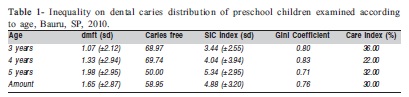
<body><![CDATA[<p><font face="Verdana, Arial, Helvetica, sans-serif" size="2">Percentages of dmft and caries-free children were used   to describe dental caries distribution among preschool   children. Significant Caries Index (SiC Index), Gini   Coefficient and Care Index were adopted to assess the unequal   distribution of dental caries and oral health care.</font></p>     <p><font face="Verdana, Arial, Helvetica, sans-serif" size="2">SiC index was calculated by taking the mean dmft of the   one third of the individuals having the highest of dmft values   in a given population, and was used to measure the polarization   of the dental caries occurrence among preschool children<sup>12</sup>.   The Care Index was calculated using the means dmft without   caries-free. The component "f" (filled teeth) was divided by   the dmft and multiplied by 100<sup>13</sup>. The Gini Coefficient was used to assess inequality of caries distribution in this study<sup>14</sup>.</font></p>     <p><font face="Verdana, Arial, Helvetica, sans-serif" size="2">The Kruskal-Wallis test was used for comparison of dmft   according to age. Spearman's correlation test was used to relate   the mean dmft with the oral health-related quality of life and   socioeconomic classification as well as to relate the results of   oral health-related quality of life with the socioeconomic   conditions. A significance level of 5% was adopted. The tests   were calculated using Statistica 9.1 software.</font></p>     <p>&nbsp;</p>     <p><font face="Verdana, Arial, Helvetica, sans-serif" size="3"><b>Results</b></font></p>     <p><font face="Verdana, Arial, Helvetica, sans-serif" size="2">As much as 229 preschool children were recruited for   the study, being 50.66% boys and 49.34 girls. These 229   children were part of the survey because consent forms were   distributed beyond the amount calculated for the sample,   due to losses that occur when distributing the consent forms   of those mothers who do not want to allow the participation   of children in research, being examined all children whose parents consented to participate.</font></p>     <p><font face="Verdana, Arial, Helvetica, sans-serif" size="2"><a href="#tab01">Table 1</a> summarizes the distribution of dental caries of   preschool children examined according to age. There was a   higher dmft in 5-year-olds than in 3-year-olds, whereas at 3   years it was found a dmft of 1.07 (2.12) and at 5 years a dmft   of 1.98 (2.95). It was found a significant caries index of 4.88 (3.20), nearly three times higher than the average dmft.</font></p>     <p><font face="Verdana, Arial, Helvetica, sans-serif" size="2">The Gini coefficient shows a change from zero to one, where   zero is related to absence of inequality and one demonstrates the   presence of the same. In this population was observed a Gini   Coefficient greater expressiveness in 4-year-olds (0.83),   demonstrating the unequal distribution of dental caries.</font></p>     <p><font face="Verdana, Arial, Helvetica, sans-serif" size="2">The care index was used to assess the capacity of health   services in meeting the needs of the population, which   revealed a low percentage of care for this population (30.00%).   In the 4-year-old group there was the lower percentage of   care (22.00%), as described in <a href="#tab01">Table 1</a>.</font></p>     <p><font face="Verdana, Arial, Helvetica, sans-serif" size="2">With respect to socioeconomic status, it was found that   66.38% of the families of preschool children examined were   classified in the lower middle class, 21.83% were classified   in the middle class, 11.35% in the upper low, 0.44% in the   upper middle class and there was no family in the lower low   and high class.</font></p>     ]]></body>
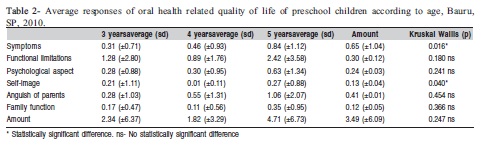
<body><![CDATA[<p><font face="Verdana, Arial, Helvetica, sans-serif" size="2">According to the responses of the different domains of   the questionnaire oral health-related quality of life according   to age, was verified that symptoms and functional limitations   presented the highest means in subscale of children and   anguish of parents demonstrated the highest mean in subscale   of family. In the domains symptoms, psychological aspects   and anguish of parents there was an increase in average with   increasing age. It was verified statistically significant   difference in the domains' symptoms (p=0.016) and selfimage   (p=0.040), as shown in <a href="#tab02">Table 2</a>.</font></p>     <p>&nbsp;</p>     <p><a name="tab01"></a></p>     <p>&nbsp;</p>     <p align="center"><img src="/img/revistas/bjos/v11n4/a07tab01.jpg"></p>     <p>&nbsp;</p>     <p><a name="tab02"></a></p>     <p>&nbsp;</p>     <p align="center"><img src="/img/revistas/bjos/v11n4/a07tab02.jpg"></p>     <p>&nbsp;</p>     ]]></body>
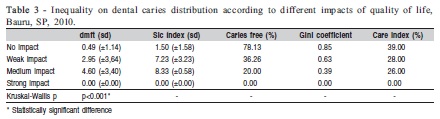
<body><![CDATA[<p><font face="Verdana, Arial, Helvetica, sans-serif" size="2">    <br>   For the development of this research, it was proposed   the assessment of the impact of oral health status in quality   of life of preschool children, where it was observed 55.90%of children with no impact of oral health on quality of life,   39.74% with weak impact, 4.36% of the preschool children   with medium impact, and no children with strong impact.</font></p>     <p><font face="Verdana, Arial, Helvetica, sans-serif" size="2">Assessing the dmft of children according to the different   impacts of oral health on quality of life, it was found that   children who showed no impact presented a dmft of 0.49   (1.14) and those who had a medium impact presented a dmft   of 4.60 (3.40), where it was found a statistically significant   difference between the different impacts (p&lt;0.001).   Moreover, it was found a reduction in the percentage of caries   free children and the care index in accordance with the   increasing impact of oral health on quality of life as described   in <a href="#tab03">Table 3</a>.</font></p>       <p>&nbsp;</p>     <p><a name="tab03"></a></p>     <p>&nbsp;</p>     <p align="center"><img src="/img/revistas/bjos/v11n4/a07tab03.jpg"></p>     <p>&nbsp;</p>     <p><font face="Verdana, Arial, Helvetica, sans-serif" size="2">    <br>   Assessing the correlation between dmft and oral healthrelated   quality of life was observed a linear and significant   ratio for the overall score and domains of the questionnaire   (p&lt;0.001). Relating oral health-related quality of life with   socioeconomic conditions of the families, it was observed a   significant inverse relationship (r =- 0.183, p=0.006), i.e.,   with higher influence of oral health on quality of life of   preschool children, lower the socioeconomic condition of   households, as well as between oral health-related quality of   life and income components (r =- 0.196, P= 0.003) and   housing (r =- 0.166; p= 0.011). However, no relationship   was found with the educational component of the parents or   guardians (r =- 0.113, p= 0.086). Relating dmft with   socioeconomic conditions of the families, it was found a   significant inverse relationship (r = - 0.190, p= 0.003).</font></p>     ]]></body>
<body><![CDATA[<p>&nbsp;</p>     <p><font face="Verdana, Arial, Helvetica, sans-serif" size="3"><b>Discussion</b></font></p>     <p><font face="Verdana, Arial, Helvetica, sans-serif" size="2"> In order to evaluate the prevalence and severity of dental   caries according to WHO recommendations, this study used   the dmft index. It was possible to evaluate the caries   experience in preschool children from the city of Bauru, State   of S&atilde;o Paulo. It could be observed polarization of dental   caries in the studied group, with a Sic Index of 4.88 (+-   3.20) and it was found low care index, demonstrating the   limited access of this population to health services and the   low restorative care to which they have been exposed. The   findings of this study are consistent with the goals of WHO   for 2000 of 50% of caries-free children among 5-year-olds<sup>15</sup>,   but are not consistent with the goals of WHO for 2020 in increasing the proportion of caries free children<sup>16</sup>.</font></p>     <p><font face="Verdana, Arial, Helvetica, sans-serif" size="2">It has been reported that when there is a large number of   cases concentrated in a small group of individuals exist a   phenomenon known as polarization<sup>17</sup>. This phenomenon is   expressed in the concentration of greater burden of disease   and treatment needs in a small portion of the population (20-40%), whereas most the children presents caries-free (40-60%),   may be reflecting the measures of prevention and control of   dental caries, based on solid population strategy, in which   moved from a situation of high prevalence of the disease for a   large percentage of caries-free individuals<sup>18</sup>. In this sense, the   greater vulnerability to injury is associated with intense   exposure to risk factors and social deprivation. In some studies,   it was emphasized that the prevalence of dental caries   decreased as socioeconomic level increased, even in areas without the addition of fluoride to public water supply<sup>19</sup>.</font></p>     <p><font face="Verdana, Arial, Helvetica, sans-serif" size="2">In order to quantify the extent which oral health   problems interfere on daily life and well-being of people,   were developed instruments of oral health-related quality of   life to assess the impact of oral health in the physical and   psychosocial development. Children, as well as young adults   are also affected by several oral health problems, which have   the potential to compromise the well-being and quality of life of them<sup>20-21</sup>.</font></p>     <p><font face="Verdana, Arial, Helvetica, sans-serif" size="2">The ECOHIS was developed for use in epidemiological studies aiming to evaluate the influence of oral diseases and   treatment on preschool children's quality of life. It considers   the experience of oral diseases and dental treatment of the child's lifetime with the answers provided by parents<sup>22</sup>.</font></p>     <p><font face="Verdana, Arial, Helvetica, sans-serif" size="2">There are few studies in the literature regarding the influence   of oral health on quality of life of children in preschool age.   This research found a greater influence of oral health on quality   of life in the domains' symptoms and anguish of parents and   lower means on self-image and family function. The maximum   score obtained in the questionnaire was 33 points.</font></p>     <p><font face="Verdana, Arial, Helvetica, sans-serif" size="2">In this study the domains with the highest means were   symptoms and functional limitations, which demonstrate that   the influence of oral health on quality of life of children can   be perceived by parents/guardians, when there are symptoms   such as pain and limitations in daily activities such as speech   and feeding. These results highlight the need to promote health   education activities with parents or guardians of preschool   children in order to raise awareness about the importance of   maintaining a healthy primary dentition both for oral health   and general health of children in this age group.</font></p>     <p><font face="Verdana, Arial, Helvetica, sans-serif" size="2">Similarly, Pahel et al. (2007) found that the highest   average of the influence of oral health on quality of life   domains were registered in symptoms, followed by functional   limitations and emotional well-being. Children who had   higher caries experience reported greater influence on quality   of life that children who had lower caries experience<sup>7</sup>. In a   research conducted by Abanto et al. (2010)<sup>22</sup> with preschool   children using the ECOHIS, parents reported greater impact   related to the child's subscale (69.30%) than with family's   subscale (30.70%). Parents reported no influence of oral health   on quality of life in 40.10% and in 59.90% of children in   child's subscales and family's subscale respectively. The   maximum score of 30 was recorded at child's session and 12 on family's session.</font></p>     <p><font face="Verdana, Arial, Helvetica, sans-serif" size="2">A recent study conducted in the city of Diamantina,   MG, Brazil showed that in the child impact section, "pain in   the teeth, mouth or jaws" was the most frequently reported   item by the parents (21.5%) and in the family impact section the most frequently reported item was "felt guilty" (14.2%)<sup>23</sup>.</font></p>     ]]></body>
<body><![CDATA[<p><font face="Verdana, Arial, Helvetica, sans-serif" size="2">This research also aimed to assess the perception of   parents of oral health-related quality of life using a scale   with different impacts from preschool children with no   impact, weak impact, medium impact and strong impact, in   order to facilitate their use in public health, where it was   observed that 55.9 % of the children had no impact, i.e., a   score of zero, and 39.74% were weak impact of oral health   on quality of life. By linking the different impacts to the   prevalence of dental caries, it was observed that children   with medium impact showed a dmft of 4.60 (3.40) and those   with no impact a dmft of 0.49 (1.14).</font></p>     <p><font face="Verdana, Arial, Helvetica, sans-serif" size="2">Likewise, the study by Li et al. (2008) revealed that the   majority of parents reported a weak impact of oral health on   quality of life of their children before they perform dental   treatment, and according to the parents, the same children had dental problems that required treatment <sup>24</sup>.</font></p>     <p><font face="Verdana, Arial, Helvetica, sans-serif" size="2">According to Baldani et al. (2002)<sup>15</sup>, the assessment of   socioeconomic conditions allows to consider possible   etiologic factors of social inequalities such as income,   educational attainment and housing conditions. In this sense,   it was found that 66.38% of the families evaluated in this   study were in the lower middle class, 21.83%, in middle   class, 11.35% in upper low and 0.44% in the upper middle   class. Knowledge of these data allows a reorientation of health   care and public spending on prevention and care activities,   enabling a fair distribution of available resources, providing more resources to those groups with the greatest needs.</font></p>     <p><font face="Verdana, Arial, Helvetica, sans-serif" size="2">Epidemiological studies have been conducted to evaluate   the relationship between oral health and socioeconomic   conditions and have been observed that low socioeconomic   status is related to higher prevalence of dental caries. The   reason for the association between oral health and   socioeconomic status is reasoned on the fact that   socioeconomic status determines access to resources that   determine the distribution of oral health, as well as, behavioral   factors and consumption of sugar among them: toothbrushing, preventive activities and regular dental visits<sup>25</sup>.</font></p>     <p><font face="Verdana, Arial, Helvetica, sans-serif" size="2">Socioeconomic data were collected from parents in order   to allow inequalities in oral health-related quality of life to   be examined. An inverse and significant relationship was   found between dmft and socioeconomic conditions   (p=0.003) as well as the education level (p=0.046) and   housing (p=0.010).</font></p>     <p><font face="Verdana, Arial, Helvetica, sans-serif" size="2">Likewise Meneghim et al. (2007)<sup>26</sup> showed that income,   education level, housing conditions and socioeconomic status   have a significant relationship with higher prevalence of   dental caries<sup>27</sup>. Similarly, a study conducted in Piracicaba,   SP, Brazil, in 2009 found an inverse association between   dental caries with income and with education level of the father and the mother.</font></p>     <p><font face="Verdana, Arial, Helvetica, sans-serif" size="2">The present study found inverse relation between oral   health-related quality of life and socioeconomic conditions   where children from low socioeconomic conditions   demonstrated higher influence of oral health conditions on   quality of life. These results indicate that people living in   low socioeconomic conditions have worst oral health   conditions due to exposure to risk factors interfering with   their quality of life. Similarly, a study conducted with   Brazilian schoolchildren found that higher impacts on   COHRQoL were observed for children presenting with   untreated dental caries. Socioeconomic factors were also   associated with COHRQoL, as poorer scores were reported   by children whose mothers had not completed primary   education (RR 1.31; 95% CI 1.17-1.46) and those with lower household income (RR 1.17; 95% CI 1.05-1.31).<sup>2</sup></font></p>     <p><font face="Verdana, Arial, Helvetica, sans-serif" size="2">Likewise, a study developed in Canada with   schoolchildren demonstrated that in children from higher   income backgrounds, mean CPQ11-14 scores were low, close   to the minimum score of 10, irrespective of the presence or   severity of oral diseases and disorders. For children from   lower income backgrounds, those free of oral diseases and   disorders also had relatively low scores. However, scores   increased significantly in the presence of oral disease. This   suggests that oral health problems have less perceived impact on high income children, but a more marked impact onchildren from low income environments<sup>3</sup>.</font></p>     <p><font face="Verdana, Arial, Helvetica, sans-serif" size="2">The questionnaires to evaluate oral health-related quality   of life of preschool children can be a valuable instrument to   demonstrate the perception of parents about the oral health   of their children and to guide the oral health attention of   this population group.</font></p>     <p><font face="Verdana, Arial, Helvetica, sans-serif" size="2">The present study identified low impact of oral health   on quality of life of preschool children examined from the   perspective of parents and verified socioeconomic inequalities   associated with oral health related quality of life of the children.   The results indicate the need of planning educational activities   with parents about the importance of taking care of the primary   teeth as well as the low capacity of the health system to treat   people of this age group. The assessment of perceived needs   by the use of quality of life questionnaires as well as   socioeconomic parameters can assist the planning of oral health   programs aiming the reduction of unnecessary and unavoidable   inequalities in the distribution of dental caries in populations   of different socioeconomic conditions.</font></p>     ]]></body>
<body><![CDATA[<p>&nbsp;</p>     <p><font face="Verdana, Arial, Helvetica, sans-serif" size="3"><b>Acknowledgements</b></font></p>     <p><font face="Verdana, Arial, Helvetica, sans-serif" size="2">The authors thank the children of public Kindergartens of the city of Bauru for their support in developing this study.</font></p>     <p>&nbsp;</p>     <p><font face="Verdana, Arial, Helvetica, sans-serif" size="3"><b>References</b></font></p>     <!-- ref --><p><font face="Verdana, Arial, Helvetica, sans-serif" size="2">1. Ferraz MJPC, Queluz DPQ, Alves MC, Santos CCG, Matsui MY. Caries   experience associated to social and preventive factors in children of a pastoral community from Limeira-SP. Braz J Oral Sci. 2011; 10: 152-7.    &nbsp;&nbsp;&nbsp;&nbsp;&nbsp;&nbsp;&nbsp;&nbsp;[&#160;<a href="javascript:void(0);" onclick="javascript: window.open('/scielo.php?script=sci_nlinks&ref=048349&pid=S1677-3225201200040000700001&lng=','','width=640,height=500,resizable=yes,scrollbars=1,menubar=yes,');">Links</a>&#160;]<!-- end-ref --></font></p>     <!-- ref --><p><font face="Verdana, Arial, Helvetica, sans-serif" size="2">2. Piovesan CJLF, Guedes RS, Ardenghi TM. Impact of socioeconomic and   clinical factors on child oral health-related quality of life (COHRQoL). Qual   lLfe Res. 2010; 19: 1359-66.    &nbsp;&nbsp;&nbsp;&nbsp;&nbsp;&nbsp;&nbsp;&nbsp;[&#160;<a href="javascript:void(0);" onclick="javascript: window.open('/scielo.php?script=sci_nlinks&ref=048351&pid=S1677-3225201200040000700002&lng=','','width=640,height=500,resizable=yes,scrollbars=1,menubar=yes,');">Links</a>&#160;]<!-- end-ref --></font></p>     <!-- ref --><p><font face="Verdana, Arial, Helvetica, sans-serif" size="2">3. Locker D. Disparities in oral health-related quality of life in a population of   Canadian children. Community Dent Oral Epidemiol. 2007; 35: 348-56.    &nbsp;&nbsp;&nbsp;&nbsp;&nbsp;&nbsp;&nbsp;&nbsp;[&#160;<a href="javascript:void(0);" onclick="javascript: window.open('/scielo.php?script=sci_nlinks&ref=048353&pid=S1677-3225201200040000700003&lng=','','width=640,height=500,resizable=yes,scrollbars=1,menubar=yes,');">Links</a>&#160;]<!-- end-ref --></font></p>     <!-- ref --><p><font face="Verdana, Arial, Helvetica, sans-serif" size="2">4. Piovesan C, Batista A, Ferreira FV, Ardenghi TM. Oral health-related quality   of life in children: Conceptual issues. Rev Odont Cienc. 2009; 24: 81-5.    &nbsp;&nbsp;&nbsp;&nbsp;&nbsp;&nbsp;&nbsp;&nbsp;[&#160;<a href="javascript:void(0);" onclick="javascript: window.open('/scielo.php?script=sci_nlinks&ref=048355&pid=S1677-3225201200040000700004&lng=','','width=640,height=500,resizable=yes,scrollbars=1,menubar=yes,');">Links</a>&#160;]<!-- end-ref --></font></p>     <!-- ref --><p><font face="Verdana, Arial, Helvetica, sans-serif" size="2">5. Koposova N, Widstr&ouml;m E, Eisemann M, Koposov R, Eriksen HM. Oral   health and quality of life in Norwegian and Russian school children: A pilot   study. Stomatologija, BDM J. 2010; 12: 10-6.    &nbsp;&nbsp;&nbsp;&nbsp;&nbsp;&nbsp;&nbsp;&nbsp;[&#160;<a href="javascript:void(0);" onclick="javascript: window.open('/scielo.php?script=sci_nlinks&ref=048357&pid=S1677-3225201200040000700005&lng=','','width=640,height=500,resizable=yes,scrollbars=1,menubar=yes,');">Links</a>&#160;]<!-- end-ref --></font></p>     <!-- ref --><p><font face="Verdana, Arial, Helvetica, sans-serif" size="2">6. Jokovic A, et al. Validity and Reliability of a Questionnaire for Measuring   Child Oral-health-related Qual Life J Dent Res. 2002; 81: 459-63.    &nbsp;&nbsp;&nbsp;&nbsp;&nbsp;&nbsp;&nbsp;&nbsp;[&#160;<a href="javascript:void(0);" onclick="javascript: window.open('/scielo.php?script=sci_nlinks&ref=048359&pid=S1677-3225201200040000700006&lng=','','width=640,height=500,resizable=yes,scrollbars=1,menubar=yes,');">Links</a>&#160;]<!-- end-ref --></font></p>     <!-- ref --><p><font face="Verdana, Arial, Helvetica, sans-serif" size="2">7. Pahel BT, Rozier RG, Slade GD. Paternal perceptions of children's oral   health: The Early childhood oral helath impact scale (ECOHIS). Health   Qual Life Outcomes. 2007; 5(6). &#91;Cited 2010 Sept 10&#93; Available from:   <a href="www.hqlo.com/content/5/1/6" target="_blank">www.hqlo.com/content/5/1/6</a>.    &nbsp;&nbsp;&nbsp;&nbsp;&nbsp;&nbsp;&nbsp;&nbsp;[&#160;<a href="javascript:void(0);" onclick="javascript: window.open('/scielo.php?script=sci_nlinks&ref=048361&pid=S1677-3225201200040000700007&lng=','','width=640,height=500,resizable=yes,scrollbars=1,menubar=yes,');">Links</a>&#160;]<!-- end-ref --></font></p>     <!-- ref --><p><font face="Verdana, Arial, Helvetica, sans-serif" size="2">8. Municipal Department of Education. The municipal Government of Bauru.  &#91;Cited 2012 Aug 20&#93; Available from: <a href="http://www.bauru.sp.gov.br/secretarias/sec_educacao/infantil.aspx" target="_blank">http://www.bauru.sp.gov.br/secretarias/sec_educacao/infantil.aspx</a>.    &nbsp;&nbsp;&nbsp;&nbsp;&nbsp;&nbsp;&nbsp;&nbsp;[&#160;<a href="javascript:void(0);" onclick="javascript: window.open('/scielo.php?script=sci_nlinks&ref=048363&pid=S1677-3225201200040000700008&lng=','','width=640,height=500,resizable=yes,scrollbars=1,menubar=yes,');">Links</a>&#160;]<!-- end-ref --></font></p>     <!-- ref --><p><font face="Verdana, Arial, Helvetica, sans-serif" size="2">9. Word Health Organization. Oral health surveys, basics methods. 4th ed.   Geneve: WHO; 1997.    &nbsp;&nbsp;&nbsp;&nbsp;&nbsp;&nbsp;&nbsp;&nbsp;[&#160;<a href="javascript:void(0);" onclick="javascript: window.open('/scielo.php?script=sci_nlinks&ref=048365&pid=S1677-3225201200040000700009&lng=','','width=640,height=500,resizable=yes,scrollbars=1,menubar=yes,');">Links</a>&#160;]<!-- end-ref --></font></p>     <!-- ref --><p><font face="Verdana, Arial, Helvetica, sans-serif" size="2">10. Tesch FC, Oliveria BH, Le&atilde;o A. Semantic equivalence of the Brazilian   version of the Early Childhood Oral Health Impact Scale. Cad Saude   Publica. 2008; 24: 1897-909.    &nbsp;&nbsp;&nbsp;&nbsp;&nbsp;&nbsp;&nbsp;&nbsp;[&#160;<a href="javascript:void(0);" onclick="javascript: window.open('/scielo.php?script=sci_nlinks&ref=048367&pid=S1677-3225201200040000700010&lng=','','width=640,height=500,resizable=yes,scrollbars=1,menubar=yes,');">Links</a>&#160;]<!-- end-ref --></font></p>     <!-- ref --><p><font face="Verdana, Arial, Helvetica, sans-serif" size="2">11. Graciano MIG. Evaluation Criteria for Socioeconomic Classification. Serv   Social Soc. 1980; 1: 81-103.    &nbsp;&nbsp;&nbsp;&nbsp;&nbsp;&nbsp;&nbsp;&nbsp;[&#160;<a href="javascript:void(0);" onclick="javascript: window.open('/scielo.php?script=sci_nlinks&ref=048369&pid=S1677-3225201200040000700011&lng=','','width=640,height=500,resizable=yes,scrollbars=1,menubar=yes,');">Links</a>&#160;]<!-- end-ref --></font></p>     <!-- ref --><p><font face="Verdana, Arial, Helvetica, sans-serif" size="2">12. Nishi M, Stjernsw&auml;rd J, Carlsson P, Bratthall D. Caries experience of   some countries and areas expressed by the Significance Caries Index.   Community Dent Oral Epidemiol. 2002; 30: 296-301.    &nbsp;&nbsp;&nbsp;&nbsp;&nbsp;&nbsp;&nbsp;&nbsp;[&#160;<a href="javascript:void(0);" onclick="javascript: window.open('/scielo.php?script=sci_nlinks&ref=048371&pid=S1677-3225201200040000700012&lng=','','width=640,height=500,resizable=yes,scrollbars=1,menubar=yes,');">Links</a>&#160;]<!-- end-ref --></font></p>     <!-- ref --><p><font face="Verdana, Arial, Helvetica, sans-serif" size="2">13. Smith GE. Tooth decay in the developing world. N Z Med J. 1987; 100:   669-70.    &nbsp;&nbsp;&nbsp;&nbsp;&nbsp;&nbsp;&nbsp;&nbsp;[&#160;<a href="javascript:void(0);" onclick="javascript: window.open('/scielo.php?script=sci_nlinks&ref=048373&pid=S1677-3225201200040000700013&lng=','','width=640,height=500,resizable=yes,scrollbars=1,menubar=yes,');">Links</a>&#160;]<!-- end-ref --></font></p>     <!-- ref --><p><font face="Verdana, Arial, Helvetica, sans-serif" size="2">14. Armfield JM, Spencer AJ, Slade GD. Changing inequalities in the   distribution of caries associated with improving child oral health in Australia. J. Public Health Dent. 2009; 69: 125-34.    &nbsp;&nbsp;&nbsp;&nbsp;&nbsp;&nbsp;&nbsp;&nbsp;[&#160;<a href="javascript:void(0);" onclick="javascript: window.open('/scielo.php?script=sci_nlinks&ref=048375&pid=S1677-3225201200040000700014&lng=','','width=640,height=500,resizable=yes,scrollbars=1,menubar=yes,');">Links</a>&#160;]<!-- end-ref --></font></p>     <!-- ref --><p><font face="Verdana, Arial, Helvetica, sans-serif" size="2">15. Bastos RS, Silva RP, Maia-Junior AF, Carvalho FS, Merlini S, Caldana   ML et al. Dental caries profile in Monte Negro, Amazonian state of Rond&ocirc;nia,   Brazil, in 2008. J Appl Oral Sci. 2010; 18: 437-41.    &nbsp;&nbsp;&nbsp;&nbsp;&nbsp;&nbsp;&nbsp;&nbsp;[&#160;<a href="javascript:void(0);" onclick="javascript: window.open('/scielo.php?script=sci_nlinks&ref=048377&pid=S1677-3225201200040000700015&lng=','','width=640,height=500,resizable=yes,scrollbars=1,menubar=yes,');">Links</a>&#160;]<!-- end-ref --></font></p>     <!-- ref --><p><font face="Verdana, Arial, Helvetica, sans-serif" size="2">16. Hobdell M, Petersen PE, Clarkson J, Johnson N. Global goals for oral   health 2020. Int Dent J. 2003; 53: 285-8.    &nbsp;&nbsp;&nbsp;&nbsp;&nbsp;&nbsp;&nbsp;&nbsp;[&#160;<a href="javascript:void(0);" onclick="javascript: window.open('/scielo.php?script=sci_nlinks&ref=048379&pid=S1677-3225201200040000700016&lng=','','width=640,height=500,resizable=yes,scrollbars=1,menubar=yes,');">Links</a>&#160;]<!-- end-ref --></font></p>     <!-- ref --><p><font face="Verdana, Arial, Helvetica, sans-serif" size="2">17. Narvai PC, Fraz&atilde;o P, Roncalli AG, Antunes JLF. Dental caries in Brazil:   decline, polarization, inequality and social exclusion. Pan Am J Public   Health. 2006; 19: 385-93.    &nbsp;&nbsp;&nbsp;&nbsp;&nbsp;&nbsp;&nbsp;&nbsp;[&#160;<a href="javascript:void(0);" onclick="javascript: window.open('/scielo.php?script=sci_nlinks&ref=048381&pid=S1677-3225201200040000700017&lng=','','width=640,height=500,resizable=yes,scrollbars=1,menubar=yes,');">Links</a>&#160;]<!-- end-ref --></font></p>     <!-- ref --><p><font face="Verdana, Arial, Helvetica, sans-serif" size="2">18. Sales Peres SHC, Carvalho FS, Carvalho CP, Bastos JRM, Lauris   JRP. Polarization of dental caries in teen-agers in the Southwest of the   state of S&atilde;o Paulo, Brazil. Cien Saude Colet. 2008; 13(Sup 2): 2155-62.    &nbsp;&nbsp;&nbsp;&nbsp;&nbsp;&nbsp;&nbsp;&nbsp;[&#160;<a href="javascript:void(0);" onclick="javascript: window.open('/scielo.php?script=sci_nlinks&ref=048383&pid=S1677-3225201200040000700018&lng=','','width=640,height=500,resizable=yes,scrollbars=1,menubar=yes,');">Links</a>&#160;]<!-- end-ref --></font></p>     <!-- ref --><p><font face="Verdana, Arial, Helvetica, sans-serif" size="2">19. Baldani MH, Narvai PC, Antunes JLF. Dental caries and socioeconomic   conditions in the State of Paran&aacute;, Brazil, 1996. Cad Saude Publica. 2002;   18; 755-63.    &nbsp;&nbsp;&nbsp;&nbsp;&nbsp;&nbsp;&nbsp;&nbsp;[&#160;<a href="javascript:void(0);" onclick="javascript: window.open('/scielo.php?script=sci_nlinks&ref=048385&pid=S1677-3225201200040000700019&lng=','','width=640,height=500,resizable=yes,scrollbars=1,menubar=yes,');">Links</a>&#160;]<!-- end-ref --></font></p>     <!-- ref --><p><font face="Verdana, Arial, Helvetica, sans-serif" size="2">20. Barbosa TS, Gavi&atilde;o MBD. Oral health-related quality of life in children:   Part II. Effects of clinical oral health status. A systematic review. Intern J   Dent Hyg. 2008; 6: 100-7.    &nbsp;&nbsp;&nbsp;&nbsp;&nbsp;&nbsp;&nbsp;&nbsp;[&#160;<a href="javascript:void(0);" onclick="javascript: window.open('/scielo.php?script=sci_nlinks&ref=048387&pid=S1677-3225201200040000700020&lng=','','width=640,height=500,resizable=yes,scrollbars=1,menubar=yes,');">Links</a>&#160;]<!-- end-ref --></font></p>     <!-- ref --><p><font face="Verdana, Arial, Helvetica, sans-serif" size="2">21. Peres KG, Peres MA, Araujo CLP, Menezes AMB, Hallal PC. Social   and dental status along the life course and oral health impacts in adolescents:   a population based birth cohort. Health Qual Life Outcomes. 2009; 7: 95.    &nbsp;&nbsp;&nbsp;&nbsp;&nbsp;&nbsp;&nbsp;&nbsp;[&#160;<a href="javascript:void(0);" onclick="javascript: window.open('/scielo.php?script=sci_nlinks&ref=048389&pid=S1677-3225201200040000700021&lng=','','width=640,height=500,resizable=yes,scrollbars=1,menubar=yes,');">Links</a>&#160;]<!-- end-ref --></font></p>     <!-- ref --><p><font face="Verdana, Arial, Helvetica, sans-serif" size="2">22. Abanto J, et al. Impact of oral diseases and disorders on oral health-related   quality of life of preschool children. Community Dent Oral Epidemiol. 2011;   39: 105-14.    &nbsp;&nbsp;&nbsp;&nbsp;&nbsp;&nbsp;&nbsp;&nbsp;[&#160;<a href="javascript:void(0);" onclick="javascript: window.open('/scielo.php?script=sci_nlinks&ref=048391&pid=S1677-3225201200040000700022&lng=','','width=640,height=500,resizable=yes,scrollbars=1,menubar=yes,');">Links</a>&#160;]<!-- end-ref --></font></p>     <!-- ref --><p><font face="Verdana, Arial, Helvetica, sans-serif" size="2">23. Martins-J&uacute;nior PA, Ramos Jorge J, Paiva SM, Marques LS, Ramos-Jorge ML. Validations of the Brazilian version of the Early Childhood Oral   Health Impact Scale (ECOHIS). Cad Saude Publica. 2012; 28: 367-74.    &nbsp;&nbsp;&nbsp;&nbsp;&nbsp;&nbsp;&nbsp;&nbsp;[&#160;<a href="javascript:void(0);" onclick="javascript: window.open('/scielo.php?script=sci_nlinks&ref=048393&pid=S1677-3225201200040000700023&lng=','','width=640,height=500,resizable=yes,scrollbars=1,menubar=yes,');">Links</a>&#160;]<!-- end-ref --></font></p>     <!-- ref --><p><font face="Verdana, Arial, Helvetica, sans-serif" size="2">24. Li S, Malkinson S, Veronneau J, Allison PJ. Testing responsivenss to   change for early childhood oral health impact scale (ECOHIS). Community   Dent Oral Epidemiol. 2008; 36: 542-8.    &nbsp;&nbsp;&nbsp;&nbsp;&nbsp;&nbsp;&nbsp;&nbsp;[&#160;<a href="javascript:void(0);" onclick="javascript: window.open('/scielo.php?script=sci_nlinks&ref=048395&pid=S1677-3225201200040000700024&lng=','','width=640,height=500,resizable=yes,scrollbars=1,menubar=yes,');">Links</a>&#160;]<!-- end-ref --></font></p>     <!-- ref --><p><font face="Verdana, Arial, Helvetica, sans-serif" size="2">25. Marmot M. Social determinants of health inequalities. The Lancet. 2005;   365; 1099-104.    &nbsp;&nbsp;&nbsp;&nbsp;&nbsp;&nbsp;&nbsp;&nbsp;[&#160;<a href="javascript:void(0);" onclick="javascript: window.open('/scielo.php?script=sci_nlinks&ref=048397&pid=S1677-3225201200040000700025&lng=','','width=640,height=500,resizable=yes,scrollbars=1,menubar=yes,');">Links</a>&#160;]<!-- end-ref --></font></p>     <!-- ref --><p><font face="Verdana, Arial, Helvetica, sans-serif" size="2">26. Cortellazzi KL et al. Influence of socioeconomic, clinical and demographic   variables on caries experience of preschool children in Piracicaba, SP.   Rev Bras Epidemiol. 2009; 12: 490-500.    &nbsp;&nbsp;&nbsp;&nbsp;&nbsp;&nbsp;&nbsp;&nbsp;[&#160;<a href="javascript:void(0);" onclick="javascript: window.open('/scielo.php?script=sci_nlinks&ref=048399&pid=S1677-3225201200040000700026&lng=','','width=640,height=500,resizable=yes,scrollbars=1,menubar=yes,');">Links</a>&#160;]<!-- end-ref --></font></p>     <!-- ref --><p><font face="Verdana, Arial, Helvetica, sans-serif" size="2">27. Meneghim MC, Kozlowski FC, Pereira AC, Ambrosano GMB, Meneghim   ZMAP. A socioeconomic classification and the discussion related to   prevalence of dental caries and dental fluorosis. Cien Saude Colet. 2007;   12: 523-9.    &nbsp;&nbsp;&nbsp;&nbsp;&nbsp;&nbsp;&nbsp;&nbsp;[&#160;<a href="javascript:void(0);" onclick="javascript: window.open('/scielo.php?script=sci_nlinks&ref=048401&pid=S1677-3225201200040000700027&lng=','','width=640,height=500,resizable=yes,scrollbars=1,menubar=yes,');">Links</a>&#160;]<!-- end-ref --></font></p>     <p>&nbsp;</p>     ]]></body>
<body><![CDATA[<p>&nbsp;</p>     <p><font face="Verdana, Arial, Helvetica, sans-serif" size="2"><a name="back"/></a><a href="#top"><img src="/img/revistas/bjos/v11n4/seta.jpg" border="0" align="absmiddle"/></a>    <b>Correspondence:</b> <br/>   Angela Xavier    <br>   Departamento de Pediatria, Ortodontia e Sa&uacute;de    <br>   Coletiva, Faculdade de Odontologia de Bauru,    <br>   Universidade de S&atilde;o Paulo    <br>   Alameda Ot&aacute;vio Pinheiro Brisolla n&deg; 9-75    <br>   CEP: 17012-901, Bauru, SP,Brasil<br/>   E-mail: <a href="mailto:dra.axavier@gmail.com">dra.axavier@gmail.com</a></font></p>     <p><font face="Verdana, Arial, Helvetica, sans-serif" size="2"><b>Received for    publication:</b> July 29, 2012<br/> <b>Accepted:</b> November 28, 2012</font></p>      ]]></body>
<back>
<ref-list>
<ref id="B1">
<label>1</label><nlm-citation citation-type="journal">
<person-group person-group-type="author">
<name>
<surname><![CDATA[Ferraz]]></surname>
<given-names><![CDATA[MJPC]]></given-names>
</name>
<name>
<surname><![CDATA[Queluz]]></surname>
<given-names><![CDATA[DPQ]]></given-names>
</name>
<name>
<surname><![CDATA[Alves]]></surname>
<given-names><![CDATA[MC]]></given-names>
</name>
<name>
<surname><![CDATA[Santos]]></surname>
<given-names><![CDATA[CCG]]></given-names>
</name>
<name>
<surname><![CDATA[Matsui]]></surname>
<given-names><![CDATA[MY]]></given-names>
</name>
</person-group>
<article-title xml:lang="en"><![CDATA[Caries experience associated to social and preventive factors in children of a pastoral community from Limeira-SP]]></article-title>
<source><![CDATA[Braz J Oral Sci]]></source>
<year>2011</year>
<volume>10</volume>
<page-range>152-7</page-range></nlm-citation>
</ref>
<ref id="B2">
<label>2</label><nlm-citation citation-type="journal">
<person-group person-group-type="author">
<name>
<surname><![CDATA[Piovesan]]></surname>
<given-names><![CDATA[CJLF]]></given-names>
</name>
<name>
<surname><![CDATA[Guedes]]></surname>
<given-names><![CDATA[RS]]></given-names>
</name>
<name>
<surname><![CDATA[Ardenghi]]></surname>
<given-names><![CDATA[TM]]></given-names>
</name>
</person-group>
<article-title xml:lang="en"><![CDATA[Impact of socioeconomic and clinical factors on child oral health-related quality of life (COHRQoL)]]></article-title>
<source><![CDATA[Qual lLfe Res]]></source>
<year>2010</year>
<volume>19</volume>
<page-range>1359-66</page-range></nlm-citation>
</ref>
<ref id="B3">
<label>3</label><nlm-citation citation-type="journal">
<person-group person-group-type="author">
<name>
<surname><![CDATA[Locker]]></surname>
<given-names><![CDATA[D]]></given-names>
</name>
</person-group>
<article-title xml:lang="en"><![CDATA[Disparities in oral health-related quality of life in a population of Canadian children]]></article-title>
<source><![CDATA[Community Dent Oral Epidemiol]]></source>
<year>2007</year>
<volume>35</volume>
<page-range>348-56</page-range></nlm-citation>
</ref>
<ref id="B4">
<label>4</label><nlm-citation citation-type="journal">
<person-group person-group-type="author">
<name>
<surname><![CDATA[Piovesan]]></surname>
<given-names><![CDATA[C]]></given-names>
</name>
<name>
<surname><![CDATA[Batista]]></surname>
<given-names><![CDATA[A]]></given-names>
</name>
<name>
<surname><![CDATA[Ferreira]]></surname>
<given-names><![CDATA[FV]]></given-names>
</name>
<name>
<surname><![CDATA[Ardenghi]]></surname>
<given-names><![CDATA[TM]]></given-names>
</name>
</person-group>
<article-title xml:lang="en"><![CDATA[Oral health-related quality of life in children: Conceptual issues]]></article-title>
<source><![CDATA[Rev Odont Cienc]]></source>
<year>2009</year>
<volume>24</volume>
<page-range>81-5</page-range></nlm-citation>
</ref>
<ref id="B5">
<label>5</label><nlm-citation citation-type="journal">
<person-group person-group-type="author">
<name>
<surname><![CDATA[Koposova]]></surname>
<given-names><![CDATA[N]]></given-names>
</name>
<name>
<surname><![CDATA[Widström]]></surname>
<given-names><![CDATA[E]]></given-names>
</name>
<name>
<surname><![CDATA[Eisemann]]></surname>
<given-names><![CDATA[M]]></given-names>
</name>
<name>
<surname><![CDATA[Koposov]]></surname>
<given-names><![CDATA[R]]></given-names>
</name>
<name>
<surname><![CDATA[Eriksen]]></surname>
<given-names><![CDATA[HM]]></given-names>
</name>
</person-group>
<article-title xml:lang="en"><![CDATA[Oral health and quality of life in Norwegian and Russian school children: A pilot study]]></article-title>
<source><![CDATA[Stomatologija, BDM J]]></source>
<year>2010</year>
<volume>12</volume>
<page-range>10-6</page-range></nlm-citation>
</ref>
<ref id="B6">
<label>6</label><nlm-citation citation-type="journal">
<person-group person-group-type="author">
<name>
<surname><![CDATA[Jokovic]]></surname>
<given-names><![CDATA[A]]></given-names>
</name>
</person-group>
<article-title xml:lang="en"><![CDATA[Validity and Reliability of a Questionnaire for Measuring Child Oral-health-related]]></article-title>
<source><![CDATA[Qual Life J Dent Res]]></source>
<year>2002</year>
<volume>81</volume>
<page-range>459-63</page-range></nlm-citation>
</ref>
<ref id="B7">
<label>7</label><nlm-citation citation-type="journal">
<person-group person-group-type="author">
<name>
<surname><![CDATA[Pahel]]></surname>
<given-names><![CDATA[BT]]></given-names>
</name>
<name>
<surname><![CDATA[Rozier]]></surname>
<given-names><![CDATA[RG]]></given-names>
</name>
<name>
<surname><![CDATA[Slade]]></surname>
<given-names><![CDATA[GD]]></given-names>
</name>
</person-group>
<article-title xml:lang="en"><![CDATA[Paternal perceptions of children's oral health: The Early childhood oral helath impact scale (ECOHIS)]]></article-title>
<source><![CDATA[Health Qual Life Outcomes]]></source>
<year>2010</year>
<month> S</month>
<day>ep</day>
<volume>5</volume>
<numero>^s6</numero>
<issue>^s6</issue>
<supplement>6</supplement>
</nlm-citation>
</ref>
<ref id="B8">
<label>8</label><nlm-citation citation-type="">
<collab>Municipal Department of Education^dThe municipal Government of Bauru</collab>
<source><![CDATA[]]></source>
<year>2012</year>
<month> A</month>
<day>ug</day>
</nlm-citation>
</ref>
<ref id="B9">
<label>9</label><nlm-citation citation-type="book">
<collab>Word Health Organization</collab>
<source><![CDATA[Oral health surveys: basics methods]]></source>
<year>1997</year>
<edition>4th</edition>
<publisher-loc><![CDATA[Geneve ]]></publisher-loc>
<publisher-name><![CDATA[WHO]]></publisher-name>
</nlm-citation>
</ref>
<ref id="B10">
<label>10</label><nlm-citation citation-type="journal">
<person-group person-group-type="author">
<name>
<surname><![CDATA[Tesch]]></surname>
<given-names><![CDATA[FC]]></given-names>
</name>
<name>
<surname><![CDATA[Oliveria]]></surname>
<given-names><![CDATA[BH]]></given-names>
</name>
<name>
<surname><![CDATA[Leão]]></surname>
<given-names><![CDATA[A]]></given-names>
</name>
</person-group>
<article-title xml:lang="en"><![CDATA[Semantic equivalence of the Brazilian version of the Early Childhood Oral Health Impact Scale]]></article-title>
<source><![CDATA[Cad Saude Publica]]></source>
<year>2008</year>
<volume>24</volume>
<page-range>1897-909</page-range></nlm-citation>
</ref>
<ref id="B11">
<label>11</label><nlm-citation citation-type="journal">
<person-group person-group-type="author">
<name>
<surname><![CDATA[Graciano]]></surname>
<given-names><![CDATA[MIG]]></given-names>
</name>
</person-group>
<article-title xml:lang="en"><![CDATA[Evaluation Criteria for Socioeconomic Classification]]></article-title>
<source><![CDATA[Serv Social Soc]]></source>
<year>1980</year>
<volume>1</volume>
<page-range>81-103</page-range></nlm-citation>
</ref>
<ref id="B12">
<label>12</label><nlm-citation citation-type="journal">
<person-group person-group-type="author">
<name>
<surname><![CDATA[Nishi]]></surname>
<given-names><![CDATA[M]]></given-names>
</name>
<name>
<surname><![CDATA[Stjernswärd]]></surname>
<given-names><![CDATA[J]]></given-names>
</name>
<name>
<surname><![CDATA[Carlsson]]></surname>
<given-names><![CDATA[P]]></given-names>
</name>
<name>
<surname><![CDATA[Bratthall]]></surname>
<given-names><![CDATA[D]]></given-names>
</name>
</person-group>
<article-title xml:lang="en"><![CDATA[Caries experience of some countries and areas expressed by the Significance Caries Index]]></article-title>
<source><![CDATA[Community Dent Oral Epidemiol]]></source>
<year>2002</year>
<volume>30</volume>
<page-range>296-301</page-range></nlm-citation>
</ref>
<ref id="B13">
<label>13</label><nlm-citation citation-type="journal">
<person-group person-group-type="author">
<name>
<surname><![CDATA[Smith]]></surname>
<given-names><![CDATA[GE]]></given-names>
</name>
</person-group>
<article-title xml:lang="en"><![CDATA[Tooth decay in the developing world]]></article-title>
<source><![CDATA[N Z Med J]]></source>
<year>1987</year>
<volume>100</volume>
<page-range>669-70</page-range></nlm-citation>
</ref>
<ref id="B14">
<label>14</label><nlm-citation citation-type="journal">
<person-group person-group-type="author">
<name>
<surname><![CDATA[Armfield]]></surname>
<given-names><![CDATA[JM]]></given-names>
</name>
<name>
<surname><![CDATA[Spencer]]></surname>
<given-names><![CDATA[AJ]]></given-names>
</name>
<name>
<surname><![CDATA[Slade]]></surname>
<given-names><![CDATA[GD]]></given-names>
</name>
</person-group>
<article-title xml:lang="en"><![CDATA[Changing inequalities in the distribution of caries associated with improving child oral health in Australia]]></article-title>
<source><![CDATA[J. Public Health Dent]]></source>
<year>2009</year>
<volume>69</volume>
<page-range>125-34</page-range></nlm-citation>
</ref>
<ref id="B15">
<label>15</label><nlm-citation citation-type="journal">
<person-group person-group-type="author">
<name>
<surname><![CDATA[Bastos]]></surname>
<given-names><![CDATA[RS]]></given-names>
</name>
<name>
<surname><![CDATA[Silva]]></surname>
<given-names><![CDATA[RP]]></given-names>
</name>
<name>
<surname><![CDATA[Maia-Junior]]></surname>
<given-names><![CDATA[AF]]></given-names>
</name>
<name>
<surname><![CDATA[Carvalho]]></surname>
<given-names><![CDATA[FS]]></given-names>
</name>
<name>
<surname><![CDATA[Merlini]]></surname>
<given-names><![CDATA[S]]></given-names>
</name>
<name>
<surname><![CDATA[Caldana]]></surname>
<given-names><![CDATA[ML]]></given-names>
</name>
</person-group>
<article-title xml:lang="en"><![CDATA[Dental caries profile in Monte Negro, Amazonian state of Rondônia, Brazil, in 2008]]></article-title>
<source><![CDATA[J Appl Oral Sci]]></source>
<year>2010</year>
<volume>18</volume>
<page-range>437-41</page-range></nlm-citation>
</ref>
<ref id="B16">
<label>16</label><nlm-citation citation-type="journal">
<person-group person-group-type="author">
<name>
<surname><![CDATA[Hobdell]]></surname>
<given-names><![CDATA[M]]></given-names>
</name>
<name>
<surname><![CDATA[Petersen]]></surname>
<given-names><![CDATA[PE]]></given-names>
</name>
<name>
<surname><![CDATA[Clarkson]]></surname>
<given-names><![CDATA[J]]></given-names>
</name>
<name>
<surname><![CDATA[Johnson]]></surname>
<given-names><![CDATA[N]]></given-names>
</name>
</person-group>
<article-title xml:lang="en"><![CDATA[Global goals for oral health 2020]]></article-title>
<source><![CDATA[Int Dent J]]></source>
<year>2003</year>
<volume>53</volume>
<page-range>285-8</page-range></nlm-citation>
</ref>
<ref id="B17">
<label>17</label><nlm-citation citation-type="journal">
<person-group person-group-type="author">
<name>
<surname><![CDATA[Narvai]]></surname>
<given-names><![CDATA[PC]]></given-names>
</name>
<name>
<surname><![CDATA[Frazão]]></surname>
<given-names><![CDATA[P]]></given-names>
</name>
<name>
<surname><![CDATA[Roncalli]]></surname>
<given-names><![CDATA[AG]]></given-names>
</name>
<name>
<surname><![CDATA[Antunes]]></surname>
<given-names><![CDATA[JLF]]></given-names>
</name>
</person-group>
<article-title xml:lang="en"><![CDATA[Dental caries in Brazil: decline, polarization, inequality and social exclusion]]></article-title>
<source><![CDATA[Pan Am J Public Health]]></source>
<year>2006</year>
<volume>19</volume>
<page-range>385-93</page-range></nlm-citation>
</ref>
<ref id="B18">
<label>18</label><nlm-citation citation-type="journal">
<person-group person-group-type="author">
<name>
<surname><![CDATA[Sales Peres]]></surname>
<given-names><![CDATA[SHC]]></given-names>
</name>
<name>
<surname><![CDATA[Carvalho]]></surname>
<given-names><![CDATA[FS]]></given-names>
</name>
<name>
<surname><![CDATA[Carvalho]]></surname>
<given-names><![CDATA[CP]]></given-names>
</name>
<name>
<surname><![CDATA[Bastos]]></surname>
<given-names><![CDATA[JRM]]></given-names>
</name>
<name>
<surname><![CDATA[Lauris]]></surname>
<given-names><![CDATA[JRP]]></given-names>
</name>
</person-group>
<article-title xml:lang="en"><![CDATA[Polarization of dental caries in teen-agers in the Southwest of the state of São Paulo, Brazil]]></article-title>
<source><![CDATA[Cien Saude Colet]]></source>
<year>2008</year>
<volume>13</volume>
<numero>^s2</numero>
<issue>^s2</issue>
<supplement>2</supplement>
<page-range>2155-62</page-range></nlm-citation>
</ref>
<ref id="B19">
<label>19</label><nlm-citation citation-type="journal">
<person-group person-group-type="author">
<name>
<surname><![CDATA[Baldani]]></surname>
<given-names><![CDATA[MH]]></given-names>
</name>
<name>
<surname><![CDATA[Narvai]]></surname>
<given-names><![CDATA[PC]]></given-names>
</name>
<name>
<surname><![CDATA[Antunes]]></surname>
<given-names><![CDATA[JLF]]></given-names>
</name>
</person-group>
<article-title xml:lang="en"><![CDATA[Dental caries and socioeconomic conditions in the State of Paraná, Brazil, 1996]]></article-title>
<source><![CDATA[Cad Saude Publica]]></source>
<year>2002</year>
<volume>18</volume>
<page-range>755-63</page-range></nlm-citation>
</ref>
<ref id="B20">
<label>20</label><nlm-citation citation-type="journal">
<person-group person-group-type="author">
<name>
<surname><![CDATA[Barbosa]]></surname>
<given-names><![CDATA[TS]]></given-names>
</name>
<name>
<surname><![CDATA[Gavião]]></surname>
<given-names><![CDATA[MBD]]></given-names>
</name>
</person-group>
<article-title xml:lang="en"><![CDATA[Oral health-related quality of life in children: Part II. Effects of clinical oral health status. A systematic review]]></article-title>
<source><![CDATA[Intern J Dent Hyg]]></source>
<year>2008</year>
<volume>6</volume>
<page-range>100-7</page-range></nlm-citation>
</ref>
<ref id="B21">
<label>21</label><nlm-citation citation-type="journal">
<person-group person-group-type="author">
<name>
<surname><![CDATA[Peres]]></surname>
<given-names><![CDATA[KG]]></given-names>
</name>
<name>
<surname><![CDATA[Peres]]></surname>
<given-names><![CDATA[MA]]></given-names>
</name>
<name>
<surname><![CDATA[Araujo]]></surname>
<given-names><![CDATA[CLP]]></given-names>
</name>
<name>
<surname><![CDATA[Menezes]]></surname>
<given-names><![CDATA[AMB]]></given-names>
</name>
<name>
<surname><![CDATA[Hallal]]></surname>
<given-names><![CDATA[PC]]></given-names>
</name>
</person-group>
<article-title xml:lang="en"><![CDATA[Social and dental status along the life course and oral health impacts in adolescents: a population based birth cohort]]></article-title>
<source><![CDATA[Health Qual Life Outcomes]]></source>
<year>2009</year>
<volume>7</volume>
<page-range>95</page-range></nlm-citation>
</ref>
<ref id="B22">
<label>22</label><nlm-citation citation-type="journal">
<person-group person-group-type="author">
<name>
<surname><![CDATA[Abanto]]></surname>
<given-names><![CDATA[J]]></given-names>
</name>
</person-group>
<article-title xml:lang="en"><![CDATA[Impact of oral diseases and disorders on oral health-related quality of life of preschool children]]></article-title>
<source><![CDATA[Community Dent Oral Epidemiol]]></source>
<year>2011</year>
<volume>39</volume>
<page-range>105-14</page-range></nlm-citation>
</ref>
<ref id="B23">
<label>23</label><nlm-citation citation-type="journal">
<person-group person-group-type="author">
<name>
<surname><![CDATA[Martins-Júnior]]></surname>
<given-names><![CDATA[PA]]></given-names>
</name>
<name>
<surname><![CDATA[Ramos Jorge]]></surname>
<given-names><![CDATA[J]]></given-names>
</name>
<name>
<surname><![CDATA[Paiva]]></surname>
<given-names><![CDATA[SM]]></given-names>
</name>
<name>
<surname><![CDATA[Marques]]></surname>
<given-names><![CDATA[LS]]></given-names>
</name>
<name>
<surname><![CDATA[Ramos-Jorge]]></surname>
<given-names><![CDATA[ML]]></given-names>
</name>
</person-group>
<article-title xml:lang="en"><![CDATA[Validations of the Brazilian version of the Early Childhood Oral Health Impact Scale (ECOHIS)]]></article-title>
<source><![CDATA[Cad Saude Publica]]></source>
<year>2012</year>
<volume>28</volume>
<page-range>367-74</page-range></nlm-citation>
</ref>
<ref id="B24">
<label>24</label><nlm-citation citation-type="journal">
<person-group person-group-type="author">
<name>
<surname><![CDATA[Li]]></surname>
<given-names><![CDATA[S]]></given-names>
</name>
<name>
<surname><![CDATA[Malkinson]]></surname>
<given-names><![CDATA[S]]></given-names>
</name>
<name>
<surname><![CDATA[Veronneau]]></surname>
<given-names><![CDATA[J]]></given-names>
</name>
<name>
<surname><![CDATA[Allison]]></surname>
<given-names><![CDATA[PJ]]></given-names>
</name>
</person-group>
<article-title xml:lang="en"><![CDATA[Testing responsivenss to change for early childhood oral health impact scale (ECOHIS)]]></article-title>
<source><![CDATA[Community Dent Oral Epidemiol]]></source>
<year>2008</year>
<volume>36</volume>
<page-range>542-8</page-range></nlm-citation>
</ref>
<ref id="B25">
<label>25</label><nlm-citation citation-type="journal">
<person-group person-group-type="author">
<name>
<surname><![CDATA[Marmot]]></surname>
<given-names><![CDATA[M]]></given-names>
</name>
</person-group>
<article-title xml:lang="en"><![CDATA[Social determinants of health inequalities]]></article-title>
<source><![CDATA[The Lancet]]></source>
<year>2005</year>
<volume>365</volume>
<page-range>1099-104</page-range></nlm-citation>
</ref>
<ref id="B26">
<label>26</label><nlm-citation citation-type="journal">
<person-group person-group-type="author">
<name>
<surname><![CDATA[Cortellazzi]]></surname>
<given-names><![CDATA[KL]]></given-names>
</name>
</person-group>
<article-title xml:lang="en"><![CDATA[Influence of socioeconomic, clinical and demographic variables on caries experience of preschool children in Piracicaba, SP]]></article-title>
<source><![CDATA[Rev Bras Epidemiol]]></source>
<year>2009</year>
<volume>12</volume>
<page-range>490-500</page-range></nlm-citation>
</ref>
<ref id="B27">
<label>27</label><nlm-citation citation-type="journal">
<person-group person-group-type="author">
<name>
<surname><![CDATA[Meneghim]]></surname>
<given-names><![CDATA[MC]]></given-names>
</name>
<name>
<surname><![CDATA[Kozlowski]]></surname>
<given-names><![CDATA[FC]]></given-names>
</name>
<name>
<surname><![CDATA[Pereira]]></surname>
<given-names><![CDATA[AC]]></given-names>
</name>
<name>
<surname><![CDATA[Ambrosano]]></surname>
<given-names><![CDATA[GMB]]></given-names>
</name>
<name>
<surname><![CDATA[Meneghim]]></surname>
<given-names><![CDATA[ZMAP]]></given-names>
</name>
</person-group>
<article-title xml:lang="en"><![CDATA[A socioeconomic classification and the discussion related to prevalence of dental caries and dental fluorosis]]></article-title>
<source><![CDATA[Cien Saude Colet]]></source>
<year>2007</year>
<volume>12</volume>
<page-range>523-9</page-range></nlm-citation>
</ref>
</ref-list>
</back>
</article>