<?xml version="1.0" encoding="ISO-8859-1"?><article xmlns:mml="http://www.w3.org/1998/Math/MathML" xmlns:xlink="http://www.w3.org/1999/xlink" xmlns:xsi="http://www.w3.org/2001/XMLSchema-instance">
<front>
<journal-meta>
<journal-id>1677-3225</journal-id>
<journal-title><![CDATA[Brazilian Journal of Oral Sciences]]></journal-title>
<abbrev-journal-title><![CDATA[Braz. j. oral sci.]]></abbrev-journal-title>
<issn>1677-3225</issn>
<publisher>
<publisher-name><![CDATA[Faculdade de Odontologia de Piracicaba, UNICAMP]]></publisher-name>
</publisher>
</journal-meta>
<article-meta>
<article-id>S1677-32252012000400013</article-id>
<title-group>
<article-title xml:lang="en"><![CDATA[Angioneurotic edema: report of two cases]]></article-title>
</title-group>
<contrib-group>
<contrib contrib-type="author">
<name>
<surname><![CDATA[Chaitra]]></surname>
<given-names><![CDATA[T.R]]></given-names>
</name>
<xref ref-type="aff" rid="A01"/>
</contrib>
<contrib contrib-type="author">
<name>
<surname><![CDATA[Ravishankar]]></surname>
<given-names><![CDATA[T.L]]></given-names>
</name>
<xref ref-type="aff" rid="A02"/>
</contrib>
<contrib contrib-type="author">
<name>
<surname><![CDATA[Nalawade]]></surname>
<given-names><![CDATA[Triveni Mohan]]></given-names>
</name>
<xref ref-type="aff" rid="A03"/>
</contrib>
</contrib-group>
<aff id="A01">
<institution><![CDATA[,Kothiwal Dental College & Research centre Department of Pediatric and Preventive Dentistry ]]></institution>
<addr-line><![CDATA[ ]]></addr-line>
</aff>
<aff id="A02">
<institution><![CDATA[,Kothiwal Dental College & Research centre Department of Community Dentistry ]]></institution>
<addr-line><![CDATA[ ]]></addr-line>
</aff>
<aff id="A03">
<institution><![CDATA[,Mannubhai Patel Dental College Department of Pediatric Dentistry ]]></institution>
<addr-line><![CDATA[ ]]></addr-line>
</aff>
<pub-date pub-type="pub">
<day>00</day>
<month>12</month>
<year>2012</year>
</pub-date>
<pub-date pub-type="epub">
<day>00</day>
<month>12</month>
<year>2012</year>
</pub-date>
<volume>11</volume>
<numero>4</numero>
<fpage>505</fpage>
<lpage>508</lpage>
<copyright-statement/>
<copyright-year/>
<self-uri xlink:href="http://revodonto.bvsalud.org/scielo.php?script=sci_arttext&amp;pid=S1677-32252012000400013&amp;lng=en&amp;nrm=iso"></self-uri><self-uri xlink:href="http://revodonto.bvsalud.org/scielo.php?script=sci_abstract&amp;pid=S1677-32252012000400013&amp;lng=en&amp;nrm=iso"></self-uri><self-uri xlink:href="http://revodonto.bvsalud.org/scielo.php?script=sci_pdf&amp;pid=S1677-32252012000400013&amp;lng=en&amp;nrm=iso"></self-uri><abstract abstract-type="short" xml:lang="en"><p><![CDATA[Pediatric angioedema exhibits a different cause and clinical manifestations than does adult angioedema. Unlike angioedema in adults, pediatric angioedema is caused mostly due to food, followed by insect bites, infection and antibiotics. Reactions to insect stings, both allergic and toxic, are commonly seen in medical pediatric practice but uncommonly encountered by pediatric dentists. Here we present two cases of angioedema involving the face mainly in children who presented insect bite in the affected region. Treatment and case resolution are described.]]></p></abstract>
<kwd-group>
<kwd lng="en"><![CDATA[giant urticaria]]></kwd>
<kwd lng="en"><![CDATA[angioneuroticedema]]></kwd>
<kwd lng="en"><![CDATA[allergy]]></kwd>
<kwd lng="en"><![CDATA[pruritis]]></kwd>
</kwd-group>
</article-meta>
</front><body><![CDATA[ <p align="right"><font face="Verdana, Arial, Helvetica, sans-serif" size="2"><b>CASE REPORT</b></font></p>     <p>&nbsp;</p>     <p><font face="Verdana, Arial, Helvetica, sans-serif" size="4"><a name="top"/><b>Angioneurotic edema: report of two cases</b></font></p>     <p>&nbsp;</p>     <p>&nbsp;</p>     <p><font face="Verdana, Arial, Helvetica, sans-serif" size="2"><b>Chaitra .T.R.<sup>I</sup>; Ravishankar .T.L.<sup>II</sup></sup>; Triveni Mohan Nalawade<sup>III</sup></b></font></p>     <p><font face="Verdana, Arial, Helvetica, sans-serif" size="2"><sup>I</sup>Senior Lecturer, Department of Pediatric and Preventive Dentistry, Kothiwal Dental College &amp; Research centre, Kanth Road , Moradabad, India<br/>   <sup>II</sup>Reader, Department of Community Dentistry, Kothiwal Dental College &amp; Research centre, Kanth Road , Moradabad-, Uttar Pradesh, India    <br> <sup>III</sup>Senior lecturer, Department of Pediatric Dentistry, Mannubhai Patel Dental College, Vadodara, India</font></p>     <p><font face="Verdana, Arial, Helvetica, sans-serif" size="2"><a href="#back">Correspondence</a></font></p>     <p>&nbsp;</p>     ]]></body>
<body><![CDATA[<p>&nbsp;</p> <hr noshade size="1">     <p><font face="Verdana, Arial, Helvetica, sans-serif" size="2"><b>ABSTRACT</b></font></p>     <p><font face="Verdana, Arial, Helvetica, sans-serif" size="2">Pediatric angioedema exhibits a different cause and clinical manifestations than does adult   angioedema. Unlike angioedema in adults, pediatric angioedema is caused mostly due to food,   followed by insect bites, infection and antibiotics. Reactions to insect stings, both allergic and toxic,   are commonly seen in medical pediatric practice but uncommonly encountered by pediatric   dentists. Here we present two cases of angioedema involving the face mainly in children who presented insect bite in the affected region. Treatment and case resolution are described.</font></p>     <p><font face="Verdana, Arial, Helvetica, sans-serif" size="2"><b>Keywords:</b>    giant urticaria, angioneuroticedema, allergy, pruritis.</font></p> <hr noshade size="1">     <p>&nbsp;</p>     <p>&nbsp;</p>     <p><font face="Verdana, Arial, Helvetica, sans-serif" size="3"><b>Introduction</b></font></p>     <p><font face="Verdana, Arial, Helvetica, sans-serif" size="2">Angioedema is a rather common form of edema occurring in both hereditary   and non-hereditary form. It appears to be closely related to general urticaria<sup>1</sup>.   Angioedema denotes similar but larger swellings of the deep dermal, subcutaneous   and submucosal tissues<sup>2</sup>. It is also referred to as "giant urticaria", "Quincke's   edema" and also "angioneurotic edema"<sup>1</sup>. Urticaria and angioedema are important   components of systemic anaphylaxis which is an acute life threatening condition<sup>2</sup>.   Reactions to insect stings, both allergic and toxic, are seen commonly in   medical practice<sup>3</sup>, but uncommon in dental practice. Large local reactors are more   frequent but rarely dangerous. The chance of a systemic reaction to a insect sting   is low (5% to 10%) in large local reactors and in children with mild (cutaneous)   systemic reactions.<sup>4</sup> Herein, we present a 7-year-old boy and a 6-year-old boy   with giant urticaria in whom the disease appeared due to insect bite on their forehead followed by swelling of face.</font></p>     <p>&nbsp;</p>     <p><font face="Verdana, Arial, Helvetica, sans-serif" size="3"><b>Case Report</b></font></p>     ]]></body>
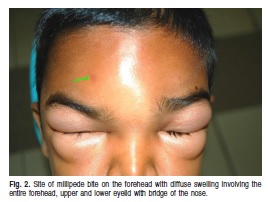
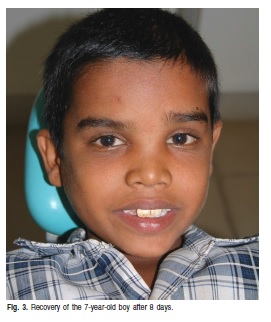
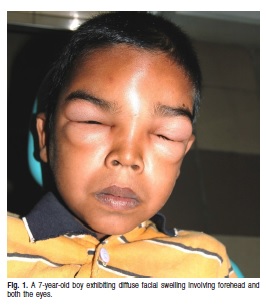
<body><![CDATA[<p><font face="Verdana, Arial, Helvetica, sans-serif" size="2"><b>Case 1</b></font></p>     <p><font face="Verdana, Arial, Helvetica, sans-serif" size="2">A 7-year-old boy reported to the Department of Pediatric and Preventive   Dentistry, with diffuse facial swelling involving forehead and both the eyes (<a href="#fig01">Figure 1</a>). His history of present illness revealed, a millipede bite on the forehead one   day before was the cause of initial swelling that involved the eyelid and gradually   increased over 2 h to involve the entire face. The swelling remained throughout   the day with no diurnal variations and no history of fever. General examination   revealed normal vital signs and the boy weighed about 18 kg. On clinical   examination, a diffuse swelling involving the whole of the forehead, upper and   lower eyelid with bridge of the nose, right and left cheek region, was seen. The edema was non-pitting in nature with no local rise of temperature. Swelling wastender on palpation and there was no pus or serous discharge. Bite mark of the millipede was seen on the right fore head region (<a href="#fig02">Figure 2</a>). Intraoral examination revealed generalized dental fluorosis and initial caries lesions in teeth 16, 26, 36, and 46. Based on history and clinical features a provisional diagnosis of angioedema was made.</font></p>     <p><font face="Verdana, Arial, Helvetica, sans-serif" size="2">The patient was treated with combination of drugs.   Injection of Avil (pheniramine maleate; 1cc IV) and   hydrocortisone (100 mg IV) were given immediately (stat),   which are believed to ameliorate delayed effects of   anaphylactic reactions and may limit biphasic anaphylaxis.   The combination of antihistamines and corticosteroids are   routinely used in emergency treatment of anaphylaxis.   Injection of Lasix (Furosemide; 20 mg IV stat) was given to   reduce the edema by reducing fluid retention and also attenuate   the symptoms of troubled breathing. Tetanus toxoid injection   was given to maintain active immunity as tetanus spores might   have entered the body through insect bite. Injection of benzyl   penicillin 7.5 lakh given three times daily (tid) empirically to   prevent the bite area from secondary infection and also   condition bear a resemblance to cellulites and Lyser D   (combination of serratiopeptidase and diclofenac sodium) (tid)   was given to reduce inflammation and alleviate the symptoms   of pain. Tab Rantac (Ranitidine) 75 mg was given twice daily   (bid). H2 blocking drugs were used concurrently with H1   antihistamine to reduce gastric secretion, and injection of   Dexona (Dexamethasone; 1.5 cc tid) was also given. IV fluid   DNS (dextrose normal saline) 10 drops/min was given. IV fluids   were continued for 2 days. After 3 days, the edema reduced   considerably with slight persisting in the lower eyelids and   finally after a period of 8 days of intensive treatment, the   swelling subsided completely (<a href="#fig03">Figure 3</a>).</font></p>     <p>&nbsp;</p>     <p><a name="fig01"></a></p>     <p>&nbsp;</p>     <p align="center"><img src="/img/revistas/bjos/v11n4/a13fig01.jpg"></p>     <p>&nbsp;</p>     <p><a name="fig02"></a></p>     <p>&nbsp;</p>     ]]></body>
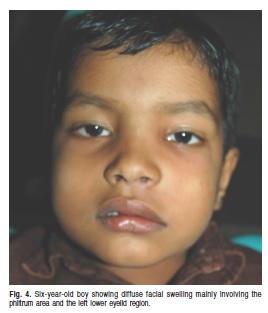
<body><![CDATA[<p align="center"><img src="/img/revistas/bjos/v11n4/a13fig02.jpg"></p>     <p>&nbsp;</p>     <p><a name="fig03"></a></p>     <p>&nbsp;</p>     <p align="center"><img src="/img/revistas/bjos/v11n4/a13fig03.jpg"></p>     <p>&nbsp;</p>     <p><font face="Verdana, Arial, Helvetica, sans-serif" size="2"><b>Case 2</b></font></p>     <p><font face="Verdana, Arial, Helvetica, sans-serif" size="2">A 6-year-old boy reported to the Department of Pediatric   and Preventive Dentistry with diffuse facial swelling mainly   involving the philtrum area and the left lower eyelid region   (<a href="#fig04">Figure 4</a>). The patient's parents suspected that the reason   for the swelling was tooth decay and hence reported to our institution for check up.</font></p>     <p><font face="Verdana, Arial, Helvetica, sans-serif" size="2">History of the disease revealed that the swelling was   sudden in onset and the parents reported immediately the   next day morning. No episode attributable to food or drug   allergy was present in history. Swelling had been diffuse,tender on palpation and non-pitting in nature with a small   injury towards the left ala of nose, which was suspected to   be an insect bite mark, but the patient's father did not reveal   any history of insect bite or fever.</font></p>     <p><font face="Verdana, Arial, Helvetica, sans-serif" size="2">General examination revealed normal vital signs and   the boy weighed about 15 kg. Intraoral examination showed   no caries involvement of any tooth. Based on history and   clinical examination, a provisional diagnosis of angioedema   was made. It later responded to antihistaminic therapy.</font></p>     ]]></body>
<body><![CDATA[<p><font face="Verdana, Arial, Helvetica, sans-serif" size="2">Patient was treated with antihistaminic Allercet (Cetrizine;   5 mg once daily) and was asked to report in case of any   aggravation of symptoms. Unfortunately the patient could not   come for recall visit as he was from a distant place, but gratefully   he called us up to let us know of his complete recovery.</font></p>     <p>&nbsp;</p>     <p><a name="fig04"></a></p>     <p>&nbsp;</p>     <p align="center"><img src="/img/revistas/bjos/v11n4/a13fig04.jpg"></p>     <p>&nbsp;</p>     <p><font face="Verdana, Arial, Helvetica, sans-serif" size="3"><b>Discussion</b></font></p>     <p><font face="Verdana, Arial, Helvetica, sans-serif" size="2"> Clinics in previous decades predominantly consisted of   children with allergic rhinitis, asthma and eczema, the   proportion of children presenting with acute severe allergic   reactions has progressively increased. Clinics are now   dominated by acute food, insect venom and drug allergy,   and there is evidence that these problems are increasing<sup>5</sup>.   Angioedema is a variant of urticaria where there is   involvement of the subcutaneous tissue<sup>6</sup>. Skin lesions may   appear on the eyelids, lips, genitalia, tongue and pharynx.   Sudden onset appears to be characteristic. Skin lesions last for few hours to few days<sup>7</sup>.</font></p>     <p><font face="Verdana, Arial, Helvetica, sans-serif" size="2">Angioedema affects males and females equally, usually   during the 3rd and 4th decade of life. Pediatric angioedema   exhibits a different cause, severity and clinical manifestations   than does adult angioedema<sup>8</sup>. Probable causes of angioedema   are food (40%), insect bites (30%), infection (20%) and   antibiotics (10%)<sup>5</sup>.</font></p>     <p><font face="Verdana, Arial, Helvetica, sans-serif" size="2">Reactions to insect stings, both allergic and toxic are   seen commonly in pediatric practice<sup>3</sup>. Papular urticaria occurs   through the bite of insects most commonly 'mosquitos' and   bed bugs. On the contrary bee or wasps stings may produce   severe acute urticaria or anaphylaxis, which may be lifethreatening   conditions. Hereditary angioedema usually   manifests during childhood<sup>5</sup> but it is rare and is transmitted   as an autosomal dominant trait. Another common form   occurring in young children is allergy to food including   multiple food allergies, allergy to nuts and cow's milk <sup>2,5,8</sup>.</font></p>     ]]></body>
<body><![CDATA[<p><font face="Verdana, Arial, Helvetica, sans-serif" size="2">In case 1, angioedema affected a 7-year-old boy with   major manifestations on the face involving forehead and   eyelids due to a millipede bite, which, to the best of our   knowledge, is the first of its kind to be published. In case 2,   angioedema affected a 6-year-old boy with mild   manifestations on left side of the face, which responded to   antihistamine therapy. No history of insect bite could be   elicited; which is common<sup>9</sup>. The main difficulties arise around   a lack of agreed definition for what constitutes an   anaphylactic reaction. However, this then excludes patients   who have developed angioedema and urticaria, which is   appropriately treated prior to its evolution into a more severe   and potentially life-threatening reaction. Conversely, if   patients presenting just with angioedema and urticaria are   incorporated into the definition, then this will include many   individuals who will not have any progression of symptoms<sup>5</sup>.</font></p>     <p><font face="Verdana, Arial, Helvetica, sans-serif" size="2">Typical reactions following an insect sting include   erythema, itching, pain, swelling and indurations localized   to the area of the sting. These local reactions usually last   only several hours and may respond to application of cool   compresses. Large local reactions also occur frequently involving   more extensive areas of the skin typically with swelling 5-10   cm in diameter (sometimes more) that is contiguous to the site   of the sting. The swelling generally reach its peak in 24-48   h, but reactions can last up to 7-10 days.</font></p>     <p><font face="Verdana, Arial, Helvetica, sans-serif" size="2">Children exhibited predominantly facial (80 %) and lip   (40%) edema. Although systemic reactions to insect stings   are exception (less than 1% occurrences in children), they   can be life-threatening conditions<sup>3</sup>.</font></p>     <p><font face="Verdana, Arial, Helvetica, sans-serif" size="2">Angioedema may present as an emergency and needs to   be treated aggressively. Understanding the various possible   causes is the first step in assessing angioedema. Allergic and   drug-induced angioedema responds to removal of cause.<sup>2</sup> a   stinger that remains in the skin after an insect sting should   be removed. The area should be cleansed with soap and water.   The immediate management of systemic reactions focuses   on the treatment of anaphylaxis, for which administration of   subcutaneous epinephrine (0.3 mL of a 1:1,000 dilution) is   the treatment of choice<sup>3,8</sup>. It is primarily used in the emergency   treatment of non-hereditary angioedema involving larynx,   it can be injected intramuscularly, subcutaneously or inhaled   depending upon the severity of the reaction<sup>2</sup>.</font></p>     <p><font face="Verdana, Arial, Helvetica, sans-serif" size="2">  An antihistamine, such as diphenhydramine (Benadryl),   or hydroxyzine (Atarax, Vistaril) may be given afterepinephrine has been administered to reduce pruritus and   inflammation<sup>3,8</sup>. When the conventional H1 and H2   antihistamine failed, other drugs like nifedipine is used as an   adjunct to antihistamines. In resistant cases a brief course of   systemic corticosteroids should be avoided because of   significant adverse effects. Topical steroids also have been   found to be effective<sup>2</sup>. Some authors suggest the use of   corticosteroids depending on clinical presentation<sup>3</sup> while others   mention corticosteroid therapy using intravenous   dexamethasone sodium phosphate or hydrocortisone remains   the main treatment for angioedema. Intravenous fluids for   intravascular volume repletion and diuresis or ventilatory   support for treatment of pulmonary edema have also been used<sup>8</sup>.   Beta-agonists, oxygen histamine<sup>2</sup> blockers and vasopressors   may also be useful depending on the clinical presentation<sup>3</sup>.</font></p>     <p><font face="Verdana, Arial, Helvetica, sans-serif" size="2">After 8 days of intensive drug therapy, the first patient   described in this paper showed complete reduction in facial   swelling and pain and was discharged.   Reactions to insect stings are seen commonly in pediatric   practice, but seldom in pediatric dentistry practice. However,   in some cases, history of insect bite cannot be elicited, as   observed in our young patients. In addition, facial swellings   similar to that presented in these cases also occur due to space   infections following tooth decay. In such diagnostic dilemmas,   it is our responsibility as health professionals to rule out dental   causes and give appropriate treatment or refer the patients to   pediatricians. As angioedema can also manifest fatally, dentists   need to know, diagnose and treat such rare conditions promptly as "The eyes do not see what the mind does not know!!".</font></p>     <p>&nbsp;</p>     <p><font face="Verdana, Arial, Helvetica, sans-serif" size="3"><b>Acknowledgements</b></font></p>     <p><font face="Verdana, Arial, Helvetica, sans-serif" size="2">The authors would like to acknowledge the generous   contributions of Dr. Guruprasad, Professor in Pediatrics in   the management of this case. He is associated with the Bapuji   Child Health Institute, Dept of Pediatrics, JJM Medical College, Davangere, Karnataka.</font></p>     <p>&nbsp;</p>     ]]></body>
<body><![CDATA[<p><font face="Verdana, Arial, Helvetica, sans-serif" size="3"><b>References</b></font></p>     <!-- ref --><p><font face="Verdana, Arial, Helvetica, sans-serif" size="2">1. Shafer WG, Hine MK, Levy BM. Physical and chemical injuries of the   oral cavity. A textbook of oral pathology .5th ed. Philadelphia: W.B. Saunders; 2006. p.719-87.    &nbsp;&nbsp;&nbsp;&nbsp;&nbsp;&nbsp;&nbsp;&nbsp;[&#160;<a href="javascript:void(0);" onclick="javascript: window.open('/scielo.php?script=sci_nlinks&ref=049634&pid=S1677-3225201200040001300001&lng=','','width=640,height=500,resizable=yes,scrollbars=1,menubar=yes,');">Links</a>&#160;]<!-- end-ref --></font></p>     <!-- ref --><p><font face="Verdana, Arial, Helvetica, sans-serif" size="2">2. Prasad PS. Urticaria. Indian J Dermatol Venereol Leprol. 2001; 67: 11-20.    &nbsp;&nbsp;&nbsp;&nbsp;&nbsp;&nbsp;&nbsp;&nbsp;[&#160;<a href="javascript:void(0);" onclick="javascript: window.open('/scielo.php?script=sci_nlinks&ref=049636&pid=S1677-3225201200040001300002&lng=','','width=640,height=500,resizable=yes,scrollbars=1,menubar=yes,');">Links</a>&#160;]<!-- end-ref --></font></p>     <!-- ref --><p><font face="Verdana, Arial, Helvetica, sans-serif" size="2">3. Booker GM, Adam HM. Insect Stings. Pediatr Rev. 2005; 26: 388-9</font>&nbsp;&nbsp;&nbsp;&nbsp;&nbsp;&nbsp;&nbsp;&nbsp;[&#160;<a href="javascript:void(0);" onclick="javascript: window.open('/scielo.php?script=sci_nlinks&ref=049638&pid=S1677-3225201200040001300003&lng=','','width=640,height=500,resizable=yes,scrollbars=1,menubar=yes,');">Links</a>&#160;]<!-- end-ref --><!-- ref --><p><font face="Verdana, Arial, Helvetica, sans-serif" size="2">4. Golden DB. Insect sting anaphylaxis. Immunol Allergy Clin North Am.   2007; 27: 261-72.    &nbsp;&nbsp;&nbsp;&nbsp;&nbsp;&nbsp;&nbsp;&nbsp;[&#160;<a href="javascript:void(0);" onclick="javascript: window.open('/scielo.php?script=sci_nlinks&ref=049639&pid=S1677-3225201200040001300004&lng=','','width=640,height=500,resizable=yes,scrollbars=1,menubar=yes,');">Links</a>&#160;]<!-- end-ref --></font></p>     <!-- ref --><p><font face="Verdana, Arial, Helvetica, sans-serif" size="2">5. Warner JO. Anaphylaxis; the latest allergy epidemic. Pediatr Allergy   Immunol. 2007; 18: 1-2.    &nbsp;&nbsp;&nbsp;&nbsp;&nbsp;&nbsp;&nbsp;&nbsp;[&#160;<a href="javascript:void(0);" onclick="javascript: window.open('/scielo.php?script=sci_nlinks&ref=049641&pid=S1677-3225201200040001300005&lng=','','width=640,height=500,resizable=yes,scrollbars=1,menubar=yes,');">Links</a>&#160;]<!-- end-ref --></font></p>     ]]></body>
<body><![CDATA[<!-- ref --><p><font face="Verdana, Arial, Helvetica, sans-serif" size="2">6. Greaves MW, Lawlor F. Angioedema; manifestations and management. J   Am Acad Dermatol. 1991; 25: 155-61.    &nbsp;&nbsp;&nbsp;&nbsp;&nbsp;&nbsp;&nbsp;&nbsp;[&#160;<a href="javascript:void(0);" onclick="javascript: window.open('/scielo.php?script=sci_nlinks&ref=049643&pid=S1677-3225201200040001300006&lng=','','width=640,height=500,resizable=yes,scrollbars=1,menubar=yes,');">Links</a>&#160;]<!-- end-ref --></font></p>     <!-- ref --><p><font face="Verdana, Arial, Helvetica, sans-serif" size="2">7. Champion RH, Roberts SOB, Carpenter RG, Roger JH. Urticaria and   angioedema: a review of 554 patients. Br J Dermatol. 1969; 81: 588-97.    &nbsp;&nbsp;&nbsp;&nbsp;&nbsp;&nbsp;&nbsp;&nbsp;[&#160;<a href="javascript:void(0);" onclick="javascript: window.open('/scielo.php?script=sci_nlinks&ref=049645&pid=S1677-3225201200040001300007&lng=','','width=640,height=500,resizable=yes,scrollbars=1,menubar=yes,');">Links</a>&#160;]<!-- end-ref --></font></p>     <!-- ref --><p><font face="Verdana, Arial, Helvetica, sans-serif" size="2">8. Shah UK, Jacobs IN. Pediatric angioedema: ten year's experience. Arch   Otolaryngol Head Neck Surg. 1999; 125: 791-5.    &nbsp;&nbsp;&nbsp;&nbsp;&nbsp;&nbsp;&nbsp;&nbsp;[&#160;<a href="javascript:void(0);" onclick="javascript: window.open('/scielo.php?script=sci_nlinks&ref=049647&pid=S1677-3225201200040001300008&lng=','','width=640,height=500,resizable=yes,scrollbars=1,menubar=yes,');">Links</a>&#160;]<!-- end-ref --></font></p>     <!-- ref --><p><font face="Verdana, Arial, Helvetica, sans-serif" size="2">9. Quercia O, Emiliani F, Foschi FG, Stefanini GF. Unusual reaction to   hymenoptera sting: a case of Schonlein-Henoch purpura. Allergy. 2007;   62: 333-4.    &nbsp;&nbsp;&nbsp;&nbsp;&nbsp;&nbsp;&nbsp;&nbsp;[&#160;<a href="javascript:void(0);" onclick="javascript: window.open('/scielo.php?script=sci_nlinks&ref=049649&pid=S1677-3225201200040001300009&lng=','','width=640,height=500,resizable=yes,scrollbars=1,menubar=yes,');">Links</a>&#160;]<!-- end-ref --></font></p>     <p>&nbsp;</p>     <p>&nbsp;</p>     ]]></body>
<body><![CDATA[<p><font face="Verdana, Arial, Helvetica, sans-serif" size="2"><a name="back"/></a><a href="#top"><img src="/img/revistas/bjos/v11n4/seta.jpg" border="0" align="absmiddle"/></a>    <b>Correspondence:</b> <br/>   Chaitra T.R.    <br>   Department of Pedodontics and    <br>   Preventive Dentistry    <br>   Kothiwal Dental College &amp; Research Centre    <br>   Kanth Road, Moradabad-244001    <br>   Uttar Pradesh, India<br/>   E-mail: <a href="chaitu4363@yahoo.co.in">chaitu4363@yahoo.co.in</a></font></p>     <p><font face="Verdana, Arial, Helvetica, sans-serif" size="2"><b>Received for    publication:</b> April 25, 2012<br/> <b>Accepted:</b> June 23, 2012</font></p>      ]]></body>
<back>
<ref-list>
<ref id="B1">
<label>1</label><nlm-citation citation-type="book">
<person-group person-group-type="author">
<name>
<surname><![CDATA[Shafer]]></surname>
<given-names><![CDATA[WG]]></given-names>
</name>
<name>
<surname><![CDATA[Hine]]></surname>
<given-names><![CDATA[MK]]></given-names>
</name>
<name>
<surname><![CDATA[Levy]]></surname>
<given-names><![CDATA[BM]]></given-names>
</name>
</person-group>
<source><![CDATA[Physical and chemical injuries of the oral cavity: A textbook of oral pathology]]></source>
<year>2006</year>
<edition>5th ed</edition>
<page-range>719-87</page-range><publisher-loc><![CDATA[Philadelphia ]]></publisher-loc>
<publisher-name><![CDATA[W.B. Saunders]]></publisher-name>
</nlm-citation>
</ref>
<ref id="B2">
<label>2</label><nlm-citation citation-type="journal">
<person-group person-group-type="author">
<name>
<surname><![CDATA[Prasad]]></surname>
<given-names><![CDATA[PS]]></given-names>
</name>
</person-group>
<article-title xml:lang="en"><![CDATA[Urticaria]]></article-title>
<source><![CDATA[Indian J Dermatol Venereol Leprol]]></source>
<year>2001</year>
<volume>67</volume>
<page-range>11-20</page-range></nlm-citation>
</ref>
<ref id="B3">
<label>3</label><nlm-citation citation-type="journal">
<person-group person-group-type="author">
<name>
<surname><![CDATA[Booker]]></surname>
<given-names><![CDATA[GM]]></given-names>
</name>
<name>
<surname><![CDATA[Adam]]></surname>
<given-names><![CDATA[HM]]></given-names>
</name>
</person-group>
<article-title xml:lang="en"><![CDATA[Insect Stings]]></article-title>
<source><![CDATA[Pediatr Rev]]></source>
<year>2005</year>
<volume>26</volume>
<page-range>388-9</page-range></nlm-citation>
</ref>
<ref id="B4">
<label>4</label><nlm-citation citation-type="journal">
<person-group person-group-type="author">
<name>
<surname><![CDATA[Golden]]></surname>
<given-names><![CDATA[DB]]></given-names>
</name>
</person-group>
<article-title xml:lang="en"><![CDATA[Insect sting anaphylaxis]]></article-title>
<source><![CDATA[Immunol Allergy Clin North Am]]></source>
<year>2007</year>
<volume>27</volume>
<page-range>261-72</page-range></nlm-citation>
</ref>
<ref id="B5">
<label>5</label><nlm-citation citation-type="journal">
<person-group person-group-type="author">
<name>
<surname><![CDATA[Warner]]></surname>
<given-names><![CDATA[JO]]></given-names>
</name>
</person-group>
<article-title xml:lang="en"><![CDATA[Anaphylaxis: the latest allergy epidemic]]></article-title>
<source><![CDATA[Pediatr Allergy Immunol]]></source>
<year>2007</year>
<volume>18</volume>
<page-range>1-2</page-range></nlm-citation>
</ref>
<ref id="B6">
<label>6</label><nlm-citation citation-type="journal">
<person-group person-group-type="author">
<name>
<surname><![CDATA[Greaves]]></surname>
<given-names><![CDATA[MW]]></given-names>
</name>
<name>
<surname><![CDATA[Lawlor]]></surname>
<given-names><![CDATA[F]]></given-names>
</name>
</person-group>
<article-title xml:lang="en"><![CDATA[Angioedema: manifestations and management]]></article-title>
<source><![CDATA[J Am Acad Dermatol]]></source>
<year>1991</year>
<volume>25</volume>
<page-range>155-61</page-range></nlm-citation>
</ref>
<ref id="B7">
<label>7</label><nlm-citation citation-type="journal">
<person-group person-group-type="author">
<name>
<surname><![CDATA[Champion]]></surname>
<given-names><![CDATA[RH]]></given-names>
</name>
<name>
<surname><![CDATA[Roberts]]></surname>
<given-names><![CDATA[SOB]]></given-names>
</name>
<name>
<surname><![CDATA[Carpenter]]></surname>
<given-names><![CDATA[RG]]></given-names>
</name>
<name>
<surname><![CDATA[Roger]]></surname>
<given-names><![CDATA[JH]]></given-names>
</name>
</person-group>
<article-title xml:lang="en"><![CDATA[Urticaria and angioedema: a review of 554 patients]]></article-title>
<source><![CDATA[Br J Dermatol]]></source>
<year>1969</year>
<volume>81</volume>
<page-range>588-97</page-range></nlm-citation>
</ref>
<ref id="B8">
<label>8</label><nlm-citation citation-type="journal">
<person-group person-group-type="author">
<name>
<surname><![CDATA[Shah]]></surname>
<given-names><![CDATA[UK]]></given-names>
</name>
<name>
<surname><![CDATA[Jacobs]]></surname>
<given-names><![CDATA[IN]]></given-names>
</name>
</person-group>
<article-title xml:lang="en"><![CDATA[Pediatric angioedema: ten year's experience]]></article-title>
<source><![CDATA[Arch Otolaryngol Head Neck Surg]]></source>
<year>1999</year>
<volume>125</volume>
<page-range>791-5</page-range></nlm-citation>
</ref>
<ref id="B9">
<label>9</label><nlm-citation citation-type="journal">
<person-group person-group-type="author">
<name>
<surname><![CDATA[Quercia]]></surname>
<given-names><![CDATA[O]]></given-names>
</name>
<name>
<surname><![CDATA[Emiliani]]></surname>
<given-names><![CDATA[F]]></given-names>
</name>
<name>
<surname><![CDATA[Foschi]]></surname>
<given-names><![CDATA[FG]]></given-names>
</name>
<name>
<surname><![CDATA[Stefanini]]></surname>
<given-names><![CDATA[GF]]></given-names>
</name>
</person-group>
<article-title xml:lang="en"><![CDATA[Unusual reaction to hymenoptera sting: a case of Schonlein-Henoch purpura]]></article-title>
<source><![CDATA[Allergy]]></source>
<year>2007</year>
<volume>62</volume>
<page-range>333-4</page-range></nlm-citation>
</ref>
</ref-list>
</back>
</article>