<?xml version="1.0" encoding="ISO-8859-1"?><article xmlns:mml="http://www.w3.org/1998/Math/MathML" xmlns:xlink="http://www.w3.org/1999/xlink" xmlns:xsi="http://www.w3.org/2001/XMLSchema-instance">
<front>
<journal-meta>
<journal-id>1677-3225</journal-id>
<journal-title><![CDATA[Brazilian Journal of Oral Sciences]]></journal-title>
<abbrev-journal-title><![CDATA[Braz. J. Oral Sci.]]></abbrev-journal-title>
<issn>1677-3225</issn>
<publisher>
<publisher-name><![CDATA[Faculdade de Odontologia de Piracicaba, UNICAMP]]></publisher-name>
</publisher>
</journal-meta>
<article-meta>
<article-id>S1677-32252013000300005</article-id>
<title-group>
<article-title xml:lang="en"><![CDATA[Cost analysis of materials used in Class III, IV and V composite resin restorations]]></article-title>
</title-group>
<contrib-group>
<contrib contrib-type="author">
<name>
<surname><![CDATA[Hebling]]></surname>
<given-names><![CDATA[Eduardo]]></given-names>
</name>
<xref ref-type="aff" rid="A01"/>
</contrib>
<contrib contrib-type="author">
<name>
<surname><![CDATA[Gonçalves]]></surname>
<given-names><![CDATA[Rodolfo Luís]]></given-names>
</name>
<xref ref-type="aff" rid="A02"/>
</contrib>
<contrib contrib-type="author">
<name>
<surname><![CDATA[Queluz]]></surname>
<given-names><![CDATA[Dagmar de Paula]]></given-names>
</name>
<xref ref-type="aff" rid="A01"/>
</contrib>
</contrib-group>
<aff id="A01">
<institution><![CDATA[,University of Campinas Piracicaba Dental School Department of Community Dentistry]]></institution>
<addr-line><![CDATA[Piracicaba SP]]></addr-line>
<country>Brazil</country>
</aff>
<aff id="A02">
<institution><![CDATA[,Brazilian Federal Court  ]]></institution>
<addr-line><![CDATA[Rio de Janeiro RJ]]></addr-line>
<country>Brazil</country>
</aff>
<pub-date pub-type="pub">
<day>00</day>
<month>12</month>
<year>2013</year>
</pub-date>
<pub-date pub-type="epub">
<day>00</day>
<month>12</month>
<year>2013</year>
</pub-date>
<volume>12</volume>
<numero>4</numero>
<fpage>298</fpage>
<lpage>306</lpage>
<copyright-statement/>
<copyright-year/>
<self-uri xlink:href="http://revodonto.bvsalud.org/scielo.php?script=sci_arttext&amp;pid=S1677-32252013000300005&amp;lng=en&amp;nrm=iso"></self-uri><self-uri xlink:href="http://revodonto.bvsalud.org/scielo.php?script=sci_abstract&amp;pid=S1677-32252013000300005&amp;lng=en&amp;nrm=iso"></self-uri><self-uri xlink:href="http://revodonto.bvsalud.org/scielo.php?script=sci_pdf&amp;pid=S1677-32252013000300005&amp;lng=en&amp;nrm=iso"></self-uri><abstract abstract-type="short" xml:lang="en"><p><![CDATA[To assess the total cost of direct and indirect materials used in Class III, IV and V composite resin direct restorations. METHODS: The calculation of costs was based on the method of variable costing system. A list of the materials was obtained by a panel of experts and based on the excellence standards established in the literature for dental team treatment. The cost considered for each material was obtained from an average of the costs found in the regional supplier market (US$1.0=R$2.12). The repetitions were obtained from Class III, IV and V cavities in artificial premanufactured teeth. The cavities were classified as shallow, medium and deep. The materials were quantified for each type of preparation. Seven brands of composite resins were used and weighed on a precision scale after their insertion in each cavity. The data were analyzed by descriptive statistics and non-parametric Friedman's test (&#945;=0.05). RESULTS: The mean costs were US$7.96 (R$16.88) for Class III restoration, US$8.13 (R$17.24) for Class IV, and US$7.84 (R$16.62) for Class V. There was statistically significant difference in cost between the types of cavities and depth classification. The small cost difference among the different resin brands resulted in no statistically significant differences in the total cost of the restorations. CONCLUSIONS: The costs obtained in this survey may be used in the calculation of the final cost of restorative procedures, helping in the management of public or private dental care services.]]></p></abstract>
<kwd-group>
<kwd lng="en"><![CDATA[dentistry]]></kwd>
<kwd lng="en"><![CDATA[costs and cost analysis]]></kwd>
<kwd lng="en"><![CDATA[dental materials]]></kwd>
<kwd lng="en"><![CDATA[composite resins]]></kwd>
</kwd-group>
</article-meta>
</front><body><![CDATA[ <p align="right"><font face="Verdana, Arial, Helvetica, sans-serif" size="2"><b>ORIGINAL    ARTICLE</b></font></p>     <p>&nbsp;</p>     <p><font face="Verdana, Arial, Helvetica, sans-serif" size="4"><a name="top"/></a><b>Cost analysis of materials used in Class III, IV and V composite resin restorations</b></font></p>     <p>&nbsp;</p>     <p>&nbsp;</p>     <p><font face="Verdana, Arial, Helvetica, sans-serif" size="2"><b>Eduardo Hebling<sup>I</sup>; Rodolfo Lu&iacute;s Gon&ccedil;alves<sup>II</sup>; Dagmar de Paula Queluz<sup>I</sup></b></font></p>     <p><font face="Verdana, Arial, Helvetica, sans-serif" size="2"><sup>I</sup> Department of Community Dentistry, Piracicaba Dental School, University of Campinas, Piracicaba, SP, Brazil<br/> <sup>II</sup> Dentist of the Brazilian Federal Court, Rio de Janeiro, RJ, Brazil </font></p>     <p><font face="Verdana, Arial, Helvetica, sans-serif" size="2"><a href="#back">Correspondence</a></font></p>     <p>&nbsp;</p>     <p>&nbsp;</p> <hr noshade size="1">     ]]></body>
<body><![CDATA[<p><font face="Verdana, Arial, Helvetica, sans-serif" size="2"><b>ABSTRACT</b></font></p>     <p><font face="Verdana, Arial, Helvetica, sans-serif" size="2"><b>AIM:</b> To assess the total cost of direct and indirect materials used in Class III, IV and V composite   resin direct restorations. <b>METHODS: </b>The calculation of costs was based on the method of variable   costing system. A list of the materials was obtained by a panel of experts and based on the   excellence standards established in the literature for dental team treatment. The cost considered   for each material was obtained from an average of the costs found in the regional supplier market   (US$1.0=R$2.12). The repetitions were obtained from Class III, IV and V cavities in artificial premanufactured   teeth. The cavities were classified as shallow, medium and deep. The materials   were quantified for each type of preparation. Seven brands of composite resins were used and   weighed on a precision scale after their insertion in each cavity. The data were analyzed by   descriptive statistics and non-parametric Friedman's test (&alpha;=0.05). <b>RESULTS: </b>The mean costs   were US$7.96 (R$16.88) for Class III restoration, US$8.13 (R$17.24) for Class IV, and US$7.84   (R$16.62) for Class V. There was statistically significant difference in cost between the types of   cavities and depth classification. The small cost difference among the different resin brands   resulted in no statistically significant differences in the total cost of the restorations.  <b>CONCLUSIONS:</b> The costs obtained in this survey may be used in the calculation of the final cost of restorative   procedures, helping in the management of public or private dental care services.</font></p>     <p><font face="Verdana, Arial, Helvetica, sans-serif" size="2"><b>Keywords:</b>    dentistry, costs and cost analysis, dental materials, composite resins.</font></p> <hr noshade size="1">     <p>&nbsp;</p>     <p>&nbsp;</p>     <p><font face="Verdana, Arial, Helvetica, sans-serif" size="3"><b>Introduction</b></font></p>     <p><font face="Verdana, Arial, Helvetica, sans-serif" size="2">Composite resins are commonly used materials in direct dental restorations.   The similarity of the original color of the teeth, afforded by the use of composite   resins, allows the maintenance and restoration of the aesthetics of the smile,   increasing the preference for this restorative material in both anterior and posterior teeth by professionals and patients<sup>1</sup>.</font></p>     <p><font face="Verdana, Arial, Helvetica, sans-serif" size="2">  The materials used in dental procedures can be classified into direct and   indirect materials<sup>2</sup>. Drills, matrix strips, wedges and composite resin are examples   of direct materials used in a restorative procedure. Disinfecting solutions, gloves,   cap and glasses are examples of used indirect materials.</font></p>     <p><font face="Verdana, Arial, Helvetica, sans-serif" size="2">  Dental care services in both private and public sectors should be managed   with the same principles applied to a commercial enterprise. Although fixed   costs can differ from one place to another, some direct variable costs related to   the implementation of the service have their values established by some criteria   that do not depend exclusively on the operator or manager of the service, such as   the cost of dental materials. The price determined by the manufacturers and suppliers of dental products, the amount of material required by cavity   size, and the type of these materials established by clinical   and scientific evidence, are examples of these criteria<sup>3</sup>.</font></p>     <p><font face="Verdana, Arial, Helvetica, sans-serif" size="2">  A costing system consists in determining a criterion by   which the costs are apportioned for the production. According   the system employed, certain costs may or may not be part of   the production costs<sup>4,5</sup>. In the variable costing system is   appropriate to services only the variable costs of production,   both direct and indirect<sup>5</sup>. The cost of materials is part of the   calculation of the value of the fees for direct dental restorations.   Knowing the cost of the materials used can help planning of   actions to manage the dental care services and determination   of dental restoration fees<sup>3,5-7</sup>.</font></p>     ]]></body>
<body><![CDATA[<p><font face="Verdana, Arial, Helvetica, sans-serif" size="2">  Despite the continuous need for less costly dental   treatments8 and standardization of dental procedures based on   scientific evidence<sup>9</sup>, there is remarkably scarce information on   the costs of different restorative materials and their use<sup>10</sup>. The   few studies available on this subject are mostly based on   estimates of longevity of the restoration, in performance of   retreatments in the medium and long term, and on their relative   cost and benefits and effectiveness<sup>11</sup>. As up to date there are   no publications that calculate the costs for direct and indirect   materials used for direct dental restorations. Thus, this study   was designed to determine the total cost of direct and indirect   materials used in Class III, IV and V cavities. An specific aim   was to compare the mean cost of direct and indirect materials   used in those types of cavity with different sizes. The null   hypothesis was that there is no difference in mean cost values   among these variables.</font></p>     <p>&nbsp;</p>     <p><font face="Verdana, Arial, Helvetica, sans-serif" size="3"><b>Material and    methods</b></font></p>        <p><font face="Verdana, Arial, Helvetica, sans-serif" size="2">This experimental study was developed at the Piracicaba   Dental School, University of Campinas, Piracicaba, Brazil in   2012. The calculation of costs was based on the method of variable costing system<sup>5</sup>.</font></p>     <p><font face="Verdana, Arial, Helvetica, sans-serif" size="2">  The list of materials was obtained through consultation   by a panel of experts and based on the excellence standards   established in the literature for dental team treatment, applying   restorative techniques with efficiency and productivity<sup>2</sup>, and   respecting the biosecurity of the patient and the dental   team<sup>12,15</sup>, the use of materials<sup>16,17</sup> and the ethical principles<sup>18</sup>.   This panel of experts was formed by 10 dentists with over 20   years of experience (4 restorative dentistry clinical specialists,   2 general dentists, 3 Restorative Dentistry professors and 1   Dental Materials professor) and 2 dental hygiene technicians   with 10 years of experience. A list of materials to be used   was prepared by the authors. The referees reviewed each item   according to the Likert scale<sup>19</sup> and attributed the following   classifications: 1) strongly disagree; 2) disagree; 3) neither   agree nor disagree; 4) agree; 5) strongly agree. The referees   were also given the possibility of including a suggestion.   The materials and quantities classified with scores 4 and 5   by the referees were maintained in the final list of materials.</font></p>     <p><font face="Verdana, Arial, Helvetica, sans-serif" size="2">  The costs of the materials were obtained from an average   of the cost found in the supplier market of the administrative   region of Campinas-SP, Brazil, in three different resellers.   The obtained costs in local currency (Real) were converted   to American dollars (US$1.00 = R$2.12). This cost was   adjusted according to the amount of material to be used. For   the non-disposable materials, the cost was adjusted   considering their mean use life.</font></p>     <p><font face="Verdana, Arial, Helvetica, sans-serif" size="2">  The amount of material was stipulated by simulating a   clinical restorative procedure. This quantity was measured with   the use of a graduated measuring cylinder, for liquid materials,   and precision digital scale (Model AB-S; Mettler Toledo&reg;,Barueri,   SP, Brazil,) with reading range of 0.01 mg to 0.1 mg, weighting   capacity from 51 g to 320 g, for solid materials.</font></p>     <p><font face="Verdana, Arial, Helvetica, sans-serif" size="2">  The repetitions were obtained from Classes III, IV, and V   cavities preparations in artificial permanent pre-manufactured   teeth. Each type of cavity was classified in relation to the preestablished   depth as shallow, medium and deep, totalizing 9   anterior artificial teeth. The depth classification was established   by the authors in the artificial teeth, which are supplied by   the manufacturer with cavities prepared according to the   currently recommended conservative techniques<sup>16,17</sup>.</font></p>     <p><font face="Verdana, Arial, Helvetica, sans-serif" size="2">  The list of materials was set up considering the dental   care performed by the dental team (operator and auxiliary),   following the biosecurity principles and the currently   recommended conservative restorative techniques based on   scientific evidence<sup>15-17</sup>. The operative and restorative   procedures were standardized as follows: specific diamond   drills<sup>20</sup> were sterilized before use and changed after being   used in 10 patients<sup>21,22</sup>; no liner was used; absolute isolation   was provided; use of condensation composite resin; an   incremental placement technique was employed for the   restorative materials; occlusal adjustment, finishing and   polishing were performed with carbon paper and specific   tips and sandpaper discs and strips<sup>16,17</sup>.</font></p>     <p><font face="Verdana, Arial, Helvetica, sans-serif" size="2">  The materials were classified into 7 different groups   and for each one were established the following   standardization criteria<sup>23</sup>:</font></p>     ]]></body>
<body><![CDATA[<p><font face="Verdana, Arial, Helvetica, sans-serif" size="2"> <b>- Group 1:</b> Materials used for the maintenance and   cleaning of equipment.</font></p>     <p><font face="Verdana, Arial, Helvetica, sans-serif" size="2"> &bull; Dental operating room equipment containing: 1) two   ultra-speed air handpieces, a set of slow-speed air handpiece   micro-motor with contra angle and three-way syringe; 2) an   auxiliary unit containing one spittoon, vacuum system with   saliva and blood suction hoses, one three-way syringe and   one light-curing device; 3) a chair with the seat and back   without seams or buttons, drive command by feet and arm   support on both sides; 4) a monofocal spotlight with single   cable; 5) stools, one for the operator and one for the auxiliary;   6) mobile auxiliary table, size 60 x 50 cm;    <br>   &bull; Lubrication of high and slow-speed handpieces: two   sprays of lubricating oil into the drive air line; lubricant oil   recommended by the manufacturer for each four hours of use;    <br>   &bull; Disinfection: use of two gauzes and disinfectant   solution. Sterilization: use of sterilization packaging   following the manufacturer's guidelines<sup>12,13</sup>.</font></p>     <p><font face="Verdana, Arial, Helvetica, sans-serif" size="2"> <b>- Group 2:</b> Materials used as disposable personal   protective equipment (PPE) and for the biosecurity of the   team and the patient.</font></p>     <p><font face="Verdana, Arial, Helvetica, sans-serif" size="2"> &bull; Use of PPE and washing of hands by helping to performthe disinfection of dental equipment; use of PPE and washing   of hands by the operator and the auxiliary to the clinical   care; use of protective barriers for the equipment; protective   barriers and eyeglass for the patient; use of preoperative   mouthwash with antiseptic solution by the patient.</font></p>     <p><font face="Verdana, Arial, Helvetica, sans-serif" size="2"> <b>- Group 3:</b> Materials used for the sterilization of   instruments.</font></p>     <p><font face="Verdana, Arial, Helvetica, sans-serif" size="2"> &bull; Sterilization in autoclave with polypropylene   thermoplastic seal packaging.</font></p>     <p><font face="Verdana, Arial, Helvetica, sans-serif" size="2"> <b>- Group 4:</b> Materials for anesthesia</font></p>     <p><font face="Verdana, Arial, Helvetica, sans-serif" size="2"> &bull; Local anesthesia; topical anesthetic gel, applied with   cotton ball; solution of lidocaine 2% with epinephrine   1:100,000 (two tubes per patient); long needle.</font></p>     ]]></body>
<body><![CDATA[<p><font face="Verdana, Arial, Helvetica, sans-serif" size="2"> <b>- Group 5:</b> Materials for absolute isolation and cavity   preparation.</font></p>     <p><font face="Verdana, Arial, Helvetica, sans-serif" size="2"> &bull; Use of sterilized and reused drills for up to 10 patients<sup>21,22</sup>;    <br>   &bull; Number of drills: two types of high-speed diamond   drills; low-speed carbide drills<sup>20</sup>;    <br>   &bull; Use of restorative instruments (packaged in drilled   holster), metal tray, rubber dam, template, punch, clamp   forceps, isolation arc, scissors, ivory clamps (packaged in   drilled holster with separations), drills (wrapped in small   drilled holster for eight drills).</font></p>     <p><font face="Verdana, Arial, Helvetica, sans-serif" size="2"> <b>- Group 6:</b> Materials for tooth restoration</font></p>     <p><font face="Verdana, Arial, Helvetica, sans-serif" size="2"> &bull; Materials were sub-classified in common use materials   for Classes III, IV, and V cavities, and specific materials for   Classes III and IV cavities (such as anatomic wooden wedges);    <br>   &bull; Adper Single Bond 2 (3M ESPE, Sumar&eacute;, SP, Brazil)   adhesive system for all types of resin;    <br>   &bull; Composite resins brands: Llis (FGM, Joinvile, SC,   Brazil); Fill Magic (Vigodent, Rio de Janeiro, RJ, Brazil);   Charisma (Heraeus-Kulzer, S&atilde;o Paulo, SP, Brazil); Prisma APH   (Dentsply, Petr&oacute;polis, RJ, Brazil); Z350 (3M Espe,); Herculite   XRV (Kerr, S&atilde;o Paulo, SP Brazil); Tetric N-Ceram (Ivoclar   Vivodent, S&atilde;o Paulo, SP, Brazil).</font></p>     <p><font face="Verdana, Arial, Helvetica, sans-serif" size="2"> <b>- Group 7:</b> Materials for finishing and polishing of   the tooth restoration:</font></p>     <p><font face="Verdana, Arial, Helvetica, sans-serif" size="2"> &bull; Assembled tips: use of materials in up to 10 patients<sup>21,22</sup>;    ]]></body>
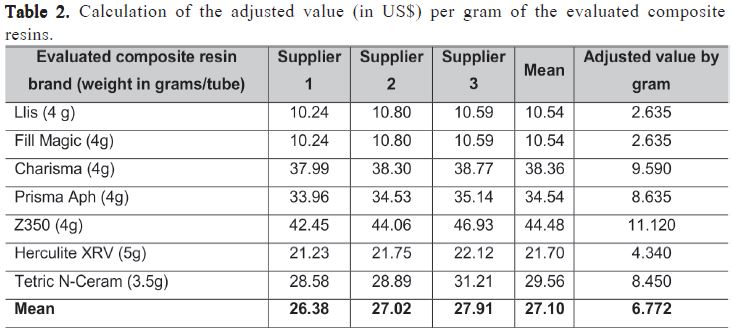
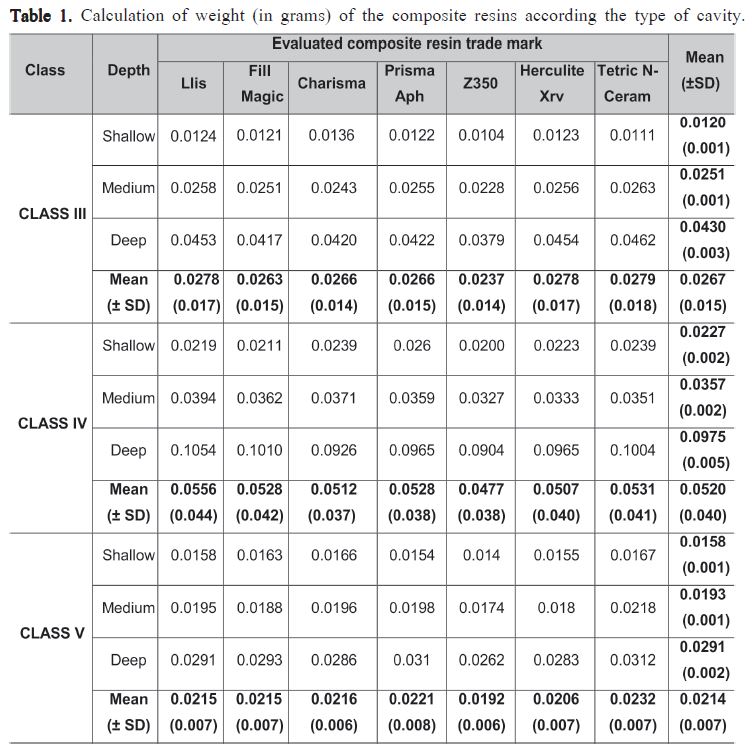
<body><![CDATA[<br>   &bull; Carbon paper and finishing and polishing discs and   trips: single use, disposable.</font></p>     <p><font face="Verdana, Arial, Helvetica, sans-serif" size="2">  The main goal of the present study was to determine the   cost of the materials in <b>Group 6</b>. In this group, the materials   were quantified for each type of preparation and depth   classification. The amount of each material determined the   final cost individually. The simulation of material use was   performed by calibrated professionals (Kappa&gt;0.85). The   calibration process consisted by one hour of theory discussion,   four hours of practical training, including both repetitions of   insertion and weighing and intra-examiner differences.</font></p>     <p><font face="Verdana, Arial, Helvetica, sans-serif" size="2">  The amount of adhesive was measured in drops,   predetermined by the panel of experts. The amount of resin   used was determined after its insertion in the artificial tooth   of each type of preparation and cavity depths, following the   realization of a pre-sculpture of the tooth anatomy, removing   the excesses and the weighing the artificial tooth with the   material, discounting the tooth weight. The final value of   the cost of the direct and indirect materials was calculated   by the sum of the individual costs of each used material.</font></p>     <p><font face="Verdana, Arial, Helvetica, sans-serif" size="2">  The independent variables studied in this study were:   composite resin trade mark (seven types); cavity preparation   (Classes III, IV and V) and depth of the cavity preparation   (shallow, medium and deep). The data of mean cost of direct   and indirect materials used in Classes III, IV and V composite   resin dental restorations were used to analyze comparatively   all the independent studied variables. The dependent variable was the total cost of the used direct and indirect materials.</font></p>     <p><font face="Verdana, Arial, Helvetica, sans-serif" size="2">  Descriptive analysis of the mean cost of direct and   indirect materials used in Classes III, IV and V composite   resin restorations were performed. Mean values found for the   seven groups of materials were considered. For each evaluated   material it was determined the amount of material required,   the amount of material per package, the average price of   materials per package and the adjusted price for the quantity   required for the achievement of the restorative procedure.   Data were assessed by the non-parametric Friedman's test   for dependent variable. This test was applied to two factors,   the first factor was a fixed independent variable and the   second factor were the blocks of each combination of the   other two independent variables. When the Friedman's test   indicated significant differences between the groups, the   Siegel-Castellan test of multiple comparisons was applied.   A 5% significance level was used to check which groups were statistically different.</font></p>     <p>&nbsp;</p>     <p><font face="Verdana, Arial, Helvetica, sans-serif" size="3"><b>Results</b></font></p>     <p><font face="Verdana, Arial, Helvetica, sans-serif" size="2">The values of the cost of the direct and indirect materials   included in groups 1, 2, 3, 4, 5 and 7 relating to materials for   biosecurity, for local anesthesia, for absolute isolation and   for cavity preparation were presented in a previous study<sup>23</sup>.   The mean total cost found for the biosecurity materials (Groups   1 to 3) was of US$4.18 (R$8.86). Out of this amount, the   materials of Group 2, which correspond to PPE disposable   materials and to the biosecurity for the dental team and the   patient, represented 56.72 % and, in Groups 1 and 3   corresponded to 6.89% and 36.39%, respectively. The mean   total cost found for the materials used for local anesthesia   (Group 4) was of US$1.01 (R$2.14), the anesthetic represented   90.23% of that value, and the topical anesthetic and the needle corresponded to 1.4% and 8.37%, respectively.</font></p>     <p><font face="Verdana, Arial, Helvetica, sans-serif" size="2">  Materials used for absolute isolation and cavity   preparation (Group 5) showed mean a total value of US$1.0   (R$2.12), the materials used to cavity preparation represented   67.30% and those for absolute isolation corresponded to   32.7% of this value. The distribution of costs adjusted for   these materials showed that the cost of the drills of low and   high-speed represented the highest found value,   corresponding to 64% of the total cost for this group. The   cost of the rubber dam, used in absolute isolation was   responsible for 26% of the mean total value of this group,   which corresponds to the mean value of US$0.26 (R$0.55)23.</font></p>     <p><font face="Verdana, Arial, Helvetica, sans-serif" size="2">  Materials used for dental finishing and polishing (Group   7) showed mean total value of US$1.23 (R$2.61). The   distribution of costs adjusted for materials showed that the costs of carbon paper and assembled part of silicone for   finishing corresponded to 74.23% of the mean total value of   this group<sup>23</sup>.   The calculation of the weights (in grams) of the evaluated   composite resins is shown in <a href="#tab01">Table 1</a>. The mean weight found   for class III was 0.027 (&plusmn;0.015) g, for class IV was 0.052   (&plusmn;0.040) g and for class V was 0.021 (&plusmn;0.007) g. The   calculation of the adjusted value (in US$) by gram from   evaluated composite resins was shown in <a href="#tab02">Table 2</a>. The mean adjusted value found was US$6.77 (R$14.35). </font></p>     ]]></body>
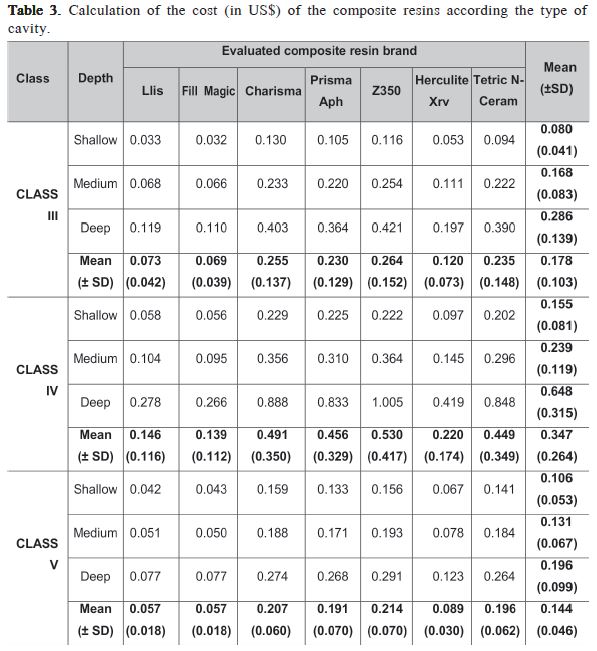
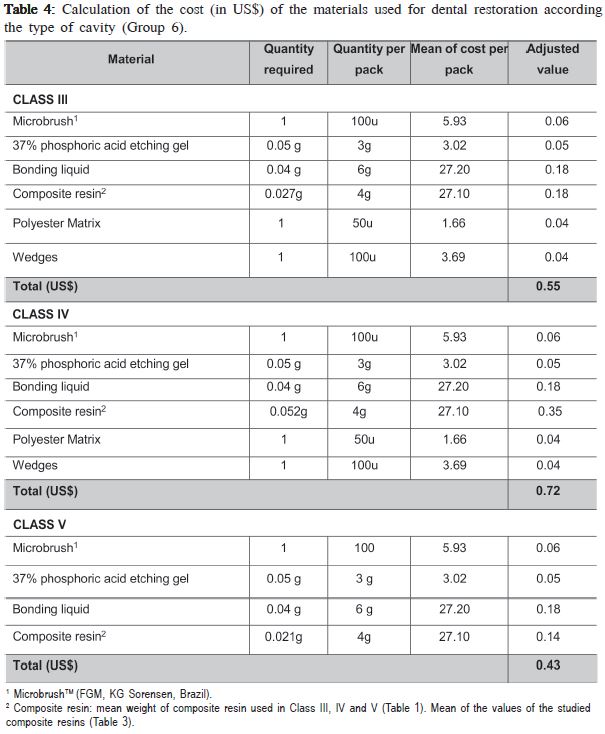
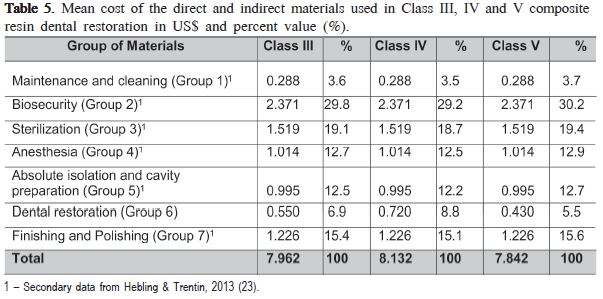
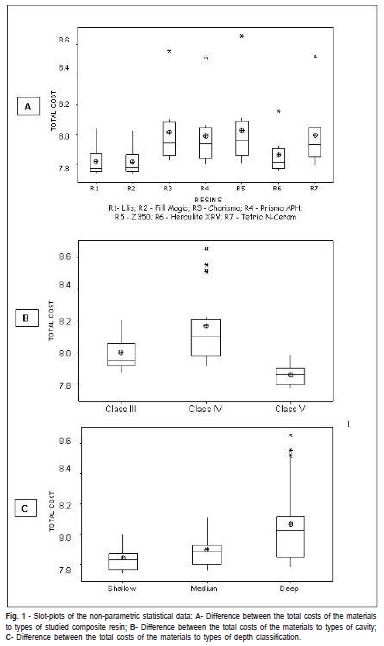
<body><![CDATA[<p><font face="Verdana, Arial, Helvetica, sans-serif" size="2">The calculation   of the cost (in US$) of the evaluated composite resins   according the studied cavity preparation is shown in <a href="#tab03">Table 3</a>. Mean values found for class III were US$0.18&plusmn;0.10   (R$0.38), for class IV was US$0.35&plusmn;0.26 (R$0.74), and for   class V was US$0.14&plusmn;0.05 (R$0.30).</font></p>     <p><font face="Verdana, Arial, Helvetica, sans-serif" size="2">  The calculation of the cost (in US$) of the materials   used for tooth restoration according the type of cavity   preparation (Group 6) was shown in <a href="#tab04">Table 4</a>. Adjusted cost   found for class III was US$0.55 (R$1.17), for class IV was   US$0.72 (R$1.53), and for class V was US$0.43 (R$0.91).   The differences found are due to the greater amount of resin   used for class IV than for classes III and V, and to the use of   polyester matrix and wedges for classes III and IV.</font></p>     <p><font face="Verdana, Arial, Helvetica, sans-serif" size="2">Costs (in US$) of the direct and indirect materials used in   Class III, IV and V composite resin dental restoration were shown   in <a href="#tab05">Table 5</a>. The mean total cost found for class III was US$7.96   (16.88), for class IV was US$8.13 (R$17.24), and for class V   was US$7.84 (16.62). There were no significant differences in   total cost of restorative materials between the types of cavity.</font></p>     <p><font face="Verdana, Arial, Helvetica, sans-serif" size="2"><a href="#fig01">Figure 1</a> shows the non-parametric statistical data. The   slot A shows the difference between the total costs of the   materials to the types of studied composite resin. Charisma,   Prisma APH, Z350, and Tetric N-Ceram composite resin trade   marks showed higher total mean cost than Llis, Fill Magic,   and Herculite XRV composite resin brands. There were   statistically significant differences between Llis and Fill Magic   to Z350 and Charisma composite resins; between Magic Fill,   Charisma, Prisma APH, Z350 to Tetric N-Ceram composite   resins; and between Herculite XRV and Z350 to Charisma   composite resins. The slot B shows the difference between the   total costs of the materials to the types of cavity preparation.   There were statistically significant differences of class III and   IV to class V. The slot C shows the difference between the   total costs of the materials to the types of depth classification.   There was statistically significant difference between the types   of depth classification of the cavity preparation.</font></p>     <p>&nbsp;</p>     <p><a name="tab01"></a></p>     <p>&nbsp; </p>     <p align="center"><img src="/img/revistas/bjos/v12n4/a05tab01.jpg">     <p>&nbsp;</p>     <p><a name="tab02"></a></p>     ]]></body>
<body><![CDATA[<p>&nbsp; </p>     <p align="center"><img src="/img/revistas/bjos/v12n4/a05tab02.jpg">     <p>&nbsp;</p>     <p><a name="tab03"></a></p>     <p>&nbsp; </p>     <p align="center"><img src="/img/revistas/bjos/v12n4/a05tab03.jpg">     <p>&nbsp;</p>     <p><a name="tab04"></a></p>     <p>&nbsp; </p>     <p align="center"><img src="/img/revistas/bjos/v12n4/a05tab04.jpg">     ]]></body>
<body><![CDATA[<p>&nbsp;</p>     <p><a name="tab05"></a></p>     <p>&nbsp; </p>     <p align="center"><img src="/img/revistas/bjos/v12n4/a05tab05.jpg">     <p>&nbsp;</p>     <p><a name="fig01"></a></p>     <p>&nbsp; </p>     <p align="center"><img src="/img/revistas/bjos/v12n4/a05fig01.jpg">     <p>&nbsp;</p>     <p><font face="Verdana, Arial, Helvetica, sans-serif" size="3"><b>Discussion</b></font></p>     ]]></body>
<body><![CDATA[<p><font face="Verdana, Arial, Helvetica, sans-serif" size="2">This is the first study in which the cost analysis of   materials used in Classes III, IV, and V composite resin dental   restorations has been analyzed in Brazil. To the best of our   knowledge, no cost analysis on any aspect has been published   in Brazil or worldwide, which makes it difficult to establish comparisons of our results.</font></p>     <p><font face="Verdana, Arial, Helvetica, sans-serif" size="2">  The list drawn up by researchers and evaluated by the   panel of referees represents an ideal pattern of care, including   the requirements for excellence in productivity and quality   of restorative procedures. All the biosecurity measures were   included, while respecting the ethical and legal precepts<sup>12-15</sup>.</font></p>     <p><font face="Verdana, Arial, Helvetica, sans-serif" size="2">  This standard of excellence of care should be observed   in all types of dental care services, be they public or private,   when performing direct composite resin dental restorations. Reduction of excellence of care may result in reduction of the   cost of biosecurity. However, the risks to the health of patients   and dental team hardly compensates for this reduction. Direct   dental restorations are low-risk contamination procedures. Even   so, the principles of biosecurity must be respected<sup>12-15</sup>. The   use of protection barriers reduces the risk of cross-contamination   for both the treated patients and the dental team<sup>15</sup>.</font></p>     <p><font face="Verdana, Arial, Helvetica, sans-serif" size="2">  The low total cost of biosecurity in this type of procedure   ($4.18/R$8.86) is still much lower than the values to be spent   to minimize the possible effects of a contamination of the   team or the patient by any infectious disease. The risks of   inability to work and death of the dental team should also   be considered, which may occur even in low-risk procedures,   as is in case of tooth restorations. The lack of other Brazilian   or international articles on the same subject made it difficult   to compare these results.</font></p>     <p><font face="Verdana, Arial, Helvetica, sans-serif" size="2">  The economic stability of Brazil, with control of inflation   and reduction in the rate of increase in materials' prices,   reflects in the present study. There were no statistically   significant differences in the total costs of the studied materials among the three evaluated suppliers.</font></p>     <p><font face="Verdana, Arial, Helvetica, sans-serif" size="2">  The present study showed that the mean cost of materials   for Class III restoration was US$7.96 (R$16.88), for Class IV   it was US$8.13 (R$17.24) and for Class V it was US$7.84   (R$16.62). There was a statistically significant difference in   cost among Classes III, Class IV and V restoration. The cost   of materials for Class IV is higher than for Classes III and V   due to the high involvement of the tooth surfaces in the   cavity preparation, requiring more restorative material than   for the other two types. Although it had a lower cost, the   polyester matrix and wedge made the material costs for   Classes III and IV to be higher than for Class V. This value   does not represent the value of dental care fees to be charged   to the patient. The cost of the material is part of the variable   costs to be considered in the calculation of the value of   dental care fees. For this calculation it must be considered   both the fixed and the variable costs associated with the   dental care service<sup>3-5</sup>.</font></p>     <p><font face="Verdana, Arial, Helvetica, sans-serif" size="2">  Differences in the properties of composite resins have   been demonstrated in other studies<sup>16,17</sup>. However, the ultimate   goal of achieving a direct restorative procedure is to obtain   esthetic and functional results of the tooth, with long-lasting   acceptable procedure, and it can be achieved with any type   of the commercial brands of resin available on the market.   Thus, the small difference in the cost of the different evaluated   resins results that there is no significant difference in the   final total cost of the used materials. This fact allows that   composite resins with better physical and aesthetic   characteristics be elected as primary choice.</font></p>     <p><font face="Verdana, Arial, Helvetica, sans-serif" size="2">  In 2012, the National Commission of Covenants and   Accreditations24 established the reference values for dental   procedures and stated minimum values of dental fees to be   complied with in the private sector. The values suggested   for Class III restoration in composite resin type was US$43.20   (US$1.0=R$2.12), for Class IV it was US$61.31 and for Class   V it was US$40.98. The cost of the materials presented in   this study, which represent only one of the items to be   considered in the calculation of the fees5, corresponded to   18.45% of the fees for Class III, 13.27% for Class IV, and   19.15% for Class V. This fact reinforces the need for constant   review of these fees.</font></p>     <p><font face="Verdana, Arial, Helvetica, sans-serif" size="2">  In the public sphere, the deployment of oral health   funding policy for the municipalities with full management   modified the lending forms to health financing. The financial   resources are no longer intended for production according   to the type of procedure to be performed, but according to   the type of oral health program to which the municipality   joins, according to the operations per inhabitant and   program<sup>25</sup>. In this way, the results of this study cannot be   compared with the resources transferred to the municipality.   However, managers of dental services, both public and private   may use the data of this study as parameters in strategic   decision-making from choosing the type of composite resin   up to the operability of using absolute isolation.</font></p>     <p><font face="Verdana, Arial, Helvetica, sans-serif" size="2">  The use or further development of this methodology for   other groups of researchers in different scenarios and countries   must be stimulated, thus allowing comparisons of the cost   estimations presented in this study.</font></p>     ]]></body>
<body><![CDATA[<p><font face="Verdana, Arial, Helvetica, sans-serif" size="2">  Based on the obtained results, it may be concluded that   there was statistically significant difference in cost of materials   between the types of cavities and teeth. The observation of a   small difference in the values of the different resins evaluated   revealed no significant differences in the final costs. This present   study showed values of direct and indirect materials to be   used. These values can be used as parameters for the calculation   of the dental care fees. Again, the lack of other studies on the   same subject makes it difficult to compare these results. This   fact can be considered as one of the limitations of this type of   study. In addition, other factors to be considered are the possible   regional differences in the values of the presented materials.   However, the methodology described in this present study, as   well as the weight of composite resin increments can be easily   reproduced in other studies, allowing the comparison of the   present results.</font></p>     <p><font face="Verdana, Arial, Helvetica, sans-serif" size="2">  Future studies should be conducted to evaluate the costbenefit   ratio from the studied resins, as well as to compare   the costs found in this present study with other costs in   different regions and countries.</font></p>     <p>&nbsp;</p>     <p><font face="Verdana, Arial, Helvetica, sans-serif" size="3"><b>References</b></font></p>     <!-- ref --><p><font face="Verdana, Arial, Helvetica, sans-serif" size="2">1. Mackenzie L, Parmar D, Shortall AC, Burke FJ. Direct anterior composites: a practical guide. Dent Update. 2013; 40: 297-9.    &nbsp;&nbsp;&nbsp;&nbsp;&nbsp;&nbsp;&nbsp;&nbsp;[&#160;<a href="javascript:void(0);" onclick="javascript: window.open('/scielo.php?script=sci_nlinks&ref=052743&pid=S1677-3225201300030000500001&lng=','','width=640,height=500,resizable=yes,scrollbars=1,menubar=yes,');">Links</a>&#160;]<!-- end-ref --></font></p>     <!-- ref --><p><font face="Verdana, Arial, Helvetica, sans-serif" size="2"> 2. Wilson NH, Dunne SM, Gainsford ID. Current materials and techniques   for direct restorations in posterior teeth. Part 2: resin composite systems.   Int Dent J. 1997; 47: 185-93.    &nbsp;&nbsp;&nbsp;&nbsp;&nbsp;&nbsp;&nbsp;&nbsp;[&#160;<a href="javascript:void(0);" onclick="javascript: window.open('/scielo.php?script=sci_nlinks&ref=052745&pid=S1677-3225201300030000500002&lng=','','width=640,height=500,resizable=yes,scrollbars=1,menubar=yes,');">Links</a>&#160;]<!-- end-ref --></font></p>     <!-- ref --><p><font face="Verdana, Arial, Helvetica, sans-serif" size="2"> 3. Drummond F. Methods for the economic evaluation of health care   programmes. New York: Oxford; 2005. 379 p.    &nbsp;&nbsp;&nbsp;&nbsp;&nbsp;&nbsp;&nbsp;&nbsp;[&#160;<a href="javascript:void(0);" onclick="javascript: window.open('/scielo.php?script=sci_nlinks&ref=052747&pid=S1677-3225201300030000500003&lng=','','width=640,height=500,resizable=yes,scrollbars=1,menubar=yes,');">Links</a>&#160;]<!-- end-ref --></font></p>     ]]></body>
<body><![CDATA[<!-- ref --><p><font face="Verdana, Arial, Helvetica, sans-serif" size="2"> 4. Shim JK, Siegel JG. Modern cost management and analysis. 3rd ed.   New York: Barron's Education Series; 2009. 376 p.    &nbsp;&nbsp;&nbsp;&nbsp;&nbsp;&nbsp;&nbsp;&nbsp;[&#160;<a href="javascript:void(0);" onclick="javascript: window.open('/scielo.php?script=sci_nlinks&ref=052749&pid=S1677-3225201300030000500004&lng=','','width=640,height=500,resizable=yes,scrollbars=1,menubar=yes,');">Links</a>&#160;]<!-- end-ref --></font></p>     <!-- ref --><p><font face="Verdana, Arial, Helvetica, sans-serif" size="2"> 5. Creese AL, Packer D. Cost analysis in primary health care: a training   manual for programme managers. Geneva: World Health Organization;   1994. 147 p.    &nbsp;&nbsp;&nbsp;&nbsp;&nbsp;&nbsp;&nbsp;&nbsp;[&#160;<a href="javascript:void(0);" onclick="javascript: window.open('/scielo.php?script=sci_nlinks&ref=052751&pid=S1677-3225201300030000500005&lng=','','width=640,height=500,resizable=yes,scrollbars=1,menubar=yes,');">Links</a>&#160;]<!-- end-ref --></font></p>     <!-- ref --><p><font face="Verdana, Arial, Helvetica, sans-serif" size="2"> 6. Gapenski LC. Healthcare Finance: An Introduction to Accounting and   Financial Management. 5th ed. Portland: Health Administration Press; 2011. 724 p.    &nbsp;&nbsp;&nbsp;&nbsp;&nbsp;&nbsp;&nbsp;&nbsp;[&#160;<a href="javascript:void(0);" onclick="javascript: window.open('/scielo.php?script=sci_nlinks&ref=052753&pid=S1677-3225201300030000500006&lng=','','width=640,height=500,resizable=yes,scrollbars=1,menubar=yes,');">Links</a>&#160;]<!-- end-ref --></font></p>     <!-- ref --><p><font face="Verdana, Arial, Helvetica, sans-serif" size="2"> 7. Logan EM. Dentistry's business secrets: proven growth strategies for   your new or existing practice. Bloomington: Authorhouse; 2011. 439 p.    &nbsp;&nbsp;&nbsp;&nbsp;&nbsp;&nbsp;&nbsp;&nbsp;[&#160;<a href="javascript:void(0);" onclick="javascript: window.open('/scielo.php?script=sci_nlinks&ref=052755&pid=S1677-3225201300030000500007&lng=','','width=640,height=500,resizable=yes,scrollbars=1,menubar=yes,');">Links</a>&#160;]<!-- end-ref --></font></p>     <!-- ref --><p><font face="Verdana, Arial, Helvetica, sans-serif" size="2"> 8. Donaldson C. Economic evaluation in dentistry: an ethical imperative?   Dent Update. 1998; 25: 260-4.    &nbsp;&nbsp;&nbsp;&nbsp;&nbsp;&nbsp;&nbsp;&nbsp;[&#160;<a href="javascript:void(0);" onclick="javascript: window.open('/scielo.php?script=sci_nlinks&ref=052757&pid=S1677-3225201300030000500008&lng=','','width=640,height=500,resizable=yes,scrollbars=1,menubar=yes,');">Links</a>&#160;]<!-- end-ref --></font></p>     ]]></body>
<body><![CDATA[<!-- ref --><p><font face="Verdana, Arial, Helvetica, sans-serif" size="2"> 9. Bader J, Ismali A, Clarkson J. Evidence-based dentistry and the dental   research community. J Dent Res. 1999; 78: 1480-3.    &nbsp;&nbsp;&nbsp;&nbsp;&nbsp;&nbsp;&nbsp;&nbsp;[&#160;<a href="javascript:void(0);" onclick="javascript: window.open('/scielo.php?script=sci_nlinks&ref=052759&pid=S1677-3225201300030000500009&lng=','','width=640,height=500,resizable=yes,scrollbars=1,menubar=yes,');">Links</a>&#160;]<!-- end-ref --></font></p>     <!-- ref --><p><font face="Verdana, Arial, Helvetica, sans-serif" size="2"> 10. Smales RJ, Hawthorne WS. Long-term survival and cost-effectiveness   of five dental restorative materials used in various classes of cavity   preparations. Int Dent J. 1996; 46: 126-30.    &nbsp;&nbsp;&nbsp;&nbsp;&nbsp;&nbsp;&nbsp;&nbsp;[&#160;<a href="javascript:void(0);" onclick="javascript: window.open('/scielo.php?script=sci_nlinks&ref=052761&pid=S1677-3225201300030000500010&lng=','','width=640,height=500,resizable=yes,scrollbars=1,menubar=yes,');">Links</a>&#160;]<!-- end-ref --></font></p>     <!-- ref --><p><font face="Verdana, Arial, Helvetica, sans-serif" size="2"> 11. Mjor IA, Burke FJ et al. The relative cost of different restorations in the UK.   Br Dent J. 1997; 182: 286-9.    &nbsp;&nbsp;&nbsp;&nbsp;&nbsp;&nbsp;&nbsp;&nbsp;[&#160;<a href="javascript:void(0);" onclick="javascript: window.open('/scielo.php?script=sci_nlinks&ref=052763&pid=S1677-3225201300030000500011&lng=','','width=640,height=500,resizable=yes,scrollbars=1,menubar=yes,');">Links</a>&#160;]<!-- end-ref --></font></p>     <!-- ref --><p><font face="Verdana, Arial, Helvetica, sans-serif" size="2"> 12. Miller CH, Palenik CJ. Infection control and management of hazardous   materials for the dental team. Saint Louis: Mosby; 2010. 365 p.    &nbsp;&nbsp;&nbsp;&nbsp;&nbsp;&nbsp;&nbsp;&nbsp;[&#160;<a href="javascript:void(0);" onclick="javascript: window.open('/scielo.php?script=sci_nlinks&ref=052765&pid=S1677-3225201300030000500012&lng=','','width=640,height=500,resizable=yes,scrollbars=1,menubar=yes,');">Links</a>&#160;]<!-- end-ref --></font></p>     <!-- ref --><p><font face="Verdana, Arial, Helvetica, sans-serif" size="2"> 13. Bonehill JA. Managing health and safety in the dental practice: a practical   guide. Ames, Iowa: Wiley-Blackwell; 2010. 264 p.    &nbsp;&nbsp;&nbsp;&nbsp;&nbsp;&nbsp;&nbsp;&nbsp;[&#160;<a href="javascript:void(0);" onclick="javascript: window.open('/scielo.php?script=sci_nlinks&ref=052767&pid=S1677-3225201300030000500013&lng=','','width=640,height=500,resizable=yes,scrollbars=1,menubar=yes,');">Links</a>&#160;]<!-- end-ref --></font></p>     ]]></body>
<body><![CDATA[<!-- ref --><p><font face="Verdana, Arial, Helvetica, sans-serif" size="2"> 14. Lemay CA, Cashman SB, McDonald A, Graves JR. A new approach to   ensuring oral health care for people living with HIV/AIDS: the dental case   manager. Prev Chronic Dis. 2012; 9: E158.    &nbsp;&nbsp;&nbsp;&nbsp;&nbsp;&nbsp;&nbsp;&nbsp;[&#160;<a href="javascript:void(0);" onclick="javascript: window.open('/scielo.php?script=sci_nlinks&ref=052769&pid=S1677-3225201300030000500014&lng=','','width=640,height=500,resizable=yes,scrollbars=1,menubar=yes,');">Links</a>&#160;]<!-- end-ref --></font></p>     <!-- ref --><p><font face="Verdana, Arial, Helvetica, sans-serif" size="2"> 15. Thomas MV, Jarboe G, Frazer RQ. Infection control in the dental office.   Dent Clin North Am. 2008; 52: 609-28.    &nbsp;&nbsp;&nbsp;&nbsp;&nbsp;&nbsp;&nbsp;&nbsp;[&#160;<a href="javascript:void(0);" onclick="javascript: window.open('/scielo.php?script=sci_nlinks&ref=052771&pid=S1677-3225201300030000500015&lng=','','width=640,height=500,resizable=yes,scrollbars=1,menubar=yes,');">Links</a>&#160;]<!-- end-ref --></font></p>     <!-- ref --><p><font face="Verdana, Arial, Helvetica, sans-serif" size="2"> 16. Dalli M, &Ccedil;olak H, Mustafa Hamidi M. Minimal intervention concept: a new   paradigm for operative dentistry. J Investig Clin Dent. 2012; 3: 167-75.    &nbsp;&nbsp;&nbsp;&nbsp;&nbsp;&nbsp;&nbsp;&nbsp;[&#160;<a href="javascript:void(0);" onclick="javascript: window.open('/scielo.php?script=sci_nlinks&ref=052773&pid=S1677-3225201300030000500016&lng=','','width=640,height=500,resizable=yes,scrollbars=1,menubar=yes,');">Links</a>&#160;]<!-- end-ref --></font></p>     <!-- ref --><p><font face="Verdana, Arial, Helvetica, sans-serif" size="2"> 17. Robinson S, Nixon PJ, Gahan MJ, Chan MF. Techniques for restoring worn   anterior teeth with direct composite resin. Dent Update. 2008; 35: 551-2.    &nbsp;&nbsp;&nbsp;&nbsp;&nbsp;&nbsp;&nbsp;&nbsp;[&#160;<a href="javascript:void(0);" onclick="javascript: window.open('/scielo.php?script=sci_nlinks&ref=052775&pid=S1677-3225201300030000500017&lng=','','width=640,height=500,resizable=yes,scrollbars=1,menubar=yes,');">Links</a>&#160;]<!-- end-ref --></font></p>     <!-- ref --><p><font face="Verdana, Arial, Helvetica, sans-serif" size="2"> 18. Marinozzi S, Corbellini G, Ottolenghi L, Ripari F, Pizzuti A, Pezzetti M, et   al. From Nuremberg to bioethics: an educational project for students of   dentistry and dental prosthesis. Ann Stomatol. 2013; 4: 138-41.    &nbsp;&nbsp;&nbsp;&nbsp;&nbsp;&nbsp;&nbsp;&nbsp;[&#160;<a href="javascript:void(0);" onclick="javascript: window.open('/scielo.php?script=sci_nlinks&ref=052777&pid=S1677-3225201300030000500018&lng=','','width=640,height=500,resizable=yes,scrollbars=1,menubar=yes,');">Links</a>&#160;]<!-- end-ref --></font></p>     ]]></body>
<body><![CDATA[<!-- ref --><p><font face="Verdana, Arial, Helvetica, sans-serif" size="2"> 19. Likert R. A Technique for the measurement of attitudes. Arch Psychol.   1932; 140: 1-55.    &nbsp;&nbsp;&nbsp;&nbsp;&nbsp;&nbsp;&nbsp;&nbsp;[&#160;<a href="javascript:void(0);" onclick="javascript: window.open('/scielo.php?script=sci_nlinks&ref=052779&pid=S1677-3225201300030000500019&lng=','','width=640,height=500,resizable=yes,scrollbars=1,menubar=yes,');">Links</a>&#160;]<!-- end-ref --></font></p>     <!-- ref --><p><font face="Verdana, Arial, Helvetica, sans-serif" size="2"> 20. Siegel SC, Von Fraunhofer JA. Dental burs: what bur for which application?   A survey of dental schools. J Prosthodont. 1999; 8: 258-63.    &nbsp;&nbsp;&nbsp;&nbsp;&nbsp;&nbsp;&nbsp;&nbsp;[&#160;<a href="javascript:void(0);" onclick="javascript: window.open('/scielo.php?script=sci_nlinks&ref=052781&pid=S1677-3225201300030000500020&lng=','','width=640,height=500,resizable=yes,scrollbars=1,menubar=yes,');">Links</a>&#160;]<!-- end-ref --></font></p>     <!-- ref --><p><font face="Verdana, Arial, Helvetica, sans-serif" size="2"> 21. Siegel SC, Von Fraunhofer JA. Assessing the cutting efficiency of dental   diamond burs. J Am Dent Assoc. 1996; 127: 763-72.    &nbsp;&nbsp;&nbsp;&nbsp;&nbsp;&nbsp;&nbsp;&nbsp;[&#160;<a href="javascript:void(0);" onclick="javascript: window.open('/scielo.php?script=sci_nlinks&ref=052783&pid=S1677-3225201300030000500021&lng=','','width=640,height=500,resizable=yes,scrollbars=1,menubar=yes,');">Links</a>&#160;]<!-- end-ref --></font></p>     <!-- ref --><p><font face="Verdana, Arial, Helvetica, sans-serif" size="2"> 22. Gureckis KM, Burgess JO, Schwartz RS. Cutting effectiveness of diamond   instruments subjected to cyclic sterilization methods. J Prosthet Dent.   1991; 66: 721-6.    &nbsp;&nbsp;&nbsp;&nbsp;&nbsp;&nbsp;&nbsp;&nbsp;[&#160;<a href="javascript:void(0);" onclick="javascript: window.open('/scielo.php?script=sci_nlinks&ref=052785&pid=S1677-3225201300030000500022&lng=','','width=640,height=500,resizable=yes,scrollbars=1,menubar=yes,');">Links</a>&#160;]<!-- end-ref --></font></p>     <!-- ref --><p><font face="Verdana, Arial, Helvetica, sans-serif" size="2"> 23. Hebling E, Trentin EF. Cost analysis of materials used in composite resin   direct posterior dental restorations. Rev Odontol UNESP. 2013; 42: 144-51.    &nbsp;&nbsp;&nbsp;&nbsp;&nbsp;&nbsp;&nbsp;&nbsp;[&#160;<a href="javascript:void(0);" onclick="javascript: window.open('/scielo.php?script=sci_nlinks&ref=052787&pid=S1677-3225201300030000500023&lng=','','width=640,height=500,resizable=yes,scrollbars=1,menubar=yes,');">Links</a>&#160;]<!-- end-ref --></font></p>     ]]></body>
<body><![CDATA[<!-- ref --><p><font face="Verdana, Arial, Helvetica, sans-serif" size="2"> 24. Brazil. Brazilian Dentistry Council. Reference values for dental procedures.   Bras&iacute;lia: Brazilian Dentistry Council; 2012.    &nbsp;&nbsp;&nbsp;&nbsp;&nbsp;&nbsp;&nbsp;&nbsp;[&#160;<a href="javascript:void(0);" onclick="javascript: window.open('/scielo.php?script=sci_nlinks&ref=052789&pid=S1677-3225201300030000500024&lng=','','width=640,height=500,resizable=yes,scrollbars=1,menubar=yes,');">Links</a>&#160;]<!-- end-ref --></font></p>     <!-- ref --><p><font face="Verdana, Arial, Helvetica, sans-serif" size="2"> 25. Brazil. Health Ministry. &#91;Operational Guidelines: pacts by life, in defense   of the SUS and management&#93;. 2nd ed. Brasilia: Health Ministry; 2006.   Portuguese.    &nbsp;&nbsp;&nbsp;&nbsp;&nbsp;&nbsp;&nbsp;&nbsp;[&#160;<a href="javascript:void(0);" onclick="javascript: window.open('/scielo.php?script=sci_nlinks&ref=052791&pid=S1677-3225201300030000500025&lng=','','width=640,height=500,resizable=yes,scrollbars=1,menubar=yes,');">Links</a>&#160;]<!-- end-ref --></font></p>     <p>&nbsp;</p>     <p>&nbsp;</p>     <p><font face="Verdana, Arial, Helvetica, sans-serif" size="2"><a name="back"/></a><a href="#top"><img src="/img/revistas/bjos/v12n4/seta.jpg" border="0" align="absmiddle"/></a>    <b>Correspondence:</b> <br/>   Eduardo Hebling    <br>   Faculdade de Odontologia de Piracicaba    <br>   Universidade Estadual de Campinas    <br>   Avenida Limeira, 901, CEP: 13414-903    ]]></body>
<body><![CDATA[<br>   Arei&atilde;o, Piracicaba, SP, Brasil<br/>   E-mail: <a href="mailto:hebling@fop.unicamp.br">hebling@fop.unicamp.br</a></font></p>     <p><font face="Verdana, Arial, Helvetica, sans-serif" size="2"><b>Received for    publication:</b> August 02, 2013<br/>   <b>Accepted:</b> November 25, 2013</font></p>      ]]></body>
<back>
<ref-list>
<ref id="B1">
<label>1</label><nlm-citation citation-type="journal">
<person-group person-group-type="author">
<name>
<surname><![CDATA[Mackenzie]]></surname>
<given-names><![CDATA[L]]></given-names>
</name>
<name>
<surname><![CDATA[Parmar]]></surname>
<given-names><![CDATA[D]]></given-names>
</name>
<name>
<surname><![CDATA[Shortall]]></surname>
<given-names><![CDATA[AC]]></given-names>
</name>
<name>
<surname><![CDATA[Burke]]></surname>
<given-names><![CDATA[FJ]]></given-names>
</name>
</person-group>
<article-title xml:lang="en"><![CDATA[Direct anterior composites: a practical guide]]></article-title>
<source><![CDATA[Dent Update]]></source>
<year>2013</year>
<volume>40</volume>
<page-range>297-9</page-range></nlm-citation>
</ref>
<ref id="B2">
<label>2</label><nlm-citation citation-type="journal">
<person-group person-group-type="author">
<name>
<surname><![CDATA[Wilson]]></surname>
<given-names><![CDATA[NH]]></given-names>
</name>
<name>
<surname><![CDATA[Dunne]]></surname>
<given-names><![CDATA[SM]]></given-names>
</name>
<name>
<surname><![CDATA[Gainsford]]></surname>
<given-names><![CDATA[ID]]></given-names>
</name>
</person-group>
<article-title xml:lang="en"><![CDATA[Current materials and techniques for direct restorations in posterior teeth.: Part 2: resin composite systems]]></article-title>
<source><![CDATA[Int Dent J]]></source>
<year>1997</year>
<volume>47</volume>
<page-range>185-93</page-range></nlm-citation>
</ref>
<ref id="B3">
<label>3</label><nlm-citation citation-type="book">
<person-group person-group-type="author">
<name>
<surname><![CDATA[Drummond]]></surname>
<given-names><![CDATA[F]]></given-names>
</name>
</person-group>
<source><![CDATA[Methods for the economic evaluation of health care programmes]]></source>
<year>2005</year>
<page-range>379</page-range><publisher-loc><![CDATA[New York ]]></publisher-loc>
<publisher-name><![CDATA[Oxford]]></publisher-name>
</nlm-citation>
</ref>
<ref id="B4">
<label>4</label><nlm-citation citation-type="book">
<person-group person-group-type="author">
<name>
<surname><![CDATA[Shim]]></surname>
<given-names><![CDATA[JK]]></given-names>
</name>
<name>
<surname><![CDATA[Siegel]]></surname>
<given-names><![CDATA[JG]]></given-names>
</name>
</person-group>
<source><![CDATA[Modern cost management and analysis]]></source>
<year>2009</year>
<edition>3rd</edition>
<page-range>376</page-range><publisher-loc><![CDATA[New York ]]></publisher-loc>
<publisher-name><![CDATA[Barron's Education Series]]></publisher-name>
</nlm-citation>
</ref>
<ref id="B5">
<label>5</label><nlm-citation citation-type="book">
<person-group person-group-type="author">
<name>
<surname><![CDATA[Creese]]></surname>
<given-names><![CDATA[AL]]></given-names>
</name>
<name>
<surname><![CDATA[Packer]]></surname>
<given-names><![CDATA[D]]></given-names>
</name>
</person-group>
<source><![CDATA[Cost analysis in primary health care: a training manual for programme managers]]></source>
<year>1994</year>
<page-range>147</page-range><publisher-loc><![CDATA[Geneva ]]></publisher-loc>
<publisher-name><![CDATA[World Health Organization]]></publisher-name>
</nlm-citation>
</ref>
<ref id="B6">
<label>6</label><nlm-citation citation-type="book">
<person-group person-group-type="author">
<name>
<surname><![CDATA[Gapenski]]></surname>
<given-names><![CDATA[LC]]></given-names>
</name>
</person-group>
<source><![CDATA[Healthcare Finance: An Introduction to Accounting and Financial Management]]></source>
<year>2011</year>
<edition>5th</edition>
<page-range>724</page-range><publisher-loc><![CDATA[Portland ]]></publisher-loc>
<publisher-name><![CDATA[Health Administration Press]]></publisher-name>
</nlm-citation>
</ref>
<ref id="B7">
<label>7</label><nlm-citation citation-type="book">
<person-group person-group-type="author">
<name>
<surname><![CDATA[Logan]]></surname>
<given-names><![CDATA[EM]]></given-names>
</name>
</person-group>
<source><![CDATA[Dentistry's business secrets: proven growth strategies for your new or existing practice]]></source>
<year>2011</year>
<page-range>439</page-range><publisher-loc><![CDATA[Bloomington ]]></publisher-loc>
<publisher-name><![CDATA[Authorhouse]]></publisher-name>
</nlm-citation>
</ref>
<ref id="B8">
<label>8</label><nlm-citation citation-type="journal">
<person-group person-group-type="author">
<name>
<surname><![CDATA[Donaldson]]></surname>
<given-names><![CDATA[C]]></given-names>
</name>
</person-group>
<article-title xml:lang="en"><![CDATA[Economic evaluation in dentistry: an ethical imperative?]]></article-title>
<source><![CDATA[Dent Update]]></source>
<year>1998</year>
<volume>25</volume>
<page-range>260-4</page-range></nlm-citation>
</ref>
<ref id="B9">
<label>9</label><nlm-citation citation-type="journal">
<person-group person-group-type="author">
<name>
<surname><![CDATA[Bader]]></surname>
<given-names><![CDATA[J]]></given-names>
</name>
<name>
<surname><![CDATA[Ismali]]></surname>
<given-names><![CDATA[A]]></given-names>
</name>
<name>
<surname><![CDATA[Clarkson]]></surname>
<given-names><![CDATA[J]]></given-names>
</name>
</person-group>
<article-title xml:lang="en"><![CDATA[Evidence-based dentistry and the dental research community]]></article-title>
<source><![CDATA[J Dent Res]]></source>
<year>1999</year>
<volume>78</volume>
<page-range>1480-3</page-range></nlm-citation>
</ref>
<ref id="B10">
<label>10</label><nlm-citation citation-type="journal">
<person-group person-group-type="author">
<name>
<surname><![CDATA[Smales]]></surname>
<given-names><![CDATA[RJ]]></given-names>
</name>
<name>
<surname><![CDATA[Hawthorne]]></surname>
<given-names><![CDATA[WS]]></given-names>
</name>
</person-group>
<article-title xml:lang="en"><![CDATA[Long-term survival and cost-effectiveness of five dental restorative materials used in various classes of cavity preparations]]></article-title>
<source><![CDATA[Int Dent J]]></source>
<year>1996</year>
<volume>46</volume>
<page-range>126-30</page-range></nlm-citation>
</ref>
<ref id="B11">
<label>11</label><nlm-citation citation-type="journal">
<person-group person-group-type="author">
<name>
<surname><![CDATA[Mjor]]></surname>
<given-names><![CDATA[IA]]></given-names>
</name>
<name>
<surname><![CDATA[Burke]]></surname>
<given-names><![CDATA[FJ]]></given-names>
</name>
</person-group>
<article-title xml:lang="en"><![CDATA[The relative cost of different restorations in the UK]]></article-title>
<source><![CDATA[Br Dent J]]></source>
<year>1997</year>
<volume>182</volume>
<page-range>286-9</page-range></nlm-citation>
</ref>
<ref id="B12">
<label>12</label><nlm-citation citation-type="book">
<person-group person-group-type="author">
<name>
<surname><![CDATA[Miller]]></surname>
<given-names><![CDATA[CH]]></given-names>
</name>
<name>
<surname><![CDATA[Palenik]]></surname>
<given-names><![CDATA[CJ]]></given-names>
</name>
</person-group>
<source><![CDATA[Infection control and management of hazardous materials for the dental team]]></source>
<year>2010</year>
<page-range>365</page-range><publisher-loc><![CDATA[Saint Louis ]]></publisher-loc>
<publisher-name><![CDATA[Mosby]]></publisher-name>
</nlm-citation>
</ref>
<ref id="B13">
<label>13</label><nlm-citation citation-type="book">
<person-group person-group-type="author">
<name>
<surname><![CDATA[Bonehill]]></surname>
<given-names><![CDATA[JA]]></given-names>
</name>
</person-group>
<source><![CDATA[Managing health and safety in the dental practice: a practical guide]]></source>
<year>2010</year>
<page-range>264</page-range><publisher-loc><![CDATA[Iowa ]]></publisher-loc>
<publisher-name><![CDATA[Wiley-Blackwell]]></publisher-name>
</nlm-citation>
</ref>
<ref id="B14">
<label>14</label><nlm-citation citation-type="journal">
<person-group person-group-type="author">
<name>
<surname><![CDATA[Lemay]]></surname>
<given-names><![CDATA[CA]]></given-names>
</name>
<name>
<surname><![CDATA[Cashman]]></surname>
<given-names><![CDATA[SB]]></given-names>
</name>
<name>
<surname><![CDATA[McDonald]]></surname>
</name>
<name>
<surname><![CDATA[Graves]]></surname>
<given-names><![CDATA[JR]]></given-names>
</name>
</person-group>
<article-title xml:lang="en"><![CDATA[A new approach to ensuring oral health care for people living with HIV/AIDS: the dental case manager]]></article-title>
<source><![CDATA[Prev Chronic Dis]]></source>
<year>2012</year>
<volume>9</volume>
<page-range>E158</page-range></nlm-citation>
</ref>
<ref id="B15">
<label>15</label><nlm-citation citation-type="journal">
<person-group person-group-type="author">
<name>
<surname><![CDATA[Thomas]]></surname>
<given-names><![CDATA[MV]]></given-names>
</name>
<name>
<surname><![CDATA[Jarboe]]></surname>
<given-names><![CDATA[G]]></given-names>
</name>
<name>
<surname><![CDATA[Frazer]]></surname>
<given-names><![CDATA[RQ]]></given-names>
</name>
</person-group>
<article-title xml:lang="en"><![CDATA[Infection control in the dental office]]></article-title>
<source><![CDATA[Dent Clin North Am]]></source>
<year>2008</year>
<volume>52</volume>
<page-range>609-28</page-range></nlm-citation>
</ref>
<ref id="B16">
<label>16</label><nlm-citation citation-type="journal">
<person-group person-group-type="author">
<name>
<surname><![CDATA[Dalli]]></surname>
<given-names><![CDATA[M]]></given-names>
</name>
<name>
<surname><![CDATA[Çolak]]></surname>
<given-names><![CDATA[H]]></given-names>
</name>
<name>
<surname><![CDATA[Mustafa Hamidi]]></surname>
<given-names><![CDATA[M]]></given-names>
</name>
</person-group>
<article-title xml:lang="en"><![CDATA[Minimal intervention concept: a new paradigm for operative dentistry]]></article-title>
<source><![CDATA[J Investig Clin Dent]]></source>
<year>2012</year>
<volume>3</volume>
<page-range>167-75</page-range></nlm-citation>
</ref>
<ref id="B17">
<label>17</label><nlm-citation citation-type="journal">
<person-group person-group-type="author">
<name>
<surname><![CDATA[Robinson]]></surname>
<given-names><![CDATA[S]]></given-names>
</name>
<name>
<surname><![CDATA[Nixon]]></surname>
<given-names><![CDATA[PJ]]></given-names>
</name>
<name>
<surname><![CDATA[Gahan]]></surname>
<given-names><![CDATA[MJ]]></given-names>
</name>
<name>
<surname><![CDATA[Chan]]></surname>
<given-names><![CDATA[MF]]></given-names>
</name>
</person-group>
<article-title xml:lang="en"><![CDATA[Techniques for restoring worn anterior teeth with direct composite resin]]></article-title>
<source><![CDATA[Dent Update]]></source>
<year>2008</year>
<volume>35</volume>
<page-range>551-2</page-range></nlm-citation>
</ref>
<ref id="B18">
<label>18</label><nlm-citation citation-type="journal">
<person-group person-group-type="author">
<name>
<surname><![CDATA[Marinozzi]]></surname>
<given-names><![CDATA[S]]></given-names>
</name>
<name>
<surname><![CDATA[Corbellini]]></surname>
<given-names><![CDATA[G]]></given-names>
</name>
<name>
<surname><![CDATA[Ottolenghi]]></surname>
<given-names><![CDATA[L]]></given-names>
</name>
<name>
<surname><![CDATA[Ripari]]></surname>
<given-names><![CDATA[F]]></given-names>
</name>
<name>
<surname><![CDATA[Pizzuti]]></surname>
<given-names><![CDATA[A]]></given-names>
</name>
<name>
<surname><![CDATA[Pezzetti]]></surname>
<given-names><![CDATA[M]]></given-names>
</name>
</person-group>
<article-title xml:lang="en"><![CDATA[From Nuremberg to bioethics: an educational project for students of dentistry and dental prosthesis]]></article-title>
<source><![CDATA[Ann Stomatol]]></source>
<year>2013</year>
<volume>4</volume>
<page-range>138-41</page-range></nlm-citation>
</ref>
<ref id="B19">
<label>19</label><nlm-citation citation-type="journal">
<person-group person-group-type="author">
<name>
<surname><![CDATA[Likert]]></surname>
<given-names><![CDATA[R]]></given-names>
</name>
</person-group>
<article-title xml:lang="en"><![CDATA[A Technique for the measurement of attitudes]]></article-title>
<source><![CDATA[Arch Psychol]]></source>
<year>1932</year>
<volume>140</volume>
<page-range>1-55</page-range></nlm-citation>
</ref>
<ref id="B20">
<label>20</label><nlm-citation citation-type="journal">
<person-group person-group-type="author">
<name>
<surname><![CDATA[Siegel]]></surname>
<given-names><![CDATA[SC]]></given-names>
</name>
<name>
<surname><![CDATA[Von Fraunhofer]]></surname>
<given-names><![CDATA[JA]]></given-names>
</name>
</person-group>
<article-title xml:lang="en"><![CDATA[Dental burs: what bur for which application? A survey of dental schools]]></article-title>
<source><![CDATA[J Prosthodont]]></source>
<year>1999</year>
<volume>8</volume>
<page-range>258-63</page-range></nlm-citation>
</ref>
<ref id="B21">
<label>21</label><nlm-citation citation-type="journal">
<person-group person-group-type="author">
<name>
<surname><![CDATA[Siegel]]></surname>
<given-names><![CDATA[SC]]></given-names>
</name>
<name>
<surname><![CDATA[Von Fraunhofer]]></surname>
<given-names><![CDATA[JA]]></given-names>
</name>
</person-group>
<article-title xml:lang="en"><![CDATA[Assessing the cutting efficiency of dental diamond burs]]></article-title>
<source><![CDATA[J Am Dent Assoc]]></source>
<year>1996</year>
<volume>127</volume>
<page-range>763-72</page-range></nlm-citation>
</ref>
<ref id="B22">
<label>22</label><nlm-citation citation-type="journal">
<person-group person-group-type="author">
<name>
<surname><![CDATA[Gureckis]]></surname>
<given-names><![CDATA[KM]]></given-names>
</name>
<name>
<surname><![CDATA[Burgess]]></surname>
<given-names><![CDATA[JO]]></given-names>
</name>
<name>
<surname><![CDATA[Schwartz]]></surname>
<given-names><![CDATA[RS]]></given-names>
</name>
</person-group>
<article-title xml:lang="en"><![CDATA[Cutting effectiveness of diamond instruments subjected to cyclic sterilization methods]]></article-title>
<source><![CDATA[J Prosthet Dent]]></source>
<year>1991</year>
<volume>66</volume>
<page-range>721-6</page-range></nlm-citation>
</ref>
<ref id="B23">
<label>23</label><nlm-citation citation-type="journal">
<person-group person-group-type="author">
<name>
<surname><![CDATA[Hebling]]></surname>
<given-names><![CDATA[E]]></given-names>
</name>
<name>
<surname><![CDATA[Trentin]]></surname>
<given-names><![CDATA[EF]]></given-names>
</name>
</person-group>
<article-title xml:lang="en"><![CDATA[Cost analysis of materials used in composite resin direct posterior dental restorations]]></article-title>
<source><![CDATA[Rev Odontol UNESP]]></source>
<year>2013</year>
<volume>42</volume>
<page-range>144-51</page-range></nlm-citation>
</ref>
<ref id="B24">
<label>24</label><nlm-citation citation-type="book">
<collab>Brazil^dBrazilian Dentistry Council</collab>
<source><![CDATA[Reference values for dental procedures]]></source>
<year>2012</year>
<publisher-loc><![CDATA[Brasília ]]></publisher-loc>
<publisher-name><![CDATA[Brazilian Dentistry Council]]></publisher-name>
</nlm-citation>
</ref>
<ref id="B25">
<label>25</label><nlm-citation citation-type="book">
<collab>Brazil^dHealth Ministry</collab>
<source><![CDATA[Operational Guidelines: pacts by life, in defense of the SUS and management]]></source>
<year>2006</year>
<edition>2nd</edition>
<publisher-loc><![CDATA[Brasilia ]]></publisher-loc>
<publisher-name><![CDATA[Health Ministry]]></publisher-name>
</nlm-citation>
</ref>
</ref-list>
</back>
</article>