<?xml version="1.0" encoding="ISO-8859-1"?><article xmlns:mml="http://www.w3.org/1998/Math/MathML" xmlns:xlink="http://www.w3.org/1999/xlink" xmlns:xsi="http://www.w3.org/2001/XMLSchema-instance">
<front>
<journal-meta>
<journal-id>1677-3225</journal-id>
<journal-title><![CDATA[Brazilian Journal of Oral Sciences]]></journal-title>
<abbrev-journal-title><![CDATA[Braz. J. Oral Sci.]]></abbrev-journal-title>
<issn>1677-3225</issn>
<publisher>
<publisher-name><![CDATA[Faculdade de Odontologia de Piracicaba, UNICAMP]]></publisher-name>
</publisher>
</journal-meta>
<article-meta>
<article-id>S1677-32252013000300007</article-id>
<title-group>
<article-title xml:lang="en"><![CDATA[Non-white people have a greater risk for maxillofacial trauma: findings from a 24-month retrospective study in Brazil]]></article-title>
</title-group>
<contrib-group>
<contrib contrib-type="author">
<name>
<surname><![CDATA[Conceição]]></surname>
<given-names><![CDATA[Luciana Domingues]]></given-names>
</name>
<xref ref-type="aff" rid="A01"/>
</contrib>
<contrib contrib-type="author">
<name>
<surname><![CDATA[Lund]]></surname>
<given-names><![CDATA[Rafael Guerra]]></given-names>
</name>
<xref ref-type="aff" rid="A01"/>
</contrib>
<contrib contrib-type="author">
<name>
<surname><![CDATA[Nascimento]]></surname>
<given-names><![CDATA[Gustavo Giacomelli]]></given-names>
</name>
<xref ref-type="aff" rid="A01"/>
</contrib>
<contrib contrib-type="author">
<name>
<surname><![CDATA[Silva]]></surname>
<given-names><![CDATA[Ricardo Henrique Alves da]]></given-names>
</name>
<xref ref-type="aff" rid="A02"/>
</contrib>
<contrib contrib-type="author">
<name>
<surname><![CDATA[Leite]]></surname>
<given-names><![CDATA[Fábio Renato Manzolli]]></given-names>
</name>
<xref ref-type="aff" rid="A03"/>
</contrib>
</contrib-group>
<aff id="A01">
<institution><![CDATA[,Federal University of Pelotas Dental School Department of Restorative Dentistry]]></institution>
<addr-line><![CDATA[Pelotas RS]]></addr-line>
<country>Brazil</country>
</aff>
<aff id="A02">
<institution><![CDATA[,University of São Paulo Ribeirão Preto Dental School Forensic Dentistry]]></institution>
<addr-line><![CDATA[Ribeirão Preto SP]]></addr-line>
<country>Brazil</country>
</aff>
<aff id="A03">
<institution><![CDATA[,Federal University of Pelotas Dental School Department of Semiology and Clinics]]></institution>
<addr-line><![CDATA[Pelotas RS]]></addr-line>
<country>Brazil</country>
</aff>
<pub-date pub-type="pub">
<day>00</day>
<month>12</month>
<year>2013</year>
</pub-date>
<pub-date pub-type="epub">
<day>00</day>
<month>12</month>
<year>2013</year>
</pub-date>
<volume>12</volume>
<numero>4</numero>
<fpage>313</fpage>
<lpage>318</lpage>
<copyright-statement/>
<copyright-year/>
<self-uri xlink:href="http://revodonto.bvsalud.org/scielo.php?script=sci_arttext&amp;pid=S1677-32252013000300007&amp;lng=en&amp;nrm=iso"></self-uri><self-uri xlink:href="http://revodonto.bvsalud.org/scielo.php?script=sci_abstract&amp;pid=S1677-32252013000300007&amp;lng=en&amp;nrm=iso"></self-uri><self-uri xlink:href="http://revodonto.bvsalud.org/scielo.php?script=sci_pdf&amp;pid=S1677-32252013000300007&amp;lng=en&amp;nrm=iso"></self-uri><abstract abstract-type="short" xml:lang="en"><p><![CDATA[To identify the predominant causes and types of maxillofacial trauma in Brazil. METHODS: Reports of corporal trauma (7,536) between 2009-2010 in the Brazilian Institute of Forensic Medicine were analyzed as to the presence of maxillofacial traumas. Victims' demographic and trauma characteristics were recorded. RESULTS: Data were submitted to chi-square test and to multivariate Poisson regression. 778 reports referred maxillofacial trauma. Most victims were men (50.8%) around 27.6 years. Main causes were physical aggression (88.1%) and traffic accidents (6.7%). The most affected extraoral area was the middle third (60.7%). Risk for trauma in the middle third was significantly higher among patients aged 61-75 (RR 1.32), and non-white patients (black-skinned RR 1.21; brown-skinned RR 1.18); while falls were associated with trauma in the lower third (RR1.79). CONCLUSIONS: Violence was the main cause of maxillofacial trauma. Prevention of interpersonal violence may be a key element to prevent maxillofacial trauma.]]></p></abstract>
<kwd-group>
<kwd lng="en"><![CDATA[epidemiology]]></kwd>
<kwd lng="en"><![CDATA[violence]]></kwd>
<kwd lng="en"><![CDATA[maxillofacial injuries]]></kwd>
</kwd-group>
</article-meta>
</front><body><![CDATA[ <p align="right"><font face="Verdana, Arial, Helvetica, sans-serif" size="2"><b>ORIGINAL    ARTICLE</b></font></p>     <p>&nbsp;</p>     <p><font face="Verdana, Arial, Helvetica, sans-serif" size="4"><a name="top"/></a><b>Non-white people have a greater risk for   maxillofacial trauma: findings from a 24-month retrospective study in Brazil</b></font></p>     <p>&nbsp;</p>     <p>&nbsp;</p>     <p><font face="Verdana, Arial, Helvetica, sans-serif" size="2"><b>Luciana Domingues Concei&ccedil;&atilde;o<sup>I</sup>; Rafael Guerra Lund<sup>I</sup>; Gustavo Giacomelli Nascimento<sup>I</sup>; Ricardo Henrique Alves da Silva<sup>II</sup>; F&aacute;bio Renato Manzolli Leite<sup>III</sup></b></font></p>     <p><font face="Verdana, Arial, Helvetica, sans-serif" size="2"><sup>I</sup> Department of Restorative Dentistry, Dental School, Federal University of Pelotas, Pelotas, RS, Brazil<br/> <sup>II</sup> Forensic Dentistry, Ribeir&atilde;o Preto Dental School, University of S&atilde;o Paulo, Ribeir&atilde;o Preto, SP, Brazil <br/> <sup>III</sup> Department of Semiology and Clinics, Dental School, Federal University of Pelotas, Pelotas, RS, Brazil </font></p>     <p><font face="Verdana, Arial, Helvetica, sans-serif" size="2"><a href="#back">Correspondence</a></font></p>     <p>&nbsp;</p>     <p>&nbsp;</p> <hr noshade size="1">     ]]></body>
<body><![CDATA[<p><font face="Verdana, Arial, Helvetica, sans-serif" size="2"><b>ABSTRACT</b></font></p>     <p><font face="Verdana, Arial, Helvetica, sans-serif" size="2"><b>AIM:</b> To identify the predominant causes and types of maxillofacial trauma in Brazil. <b>METHODS: </b>Reports of corporal trauma (7,536) between 2009-2010 in the Brazilian Institute of Forensic   Medicine were analyzed as to the presence of maxillofacial traumas. Victims' demographic and   trauma characteristics were recorded. <b>RESULTS: </b>Data were submitted to chi-square test and to   multivariate Poisson regression. 778 reports referred maxillofacial trauma. Most victims were men   (50.8%) around 27.6 years. Main causes were physical aggression (88.1%) and traffic accidents   (6.7%). The most affected extraoral area was the middle third (60.7%). Risk for trauma in the   middle third was significantly higher among patients aged 61-75 (RR 1.32), and non-white patients   (black-skinned RR 1.21; brown-skinned RR 1.18); while falls were associated with trauma in the   lower third (RR1.79).  <b>CONCLUSIONS:</b> Violence was the main cause of maxillofacial trauma.   Prevention of interpersonal violence may be a key element to prevent maxillofacial trauma.</font></p>     <p><font face="Verdana, Arial, Helvetica, sans-serif" size="2"><b>Keywords:</b>    epidemiology, violence, maxillofacial injuries.</font></p> <hr noshade size="1">     <p>&nbsp;</p>     <p>&nbsp;</p>     <p><font face="Verdana, Arial, Helvetica, sans-serif" size="3"><b>Introduction</b></font></p>     <p><font face="Verdana, Arial, Helvetica, sans-serif" size="2">The face is usually the first area to be damaged in case of physical aggression,   car accidents and falls, which makes the maxillofacial region very susceptible to   traumas due to its prominence<sup>1</sup>. Traumas of the maxillofacial complex represent   one of the most important health problems worldwide, especially because of the   high incidence and the diversity of facial lesions<sup>2</sup>. Moreover, the face represents   the center of human attention and sometimes lesions may leave marks or   unrepairable sequels that cause physical or psychological damages, burdening   the country economy<sup>3</sup>. Within the same country and among different countries   the type of maxillofacial trauma is influenced by socio-economic status, cultural and environmental factors, and the period of investigation<sup>4</sup>.</font></p>     <p><font face="Verdana, Arial, Helvetica, sans-serif" size="2">  Brazil presents the world's fifth largest geographical area and population.   Especially after the 2007-2008 crises, the country has strengthened its status as   an economic power, developing more employment opportunities, vehicle sales   and social mobility, which may influence public policies. However, the economic   growth is not being followed by reduction of social inequalities. Dark-skinned people are still the poorest, consequently, the ones who   concentrate more social and health problems<sup>5</sup>. Moreover, as   they usually live far from the central urban areas, they are   more exposed to violent episodes<sup>6</sup>.</font></p>     <p><font face="Verdana, Arial, Helvetica, sans-serif" size="2">  There are many studies worldwide evaluating traumas in   the oral and maxillofacial region<sup>1,3,7</sup> and some of them   conducted in Brazil<sup>4,8</sup>. Literature has identified different causes   for traumas in developed and developing countries. There are   controversies regarding the association of traffic accident and   physical aggression with the country's economic status<sup>3,7,9</sup>.   Authors also observed the high prevalence of falls and sports   traumas in both developed and developing countries<sup>10</sup>. In   Brazil, the conducted studies presented some limitations: (a)   evaluation of a specific population, like children<sup>11</sup> or rural   population;<sup>8</sup> (b) evaluation of fractures and the required   treatment only;<sup>12</sup> (c) analysis of the dental traumas only<sup>13</sup>.</font></p>     <p><font face="Verdana, Arial, Helvetica, sans-serif" size="2">  Although there are some minor studies on maxillofacial   trauma in some parts of Brazil, this is the first report analyzing   data of oral and maxillofacial traumas in the last decade.   The main purpose of this study is to evaluate the   epidemiological characteristics of prevalence, cause and   associated factors of maxillofacial traumas in Southern Brazil   in 2009 and 2010.</font></p>     ]]></body>
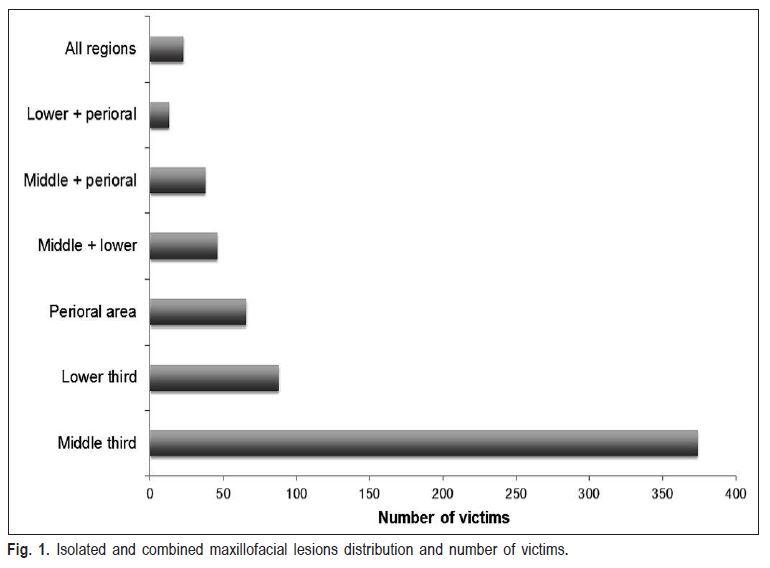
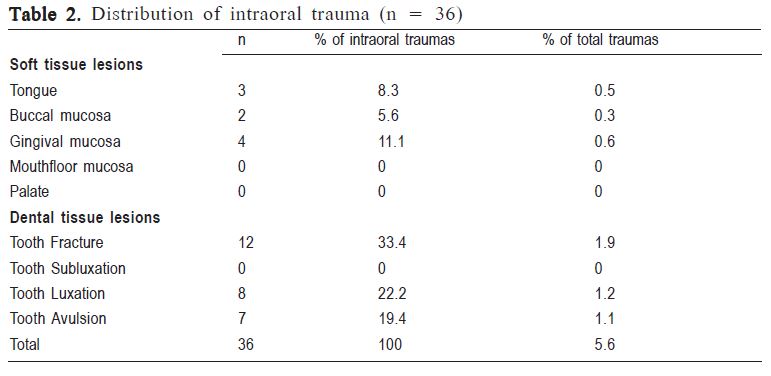
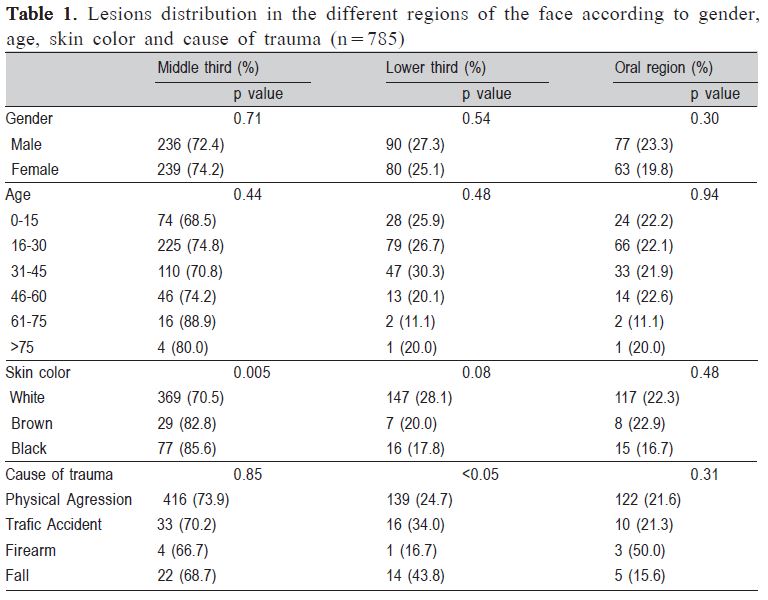
<body><![CDATA[<p>&nbsp;</p>     <p><font face="Verdana, Arial, Helvetica, sans-serif" size="3"><b>Material and    methods</b></font></p>     <p><font face="Verdana, Arial, Helvetica, sans-serif" size="2">This retrospective and cross-sectional study was carried   out on the records of consecutive patients with maxillofacial   traumas who were referred to the Brazilian Institute of   Forensic Medicine, Pelotas, Southern Brazil, from January   2009 to December 2010 (n=7,536). The institute is a   reference for 11 cities with a total of 600,000 inhabitants.   From these records a selection was made according to the   following inclusion criteria: (1) offense to the integrity and/or health of the victim and (2) presence of maxillofacial   traumas. Maxillofacial lesions were grouped in the following   extraoral regions: lower third (masseter, mandible and mentum   regions), middle third (infraorbital, zygomatic and nasal   regions) and oral (intraoral, lips and perioral soft tissues).   Oral lesions were defined as those involving the following   areas: (a) teeth and surrounding supportive tissues   (periodontium); (b) oral mucosa including gums, alveolar   mucosa in edentulous patient, palate and mucosa; (c) jaw   bones (upper and lower); (d) lips (mucosa and skin); (e)   tongue; (f) perioral soft tissues (extraoral tissues that surround   mouth and cover upper and lower jaw). This study followed   the Declaration of Helsinki on medical protocol and was   approved by the Institutional Review Board of the Federal University of Pelotas, Dental School (protocol 88/2009).</font></p>     <p><font face="Verdana, Arial, Helvetica, sans-serif" size="2">  The selected cases (n=648) were studied for data   regarding the victim's and offender's demographic   characteristics, nature and number of inflicted traumas and   their consequences. Personal information such as gender, race,   age and marital status, and lesion's characteristics (location,   etiology, type) were recorded in an Excel spreadsheet. In   addition, anatomic location and nature of the trauma were   identified to evaluate oral traumas.</font></p>     <p><font face="Verdana, Arial, Helvetica, sans-serif" size="2">  Data were double typed and analyzed by Stata 12.0 software   (StataCorp, College Station, TX, USA). Descriptive statistics   was performed using frequency analysis for categorical variables   and descriptive analysis for continuous variables. The statistical   significance of the difference in the prevalence of oral and   maxillofacial traumas according to gender, age group, skin color   and cause of trauma was tested using the chi-square test.   Multivariate Poisson regression analysis was conducted by using   traumas in the different parts of face as the dichotomized   dependent variable in order to test the association between the   outcomes and the independent variables, adjusting it for potential   confounders. For variable selection, the stepwise method with   backward selection was used. Variables with p&lt;0.25 were   included in the final model, estimated their Risk Ratio (RR)   and set the interval confidence at 95% .</font></p>     <p>&nbsp;</p>     <p><font face="Verdana, Arial, Helvetica, sans-serif" size="3"><b>Results</b></font></p>     <p><font face="Verdana, Arial, Helvetica, sans-serif" size="2">In this study, out of a total of 7,536 victims only 892   (11.8%) presented maxillofacial traumas. Patients with missing   data were excluded from the study, totalizing 648 (8.6%)   patients presenting 785 traumas. The number of cases was   similar in 2009 (n=306; 47.2%) and 2010 (n=342; 52.8%).   The majority were men (50.1%), single (75.2%), most of them   white (80.6%). The mean age was 27.6 years (SD=7.37), and   victims aged between 16 to 30 years were the most affected (46.1%), followed by those from 31 to 45 years (24.0%).</font></p>     <p><font face="Verdana, Arial, Helvetica, sans-serif" size="2">  The specialized police station for women's defense (209;   31.9%) referred most of the patients followed by the specialized   police station for children and adolescent defense (124; 19.1%)   and first assistance police station (120; 18.1%). Most of the   maxillofacial traumas were due to physical aggressions (563;   86.8%), traffic accidents (47; 7.2%) and falls (32; 4.9%). About   the damage caused by lesions, 22 patients (3.3%) presented   permanent and irreversible consequences, becoming unable   for daily, social and working activities.</font></p>     <p><font face="Verdana, Arial, Helvetica, sans-serif" size="2">  Traumas occurred on all regions of the face in different   proportions, with the middle third concentrating most of the   traumas (475, 73.3%), followed by the lower third (170, 26.2%)   and by the oral region (140, 21.6%). <a href="#tab01">Table 1</a> describes the   associations between the traumas and independent variables,   which are listed according to the different regions of face.   Traumas occurred in single thirds or more than one third (<a href="#fig01">Figure 1</a>). For dental traumas, tooth fracture was the most prevalent   (12, 33.4%) followed by luxation (8, 22.2%) With respect to   the intraoral soft tissue lesions, oral and gingival mucosa and   tongue were the most affected sites (<a href="#tab02">Table 2</a>).</font></p>     ]]></body>
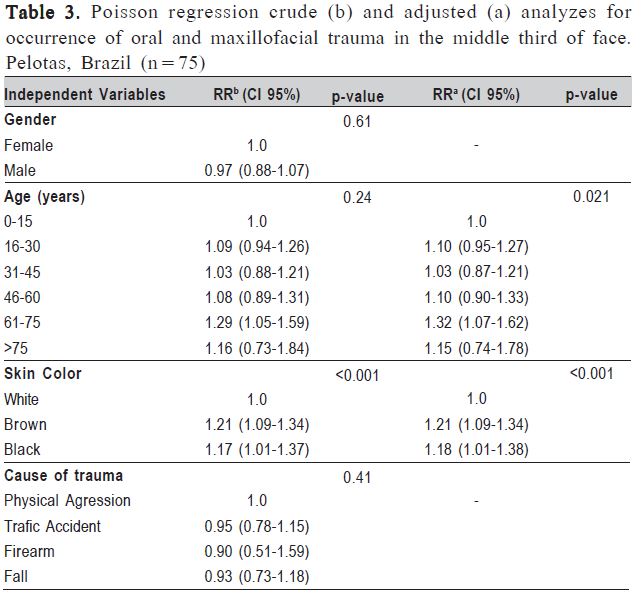
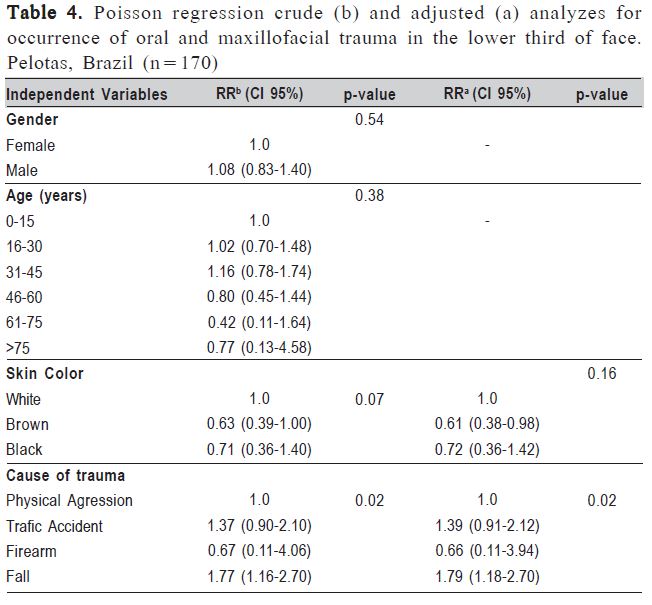
<body><![CDATA[<p><font face="Verdana, Arial, Helvetica, sans-serif" size="2">  When the associations between the occurrence of oral   and maxillofacial trauma and explanatory variables were   considered simultaneously, in the multivariate regression   model, (Tables <a href="#tab03">3</a> and <a href="#tab04">4</a>), the risk for trauma in the middle   third was significantly higher among patients aged between   61-75 years (RR, 1.32; 95%CI, 1.07-1.62), and non-white   patients (brown skinned, RR 1.21, 95% CI, 1.09-1.34; black   skinned RR 1.18; 95%CI, 1.01-1.38). The risk for lower third   trauma was significantly higher when falls were the main   causes of trauma (RR 1.79; 95%CI, 1.18-2.70).</font></p>     <p>&nbsp;</p>     <p><a name="tab01"></a></p>     <p>&nbsp; </p>     <p align="center"><img src="/img/revistas/bjos/v12n4/a07tab01.jpg">     <p>&nbsp;</p>     <p><a name="fig01"></a></p>     <p>&nbsp; </p>     <p align="center"><img src="/img/revistas/bjos/v12n4/a07fig01.jpg">     <p>&nbsp;</p>     ]]></body>
<body><![CDATA[<p><font face="Verdana, Arial, Helvetica, sans-serif" size="3"><b>Discussion</b></font></p>     <p><font face="Verdana, Arial, Helvetica, sans-serif" size="2">Information on health is important for planning,   monitoring and management of collective and individual   health interventions. In the last years, traumas to the   maxillofacial region are becoming more common both in   the urban and rural areas.<sup>1</sup> Changes in the global socioeconomic   scenery are responsible for switches in the pattern of maxillofacial traumas etiologies.</font></p>     <p><font face="Verdana, Arial, Helvetica, sans-serif" size="2">  Brazil has emerged as an economic power in the last   years, resulting in higher employment and immigration rates,   but on the other side growth was accompanied by social   disparities. In this way, more traumas due to physical   aggression are expected. This study shows for the first time   that Brazilian growth is reflecting in increased reports of   trauma due to interpersonal violence. In the present study,   the main cause for traumas in all three analyzed regions was   physical aggression, followed by car accident and falls, as seen in many urban centers in Germany<sup>14</sup> and the United States<sup>15</sup>.</font></p>     <p>&nbsp;</p>     <p><a name="tab02"></a></p>     <p>&nbsp; </p>     <p align="center"><img src="/img/revistas/bjos/v12n4/a07tab02.jpg">     <p>&nbsp;</p>     <p><a name="tab03"></a></p>     <p>&nbsp; </p>     ]]></body>
<body><![CDATA[<p align="center"><img src="/img/revistas/bjos/v12n4/a07tab03.jpg">     <p>&nbsp;</p>     <p><font face="Verdana, Arial, Helvetica, sans-serif" size="2">  The explanation for the increase if interpersonal violence   is higher alcohol consumption, drug abuse and social   disparities due to unequal wealth distribution<sup>1,16,17</sup>. It was   found that skin color, a marker of social inequality,<sup>5,6</sup>   represents a risk factor for facial traumas, since black and   brown victims tended to have more lesions in the middle   third of the face. It is important to emphasize that no   previously published paper has reported a social marker as a   risk factor for oral and maxillofacial traumas. According to   Minayo<sup>18</sup> (1990), non-white people are the most vulnerable   to violence in urban areas with low quality of life, since   they live along with violence on a daily basis. As seen in   other reports, non-white people at greatest risk of being   victims of violence are men, young, single and belonging to   low-income families.<sup>6</sup> On the other hand, the stiffening of   road traffic laws and safety norms such as obligatory use of   seat belts, air bags, helmet wearing for motorized two-wheelers   and speed surveillance reduced maxillofacial traumas due to traffic accidents<sup>16,17,19</sup>.</font></p>     <p><font face="Verdana, Arial, Helvetica, sans-serif" size="2">  According to the age groups, maxillofacial traumas were   more frequent in people between 16 and 30 years followed   by ages between 31 to 45 years which concurs with previous   studies<sup>1,17,20-22</sup>. People in these age groups have more social   interaction than other age groups, with higher alcohol and   other drugs consumption<sup>1,20</sup>. Despite of it, an increase of oral   and maxillofacial traumas in the elderly is being observed.   According to Al-Khateeb and Abdullah<sup>9</sup> (2007) this fact is   due to an increase in average life expectancy, a more active   lifestyle and higher percentage of elderly people in the   population. The main cause of traumas in the elderly   population was due to falls, which has been related to reduced   physical agility, presence of systemic pathologies and use   of psychotropic medications. Our data corroborate other studieswhere the middle third facial area is more affected in elderly   victims, with special regards to the orbital-zygomatic region<sup>23,24</sup>.</font></p>     <p>&nbsp;</p>     <p><a name="tab04"></a></p>     <p>&nbsp; </p>     <p align="center"><img src="/img/revistas/bjos/v12n4/a07tab04.jpg">     <p>&nbsp;</p>     <p><font face="Verdana, Arial, Helvetica, sans-serif" size="2">  Another finding was a greater risk for trauma on the lower   third associated with falls after adjustment in the final regression   model. This fact may be explained by the chin prominence   trauma when the victims fall. In addition, Iida et al.<sup>7,14</sup> (2001,   2003) reported that fall is usually observed as a chin impact   leading to condyle fracture, and in less cases, multiple fractures when the impact occurs in the lateral sides of mandible.</font></p>     ]]></body>
<body><![CDATA[<p><font face="Verdana, Arial, Helvetica, sans-serif" size="2">  In contrast to other studies that reported mandible as the   most commonly affected site,22,25,26 in the results of this study   middle third was more affected (73.3%) than the lower third   (26.2%), which agrees with the studies conducted by Gandhi   et al<sup>1</sup> (2011). Among the lower third maxillofacial lesions,   dentoalveolar traumas presented a low prevalence (3.6%)   concurring with previous studies<sup>27-30</sup>. In this report, crown   fracture was the most common (1.9%) followed by luxation   (1.2%). As expected, most of these lesions correlate with lowimpact   traumas due to interpersonal violence that are usually   observed as soft tissue abrasion, hematoma, and dentoalveolar   fractures<sup>8</sup>. It is supposed that the importance, number and   severity of the perioral and intraoral lesions would change   with the presence of a forensic dentist at the Institutes of   Forensic Medicine and their prevalence would increase.</font></p>     <p><font face="Verdana, Arial, Helvetica, sans-serif" size="2">  An example of specific professional care that has   increased the number of notified lesions was the creation of   specialized police stations for women's defense in Brazil.   These units stimulated the notification of aggression against   women and reduced the male-to-female ratio of reported   traumas to 1.03:1. Some countries have ratios of up to 8:1,   but recent studies show a trend towards an equal male-tofemale   ratio<sup>17,22</sup>. The increase in the number of women   presenting maxillofacial traumas was attributed to an increase   in the women's working force and many of them working   outdoors in more high-risk occupations, thus becoming more   exposed to traumas<sup>9</sup>.</font></p>     <p><font face="Verdana, Arial, Helvetica, sans-serif" size="2">  In the last decade, changes in global economy reflected   in different aspects of the worldwide development. New   economies are emerging with consequences to their   population. Specific preventive public policy must respect   the differences of each country, especially in countries with   different social and economic realities aggravated due to   social inequalities. As seen in many countries, there is a   worldwide trend of decreasing traffic-related traumas and   increasing violence-related traumas. Thus, appropriate   strategies at both community and individual levels should   be implemented to prevent and reduce overall trauma.</font></p>     <p>&nbsp;</p>     <p><font face="Verdana, Arial, Helvetica, sans-serif" size="3"><b>References</b></font></p>     <!-- ref --><p><font face="Verdana, Arial, Helvetica, sans-serif" size="2">1. Gandhi S, Ranganathan LK, Solanki M, Mathew GC, Singh I, Bither S. Pattern of maxillofacial fractures at a tertiary hospital in northern India: a 4-year retrospective study of 718 patients. Dent Traumatol. 2011; 27: 257-62.    &nbsp;&nbsp;&nbsp;&nbsp;&nbsp;&nbsp;&nbsp;&nbsp;[&#160;<a href="javascript:void(0);" onclick="javascript: window.open('/scielo.php?script=sci_nlinks&ref=053082&pid=S1677-3225201300030000700001&lng=','','width=640,height=500,resizable=yes,scrollbars=1,menubar=yes,');">Links</a>&#160;]<!-- end-ref --></font></p>     <!-- ref --><p><font face="Verdana, Arial, Helvetica, sans-serif" size="2"> 2. Haug RH, Prather J, Indresano AT. An epidemiologic survey of facial fractures   and concomitant injuries. J Oral Maxillofac Surg. 1990; 48: 926-32.    &nbsp;&nbsp;&nbsp;&nbsp;&nbsp;&nbsp;&nbsp;&nbsp;[&#160;<a href="javascript:void(0);" onclick="javascript: window.open('/scielo.php?script=sci_nlinks&ref=053084&pid=S1677-3225201300030000700002&lng=','','width=640,height=500,resizable=yes,scrollbars=1,menubar=yes,');">Links</a>&#160;]<!-- end-ref --></font></p>     <!-- ref --><p><font face="Verdana, Arial, Helvetica, sans-serif" size="2"> 3. Kostakis G, Stathopoulos P, Dais P, Gkinis G, Igoumenakis D, Mezitis   M, et al. An epidemiologic analysis of 1,142 maxillofacial fractures and   concomitant injuries. Oral Surg Oral Med Oral Pathol Oral Radiol. 2012;   114(Suppl 5): 69-73.    &nbsp;&nbsp;&nbsp;&nbsp;&nbsp;&nbsp;&nbsp;&nbsp;[&#160;<a href="javascript:void(0);" onclick="javascript: window.open('/scielo.php?script=sci_nlinks&ref=053086&pid=S1677-3225201300030000700003&lng=','','width=640,height=500,resizable=yes,scrollbars=1,menubar=yes,');">Links</a>&#160;]<!-- end-ref --></font></p>     <!-- ref --><p><font face="Verdana, Arial, Helvetica, sans-serif" size="2"> 4. Brasileiro BF, Passeri LA. Epidemiological analysis of maxillofacial fractures   in Brazil: a 5-year prospective study. Oral Surg Oral Med Oral Pathol Oral   Radiol Endod. 2006; 102: 28-34.    &nbsp;&nbsp;&nbsp;&nbsp;&nbsp;&nbsp;&nbsp;&nbsp;[&#160;<a href="javascript:void(0);" onclick="javascript: window.open('/scielo.php?script=sci_nlinks&ref=053088&pid=S1677-3225201300030000700004&lng=','','width=640,height=500,resizable=yes,scrollbars=1,menubar=yes,');">Links</a>&#160;]<!-- end-ref --></font></p>     <!-- ref --><p><font face="Verdana, Arial, Helvetica, sans-serif" size="2"> 5. Silva A, Faleiros HH, Shimizu WAL, Nogueira L de M, Nh&atilde;n LL, Silva,   BMF da. et al. &#91;The prevalence of falls and associated factors among the   elderly according to ethnicity&#93;. Cien Saude Colet. 2012; 17: 2181-90.    &nbsp;&nbsp;&nbsp;&nbsp;&nbsp;&nbsp;&nbsp;&nbsp;[&#160;<a href="javascript:void(0);" onclick="javascript: window.open('/scielo.php?script=sci_nlinks&ref=053090&pid=S1677-3225201300030000700005&lng=','','width=640,height=500,resizable=yes,scrollbars=1,menubar=yes,');">Links</a>&#160;]<!-- end-ref --></font></p>     <!-- ref --><p><font face="Verdana, Arial, Helvetica, sans-serif" size="2"> 6. Soares Filho AM. Homicide victimization according to racial characteristics in Brazil. Rev Saude Publica. 2011; 45: 745-455.    &nbsp;&nbsp;&nbsp;&nbsp;&nbsp;&nbsp;&nbsp;&nbsp;[&#160;<a href="javascript:void(0);" onclick="javascript: window.open('/scielo.php?script=sci_nlinks&ref=053092&pid=S1677-3225201300030000700006&lng=','','width=640,height=500,resizable=yes,scrollbars=1,menubar=yes,');">Links</a>&#160;]<!-- end-ref --></font></p>     <!-- ref --><p><font face="Verdana, Arial, Helvetica, sans-serif" size="2"> 7. Iida S, Kogo M, Sugiura T, Mima T, Matsuya T. Retrospective analysis of   1,502 patients with facial fractures. Int J Oral Maxillofac Surg. 2001; 30:   286-90.    &nbsp;&nbsp;&nbsp;&nbsp;&nbsp;&nbsp;&nbsp;&nbsp;[&#160;<a href="javascript:void(0);" onclick="javascript: window.open('/scielo.php?script=sci_nlinks&ref=053094&pid=S1677-3225201300030000700007&lng=','','width=640,height=500,resizable=yes,scrollbars=1,menubar=yes,');">Links</a>&#160;]<!-- end-ref --></font></p>     <!-- ref --><p><font face="Verdana, Arial, Helvetica, sans-serif" size="2"> 8. Batista AM, Marques LS, Batista AE, Falci SG, Ramos-Jorge ML. Urbanrural   differences in oral and maxillofacial trauma. Braz Oral Res. 2012; 26:   132-8.    &nbsp;&nbsp;&nbsp;&nbsp;&nbsp;&nbsp;&nbsp;&nbsp;[&#160;<a href="javascript:void(0);" onclick="javascript: window.open('/scielo.php?script=sci_nlinks&ref=053096&pid=S1677-3225201300030000700008&lng=','','width=640,height=500,resizable=yes,scrollbars=1,menubar=yes,');">Links</a>&#160;]<!-- end-ref --></font></p>     <!-- ref --><p><font face="Verdana, Arial, Helvetica, sans-serif" size="2"> 9. Al-Khateeb T, Abdullah FM. Craniomaxillofacial injuries in the United Arab   Emirates: a retrospective study. J Oral Maxillofac Surg. 2007; 65: 1094-   101.    &nbsp;&nbsp;&nbsp;&nbsp;&nbsp;&nbsp;&nbsp;&nbsp;[&#160;<a href="javascript:void(0);" onclick="javascript: window.open('/scielo.php?script=sci_nlinks&ref=053098&pid=S1677-3225201300030000700009&lng=','','width=640,height=500,resizable=yes,scrollbars=1,menubar=yes,');">Links</a>&#160;]<!-- end-ref --></font></p>     <!-- ref --><p><font face="Verdana, Arial, Helvetica, sans-serif" size="2"> 10. Van den Bergh B, Karagozoglu KH, Heymans MW, Forouzanfar T.   Aetiology and incidence of maxillofacial trauma in Amsterdam: a   retrospective analysis of 579 patients. J Craniomaxillofac Surg. 2012; 40:   e165-9.    &nbsp;&nbsp;&nbsp;&nbsp;&nbsp;&nbsp;&nbsp;&nbsp;[&#160;<a href="javascript:void(0);" onclick="javascript: window.open('/scielo.php?script=sci_nlinks&ref=053100&pid=S1677-3225201300030000700010&lng=','','width=640,height=500,resizable=yes,scrollbars=1,menubar=yes,');">Links</a>&#160;]<!-- end-ref --></font></p>     <!-- ref --><p><font face="Verdana, Arial, Helvetica, sans-serif" size="2"> 11. Munante-Cardenas JL, Olate S, Asprino L, de Albergaria Barbosa JR, de   Moraes M, Moreira RW. Pattern and treatment of facial trauma in pediatric   and adolescent patients. J Craniofac Surg. 2011; 22: 1251-5.    &nbsp;&nbsp;&nbsp;&nbsp;&nbsp;&nbsp;&nbsp;&nbsp;[&#160;<a href="javascript:void(0);" onclick="javascript: window.open('/scielo.php?script=sci_nlinks&ref=053102&pid=S1677-3225201300030000700011&lng=','','width=640,height=500,resizable=yes,scrollbars=1,menubar=yes,');">Links</a>&#160;]<!-- end-ref --></font></p>     <!-- ref --><p><font face="Verdana, Arial, Helvetica, sans-serif" size="2"> 12. Martini MZ, Takahashi A, de Oliveira Neto HG, de Carvalho Junior JP,   Curcio R, Shinohara EH. Epidemiology of mandibular fractures treated in   a Brazilian level I trauma public hospital in the city of S&atilde;o Paulo, Brazil.   Braz Dent J. 2006; 17: 243-8.    &nbsp;&nbsp;&nbsp;&nbsp;&nbsp;&nbsp;&nbsp;&nbsp;[&#160;<a href="javascript:void(0);" onclick="javascript: window.open('/scielo.php?script=sci_nlinks&ref=053104&pid=S1677-3225201300030000700012&lng=','','width=640,height=500,resizable=yes,scrollbars=1,menubar=yes,');">Links</a>&#160;]<!-- end-ref --></font></p>     <!-- ref --><p><font face="Verdana, Arial, Helvetica, sans-serif" size="2"> 13. Gulinelli JL, Saito CTMH, Garcia-J&uacute;nior IR, Panzarini SR, Poi WR,   Sonoda CK, et al. Occurrence of tooth injuries in patients treated in hospital   environment in the region of Aracatuba, Brazil during a 6-year period. Dent   Traumatol. 2008; 24: 640-4.    &nbsp;&nbsp;&nbsp;&nbsp;&nbsp;&nbsp;&nbsp;&nbsp;[&#160;<a href="javascript:void(0);" onclick="javascript: window.open('/scielo.php?script=sci_nlinks&ref=053106&pid=S1677-3225201300030000700013&lng=','','width=640,height=500,resizable=yes,scrollbars=1,menubar=yes,');">Links</a>&#160;]<!-- end-ref --></font></p>     <!-- ref --><p><font face="Verdana, Arial, Helvetica, sans-serif" size="2"> 14. lida S, Hassfeld S, Reuther T, Schweigert Hans-Gert, Haag C, Klein J,   et al. Maxillofacial fractures resulting from falls. J Craniomaxillofac Surg.   2003; 31: 278-83.    &nbsp;&nbsp;&nbsp;&nbsp;&nbsp;&nbsp;&nbsp;&nbsp;[&#160;<a href="javascript:void(0);" onclick="javascript: window.open('/scielo.php?script=sci_nlinks&ref=053108&pid=S1677-3225201300030000700014&lng=','','width=640,height=500,resizable=yes,scrollbars=1,menubar=yes,');">Links</a>&#160;]<!-- end-ref --></font></p>     <!-- ref --><p><font face="Verdana, Arial, Helvetica, sans-serif" size="2"> 15. Laski R, Ziccardi VB, Broder HL, Janal M. Facial trauma: a recurrent   disease? The potential role of disease prevention. J Oral Maxillofac Surg.   2004; 62: 685-8.    &nbsp;&nbsp;&nbsp;&nbsp;&nbsp;&nbsp;&nbsp;&nbsp;[&#160;<a href="javascript:void(0);" onclick="javascript: window.open('/scielo.php?script=sci_nlinks&ref=053110&pid=S1677-3225201300030000700015&lng=','','width=640,height=500,resizable=yes,scrollbars=1,menubar=yes,');">Links</a>&#160;]<!-- end-ref --></font></p>     <!-- ref --><p><font face="Verdana, Arial, Helvetica, sans-serif" size="2"> 16. Bacchieri G, Barros AJ. Traffic accidents in Brazil from 1998 to 2010:   many changes and few effects. Rev Saude Publica. 2011; 45: 949-63.    &nbsp;&nbsp;&nbsp;&nbsp;&nbsp;&nbsp;&nbsp;&nbsp;[&#160;<a href="javascript:void(0);" onclick="javascript: window.open('/scielo.php?script=sci_nlinks&ref=053112&pid=S1677-3225201300030000700016&lng=','','width=640,height=500,resizable=yes,scrollbars=1,menubar=yes,');">Links</a>&#160;]<!-- end-ref --></font></p>     <!-- ref --><p><font face="Verdana, Arial, Helvetica, sans-serif" size="2"> 17. Van Beek GJ, Merkx CA. Changes in the pattern of fractures of the   maxillofacial skeleton. Int J Oral Maxillofac Surg. 1999; 28: 424-8.    &nbsp;&nbsp;&nbsp;&nbsp;&nbsp;&nbsp;&nbsp;&nbsp;[&#160;<a href="javascript:void(0);" onclick="javascript: window.open('/scielo.php?script=sci_nlinks&ref=053114&pid=S1677-3225201300030000700017&lng=','','width=640,height=500,resizable=yes,scrollbars=1,menubar=yes,');">Links</a>&#160;]<!-- end-ref --></font></p>     <!-- ref --><p><font face="Verdana, Arial, Helvetica, sans-serif" size="2"> 18. Minayo MCS. Violence in adolescence: a public health problem. Cad   Saude Publica. 1990; 6: 278-92.    &nbsp;&nbsp;&nbsp;&nbsp;&nbsp;&nbsp;&nbsp;&nbsp;[&#160;<a href="javascript:void(0);" onclick="javascript: window.open('/scielo.php?script=sci_nlinks&ref=053116&pid=S1677-3225201300030000700018&lng=','','width=640,height=500,resizable=yes,scrollbars=1,menubar=yes,');">Links</a>&#160;]<!-- end-ref --></font></p>     <!-- ref --><p><font face="Verdana, Arial, Helvetica, sans-serif" size="2"> 19. De Matos FP, Arnez MF, Sverzut CE, Trivellato AE. A retrospective   study of mandibular fracture in a 40-month period. Int J Oral Maxillofac   Surg. 2010; 39: 10-5.    &nbsp;&nbsp;&nbsp;&nbsp;&nbsp;&nbsp;&nbsp;&nbsp;[&#160;<a href="javascript:void(0);" onclick="javascript: window.open('/scielo.php?script=sci_nlinks&ref=053118&pid=S1677-3225201300030000700019&lng=','','width=640,height=500,resizable=yes,scrollbars=1,menubar=yes,');">Links</a>&#160;]<!-- end-ref --></font></p>     <!-- ref --><p><font face="Verdana, Arial, Helvetica, sans-serif" size="2"> 20. Lee JH, Cho BK, Park WJ. A 4-year retrospective study of facial fractures   on Jeju, Korea. J Craniomaxillofac Surg. 2010; 38: 192-6.    &nbsp;&nbsp;&nbsp;&nbsp;&nbsp;&nbsp;&nbsp;&nbsp;[&#160;<a href="javascript:void(0);" onclick="javascript: window.open('/scielo.php?script=sci_nlinks&ref=053120&pid=S1677-3225201300030000700020&lng=','','width=640,height=500,resizable=yes,scrollbars=1,menubar=yes,');">Links</a>&#160;]<!-- end-ref --></font></p>     <!-- ref --><p><font face="Verdana, Arial, Helvetica, sans-serif" size="2"> 21. Cheema SA, Amin F. Incidence and causes of maxillofacial skeletal   injuries at the Mayo Hospital in Lahore, Pakistan. Br J Oral Maxillofac   Surg. 2006; 44: 232-4.    &nbsp;&nbsp;&nbsp;&nbsp;&nbsp;&nbsp;&nbsp;&nbsp;[&#160;<a href="javascript:void(0);" onclick="javascript: window.open('/scielo.php?script=sci_nlinks&ref=053122&pid=S1677-3225201300030000700021&lng=','','width=640,height=500,resizable=yes,scrollbars=1,menubar=yes,');">Links</a>&#160;]<!-- end-ref --></font></p>     <!-- ref --><p><font face="Verdana, Arial, Helvetica, sans-serif" size="2"> 22. Bakardjiev A, Pechalova P. Maxillofacial fractures in Southern Bulgaria -   a retrospective study of 1,706 cases. J Craniomaxillofac Surg. 2007; 35:   147-50.    &nbsp;&nbsp;&nbsp;&nbsp;&nbsp;&nbsp;&nbsp;&nbsp;[&#160;<a href="javascript:void(0);" onclick="javascript: window.open('/scielo.php?script=sci_nlinks&ref=053124&pid=S1677-3225201300030000700022&lng=','','width=640,height=500,resizable=yes,scrollbars=1,menubar=yes,');">Links</a>&#160;]<!-- end-ref --></font></p>     <!-- ref --><p><font face="Verdana, Arial, Helvetica, sans-serif" size="2"> 23. Gerbino G, Roccia F, De Gioanni PP, Berrone S. Maxillofacial trauma in   the elderly. J Oral Maxillofac Surg. 1999; 57: 777-82; discussion 82-3.    &nbsp;&nbsp;&nbsp;&nbsp;&nbsp;&nbsp;&nbsp;&nbsp;[&#160;<a href="javascript:void(0);" onclick="javascript: window.open('/scielo.php?script=sci_nlinks&ref=053126&pid=S1677-3225201300030000700023&lng=','','width=640,height=500,resizable=yes,scrollbars=1,menubar=yes,');">Links</a>&#160;]<!-- end-ref --></font></p>     <!-- ref --><p><font face="Verdana, Arial, Helvetica, sans-serif" size="2"> 24. Falcone PA, Haedicke GJ, Brooks G, Sullivan PK. Maxillofacial fractures   in the elderly: a comparative study. Plast Reconstr Surg. 1990; 86: 443-8.    &nbsp;&nbsp;&nbsp;&nbsp;&nbsp;&nbsp;&nbsp;&nbsp;[&#160;<a href="javascript:void(0);" onclick="javascript: window.open('/scielo.php?script=sci_nlinks&ref=053128&pid=S1677-3225201300030000700024&lng=','','width=640,height=500,resizable=yes,scrollbars=1,menubar=yes,');">Links</a>&#160;]<!-- end-ref --></font></p>     <!-- ref --><p><font face="Verdana, Arial, Helvetica, sans-serif" size="2"> 25. Kieser J, Stephenson S, Liston PN, Tong DC, Langley JD. Serious facial   fractures in New Zealand from 1979 to 1998. Int J Oral Maxillofac Surg.   2002; 31: 206-9.    &nbsp;&nbsp;&nbsp;&nbsp;&nbsp;&nbsp;&nbsp;&nbsp;[&#160;<a href="javascript:void(0);" onclick="javascript: window.open('/scielo.php?script=sci_nlinks&ref=053130&pid=S1677-3225201300030000700025&lng=','','width=640,height=500,resizable=yes,scrollbars=1,menubar=yes,');">Links</a>&#160;]<!-- end-ref --></font></p>     <!-- ref --><p><font face="Verdana, Arial, Helvetica, sans-serif" size="2"> 26. Erol B, Tanrikulu R, Gorgun B. Maxillofacial fractures. Analysis of   demographic distribution and treatment in 2,901 patients (25-year experience).   J Craniomaxillofac Surg. 2004; 32: 308-13.    &nbsp;&nbsp;&nbsp;&nbsp;&nbsp;&nbsp;&nbsp;&nbsp;[&#160;<a href="javascript:void(0);" onclick="javascript: window.open('/scielo.php?script=sci_nlinks&ref=053132&pid=S1677-3225201300030000700026&lng=','','width=640,height=500,resizable=yes,scrollbars=1,menubar=yes,');">Links</a>&#160;]<!-- end-ref --></font></p>     <!-- ref --><p><font face="Verdana, Arial, Helvetica, sans-serif" size="2"> 27. Motamedi MH, Sagafinia M, Famouri-Hosseinizadeh M. Oral and   maxillofacial injuries in civilians during training at military garrisons:   prevalence and causes. Oral Surg Oral Med Oral Pathol Oral Radiol.   2012; 114: 49-51.    &nbsp;&nbsp;&nbsp;&nbsp;&nbsp;&nbsp;&nbsp;&nbsp;[&#160;<a href="javascript:void(0);" onclick="javascript: window.open('/scielo.php?script=sci_nlinks&ref=053134&pid=S1677-3225201300030000700027&lng=','','width=640,height=500,resizable=yes,scrollbars=1,menubar=yes,');">Links</a>&#160;]<!-- end-ref --></font></p>     <!-- ref --><p><font face="Verdana, Arial, Helvetica, sans-serif" size="2"> 28. Castro JC, Poi WR, Manfrin TM, Zina LG. Analysis of the crown fractures   and crown-root fractures due to dental trauma assisted by the Integrated   Clinic from 1992 to 2002. Dent Traumatol. 2005; 21: 121-6.    &nbsp;&nbsp;&nbsp;&nbsp;&nbsp;&nbsp;&nbsp;&nbsp;[&#160;<a href="javascript:void(0);" onclick="javascript: window.open('/scielo.php?script=sci_nlinks&ref=053136&pid=S1677-3225201300030000700028&lng=','','width=640,height=500,resizable=yes,scrollbars=1,menubar=yes,');">Links</a>&#160;]<!-- end-ref --></font></p>     <!-- ref --><p><font face="Verdana, Arial, Helvetica, sans-serif" size="2"> 29. Santos SE, Marchiori EC, Soares AJ, Asprino L, de Souza Filho FJ, de   Moraes M, et al. A 9-year retrospective study of dental trauma in Piracicaba   and neighboring regions in the State of S&atilde;o Paulo, Brazil. J Oral Maxillofac   Surg. 2010; 68: 1826-32.    &nbsp;&nbsp;&nbsp;&nbsp;&nbsp;&nbsp;&nbsp;&nbsp;[&#160;<a href="javascript:void(0);" onclick="javascript: window.open('/scielo.php?script=sci_nlinks&ref=053138&pid=S1677-3225201300030000700029&lng=','','width=640,height=500,resizable=yes,scrollbars=1,menubar=yes,');">Links</a>&#160;]<!-- end-ref --></font></p>     <!-- ref --><p><font face="Verdana, Arial, Helvetica, sans-serif" size="2"> 30. Caldas IM, Magalh&atilde;es T, Afonso A, Matos E. The consequences of   orofacial trauma resulting from violence: a study in Porto Dent Traumatol.   2010; 26: 484-9.    &nbsp;&nbsp;&nbsp;&nbsp;&nbsp;&nbsp;&nbsp;&nbsp;[&#160;<a href="javascript:void(0);" onclick="javascript: window.open('/scielo.php?script=sci_nlinks&ref=053140&pid=S1677-3225201300030000700030&lng=','','width=640,height=500,resizable=yes,scrollbars=1,menubar=yes,');">Links</a>&#160;]<!-- end-ref --></font></p>     <p>&nbsp;</p>     <p>&nbsp;</p>     <p><font face="Verdana, Arial, Helvetica, sans-serif" size="2"><a name="back"/></a><a href="#top"><img src="/img/revistas/bjos/v12n4/seta.jpg" border="0" align="absmiddle"/></a>    <b>Correspondence:</b> <br/>F&aacute;bio Renato Manzolli Leite    <br>   Faculdade de Odontologia,    <br>   Universidade Federal de Pelotas    ]]></body>
<body><![CDATA[<br>   Rua Gon&ccedil;alves Chaves, 457, CEP: 96015-560    <br>   Centro, Pelotas, RS, Brasil<br/>   E-mail: <a href="mailto:leite.fabio@gmail.com">leite.fabio@gmail.com</a></font></p>     <p><font face="Verdana, Arial, Helvetica, sans-serif" size="2"><b>Received for    publication:</b> August 30, 2013<br/>   <b>Accepted:</b> November 28, 2013</font></p>      ]]></body>
<back>
<ref-list>
<ref id="B1">
<label>1</label><nlm-citation citation-type="journal">
<person-group person-group-type="author">
<name>
<surname><![CDATA[Gandhi]]></surname>
<given-names><![CDATA[S]]></given-names>
</name>
<name>
<surname><![CDATA[Ranganathan]]></surname>
<given-names><![CDATA[LK]]></given-names>
</name>
<name>
<surname><![CDATA[Solanki]]></surname>
<given-names><![CDATA[M]]></given-names>
</name>
<name>
<surname><![CDATA[Mathew]]></surname>
<given-names><![CDATA[GC]]></given-names>
</name>
<name>
<surname><![CDATA[Singh]]></surname>
</name>
<name>
<surname><![CDATA[Bither]]></surname>
<given-names><![CDATA[S]]></given-names>
</name>
</person-group>
<article-title xml:lang="en"><![CDATA[Pattern of maxillofacial fractures at a tertiary hospital in northern India: a 4-year retrospective study of 718 patients]]></article-title>
<source><![CDATA[Dent Traumatol]]></source>
<year>2011</year>
<volume>27</volume>
<page-range>257-62</page-range></nlm-citation>
</ref>
<ref id="B2">
<label>2</label><nlm-citation citation-type="journal">
<person-group person-group-type="author">
<name>
<surname><![CDATA[Haug]]></surname>
<given-names><![CDATA[RH]]></given-names>
</name>
<name>
<surname><![CDATA[Prather]]></surname>
<given-names><![CDATA[J]]></given-names>
</name>
<name>
<surname><![CDATA[Indresano]]></surname>
<given-names><![CDATA[AT]]></given-names>
</name>
</person-group>
<article-title xml:lang="en"><![CDATA[An epidemiologic survey of facial fractures and concomitant injuries]]></article-title>
<source><![CDATA[J Oral Maxillofac Surg]]></source>
<year>1990</year>
<volume>48</volume>
<page-range>926-32</page-range></nlm-citation>
</ref>
<ref id="B3">
<label>3</label><nlm-citation citation-type="journal">
<person-group person-group-type="author">
<name>
<surname><![CDATA[Kostakis]]></surname>
<given-names><![CDATA[G]]></given-names>
</name>
<name>
<surname><![CDATA[Stathopoulos]]></surname>
<given-names><![CDATA[P]]></given-names>
</name>
<name>
<surname><![CDATA[Dais]]></surname>
<given-names><![CDATA[P]]></given-names>
</name>
<name>
<surname><![CDATA[Gkinis]]></surname>
<given-names><![CDATA[G]]></given-names>
</name>
<name>
<surname><![CDATA[Igoumenakis]]></surname>
<given-names><![CDATA[D]]></given-names>
</name>
<name>
<surname><![CDATA[Mezitis]]></surname>
<given-names><![CDATA[M]]></given-names>
</name>
</person-group>
<source><![CDATA[Oral Surg Oral Med Oral Pathol Oral Radiol]]></source>
<year>2012</year>
<volume>114</volume>
<numero>^s5</numero>
<issue>^s5</issue>
<supplement>5</supplement>
<page-range>69-73</page-range></nlm-citation>
</ref>
<ref id="B4">
<label>4</label><nlm-citation citation-type="journal">
<person-group person-group-type="author">
<name>
<surname><![CDATA[Brasileiro]]></surname>
<given-names><![CDATA[BF]]></given-names>
</name>
<name>
<surname><![CDATA[Passeri]]></surname>
<given-names><![CDATA[LA]]></given-names>
</name>
</person-group>
<article-title xml:lang="en"><![CDATA[Epidemiological analysis of maxillofacial fractures in Brazil: a 5-year prospective study]]></article-title>
<source><![CDATA[Oral Surg Oral Med Oral Pathol Oral Radiol Endod]]></source>
<year>2006</year>
<volume>102</volume>
<page-range>28-34</page-range></nlm-citation>
</ref>
<ref id="B5">
<label>5</label><nlm-citation citation-type="journal">
<person-group person-group-type="author">
<name>
<surname><![CDATA[Silva]]></surname>
<given-names><![CDATA[A]]></given-names>
</name>
<name>
<surname><![CDATA[Faleiros]]></surname>
<given-names><![CDATA[HH]]></given-names>
</name>
<name>
<surname><![CDATA[Shimizu]]></surname>
</name>
<name>
<surname><![CDATA[Nogueira]]></surname>
<given-names><![CDATA[L de M]]></given-names>
</name>
<name>
<surname><![CDATA[Nhãn]]></surname>
<given-names><![CDATA[LL]]></given-names>
</name>
<name>
<surname><![CDATA[Silva]]></surname>
<given-names><![CDATA[BMF da]]></given-names>
</name>
</person-group>
<article-title xml:lang="en"><![CDATA[The prevalence of falls and associated factors among the elderly according to ethnicity]]></article-title>
<source><![CDATA[Cien Saude Colet]]></source>
<year>2012</year>
<volume>17</volume>
<page-range>2181-90</page-range></nlm-citation>
</ref>
<ref id="B6">
<label>6</label><nlm-citation citation-type="journal">
<person-group person-group-type="author">
<name>
<surname><![CDATA[Soares Filho]]></surname>
<given-names><![CDATA[AM]]></given-names>
</name>
</person-group>
<article-title xml:lang="en"><![CDATA[Homicide victimization according to racial characteristics in Brazil]]></article-title>
<source><![CDATA[Rev Saude Publica]]></source>
<year>2011</year>
<volume>45</volume>
<page-range>745-455</page-range></nlm-citation>
</ref>
<ref id="B7">
<label>7</label><nlm-citation citation-type="journal">
<person-group person-group-type="author">
<name>
<surname><![CDATA[Iida]]></surname>
<given-names><![CDATA[S]]></given-names>
</name>
<name>
<surname><![CDATA[Kogo]]></surname>
<given-names><![CDATA[M]]></given-names>
</name>
<name>
<surname><![CDATA[Sugiura]]></surname>
<given-names><![CDATA[T]]></given-names>
</name>
<name>
<surname><![CDATA[Mima]]></surname>
<given-names><![CDATA[T]]></given-names>
</name>
<name>
<surname><![CDATA[Matsuya]]></surname>
<given-names><![CDATA[T]]></given-names>
</name>
</person-group>
<article-title xml:lang="en"><![CDATA[Retrospective analysis of 1,502 patients with facial fractures]]></article-title>
<source><![CDATA[Int J Oral Maxillofac Surg]]></source>
<year>2001</year>
<volume>30</volume>
<page-range>286-90</page-range></nlm-citation>
</ref>
<ref id="B8">
<label>8</label><nlm-citation citation-type="journal">
<person-group person-group-type="author">
<name>
<surname><![CDATA[Batista]]></surname>
<given-names><![CDATA[AM]]></given-names>
</name>
<name>
<surname><![CDATA[Marques]]></surname>
<given-names><![CDATA[LS]]></given-names>
</name>
<name>
<surname><![CDATA[Batista]]></surname>
<given-names><![CDATA[AE]]></given-names>
</name>
<name>
<surname><![CDATA[Falci]]></surname>
<given-names><![CDATA[SG]]></given-names>
</name>
<name>
<surname><![CDATA[Ramos-Jorge]]></surname>
<given-names><![CDATA[ML]]></given-names>
</name>
</person-group>
<article-title xml:lang="en"><![CDATA[Urbanrural differences in oral and maxillofacial trauma]]></article-title>
<source><![CDATA[Braz Oral Res]]></source>
<year>2012</year>
<volume>26</volume>
<page-range>132-8</page-range></nlm-citation>
</ref>
<ref id="B9">
<label>9</label><nlm-citation citation-type="journal">
<person-group person-group-type="author">
<name>
<surname><![CDATA[Al-Khateeb]]></surname>
<given-names><![CDATA[T]]></given-names>
</name>
<name>
<surname><![CDATA[Abdullah]]></surname>
<given-names><![CDATA[FM]]></given-names>
</name>
</person-group>
<article-title xml:lang="en"><![CDATA[Craniomaxillofacial injuries in the United Arab Emirates: a retrospective study]]></article-title>
<source><![CDATA[J Oral Maxillofac Surg]]></source>
<year>2007</year>
<volume>65</volume>
<page-range>1094- 101</page-range></nlm-citation>
</ref>
<ref id="B10">
<label>10</label><nlm-citation citation-type="journal">
<person-group person-group-type="author">
<name>
<surname><![CDATA[Van den Bergh]]></surname>
<given-names><![CDATA[B]]></given-names>
</name>
<name>
<surname><![CDATA[Karagozoglu]]></surname>
<given-names><![CDATA[KH]]></given-names>
</name>
<name>
<surname><![CDATA[Heymans]]></surname>
<given-names><![CDATA[MW]]></given-names>
</name>
<name>
<surname><![CDATA[Forouzanfar]]></surname>
<given-names><![CDATA[T]]></given-names>
</name>
</person-group>
<article-title xml:lang="en"><![CDATA[Aetiology and incidence of maxillofacial trauma in Amsterdam: a retrospective analysis of 579 patients]]></article-title>
<source><![CDATA[J Craniomaxillofac Surg]]></source>
<year>2012</year>
<volume>40</volume>
<page-range>e165-9</page-range></nlm-citation>
</ref>
<ref id="B11">
<label>11</label><nlm-citation citation-type="journal">
<person-group person-group-type="author">
<name>
<surname><![CDATA[Munante-Cardenas]]></surname>
<given-names><![CDATA[JL]]></given-names>
</name>
<name>
<surname><![CDATA[Olate]]></surname>
<given-names><![CDATA[S]]></given-names>
</name>
<name>
<surname><![CDATA[Asprino]]></surname>
<given-names><![CDATA[L]]></given-names>
</name>
<name>
<surname><![CDATA[de Albergaria Barbosa]]></surname>
<given-names><![CDATA[JR]]></given-names>
</name>
<name>
<surname><![CDATA[de Moraes]]></surname>
<given-names><![CDATA[M]]></given-names>
</name>
<name>
<surname><![CDATA[Moreira]]></surname>
<given-names><![CDATA[RW]]></given-names>
</name>
</person-group>
<article-title xml:lang="en"><![CDATA[Pattern and treatment of facial trauma in pediatric and adolescent patients]]></article-title>
<source><![CDATA[J Craniofac Surg]]></source>
<year>2011</year>
<volume>22</volume>
<page-range>1251-5</page-range></nlm-citation>
</ref>
<ref id="B12">
<label>12</label><nlm-citation citation-type="journal">
<person-group person-group-type="author">
<name>
<surname><![CDATA[Martini]]></surname>
<given-names><![CDATA[MZ]]></given-names>
</name>
<name>
<surname><![CDATA[Takahashi]]></surname>
<given-names><![CDATA[A]]></given-names>
</name>
<name>
<surname><![CDATA[de Oliveira Neto]]></surname>
<given-names><![CDATA[HG]]></given-names>
</name>
<name>
<surname><![CDATA[de Carvalho Junior]]></surname>
<given-names><![CDATA[JP]]></given-names>
</name>
<name>
<surname><![CDATA[Curcio]]></surname>
<given-names><![CDATA[R]]></given-names>
</name>
<name>
<surname><![CDATA[Shinohara]]></surname>
<given-names><![CDATA[EH]]></given-names>
</name>
</person-group>
<article-title xml:lang="en"><![CDATA[Epidemiology of mandibular fractures treated in a Brazilian level I trauma public hospital in the city of São Paulo, Brazil]]></article-title>
<source><![CDATA[Braz Dent J]]></source>
<year>2006</year>
<volume>17</volume>
<page-range>243-8</page-range></nlm-citation>
</ref>
<ref id="B13">
<label>13</label><nlm-citation citation-type="journal">
<person-group person-group-type="author">
<name>
<surname><![CDATA[Gulinelli]]></surname>
<given-names><![CDATA[JL]]></given-names>
</name>
<name>
<surname><![CDATA[Saito]]></surname>
<given-names><![CDATA[CTMH]]></given-names>
</name>
<name>
<surname><![CDATA[Garcia-Júnior]]></surname>
<given-names><![CDATA[IR]]></given-names>
</name>
<name>
<surname><![CDATA[Panzarini]]></surname>
<given-names><![CDATA[SR]]></given-names>
</name>
<name>
<surname><![CDATA[Poi]]></surname>
<given-names><![CDATA[WR]]></given-names>
</name>
<name>
<surname><![CDATA[Sonoda]]></surname>
<given-names><![CDATA[CK]]></given-names>
</name>
</person-group>
<article-title xml:lang="en"><![CDATA[Occurrence of tooth injuries in patients treated in hospital environment in the region of Aracatuba, Brazil during a 6-year period]]></article-title>
<source><![CDATA[Dent Traumatol]]></source>
<year>2008</year>
<volume>24</volume>
<page-range>640-4</page-range></nlm-citation>
</ref>
<ref id="B14">
<label>14</label><nlm-citation citation-type="journal">
<person-group person-group-type="author">
<name>
<surname><![CDATA[lida]]></surname>
<given-names><![CDATA[S]]></given-names>
</name>
<name>
<surname><![CDATA[Hassfeld]]></surname>
<given-names><![CDATA[S]]></given-names>
</name>
<name>
<surname><![CDATA[Reuther]]></surname>
<given-names><![CDATA[T]]></given-names>
</name>
<name>
<surname><![CDATA[Schweigert]]></surname>
<given-names><![CDATA[Hans-Gert]]></given-names>
</name>
<name>
<surname><![CDATA[Haag]]></surname>
<given-names><![CDATA[C]]></given-names>
</name>
</person-group>
<source><![CDATA[J Craniomaxillofac Surg]]></source>
<year>2003</year>
<volume>31</volume>
<page-range>278-83</page-range></nlm-citation>
</ref>
<ref id="B15">
<label>15</label><nlm-citation citation-type="journal">
<person-group person-group-type="author">
<name>
<surname><![CDATA[Laski]]></surname>
<given-names><![CDATA[R]]></given-names>
</name>
<name>
<surname><![CDATA[Ziccardi]]></surname>
<given-names><![CDATA[VB]]></given-names>
</name>
<name>
<surname><![CDATA[Broder]]></surname>
<given-names><![CDATA[HL]]></given-names>
</name>
<name>
<surname><![CDATA[Janal]]></surname>
<given-names><![CDATA[M]]></given-names>
</name>
</person-group>
<article-title xml:lang="en"><![CDATA[Facial trauma: a recurrent disease? The potential role of disease prevention]]></article-title>
<source><![CDATA[J Oral Maxillofac Surg]]></source>
<year>2004</year>
<volume>62</volume>
<page-range>685-8</page-range></nlm-citation>
</ref>
<ref id="B16">
<label>16</label><nlm-citation citation-type="journal">
<person-group person-group-type="author">
<name>
<surname><![CDATA[Bacchieri]]></surname>
<given-names><![CDATA[G]]></given-names>
</name>
<name>
<surname><![CDATA[Barros]]></surname>
<given-names><![CDATA[AJ]]></given-names>
</name>
</person-group>
<article-title xml:lang="en"><![CDATA[Traffic accidents in Brazil from 1998 to 2010: many changes and few effects]]></article-title>
<source><![CDATA[Rev Saude Publica]]></source>
<year>2011</year>
<volume>45</volume>
<page-range>949-63</page-range></nlm-citation>
</ref>
<ref id="B17">
<label>17</label><nlm-citation citation-type="journal">
<person-group person-group-type="author">
<name>
<surname><![CDATA[Van Beek]]></surname>
<given-names><![CDATA[GJ]]></given-names>
</name>
<name>
<surname><![CDATA[Merkx]]></surname>
<given-names><![CDATA[CA]]></given-names>
</name>
</person-group>
<article-title xml:lang="en"><![CDATA[Changes in the pattern of fractures of the maxillofacial skeleton]]></article-title>
<source><![CDATA[Int J Oral Maxillofac Surg]]></source>
<year>1999</year>
<volume>28</volume>
<page-range>424-8</page-range></nlm-citation>
</ref>
<ref id="B18">
<label>18</label><nlm-citation citation-type="journal">
<person-group person-group-type="author">
<name>
<surname><![CDATA[Minayo]]></surname>
<given-names><![CDATA[MCS]]></given-names>
</name>
</person-group>
<article-title xml:lang="en"><![CDATA[Violence in adolescence: a public health problem]]></article-title>
<source><![CDATA[Cad Saude Publica]]></source>
<year>1990</year>
<volume>6</volume>
<page-range>278-92</page-range></nlm-citation>
</ref>
<ref id="B19">
<label>19</label><nlm-citation citation-type="journal">
<person-group person-group-type="author">
<name>
<surname><![CDATA[De Matos]]></surname>
<given-names><![CDATA[FP]]></given-names>
</name>
<name>
<surname><![CDATA[Arnez]]></surname>
<given-names><![CDATA[MF]]></given-names>
</name>
<name>
<surname><![CDATA[Sverzut]]></surname>
<given-names><![CDATA[CE]]></given-names>
</name>
<name>
<surname><![CDATA[Trivellato]]></surname>
<given-names><![CDATA[AE]]></given-names>
</name>
</person-group>
<article-title xml:lang="en"><![CDATA[A retrospective study of mandibular fracture in a 40-month period]]></article-title>
<source><![CDATA[Int J Oral Maxillofac Surg]]></source>
<year>2010</year>
<volume>39</volume>
<page-range>10-5</page-range></nlm-citation>
</ref>
<ref id="B20">
<label>20</label><nlm-citation citation-type="journal">
<person-group person-group-type="author">
<name>
<surname><![CDATA[Lee]]></surname>
<given-names><![CDATA[JH]]></given-names>
</name>
<name>
<surname><![CDATA[Cho]]></surname>
<given-names><![CDATA[BK]]></given-names>
</name>
<name>
<surname><![CDATA[Park]]></surname>
<given-names><![CDATA[WJ]]></given-names>
</name>
</person-group>
<article-title xml:lang="en"><![CDATA[A 4-year retrospective study of facial fractures on Jeju, Korea]]></article-title>
<source><![CDATA[J Craniomaxillofac Surg]]></source>
<year>2010</year>
<volume>38</volume>
<page-range>192-6</page-range></nlm-citation>
</ref>
<ref id="B21">
<label>21</label><nlm-citation citation-type="journal">
<person-group person-group-type="author">
<name>
<surname><![CDATA[Cheema]]></surname>
<given-names><![CDATA[SA]]></given-names>
</name>
<name>
<surname><![CDATA[Amin]]></surname>
<given-names><![CDATA[F]]></given-names>
</name>
</person-group>
<article-title xml:lang="en"><![CDATA[Incidence and causes of maxillofacial skeletal injuries at the Mayo Hospital in Lahore, Pakistan]]></article-title>
<source><![CDATA[Br J Oral Maxillofac Surg]]></source>
<year>2006</year>
<volume>44</volume>
<page-range>232-4</page-range></nlm-citation>
</ref>
<ref id="B22">
<label>22</label><nlm-citation citation-type="journal">
<person-group person-group-type="author">
<name>
<surname><![CDATA[Bakardjiev]]></surname>
<given-names><![CDATA[A]]></given-names>
</name>
<name>
<surname><![CDATA[Pechalova]]></surname>
<given-names><![CDATA[P]]></given-names>
</name>
</person-group>
<article-title xml:lang="en"><![CDATA[Maxillofacial fractures in Southern Bulgaria: a retrospective study of 1,706 cases]]></article-title>
<source><![CDATA[J Craniomaxillofac Surg]]></source>
<year>2007</year>
<volume>35</volume>
<page-range>147-50</page-range></nlm-citation>
</ref>
<ref id="B23">
<label>23</label><nlm-citation citation-type="journal">
<person-group person-group-type="author">
<name>
<surname><![CDATA[Gerbino]]></surname>
<given-names><![CDATA[G]]></given-names>
</name>
<name>
<surname><![CDATA[Roccia]]></surname>
<given-names><![CDATA[F]]></given-names>
</name>
<name>
<surname><![CDATA[De Gioanni]]></surname>
<given-names><![CDATA[PP]]></given-names>
</name>
<name>
<surname><![CDATA[Berrone]]></surname>
<given-names><![CDATA[S]]></given-names>
</name>
</person-group>
<article-title xml:lang="en"><![CDATA[Maxillofacial trauma in the elderly]]></article-title>
<source><![CDATA[J Oral Maxillofac Surg]]></source>
<year>1999</year>
<volume>57</volume>
<page-range>777-82</page-range></nlm-citation>
</ref>
<ref id="B24">
<label>24</label><nlm-citation citation-type="journal">
<person-group person-group-type="author">
<name>
<surname><![CDATA[Falcone]]></surname>
<given-names><![CDATA[PA]]></given-names>
</name>
<name>
<surname><![CDATA[Haedicke]]></surname>
<given-names><![CDATA[GJ]]></given-names>
</name>
<name>
<surname><![CDATA[Brooks]]></surname>
<given-names><![CDATA[G]]></given-names>
</name>
<name>
<surname><![CDATA[Sullivan]]></surname>
<given-names><![CDATA[PK]]></given-names>
</name>
</person-group>
<article-title xml:lang="en"><![CDATA[Maxillofacial fractures in the elderly: a comparative study]]></article-title>
<source><![CDATA[Plast Reconstr Surg]]></source>
<year>1990</year>
<volume>86</volume>
<page-range>443-8</page-range></nlm-citation>
</ref>
<ref id="B25">
<label>25</label><nlm-citation citation-type="journal">
<person-group person-group-type="author">
<name>
<surname><![CDATA[Kieser]]></surname>
<given-names><![CDATA[J]]></given-names>
</name>
<name>
<surname><![CDATA[Stephenson]]></surname>
<given-names><![CDATA[S]]></given-names>
</name>
<name>
<surname><![CDATA[Liston]]></surname>
<given-names><![CDATA[PN]]></given-names>
</name>
<name>
<surname><![CDATA[Tong]]></surname>
<given-names><![CDATA[DC]]></given-names>
</name>
<name>
<surname><![CDATA[Langley]]></surname>
<given-names><![CDATA[JD]]></given-names>
</name>
</person-group>
<article-title xml:lang="en"><![CDATA[Serious facial fractures in New Zealand from 1979 to 1998]]></article-title>
<source><![CDATA[Int J Oral Maxillofac Surg]]></source>
<year>2002</year>
<volume>31</volume>
<page-range>206-9</page-range></nlm-citation>
</ref>
<ref id="B26">
<label>26</label><nlm-citation citation-type="journal">
<person-group person-group-type="author">
<name>
<surname><![CDATA[Erol]]></surname>
<given-names><![CDATA[B]]></given-names>
</name>
<name>
<surname><![CDATA[Tanrikulu]]></surname>
<given-names><![CDATA[R]]></given-names>
</name>
<name>
<surname><![CDATA[Gorgun]]></surname>
<given-names><![CDATA[B]]></given-names>
</name>
</person-group>
<article-title xml:lang="en"><![CDATA[Maxillofacial fractures.: Analysis of demographic distribution and treatment in 2,901 patients (25-year experience)]]></article-title>
<source><![CDATA[J Craniomaxillofac Surg]]></source>
<year>2004</year>
<volume>32</volume>
<page-range>308-13</page-range></nlm-citation>
</ref>
<ref id="B27">
<label>27</label><nlm-citation citation-type="journal">
<person-group person-group-type="author">
<name>
<surname><![CDATA[Motamedi]]></surname>
<given-names><![CDATA[MH]]></given-names>
</name>
<name>
<surname><![CDATA[Sagafinia]]></surname>
<given-names><![CDATA[M]]></given-names>
</name>
<name>
<surname><![CDATA[Famouri-Hosseinizadeh]]></surname>
<given-names><![CDATA[M]]></given-names>
</name>
</person-group>
<article-title xml:lang="en"><![CDATA[Oral and maxillofacial injuries in civilians during training at military garrisons: prevalence and causes]]></article-title>
<source><![CDATA[Oral Surg Oral Med Oral Pathol Oral Radiol]]></source>
<year>2012</year>
<volume>114</volume>
<page-range>49-51</page-range></nlm-citation>
</ref>
<ref id="B28">
<label>28</label><nlm-citation citation-type="journal">
<person-group person-group-type="author">
<name>
<surname><![CDATA[Castro]]></surname>
<given-names><![CDATA[JC]]></given-names>
</name>
<name>
<surname><![CDATA[Poi]]></surname>
<given-names><![CDATA[WR]]></given-names>
</name>
<name>
<surname><![CDATA[Manfrin]]></surname>
<given-names><![CDATA[TM]]></given-names>
</name>
<name>
<surname><![CDATA[Zina]]></surname>
<given-names><![CDATA[LG]]></given-names>
</name>
</person-group>
<article-title xml:lang="en"><![CDATA[Analysis of the crown fractures and crown-root fractures due to dental trauma assisted by the Integrated Clinic from 1992 to 2002]]></article-title>
<source><![CDATA[Dent Traumatol]]></source>
<year>2005</year>
<volume>21</volume>
<page-range>121-6</page-range></nlm-citation>
</ref>
<ref id="B29">
<label>29</label><nlm-citation citation-type="journal">
<person-group person-group-type="author">
<name>
<surname><![CDATA[Santos]]></surname>
<given-names><![CDATA[SE]]></given-names>
</name>
<name>
<surname><![CDATA[Marchiori]]></surname>
<given-names><![CDATA[EC]]></given-names>
</name>
<name>
<surname><![CDATA[Soares]]></surname>
<given-names><![CDATA[AJ]]></given-names>
</name>
<name>
<surname><![CDATA[Asprino]]></surname>
<given-names><![CDATA[L]]></given-names>
</name>
<name>
<surname><![CDATA[de Souza Filho]]></surname>
<given-names><![CDATA[FJ]]></given-names>
</name>
<name>
<surname><![CDATA[de Moraes]]></surname>
<given-names><![CDATA[M]]></given-names>
</name>
</person-group>
<article-title xml:lang="en"><![CDATA[A 9-year retrospective study of dental trauma in Piracicaba and neighboring regions in the State of São Paulo, Brazil]]></article-title>
<source><![CDATA[J Oral Maxillofac Surg]]></source>
<year>2010</year>
<volume>68</volume>
<page-range>1826-32</page-range></nlm-citation>
</ref>
<ref id="B30">
<label>30</label><nlm-citation citation-type="journal">
<person-group person-group-type="author">
<name>
<surname><![CDATA[Caldas]]></surname>
<given-names><![CDATA[IM]]></given-names>
</name>
<name>
<surname><![CDATA[Magalhães]]></surname>
<given-names><![CDATA[T]]></given-names>
</name>
<name>
<surname><![CDATA[Afonso]]></surname>
<given-names><![CDATA[A]]></given-names>
</name>
<name>
<surname><![CDATA[Matos]]></surname>
<given-names><![CDATA[E]]></given-names>
</name>
</person-group>
<article-title xml:lang="en"><![CDATA[The consequences of orofacial trauma resulting from violence: a study in Porto]]></article-title>
<source><![CDATA[Dent Traumatol]]></source>
<year>2010</year>
<volume>26</volume>
<page-range>484-9</page-range></nlm-citation>
</ref>
</ref-list>
</back>
</article>