<?xml version="1.0" encoding="ISO-8859-1"?><article xmlns:mml="http://www.w3.org/1998/Math/MathML" xmlns:xlink="http://www.w3.org/1999/xlink" xmlns:xsi="http://www.w3.org/2001/XMLSchema-instance">
<front>
<journal-meta>
<journal-id>1677-3225</journal-id>
<journal-title><![CDATA[Brazilian Journal of Oral Sciences]]></journal-title>
<abbrev-journal-title><![CDATA[Braz. J. Oral Sci.]]></abbrev-journal-title>
<issn>1677-3225</issn>
<publisher>
<publisher-name><![CDATA[Faculdade de Odontologia de Piracicaba, UNICAMP]]></publisher-name>
</publisher>
</journal-meta>
<article-meta>
<article-id>S1677-32252013000300014</article-id>
<title-group>
<article-title xml:lang="en"><![CDATA[Radiographic evaluation of the dental condition of elderly people treated at a Brazilian public university]]></article-title>
</title-group>
<contrib-group>
<contrib contrib-type="author">
<name>
<surname><![CDATA[Limeira]]></surname>
<given-names><![CDATA[Francisco Ivison Rodrigues]]></given-names>
</name>
<xref ref-type="aff" rid="A01"/>
</contrib>
<contrib contrib-type="author">
<name>
<surname><![CDATA[Melo]]></surname>
<given-names><![CDATA[Daniela Pita de]]></given-names>
</name>
<xref ref-type="aff" rid="A01"/>
</contrib>
<contrib contrib-type="author">
<name>
<surname><![CDATA[Gomes]]></surname>
<given-names><![CDATA[Daliana Queiroga de Castro]]></given-names>
</name>
<xref ref-type="aff" rid="A02"/>
</contrib>
<contrib contrib-type="author">
<name>
<surname><![CDATA[Cavalcanti]]></surname>
<given-names><![CDATA[Sérgio d'Ávila Lins Bezerra]]></given-names>
</name>
<xref ref-type="aff" rid="A03"/>
</contrib>
<contrib contrib-type="author">
<name>
<surname><![CDATA[Bento]]></surname>
<given-names><![CDATA[Patrícia Meira]]></given-names>
</name>
<xref ref-type="aff" rid="A04"/>
</contrib>
</contrib-group>
<aff id="A01">
<institution><![CDATA[,State University of Paraiba, Department of Dentistry Area of Dental Radiology]]></institution>
<addr-line><![CDATA[Campina Grande PB]]></addr-line>
<country>Brazil</country>
</aff>
<aff id="A02">
<institution><![CDATA[,State University of Paraiba Department of Dentistry II Area of Oral Diagnosis]]></institution>
<addr-line><![CDATA[Campina Grande PB]]></addr-line>
<country>Brazil</country>
</aff>
<aff id="A03">
<institution><![CDATA[,State University of Paraiba Department of Dentistry III Area of Public Health]]></institution>
<addr-line><![CDATA[Campina Grande PB]]></addr-line>
<country>Brazil</country>
</aff>
<aff id="A04">
<institution><![CDATA[,State University of Paraiba Department of Dentistry Area of Oral Pathology]]></institution>
<addr-line><![CDATA[Campina Grande PB]]></addr-line>
<country>Brazil</country>
</aff>
<pub-date pub-type="pub">
<day>00</day>
<month>12</month>
<year>2013</year>
</pub-date>
<pub-date pub-type="epub">
<day>00</day>
<month>12</month>
<year>2013</year>
</pub-date>
<volume>12</volume>
<numero>4</numero>
<fpage>352</fpage>
<lpage>356</lpage>
<copyright-statement/>
<copyright-year/>
<self-uri xlink:href="http://revodonto.bvsalud.org/scielo.php?script=sci_arttext&amp;pid=S1677-32252013000300014&amp;lng=en&amp;nrm=iso"></self-uri><self-uri xlink:href="http://revodonto.bvsalud.org/scielo.php?script=sci_abstract&amp;pid=S1677-32252013000300014&amp;lng=en&amp;nrm=iso"></self-uri><self-uri xlink:href="http://revodonto.bvsalud.org/scielo.php?script=sci_pdf&amp;pid=S1677-32252013000300014&amp;lng=en&amp;nrm=iso"></self-uri><abstract abstract-type="short" xml:lang="en"><p><![CDATA[To assess the dental status of elderly patients examined in the clinical dentistry course of a Brazilian public university. METHODS: An observational and descriptive study based on the analysis of panoramic radiographs. The sample consisted of 60 elderly patients who met the inclusion criteria. Two observers who had been trained in appropriate conditions performed the radiographic analysis. Data were stored in a specific form, recorded in a database and analyzed using descriptive statistics (measures of central tendency and variability) and inferential statistics (Mann-Whitney U test, Kruskal-Wallis test, Chi-square analysis and calculation of the Cramer's V coefficient). RESULTS: Most patients had at least one tooth in the oral cavity (71.7%), while 28.3% were totally edentulous, an average of 10.5 teeth per individual. The average number of teeth was 11.36 in males and 9.89 in females. The number of healthy teeth was 328 (5.47 per patient). In this study, 88.3% of the subjects had periodontal bone loss, with prevalence of moderate (35.0%) and severe (28.3%) bone loss. CONCLUSIONS: Given the high incidence of edentulous individuals, the high number of restored teeth and poor periodontal conditions, it is concluded that the overall oral health status of the evaluated elderly subjects is poor.]]></p></abstract>
<kwd-group>
<kwd lng="en"><![CDATA[oral health]]></kwd>
<kwd lng="en"><![CDATA[panoramic radiography]]></kwd>
<kwd lng="en"><![CDATA[epidemiology]]></kwd>
</kwd-group>
</article-meta>
</front><body><![CDATA[ <p align="right"><font face="Verdana, Arial, Helvetica, sans-serif" size="2"><b>ORIGINAL    ARTICLE</b></font></p>     <p>&nbsp;</p>     <p><font face="Verdana, Arial, Helvetica, sans-serif" size="4"><a name="top"/><b>Radiographic evaluation of the dental   condition of elderly people treated at a Brazilian public university</b></font></p>     <p>&nbsp;</p>     <p>&nbsp;</p>     <p><font face="Verdana, Arial, Helvetica, sans-serif" size="2"><b>Francisco Ivison Rodrigues Limeira<sup>I</sup>; Daniela Pita de Melo<sup>I</sup>; Daliana Queiroga de Castro Gomes<sup>II</sup>; S&eacute;rgio d'&Aacute;vila Lins Bezerra Cavalcanti<sup>III</sup>; Patr&iacute;cia Meira Bento<sup>IV</sup></b></font></p>     <p><font face="Verdana, Arial, Helvetica, sans-serif" size="2"><sup>I</sup> Area of Dental Radiology, Department of Dentistry, State University of Paraiba, Campina Grande, PB, Brazil<br/> <sup>II</sup> Area of Oral Diagnosis, Department of Dentistry, State University of Paraiba, Campina Grande, PB, Brazil <br/> <sup>III</sup> Area of Public Health, Department of Dentistry, State University of Paraiba, Campina Grande, PB, Brazil<br/> <sup>IV</sup> Area of Oral Pathology, Department of Dentistry, State University of Paraiba, Campina Grande, PB, Brazil </font></p>     <p><font face="Verdana, Arial, Helvetica, sans-serif" size="2"><a href="#back">Correspondence</a></font></p>     <p>&nbsp;</p>     <p>&nbsp;</p> <hr noshade size="1">     ]]></body>
<body><![CDATA[<p><font face="Verdana, Arial, Helvetica, sans-serif" size="2"><b>ABSTRACT</b></font></p>     <p><font face="Verdana, Arial, Helvetica, sans-serif" size="2"><b> AIM:</b> To assess the dental status of elderly patients examined in the clinical dentistry course of a   Brazilian public university. <b>METHODS: </b>An observational and descriptive study based on the   analysis of panoramic radiographs. The sample consisted of 60 elderly patients who met the   inclusion criteria. Two observers who had been trained in appropriate conditions performed the   radiographic analysis. Data were stored in a specific form, recorded in a database and analyzed   using descriptive statistics (measures of central tendency and variability) and inferential statistics   (Mann-Whitney U test, Kruskal-Wallis test, Chi-square analysis and calculation of the Cramer's   V coefficient). <b>RESULTS: </b>Most patients had at least one tooth in the oral cavity (71.7%), while   28.3% were totally edentulous, an average of 10.5 teeth per individual. The average number   of teeth was 11.36 in males and 9.89 in females. The number of healthy teeth was 328 (5.47 per   patient). In this study, 88.3% of the subjects had periodontal bone loss, with prevalence of   moderate (35.0%) and severe (28.3%) bone loss. <b>CONCLUSIONS:</b> Given the high incidence of   edentulous individuals, the high number of restored teeth and poor periodontal conditions, it is   concluded that the overall oral health status of the evaluated elderly subjects is poor.</font></p>     <p><font face="Verdana, Arial, Helvetica, sans-serif" size="2"><b>Keywords:</b>    oral health, panoramic radiography, epidemiology.</font></p> <hr noshade size="1">     <p>&nbsp;</p>     <p>&nbsp;</p>     <p><font face="Verdana, Arial, Helvetica, sans-serif" size="3"><b>Introduction</b></font></p>     <p><font face="Verdana, Arial, Helvetica, sans-serif" size="2">According to the World Health Organization (WHO), the chronological level   of 60 years of age and over is used to define the elderly population in developing countries<sup>1</sup>.</font></p>     <p><font face="Verdana, Arial, Helvetica, sans-serif" size="2">  It is estimated that there are approximately 17.6 million elderly Brazilians   and that by the year 2025, the country will have the sixth largest elderly population   in the world, over 30 million people<sup>2,3</sup>. Among the main challenges faced by the   healthcare system is the generation of new demands<sup>4</sup>. Regarding oral health,   such changes have predictable consequences and should be instrumental in   defining effective measures to prevent disease and loss of teeth along an   individual's lifetime<sup>5</sup>. Preliminary results of the most recently released survey   showed that more than 3 million seniors need complete dentures and other 4   million need partial dentures<sup>6</sup>.</font></p>     <p><font face="Verdana, Arial, Helvetica, sans-serif" size="2">  Aging is an ongoing and complex process that occurs   in all types of body cells, although it presents special features   in certain organs and systems<sup>7</sup>. According to Matos et al.<sup>8</sup>   and Meloto et al.<sup>9</sup>, the aging process is associated with many   changes in the mouth, some of them related to systemic   problems (cardiovascular and cerebrovascular diseases,   diabetes mellitus, oral cancer, osteoporosis, Alzheimer's and   Parkinson's diseases) and their treatments, where the loss of   teeth is not a consequence of aging but rather the result of   complex interaction between dental diseases and the lack of   preventive measures implemented either by the dentist or   the individual. Thus, dental professionals must understand   the complexities inherent to older people, their special needs and their ability to undergo and respond to care.</font></p>     <p><font face="Verdana, Arial, Helvetica, sans-serif" size="2">  Many of these senior citizens still have their natural   teeth, requiring significant levels of maintenance, which is   beneficial to their overall health, considering the advantages   of better nutrition and life quality<sup>10</sup>. However, these benefits   can only be maintained if the individual's dental health is   preserved, increasing the emphasis on preventive care<sup>11</sup>.</font></p>     ]]></body>
<body><![CDATA[<p><font face="Verdana, Arial, Helvetica, sans-serif" size="2">  Given the importance of understanding the oral health   status of this population, the aim of this study was to survey   the dental status of elderly patients examined in the clinical   dentistry course of a Brazilian public university.</font></p>     <p>&nbsp;</p>     <p><font face="Verdana, Arial, Helvetica, sans-serif" size="3"><b>Material and    methods</b></font></p>     <p><font face="Verdana, Arial, Helvetica, sans-serif" size="2">This is an observational and descriptive study based   on the analysis of panoramic radiographs of elderly patients   (people with 60 years or more) examined in the clinical   dentistry course of a public university in Brazil from August   2009 to June 2010. During this period, 78 senior citizens   were examined, but some panoramic radiographs without conditions for a good interpretation were excluded.</font></p>     <p><font face="Verdana, Arial, Helvetica, sans-serif" size="2">  The sample consisted of 60 senior citizens of both   genders, enrolled by a non-probabilistic sampling, who had   panoramic radiography as prerequisite for a treatment plan.</font></p>     <p><font face="Verdana, Arial, Helvetica, sans-serif" size="2">  The research project was approved by UEPB Ethics   Committee with CAAE (Presentation of Certificate of   Appreciation for Ethics) protocol number 0539.0.133.000-   09, according to Resolution 466/12 of the CNS (National   Health Council).</font></p>     <p><font face="Verdana, Arial, Helvetica, sans-serif" size="2">  Two double-blinded investigators who had received   previous theoretical and practical training to ensure a   consistent interpretation of the established criteria performed   the radiographic evaluation. A pilot study was conducted   with 20 elders to test the methodology and instruments to   be used. Three weeks later this group was re-evaluated. The   calibration for the radiographic analysis was carried out   according to the recommendations of a dental radiologist,   and the Kappa agreement index was 0.91.</font></p>     <p><font face="Verdana, Arial, Helvetica, sans-serif" size="2">  The radiographic interpretation was performed in the   same light box, with appropriate light intensity, using a 4x   magnifying lens and a sequence by quadrants. All information   obtained in the radiographic examinations was recorded on   a structured form containing each individual's socioeconomic   information, including age, gender, and ethnicity, as well as   the radiographic findings, describing the condition of the   patient's teeth and oral bone structures.</font></p>     <p><font face="Verdana, Arial, Helvetica, sans-serif" size="2">  In the radiographic analysis were considered as healthy   teeth without evidence of caries (radiolucent image) or   radiopaque restoration. The teeth restored with amalgam,   metal crowns, ceramic metals, or other radiopaque materials   were considered as radiopaque restoration. Teeth with healthy   roots were included in this study, and residual roots were   not included in the number of present teeth. The following   scores were adopted for the classification of periodontal bone   loss in the periodontal assessment: 0 no bone loss; 1 cervical   bone loss; 2 bone loss in the middle third; 3 bone loss in the   apical third.</font></p>     <p><font face="Verdana, Arial, Helvetica, sans-serif" size="2">  The data were recorded using the Statistical Package   for Social Sciences (SPSS) for Windows&reg;, version 15.0, and   analyzed using descriptive statistics (measures of central   tendency and variability) and inferential statistics (Mann-Whitney U test, Kruskal-Wallis test, Chi-square analysis and   calculation of the Cramer's V coefficient). Finally, a 95%   confidence interval at a 5% significance level (p&lt;0.05) was   set for data analysis.</font></p>     ]]></body>
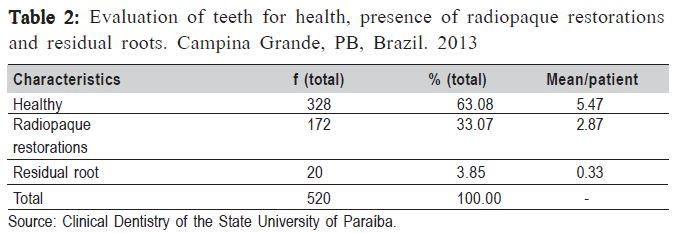
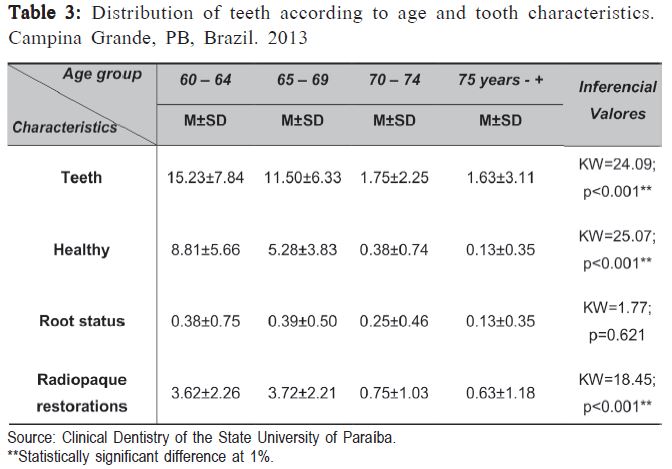
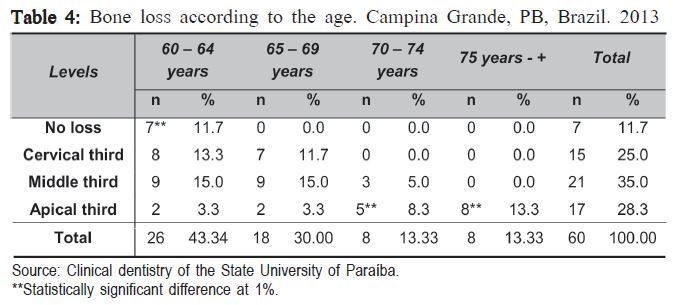
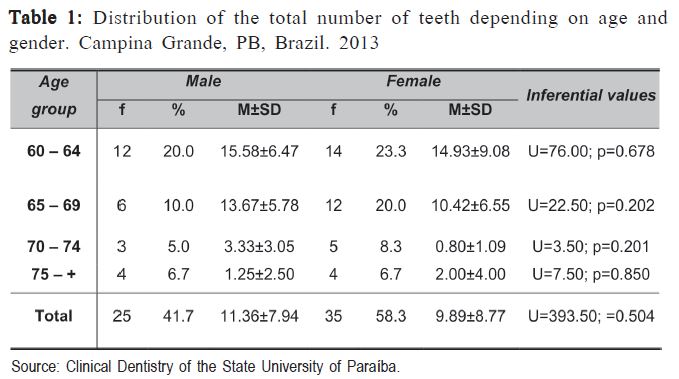
<body><![CDATA[<p>&nbsp;</p>     <p><font face="Verdana, Arial, Helvetica, sans-serif" size="3"><b>Results</b></font></p>     <p><font face="Verdana, Arial, Helvetica, sans-serif" size="2">In the examined sample, most individuals (58.3%) were   female and aged 60&quot;64 years (43.3%). The percentages   corresponding to the other age groups were: 65&quot;69 years,   30.0%; 70&quot;74 years, 13.3%; and 75 or older, 13.3%. Among   the participants, 56.7% had at least one tooth in both arches,   28.3% were totally edentulous, 13.3% were edentulous in the maxillary arch, and 1.7% in the mandibular arch.</font></p>     <p><font face="Verdana, Arial, Helvetica, sans-serif" size="2">  Regarding the teeth present, it was verified that out of   a total of 630, there were 293 teeth in the maxillary arch and   337 teeth in the mandibular arch, resulting in a mean of   10.5 (SD = 8.74) teeth per individual. Among the   participants, 20% had 1&quot;10 teeth, 46.7% had 11&quot;20 teeth,   and 5.0% had over 20 teeth. The mean number of teeth in   males was 11.36 and 9.89 in females. Despite this variation,   there were no statistically significant differences by gender   (U=393.5, p=0504) (<a href="#tab01">Table 1</a>).</font></p>     <p><font face="Verdana, Arial, Helvetica, sans-serif" size="2">  Regarding dental characteristics, the total sum of healthy   teeth was 328 (5.47 per patient). Residual root tissue was   present in 26.7% of participants (0.33 per patient), and   radiopaque fillings were present in 70.0% of patients (2.87   per patient) (<a href="#tab02">Table 2</a>).</font></p>     <p><font face="Verdana, Arial, Helvetica, sans-serif" size="2">  There was a progressive decrease in the number of teeth   corresponding to higher age. The average number of teeth   present in those aged 60&quot;64 years was 15.23 teeth, while the   average decreased to 11.50 in those aged 65&quot;69 years, and,   more drastically, to 1.75 or 1.63 in the group aged 70 and   above (<a href="#tab02">Table 2</a>). This difference was statistically significant   (KW=24.09, p&lt;0.001) (<a href="#tab03">Table 3</a>).</font></p>     <p><font face="Verdana, Arial, Helvetica, sans-serif" size="2">  Bone loss occurred in 88.3% of the participant individuals   at the following levels: cervical/mild, 25.0%; medium/   moderate, 35.0%; and apical/severe, 28.3% (<a href="#tab04">Table 4</a>).</font></p>     <p><font face="Verdana, Arial, Helvetica, sans-serif" size="2">  Tooth loss was statistically correlated with the age of   participants (&divide;&sup2;=10.363, p=0.016). The results suggested a moderate association (V=0.486) and statistical significance   (&divide;&sup2;=42.453, p&lt;0.001), mainly regarding the apical loss   in those aged 70 years and older.</font></p>     <p>&nbsp;</p>     <p><a name="tab01"></a></p>     ]]></body>
<body><![CDATA[<p>&nbsp; </p>     <p align="center"><img src="/img/revistas/bjos/v12n4/a14tab01.jpg">     <p>&nbsp;</p>     <p><a name="tab02"></a></p>     <p>&nbsp; </p>     <p align="center"><img src="/img/revistas/bjos/v12n4/a14tab02.jpg">     <p>&nbsp;</p>     <p><a name="tab03"></a></p>     <p>&nbsp; </p>     <p align="center"><img src="/img/revistas/bjos/v12n4/a14tab03.jpg">     ]]></body>
<body><![CDATA[<p>&nbsp;</p>     <p><a name="tab04"></a></p>     <p>&nbsp; </p>     <p align="center"><img src="/img/revistas/bjos/v12n4/a14tab04.jpg">     <p>&nbsp;</p>     <p><font face="Verdana, Arial, Helvetica, sans-serif" size="3"><b>Discussion</b></font></p>     <p><font face="Verdana, Arial, Helvetica, sans-serif" size="2">In Brazil, there are few studies assessing the current oral   health status of the elderly. This may be due to the low   demand for dental treatment by the elderly, who consider   poor oral health an inevitable consequence of aging. The   extant studies show edentulism, coronal and root carious   lesions, periodontopathy and soft-tissue lesions to be the most frequent changes in this population<sup>12-13</sup>.</font></p>     <p><font face="Verdana, Arial, Helvetica, sans-serif" size="2">  Regarding the gender of the participants, most were   female (58.3%), corroborating a strong trend in the recent   epidemiological studies in elderly populations<sup>13-16</sup>. The greater   female presence may be associated with the phenomenon of   the "feminization of old age", as women are majority in the   world's elderly population, and there is a global difference   in life expectancy between the genders. Mastroeni et al.<sup>18</sup>   and Costa et al.<sup>19</sup>, affirm that the current predominance of   women over 60 years, in proportions that increase with age,   is an important aspect to consider in the planning of local   programs to assist senior citizens.</font></p>     <p><font face="Verdana, Arial, Helvetica, sans-serif" size="2">  The age group with the largest number of participants   was the 60-64year-old age group, which represented 43.3%   of the total. The behavior was similar in both genders.   However, the subgroup that grew most rapidly in the last 10   years is the group aged 75 years or more, according to data   from the American Geriatrics Society<sup>20</sup>.</font></p>     <p><font face="Verdana, Arial, Helvetica, sans-serif" size="2">  In the analysis of oral conditions, it was observed that   28.3% showed total edentulism, similar to the findings of Talwar,   Malik and Sharma<sup>21</sup>. Other studies show an even worse situation,   such as the one reported by Costa et al.<sup>19</sup> (31,1%), Simunkovic   et al.<sup>22</sup> (45,3%) and Mack et al.<sup>23</sup>: 16% in the age group from   60-65 years and 30% in the age range from 75 to 79 years.</font></p>     ]]></body>
<body><![CDATA[<p><font face="Verdana, Arial, Helvetica, sans-serif" size="2">  Other studies that evaluated the oral health status of   the elderly population by radiographs also found a high   incidence of total edentulism, such as the study conducted   by Soikkonen et al.<sup>24</sup>, who evaluated the oral radiographs of   293 senior citizens between 76 and 86 years old and found,   that 124 were completely edentulous. Additionally, the study   conducted by Karhunen et al.<sup>25</sup> with radiographic evaluation   of the dental health of men aged 33&quot;69 years by panoramic   radiographs taken in autopsies, found that 17.4% of men   were completely edentulous.</font></p>     <p><font face="Verdana, Arial, Helvetica, sans-serif" size="2">  According to Alcantara et al.<sup>17</sup>, the suboptimal status of   the elderly Brazilian population's oral health is due to the   lack of preventive attitudes by the dentists, who, for some   years performed unnecessary extractions that were possibly   iatrogenic, and this increased the rate of edentulism in the   country. The partial or total loss of teeth is a large part of an   irreversible and cumulative process. According to Rihs et   al.<sup>26</sup> this scenario may reflect the difficulty of access to dental   services for a large portion of the Brazilian population or   even the lack of importance assigned by these individuals   to oral health along their lives.</font></p>     <p><font face="Verdana, Arial, Helvetica, sans-serif" size="2">  Based on the situations observed in the current study, it   is believed that the poor oral health conditions arise from the   fact that there has been no policy for oral health education for   this population in their lives. This implies that this population   does not actively seek dental care because they are not aware   that poor dental health is not a necessary part of aging.</font></p>     <p><font face="Verdana, Arial, Helvetica, sans-serif" size="2">  Regarding the teeth found present in the study, there was a   total of 630 teeth, with an average of 10.5 teeth per individual.   The average number of teeth in males was 11.36 and 9.89 in   females. The healthy teeth amounted to a total of 328, an average   of 5.47 per patient, and 172, or an average of 2.87 per participant   showing radiopaque restoration. These results are similar to those   found in other studies that show poor oral conditions, such as   Mack et al.<sup>23</sup>. In their study, 26% of the participants aged 60&quot;69   years and 17% of those in the aged 70-79 years had the examined   teeth restored, and dental caries were found in 2% of the teeth   in both age groups. Simunkovic et al.<sup>22</sup> reported that the average   number of decayed teeth was 1.03 per participant and 0.74   restored teeth per participant, and approximately 9 teeth per   person needed treatment.</font></p>     <p><font face="Verdana, Arial, Helvetica, sans-serif" size="2">  Periodontal disease, expressed as gingival inflammation   and retraction, tooth root exposure, and loss of alveolar bone   structure supporting the teeth, was found as a major cause of   tooth loss in adults<sup>5</sup>. In their study, Carneiro et al.<sup>12</sup> selected   293 subjects, stratified according to age and gender. More   than 94% of the subjects showed calculus as the ultimate   sign of periodontal neglect; only 1.8% had healthy   periodontal conditions, and 33.3% had insertion losses of   6&quot;8 mm. In this study, 88.3% of the elders had periodontal   bone loss, which varied from moderate (35.0%) to severe   (28.3%), similar to the study of Mack et al.<sup>23</sup> where the   prevalence of periodontal disease was higher in men and   among the younger subjects (men aged 60-69 years: 85% vs.   71% in 70-79-year-old men; women aged 60-69 years: 71%   vs. 62% in 70-79-years), which is possibly associated with   oral hygiene, according to Viana et al.<sup>16</sup>.</font></p>     <p><font face="Verdana, Arial, Helvetica, sans-serif" size="2">  Aging with dignity is a desire in every society, but this   will only be achieved when it is translated into a better quality   of life. The National Oral Health Policy of the Ministry of   Health emphasizes its goal to increase the number of Brazilian   adults and senior citizens who possess a satisfactory quality   of life level relative to their oral health. However, according   to Saintrain et al.<sup>27</sup> and Matheus et al.<sup>28</sup>, the dentistry area as   a whole should incorporate a new mind frame in training   professionals, based on interdisciplinary and comprehensive   health care for the elderly individuals, to meet the demands   of patients in this age group. This would require training   professionals to specialize in geriatric dentistry, specific to   all levels of senior citizens' care, involving not only the   professional team, but also the senior citizens and their   families, the authorities and the community through more   objective and effective integrated actions.</font></p>     <p><font face="Verdana, Arial, Helvetica, sans-serif" size="2">  Given the high incidence of edentulism, the large number   of restored teeth and poor periodontal conditions found in   elderly test subjects, it is clear that there is a need to take   steps in the community towards providing full and   comprehensive oral health care to senior citizens.</font></p>     <p>&nbsp;</p>     <p><font face="Verdana, Arial, Helvetica, sans-serif" size="3"><b>Acknowledgments</b></font></p>     <p><font face="Verdana, Arial, Helvetica, sans-serif" size="2">  The authors are grateful to the National Council for   Scientific and Technological Development (CNPq) for financial support.</font></p>     ]]></body>
<body><![CDATA[<p>&nbsp;</p>     <p><font face="Verdana, Arial, Helvetica, sans-serif" size="3"><b>References</b></font></p>     <!-- ref --><p><font face="Verdana, Arial, Helvetica, sans-serif" size="2">1. WHO Library Cataloguing in Publication Data. Integrating poverty and   gender into health programmes: a sourcebook for health professionals: module on ageing. Geneva: WHO; 2006.    &nbsp;&nbsp;&nbsp;&nbsp;&nbsp;&nbsp;&nbsp;&nbsp;[&#160;<a href="javascript:void(0);" onclick="javascript: window.open('/scielo.php?script=sci_nlinks&ref=054243&pid=S1677-3225201300030001400001&lng=','','width=640,height=500,resizable=yes,scrollbars=1,menubar=yes,');">Links</a>&#160;]<!-- end-ref --></font></p>     <!-- ref --><p><font face="Verdana, Arial, Helvetica, sans-serif" size="2"> 2. Carvalho JAM, Garcia RA. The aging process in the Brazilian population:   a demographic approach. Reports in Public Health. 2003; 19: 725-33.    &nbsp;&nbsp;&nbsp;&nbsp;&nbsp;&nbsp;&nbsp;&nbsp;[&#160;<a href="javascript:void(0);" onclick="javascript: window.open('/scielo.php?script=sci_nlinks&ref=054245&pid=S1677-3225201300030001400002&lng=','','width=640,height=500,resizable=yes,scrollbars=1,menubar=yes,');">Links</a>&#160;]<!-- end-ref --></font></p>     <!-- ref --><p><font face="Verdana, Arial, Helvetica, sans-serif" size="2"> 3. Lima-Costa MF, Veras R. Aging and public health. Reports in Public   Health. 2003; 19: 700-1.    &nbsp;&nbsp;&nbsp;&nbsp;&nbsp;&nbsp;&nbsp;&nbsp;[&#160;<a href="javascript:void(0);" onclick="javascript: window.open('/scielo.php?script=sci_nlinks&ref=054247&pid=S1677-3225201300030001400003&lng=','','width=640,height=500,resizable=yes,scrollbars=1,menubar=yes,');">Links</a>&#160;]<!-- end-ref --></font></p>     <!-- ref --><p><font face="Verdana, Arial, Helvetica, sans-serif" size="2"> 4. Pan American Health Organization. Managerial network of informations for   health. Report of situations and trends: demographic and health. Bras&iacute;lia:   2009.    &nbsp;&nbsp;&nbsp;&nbsp;&nbsp;&nbsp;&nbsp;&nbsp;[&#160;<a href="javascript:void(0);" onclick="javascript: window.open('/scielo.php?script=sci_nlinks&ref=054249&pid=S1677-3225201300030001400004&lng=','','width=640,height=500,resizable=yes,scrollbars=1,menubar=yes,');">Links</a>&#160;]<!-- end-ref --></font></p>     ]]></body>
<body><![CDATA[<!-- ref --><p><font face="Verdana, Arial, Helvetica, sans-serif" size="2"> 5. Cardoso EM, Parente RCP, Vettore MV, Rebelo MAB. Oral health   conditions of elderly residents in the city of Manaus, Amazonas: estimates   by sex. Brazilian Journal of Epidemiology. 2011; 14: 131-40.    &nbsp;&nbsp;&nbsp;&nbsp;&nbsp;&nbsp;&nbsp;&nbsp;[&#160;<a href="javascript:void(0);" onclick="javascript: window.open('/scielo.php?script=sci_nlinks&ref=054251&pid=S1677-3225201300030001400005&lng=','','width=640,height=500,resizable=yes,scrollbars=1,menubar=yes,');">Links</a>&#160;]<!-- end-ref --></font></p>     <!-- ref --><p><font face="Verdana, Arial, Helvetica, sans-serif" size="2"> 6. Brazil. Health of Ministry. Department of health care. Department of primary   care. SB Brasil 2010. National Survey of Oral Health: preliminary results.   Bras&iacute;lia: Health of Ministry; 2011.    &nbsp;&nbsp;&nbsp;&nbsp;&nbsp;&nbsp;&nbsp;&nbsp;[&#160;<a href="javascript:void(0);" onclick="javascript: window.open('/scielo.php?script=sci_nlinks&ref=054253&pid=S1677-3225201300030001400006&lng=','','width=640,height=500,resizable=yes,scrollbars=1,menubar=yes,');">Links</a>&#160;]<!-- end-ref --></font></p>     <!-- ref --><p><font face="Verdana, Arial, Helvetica, sans-serif" size="2"> 7. Oliveira MC, Schoffen JPF. Oxidative Stress Action in Cellular Aging.   Braz Arch Biol Technol. 2010; 53: 1333-42.    &nbsp;&nbsp;&nbsp;&nbsp;&nbsp;&nbsp;&nbsp;&nbsp;[&#160;<a href="javascript:void(0);" onclick="javascript: window.open('/scielo.php?script=sci_nlinks&ref=054255&pid=S1677-3225201300030001400007&lng=','','width=640,height=500,resizable=yes,scrollbars=1,menubar=yes,');">Links</a>&#160;]<!-- end-ref --></font></p>     <!-- ref --><p><font face="Verdana, Arial, Helvetica, sans-serif" size="2"> 8. Matos FD, Freitas EV, Py L et al. Diseases of high digestive tract. In:   Freitas EV, Py L, Cancado FAX et al. Treaty of Geriatrics and Gerontology.   Brasil: Guanabara Koogan, 2006: 641-642.    &nbsp;&nbsp;&nbsp;&nbsp;&nbsp;&nbsp;&nbsp;&nbsp;[&#160;<a href="javascript:void(0);" onclick="javascript: window.open('/scielo.php?script=sci_nlinks&ref=054257&pid=S1677-3225201300030001400008&lng=','','width=640,height=500,resizable=yes,scrollbars=1,menubar=yes,');">Links</a>&#160;]<!-- end-ref --></font></p>     <!-- ref --><p><font face="Verdana, Arial, Helvetica, sans-serif" size="2"> 9. Meloto CB, Rizzatti-Barbosa CM, Gomes SGF, Custodio W. Dental   practice implications of systemic diseases affecting the elderly: a literature   review. Braz J Oral Sci. 2012; 27: 1691-1699.    &nbsp;&nbsp;&nbsp;&nbsp;&nbsp;&nbsp;&nbsp;&nbsp;[&#160;<a href="javascript:void(0);" onclick="javascript: window.open('/scielo.php?script=sci_nlinks&ref=054259&pid=S1677-3225201300030001400009&lng=','','width=640,height=500,resizable=yes,scrollbars=1,menubar=yes,');">Links</a>&#160;]<!-- end-ref --></font></p>     ]]></body>
<body><![CDATA[<!-- ref --><p><font face="Verdana, Arial, Helvetica, sans-serif" size="2"> 10. Haikal DS, Paula AMB, Martins AMEBL, Moreira AN, Ferreira EF. Selfperception   of oral health and impact on quality of life among the elderly: a   quantitative-qualitative approach. Ci&ecirc;ncia &amp; Sa&uacute;de Coletiva. 2011; 16:   3317-3329.    &nbsp;&nbsp;&nbsp;&nbsp;&nbsp;&nbsp;&nbsp;&nbsp;[&#160;<a href="javascript:void(0);" onclick="javascript: window.open('/scielo.php?script=sci_nlinks&ref=054261&pid=S1677-3225201300030001400010&lng=','','width=640,height=500,resizable=yes,scrollbars=1,menubar=yes,');">Links</a>&#160;]<!-- end-ref --></font></p>     <!-- ref --><p><font face="Verdana, Arial, Helvetica, sans-serif" size="2"> 11. Newton JP. Oral health for older people. Gerodontology. 2006; 23: 1-2.    &nbsp;&nbsp;&nbsp;&nbsp;&nbsp;&nbsp;&nbsp;&nbsp;[&#160;<a href="javascript:void(0);" onclick="javascript: window.open('/scielo.php?script=sci_nlinks&ref=054263&pid=S1677-3225201300030001400011&lng=','','width=640,height=500,resizable=yes,scrollbars=1,menubar=yes,');">Links</a>&#160;]<!-- end-ref --></font></p>     <!-- ref --><p><font face="Verdana, Arial, Helvetica, sans-serif" size="2"> 12. Carneiro RMV, Silva DD, Sousa MLS, Wada RS. Oral health of   institutionalized elderly in the eastern zone of S&atilde;o Paulo, Brazil, 1999.   Reports in Public Health. 2005; 21: 1709-1716.    &nbsp;&nbsp;&nbsp;&nbsp;&nbsp;&nbsp;&nbsp;&nbsp;[&#160;<a href="javascript:void(0);" onclick="javascript: window.open('/scielo.php?script=sci_nlinks&ref=054265&pid=S1677-3225201300030001400012&lng=','','width=640,height=500,resizable=yes,scrollbars=1,menubar=yes,');">Links</a>&#160;]<!-- end-ref --></font></p>     <p><font face="Verdana, Arial, Helvetica, sans-serif" size="2"> 13. Andrade FB, Lebr&atilde;o ML, Santos JLF, Duarte YAO. Relationship between   oral health and frailty in community-dwelling elderly individuals in Brazil. J   Am Geriatr Soc. 2013; 61: 809&ndash;814.</font></p>     <!-- ref --><p><font face="Verdana, Arial, Helvetica, sans-serif" size="2"> 14. Rodrigues SM, Oliveira AC, Vargas AMD, Moreira AN, Ferreira EF.   Implications of edentulism on quality of life among elderly. Int J Environ   Res Public Health. 2012; 9: 100-109.    &nbsp;&nbsp;&nbsp;&nbsp;&nbsp;&nbsp;&nbsp;&nbsp;[&#160;<a href="javascript:void(0);" onclick="javascript: window.open('/scielo.php?script=sci_nlinks&ref=054268&pid=S1677-3225201300030001400014&lng=','','width=640,height=500,resizable=yes,scrollbars=1,menubar=yes,');">Links</a>&#160;]<!-- end-ref --></font></p>     <!-- ref --><p><font face="Verdana, Arial, Helvetica, sans-serif" size="2"> 15. Lemos MMC, Zanin L, Jorge MLR, Fl&oacute;rio FM. Oral health conditions and   self-perception among edentulous individuals with different prosthetic status. Braz J Oral Sci. 2013; 12: 5-10.    &nbsp;&nbsp;&nbsp;&nbsp;&nbsp;&nbsp;&nbsp;&nbsp;[&#160;<a href="javascript:void(0);" onclick="javascript: window.open('/scielo.php?script=sci_nlinks&ref=054270&pid=S1677-3225201300030001400015&lng=','','width=640,height=500,resizable=yes,scrollbars=1,menubar=yes,');">Links</a>&#160;]<!-- end-ref --></font></p>     <!-- ref --><p><font face="Verdana, Arial, Helvetica, sans-serif" size="2"> 16. Viana LRF, Castro CP, Pereira HBW, Pereira, AFV, Lopes FF. Is   depression associated with periodontal status in elderly? Braz J Oral Sci.   2013; 12: 20-22.    &nbsp;&nbsp;&nbsp;&nbsp;&nbsp;&nbsp;&nbsp;&nbsp;[&#160;<a href="javascript:void(0);" onclick="javascript: window.open('/scielo.php?script=sci_nlinks&ref=054272&pid=S1677-3225201300030001400016&lng=','','width=640,height=500,resizable=yes,scrollbars=1,menubar=yes,');">Links</a>&#160;]<!-- end-ref --></font></p>     <!-- ref --><p><font face="Verdana, Arial, Helvetica, sans-serif" size="2"> 17. Alc&acirc;ntara CM, Dias CA, Rodrigues SM, Reis FA. Comparative study of   the oral health status of non-institutionalized elderly from Governador   Valadares-MG, with the goal proposed by the World Health Organization,   2010. Physis. 2011; 21: 1023-1044.    &nbsp;&nbsp;&nbsp;&nbsp;&nbsp;&nbsp;&nbsp;&nbsp;[&#160;<a href="javascript:void(0);" onclick="javascript: window.open('/scielo.php?script=sci_nlinks&ref=054274&pid=S1677-3225201300030001400017&lng=','','width=640,height=500,resizable=yes,scrollbars=1,menubar=yes,');">Links</a>&#160;]<!-- end-ref --></font></p>     <!-- ref --><p><font face="Verdana, Arial, Helvetica, sans-serif" size="2"> 18. Mastroeni MF, Erzinger GS, Mastroeni SSBS, Silva NN, Marucci MFN.   Demographic profile of the elderly in the city of Joinville, Santa Catarina: a   household survey. Brazilian Journal of Epidemiology. 2007; 10:190-201.    &nbsp;&nbsp;&nbsp;&nbsp;&nbsp;&nbsp;&nbsp;&nbsp;[&#160;<a href="javascript:void(0);" onclick="javascript: window.open('/scielo.php?script=sci_nlinks&ref=054276&pid=S1677-3225201300030001400018&lng=','','width=640,height=500,resizable=yes,scrollbars=1,menubar=yes,');">Links</a>&#160;]<!-- end-ref --></font></p>     <!-- ref --><p><font face="Verdana, Arial, Helvetica, sans-serif" size="2"> 19. Costa AM, Guimar&atilde;es MCM, Pedrosa SP, N&oacute;brega OT, Bezerra ACB.   Oral health status of elderly women from the Brazilian Federal District.   Ci&ecirc;ncia &amp; Sa&uacute;de Coletiva. 2010; 15: 2207-2213.    &nbsp;&nbsp;&nbsp;&nbsp;&nbsp;&nbsp;&nbsp;&nbsp;[&#160;<a href="javascript:void(0);" onclick="javascript: window.open('/scielo.php?script=sci_nlinks&ref=054278&pid=S1677-3225201300030001400019&lng=','','width=640,height=500,resizable=yes,scrollbars=1,menubar=yes,');">Links</a>&#160;]<!-- end-ref --></font></p>     <!-- ref --><p><font face="Verdana, Arial, Helvetica, sans-serif" size="2"> 20. American Geriatrics Society. Geriatrics in Brazil: A Big Country with Big   Opportunities. J Am Geriatr Soc. 2005; 53: 2018-2022.    &nbsp;&nbsp;&nbsp;&nbsp;&nbsp;&nbsp;&nbsp;&nbsp;[&#160;<a href="javascript:void(0);" onclick="javascript: window.open('/scielo.php?script=sci_nlinks&ref=054280&pid=S1677-3225201300030001400020&lng=','','width=640,height=500,resizable=yes,scrollbars=1,menubar=yes,');">Links</a>&#160;]<!-- end-ref --></font></p>     <!-- ref --><p><font face="Verdana, Arial, Helvetica, sans-serif" size="2"> 21. Talwar M, Malik G, Sharma S. Prevalence of dental caries and periodontal   disease in the elderly of chandigarh - A hospital based study. J Indian Dent   Assoc. 2012; 6: 78-82.    &nbsp;&nbsp;&nbsp;&nbsp;&nbsp;&nbsp;&nbsp;&nbsp;[&#160;<a href="javascript:void(0);" onclick="javascript: window.open('/scielo.php?script=sci_nlinks&ref=054282&pid=S1677-3225201300030001400021&lng=','','width=640,height=500,resizable=yes,scrollbars=1,menubar=yes,');">Links</a>&#160;]<!-- end-ref --></font></p>     <!-- ref --><p><font face="Verdana, Arial, Helvetica, sans-serif" size="2"> 22. Simunkovi&aelig; SK, Boras VV, Panduri&aelig; J, Zili&aelig; IA. Oral health among   institutionalized elderly in Zagreb, Croatia. Gerodontology. 2005; 22: 238-241.    &nbsp;&nbsp;&nbsp;&nbsp;&nbsp;&nbsp;&nbsp;&nbsp;[&#160;<a href="javascript:void(0);" onclick="javascript: window.open('/scielo.php?script=sci_nlinks&ref=054284&pid=S1677-3225201300030001400022&lng=','','width=640,height=500,resizable=yes,scrollbars=1,menubar=yes,');">Links</a>&#160;]<!-- end-ref --></font></p>     <!-- ref --><p><font face="Verdana, Arial, Helvetica, sans-serif" size="2"> 23. Mack F, Mojon P, Budtz-Jorgensen E, Kocher T, Splieth C, Schwahn C, et   al. Caries and periodontal disease of the elderly in Pomerania, Germany:   results of the Study of Health in Pomerania. Gerodontology. 2004; 21: 27-36.    &nbsp;&nbsp;&nbsp;&nbsp;&nbsp;&nbsp;&nbsp;&nbsp;[&#160;<a href="javascript:void(0);" onclick="javascript: window.open('/scielo.php?script=sci_nlinks&ref=054286&pid=S1677-3225201300030001400023&lng=','','width=640,height=500,resizable=yes,scrollbars=1,menubar=yes,');">Links</a>&#160;]<!-- end-ref --></font></p>     <!-- ref --><p><font face="Verdana, Arial, Helvetica, sans-serif" size="2"> 24. Soikkonen K, Wolf J, Salo T, Tilvis R. Radiographic periodontal attachment   loss as an indicator of death risk in the elderly. J Clin Periodontol. 2000;   27: 87-92.    &nbsp;&nbsp;&nbsp;&nbsp;&nbsp;&nbsp;&nbsp;&nbsp;[&#160;<a href="javascript:void(0);" onclick="javascript: window.open('/scielo.php?script=sci_nlinks&ref=054288&pid=S1677-3225201300030001400024&lng=','','width=640,height=500,resizable=yes,scrollbars=1,menubar=yes,');">Links</a>&#160;]<!-- end-ref --></font></p>     <!-- ref --><p><font face="Verdana, Arial, Helvetica, sans-serif" size="2"> 25. Karhunen V, Forss H, Goebeler S, Huhtala H, Ilveskoski E, Kajander O,   et al. Radiographic assessment of dental health in middle-aged men following   sudden cardiac death. J Dent Res. 2006; 1: 89-93.    &nbsp;&nbsp;&nbsp;&nbsp;&nbsp;&nbsp;&nbsp;&nbsp;[&#160;<a href="javascript:void(0);" onclick="javascript: window.open('/scielo.php?script=sci_nlinks&ref=054290&pid=S1677-3225201300030001400025&lng=','','width=640,height=500,resizable=yes,scrollbars=1,menubar=yes,');">Links</a>&#160;]<!-- end-ref --></font></p>     <!-- ref --><p><font face="Verdana, Arial, Helvetica, sans-serif" size="2"> 26. Rihs LB, Silva DD, Sousa MLR. Dental caries in an elderly population in   Brasil. J Appl Oral Sci. 2009; 17: 8-12.    &nbsp;&nbsp;&nbsp;&nbsp;&nbsp;&nbsp;&nbsp;&nbsp;[&#160;<a href="javascript:void(0);" onclick="javascript: window.open('/scielo.php?script=sci_nlinks&ref=054292&pid=S1677-3225201300030001400026&lng=','','width=640,height=500,resizable=yes,scrollbars=1,menubar=yes,');">Links</a>&#160;]<!-- end-ref --></font></p>     <!-- ref --><p><font face="Verdana, Arial, Helvetica, sans-serif" size="2"> 27. Saintrain MVL, Souza EHA, Caldas J&uacute;nior AF. Geriatric dentistry in   Brazilian universities. Gerodontology. 2006; 23: 231-236.    &nbsp;&nbsp;&nbsp;&nbsp;&nbsp;&nbsp;&nbsp;&nbsp;[&#160;<a href="javascript:void(0);" onclick="javascript: window.open('/scielo.php?script=sci_nlinks&ref=054294&pid=S1677-3225201300030001400027&lng=','','width=640,height=500,resizable=yes,scrollbars=1,menubar=yes,');">Links</a>&#160;]<!-- end-ref --></font></p>     <!-- ref --><p><font face="Verdana, Arial, Helvetica, sans-serif" size="2"> 28. Matthews DC, Clovis JB, Brillant MGS, Filiaggi MJ, McNally ME,   Kotzer RD et al. Oral health status of long-term care residents - A vulnerable   population. J Can Dent Assoc. 2012; 78: 1-10.    &nbsp;&nbsp;&nbsp;&nbsp;&nbsp;&nbsp;&nbsp;&nbsp;[&#160;<a href="javascript:void(0);" onclick="javascript: window.open('/scielo.php?script=sci_nlinks&ref=054296&pid=S1677-3225201300030001400028&lng=','','width=640,height=500,resizable=yes,scrollbars=1,menubar=yes,');">Links</a>&#160;]<!-- end-ref --></font></p>     <p>&nbsp;</p>     <p>&nbsp;</p>     <p><font face="Verdana, Arial, Helvetica, sans-serif" size="2"><a name="back"/></a><a href="#top"><img src="/img/revistas/bjos/v12n4/seta.jpg" border="0" align="absmiddle"/></a>    <b>Correspondence:</b> <br/>   Francisco Ivison Rodrigues Limeira    ]]></body>
<body><![CDATA[<br>   Avenida Baraunas, 351, CEP: 58109-753    <br>   Universidade Estadual da Para&iacute;ba    <br>   Campus Universit&aacute;rio Bodocong&oacute;, Campina    <br>   Grande, Para&iacute;ba, Brasil<br/>   E-mail: <a href="mailto:ivisonodontoce@hotmail.com">ivisonodontoce@hotmail.com</a></font></p>     <p><font face="Verdana, Arial, Helvetica, sans-serif" size="2"><b>Received for    publication:</b> September 29, 2013<br/>   <b>Accepted:</b> December 17, 2013</font></p>      ]]></body>
<back>
<ref-list>
<ref id="B1">
<label>1</label><nlm-citation citation-type="book">
<collab>WHO Library Cataloguing in Publication Data.</collab>
<source><![CDATA[Integrating poverty and gender into health programmes: a sourcebook for health professionals: module on ageing.]]></source>
<year>2006</year>
<publisher-loc><![CDATA[Geneva ]]></publisher-loc>
<publisher-name><![CDATA[WHO]]></publisher-name>
</nlm-citation>
</ref>
<ref id="B2">
<label>2</label><nlm-citation citation-type="journal">
<person-group person-group-type="author">
<name>
<surname><![CDATA[Carvalho]]></surname>
<given-names><![CDATA[JAM]]></given-names>
</name>
<name>
<surname><![CDATA[Garcia]]></surname>
<given-names><![CDATA[RA.]]></given-names>
</name>
</person-group>
<article-title xml:lang="en"><![CDATA[The aging process in the Brazilian population: a demographic approach.]]></article-title>
<source><![CDATA[Reports in Public Health.]]></source>
<year>2003</year>
<volume>19</volume>
<page-range>725-33</page-range></nlm-citation>
</ref>
<ref id="B3">
<label>3</label><nlm-citation citation-type="journal">
<person-group person-group-type="author">
<name>
<surname><![CDATA[Lima-Costa]]></surname>
<given-names><![CDATA[MF]]></given-names>
</name>
<name>
<surname><![CDATA[Veras]]></surname>
<given-names><![CDATA[R.]]></given-names>
</name>
</person-group>
<article-title xml:lang="en"><![CDATA[Aging and public health.]]></article-title>
<source><![CDATA[Reports in Public Health.]]></source>
<year>2003</year>
<volume>19</volume>
<page-range>700-1</page-range></nlm-citation>
</ref>
<ref id="B4">
<label>4</label><nlm-citation citation-type="">
<collab>Pan American Health Organization.</collab>
<source><![CDATA[Managerial network of informations for health.: Report of situations and trends: demographic and health.]]></source>
<year>2009</year>
<publisher-loc><![CDATA[Brasília ]]></publisher-loc>
</nlm-citation>
</ref>
<ref id="B5">
<label>5</label><nlm-citation citation-type="journal">
<person-group person-group-type="author">
<name>
<surname><![CDATA[Cardoso]]></surname>
<given-names><![CDATA[EM]]></given-names>
</name>
<name>
<surname><![CDATA[Parente]]></surname>
<given-names><![CDATA[RCP]]></given-names>
</name>
<name>
<surname><![CDATA[Vettore]]></surname>
<given-names><![CDATA[MV]]></given-names>
</name>
<name>
<surname><![CDATA[Rebelo]]></surname>
<given-names><![CDATA[MAB.]]></given-names>
</name>
</person-group>
<article-title xml:lang="en"><![CDATA[Oral health conditions of elderly residents in the city of Manaus, Amazonas: estimates by sex.]]></article-title>
<source><![CDATA[Brazilian Journal of Epidemiology.]]></source>
<year>2011</year>
<volume>14</volume>
<page-range>131-40</page-range></nlm-citation>
</ref>
<ref id="B6">
<label>6</label><nlm-citation citation-type="book">
<collab>Brazil^dHealth of Ministry. Department of health care. Department of primary care. SB Brasil 2010</collab>
<source><![CDATA[National Survey of Oral Health: preliminary results]]></source>
<year>2011</year>
<publisher-loc><![CDATA[Brasília ]]></publisher-loc>
<publisher-name><![CDATA[Health of Ministry]]></publisher-name>
</nlm-citation>
</ref>
<ref id="B7">
<label>7</label><nlm-citation citation-type="journal">
<person-group person-group-type="author">
<name>
<surname><![CDATA[Oliveira]]></surname>
<given-names><![CDATA[MC]]></given-names>
</name>
<name>
<surname><![CDATA[Schoffen]]></surname>
<given-names><![CDATA[JPF.]]></given-names>
</name>
</person-group>
<article-title xml:lang="en"><![CDATA[Oxidative Stress Action in Cellular Aging.]]></article-title>
<source><![CDATA[Braz Arch Biol Technol]]></source>
<year>2010</year>
<volume>53</volume>
<page-range>1333-42</page-range></nlm-citation>
</ref>
<ref id="B8">
<label>8</label><nlm-citation citation-type="book">
<person-group person-group-type="author">
<name>
<surname><![CDATA[Matos]]></surname>
<given-names><![CDATA[FD]]></given-names>
</name>
<name>
<surname><![CDATA[Freitas]]></surname>
<given-names><![CDATA[EV]]></given-names>
</name>
<name>
<surname><![CDATA[Py]]></surname>
<given-names><![CDATA[L]]></given-names>
</name>
</person-group>
<article-title xml:lang="en"><![CDATA[Diseases of high digestive tract.]]></article-title>
<person-group person-group-type="editor">
<name>
<surname><![CDATA[Freitas]]></surname>
<given-names><![CDATA[EV]]></given-names>
</name>
<name>
<surname><![CDATA[Py]]></surname>
<given-names><![CDATA[L]]></given-names>
</name>
<name>
<surname><![CDATA[Cancado]]></surname>
<given-names><![CDATA[FAX]]></given-names>
</name>
</person-group>
<source><![CDATA[Treaty of Geriatrics and Gerontology.]]></source>
<year>2006</year>
<page-range>641-642</page-range><publisher-loc><![CDATA[Brasil ]]></publisher-loc>
<publisher-name><![CDATA[Guanabara Koogan]]></publisher-name>
</nlm-citation>
</ref>
<ref id="B9">
<label>9</label><nlm-citation citation-type="journal">
<person-group person-group-type="author">
<name>
<surname><![CDATA[Meloto]]></surname>
<given-names><![CDATA[CB]]></given-names>
</name>
<name>
<surname><![CDATA[Rizzatti-Barbosa]]></surname>
<given-names><![CDATA[CM]]></given-names>
</name>
<name>
<surname><![CDATA[Gomes]]></surname>
<given-names><![CDATA[SGF]]></given-names>
</name>
<name>
<surname><![CDATA[Custodio]]></surname>
<given-names><![CDATA[W.]]></given-names>
</name>
</person-group>
<article-title xml:lang="en"><![CDATA[Dental practice implications of systemic diseases affecting the elderly: a literature review.]]></article-title>
<source><![CDATA[Braz J Oral Sci.]]></source>
<year>2012</year>
<volume>27</volume>
<page-range>1691-1699</page-range></nlm-citation>
</ref>
<ref id="B10">
<label>10</label><nlm-citation citation-type="journal">
<person-group person-group-type="author">
<name>
<surname><![CDATA[Haikal]]></surname>
<given-names><![CDATA[DS]]></given-names>
</name>
<name>
<surname><![CDATA[Paula]]></surname>
<given-names><![CDATA[AMB]]></given-names>
</name>
<name>
<surname><![CDATA[Martins]]></surname>
<given-names><![CDATA[AMEBL]]></given-names>
</name>
<name>
<surname><![CDATA[Moreira]]></surname>
<given-names><![CDATA[AN]]></given-names>
</name>
<name>
<surname><![CDATA[Ferreira]]></surname>
<given-names><![CDATA[EF.]]></given-names>
</name>
</person-group>
<article-title xml:lang="en"><![CDATA[Selfperception of oral health and impact on quality of life among the elderly: a quantitative-qualitative approach.]]></article-title>
<source><![CDATA[Ciência & Saúde Coletiva.]]></source>
<year>2011</year>
<volume>16</volume>
<page-range>3317-3329</page-range></nlm-citation>
</ref>
<ref id="B11">
<label>11</label><nlm-citation citation-type="journal">
<person-group person-group-type="author">
<name>
<surname><![CDATA[Newton]]></surname>
<given-names><![CDATA[JP.]]></given-names>
</name>
</person-group>
<article-title xml:lang="en"><![CDATA[Oral health for older people.]]></article-title>
<source><![CDATA[Gerodontology.]]></source>
<year>2006</year>
<volume>23</volume>
<page-range>1-2</page-range></nlm-citation>
</ref>
<ref id="B12">
<label>12</label><nlm-citation citation-type="journal">
<person-group person-group-type="author">
<name>
<surname><![CDATA[Carneiro]]></surname>
<given-names><![CDATA[RMV]]></given-names>
</name>
<name>
<surname><![CDATA[Silva]]></surname>
<given-names><![CDATA[DD]]></given-names>
</name>
<name>
<surname><![CDATA[Sousa]]></surname>
<given-names><![CDATA[MLS]]></given-names>
</name>
<name>
<surname><![CDATA[Wada]]></surname>
<given-names><![CDATA[RS.]]></given-names>
</name>
</person-group>
<article-title xml:lang="en"><![CDATA[Oral health of institutionalized elderly in the eastern zone of São Paulo, Brazil, 1999.]]></article-title>
<source><![CDATA[Reports in Public Health.]]></source>
<year>2005</year>
<volume>21</volume>
<page-range>1709-1716</page-range></nlm-citation>
</ref>
<ref id="B13">
<label>13</label><nlm-citation citation-type="journal">
<person-group person-group-type="author">
<name>
<surname><![CDATA[Andrade]]></surname>
<given-names><![CDATA[FB]]></given-names>
</name>
<name>
<surname><![CDATA[Lebrão]]></surname>
<given-names><![CDATA[ML]]></given-names>
</name>
<name>
<surname><![CDATA[Santos]]></surname>
<given-names><![CDATA[JLF]]></given-names>
</name>
<name>
<surname><![CDATA[Duarte]]></surname>
<given-names><![CDATA[YAO.]]></given-names>
</name>
</person-group>
<article-title xml:lang="en"><![CDATA[Relationship between oral health and frailty in community-dwelling elderly individuals in Brazil.]]></article-title>
<source><![CDATA[J Am Geriatr Soc.]]></source>
<year>2013</year>
<volume>61</volume>
<page-range>809-814</page-range></nlm-citation>
</ref>
<ref id="B14">
<label>14</label><nlm-citation citation-type="journal">
<person-group person-group-type="author">
<name>
<surname><![CDATA[Rodrigues]]></surname>
<given-names><![CDATA[SM]]></given-names>
</name>
<name>
<surname><![CDATA[Oliveira]]></surname>
<given-names><![CDATA[AC]]></given-names>
</name>
<name>
<surname><![CDATA[Vargas]]></surname>
<given-names><![CDATA[AMD]]></given-names>
</name>
<name>
<surname><![CDATA[Moreira]]></surname>
<given-names><![CDATA[AN]]></given-names>
</name>
<name>
<surname><![CDATA[Ferreira]]></surname>
<given-names><![CDATA[EF.]]></given-names>
</name>
</person-group>
<article-title xml:lang="en"><![CDATA[Implications of edentulism on quality of life among elderly.]]></article-title>
<source><![CDATA[Int J Environ Res Public Health.]]></source>
<year>2012</year>
<volume>9</volume>
<page-range>100-109</page-range></nlm-citation>
</ref>
<ref id="B15">
<label>15</label><nlm-citation citation-type="journal">
<person-group person-group-type="author">
<name>
<surname><![CDATA[Lemos]]></surname>
<given-names><![CDATA[MMC]]></given-names>
</name>
<name>
<surname><![CDATA[Zanin]]></surname>
<given-names><![CDATA[L]]></given-names>
</name>
<name>
<surname><![CDATA[Jorge]]></surname>
<given-names><![CDATA[MLR]]></given-names>
</name>
<name>
<surname><![CDATA[Flório]]></surname>
<given-names><![CDATA[FM.]]></given-names>
</name>
</person-group>
<article-title xml:lang="en"><![CDATA[Oral health conditions and self-perception among edentulous individuals with different prosthetic status.]]></article-title>
<source><![CDATA[Braz J Oral Sci.]]></source>
<year>2013</year>
<volume>12</volume>
<page-range>5-10</page-range></nlm-citation>
</ref>
<ref id="B16">
<label>16</label><nlm-citation citation-type="journal">
<person-group person-group-type="author">
<name>
<surname><![CDATA[Viana]]></surname>
<given-names><![CDATA[LRF]]></given-names>
</name>
<name>
<surname><![CDATA[Castro]]></surname>
<given-names><![CDATA[CP]]></given-names>
</name>
<name>
<surname><![CDATA[Pereira]]></surname>
<given-names><![CDATA[HBW]]></given-names>
</name>
<name>
<surname><![CDATA[Pereira]]></surname>
<given-names><![CDATA[AFV]]></given-names>
</name>
<name>
<surname><![CDATA[Lopes]]></surname>
<given-names><![CDATA[FF.]]></given-names>
</name>
</person-group>
<article-title xml:lang="en"><![CDATA[Is depression associated with periodontal status in elderly]]></article-title>
<source><![CDATA[Braz J Oral Sci.]]></source>
<year>2013</year>
<volume>12</volume>
<page-range>20-22</page-range></nlm-citation>
</ref>
<ref id="B17">
<label>17</label><nlm-citation citation-type="journal">
<person-group person-group-type="author">
<name>
<surname><![CDATA[Alcântara]]></surname>
<given-names><![CDATA[CM]]></given-names>
</name>
<name>
<surname><![CDATA[Dias]]></surname>
<given-names><![CDATA[CA]]></given-names>
</name>
<name>
<surname><![CDATA[Rodrigues]]></surname>
<given-names><![CDATA[SM]]></given-names>
</name>
<name>
<surname><![CDATA[Reis]]></surname>
<given-names><![CDATA[FA.]]></given-names>
</name>
</person-group>
<article-title xml:lang="en"><![CDATA[Comparative study of the oral health status of non-institutionalized elderly from Governador Valadares-MG, with the goal proposed by the World Health Organization, 2010.]]></article-title>
<source><![CDATA[Physis]]></source>
<year>2011</year>
<volume>21</volume>
<page-range>1023-1044</page-range></nlm-citation>
</ref>
<ref id="B18">
<label>18</label><nlm-citation citation-type="journal">
<person-group person-group-type="author">
<name>
<surname><![CDATA[Mastroeni]]></surname>
<given-names><![CDATA[MF]]></given-names>
</name>
<name>
<surname><![CDATA[Erzinger]]></surname>
<given-names><![CDATA[GS]]></given-names>
</name>
<name>
<surname><![CDATA[Mastroeni]]></surname>
<given-names><![CDATA[SSBS]]></given-names>
</name>
<name>
<surname><![CDATA[Silva]]></surname>
<given-names><![CDATA[NN]]></given-names>
</name>
<name>
<surname><![CDATA[Marucci]]></surname>
<given-names><![CDATA[MFN.]]></given-names>
</name>
</person-group>
<article-title xml:lang="en"><![CDATA[Demographic profile of the elderly in the city of Joinville, Santa Catarina: a household survey.]]></article-title>
<source><![CDATA[Brazilian Journal of Epidemiology.]]></source>
<year>2007</year>
<volume>10</volume>
<page-range>190-201</page-range></nlm-citation>
</ref>
<ref id="B19">
<label>19.</label><nlm-citation citation-type="journal">
<person-group person-group-type="author">
<name>
<surname><![CDATA[Costa]]></surname>
<given-names><![CDATA[AM]]></given-names>
</name>
<name>
<surname><![CDATA[Guimarães]]></surname>
<given-names><![CDATA[MCM]]></given-names>
</name>
<name>
<surname><![CDATA[Pedrosa]]></surname>
<given-names><![CDATA[SP]]></given-names>
</name>
<name>
<surname><![CDATA[Nóbrega]]></surname>
<given-names><![CDATA[OT]]></given-names>
</name>
<name>
<surname><![CDATA[Bezerra]]></surname>
<given-names><![CDATA[ACB.]]></given-names>
</name>
</person-group>
<article-title xml:lang="en"><![CDATA[Oral health status of elderly women from the Brazilian Federal District.]]></article-title>
<source><![CDATA[Ciência & Saúde Coletiva.]]></source>
<year>2010</year>
<volume>15</volume>
<page-range>2207-2213</page-range></nlm-citation>
</ref>
<ref id="B20">
<label>20</label><nlm-citation citation-type="journal">
<collab>American Geriatrics Society</collab>
<article-title xml:lang="en"><![CDATA[Geriatrics in Brazil: A Big Country with Big Opportunities.]]></article-title>
<source><![CDATA[J Am Geriatr Soc.]]></source>
<year>2005</year>
<volume>53</volume>
<page-range>2018-2022</page-range></nlm-citation>
</ref>
<ref id="B21">
<label>21</label><nlm-citation citation-type="journal">
<person-group person-group-type="author">
<name>
<surname><![CDATA[Talwar]]></surname>
<given-names><![CDATA[M]]></given-names>
</name>
<name>
<surname><![CDATA[Malik]]></surname>
<given-names><![CDATA[G]]></given-names>
</name>
<name>
<surname><![CDATA[Sharma]]></surname>
<given-names><![CDATA[S.]]></given-names>
</name>
</person-group>
<article-title xml:lang="en"><![CDATA[Prevalence of dental caries and periodontal disease in the elderly of chandigarh - A hospital based study.]]></article-title>
<source><![CDATA[J Indian Dent Assoc.]]></source>
<year>2012</year>
<volume>6</volume>
<page-range>78-82</page-range></nlm-citation>
</ref>
<ref id="B22">
<label>22</label><nlm-citation citation-type="journal">
<person-group person-group-type="author">
<name>
<surname><![CDATA[Simunkoviæ]]></surname>
<given-names><![CDATA[SK]]></given-names>
</name>
<name>
<surname><![CDATA[Boras]]></surname>
<given-names><![CDATA[VV]]></given-names>
</name>
<name>
<surname><![CDATA[Panduriæ]]></surname>
<given-names><![CDATA[J]]></given-names>
</name>
<name>
<surname><![CDATA[Ziliæ]]></surname>
<given-names><![CDATA[IA.]]></given-names>
</name>
</person-group>
<article-title xml:lang="en"><![CDATA[Oral health among institutionalized elderly in Zagreb, Croatia.]]></article-title>
<source><![CDATA[Gerodontology.]]></source>
<year>2005</year>
<volume>22</volume>
<page-range>238-241</page-range></nlm-citation>
</ref>
<ref id="B23">
<label>23</label><nlm-citation citation-type="journal">
<person-group person-group-type="author">
<name>
<surname><![CDATA[Mack]]></surname>
<given-names><![CDATA[F]]></given-names>
</name>
<name>
<surname><![CDATA[Mojon]]></surname>
<given-names><![CDATA[P]]></given-names>
</name>
<name>
<surname><![CDATA[Budtz-Jorgensen]]></surname>
<given-names><![CDATA[E]]></given-names>
</name>
<name>
<surname><![CDATA[Kocher]]></surname>
<given-names><![CDATA[T]]></given-names>
</name>
<name>
<surname><![CDATA[Splieth]]></surname>
<given-names><![CDATA[C]]></given-names>
</name>
<name>
<surname><![CDATA[Schwahn]]></surname>
<given-names><![CDATA[C]]></given-names>
</name>
</person-group>
<article-title xml:lang="en"><![CDATA[Caries and periodontal disease of the elderly in Pomerania, Germany: results of the Study of Health in Pomerania.]]></article-title>
<source><![CDATA[Gerodontology.]]></source>
<year>2004</year>
<volume>21</volume>
<page-range>27-36</page-range></nlm-citation>
</ref>
<ref id="B24">
<label>24</label><nlm-citation citation-type="journal">
<person-group person-group-type="author">
<name>
<surname><![CDATA[Soikkonen]]></surname>
<given-names><![CDATA[K]]></given-names>
</name>
<name>
<surname><![CDATA[Wolf]]></surname>
<given-names><![CDATA[J]]></given-names>
</name>
<name>
<surname><![CDATA[Salo]]></surname>
<given-names><![CDATA[T]]></given-names>
</name>
<name>
<surname><![CDATA[Tilvis]]></surname>
<given-names><![CDATA[R.]]></given-names>
</name>
</person-group>
<article-title xml:lang="en"><![CDATA[Radiographic periodontal attachment loss as an indicator of death risk in the elderly.]]></article-title>
<source><![CDATA[J Clin Periodontol.]]></source>
<year>2000</year>
<volume>27</volume>
<page-range>87-92</page-range></nlm-citation>
</ref>
<ref id="B25">
<label>25</label><nlm-citation citation-type="journal">
<person-group person-group-type="author">
<name>
<surname><![CDATA[Karhunen]]></surname>
<given-names><![CDATA[V]]></given-names>
</name>
<name>
<surname><![CDATA[Forss]]></surname>
<given-names><![CDATA[H]]></given-names>
</name>
<name>
<surname><![CDATA[Goebeler]]></surname>
<given-names><![CDATA[S]]></given-names>
</name>
<name>
<surname><![CDATA[Huhtala]]></surname>
<given-names><![CDATA[H]]></given-names>
</name>
<name>
<surname><![CDATA[Ilveskoski]]></surname>
<given-names><![CDATA[E]]></given-names>
</name>
<name>
<surname><![CDATA[Kajander]]></surname>
<given-names><![CDATA[O]]></given-names>
</name>
</person-group>
<article-title xml:lang="en"><![CDATA[Radiographic assessment of dental health in middle-aged men following sudden cardiac death.]]></article-title>
<source><![CDATA[J Dent Res.]]></source>
<year>2006</year>
<volume>1</volume>
<page-range>89-93</page-range></nlm-citation>
</ref>
<ref id="B26">
<label>26</label><nlm-citation citation-type="journal">
<person-group person-group-type="author">
<name>
<surname><![CDATA[Rihs]]></surname>
<given-names><![CDATA[LB]]></given-names>
</name>
<name>
<surname><![CDATA[Silva]]></surname>
<given-names><![CDATA[DD]]></given-names>
</name>
<name>
<surname><![CDATA[Sousa]]></surname>
<given-names><![CDATA[MLR.]]></given-names>
</name>
</person-group>
<article-title xml:lang="en"><![CDATA[Dental caries in an elderly population in Brasil.]]></article-title>
<source><![CDATA[J Appl Oral Sci.]]></source>
<year>2009</year>
<volume>17</volume>
<page-range>8-12</page-range></nlm-citation>
</ref>
<ref id="B27">
<label>27</label><nlm-citation citation-type="journal">
<person-group person-group-type="author">
<name>
<surname><![CDATA[Saintrain]]></surname>
<given-names><![CDATA[MVL]]></given-names>
</name>
<name>
<surname><![CDATA[Souza]]></surname>
<given-names><![CDATA[EHA]]></given-names>
</name>
<name>
<surname><![CDATA[Caldas Júnior]]></surname>
<given-names><![CDATA[AF.]]></given-names>
</name>
</person-group>
<article-title xml:lang="en"><![CDATA[Geriatric dentistry in Brazilian universities.]]></article-title>
<source><![CDATA[Gerodontology.]]></source>
<year>2006</year>
<volume>23</volume>
<page-range>231-236</page-range></nlm-citation>
</ref>
<ref id="B28">
<label>28</label><nlm-citation citation-type="journal">
<person-group person-group-type="author">
<name>
<surname><![CDATA[Matthews]]></surname>
<given-names><![CDATA[DC]]></given-names>
</name>
<name>
<surname><![CDATA[Clovis]]></surname>
<given-names><![CDATA[JB]]></given-names>
</name>
<name>
<surname><![CDATA[Brillant]]></surname>
<given-names><![CDATA[MGS]]></given-names>
</name>
<name>
<surname><![CDATA[Filiaggi]]></surname>
<given-names><![CDATA[MJ]]></given-names>
</name>
<name>
<surname><![CDATA[McNally]]></surname>
<given-names><![CDATA[ME]]></given-names>
</name>
<name>
<surname><![CDATA[Kotzer]]></surname>
<given-names><![CDATA[RD]]></given-names>
</name>
</person-group>
<article-title xml:lang="en"><![CDATA[Oral health status of long-term care residents - A vulnerable population.]]></article-title>
<source><![CDATA[J Can Dent Assoc.]]></source>
<year>2012</year>
<volume>78</volume>
<page-range>1-10</page-range></nlm-citation>
</ref>
</ref-list>
</back>
</article>