
<?xml version="1.0" encoding="ISO-8859-1"?><article xmlns:mml="http://www.w3.org/1998/Math/MathML" xmlns:xlink="http://www.w3.org/1999/xlink" xmlns:xsi="http://www.w3.org/2001/XMLSchema-instance">
<front>
<journal-meta>
<journal-id>1980-6523</journal-id>
<journal-title><![CDATA[Revista Odonto Ciência (Online)]]></journal-title>
<abbrev-journal-title><![CDATA[Rev. odonto ciênc. (Online)]]></abbrev-journal-title>
<issn>1980-6523</issn>
<publisher>
<publisher-name><![CDATA[Pontifícia Universidade Católica do Rio Grande do Sul]]></publisher-name>
</publisher>
</journal-meta>
<article-meta>
<article-id>S1980-65232010000300004</article-id>
<title-group>
<article-title xml:lang="en"><![CDATA[Fluoride intake in preschoolers from two different communes in Santiago, Chile]]></article-title>
<article-title xml:lang="pt"><![CDATA[Ingestão de flúor em crianças pré-escolares de duas comunidades em Santiago, Chile]]></article-title>
</title-group>
<contrib-group>
<contrib contrib-type="author">
<name>
<surname><![CDATA[Yévenes]]></surname>
<given-names><![CDATA[Ismael]]></given-names>
</name>
<xref ref-type="aff" rid="A01"/>
</contrib>
<contrib contrib-type="author">
<name>
<surname><![CDATA[Henández]]></surname>
<given-names><![CDATA[Barbara]]></given-names>
</name>
<xref ref-type="aff" rid="A02"/>
</contrib>
<contrib contrib-type="author">
<name>
<surname><![CDATA[Ramos]]></surname>
<given-names><![CDATA[Alfredo Apip]]></given-names>
</name>
<xref ref-type="aff" rid="A02"/>
</contrib>
<contrib contrib-type="author">
<name>
<surname><![CDATA[Jara]]></surname>
<given-names><![CDATA[Miguel Neira]]></given-names>
</name>
<xref ref-type="aff" rid="A01"/>
</contrib>
<contrib contrib-type="author">
<name>
<surname><![CDATA[Wolfenson]]></surname>
<given-names><![CDATA[Paula Maass]]></given-names>
</name>
<xref ref-type="aff" rid="A01"/>
</contrib>
<contrib contrib-type="author">
<name>
<surname><![CDATA[Petrasic]]></surname>
<given-names><![CDATA[Ljubica]]></given-names>
</name>
<xref ref-type="aff" rid="A01"/>
</contrib>
</contrib-group>
<aff id="A01">
<institution><![CDATA[,University of Chile Dental School Department of Chemical]]></institution>
<addr-line><![CDATA[Santiago ]]></addr-line>
<country>Chile</country>
</aff>
<aff id="A02">
<institution><![CDATA[,University of Chile Dental School Department of Restorative Dentistry]]></institution>
<addr-line><![CDATA[Santiago ]]></addr-line>
<country>Chile</country>
</aff>
<pub-date pub-type="pub">
<day>00</day>
<month>09</month>
<year>2010</year>
</pub-date>
<pub-date pub-type="epub">
<day>00</day>
<month>09</month>
<year>2010</year>
</pub-date>
<volume>25</volume>
<numero>3</numero>
<fpage>239</fpage>
<lpage>244</lpage>
<copyright-statement/>
<copyright-year/>
<self-uri xlink:href="http://revodonto.bvsalud.org/scielo.php?script=sci_arttext&amp;pid=S1980-65232010000300004&amp;lng=en&amp;nrm=iso"></self-uri><self-uri xlink:href="http://revodonto.bvsalud.org/scielo.php?script=sci_abstract&amp;pid=S1980-65232010000300004&amp;lng=en&amp;nrm=iso"></self-uri><self-uri xlink:href="http://revodonto.bvsalud.org/scielo.php?script=sci_pdf&amp;pid=S1980-65232010000300004&amp;lng=en&amp;nrm=iso"></self-uri><abstract abstract-type="short" xml:lang="en"><p><![CDATA[PURPOSE: To determine the fluoride intake in three- to five-year-old preschool children from two communes in Chile, one with a non-fluoridated public water supply (Maipú) and the other with fluoridated public water supply since 1996, at a fluoride concentration of 0.6 mg/L (Peñalolen). METHODS: Cross-sectional, observational design. The sample population was composed of 200 three-to-five-year-old children attending four kindergartens in the Santiago Metropolitan Region, Chile, in the communes of Maipú and Peñalolen. Intake of fluoride was measured in a morning urine sample by using an ion-specific electrode and creatinine concentration. The fluoride intake from other sources was estimated from the parents' and educators' survey answers. RESULTS: The daily dose of fluoride intake (DDI) for all Maipú preschoolers was 0.021 mg F/kg body weight (bw)/day, a value less than the optimal dose, which is 0.05 to 0.07 mg F/kg bw/day. The DDI for the Peñalolen sample reached 0.066 mg F/kg bw/day. There is a contribution from fluoride toothpaste ingestion of 0.019 mg F/kg bw/day in Maipú and 0.017 mg F/kg bw/day in Peñalolen. The overall frequency of daily brushing was 3.15 times, during which 31% of Maipú children and 33% of Peñalolen children ingested toothpaste. The estimated amount of fluoride intake from toothpaste and tea consumption explained the contribution of fluoride not coming from fluoridated water. CONCLUSION: The fluoride ingestion from water and other sources in the preschool commune of Peñalolen is much higher than the fluoride intake in preschoolers of the Maipú district.]]></p></abstract>
<abstract abstract-type="short" xml:lang="pt"><p><![CDATA[OBJETIVO: Determinar a ingestão de flúor em pré-escolares de três a cinco anos de idade, de duas comunidades de Santiago, Chile, sendo uma com abastecimento público de água não fluoretada e outra com água fluoretada. METODOLOGIA: Estudo observacional, transversal. A amostra foi composta de 200 crianças de três a cinco anos de idade, com boa saúde geral, de baixo nível socioeconómico, que frequentavam quatro jardins de infância da Região Metropolitana de Santiago, Chile. Duas escolas estavam localizadas em Maipú, que não tem água pública fluoretada e duas escolas estavam localizadas em Peñalolén, com água fluoretada desde 1996, em uma concentração de flúor de 0,6 mg/L. A ingestão de flúor foi medida em uma amostra de urina da manhã, medindo-se o flúor com eletrodo íon-específico e concentração de creatinina com o produto comercial VALTEK (R). A ingestão de flúor estimado de outros veículos foi avaliada por questionários aos pais e educadores. RESULTADOS: A dose diária de ingestão de flúor (DDI) para todos os pré-escolares Maipú foi 0,021 mg F/kg peso corporal (pc)/dia, um valor menor do que a dose ideal de flúor, de 0,05 para 0,07 mg F/kg corporal/dia. Na amostra de Peñalolen a DDI atingiu 0.066 mg F/kg corporal/dia, dentro dos parâmetros ideais. Houve cerca de 0,019 mg F/kg bw/dia em Maipú e 0.017 mg F/kg corporal/dia em Peñalolén proveniente da ingestão de creme dental com flúor. A frequência de escovação diária foi de 3,15 vezes, sendo que 31% das crianças de Maipú e 33% das crianças Peñalolen ingeriam creme dental. Cerca de 46,5% das crianças bebia chá todos os dias. A estimativa para a quantidade de ingestão de flúor do creme dental e consumo de chá explica a contribuição de flúor não proveniente de água fluoretada. CONCLUSÃO: A ingestão de flúor da água e outras fontes no município de Peñalolen pré-escolar é muito maior que a ingestão de flúor em pré-escolares do distrito de Maipú.]]></p></abstract>
<kwd-group>
<kwd lng="en"><![CDATA[Fluoride]]></kwd>
<kwd lng="en"><![CDATA[children]]></kwd>
<kwd lng="en"><![CDATA[ingestion]]></kwd>
<kwd lng="pt"><![CDATA[Flúor]]></kwd>
<kwd lng="pt"><![CDATA[crianças]]></kwd>
<kwd lng="pt"><![CDATA[ingestão]]></kwd>
</kwd-group>
</article-meta>
</front><body><![CDATA[ <p align="right"><font size="2" face="Verdana"><b>ORIGINAL ARTICLE</b></font></p>    <p>&nbsp;</p>    <p><font size="4" face="verdana"><a name="tx"></a><b>Fluoride  intake in preschoolers from two different communes in Santiago, Chile</b></font></p>    <p>&nbsp;</p>    <p><font size="3" face="Verdana"><b>Ingest&atilde;o  de fl&uacute;or em crian&ccedil;as pr&eacute;&#45;escolares de duas comunidades  em Santiago, Chile</b></font></p>    <p>&nbsp;</p>    <p>&nbsp;</p>    <p><font size="2" face="Verdana"><b>Ismael  Y&eacute;venes<Sup>I</Sup>; Barbara Hen&aacute;ndez<Sup>II</Sup>; Alfredo Apip  Ramos<Sup>II</Sup>; Miguel Neira Jara<Sup>I</Sup>; Paula Maass Wolfenson<Sup>I</Sup>;  Ljubica Petrasic<Sup>I</Sup></b> </font></p>    <p><font size="2" face="Verdana"><Sup>I</Sup>Department  of Chemical, Dental School, University of Chile, Santiago, Chile    <br> <Sup>II</Sup>Department  of Restorative Dentistry, Dental School, University of Chile, Santiago, Chile</font></p>    ]]></body>
<body><![CDATA[<p><font size="2" face="Verdana"><a href="#nt">Correspondence</a></font></p>    <p>&nbsp;</p>    <p>&nbsp;</p><hr size="1" noshade>      <p><font size="2" face="Verdana"><B>ABSTRACT</B></font></p>    <p><font size="2" face="Verdana"><B>PURPOSE:  </B> To determine the fluoride intake in three&#45; to five&#45;year&#45;old preschool  children from two communes in Chile, one with a non&#45;fluoridated public water  supply (Maip&uacute;) and the other with fluoridated public water supply since  1996, at a fluoride concentration of 0.6 mg/L (Pe&ntilde;alolen).    <BR> <B>METHODS:  </B>Cross&#45;sectional, observational design. The sample population was composed  of 200 three&#45;to&#45;five&#45;year&#45;old children attending four kindergartens  in the Santiago Metropolitan Region, Chile, in the communes of Maip&uacute; and  Pe&ntilde;alolen. Intake of fluoride was measured in a morning urine sample by  using an ion&#45;specific electrode and creatinine concentration. The fluoride  intake from other sources was estimated from the parents' and educators' survey  answers.    <BR> <B>RESULTS: </B> The daily dose of fluoride intake (DDI) for all  Maip&uacute; preschoolers was 0.021 mg F/kg body weight (bw)/day, a value less  than the optimal dose, which is 0.05 to 0.07 mg F/kg bw/day. The DDI for the Pe&ntilde;alolen  sample reached 0.066 mg F/kg bw/day. There is a contribution from fluoride toothpaste  ingestion of 0.019 mg F/kg bw/day in Maip&uacute; and 0.017 mg F/kg bw/day in  Pe&ntilde;alolen. The overall frequency of daily brushing was 3.15 times, during  which 31% of Maip&uacute; children and 33% of Pe&ntilde;alolen children ingested  toothpaste. The estimated amount of fluoride intake from toothpaste and tea consumption  explained the contribution of fluoride not coming from fluoridated water.    <BR>  <B>CONCLUSION: </B> The fluoride ingestion from water and other sources in the  preschool commune of Pe&ntilde;alolen is much higher than the fluoride intake  in preschoolers of the Maip&uacute; district.</font></p>    <p><font size="2" face="Verdana"><B>Key  words: </B> Fluoride; children; ingestion</font></p><hr size="1" noshade>     <p><font size="2" face="Verdana"><B>RESUMO</B></font></p>    ]]></body>
<body><![CDATA[<p><font size="2" face="Verdana"><B>OBJETIVO:  </B> Determinar a ingest&atilde;o de fl&uacute;or em pr&eacute;&#45;escolares  de tr&ecirc;s a cinco anos de idade, de duas comunidades de Santiago, Chile, sendo  uma com abastecimento p&uacute;blico de &aacute;gua n&atilde;o fluoretada e outra  com &aacute;gua fluoretada.    <BR> <B>METODOLOGIA: </B> Estudo observacional, transversal.  A amostra foi composta de 200 crian&ccedil;as de tr&ecirc;s a cinco anos de idade,  com boa sa&uacute;de geral, de baixo n&iacute;vel socioecon&oacute;mico, que frequentavam  quatro jardins de inf&acirc;ncia da Regi&atilde;o Metropolitana de Santiago, Chile.  Duas escolas estavam localizadas em Maip&uacute;, que n&atilde;o tem &aacute;gua  p&uacute;blica fluoretada e duas escolas estavam localizadas em Pe&ntilde;alol&eacute;n,  com &aacute;gua fluoretada desde 1996, em uma concentra&ccedil;&atilde;o de fl&uacute;or  de 0,6 mg/L. A ingest&atilde;o de fl&uacute;or foi medida em uma amostra de urina  da manh&atilde;, medindo&#45;se o fl&uacute;or com eletrodo &iacute;on&#45;espec&iacute;fico  e concentra&ccedil;&atilde;o de creatinina com o produto comercial VALTEK (R).  A ingest&atilde;o de fl&uacute;or estimado de outros ve&iacute;culos foi avaliada  por question&aacute;rios aos pais e educadores.    <BR> <B>RESULTADOS: </B> A dose  di&aacute;ria de ingest&atilde;o de fl&uacute;or (DDI) para todos os pr&eacute;&#45;escolares  Maip&uacute; foi 0,021 mg F/kg peso corporal (pc)/dia, um valor menor do que a  dose ideal de fl&uacute;or, de 0,05 para 0,07 mg F/kg corporal/dia. Na amostra  de Pe&ntilde;alolen a DDI atingiu 0.066 mg F/kg corporal/dia, dentro dos par&acirc;metros  ideais. Houve cerca de 0,019 mg F/kg bw/dia em Maip&uacute; e 0.017 mg F/kg corporal/dia  em Pe&ntilde;alol&eacute;n proveniente da ingest&atilde;o de creme dental com  fl&uacute;or. A frequ&ecirc;ncia de escova&ccedil;&atilde;o di&aacute;ria foi  de 3,15 vezes, sendo que 31% das crian&ccedil;as de Maip&uacute; e 33% das crian&ccedil;as  Pe&ntilde;alolen ingeriam creme dental. Cerca de 46,5% das crian&ccedil;as bebia  ch&aacute; todos os dias. A estimativa para a quantidade de ingest&atilde;o de  fl&uacute;or do creme dental e consumo de ch&aacute; explica a contribui&ccedil;&atilde;o  de fl&uacute;or n&atilde;o proveniente de &aacute;gua fluoretada.    <BR> <B>CONCLUS&Atilde;O:  </B> A ingest&atilde;o de fl&uacute;or da &aacute;gua e outras fontes no munic&iacute;pio  de Pe&ntilde;alolen pr&eacute;&#45;escolar &eacute; muito maior que a ingest&atilde;o  de fl&uacute;or em pr&eacute;&#45;escolares do distrito de Maip&uacute;.</font></p>    <p><font size="2" face="Verdana"><B>Palavras&#45;chave:  </B> Fl&uacute;or; crian&ccedil;as; ingest&atilde;o</font></p><hr size="1" noshade>      <p>&nbsp;</p>    <p>&nbsp;</p>    <p><font size="3" face="Verdana"><B>Introduction</B></font></p>    <p><font size="2" face="Verdana">Studies  of the levels of urinary excretion of fluoride (F) provide important information  when monitoring health status and have modified the concentration of fluoride  used in food or drink for human consumption. Thus, this process becomes part of  Public Health for evaluation of those programs and establishes relationships between  intake dose and possible physiological changes or beneficial effects.</font></p>    <p><font size="2" face="Verdana">The  percentage of fluoride actually absorbed and utilized by the body, also known  as bioavailability, is variable. According to the INTA (Institute of Nutrition  and Food Technology in Chile), the bioavailability is 100% in water, drops and  tablets; 69% in milk and 50% in food in general (1). </font></p>    ]]></body>
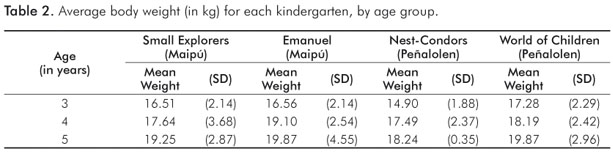
<body><![CDATA[<p><font size="2" face="Verdana">The  main contributor to the total intake of fluoride is drinking water. In the U.S,  approximately 76% of the fluoride ingested by the population comes from water  and non&#45;dairy beverages (soft drinks) (2,3). However, it is important to take  into consideration all potential sources. One of these sources includes toothpaste  because it has a strong contributor to the total fluoride intake (4).</font></p>    <p><font size="2" face="Verdana">In  2001, the Institute of Medicine, Food and Nutrition Board (USA), determined that  there is an optimal dose of systemic fluoride, which gives the maximum benefit,  when compared to dental caries level. Based on empirical data, the optimal dose  range is 0.05 to 0.07 mg F/kg/day (5).</font></p>    <p><font size="2" face="Verdana">Fluoride  absorption is rapid and depending on its bioavailability, is delivered directly  to the circulatory system. Studies indicate that 50% of fluoride absorbed is excreted  in the urine 24 hours after ingestion, and the rest is retained in mineralized  tissues (6,7).</font></p>    <p><font size="2" face="Verdana">The renal excretion  of the fluoride ion ranges from 30% to 85% in children between 3 and 5 years.  Regarding this, it has been determined that in general, the higher the fluoride  intake, age and urine flow, the greater the fluoride excretion (8&#45;12).</font></p>    <p><font size="2" face="Verdana">In  Chile, approximately 66.3% of the population receives public water with a fluoride  concentration of 0.6 mg/L (ppm), and the majority of this population are residents  of the metropolitan area. Among these communities, Pe&ntilde;alolen has supplemented  fluoride in their public water supply since 1996. Moreover, there are still communities  in the metropolitan area that are outside this program. One of those is Maip&uacute;,  which owns an independent drinking&#45;water&#45;network, SMAP, which has only  partially implemented fluoridation of the water supply, leaving large sections  of the community without this supplement in drinking water (13,14). The purpose  of this study was to determine the fluoride intake in preschool children of these  two communities.</font></p>    <p>&nbsp;</p>    <p><font size="3" face="Verdana"><B>Methodology</B></font></p>    <p><font size="2" face="Verdana">Characteristics  of the Study</font></p>    <p><font size="2" face="Verdana">Observational, Cross&#45;sectional.  The sample was composed of 200 children attending four kindergarten schools belonging  to the board of the National Kindergartens (JUNJI) of the Santiago Metropolitan  Region, in Chile. Two schools were located in the commune of Maip&uacute; (Emanuel  and Small Explorers) and two schools in the commune of Pe&ntilde;alolen (World  of Children and Nest&#45;Condors). From each kindergarten school, 50 children  between 3 and 5 years old were selected, and the age distribution is displayed  in <a href="/img/revistas/roc/v25n3/a04tab01.jpg">Table 1</a>. The age of the  children was considered as completed years from the date of the examination, <I>i.e.</I>,  a 3 year&#45;old child was considered the age from 3 years and 0 months until  3 years, 11 months and 30 days. The correlation between weight and age are shown  in <a href="/img/revistas/roc/v25n3/a04tab02.jpg">Table 2</a>. </font></p>    <p><font size="2" face="Verdana">This  study was approved by the Ethics Committee of the Faculty of Dentistry of the  University of Chile, and the parents of all children accepted participation in  the study, signed an informed consent form and verbally confirmed that the residence  of the child never changed since birth. The 2003 CASEN survey (Social Economic  Characterization Survey) indicated that the target population had low socioeconomic  status with a poverty percentage of 10.5% and 16.7% for the districts of Maip&uacute;  and Pe&ntilde;alolen, respectively. The subjects included in the study have good  general health and reside in the Maip&uacute; or Pe&ntilde;alolen communes of  the Metropolitan Region. The exclusion criteria were those children who have changed  their commune of residence throughout their lives.<a href="/img/revistas/roc/v25n3/a04tab02.jpg">Table  2</a> demonstrates a correlation between weight and age. There is no statistically  significant difference between groups (<I>P</I>&gt;0.05). The average body weight  was 17.5 kg for Pe&ntilde;alolen children and 17.6 kg for Maip&uacute; children.  The results for the preschools of Pe&ntilde;alolen are similar and were treated  as a single population for the analysis. A similar analysis was performed for  the children of Maip&uacute;. </font></p>    ]]></body>
<body><![CDATA[<p><font size="2" face="Verdana">Procedures</font></p>    <p><font size="2" face="Verdana">Plastic  bottles labeled with the name of each child were handed to parents, with instructions  to collect a morning urine sample. To ensure stability, they were asked to keep  the sample refrigerated at home until the time of collection. The dates of urine  sample collection were agreed upon by the teachers of each grade. During the collection,  urine samples remained at the kindergarten, stored in a cooler with ice close  to &plusmn; 4ºC. The samples were transferred under the same conditions. Each  cooler also contained two water samples from different points of the kindergarten.  The samples were kept refrigerated until they were processed within the next 72  hours. The process from sample collection to analysis lasted 5 days total. The  fluoride and creatinine levels in the urine samples were measured, which provided  the daily fluoride intake.</font></p>    <p><font size="2" face="Verdana">Determination  of Fluoride in Urine and Water</font></p>    <p><font size="2" face="Verdana">Fluoride  in urine and water was determined in potentiometric form, with an ion&#45;specific  electrode, according to the technique described by Villa (15), modified by Y&eacute;venes  et al. (16). 5 ml of TISAB II was added to 5 mL filtered urine/water and read  directly by an ion meter previously calibrated, obtaining readings in mg/L (ppm:  parts per million) of fluoride. </font></p>    <p><font size="2" face="Verdana">Creatinine  determination</font></p>    <p><font size="2" face="Verdana">We used a commercial  product by VALTEK, based on the Jaff&eacute; reaction (17), where the creatinine  mixed with alkaline picrate produces an orange color in proportion to the concentration  in the sample and was measured at 510 nm in a spectrophotometer.</font></p>    <p><font size="2" face="Verdana">Calculation  of excreted fluoride in urine</font></p>    <p><font size="2" face="Verdana">We used  an equation that relates the ratio of morning fluoride/creatinine, described by  Villa (18) to determine urinary fluoride excretion in preschool children at the  community level</font></p>    <p align="center"><font size="2" face="Verdana">Fluoride/creatinine  = &#45;0.13+ 3.59 excreted per day</font></p>    <p><font size="2" face="Verdana">Evaluation  of the average daily intake (DDI) of fluoride</font></p>    ]]></body>
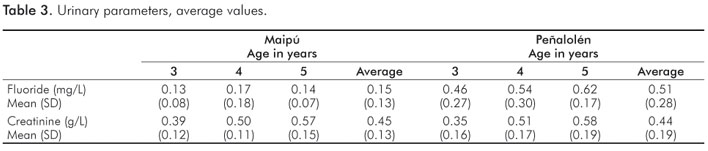
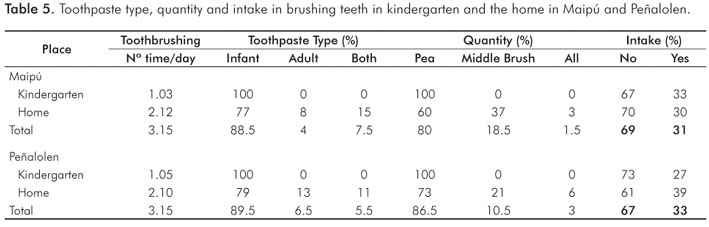
<body><![CDATA[<p><font size="2" face="Verdana">We  calculated DDI using an equation that relates the ratio of measured fluoride excretion/day  (mg/day)/average predicted excretion of fluoride ingested, which is 35.5% (11),  considering the average weight of the group under study.</font></p>    <p><font size="2" face="Verdana">Determination  of daily frequency of toothpaste use and weekly tea consumption</font></p>    <p><font size="2" face="Verdana">Frequencies  were determined from results of a survey, which was answered by parents, guardians  and educators. Determination of the daily intake of fluoride from toothpastes  was calculated using the equation that relates the ratio between the average daily  brushing, the type of paste, the amount of toothpaste used and the intake/body  weight. It was assumed that 35.5% of the paste used is ingested by the children  in this age group (15).</font></p>    <p><font size="2" face="Verdana">Statistical  analysis</font></p>    <p><font size="2" face="Verdana">Data were analyzed by Statistic  4.5 software (StatSoft, Tulsa, USA) with Student's t&#45;test and analysis of  variance at a 0.05 significance level and 95% confidence interval.</font></p>    <p>&nbsp;</p>    <p><font size="3" face="Verdana"><B>Results  </B></font></p>    <p><font size="2" face="Verdana">The results of the urinary parameters  of a single morning urine sample for the 200 children studied are shown in <a href="/img/revistas/roc/v25n3/a04tab03.jpg">Table  3</a>. The value of creatinine is similar between the two samples studied. The  value of the fluoride concentration in urine, expressed as mg/L, shows differences  between communities. The population from Maip&uacute; exhibited an average of  0.15 mg/L, while in Pe&ntilde;alolen, this value reached 0.51 mg/L, which is significantly  higher (<I>P</I>&lt;0.05).</font></p>    <p><font size="2" face="Verdana"><a href="/img/revistas/roc/v25n3/a04tab04.jpg">Table  4</a> shows the results of the excretion study for Maip&uacute; and Pe&ntilde;alolen.  In Maip&uacute;, the excretion average for the group studied is 0.14&plusmn;0.11  mg F/day. According to this value, the total calculated intake for the group was  0.39&plusmn;0.25 mg F/day and the daily dose (DDI) reached 0.021 mg F/kg bw/day&plusmn;0.010  mg F/kg bw/day. The values of excretion for Pe&ntilde;alolen had an average of  0.41&plusmn;0.25 mg F/day for the three groups studied; there is an increased  contribution of the group of children 3 years of age, which is also observed in  the intake values and the daily dose. Values for these parameters indicate that  children ingested 1.17&plusmn;0.71 mg F/day, and the daily dose reached 0.066&plusmn;0.039  mg F/kg bw/day.</font></p>    <p><font size="2" face="Verdana"><a href="/img/revistas/roc/v25n3/a04tab05.jpg">Table  5</a> shows the results for brushing teeth, toothpaste used and intake for both  communities, drawn from the parents' survey and nursery schools. All the surveys  in both communities reported use of toothpaste on toothbrush at home and in the  kindergarten, whereas in all preschools, only children toothpaste was used. At  home, the use of child toothpaste reaches similar values in Maip&uacute; and Pe&ntilde;alolen,  77% and 79% respectively. About 23% of the children in Maip&uacute; occasionally  used adult toothpaste in the household. This value is equivalent to Pe&ntilde;alolen,  reaching 24%. The average frequency of brushing was 3.15 times per day in both  communities. In relation to the amount of toothpaste used, the "pea size" was  selected by 100% in all four kindergartens. At home, the same size category reached  60% in Maip&uacute; and 73% in Pe&ntilde;alolen. The category of "medium brush"  is slightly higher in Maip&uacute; (37%) than in Pe&ntilde;alolen (21%). The "brush  all" presented minimum values in both communes. The ingestion of toothpaste is  similar in both communes, 31% in Maip&uacute; and 33% in Pe&ntilde;alolen. These  values are an average intake between home and school. In this study, no significant  differences between home or kindergarten (<I>P</I>&gt;0.05) intakes were found.  The estimated dose of daily intake of fluoride from toothpastes was 0.019 mg F/kg  bw/day for Maip&uacute; and 0.017 mg F/kg bw/day for Pe&ntilde;alolen. Values  are explained by the similarity in the measured parameters as type and quantity  of paste and frequency of use. All subjects reported no tea consumption in the  kindergarten. Tea consumption at home was similar in both communities, reaching  49% in Maip&uacute; and 44% in Pe&ntilde;alolen, whereas the average number of  cups per day was less than one cup, 0.8 and 0.55, respectively (<a href="#tab06">Table  6</a>).</font></p>    ]]></body>
<body><![CDATA[<p><a name="tab06"></a></p>    <p>&nbsp;</p>    <p align="center"><img src="/img/revistas/roc/v25n3/a04tab06.jpg"></p>    <p>&nbsp;</p>    <p><font size="3" face="Verdana"><B>Discussion  </B></font></p>    <p><font size="2" face="Verdana">The municipality of Maip&uacute;,  which has no fluoridation program for the public water supply, showed an average  fluoride concentration of 0.1 ppm between the two kindergartens analyzed in this  study. The "Emanuel" kindergarten presented a concentration of 0.1 mg/L (ppm)  fluoride, while in "Small Explorers", it was of 0.09 mg/L. These values are lower  than those reported by Villa in 1996 for the metropolitan area prior to the program  "Fluoridation of water consumption" (0.20 mg/L fluoride) (19). </font></p>    <p><font size="2" face="Verdana">The  "World of Children" and "Nest&#45;Condors" kindergarten of Pe&ntilde;alolen showed  a concentration of 0.45 mg/L and 0.5 mg/L fluoride in the water consumed, respectively,  giving an average of 0.48 mg/L fluoride. Regarding this commune, the MINSAL reported  in 2004 a concentration of 0.67 mg/L, higher than the value found in this study.  All values were obtained by taking two samples of drinking water at different  sites of each educational venue. The data in this study shows a clear difference  in the amount of available fluoride intake through water consumption.</font></p>    <p><font size="2" face="Verdana">Values  of DDI in the municipality of Maip&uacute; was higher than those reported in Japanese  children between 1 and 6 years (0.019 mg F/kg bw/day) (20), but lower than the  non&#45;fluoridated communities in New Zealand (0.027 mg F/kg bw/day) (21) and  in children 3 and 4 years of age and in non&#45;fluoridated areas of the northeast  of England (0.031 mg F/kg bw/day) (22), although all these values are lower than  the recommended DDI, between 0.05 to 0.07 mg F/kg bw/day (5). In the fluoridated  commune of Pe&ntilde;alolen, the value 0.066 mg F/kg bw/day was similar to the  DDI found in the study in 2000 (11), but higher than the 0.036 mg F/kg bw/day  found in children 3 and 4 years old in fluoridated areas of New Zealand (21),  the 0.047 mg F/kg bw/day found in English children in fluoridated areas (22) and  the 0.053 mg F/kg bw/day in German children (23). Groups of children 4 to 5 years  old in this study were found in the recommended ranges of DDI, whereas the group  that was three years of age was located on the optimum. These findings are consistent  with other studies that compare fluoride intake in children in relation to weight  body decreases (20).</font></p>    <p><font size="2" face="Verdana">The daily dose  of fluoride ingested from toothpastes was 0.019 mg F/kg bw/day for Maip&uacute;  and 0.017 mg F/kg bw/day for Pe&ntilde;alolen. This was similar to previous studies  in 1996 (19) and 2004 (14), which reported values reaching 0.025 and 0.017 mg  F/kg bw/day, respectively. However, a recent study investigating the fluoride  intake from toothpaste in 1&#45; to 3&#45;year&#45;old Brazilian children (4),  reported 0.106&plusmn;0.085 mg F/kg bw/day and speculated that this different  contribution of toothpaste may be due to the higher fluoride concentrations found  in toothpaste; age differences of the study population, as younger children are  more likely to swallow toothpaste; or differences in the methods of estimating  the fluoride intake from toothpaste.</font></p>    <p><font size="2" face="Verdana">In  relation to tea intake, the results indicate that 46.5% of the total population  consumes tea, with an average of 0.67 cups per person per day. These figures are  lower than those described by the MINSAL in 2004 (56.69% of intake) and Campos  in 2006 (61.2%) (24), although the frequency is similar, as that study reached  0.68 cups per person per day. This infusion is an important source of fluoride  and, in our population, is a significant part of the daily diet of a significant  percentage of the children studied. </font></p>    ]]></body>
<body><![CDATA[<p>&nbsp;</p>    <p><font size="3" face="Verdana"><B>Conclusions</B></font></p>    <p><font size="2" face="Verdana">The  ingestion of fluoride from water and other sources in the preschool commune of  Pe&ntilde;alolen is much higher than the intake of preschoolers in the commune  of Maip&uacute;.</font></p>    <p>&nbsp;</p>    <p><font size="3" face="Verdana"><B>References</B></font></p>    <!-- ref --><p><font size="2" face="Verdana">1.  Institute of Nutrition and Food Technology 1985. "Bioavailability of fluoride:  a study of the fluoride level". First Symposium on Fluorides. INTA. U de Chile,  Santiago.    &nbsp;&nbsp;&nbsp;&nbsp;&nbsp;&nbsp;&nbsp;&nbsp;[&#160;<a href="javascript:void(0);" onclick="javascript: window.open('/scielo.php?script=sci_nlinks&ref=363899&pid=S1980-6523201000030000400001&lng=','','width=640,height=500,resizable=yes,scrollbars=1,menubar=yes,');">Links</a>&#160;]<!-- end-ref --></font></p>    <!-- ref --><p><font size="2" face="Verdana">2. Fomon SJ, Ekstrand J,  Fluoride Intake. In: Fejerskov O, Ekstrand J, Burt B, (eds). Fluoride in Dentistry.  Copenhague: Munksgaard; 1996. p.40&#45;52.    &nbsp;&nbsp;&nbsp;&nbsp;&nbsp;&nbsp;&nbsp;&nbsp;[&#160;<a href="javascript:void(0);" onclick="javascript: window.open('/scielo.php?script=sci_nlinks&ref=363901&pid=S1980-6523201000030000400002&lng=','','width=640,height=500,resizable=yes,scrollbars=1,menubar=yes,');">Links</a>&#160;]<!-- end-ref --></font></p>    <!-- ref --><p><font size="2" face="Verdana">3.  Subba&#45;Rao G. Dietary intake and bioavailability of fluoride. Am Rev Nutr 1984;4:115&#45;36.    &nbsp;&nbsp;&nbsp;&nbsp;&nbsp;&nbsp;&nbsp;&nbsp;[&#160;<a href="javascript:void(0);" onclick="javascript: window.open('/scielo.php?script=sci_nlinks&ref=363903&pid=S1980-6523201000030000400003&lng=','','width=640,height=500,resizable=yes,scrollbars=1,menubar=yes,');">Links</a>&#160;]<!-- end-ref --></font></p>    <!-- ref --><p><font size="2" face="Verdana">4.  de Almeida BS, da Silva Cardoso VE, Bufazalaf MAR. Fluoride ingestion from toothpaste  and diet in 1&#45; to 3&#45;year&#45;old Brazilian children. Community Dent Oral  Epidemiol 2007;35:53&#45;63.    &nbsp;&nbsp;&nbsp;&nbsp;&nbsp;&nbsp;&nbsp;&nbsp;[&#160;<a href="javascript:void(0);" onclick="javascript: window.open('/scielo.php?script=sci_nlinks&ref=363905&pid=S1980-6523201000030000400004&lng=','','width=640,height=500,resizable=yes,scrollbars=1,menubar=yes,');">Links</a>&#160;]<!-- end-ref --></font></p>    <!-- ref --><p><font size="2" face="Verdana">5. Institute  of Medicine, Food and Nutrition Board. Dietary reference intakes (DRIs): Applications  in Dietary Assessment. Washington DC: National Academy Press, 2001.    &nbsp;&nbsp;&nbsp;&nbsp;&nbsp;&nbsp;&nbsp;&nbsp;[&#160;<a href="javascript:void(0);" onclick="javascript: window.open('/scielo.php?script=sci_nlinks&ref=363907&pid=S1980-6523201000030000400005&lng=','','width=640,height=500,resizable=yes,scrollbars=1,menubar=yes,');">Links</a>&#160;]<!-- end-ref --></font></p>    <!-- ref --><p><font size="2" face="Verdana">6.  Whitford GM. The metabolism and toxicity of fluoride. In: Myers HM (ed) Monographs  in oral science. S.Karger, Basel. 1996. p.10&#45;29.    &nbsp;&nbsp;&nbsp;&nbsp;&nbsp;&nbsp;&nbsp;&nbsp;[&#160;<a href="javascript:void(0);" onclick="javascript: window.open('/scielo.php?script=sci_nlinks&ref=363909&pid=S1980-6523201000030000400006&lng=','','width=640,height=500,resizable=yes,scrollbars=1,menubar=yes,');">Links</a>&#160;]<!-- end-ref --></font></p>    <!-- ref --><p><font size="2" face="Verdana">7.  Whitford GM. The metabolism and toxicity of fluoride. In: Myers HM (ed) Monographs  in oral science. S.Karger, Basel. 1996. p.1&#45;9.    &nbsp;&nbsp;&nbsp;&nbsp;&nbsp;&nbsp;&nbsp;&nbsp;[&#160;<a href="javascript:void(0);" onclick="javascript: window.open('/scielo.php?script=sci_nlinks&ref=363911&pid=S1980-6523201000030000400007&lng=','','width=640,height=500,resizable=yes,scrollbars=1,menubar=yes,');">Links</a>&#160;]<!-- end-ref --> </font></p>    <!-- ref --><p><font size="2" face="Verdana">8.  Grijalva&#45;Haro MI, Barba&#45;Leiva ME, Laborin&#45;Alvarez A. Fluoride intake  and excretion among children in Hermosillo, Sonora, Mexico. Salud P&uacute;blica  Mex 2001;43:127&#45;34.    &nbsp;&nbsp;&nbsp;&nbsp;&nbsp;&nbsp;&nbsp;&nbsp;[&#160;<a href="javascript:void(0);" onclick="javascript: window.open('/scielo.php?script=sci_nlinks&ref=363913&pid=S1980-6523201000030000400008&lng=','','width=640,height=500,resizable=yes,scrollbars=1,menubar=yes,');">Links</a>&#160;]<!-- end-ref --> </font></p>    <!-- ref --><p><font size="2" face="Verdana">9. Zohouri  F V, Rugg&#45;Gunn AJ. Total fluoride intake and urinary excretion in 4&#45;year&#45;old  Iranian children residing in low&#45;fluoride areas. Br J Nutr 2000;83:15&#45;25.    &nbsp;&nbsp;&nbsp;&nbsp;&nbsp;&nbsp;&nbsp;&nbsp;[&#160;<a href="javascript:void(0);" onclick="javascript: window.open('/scielo.php?script=sci_nlinks&ref=363915&pid=S1980-6523201000030000400009&lng=','','width=640,height=500,resizable=yes,scrollbars=1,menubar=yes,');">Links</a>&#160;]<!-- end-ref --></font></p>    <!-- ref --><p><font size="2" face="Verdana">10.  Haftenberg M, Viergutz G, Neumeister V, Hetzer G. Total fluoride intake and urinary  excretion in german children aged 3&#45;6 years. Caries Res 2001; 35:451&#45;7.    &nbsp;&nbsp;&nbsp;&nbsp;&nbsp;&nbsp;&nbsp;&nbsp;[&#160;<a href="javascript:void(0);" onclick="javascript: window.open('/scielo.php?script=sci_nlinks&ref=363917&pid=S1980-6523201000030000400010&lng=','','width=640,height=500,resizable=yes,scrollbars=1,menubar=yes,');">Links</a>&#160;]<!-- end-ref --></font></p>    <!-- ref --><p><font size="2" face="Verdana">11.  Villa AE, Anabal&oacute;n M, Cabezas L. The fractional urinary fluoride excretion  in young children under stable fluoride intake conditions. Community Dent Oral  Epidemiol 2000;28:344&#45;55.    &nbsp;&nbsp;&nbsp;&nbsp;&nbsp;&nbsp;&nbsp;&nbsp;[&#160;<a href="javascript:void(0);" onclick="javascript: window.open('/scielo.php?script=sci_nlinks&ref=363919&pid=S1980-6523201000030000400011&lng=','','width=640,height=500,resizable=yes,scrollbars=1,menubar=yes,');">Links</a>&#160;]<!-- end-ref --></font></p>    <!-- ref --><p><font size="2" face="Verdana">12. G&oacute;mez  S. Fluoride therapy in dentistry for children and adolescents. 3.ed. Por Grant  Educacional Colgate. Santiago, 2001.    &nbsp;&nbsp;&nbsp;&nbsp;&nbsp;&nbsp;&nbsp;&nbsp;[&#160;<a href="javascript:void(0);" onclick="javascript: window.open('/scielo.php?script=sci_nlinks&ref=363921&pid=S1980-6523201000030000400012&lng=','','width=640,height=500,resizable=yes,scrollbars=1,menubar=yes,');">Links</a>&#160;]<!-- end-ref --></font></p>    <!-- ref --><p><font size="2" face="Verdana">13.  Villa AE, Guerrero S, Villalobos J. Estimation of optimal concentration of fluoride  in drinking water under conditions prevailing in Chile. Community Dent Oral Epidemiol  1998;26:249&#45;55.    &nbsp;&nbsp;&nbsp;&nbsp;&nbsp;&nbsp;&nbsp;&nbsp;[&#160;<a href="javascript:void(0);" onclick="javascript: window.open('/scielo.php?script=sci_nlinks&ref=363923&pid=S1980-6523201000030000400013&lng=','','width=640,height=500,resizable=yes,scrollbars=1,menubar=yes,');">Links</a>&#160;]<!-- end-ref --> </font></p>    <!-- ref --><p><font size="2" face="Verdana">14. MINSAL Dental  Department. Report of progress of the national Fluoridation of drinking water.  Santiago: Chilean Health Ministry; 2004.    &nbsp;&nbsp;&nbsp;&nbsp;&nbsp;&nbsp;&nbsp;&nbsp;[&#160;<a href="javascript:void(0);" onclick="javascript: window.open('/scielo.php?script=sci_nlinks&ref=363925&pid=S1980-6523201000030000400014&lng=','','width=640,height=500,resizable=yes,scrollbars=1,menubar=yes,');">Links</a>&#160;]<!-- end-ref --></font></p>    <!-- ref --><p><font size="2" face="Verdana">15.  Villa A. Rapid method for determining very low fluoride con&#45; centrations using  a ion selective electrode. Analyst 1988;113: 50&#45;6.    &nbsp;&nbsp;&nbsp;&nbsp;&nbsp;&nbsp;&nbsp;&nbsp;[&#160;<a href="javascript:void(0);" onclick="javascript: window.open('/scielo.php?script=sci_nlinks&ref=363927&pid=S1980-6523201000030000400015&lng=','','width=640,height=500,resizable=yes,scrollbars=1,menubar=yes,');">Links</a>&#160;]<!-- end-ref --></font></p>    <!-- ref --><p><font size="2" face="Verdana">16.  Y&eacute;venes I, Reyes J, S&aacute;nchez U, Sanza H. Study and determination  of fluoride, triclosan and zinc citrate dentifrices double action. Av Odonto Estomatol  1999;15:433&#45;44.    &nbsp;&nbsp;&nbsp;&nbsp;&nbsp;&nbsp;&nbsp;&nbsp;[&#160;<a href="javascript:void(0);" onclick="javascript: window.open('/scielo.php?script=sci_nlinks&ref=363929&pid=S1980-6523201000030000400016&lng=','','width=640,height=500,resizable=yes,scrollbars=1,menubar=yes,');">Links</a>&#160;]<!-- end-ref --></font></p>    <!-- ref --><p><font size="2" face="Verdana">17. Bonsnes RW,  Taussky HH. Colorimetric on the determination of creatinine by the Jaffe reaction.  J Biol Chem 1945;158: 581&#45;91.    &nbsp;&nbsp;&nbsp;&nbsp;&nbsp;&nbsp;&nbsp;&nbsp;[&#160;<a href="javascript:void(0);" onclick="javascript: window.open('/scielo.php?script=sci_nlinks&ref=363931&pid=S1980-6523201000030000400017&lng=','','width=640,height=500,resizable=yes,scrollbars=1,menubar=yes,');">Links</a>&#160;]<!-- end-ref --></font></p>    <!-- ref --><p><font size="2" face="Verdana">18.  Villa A. A new method for determining fluoride excretion in preschool children  at the community level. Odontol Chil 1994; 42:28&#45;31.    &nbsp;&nbsp;&nbsp;&nbsp;&nbsp;&nbsp;&nbsp;&nbsp;[&#160;<a href="javascript:void(0);" onclick="javascript: window.open('/scielo.php?script=sci_nlinks&ref=363933&pid=S1980-6523201000030000400018&lng=','','width=640,height=500,resizable=yes,scrollbars=1,menubar=yes,');">Links</a>&#160;]<!-- end-ref --></font></p>    <!-- ref --><p><font size="2" face="Verdana">19.  Villa A, Salazar G, Andrade M, Villa C, Anabal&oacute;n M, Cabezas S et al. Study  of urinary excretion and the use of toothpastes and other sources of fluoride  in children pre&#45;school, regions II, VI, VIII, IX, X and RM. Chilean Health  Ministry; 1996.    &nbsp;&nbsp;&nbsp;&nbsp;&nbsp;&nbsp;&nbsp;&nbsp;[&#160;<a href="javascript:void(0);" onclick="javascript: window.open('/scielo.php?script=sci_nlinks&ref=363935&pid=S1980-6523201000030000400019&lng=','','width=640,height=500,resizable=yes,scrollbars=1,menubar=yes,');">Links</a>&#160;]<!-- end-ref --></font></p>    <!-- ref --><p><font size="2" face="Verdana">20. Kimura T, Morita  M, Kinoshita T, Tsuneishi M, Akagi T, Yamashita F et al. Fluoride intake from  food and drink in Japanese children aged 1&#45;6 years. Caries Res 2001; 35:47&#45;49.    &nbsp;&nbsp;&nbsp;&nbsp;&nbsp;&nbsp;&nbsp;&nbsp;[&#160;<a href="javascript:void(0);" onclick="javascript: window.open('/scielo.php?script=sci_nlinks&ref=363937&pid=S1980-6523201000030000400020&lng=','','width=640,height=500,resizable=yes,scrollbars=1,menubar=yes,');">Links</a>&#160;]<!-- end-ref --></font></p>    <!-- ref --><p><font size="2" face="Verdana">21.  Guha&#45;Chowdhury N, Drummond BK, Smillie AC. Total fluoride intake in children  aged 3 to 4 years&#45; a longitudinal study. J Dent Res 1996; 75:1451&#45;7.    &nbsp;&nbsp;&nbsp;&nbsp;&nbsp;&nbsp;&nbsp;&nbsp;[&#160;<a href="javascript:void(0);" onclick="javascript: window.open('/scielo.php?script=sci_nlinks&ref=363939&pid=S1980-6523201000030000400021&lng=','','width=640,height=500,resizable=yes,scrollbars=1,menubar=yes,');">Links</a>&#160;]<!-- end-ref --> </font></p>    <!-- ref --><p><font size="2" face="Verdana">22.  Maguire A, Zohouri FV, Hindmarch PN, Hatts J, Moynihan PJ. Fluoride intake and  urinary excretion in 6 to 7&#45;years&#45;old children living in optimally, sub&#45;optimally  and non&#45;fluoridated areas. Community Dent Oral Epidemiol 2007; 35:479&#45;88.    &nbsp;&nbsp;&nbsp;&nbsp;&nbsp;&nbsp;&nbsp;&nbsp;[&#160;<a href="javascript:void(0);" onclick="javascript: window.open('/scielo.php?script=sci_nlinks&ref=363941&pid=S1980-6523201000030000400022&lng=','','width=640,height=500,resizable=yes,scrollbars=1,menubar=yes,');">Links</a>&#160;]<!-- end-ref --></font></p>    <!-- ref --><p><font size="2" face="Verdana">23.  Haftenberger M, Viergutz G, Neumeister V, Hetzer G. Total fluoride intake and  urinary excretion in German children aged 3&#45;6 years. Caries Res 2001; 35;451&#45;7.    &nbsp;&nbsp;&nbsp;&nbsp;&nbsp;&nbsp;&nbsp;&nbsp;[&#160;<a href="javascript:void(0);" onclick="javascript: window.open('/scielo.php?script=sci_nlinks&ref=363943&pid=S1980-6523201000030000400023&lng=','','width=640,height=500,resizable=yes,scrollbars=1,menubar=yes,');">Links</a>&#160;]<!-- end-ref --></font></p>    <!-- ref --><p><font size="2" face="Verdana">24.  Yevenes I, Campos B, Apip A, Espinoza RM, Jara MN, Smith LP. Prevalence of dental  caries in preschool children in Pe&ntilde;aflor, Santiago, Chile. Rev Odont Cienc  2009; 24:116&#45;9.    &nbsp;&nbsp;&nbsp;&nbsp;&nbsp;&nbsp;&nbsp;&nbsp;[&#160;<a href="javascript:void(0);" onclick="javascript: window.open('/scielo.php?script=sci_nlinks&ref=363945&pid=S1980-6523201000030000400024&lng=','','width=640,height=500,resizable=yes,scrollbars=1,menubar=yes,');">Links</a>&#160;]<!-- end-ref --></font></p>    <p>&nbsp;</p>    <p>&nbsp;</p>    <p><font size="2" face="Verdana"><A NAME="nt"></A><a href="#tx"><img src="/img/revistas/roc/v25n3/seta.jpg" border="0"></a>  <b>Correspondence:</b>    <br> Ismael Y&eacute;venes    <br> Department of Chemistry,  Dental School. University of Chile    <br> Sergio Livingstone (ex&#45;Olivos) 943,  Independencia    <br> Santiago &#150; Chile    ]]></body>
<body><![CDATA[<br> E&#45;mail: <a href="mailto:iyevenes@odontologia.uchile.cl">iyevenes@odontologia.uchile.cl</a></font></p>    <p><font size="2" face="Verdana">Received:  December 30, 2009    <br> Accepted: May 11, 2010</font></p>    <p>&nbsp;</p>    <p>&nbsp;</p>    <p><font size="2" face="Verdana"><b>Conflict  of Interest Statement:</b> The authors state that there are no financial and personal  conflicts of interest that could have inappropriately influenced their work. </font></p>      ]]></body>
<back>
<ref-list>
<ref id="B1">
<label>1</label><nlm-citation citation-type="confpro">
<collab>Institute of Nutrition and Food Technology 1985</collab>
<source><![CDATA["Bioavailability of fluoride: a study of the fluoride level"]]></source>
<year></year>
<conf-name><![CDATA[ First Symposium on Fluorides]]></conf-name>
<conf-loc>Santiago </conf-loc>
</nlm-citation>
</ref>
<ref id="B2">
<label>2</label><nlm-citation citation-type="book">
<person-group person-group-type="author">
<name>
<surname><![CDATA[Fomon]]></surname>
<given-names><![CDATA[SJ]]></given-names>
</name>
<name>
<surname><![CDATA[Ekstrand]]></surname>
<given-names><![CDATA[J]]></given-names>
</name>
</person-group>
<article-title xml:lang="en"><![CDATA[Fluoride Intake]]></article-title>
<person-group person-group-type="editor">
<name>
<surname><![CDATA[Fejerskov]]></surname>
<given-names><![CDATA[O]]></given-names>
</name>
<name>
<surname><![CDATA[Ekstrand]]></surname>
<given-names><![CDATA[J]]></given-names>
</name>
<name>
<surname><![CDATA[Burt]]></surname>
<given-names><![CDATA[B]]></given-names>
</name>
</person-group>
<source><![CDATA[Fluoride in Dentistry]]></source>
<year>1996</year>
<page-range>40-52</page-range><publisher-loc><![CDATA[Copenhague ]]></publisher-loc>
<publisher-name><![CDATA[Munksgaard]]></publisher-name>
</nlm-citation>
</ref>
<ref id="B3">
<label>3</label><nlm-citation citation-type="journal">
<person-group person-group-type="author">
<name>
<surname><![CDATA[Subba-Rao]]></surname>
<given-names><![CDATA[G]]></given-names>
</name>
</person-group>
<article-title xml:lang="en"><![CDATA[Dietary intake and bioavailability of fluoride]]></article-title>
<source><![CDATA[Am Rev Nutr]]></source>
<year>1984</year>
<volume>4</volume>
<page-range>115-36</page-range></nlm-citation>
</ref>
<ref id="B4">
<label>4</label><nlm-citation citation-type="journal">
<person-group person-group-type="author">
<name>
<surname><![CDATA[de Almeida]]></surname>
<given-names><![CDATA[BS]]></given-names>
</name>
<name>
<surname><![CDATA[da Silva Cardoso]]></surname>
<given-names><![CDATA[VE]]></given-names>
</name>
<name>
<surname><![CDATA[Bufazalaf]]></surname>
<given-names><![CDATA[MAR]]></given-names>
</name>
</person-group>
<article-title xml:lang="en"><![CDATA[Fluoride ingestion from toothpaste and diet in 1- to 3-year-old Brazilian children]]></article-title>
<source><![CDATA[Community Dent Oral Epidemiol]]></source>
<year>2007</year>
<volume>35</volume>
<page-range>53-63</page-range></nlm-citation>
</ref>
<ref id="B5">
<label>5</label><nlm-citation citation-type="book">
<collab>Institute of Medicine.Food and Nutrition Board</collab>
<source><![CDATA[Dietary reference intakes (DRIs): Applications in Dietary Assessment]]></source>
<year>2001</year>
<publisher-loc><![CDATA[Washington DC ]]></publisher-loc>
<publisher-name><![CDATA[National Academy Press]]></publisher-name>
</nlm-citation>
</ref>
<ref id="B6">
<label>6</label><nlm-citation citation-type="book">
<person-group person-group-type="author">
<name>
<surname><![CDATA[Whitford]]></surname>
<given-names><![CDATA[GM]]></given-names>
</name>
</person-group>
<article-title xml:lang="en"><![CDATA[The metabolism and toxicity of fluoride]]></article-title>
<person-group person-group-type="editor">
<name>
<surname><![CDATA[Myers]]></surname>
<given-names><![CDATA[HM]]></given-names>
</name>
</person-group>
<source><![CDATA[Monographs in oral science]]></source>
<year>1996</year>
<page-range>10-29</page-range><publisher-name><![CDATA[S.Karger, Basel]]></publisher-name>
</nlm-citation>
</ref>
<ref id="B7">
<label>7</label><nlm-citation citation-type="book">
<person-group person-group-type="author">
<name>
<surname><![CDATA[Whitford]]></surname>
<given-names><![CDATA[GM.]]></given-names>
</name>
</person-group>
<article-title xml:lang="en"><![CDATA[The metabolism and toxicity of fluoride]]></article-title>
<person-group person-group-type="editor">
<name>
<surname><![CDATA[Myers]]></surname>
<given-names><![CDATA[HM]]></given-names>
</name>
</person-group>
<source><![CDATA[Monographs in oral science]]></source>
<year>1996</year>
<page-range>1-9</page-range><publisher-name><![CDATA[S.Karger, Basel]]></publisher-name>
</nlm-citation>
</ref>
<ref id="B8">
<label>8</label><nlm-citation citation-type="journal">
<person-group person-group-type="author">
<name>
<surname><![CDATA[Grijalva-Haro]]></surname>
<given-names><![CDATA[MI]]></given-names>
</name>
<name>
<surname><![CDATA[Barba-Leiva]]></surname>
<given-names><![CDATA[ME]]></given-names>
</name>
<name>
<surname><![CDATA[Laborin-Alvarez]]></surname>
<given-names><![CDATA[A]]></given-names>
</name>
</person-group>
<article-title xml:lang="en"><![CDATA[Fluoride intake and excretion among children in Hermosillo, Sonora, Mexico]]></article-title>
<source><![CDATA[Salud Pública Mex]]></source>
<year>2001</year>
<volume>43</volume>
<page-range>127-34</page-range></nlm-citation>
</ref>
<ref id="B9">
<label>9</label><nlm-citation citation-type="journal">
<person-group person-group-type="author">
<name>
<surname><![CDATA[Zohouri F]]></surname>
<given-names><![CDATA[V]]></given-names>
</name>
<name>
<surname><![CDATA[Rugg-Gunn]]></surname>
<given-names><![CDATA[AJ]]></given-names>
</name>
</person-group>
<article-title xml:lang="en"><![CDATA[Total fluoride intake and urinary excretion in 4-year-old Iranian children residing in low-fluoride areas]]></article-title>
<source><![CDATA[Br J Nutr]]></source>
<year>2000</year>
<volume>83</volume>
<page-range>15-25</page-range></nlm-citation>
</ref>
<ref id="B10">
<label>10</label><nlm-citation citation-type="journal">
<person-group person-group-type="author">
<name>
<surname><![CDATA[Haftenberg]]></surname>
<given-names><![CDATA[M]]></given-names>
</name>
<name>
<surname><![CDATA[Viergutz]]></surname>
<given-names><![CDATA[G]]></given-names>
</name>
<name>
<surname><![CDATA[Neumeister]]></surname>
<given-names><![CDATA[V]]></given-names>
</name>
<name>
<surname><![CDATA[Hetzer]]></surname>
<given-names><![CDATA[G]]></given-names>
</name>
</person-group>
<article-title xml:lang="en"><![CDATA[Total fluoride intake and urinary excretion in german children aged 3-6 years]]></article-title>
<source><![CDATA[Caries Res]]></source>
<year>2001</year>
<volume>35</volume>
<page-range>451-7</page-range></nlm-citation>
</ref>
<ref id="B11">
<label>11</label><nlm-citation citation-type="journal">
<person-group person-group-type="author">
<name>
<surname><![CDATA[Villa]]></surname>
<given-names><![CDATA[AE]]></given-names>
</name>
<name>
<surname><![CDATA[Anabalón]]></surname>
<given-names><![CDATA[M]]></given-names>
</name>
<name>
<surname><![CDATA[Cabezas]]></surname>
<given-names><![CDATA[L]]></given-names>
</name>
</person-group>
<article-title xml:lang="en"><![CDATA[The fractional urinary fluoride excretion in young children under stable fluoride intake conditions]]></article-title>
<source><![CDATA[Community Dent Oral Epidemiol]]></source>
<year>2000</year>
<volume>28</volume>
<page-range>344-55</page-range></nlm-citation>
</ref>
<ref id="B12">
<label>12</label><nlm-citation citation-type="book">
<person-group person-group-type="author">
<name>
<surname><![CDATA[Gómez]]></surname>
<given-names><![CDATA[S.]]></given-names>
</name>
</person-group>
<source><![CDATA[Fluoride therapy in dentistry for children and adolescents]]></source>
<year>2001</year>
<edition>3</edition>
<publisher-loc><![CDATA[Santiago ]]></publisher-loc>
<publisher-name><![CDATA[Por Grant Educacional Colgate]]></publisher-name>
</nlm-citation>
</ref>
<ref id="B13">
<label>13</label><nlm-citation citation-type="journal">
<person-group person-group-type="author">
<name>
<surname><![CDATA[Villa]]></surname>
<given-names><![CDATA[AE]]></given-names>
</name>
<name>
<surname><![CDATA[Guerrero]]></surname>
<given-names><![CDATA[S]]></given-names>
</name>
<name>
<surname><![CDATA[Villalobos]]></surname>
<given-names><![CDATA[J]]></given-names>
</name>
</person-group>
<article-title xml:lang="en"><![CDATA[Estimation of optimal concentration of fluoride in drinking water under conditions prevailing in Chile]]></article-title>
<source><![CDATA[Community Dent Oral Epidemiol]]></source>
<year>1998</year>
<volume>26</volume>
<page-range>249-55</page-range></nlm-citation>
</ref>
<ref id="B14">
<label>14</label><nlm-citation citation-type="book">
<collab>MINSAL Dental Department</collab>
<source><![CDATA[Report of progress of the national Fluoridation of drinking water]]></source>
<year>2004</year>
<publisher-loc><![CDATA[Santiago ]]></publisher-loc>
<publisher-name><![CDATA[Chilean Health Ministry]]></publisher-name>
</nlm-citation>
</ref>
<ref id="B15">
<label>15</label><nlm-citation citation-type="journal">
<person-group person-group-type="author">
<name>
<surname><![CDATA[Villa]]></surname>
<given-names><![CDATA[A]]></given-names>
</name>
</person-group>
<article-title xml:lang="en"><![CDATA[Rapid method for determining very low fluoride con- centrations using a ion selective electrode]]></article-title>
<source><![CDATA[Analyst]]></source>
<year>1988</year>
<volume>113</volume>
<page-range>50-6</page-range></nlm-citation>
</ref>
<ref id="B16">
<label>16</label><nlm-citation citation-type="journal">
<person-group person-group-type="author">
<name>
<surname><![CDATA[Yévenes]]></surname>
<given-names><![CDATA[I]]></given-names>
</name>
<name>
<surname><![CDATA[Reyes]]></surname>
<given-names><![CDATA[J]]></given-names>
</name>
<name>
<surname><![CDATA[Sánchez]]></surname>
<given-names><![CDATA[U]]></given-names>
</name>
<name>
<surname><![CDATA[Sanza]]></surname>
<given-names><![CDATA[H]]></given-names>
</name>
</person-group>
<article-title xml:lang="en"><![CDATA[Study and determination of fluoride, triclosan and zinc citrate dentifrices double action]]></article-title>
<source><![CDATA[Av Odonto Estomatol]]></source>
<year>1999</year>
<volume>15</volume>
<page-range>433-44</page-range></nlm-citation>
</ref>
<ref id="B17">
<label>17</label><nlm-citation citation-type="journal">
<person-group person-group-type="author">
<name>
<surname><![CDATA[Bonsnes]]></surname>
<given-names><![CDATA[RW]]></given-names>
</name>
<name>
<surname><![CDATA[Taussky]]></surname>
<given-names><![CDATA[HH]]></given-names>
</name>
</person-group>
<article-title xml:lang="en"><![CDATA[Colorimetric on the determination of creatinine by the Jaffe reaction]]></article-title>
<source><![CDATA[J Biol Chem]]></source>
<year>1945</year>
<volume>158</volume>
<page-range>581-91</page-range></nlm-citation>
</ref>
<ref id="B18">
<label>18</label><nlm-citation citation-type="journal">
<person-group person-group-type="author">
<name>
<surname><![CDATA[Villa]]></surname>
<given-names><![CDATA[A]]></given-names>
</name>
</person-group>
<article-title xml:lang="en"><![CDATA[A new method for determining fluoride excretion in preschool children at the community level]]></article-title>
<source><![CDATA[Odontol Chil]]></source>
<year>1994</year>
<volume>42</volume>
<page-range>28-31</page-range></nlm-citation>
</ref>
<ref id="B19">
<label>19</label><nlm-citation citation-type="book">
<person-group person-group-type="author">
<name>
<surname><![CDATA[Villa]]></surname>
<given-names><![CDATA[A]]></given-names>
</name>
<name>
<surname><![CDATA[Salazar]]></surname>
<given-names><![CDATA[G]]></given-names>
</name>
<name>
<surname><![CDATA[Andrade]]></surname>
<given-names><![CDATA[M]]></given-names>
</name>
<name>
<surname><![CDATA[Villa]]></surname>
<given-names><![CDATA[C]]></given-names>
</name>
<name>
<surname><![CDATA[Anabalón]]></surname>
<given-names><![CDATA[M]]></given-names>
</name>
<name>
<surname><![CDATA[Cabezas]]></surname>
<given-names><![CDATA[S]]></given-names>
</name>
</person-group>
<source><![CDATA[Study of urinary excretion and the use of toothpastes and other sources of fluoride in children pre-school, regions II, VI, VIII, IX, X and RM]]></source>
<year>1996</year>
<publisher-name><![CDATA[Chilean Health Ministry]]></publisher-name>
</nlm-citation>
</ref>
<ref id="B20">
<label>20</label><nlm-citation citation-type="journal">
<person-group person-group-type="author">
<name>
<surname><![CDATA[Kimura]]></surname>
<given-names><![CDATA[T]]></given-names>
</name>
<name>
<surname><![CDATA[Morita]]></surname>
<given-names><![CDATA[M]]></given-names>
</name>
<name>
<surname><![CDATA[Kinoshita]]></surname>
<given-names><![CDATA[T]]></given-names>
</name>
<name>
<surname><![CDATA[Tsuneishi]]></surname>
<given-names><![CDATA[M]]></given-names>
</name>
<name>
<surname><![CDATA[Akagi]]></surname>
<given-names><![CDATA[T]]></given-names>
</name>
<name>
<surname><![CDATA[Yamashita]]></surname>
<given-names><![CDATA[F]]></given-names>
</name>
</person-group>
<article-title xml:lang="en"><![CDATA[Fluoride intake from food and drink in Japanese children aged 1-6 years]]></article-title>
<source><![CDATA[Caries Res]]></source>
<year>2001</year>
<volume>35</volume>
<page-range>47-49</page-range></nlm-citation>
</ref>
<ref id="B21">
<label>21</label><nlm-citation citation-type="journal">
<person-group person-group-type="author">
<name>
<surname><![CDATA[Guha-Chowdhury]]></surname>
<given-names><![CDATA[N]]></given-names>
</name>
<name>
<surname><![CDATA[Drummond]]></surname>
<given-names><![CDATA[BK]]></given-names>
</name>
<name>
<surname><![CDATA[Smillie]]></surname>
<given-names><![CDATA[AC]]></given-names>
</name>
</person-group>
<article-title xml:lang="en"><![CDATA[Total fluoride intake in children aged 3 to 4 years- a longitudinal study]]></article-title>
<source><![CDATA[J Dent Res]]></source>
<year>1996</year>
<volume>75</volume>
<page-range>1451-7</page-range></nlm-citation>
</ref>
<ref id="B22">
<label>22</label><nlm-citation citation-type="journal">
<person-group person-group-type="author">
<name>
<surname><![CDATA[Maguire]]></surname>
<given-names><![CDATA[A]]></given-names>
</name>
<name>
<surname><![CDATA[Zohouri]]></surname>
<given-names><![CDATA[FV]]></given-names>
</name>
<name>
<surname><![CDATA[Hindmarch]]></surname>
<given-names><![CDATA[PN]]></given-names>
</name>
<name>
<surname><![CDATA[Hatts]]></surname>
<given-names><![CDATA[J]]></given-names>
</name>
<name>
<surname><![CDATA[Moynihan]]></surname>
<given-names><![CDATA[PJ]]></given-names>
</name>
</person-group>
<article-title xml:lang="en"><![CDATA[Fluoride intake and urinary excretion in 6 to 7-years-old children living in optimally, sub-optimally and non-fluoridated areas]]></article-title>
<source><![CDATA[Community Dent Oral Epidemiol]]></source>
<year>2007</year>
<volume>35</volume>
<page-range>479-88</page-range></nlm-citation>
</ref>
<ref id="B23">
<label>23</label><nlm-citation citation-type="journal">
<person-group person-group-type="author">
<name>
<surname><![CDATA[Haftenberger]]></surname>
<given-names><![CDATA[M]]></given-names>
</name>
<name>
<surname><![CDATA[Viergutz]]></surname>
<given-names><![CDATA[G]]></given-names>
</name>
<name>
<surname><![CDATA[Neumeister]]></surname>
<given-names><![CDATA[V]]></given-names>
</name>
<name>
<surname><![CDATA[Hetzer]]></surname>
<given-names><![CDATA[G]]></given-names>
</name>
</person-group>
<article-title xml:lang="en"><![CDATA[Total fluoride intake and urinary excretion in German children aged 3-6 years]]></article-title>
<source><![CDATA[Caries Res]]></source>
<year>2001</year>
<volume>35</volume>
<page-range>451-7</page-range></nlm-citation>
</ref>
<ref id="B24">
<label>24</label><nlm-citation citation-type="journal">
<person-group person-group-type="author">
<name>
<surname><![CDATA[Yevenes]]></surname>
<given-names><![CDATA[I]]></given-names>
</name>
<name>
<surname><![CDATA[Campos]]></surname>
<given-names><![CDATA[B]]></given-names>
</name>
<name>
<surname><![CDATA[Apip]]></surname>
<given-names><![CDATA[A]]></given-names>
</name>
<name>
<surname><![CDATA[Espinoza]]></surname>
<given-names><![CDATA[RM]]></given-names>
</name>
<name>
<surname><![CDATA[Jara]]></surname>
<given-names><![CDATA[MN]]></given-names>
</name>
<name>
<surname><![CDATA[Smith]]></surname>
<given-names><![CDATA[LP]]></given-names>
</name>
</person-group>
<article-title xml:lang="en"><![CDATA[Prevalence of dental caries in preschool children in Peñaflor, Santiago, Chile]]></article-title>
<source><![CDATA[Rev Odont Cienc]]></source>
<year>2009</year>
<volume>24</volume>
<page-range>116-9</page-range></nlm-citation>
</ref>
</ref-list>
</back>
</article>
