Physician's knowledge about dental treatment during pregnancy
Visão médica do tratamento odontológico em gestantes
Priscilla LASLOWSKI I; Gabriel Tilli POLITANO I; Daniela Prócida RAGGIO II; Sandra Regina Echeverria Pinho da SILVA III; José Carlos Pettorossi IMPARATO II
I Faculdade São Leopoldo Mandic, Curso de Odontologia, Programa de Pós-Graduação em Odontopediatria. Rua José Rocha Junqueira, 13, Swift, 13045- 755, Campinas, SP, Brasil
II Universidade de São Paulo, Faculdade de Odontologia, Departamento de Ortodontia e Odontopediatria. São Paulo, SP, Brasil ]]>
III Universidade Camilo Castelo Branco, Faculdade de Odontologia. São Paulo, SP, Brasil
ABSTRACT
Objective
To guide pregnant patients, as regards their general and oral health, thus justifying the need to have regular prenatal and dental care, is an obligation of health professionals. Physicians, especially gynecologists and obstetricians play an important role, since they are the first professionals to take care of pregnant patients.
Methods
The objective of present study was to evaluate physician's knowledge about dental treatment during pregnancy. Methods: Using questionnaires, 40 gynecologists and obstetricians were evaluated as regards their knowledge of dental care, and use of drugs and dental anesthetics in dental procedures during pregnancy.
Results ]]> Many myths referring to dental care in pregnant women were observed. Many physicians have knowledge about association between susceptibility to gingivitis/periodontitis and pregnancy. With reference to local anesthetics and vasoconstrictors used in dentistry, the physicians still have some doubts about their use, even with the literature supporting their safety in this period. It is intended to continue these contacts with the obstetricians, in order to extend their knowledge and seek multidisciplinary cooperation, which would promote adequate and complete prenatal care.
Conclusion
It could be concluded that there are some divergences between obstetricians and dentists concerning dental care in pregnant women, which means losses for the patient.
Indexing terms: Dentist-patient relations. Obstetrics. Pregnancy.
RESUMO
Objetivo
Avaliar o conhecimento destes profissionais sobre o tratamento odontológico na gestação.
Métodos
Por meio do emprego de questionários, 40 médicos ginecologistas/obstetras tiveram seus conhecimentos avaliados no que se refere ao atendimento odontológico em gestantes e utilização de medicamentos e anestésicos pelos dentistas.
Resultados ]]> Com este estudo pôde-se observar que ainda existem muitos mitos em relação ao atendimento odontológico no período gestacional. Muitos médicos estão cientes das possíveis associações entre gravidez e aumento da suscetibilidade de problemas periodontais, por atuação hormonal. Quanto ao emprego de anestésicos locais e vasoconstritores, os médicos ainda apresentam grande receio em indicá-los, mesmo a literatura suportando a segurança de sua utilização e indicando a necessidade de intervenção odontológica neste período. Pretende-se continuar estas avaliações e contatos com os médicos obstetras, estendendo o conhecimento dos mesmos e buscando a atuação multidisciplinar, o que promoveria um pré-natal adequado.
Conclusão
Conclui-se que ainda há divergências entre médicos obstetras e dentistas no que se refere ao atendimento odontológico das gestantes, o que pode trazer prejuízos para a própria paciente.
Termos de indexação: Relações dentista-paciente. Obstetrícia. Gravidez.
INTRODUCTION
Pregnancy is a unique physiological process in a woman's life that involves a series of both psychological and physiological changes that affect health in general. It is the obligation of health care professionals to instruct pregnant woman about oral and general health care and emphasize the importance of periodical prenatal and dental consultations1.
Physicians, particularly gynecologists/obstetricians, play an important role, as they are the first professionals to interact with pregnant women. Therefore, it is essential to analyze their knowledge and attitudes as well as assess the health professionals' behavior with regard to dental treatment in pregnant women and guidance offered to them for the newborn2.
The health area has failed, through fear or omission, by failing to adopt a professional and safe approach to the dental problems of pregnant women. The majority of pregnant women have a phobia about dentists, and their main reason is the fear that anesthesia could harm the fetus and cause oral hemorrhages3-4.
]]> In general, the pregnant women must be informed about treatments needed in a clear and objective way. Basically, three limitations involve the practice of dental treatment: impossibility to perform prolonged treatment, especially in the supine position, attention to prescription drugs, and care in the use of X-rays.The prevalence of caries disease does not necessarily increase during pregnancy, as has previously been reported. It is believed that during pregnancy, some pregnant women have an increased risk of developing caries due to the difficulty in maintaining proper oral hygiene, nausea and because of the desire to consume sugary foods, increasing the number of streptococcus mutans and the possibility of transmitting these microorganisms to their babies5.
Dental radiography should be used cautiously during pregnancy and only if it contributes significantly to the diagnosis of a problem and treatment planning2.
The risk of reaching a teratogenic threshold dosage of radiation related to dental radiographs is less than 0.1%, or 1,000 times less than the risk of spontaneous abortion and malformation6.
The use of prenatal fluoride administration in pregnant women to protect their children's teeth has been the subject of much discussion for several years7. Prenatal fluoride prescription needs more information on the following: lack of reliable clinical results in terms of efficiency; significance of intrauterine mineralization; importance of current concepts of the mechanism of action of fluoride (which is important when constantly present in the oral cavity, participating in the process of demineralization and remineralization); empirical dose/effect association and when it is prescribed, it is combined with minerals/vitamins, which would reduce its absorption8.
Pregnancy is not the cause of periodontal disease, but it aggravates a pre-existing condition9. Dental plaque is etiological factor and pregnancy increases tissue response to plaque modifying the clinical condition10. No significant gingival tissue alterations were found during pregnancy when local factors were absent11.
Research on the association of periodontal disease with preterm labor found that untreated periodontal disease in pregnant women may increase the risk factor for preterm birth (less than 37 weeks) or cause low birth weight (less than 2500g)12.
Taking into consideration that periodontal disease is a long-term effect of low- intensity maternal infection, inflammatory response is chronic. This response jeopardizes the maternal-fetal-placental unit and it can be measured by inflammatory mediators such as prostaglandin, endotoxin, cytokine and platelet-activating factor, which are present in the process of prematurity13.
With regard to systemic medications, it is known that the placenta is not an effective barrier against most drugs14. Once the drug has passed through the placenta, its effect depends on the ability of the fetal tissues to metabolize the substance, as well as the susceptibility of these tissues to the aggression15.
Due to the difficulty in establishing the action and therefore the effect of drugs during this period, the Food and Drug Administration (FDA) classified drugs into categories to guide their prescription to pregnant women16. These are arranged into categories A, B, C, D and X, in which the drugs classified as A are extremely safe and those belonging to X category are contraindicated at least at some time during pregnancy. Most medications used in dentistry fit into the B category and they are considered to be safe. The medications are as follows: lidocaine, amoxicillin, erythromycin stearate, metronidazole, potassium clavulanate, acetaminophen (paracetamol), and clindamycin. However, non-steroidal anti-inflammatory drugs (including diclofenac) belong to the D category in the third trimester of pregnancy and they must be avoided as they can present a risk to the fetus.
]]> With regard to local anesthetics, they are not contraindicated during pregnancy. The decision to postpone dental treatment because of the need to use anesthesia must not be a routine, however, if treatment is elective and not urgent, postponing it to the second trimester of pregnancy is a good option15.The amount of local anesthetic that could pass through the placenta depends on a series of factors, among them17: a) molecular size: small anesthetic molecules easily pass through the placenta and they are more toxic. Prilocaine crosses the placental barrier more quickly than lidocaine, mepivacaine or bupivacaine and if used in high doses it can cause methemoglobinemia. The passage of lidocaine and mepivacaine in the fetal circulation are practically equal, b) the extent of local anesthetic binding to the plasma protein in maternal circulation: All local anesthetic linked to the protein molecule does not pass to the fetus, whereas the free molecule easily passes through the placenta. Therefore, the greater the protein binding, the more protected is the fetus. Taking this aspect into account, bupivacaine is considered the safest drug during pregnancy with 95% of protein binding. However, it has a long duration of action, being indicated for surgical cases. The protein binding of Mepivacaine is 77%, lidocaine 64% and prilocaine 55% and c) fetal hepatic metabolism: the fetus easily metabolizes local anesthetic. The hepatic metabolism of mepivacaine is two to three times slower than that of lidocaine. Lidocaine is metabolized in the liver of the fetus at a slower speed than in the mother's liver18.
The local anesthetic of choice must be the one that provides to the pregnant patient. Based on this concept, anesthetic solutions should contain a vasoconstrictive agent in their composition with the goal of slowing down the absorption of anesthetic salt into the bloodstream, which would decrease the toxicity and increase the duration of anesthesia17.
The safety of using felypressin as a vasoconstrictive agent is uncertain since it has structural similarity with oxytocin, which can cause uterine contractions, although much higher doses would be needed than those present in a dental cartridge18.
With respect to epinephrine and norepinephrine, the body itself in a situation of stress (pain) releases endogenous vasoconstrictive agents to control the situation. The use of epinephrine at a ratio of 1:100,000 in healthy pregnant patients is safe. The release of endogenous epinephrine and norepinephrine increases forty times higher under stress than at rest19.
Because it is known that this discussion is important for good dental care of the pregnant woman and that the physician is the patient's primary source of information, the aim of this study was to evaluate the knowledge of these professionals regarding the most relevant issues of dental treatment during pregnancy.
METHODS
To conduct the study, a questionnaire containing multiple-choice and objective questions was used and applied to 127 physicians who work at private clinics in the city of Curitiba (PR), and are doing a specialization course in obstetrics and gynecology. The questionnaires were handed to the physicians at their clinics by the researcher and were collected 7 days later. To participate in the study, it was necessary for the physician to have shown interest and given written permission by signing a term of free and informed consent. The physicians only returned 31% of the questionnaires completed.
After the questionnaires were collected, the data were analyzed descriptively and by percentage and were used to obtain the results and discussion.
]]> The study was approved by the Research Ethics Committee of the School São Leopoldo Mandic under protocol No. 06/335.
RESULTS
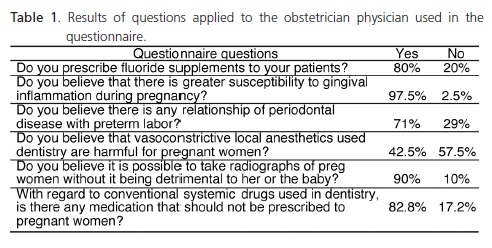
The results will be shown in tables to facilitate their understanding (Tables 1 and 2), according to the questions.
Among the main results, 80% of physicians prescribed fluorinated vitamin compounds to pregnant women. The majority of physicians (97.5%) believed that there was greater susceptibility to gingival inflammatory alterations during pregnancy and 71% attributed the risk of premature birth to periodontal infection.
With regard to the procedures adopted by dentists, 42.5% of physicians believe that vasoconstrictors used in dentistry could harm the mother and fetus.
On the other hand, 90% of physicians believe that use of X-rays could not harm the fetus.
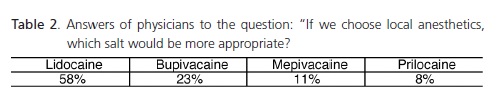
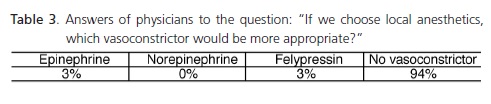
The majority of physicians (58%) believed that lidocaine would be the best anesthetic to be used by the dentist, but 94% thought it would be better not to use the vasoconstrictor during local anesthesia for dental purposes.
]]>
 ]]>
]]>
DISCUSSION
Taking into consideration the exposure to radiographs taken during pregnancy, 90% of physicians believe that it is possible to perform them if the following basic care is taken: short exposure time, use of ultrasensitive radiographic films and lead apron. Among the 10% of physicians who contraindicated radiographs, they referred to the first trimester of pregnancy, due to fetal organogenesis and possible teratogenic effects due to radiation. Although it is known that the younger the cell, the greater the risk of teratogenicity, there is no evidence in the literature that dental radiation can harm the baby and it may be used when needed20.
Fluoride supplementation has been used for many years in order to protect the teeth of the fetus. The mineralization of deciduous dentition is not advanced enough at birth to for fluoride to accumulate in the enamel21. However, 80% of respondents still prescribe fluoride supplements to pregnant patients, believing that it will enter the placenta barrier and be deposited in the teeth of the fetus in order to protect them against caries and strengthen teeth. One should remember that in addition to the most important action of fluoride being topical, the vitamin complexes containing fluoride associate this fluoride with important mineral salts and vitamins whose absorption may thus be harmed8.
Of the physicians interviewed, 97.5% believe that there is a greater susceptibility to gingival inflammatory alterations during pregnancy. The literature confirms this suspicion, since gingivitis is extremely common during pregnancy due to the presence of vasodilator hormones that exacerbate the inflammatory process, however, it should be remembered that the presence of biofilm is an essential factor for this condition10.
Although almost all physicians (97.5%) believed that that there was greater susceptibility to gingival inflammatory alterations during pregnancy, only 71% of them believed that this disease was correlated to premature birth. The current literature has associated low-intensity chronic periodontal infection with the risk of premature delivery, low birth weight infants and preeclampsia13,22-24.
Despite the doubts regarding the existence of a mechanism that would associate periodontal infection with obstetric complications, especially preeclampsia, current research has shown, for example, that inflammatory mediators related to preeclampsia (TNF-alpha) found in the blood plasma of pregnant women with this alteration, are increased to an even greater extent in the presence of periodontitis25-26.
Furthermore, a recent meta-analysis sought to enumerate the maternal infections related to the risk of developing preeclampsia concluded that periodontitis could be included in these morbidities27.
The use of vasoconstrictive local anesthetics is the most controversial subject when the dental treatment of pregnant women is discussed. Although 57.5% of the physicians believe that vasoconstrictive local anesthetics can be used during pregnancy without harming the pregnant women, 42.5% affirm that the vasoconstrictors can cause placental vasoconstriction, hypertension, cardiopathies and placental displacement. It should be remembered that the scientific literature does not contraindicate the use of vasoconstrictors during pregnancy, particularly in healthy pregnant women, since not using them could lead to a painful treatment, causing the release of harmful endogenous agents17.
With regard to the choice of anesthetic salt, 58% of physicians indicate the use of lidocaine as the salt of choice. The second option was bupivacaine by 23% of the respondents. Mepivacaine was the choice of 11% of the obstetricians and prilocaine was the least recommended, being the one of choice of 8% of the physicians. To choose the anesthetic salt, according to the literature, it is necessary to assess the amount of local anesthetic that will pass through the placenta17. This will depend on one of the following factors: molecular size, the extent of anesthetic binding to the maternal plasma protein and fetal metabolism of the drug. According to these factors and in agreement with the majority of physicians interviewed, the anesthetic salt of choice for the gestation period is lidocaine, classified as group B by Food and Drug Administration18,28.
]]> There was a controversy regarding the indication of vasoconstrictors because many of physicians affirmed that they are not harmful (57.5%), but when asked which is the most suitable vasoconstrictor, they chose not to use the substance (94%). It must be emphasized that the anesthetic solutions should contain a vasoconstrictor agent in their composition with the goal of slowing down the absorption of anesthetic salt into the bloodstream, which would decrease toxicity and increase the duration of anesthesia. Without the use of this agent in anesthetic solutions, in addition to not having the vasoconstrictor, the anesthetic solution, which is a vasodilator, would be more rapidly absorbed, causing greater toxicity to the fetus28.Once having opted to use a vasoconstrictor agent, only 2.94% of the physicians would use epinephrine. There is no support in the medical and dental literature for the concern about using this substance, which is also released endogenously. The physician often believes that the anesthetic cartridge has an excessive amount of this vasoconstrictive agent, however, it contains 0.018 mg (at the ratio of 1:100,000), which is too little and too close to the amount released endogenously at rest. It is worth remembering that not using these vasoconstrictive agents may cause pain during treatment, thereby increasing their plasmatic level by up to 40 times29.
With further reference to vasoconstrictors, it may be said that it is not advisable to use norepinephrine in pregnant women. Due to its almost exclusive action on the alpha-adrenergic receptors, the concentration of norepinephrine available in Brazil (1:50,000) could cause surface necrosis of the tissues on which it is deposited, therefore it must not be used to obtain hemostasis. In the United States of America this vasoconstrictor is not available for local anesthetic solutions in Dentistry29. In a review, it was suggested that epinephrine should be used for pregnant patients at a ratio of 1:200,000 or 1:100,00028.
Felypressin was also cited by 2.94% of the obstetricians as the vasoconstrictive agent of choice used during pregnancy. However, felypressin is structurally similar to oxytocin, which causes uterine contraction. Despite the small amount of felypressin contained in the dental cartridge, this vasoconstrictor is not the best option for Dentistry or pregnant women18.
According to all these evidences, one of anesthetic solution that provides greatest safety in the gestation period is the association of 2% lidocaine with epinephrine 1:200,000 or 1:100,000. It should be pointed out that performing the anesthetic technique correctly is as important as the appropriate selection of the anesthetic salt and vasoconstrictor. No more than 2 anesthetic vials (3.6 ml) should be used per treatment session, without forgetting to aspirate before and during the anesthesia procedure. These procedures will reduce the risk of systemic complications, pain and stress during injection of the drug18,28-29.
Another point of disagreement between physicians and dentists is related to the use of systemic medication during pregnancy. According to 82.8% of the respondents, there are medications that must not be used during the gestation period. Among them, the most mentioned types are antibiotics (without specifying the salt), antimetabolites, anti-inflammatory drugs (especially the non-steroidal antiinflammatory agents) and acetylsalicylic acid.
Not all these medications are allowed as the placenta is not an selective barrier against most drugs14. Once the drug has passed through the placenta, its effect will depend on the ability of the fetal tissues to metabolize the substance, and the susceptibility of these tissues to the aggression14.
Amoxicillin, the antibiotic of first choice for oral infections in most cases, is classified as group B by the Food and Drug Administration, which is apparently safe to use during pregnancy. With regard to analgesics, the option should be paracetamol, but it must not be used without control30.
Non-steroidal anti-inflammatory drugs (NSAIDs) are medications that must be used with caution because they may cause harm, especially during the first and last trimester of pregnancy30.
A research showed that non-steroidal antiinflammatory agents may not be safe to use during the first trimester of pregnancy. The authors suggest that when used at a time close to conception, NSAIDs decrease the chances of successful implantation of the egg in the uterine wall due to the importance prostaglandins have in this process. On the other hand, due to the different action mechanism of paracetamol, it was not shown to be dangerous during this period30.
]]> Because NSAIDs decrease the systemic release of prostaglandins, the literature has shown, for example, that all the cyclooxygenase enzyme inhibitors (selective, non-selective and specific) act to stimulate constriction of the ductus arteriosus in the fetus, a blood vessel that prevents the fetal lung from receiving an excessive amount of blood. These drugs should be completely avoided in the last trimester when the canal is physiologically preparing to close30. When anti-inflammatory action is needed, the option should be corticosteroid at a dose of 4mg (betamethasone), 1 hour before the procedure, since this drug seems to have less pronounced effects on the fetus and pregnant woman, particularly if used at the doses recommended in dentistry.If in doubt when prescribing systemic medication, the dentist should contact the patient's obstetrician, since the physician knows the patient's general health situation.
CONCLUSION
From the data presented, it could be concluded that even in view of all the contemporary scientific evidence, there are still many divergences with respect to dental care for pregnant women from a medical point of view. Obstetricians continue to show some reluctance in allowing and indicating dental treatment during pregnancy, especially with regard to the use of X-rays, systemic medication and local anesthetics. The implementation of programs to disseminate researches with reference to this subject to obstetricians is suggested, in order to seek uniformity in their practices thereby improving the quality of care for pregnant women.
Collaborators
P LASLOWSKI developed the project, collected the data and wrote the manuscript. GT POLITANO, SEP SILVA, DP RAGGIO and JC IMPARATO supervised and guided the study and contributed to the writing of the article.
REFERENCES
1. Casamassimo OS. Maternal oral health. Dent Clin North Am. 2001;45(3):469-77. [ Links ]
2. Silva SR. Atendimento à gestante: 9 meses de espera? Rev Assoc Cir Dent. 2002;56(2):89-99.
3. Carvalho EMC. Abordagem odontológica durante a gestação. Rev Fac Odont Univ Fed Bahia. 1985;6:43-58.
4. Scavuzzi AIF, Rocha MCBS, Vianna MIP. Influência da gestação na prevalência da cárie dentária e da doença periodontal. Rev Fac Odontol Univ Fed Bahia. 1999;18:15-21.
5. Thylstrup A, Fejerskov O. Cariologia clínica. 2ª ed. São Paulo: Santos; 1995.
6. Hilgers KK, Douglass J, Mathieu GP. Adolescent pregnancy: a review of dental treatment guidelines. Pediatr Dent. 2003;25(5):459-67.
7. Campos PRB, Armonia PL, Saraceni Junior G, Ribas TRC, Melo JAJ. Suplementos fluorados durante a gestação e lactação: verdades e mitos. Rev Odontol Univ Santo Amaro. 2000;5(2):84- 9.
8. Pinto LS, Uema APA, Galassi MA, Ciuff NJ. O que as gestantes conhecem sobre saúde bucal? J Bras Odontopediatr Odontol Bebe. 2001;4(21):429-34.
9. Calabrich CFC, Calabrich JLS. A infecção periodontal durante a gravidez. Femina. 2005;33(8):609-12.
10. Bosco AF, Luize DS, Murakawa AC, Esper LA. A influência dos hormônios sexuais nos tecidos periodontais: revisão de literatura. Rev Odontol Araçatuba. 2004;25(2):22-7.
]]> 11. Egbert B, Toledo C, Rossa C. Influências das condições sistêmicas sobre as doenças periodontais e das doenças periodontais sobre as condições sistêmicas. In: Tunes UR, Ropp GE. Atualização em periodontia e implantodontia. São Paulo: Artes Médicas; 1999. p. 29-60.12. Offenbacher S, Jared HL, O'Reilly PG, Wells SR, Salvi GE, Lawrence HP, et al. Potencial pathogenic mechanisms of periodontitis associated with pregnancy complications. Ann Periodontol. 1998;3(1):233-50.
13. Chazan FL, Aquino MMA, Neto CM. Doença periodontal e prematuridade. Femina. 2004;32(3):219-22.
14. Tortamano N, Armonia PL. Guia terapêutico odontológico. São Paulo: Santos; 2001.
15. Silva JRO. Avaliação e tratamento da paciente gestante na odontologia. Odontol Mod. 1990;17(7):23-8.
16. Zimmermmann JB, Araújo DAC, Zimmermmann SG, Rodrigues DM, Silva DJN, Carvalho DC, et al. Uso de medicamentos na gravidez e lactação: protocolo de conduta. Femina. 2005;33(2):115-20.
17. Andrade ED, Volpato MC, Ranali J. Pacientes que requerem cuidados especiais. In: Andrade ED. Terapêutica medicamentosa em odontologia. 2ª ed. São Paulo: Artes Médicas; 2006. p.117- 58.
18. Rood JP. Local analgesia during pregnancy. Dent Update. 1981;8(7):483-5.
19. Turner M, Aziz SR. Management of the pregnant oral and maxillofacial surgery patient. J Oral Maxillofac Surg. 2002;60(12):1479-88. doi: 10.1053/joms.2002.36132.
20. American Dental Association Council on Scientific Affairs. The use of dental radiographs: update and recommendations. J Am Dent Assoc. 2006;137(9):1304-12.
]]> 21. Thylstrup A. Is there a biological rationale for prenatal fluoride administration? ASDC J Dent Child. 1981;48(2):103-8.22. Offenbacher S, Lieff S, Boggess KA, Murtha AP, Madianos PN, Champagne CM, et al. Maternal periodontitis and prematurity. Part I: Obstetric outcome of prematurity and growth restriction. Ann Periodontol. 2001;6(1):164-74.
23. Canakci V, Canakci CF, Canakci H, Canakci E, Cicek Y, Ingec M, et al. Periodontal disease as a risk factor for pre-eclampsia: a case control study. Aust N Z J Obstet Gynaecol. 2004;44(6):568- 73. doi: 10.1111/j.1479-828X.2004.00323.x.
24. Contreras A, Herrera JA, Soto JE, Arce RM, Jaramillo A, Botero JE. Periodontitis is associated with preeclampsia in pregnant women. J Periodontol. 2006;77(2):182-8. doi: 10.1902/ jop.2006.050020.
25. Politano GT, Passini R, Nomura ML, Velloso L, Morari J, Couto E. Correlation between periodontal disease, inflammatory alterations and pre-eclampsia. J Periodontal Res. 2011;46(4):505- 11. doi: 10.1111/j.1600-0765.2011.01368.x
26. Passini Júnior R, Nomura, ML, Politano GT. Doença periodontal e complicações obstétricas: há relação de risco? Rev Bras Ginecol Obstet. 2007;29(7):370-5. doi: 10.1590/S0100- 72032007000700008.
27. Conde-Agudelo A, Villar J, Lindheimer M. Maternal infection and risk of preeclampsia: systematic review and metaanalysis. Am J Obstet Gynecol. 2008;198(1):7-22. doi: 10.1016/j. ajog.2007.07.040.
28. Haas DA. An update on local anesthetics in dentistry. J Can Dent Assoc. 2002;68(9):546-51.
29. Malamed S. Manual de anesthesia local. 5ª ed. Rio de Janeiro: Elsevier; 2005.
30. Li DK, Liu L, Odouli R. Exposure to non-steroidal antiinflammatory drugs during pregnancy and risk of miscarriage: population based cohort study. BMJ. 2003;327(7411):368. doi: 10.1136/bmj.327.7411.368.
]]>
 Correspondence to:
GT POLITANO
e-mail: gabriel@clinicapolitano.com.br
Received on: 7/5/2010
Final version resubmitted on: 25/11/2010
Approved on: 4/1/2011
]]>