<?xml version="1.0" encoding="ISO-8859-1"?><article xmlns:mml="http://www.w3.org/1998/Math/MathML" xmlns:xlink="http://www.w3.org/1999/xlink" xmlns:xsi="http://www.w3.org/2001/XMLSchema-instance">
<front>
<journal-meta>
<journal-id>1981-8637</journal-id>
<journal-title><![CDATA[RGO.Revista Gaúcha de Odontologia (Online)]]></journal-title>
<abbrev-journal-title><![CDATA[RGO, Rev. gaúch. odontol. (Online)]]></abbrev-journal-title>
<issn>1981-8637</issn>
<publisher>
<publisher-name><![CDATA[Mundi Brasil Gráfica e Editora Ltda.]]></publisher-name>
</publisher>
</journal-meta>
<article-meta>
<article-id>S1981-86372013000100011</article-id>
<title-group>
<article-title xml:lang="en"><![CDATA[The approval rating through the use of an interocclusal device]]></article-title>
<article-title xml:lang="pt"><![CDATA[Grau de satisfação pelo uso de um dispositivo interoclusal]]></article-title>
</title-group>
<contrib-group>
<contrib contrib-type="author">
<name>
<surname><![CDATA[OLIVEIRA]]></surname>
<given-names><![CDATA[Francisco Artur Forte]]></given-names>
</name>
<xref ref-type="aff" rid="A01"/>
</contrib>
<contrib contrib-type="author">
<name>
<surname><![CDATA[FERNANDES]]></surname>
<given-names><![CDATA[Clarissa Pessoa]]></given-names>
</name>
<xref ref-type="aff" rid="A01"/>
</contrib>
<contrib contrib-type="author">
<name>
<surname><![CDATA[CHAVES]]></surname>
<given-names><![CDATA[Filipe Nobre]]></given-names>
</name>
<xref ref-type="aff" rid="A02"/>
</contrib>
<contrib contrib-type="author">
<name>
<surname><![CDATA[MAGRO]]></surname>
<given-names><![CDATA[Lorena Barreira]]></given-names>
</name>
<xref ref-type="aff" rid="A01"/>
</contrib>
</contrib-group>
<aff id="A01">
<institution><![CDATA[,Programa de Pós-Graduação em Disfunção Temporomandibular Curso de Odontologia Faculdade São Leopoldo Mandic]]></institution>
<addr-line><![CDATA[ ]]></addr-line>
</aff>
<aff id="A02">
<institution><![CDATA[,Departamento de Ciências Morfológicas Instituto de Ciências Básicas da Saúde Universidade Federal do Rio Grande do Sul]]></institution>
<addr-line><![CDATA[Porto Alegre RS]]></addr-line>
<country>Brasil</country>
</aff>
<pub-date pub-type="pub">
<day>00</day>
<month>03</month>
<year>2013</year>
</pub-date>
<pub-date pub-type="epub">
<day>00</day>
<month>03</month>
<year>2013</year>
</pub-date>
<volume>61</volume>
<numero>1</numero>
<fpage>85</fpage>
<lpage>91</lpage>
<copyright-statement/>
<copyright-year/>
<self-uri xlink:href="http://revodonto.bvsalud.org/scielo.php?script=sci_arttext&amp;pid=S1981-86372013000100011&amp;lng=en&amp;nrm=iso"></self-uri><self-uri xlink:href="http://revodonto.bvsalud.org/scielo.php?script=sci_abstract&amp;pid=S1981-86372013000100011&amp;lng=en&amp;nrm=iso"></self-uri><self-uri xlink:href="http://revodonto.bvsalud.org/scielo.php?script=sci_pdf&amp;pid=S1981-86372013000100011&amp;lng=en&amp;nrm=iso"></self-uri><abstract abstract-type="short" xml:lang="en"><p><![CDATA[Objective The objective of this study was to assess the approval rating of patients with muscular and/or joint TMD during the use of an interocclusal device. Methods 51 consenting patients were selected with muscular and/or joint TMD, according to the criteria of the Research Diagnostic Criteria protocol (RDC/TMD) and needing the use of an interocclusal device as part of a conservative treatment at the São Leopoldo Mandic Dental Research Center in Campinas, São Paulo, Brazil. The interocclusal device was installed using the protocol defined by the manufacturer for its use and adaptation. The satisfaction questionnaire was applied to the subjects of the research after 30 days using the interocclusal device. Results The results were: 71% of the patients had felt comfortable using the device; 73% used the device all night long, but 27% removed it at some time during the night, and 5 of these patients removed it every night, thus they did not succeed in using this type of device; 88% used it daily; 70% achieved the greatest relief from the main complaint in the first 3 weeks; 61% did not notice any change in bite; 47% did not feel any kind of tooth sensitivity; 51% did not grind their teeth with the use of the device and 72% took one or two weeks to get used to the device. Conclusion The majority obtained a high level of rating approval during the use of an interocclusal device.]]></p></abstract>
<abstract abstract-type="short" xml:lang="pt"><p><![CDATA[Objetivo Avaliar o grau de satisfação por parte dos pacientes com disfunção temporomandibular muscular, articular ou ambas com o uso de um dispositivo interoclusal parcial anterior. Métodos Foram selecionados 51 pacientes com disfunção temporomandibular muscular, articular ou ambas, segundo os critérios de diagnóstico do protocolo Research Diagnostic Criteria (RDC/TMD) e que necessitassem do uso de um dispositivo interoclusal como parte de um tratamento conservador, na clínica do Centro de Pesquisas Odontológicas São Leopoldo Mandic, Campinas, São Paulo. O dispositivo foi instalado utilizando-se o protocolo definido pelo fabricante para seu uso e adaptação. Foi aplicado aos indivíduos da pesquisa o questionário de satisfação, após 30 dias do uso do dispositivo interoclusal. Resultados Os resultados obtidos demonstraram que: 71% dos pacientes sentiram conforto ao usar o dispositivo; 73% usaram o aparelho durante toda à noite, mas 27% não conseguiram sendo que cinco desses pacientes retiraram por todas as noites, ou seja, não alcançaram êxito com o uso desse tipo de dispositivo; 88% usaram diariamente. O alívio maior da queixa principal foi alcançado nas três primeiras semanas por 70% dos pacientes; 61% não notaram mudanças na mordida; 47% não relataram sensibilidade nos dentes; 51% não rangeram ou apertaram os dentes com o uso do dispositivo e 72% precisaram de uma a duas semanas para se acostumarem com o dispositivo. Conclusão A maioria dos indivíduos da pesquisa alcançou um alto grau de satisfação ao usar o dispositivo.]]></p></abstract>
<kwd-group>
<kwd lng="en"><![CDATA[Instrumentation]]></kwd>
<kwd lng="en"><![CDATA[Patient satisfaction]]></kwd>
<kwd lng="en"><![CDATA[Temporomandibular joint dysfunction syndrome]]></kwd>
<kwd lng="pt"><![CDATA[Instrumentação]]></kwd>
<kwd lng="pt"><![CDATA[Satisfação do paciente]]></kwd>
<kwd lng="pt"><![CDATA[Síndrome da disfunção da articulação temporomandibular]]></kwd>
</kwd-group>
</article-meta>
</front><body><![CDATA[ <p align="right"><font size="2" face="Verdana, Arial, Helvetica, sans-serif"><b>ORIGINAL</b> / ORIGINAL</font></p>     <p>&nbsp;</p>     <p><font size="4" face="Verdana, Arial, Helvetica, sans-serif"><a name="top"/></a><B>The approval rating through the use of an interocclusal device</B></font></p>     <p>&nbsp;</p>     <p><font size="3" face="Verdana, Arial, Helvetica, sans-serif"><b>Grau de satisfa&ccedil;&atilde;o pelo uso de um dispositivo interoclusal</b> </font></p>     <p>&nbsp;</p>     <p>&nbsp;</p>     <p><font size="2" face="Verdana, Arial, Helvetica, sans-serif"><b>Francisco Artur Forte OLIVEIRA<sup>I</sup>; Clarissa Pessoa FERNANDES<sup>I</sup>; Filipe Nobre CHAVES<sup>II</sup>; Lorena Barreira MAGRO<sup>I</sup></b></font></p>     <p><font size="2" face="Verdana, Arial, Helvetica, sans-serif"><sup>I</sup> Faculdade S&atilde;o Leopoldo Mandic, Curso de Odontologia, Programa de P&oacute;s-Gradua&ccedil;&atilde;o em Disfun&ccedil;&atilde;o Temporomandibular    <br> <sup>II</sup> Universidade Federal do Rio Grande do Sul, Instituto de Ci&ecirc;ncias B&aacute;sicas da Sa&uacute;de, Departamento de Ci&ecirc;ncias Morfol&oacute;gicas. Porto Alegre, RS, Brasil </font></p>     ]]></body>
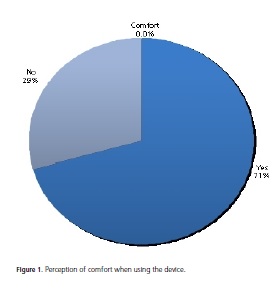
<body><![CDATA[<p><font size="2" face="Verdana, Arial, Helvetica, sans-serif"><a href="#back">Correspondence:</a></font></p>     <p>&nbsp;</p>     <p>&nbsp;</p> <hr size="1" noshade>     <p><font size="3" face="Verdana, Arial, Helvetica, sans-serif"><b>ABSTRACT</b> </font></p>     <p><font size="2" face="Verdana, Arial, Helvetica, sans-serif"><b>Objective</b>    <br>    </font><font size="2" face="Verdana, Arial, Helvetica, sans-serif">The objective of this study was to assess the approval rating of patients with muscular and/or joint TMD during the use of an interocclusal device. </font></p>     <p><font size="2" face="Verdana, Arial, Helvetica, sans-serif"><b>Methods</b>    <br>  </font><font size="2" face="Verdana, Arial, Helvetica, sans-serif">51 consenting patients were selected with muscular and/or joint TMD, according to the criteria of the Research Diagnostic Criteria protocol (RDC/TMD) and needing the use of an interocclusal device as part of a conservative treatment at the S&atilde;o Leopoldo Mandic Dental Research Center in Campinas, S&atilde;o Paulo, Brazil. The interocclusal device was installed using the protocol defined by the manufacturer for its use and adaptation. The satisfaction questionnaire was applied to the subjects of the research after 30 days using the interocclusal device. </font></p>     <p><font size="2" face="Verdana, Arial, Helvetica, sans-serif"><b>Results</b>    <br>    </font><font size="2" face="Verdana, Arial, Helvetica, sans-serif">The results were: 71% of the patients had felt comfortable using the device; 73% used the device all night long, but 27% removed it at some time during the night, and 5 of these patients removed it every night, thus they did not succeed in using this type of device; 88% used it daily; 70% achieved the greatest relief from the main complaint in the first 3 weeks; 61% did not notice any change in bite; 47% did not feel any kind of tooth sensitivity; 51% did not grind their teeth with the use of the device and 72% took one or two weeks to get used to the device. </font></p>     ]]></body>
<body><![CDATA[<p><font size="2" face="Verdana, Arial, Helvetica, sans-serif"><b>Conclusion</b>    <br>    </font><font size="2" face="Verdana, Arial, Helvetica, sans-serif">The majority obtained a high level of rating approval during the use of an interocclusal device. </font></p>     <p><font size="2" face="Verdana, Arial, Helvetica, sans-serif"><B>Indexing terms: </B>Instrumentation. Patient satisfaction. Temporomandibular joint dysfunction syndrome.</font></p> <hr size="1" noshade>     <p><font size="3" face="Verdana, Arial, Helvetica, sans-serif"><B>RESUMO</B> </font></p>     <p><font size="2" face="Verdana, Arial, Helvetica, sans-serif"><b>Objetivo</b>    <br>  </font><font size="2" face="Verdana, Arial, Helvetica, sans-serif">Avaliar o grau de satisfa&ccedil;&atilde;o por parte dos pacientes com disfun&ccedil;&atilde;o temporomandibular muscular, articular ou ambas com o uso de um dispositivo interoclusal parcial anterior. </font></p>     <p><font size="2" face="Verdana, Arial, Helvetica, sans-serif"><b>M&eacute;todos</b>    <br>  </font><font size="2" face="Verdana, Arial, Helvetica, sans-serif">Foram selecionados 51 pacientes com disfun&ccedil;&atilde;o temporomandibular muscular, articular ou ambas, segundo os crit&eacute;rios de diagn&oacute;stico do protocolo Research Diagnostic Criteria (RDC/TMD) e que necessitassem do uso de um dispositivo interoclusal como parte de um tratamento conservador, na cl&iacute;nica do Centro de Pesquisas Odontol&oacute;gicas S&atilde;o Leopoldo Mandic, Campinas, S&atilde;o Paulo. O dispositivo foi instalado utilizando-se o protocolo definido pelo fabricante para seu uso e adapta&ccedil;&atilde;o. Foi aplicado aos indiv&iacute;duos da pesquisa o question&aacute;rio de satisfa&ccedil;&atilde;o, ap&oacute;s 30 dias do uso do dispositivo interoclusal. </font></p>     <p><font size="2" face="Verdana, Arial, Helvetica, sans-serif"><b>Resultados</b>    <br>  </font><font size="2" face="Verdana, Arial, Helvetica, sans-serif">Os resultados obtidos demonstraram que: 71% dos pacientes sentiram conforto ao usar o dispositivo; 73% usaram o aparelho durante toda &agrave; noite, mas 27% n&atilde;o conseguiram sendo que cinco desses pacientes retiraram por todas as noites, ou seja, n&atilde;o alcan&ccedil;aram &ecirc;xito com o uso desse tipo de dispositivo; 88% usaram diariamente. O al&iacute;vio maior da queixa principal foi alcan&ccedil;ado nas tr&ecirc;s primeiras semanas por 70% dos pacientes; 61% n&atilde;o notaram mudan&ccedil;as na mordida; 47% n&atilde;o relataram sensibilidade nos dentes; 51% n&atilde;o rangeram ou apertaram os dentes com o uso do dispositivo e 72% precisaram de uma a duas semanas para se acostumarem com o dispositivo. </font></p>     ]]></body>
<body><![CDATA[<p><font size="2" face="Verdana, Arial, Helvetica, sans-serif"><b>Conclus&atilde;o</b>    <br>  </font><font size="2" face="Verdana, Arial, Helvetica, sans-serif">A maioria dos indiv&iacute;duos da pesquisa alcan&ccedil;ou um alto grau de satisfa&ccedil;&atilde;o ao usar o dispositivo. </font></p>     <p><font size="2" face="Verdana, Arial, Helvetica, sans-serif"><B>Termos de indexa&ccedil;&atilde;o: </B>Instrumenta&ccedil;&atilde;o. Satisfa&ccedil;&atilde;o do paciente. S&iacute;ndrome da disfun&ccedil;&atilde;o da articula&ccedil;&atilde;o temporomandibular.</font></p> <hr noshade size="1">     <p>&nbsp;</p>     <p>&nbsp;</p>     <p><font size="3" face="Verdana, Arial, Helvetica, sans-serif"><B> INTRODUCTION</B></font></p>     <p><font size="2" face="Verdana, Arial, Helvetica, sans-serif">Temporomandibular dysfunction (TMD), a term   adopted by the American Dental Association (ADA), is a   set of joint and muscle disturbances in the orofacial area,   primarily characterized by pain, joint noise and mandibular   function which is abnormal or has some deviation<sup>1</sup>. The   pain is not of neurogenic, psychogenic or visceral origin.   Periodontal, dental and skin pains were also excluded from this definition<sup>2</sup>.</font></p>     <p><font size="2" face="Verdana, Arial, Helvetica, sans-serif">  Interocclusal appliances are often used to treat   patients with TMD with the aim of stabilizing the unstable   occlusion, rearranging the function of chewing muscles, of   TMJ, relieving the painful symptoms experienced by these   patients<sup>3</sup>. They are also recommended for the protection of   teeth of patients with nocturnal bruxism<sup>4</sup>.</font></p>     <p><font size="2" face="Verdana, Arial, Helvetica, sans-serif">  The risk of side effects is low and depends on   the appliance design and the length of use, since it is a   conservative method of treatment<sup>5</sup>. When used incorrectly,   they can produce serious, irreversible consequences<sup>6</sup>. The   risk is particularly great in cases of mandibular advancement   splints and with partial coverage devices (they only come   into contact with parts of the antagonist teeth), used for a   period of time in excess of four to six weeks, and without   proper supervision<sup>7</sup>.</font></p>     <p><font size="2" face="Verdana, Arial, Helvetica, sans-serif">  With the emergence of a new interocclusal   device to treat TMDs, the nociceptive trigeminal inhibitor   (NTI), studies have started to be carried out to prove its   effectiveness<sup>8</sup>.</font></p>     ]]></body>
<body><![CDATA[<p><font size="2" face="Verdana, Arial, Helvetica, sans-serif">  The aim of the present study was to evaluate the   degree of satisfaction of patients with muscular TMD,   joint TMD, or both, with the use of the partial anterior   interocclusal device, the NTI.</font></p>     <p><font size="2" face="Verdana, Arial, Helvetica, sans-serif">  Manns et al.<sup>9</sup> selected 75 patients (9 males and 66   females aged between 13 and 53), with TMD symptoms.   The vertical dimensions were taken with a minimum of   muscle activity (evaluated via electromyography) for each   patient, and based on these data, they were divided into   three groups: group I with 1 mm of splint height; group II   with an average height of 4.42 mm; and group III at 8.15   mm. It was found that the temporary use of the splint,   with a height beyond the physiological rest position, did   not cause an increase in muscle tone, nor hyperactivity   of the masseter muscles; according to these authors, this   provided greater neuromuscular relaxation.</font></p>     <p><font size="2" face="Verdana, Arial, Helvetica, sans-serif">  Clark6 conducted a critical review with appliances   with an anterior bite plane which was used in cases of   occlusal alteration to reestablish a new vertical dimension   and muscle relaxation. The author concluded that this type of interocclusal device could produce irreversible   complications, such as dental intrusion and extrusion, when   used for long periods, and are therefore recommended   for emergency interventions such as trismus or reduced   opening of the mouth.</font></p>     <p><font size="2" face="Verdana, Arial, Helvetica, sans-serif">  Continuing this line of research, Boero4 performed   a review of four basic types of splint (stabilizing, pivoting,   resilient and repositioning). He concluded that the muscles   that raise the lower jaw are more efficient when the   vertical dimension is more increased than in the vertical   dimension of occlusion and that the postural position   with minimum muscle activity is vertically greater than   the clinical rest position. The interocclusal splints that   increase the vertical dimension beyond the free function   space produce an accommodation of the central nervous   system to this alteration, and as a consequence produce   a reduction in electromyographic activity of the anterior   temporal muscles.</font></p>     <p><font size="2" face="Verdana, Arial, Helvetica, sans-serif">  List &amp; Helkimo5 evaluated the effects of therapy   with an occlusal splint in a sample of 61 patients with   TMD (17 men and 44 women with ages ranging from 19   to 69). A total of 10% of patients were assessed as very   comfortable, another 10% as comfortable, 80% said that   it was neither comfortable nor uncomfortable, and one   patient reported discomfort when using the occlusal splint.</font></p>     <p><font size="2" face="Verdana, Arial, Helvetica, sans-serif">  Attanasio<sup>10</sup> described the therapy with intraoral   appliances with anterior bite plane, emphasizing that   these lead to complete posterior disocclusion, there being   no load on the structures of the stomatognathic system via   the posterior teeth, and as such are well recommended for   the control of nocturnal bruxism with painful symptoms   in the muscles deriving from parafunctional behavior. This   appliance reduces the activity of the temporal muscle   when swallowing and also releases the mandibular along   the antero-posterior axis for repositioning. Care should   be taken with the possibility of the super-eruption of the posterior teeth with the continuous use of the appliance.</font></p>     <p><font size="2" face="Verdana, Arial, Helvetica, sans-serif">  Para Widmalm<sup>7</sup>, despite divergence over the value   of therapy using the splint, it is reasonable to recommend   its use, as follows: to protect the oral tissue of patients   with oral parafunction; to stabilize unstable occlusions;   to eliminate the effect of occlusal interference and to test   the effects that changes in occlusion could have on TMJ   function and the chewing muscles prior to restorative   treatment.</font></p>     <p><font size="2" face="Verdana, Arial, Helvetica, sans-serif">  Omatsu et al.<sup>11</sup> selected 10 healthy volunteers.   Two types of device were fabricated for each individual,   one incisal splint that covered the upper central incisors   and had only one point of contact with the lower incisors</font><font size="2" face="Verdana, Arial, Helvetica, sans-serif"> in any position of the lower jaw and the stabilizing splint.   They concluded that the incisal plate can significantly   reduce muscle activity and should be used more for the   treatment of the symptoms of nocturnal clenching.</font></p>     <p><font size="2" face="Verdana, Arial, Helvetica, sans-serif">  Ekberg et al.<sup>12</sup> selected 60 patients (52 women   and 8 men with an average age of 29) out of 926 who   sought treatment for TMD at the Faculty of Dentistry in   Malm&ouml;. They obtained the following data: 23% of the   patients in the treatment group and 30% in the control   group complained of discomfort with the use of the splint;   83% of the treatment group and 77% in the control group   said they had used the splint every night or nearly every   night.</font></p>     <p><font size="2" face="Verdana, Arial, Helvetica, sans-serif">  Helkimo<sup>13</sup> issued an opinion for the Swedish Dental   Association about the use of the NTI-tss device (nociceptive   trigeminal inhibition - tension suppression system) for the   treatment of stomatognathic problems and migraine. It   is called this as it has a reduced frontal contact, leading   to the reduction of bite force, clenching and grinding.   The aforementioned "suppression" is ostensibly due to   a natural reflex to prevent a load increase on the teeth,   reducing or preventing the "muscle trigger component of   migraine". There are no studies to prove that the NTI was   superior to the other existing devices for the treatment   of myofascial pain and TMD, or that there is some other   mechanism whose effectiveness is different from the   action mechanism of the other deprogrammers. Unlike   the stabilizing splints, the NTI carries a risk of producing   adverse effects on the occlusion.</font></p>     ]]></body>
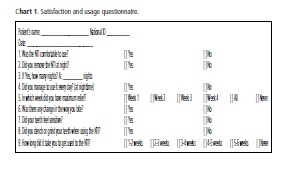
<body><![CDATA[<p><font size="2" face="Verdana, Arial, Helvetica, sans-serif">  Magnusson et al.<sup>14</sup> selected 30 patients with signs   and symptoms of TMD to be treated either with a stabilizing   splint or with a new type of device based on the concept of   nociceptive trigeminal inhibition (NTI). The result was that   four subjects in the NTI group accepted a switch to the   stabilizing splint group because of a lack of improvement   or because of a worsening of the symptoms, considering   this therapy to be unsatisfactory. On the other hand, no   subject in the stabilizing splint group agreed to switch to   the NTI group. Nine patients in the NTI group experienced   using two types of appliance and seven of these deemed   the stabilizer splint to be more comfortable than the NTI.   The use of the NTI for a long period could be detrimental   to occlusion. The positive effects attributed to the use of   the NTI seem to be extremely exaggerated and no support   was found for the statement that the NTI is a substitute for   the conventional interocclusal appliance.</font></p>     <p><font size="2" face="Verdana, Arial, Helvetica, sans-serif">  Jokstad et al.<sup>8</sup> selected 40 TMD clinic patients.   Two types of appliance were used: a Michigan stabilizing   splint and the NTI. The differences in the devices were not   described to the patients. Comfort with the use of the   appliance seemed to be similar in the two groups based on   the score in the visual-analog scale, although the NTI has   shown a tendency to being more comfortable. As far as   the NTI is concerned, the most frequent complaints were   dry mouth attributed to the design of the appliance which   obliges an open bite; appliance drops out or it is removed   subconsciously while asleep; difficulty in swallowing;   irritation at the tips and sensitivity of the lower anterior   teeth.</font></p>     <p><font size="2" face="Verdana, Arial, Helvetica, sans-serif">  Stapelmann and Turp<sup>15</sup>, in a systematic review,   compared the available evidence on the efficacy and safety   guaranteed by the NTI-tss manufacturer for the treatment   and prevention of bruxism, TMD, tension headache and   migraine. The review was performed on nine electronic   databases and on NTI-tss associated websites. The results   were that the NTI-tss led to complications with individual   teeth or with occlusion. The recommendation to use the   NTI-tss could be justified to reduce activity in the muscles   used to close the lower jaw (tooth clenching or grinding),   or as an emergency device for patients with acute   temporomandibular pain and limitations on the opening   of the mouth.</font></p>     <p>&nbsp;</p>     <p><font size="3" face="Verdana, Arial, Helvetica, sans-serif"><B> METHODS</B></font></p>     <p><font size="2" face="Verdana, Arial, Helvetica, sans-serif">A total of 51 volunteer patients were selected, of   both sexes, regardless of race and aged between 17 and   73 (average age 41.94), and comprised 6 men (11.76%)   and 45 women (88.24%), with muscular and/or joint TMD,   according to the diagnostic criteria of the I-a and l-b axes   of the Research Diagnostic Criteria protocol (RDC/TMD)16   and who needed to use an interocclusal device as part of   a conservative treatment, in the clinic of the S&atilde;o Leopoldo   Mandic Center for Dental Research, Campinas (in the state   of S&atilde;o Paulo). The only exclusion criterion was the refusal of the patient to take part in the study.</font></p>     <p><font size="2" face="Verdana, Arial, Helvetica, sans-serif">  This was a cross-sectional, clinical study, with no   dropouts during the treatment, in which the interocclusal   device (Standard NTI-tss model) was installed using the   protocol defined by the manufacturer.   After explaining the study and acquiring the agreement   of the volunteers to take part in the study, the Free and   Informed Consent Form was signed.</font></p>     <p><font size="2" face="Verdana, Arial, Helvetica, sans-serif">  For the data collection, the individuals were   given a satisfaction questionnaire to complete (<a href="#quad01">Chart I</a>),   after 30 days using the interocclusal device. The patient   received the card and answered the questions, requesting   assistance from the operator in the event of any doubtson how to fill it in. The data obtained were tabulated and   graphs produced.</font></p>     <p><font size="2" face="Verdana, Arial, Helvetica, sans-serif">  The research project was submitted to and approved   by the Ethics in Research Committee at the S&atilde;o Leopoldo   Mandic Center of Dental Research on March 19, 2007, filed   under reference 07/475, being in compliance with the ethical   principles contained in the Declaration of Helsinki (2000),   and also in compliance with the specific legislation of the   country in which the study was conducted.</font></p>     <p>&nbsp;</p>     ]]></body>
<body><![CDATA[<p><a name="quad01"></a></p>     <p>&nbsp; </p>     <p align="center"><img src="/img/revistas/rgo/v61n1/a11quad01.jpg">     <p>&nbsp;</p>     <p><font size="3" face="Verdana, Arial, Helvetica, sans-serif"><B> RESULTS</B></font></p>     <p><font size="2" face="Verdana, Arial, Helvetica, sans-serif">The results are arranged in the form of figures:</font></p>     <p>&nbsp;</p>     <p><a name="fig01"></a></p>     <p>&nbsp; </p>     <p align="center"><img src="/img/revistas/rgo/v61n1/a11fig01.jpg">     ]]></body>
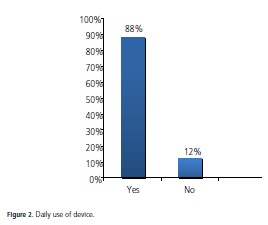
<body><![CDATA[<p>&nbsp;</p>     <p><a name="fig02"></a></p>     <p>&nbsp; </p>     <p align="center"><img src="/img/revistas/rgo/v61n1/a11fig02.jpg">     <p>&nbsp;</p>     <p><font size="2" face="Verdana, Arial, Helvetica, sans-serif"> With regard to the usage of the device, 88% of   patients used it every day, that is to say, every night for 30 days, while 12% did not.</font></p>     <p><font size="2" face="Verdana, Arial, Helvetica, sans-serif">  As for the use of the device throughout the night,   73% of patients used it the whole night while 27% did   not.</font></p>     <p><font size="2" face="Verdana, Arial, Helvetica, sans-serif">  Of the 14 patients, one removed it on three   occasions, one for four nights, one for seventeen nights,   two for one night, two for two nights, two for five nights   and five removed the device every night, i.e. they were unable to go on using this type of device.</font></p>     <p>&nbsp;</p>     <p><a name="fig03"></a></p>     ]]></body>
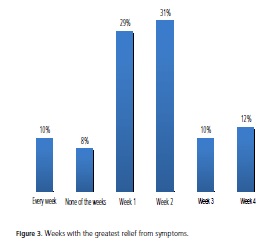
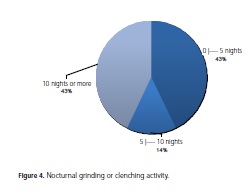
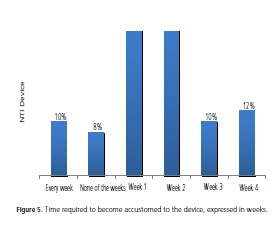
<body><![CDATA[<p>&nbsp; </p>     <p align="center"><img src="/img/revistas/rgo/v61n1/a11fig03.jpg">     <p>&nbsp;</p>     <p><font size="2" face="Verdana, Arial, Helvetica, sans-serif"> As far as the primary complaint is concerned,   the greatest relief occurred in the first week for 29% of   patients, the second week for 31%, the third week for   10%, fourth week for 12%, the same every week for 10% and no relief for 8%.</font></p>     <p><font size="2" face="Verdana, Arial, Helvetica, sans-serif">  In relation to the occlusal/dental aspects, 39% of   patients experienced some form of change in their bite   (the teeth came into contact with each other differently   immediately after using the device, returning to the   previous position during the following morning) and 61%   did not note any change.</font></p>     <p><font size="2" face="Verdana, Arial, Helvetica, sans-serif">  More than a half of patients (53%) felt their teeth   to be sensitive (lower anterior teeth through nocturnal   grinding or clenching and upper anterior teeth through   having to put up with the device).</font></p>     <p><font size="2" face="Verdana, Arial, Helvetica, sans-serif">  With regard to nocturnal activity: 49% grinded or   clenched the teeth when using the device.</font></p>     <p>&nbsp;</p>     <p><a name="fig04"></a></p>     <p>&nbsp; </p>     ]]></body>
<body><![CDATA[<p align="center"><img src="/img/revistas/rgo/v61n1/a11fig04.jpg">     <p>&nbsp;</p>     <p><a name="fig05"></a></p>     <p>&nbsp; </p>     <p align="center"><img src="/img/revistas/rgo/v61n1/a11fig05.jpg">     <p>&nbsp;</p>     <p><font size="2" face="Verdana, Arial, Helvetica, sans-serif"> In relation to the time required to become   accustomed to the device, the majority (72%) took one to   two weeks, 10% took two to three weeks, 2% took three   to four weeks, 2% took four to five weeks, 4% took five to six weeks and 10% were unable to get used to the device.</font></p>     <p>&nbsp;</p>     <p><font size="3" face="Verdana, Arial, Helvetica, sans-serif"><B> DISCUSSION</B></font></p>     <p><font size="2" face="Verdana, Arial, Helvetica, sans-serif">According to the results of this study, 71% of   patients felt comfortable. Ekberg et al.<sup>12</sup> showed, in their   study, that 23% of patients in the treatment group and   30% in the control group complained of discomfort   when using the splint. In the study by Magnusson et al.<sup>14</sup>,   however, of the nine patients who used the NTI and the   stabilizing splint, seven rated the stabilizing splint as more   comfortable than the NTI. In two other comparative studies,   the assessment was that they were similar: in Dahlstr&ouml;m   and Haraldson<sup>17</sup>, there was no statistical difference   between the two groups evaluated (Hawley18 modified   retainer and stabilizing splint) in terms of the discomfort   index at the beginning of the study, however by the end,   five patients in the Hawley<sup>18</sup> modified retainer group rated   it as being less uncomfortable, two as more uncomfortable   and two did not alter their initial assessment. As for the   group with the stabilizing splint, seven patients rated it as   less uncomfortable, none as being more uncomfortable   and three maintained their initial assessment. In the study   by Jokstad et al.<sup>8</sup>, the degree of comfort with the use of the   stabilizing splint and the NTI seemed to be similar, though the NTI did show a tendency to be more comfortable.</font></p>     ]]></body>
<body><![CDATA[<p><font size="2" face="Verdana, Arial, Helvetica, sans-serif">  The explanation for 73% of patients not having   removed the device during the night may be due to its   comfortableness, it being recognized by the organism as   an integral part of the occlusal/masticatory system.</font></p>     <p><font size="2" face="Verdana, Arial, Helvetica, sans-serif">  The data in this study show that 88% of patients   used the device every day, similar to the results found by   Ekberg et al.<sup>12</sup>, where 83% of the treatment group and   77% of the control group said they had used the splint   every or nearly every night.</font></p>     <p><font size="2" face="Verdana, Arial, Helvetica, sans-serif">  A total of 70% of the patients enrolled in this   study obtained greater relief in the first three weeks   and ran no risk of complications as these risks are more   prevalent in cases of mandibular advancement splints and   in cases involving appliances with partial tooth coverage   used for a period longer than four to six weeks without   proper supervision<sup>7</sup>.</font></p>     <p><font size="2" face="Verdana, Arial, Helvetica, sans-serif">  Regarding the change in bite (61% of patients   did not note any change in their bite), there is quite a   lot of controversy in the literature as the use of the splint could produce a change in muscle activity during the   day<sup>4</sup> and reduce the activity of the temporal muscle   when swallowing, as well as releasing the mandibular in   an antero-posterior manner for its repositioning<sup>10</sup>. The   continuous use of this device could cause super-eruption   of the posterior teeth, there being a risk of intrusion of the   antagonist teeth. The patient should be advised to make a   return visit to reevaluate the dental occlusion<sup>7,10,14-15</sup>.</font></p>     <p><font size="2" face="Verdana, Arial, Helvetica, sans-serif">  One of the complaints with the use of the NTI   is the sensitivity of the lower anterior teeth<sup>8</sup>. Side effects   are rare and consist mainly of alterations in saliva flow   (an increase or decrease) and a sensation of pressure on   the teeth<sup>5</sup>, which is consistent with the data obtained in   the present study which indicated that 53% of patients   experienced some form of tooth sensitivity.</font></p>     <p><font size="2" face="Verdana, Arial, Helvetica, sans-serif">  Practically one half of the patients (51%) did not   grind their teeth when using the NTI device. This outcome   serves to broaden the discussion on the topic since splints   with or without occlusal coverage reduce muscle activity   associated with nocturnal bruxism in 50% of instances<sup>19</sup>,   and reduce electromyographic activity in the anterior   temporal muscles, thereby reducing the total amount of   nocturnal activity in patients with bruxism<sup>4</sup>. The incisal   splint could significantly reduce muscle activity and should   be used rather for the treatment of nocturnal clenching   symptoms<sup>11</sup>. The recommendation to use the NTI could be   justified to reduce activity of the muscles used in closing   the lower jaw, or as an emergency device in patients with   acute temporomandibular pain and with mouth opening   limitations<sup>15</sup>.</font></p>     <p><font size="2" face="Verdana, Arial, Helvetica, sans-serif">  During sleep, however, some patients perform   greater parafunction with the splint than without it<sup>20</sup>, the   parafunctional activity of nocturnal bruxism not stopping<sup>21</sup>.   On the other hand, the study by Magnusson et al.<sup>14</sup> states   that the NTI maintained the clenching and grinding of the   teeth that were recorded at the start of the treatment.</font></p>     <p><font size="2" face="Verdana, Arial, Helvetica, sans-serif">  The majority (72% of patients) took from one to   two weeks to get accustomed to using the device, differing   from Clark et al.<sup>20</sup> who alerted to the fact of the splint being   a foreign body and that during the adaptation phase, in   addition to the possibility of aggravated symptoms, some   patients performed greater parafunction with the splint   than without it, thereby making adaptation difficult.</font></p>     <p><font size="2" face="Verdana, Arial, Helvetica, sans-serif">  Despite 88% of patients having used the device   every night, there was a percentage of these patients who   did not manage to use it throughout the whole night,   removing it during this period. It is possible that different   patients, when subjected to the same splint therapy present   with different responses due to their adaptive ability, or on   account of individual, intrinsic questions that are as yet not   well understood.</font></p>     <p><font size="2" face="Verdana, Arial, Helvetica, sans-serif">  As far as the TMD evaluation criterion is concerned,   the literature contains a series of questionnaires that seek   to assist the health professional. With the aim of creating   universal standardization of results, that avoids conflicting   diagnostic failures that could be perpetuated, Dworkin et   al.<sup>16</sup> created a protocol for standardizing clinical research   related to Temporomandibular Disorders, by establishing   an examination methodology. The present study, in   order to establish meticulous, reliable results based on   standardization, opted for RDC. Pettengill et al.<sup>22</sup>, Raphael   and Marbach<sup>23</sup> and Ekberg et al.<sup>12</sup> also used this standard   (RDC/TMD<sup>16</sup>). Selligman et al.<sup>24</sup>, Gesch et al.<sup>25</sup> and Gesch   et al.<sup>26</sup> resorted to the use of the guidelines issued by the   American Academy of Orofacial Pain. As for Dahlstr&ouml;m   and Haraldson<sup>17</sup> and Magnusson et al.<sup>14</sup>, they used the   Helkimo classification index; others made use of criteria   such as those of Clark, used by Pullinger et al.<sup>27</sup> and of   Gutiwski, used by Celic et al.<sup>28</sup>.</font></p>     ]]></body>
<body><![CDATA[<p><font size="2" face="Verdana, Arial, Helvetica, sans-serif">  The interocclusal device is a form of conservative   therapy that produces favorable results with regard to   TMD. Nevertheless, there are other mechanisms involved   in the therapeutic response of this pathology which are as   yet poorly understood<sup>29</sup>, or they could simply be the result   of the placebo effect<sup>10</sup>.</font></p>     <p><font size="2" face="Verdana, Arial, Helvetica, sans-serif">  It is necessary to carry out fresh research with a   different methodology that makes it possible to isolate the   effect of this device and to correlate the data on its use   with the results of symptom control, as well as taking into   consideration the TMD subtypes.</font></p>     <p>&nbsp;</p>     <p><font size="3" face="Verdana, Arial, Helvetica, sans-serif"><B> CONCLUSION</B></font></p>     <p><font size="2" face="Verdana, Arial, Helvetica, sans-serif">In accordance with the methodology employed in   the present study, it may be concluded that, for the majority   of patients, there was a high degree of satisfaction with the use of the NTI device.</font></p>     <p><font size="2" face="Verdana, Arial, Helvetica, sans-serif"><B> Collaborators</B></font></p>       <p><font size="2" face="Verdana, Arial, Helvetica, sans-serif">   LFR PEGADO and E GROSSMANN were responsible   for implementing the methods and writing of the article. AS   GUIMARAES was the creator of the work and participated in the   writing of the article. LF PEGADO, FL SILVA were responsible for   the literature review and writing of the article. AS GUIMARAES, E   GROSSMANN attended the correction and article writing. </font></p>     <p>&nbsp;</p>     <p><font size="3" face="Verdana, Arial, Helvetica, sans-serif"><B>REFERENCES </B></font></p>     <!-- ref --><p><font size="2" face="Verdana, Arial, Helvetica, sans-serif">1. Okeson JP. Fundamentos de oclus&atilde;o e desordens   temporomandibulares. 2&ordf; ed. S&atilde;o Paulo: Artes M&eacute;dicas; 1992.    &nbsp;&nbsp;&nbsp;&nbsp;&nbsp;&nbsp;&nbsp;&nbsp;[&#160;<a href="javascript:void(0);" onclick="javascript: window.open('/scielo.php?script=sci_nlinks&ref=206440&pid=S1981-8637201300010001100001&lng=','','width=640,height=500,resizable=yes,scrollbars=1,menubar=yes,');">Links</a>&#160;]<!-- end-ref --> </font></p>     <!-- ref --><p><font size="2" face="Verdana, Arial, Helvetica, sans-serif">2. Zarb GA, Carlsson GE. Temporomandibular joint: function and   dysfunction. Copenhagen: Munksgaard; 1979.    &nbsp;&nbsp;&nbsp;&nbsp;&nbsp;&nbsp;&nbsp;&nbsp;[&#160;<a href="javascript:void(0);" onclick="javascript: window.open('/scielo.php?script=sci_nlinks&ref=206442&pid=S1981-8637201300010001100002&lng=','','width=640,height=500,resizable=yes,scrollbars=1,menubar=yes,');">Links</a>&#160;]<!-- end-ref --></font></p>     <!-- ref --><p><font size="2" face="Verdana, Arial, Helvetica, sans-serif"> 3. Nelson SJ. Principles of stabilization bite splint therapy. Dent Clin   North Am. 1995;39(2):403-21.    &nbsp;&nbsp;&nbsp;&nbsp;&nbsp;&nbsp;&nbsp;&nbsp;[&#160;<a href="javascript:void(0);" onclick="javascript: window.open('/scielo.php?script=sci_nlinks&ref=206444&pid=S1981-8637201300010001100003&lng=','','width=640,height=500,resizable=yes,scrollbars=1,menubar=yes,');">Links</a>&#160;]<!-- end-ref --></font></p>     <!-- ref --><p><font size="2" face="Verdana, Arial, Helvetica, sans-serif"> 4. Boero RP. The physiology of splint therapy: a literature review.   Angle Orthod. 1989;59(3):165-80.    &nbsp;&nbsp;&nbsp;&nbsp;&nbsp;&nbsp;&nbsp;&nbsp;[&#160;<a href="javascript:void(0);" onclick="javascript: window.open('/scielo.php?script=sci_nlinks&ref=206446&pid=S1981-8637201300010001100004&lng=','','width=640,height=500,resizable=yes,scrollbars=1,menubar=yes,');">Links</a>&#160;]<!-- end-ref --></font></p>     <!-- ref --><p><font size="2" face="Verdana, Arial, Helvetica, sans-serif"> 5. List T, Helkimo M. Adverse events of acupuncture and occlusal   splint therapy in the treatment of craniomandibular disorders.   Cranio. 1992;10(4):318-24.    &nbsp;&nbsp;&nbsp;&nbsp;&nbsp;&nbsp;&nbsp;&nbsp;[&#160;<a href="javascript:void(0);" onclick="javascript: window.open('/scielo.php?script=sci_nlinks&ref=206448&pid=S1981-8637201300010001100005&lng=','','width=640,height=500,resizable=yes,scrollbars=1,menubar=yes,');">Links</a>&#160;]<!-- end-ref --></font></p>     <!-- ref --><p><font size="2" face="Verdana, Arial, Helvetica, sans-serif"> 6. Clark GT. A critical evaluation of orthopedic interocclusal   appliance therapy: design, theory, and overall effectiveness. J   Am Dent Assoc. 1984;108(3):359-64.    &nbsp;&nbsp;&nbsp;&nbsp;&nbsp;&nbsp;&nbsp;&nbsp;[&#160;<a href="javascript:void(0);" onclick="javascript: window.open('/scielo.php?script=sci_nlinks&ref=206450&pid=S1981-8637201300010001100006&lng=','','width=640,height=500,resizable=yes,scrollbars=1,menubar=yes,');">Links</a>&#160;]<!-- end-ref --></font></p>     <!-- ref --><p><font size="2" face="Verdana, Arial, Helvetica, sans-serif"> 7. Widmalm SE. Use and abuse of bite splints. Compend Contin   Educ Dent. 1999;20(3):249-59.    &nbsp;&nbsp;&nbsp;&nbsp;&nbsp;&nbsp;&nbsp;&nbsp;[&#160;<a href="javascript:void(0);" onclick="javascript: window.open('/scielo.php?script=sci_nlinks&ref=206452&pid=S1981-8637201300010001100007&lng=','','width=640,height=500,resizable=yes,scrollbars=1,menubar=yes,');">Links</a>&#160;]<!-- end-ref --></font></p>     <!-- ref --><p><font size="2" face="Verdana, Arial, Helvetica, sans-serif"> 8. Jokstad A, Mo A, Krogstad BS. Clinical comparison between   two different splint designs for temporomandibular disorder   therapy. Acta Odontol Scand. 2005;63(4):218-26. doi: 10.1080/00016350510019982.    &nbsp;&nbsp;&nbsp;&nbsp;&nbsp;&nbsp;&nbsp;&nbsp;[&#160;<a href="javascript:void(0);" onclick="javascript: window.open('/scielo.php?script=sci_nlinks&ref=206454&pid=S1981-8637201300010001100008&lng=','','width=640,height=500,resizable=yes,scrollbars=1,menubar=yes,');">Links</a>&#160;]<!-- end-ref --></font></p>     <!-- ref --><p><font size="2" face="Verdana, Arial, Helvetica, sans-serif"> 9. Manns A, Miralles R, Santander H, Valdivia J. Influence of   the vertical dimension in the treatment of myofascial paindysfunction   syndrome. J Prosthet Dent. 1983;50(5):700-9. doi:   10.1016/0022-3913(83)90213-5.    &nbsp;&nbsp;&nbsp;&nbsp;&nbsp;&nbsp;&nbsp;&nbsp;[&#160;<a href="javascript:void(0);" onclick="javascript: window.open('/scielo.php?script=sci_nlinks&ref=206456&pid=S1981-8637201300010001100009&lng=','','width=640,height=500,resizable=yes,scrollbars=1,menubar=yes,');">Links</a>&#160;]<!-- end-ref --></font></p>     <!-- ref --><p><font size="2" face="Verdana, Arial, Helvetica, sans-serif"> 10. Attanasio R. Intraoral orthotic therapy. Dent Clin North Am.   1997;41(2):309-24.    &nbsp;&nbsp;&nbsp;&nbsp;&nbsp;&nbsp;&nbsp;&nbsp;[&#160;<a href="javascript:void(0);" onclick="javascript: window.open('/scielo.php?script=sci_nlinks&ref=206458&pid=S1981-8637201300010001100010&lng=','','width=640,height=500,resizable=yes,scrollbars=1,menubar=yes,');">Links</a>&#160;]<!-- end-ref --></font></p>     <!-- ref --><p><font size="2" face="Verdana, Arial, Helvetica, sans-serif"> 11. Omatsu S, Ishigaki S, Kajiwara K, Morishige E, Kurozumi T.   2332 Electromyographic evaluation of the effect of two types of   occlusal splints on the muscle activity in the decubitus* position  &#91;cited 2010 Fev 15&#93;. Available from: &lt;http://www.nti-tss.com/Science/Japanese-NTI-study.html&gt;    &nbsp;&nbsp;&nbsp;&nbsp;&nbsp;&nbsp;&nbsp;&nbsp;[&#160;<a href="javascript:void(0);" onclick="javascript: window.open('/scielo.php?script=sci_nlinks&ref=206460&pid=S1981-8637201300010001100011&lng=','','width=640,height=500,resizable=yes,scrollbars=1,menubar=yes,');">Links</a>&#160;]<!-- end-ref -->.</font></p>     <!-- ref --><p><font size="2" face="Verdana, Arial, Helvetica, sans-serif"> 12. Ekberg E, Vallon D, Nilner M. The efficacy of appliance therapy   in patients with temporomandibular disorders of mainly   myogenous origin. a randomized, controlled, short-term trial. J   Orofac Pain. 2003;17(2):133-9.    &nbsp;&nbsp;&nbsp;&nbsp;&nbsp;&nbsp;&nbsp;&nbsp;[&#160;<a href="javascript:void(0);" onclick="javascript: window.open('/scielo.php?script=sci_nlinks&ref=206462&pid=S1981-8637201300010001100012&lng=','','width=640,height=500,resizable=yes,scrollbars=1,menubar=yes,');">Links</a>&#160;]<!-- end-ref --></font></p>     <!-- ref --><p><font size="2" face="Verdana, Arial, Helvetica, sans-serif"> 13. Helkimo M. The Swedish Dental Association turned to the   Swedish National Board of Health (Socialstyrelsen) &#91;cited 2010   Fev 15&#93;. Available from: &lt;<a href="http://www.pdfio.com/k-1213794.html" target="_blank">http://www.pdfio.com/k-1213794.html</a>&gt;    &nbsp;&nbsp;&nbsp;&nbsp;&nbsp;&nbsp;&nbsp;&nbsp;[&#160;<a href="javascript:void(0);" onclick="javascript: window.open('/scielo.php?script=sci_nlinks&ref=206464&pid=S1981-8637201300010001100013&lng=','','width=640,height=500,resizable=yes,scrollbars=1,menubar=yes,');">Links</a>&#160;]<!-- end-ref -->.</font></p>     <!-- ref --><p><font size="2" face="Verdana, Arial, Helvetica, sans-serif"> 14. Magnusson T, Adiels A, Nilsson H, Helkimo M. Treatment effect   on signs and symptoms of temporomandibular disorders:   comparison between stabilization splint and a new type of splint   (NTI). A pilot study. Swed Dent J. 2004;28(1):11-20.    &nbsp;&nbsp;&nbsp;&nbsp;&nbsp;&nbsp;&nbsp;&nbsp;[&#160;<a href="javascript:void(0);" onclick="javascript: window.open('/scielo.php?script=sci_nlinks&ref=206466&pid=S1981-8637201300010001100014&lng=','','width=640,height=500,resizable=yes,scrollbars=1,menubar=yes,');">Links</a>&#160;]<!-- end-ref --></font></p>     <!-- ref --><p><font size="2" face="Verdana, Arial, Helvetica, sans-serif"> 15. Stapelmann H, Turp JC. O aparelho NTI-tss para terapia do   bruxismo, desordens temporomandibulares e dor de cabe&ccedil;a:   aonde estamos? Uma sistem&aacute;tica e qualitativa revis&atilde;o da   literatura. BMC Oral Health. 2008;8:22.    &nbsp;&nbsp;&nbsp;&nbsp;&nbsp;&nbsp;&nbsp;&nbsp;[&#160;<a href="javascript:void(0);" onclick="javascript: window.open('/scielo.php?script=sci_nlinks&ref=206468&pid=S1981-8637201300010001100015&lng=','','width=640,height=500,resizable=yes,scrollbars=1,menubar=yes,');">Links</a>&#160;]<!-- end-ref --></font></p>     <!-- ref --><p><font size="2" face="Verdana, Arial, Helvetica, sans-serif"> 16. Dworkin SF, LeResche L. Research diagnostic criteria for   temporomandibular disorders: review, criteria, examinations and   specifications, critique. J Craniomandib Disord. 1992;6(4):301-   55.    &nbsp;&nbsp;&nbsp;&nbsp;&nbsp;&nbsp;&nbsp;&nbsp;[&#160;<a href="javascript:void(0);" onclick="javascript: window.open('/scielo.php?script=sci_nlinks&ref=206470&pid=S1981-8637201300010001100016&lng=','','width=640,height=500,resizable=yes,scrollbars=1,menubar=yes,');">Links</a>&#160;]<!-- end-ref --></font></p>     <!-- ref --><p><font size="2" face="Verdana, Arial, Helvetica, sans-serif"> 17. Dahlstr&ouml;m L, Haraldson T. Bite plates and stabilization splints   in mandibular dysfunction: a clinical and electromyographic   comparison. Acta Odontol Scand. 1985;43(2):109-14.    &nbsp;&nbsp;&nbsp;&nbsp;&nbsp;&nbsp;&nbsp;&nbsp;[&#160;<a href="javascript:void(0);" onclick="javascript: window.open('/scielo.php?script=sci_nlinks&ref=206472&pid=S1981-8637201300010001100017&lng=','','width=640,height=500,resizable=yes,scrollbars=1,menubar=yes,');">Links</a>&#160;]<!-- end-ref --></font></p>     <!-- ref --><p><font size="2" face="Verdana, Arial, Helvetica, sans-serif"> 18. Hawley CA. A removal retainer. Int J Orthod. 1919;5:291-9.    &nbsp;&nbsp;&nbsp;&nbsp;&nbsp;&nbsp;&nbsp;&nbsp;[&#160;<a href="javascript:void(0);" onclick="javascript: window.open('/scielo.php?script=sci_nlinks&ref=206474&pid=S1981-8637201300010001100018&lng=','','width=640,height=500,resizable=yes,scrollbars=1,menubar=yes,');">Links</a>&#160;]<!-- end-ref --></font></p>     <!-- ref --><p><font size="2" face="Verdana, Arial, Helvetica, sans-serif"> 19. Dube C, Rompre PH, Manzini C, Guitard F, Grandmont P, Lavigne   GJ. Quantitative polygraphic controlled study on efficacy and   safety of oral splint devices in tooth-grinding subjects. J Dent   Res. 2004;83(5):398-403.doi: 10.1177/154405910408300509.    &nbsp;&nbsp;&nbsp;&nbsp;&nbsp;&nbsp;&nbsp;&nbsp;[&#160;<a href="javascript:void(0);" onclick="javascript: window.open('/scielo.php?script=sci_nlinks&ref=206476&pid=S1981-8637201300010001100019&lng=','','width=640,height=500,resizable=yes,scrollbars=1,menubar=yes,');">Links</a>&#160;]<!-- end-ref --></font></p>     <!-- ref --><p><font size="2" face="Verdana, Arial, Helvetica, sans-serif"> 20. Clark GT, Beemsterboer PL, Solberg WK, Rugh JD. Nocturnal   electromyographic evaluation of myofascial pain dysfunction in   patients undergoing occlusal splint therapy. J Am Dent Assoc.   1979;99(4):607-11.    &nbsp;&nbsp;&nbsp;&nbsp;&nbsp;&nbsp;&nbsp;&nbsp;[&#160;<a href="javascript:void(0);" onclick="javascript: window.open('/scielo.php?script=sci_nlinks&ref=206478&pid=S1981-8637201300010001100020&lng=','','width=640,height=500,resizable=yes,scrollbars=1,menubar=yes,');">Links</a>&#160;]<!-- end-ref --></font></p>     <!-- ref --><p><font size="2" face="Verdana, Arial, Helvetica, sans-serif"> 21. Holmgren K, Sheikholeslam A, Riise C. Effect of a full-arch   maxillary occlusal splint on parafunctional activity during sleep   in patients with nocturnal bruxism and signs and symptoms of   craniomandibular disorders. J Prosthet Dent. 1993;69(3):293-7.</font><font size="2" face="Verdana, Arial, Helvetica, sans-serif"> doi: 10.1016/0022-3913(93)90109-2.    &nbsp;&nbsp;&nbsp;&nbsp;&nbsp;&nbsp;&nbsp;&nbsp;[&#160;<a href="javascript:void(0);" onclick="javascript: window.open('/scielo.php?script=sci_nlinks&ref=206480&pid=S1981-8637201300010001100021&lng=','','width=640,height=500,resizable=yes,scrollbars=1,menubar=yes,');">Links</a>&#160;]<!-- end-ref --></font></p>     <!-- ref --><p><font size="2" face="Verdana, Arial, Helvetica, sans-serif"> 22. Pettengill CA, Growney Junior MR, Schoff R, Kenworthy CR. A   pilot study comparing the efficacy of hard and soft stabilizing   appliances in treating patients with temporomandibular   disorders. J Prosthet Dent. 1998;79(2):165-8. doi: 10.1016/S0022-3913(98)70211-2.    &nbsp;&nbsp;&nbsp;&nbsp;&nbsp;&nbsp;&nbsp;&nbsp;[&#160;<a href="javascript:void(0);" onclick="javascript: window.open('/scielo.php?script=sci_nlinks&ref=206482&pid=S1981-8637201300010001100022&lng=','','width=640,height=500,resizable=yes,scrollbars=1,menubar=yes,');">Links</a>&#160;]<!-- end-ref --></font></p>     <!-- ref --><p><font size="2" face="Verdana, Arial, Helvetica, sans-serif"> 23. Raphael KG, Marbach JJ. Widespread pain and the effectiveness   of oral splints in myofascial face pain. J Am Dent Assoc.   2001;132(3):305-16.    &nbsp;&nbsp;&nbsp;&nbsp;&nbsp;&nbsp;&nbsp;&nbsp;[&#160;<a href="javascript:void(0);" onclick="javascript: window.open('/scielo.php?script=sci_nlinks&ref=206484&pid=S1981-8637201300010001100023&lng=','','width=640,height=500,resizable=yes,scrollbars=1,menubar=yes,');">Links</a>&#160;]<!-- end-ref --></font></p>     <!-- ref --><p><font size="2" face="Verdana, Arial, Helvetica, sans-serif"> 24. Seligman DA, Pullinger AG. Analysis of occlusal variables,   dental attrition, and age for distinguishing healthy controls   from female patients with intracapsular temporomandibular   disorders. J Prosthet Dent. 2000;83(1):76-82. doi: 10.1016/S0022-3913(00)70091-6.    &nbsp;&nbsp;&nbsp;&nbsp;&nbsp;&nbsp;&nbsp;&nbsp;[&#160;<a href="javascript:void(0);" onclick="javascript: window.open('/scielo.php?script=sci_nlinks&ref=206486&pid=S1981-8637201300010001100024&lng=','','width=640,height=500,resizable=yes,scrollbars=1,menubar=yes,');">Links</a>&#160;]<!-- end-ref --></font></p>     <!-- ref --><p><font size="2" face="Verdana, Arial, Helvetica, sans-serif"> 25. Gesch D, Bernhardt O, Kocher T, Jonh U, Hensel PE, Alte D.   Association of malocclusion and functional occlusion with   signs of temporomandibular disorders in adults: results of the   population-based Study of Health in Pomerania. Angle Orthod. 2004;74(4):512-20.    &nbsp;&nbsp;&nbsp;&nbsp;&nbsp;&nbsp;&nbsp;&nbsp;[&#160;<a href="javascript:void(0);" onclick="javascript: window.open('/scielo.php?script=sci_nlinks&ref=206488&pid=S1981-8637201300010001100025&lng=','','width=640,height=500,resizable=yes,scrollbars=1,menubar=yes,');">Links</a>&#160;]<!-- end-ref --></font></p>     <!-- ref --><p><font size="2" face="Verdana, Arial, Helvetica, sans-serif"> 26. Gesch D, Bernhardt O, Mack F, John U, Kocher T, Alte D.   Association of malocclusion and functional occlusion with   subjective symptoms of TMD in adults: results of the Study of   Health in Pomerania (SHIP). Angle Orthod. 2005;75(2):179-86.    &nbsp;&nbsp;&nbsp;&nbsp;&nbsp;&nbsp;&nbsp;&nbsp;[&#160;<a href="javascript:void(0);" onclick="javascript: window.open('/scielo.php?script=sci_nlinks&ref=206490&pid=S1981-8637201300010001100026&lng=','','width=640,height=500,resizable=yes,scrollbars=1,menubar=yes,');">Links</a>&#160;]<!-- end-ref --></font></p>     <!-- ref --><p><font size="2" face="Verdana, Arial, Helvetica, sans-serif"> 27. Pullinger AG, Seligman DA, Gornbein JA. A multiple   logistic regression analysis of the risk and relative odds of   temporomandibular disorders as a function of common occlusal   features. J Dent Res. 72(6):968-79.    &nbsp;&nbsp;&nbsp;&nbsp;&nbsp;&nbsp;&nbsp;&nbsp;[&#160;<a href="javascript:void(0);" onclick="javascript: window.open('/scielo.php?script=sci_nlinks&ref=206492&pid=S1981-8637201300010001100027&lng=','','width=640,height=500,resizable=yes,scrollbars=1,menubar=yes,');">Links</a>&#160;]<!-- end-ref --></font></p>     <!-- ref --><p><font size="2" face="Verdana, Arial, Helvetica, sans-serif"> 28. Celic R, Jerolimov V. Association of horizontal and vertical overlap   with prevalence of temporomandibular disorders. J Oral Rehabil.   2002;29(6):588-93. doi: 10.1046/j.1365-2842.2002.00865.x.    &nbsp;&nbsp;&nbsp;&nbsp;&nbsp;&nbsp;&nbsp;&nbsp;[&#160;<a href="javascript:void(0);" onclick="javascript: window.open('/scielo.php?script=sci_nlinks&ref=206494&pid=S1981-8637201300010001100028&lng=','','width=640,height=500,resizable=yes,scrollbars=1,menubar=yes,');">Links</a>&#160;]<!-- end-ref --></font></p>     <!-- ref --><p><font size="2" face="Verdana, Arial, Helvetica, sans-serif"> 29. Dao TT, Lavigne GJ. Oral splints: the crutches for temporomandibular   disorders and bruxism? Crit Rev Oral Biol Med. 1998;9(3):345-61. doi: 10.1177/10454411980090030701.    &nbsp;&nbsp;&nbsp;&nbsp;&nbsp;&nbsp;&nbsp;&nbsp;[&#160;<a href="javascript:void(0);" onclick="javascript: window.open('/scielo.php?script=sci_nlinks&ref=206496&pid=S1981-8637201300010001100029&lng=','','width=640,height=500,resizable=yes,scrollbars=1,menubar=yes,');">Links</a>&#160;]<!-- end-ref --></font></p>     <p>&nbsp;</p>     <p>&nbsp;</p>     <p><font size="2" face="Verdana, Arial, Helvetica, sans-serif"><a name="back"/></a><a href="#top"><img src="/img/revistas/rgo/v61n1/seta.jpg" border="0" align="absmiddle"/></a><b>Correspondence to:</b>    ]]></body>
<body><![CDATA[<br>   </font><font size="2" face="Verdana, Arial, Helvetica, sans-serif">LFR PEGADO    <br>   Rua Jos&eacute; Rocha Junqueira, 13, Swift, 13045-755, Campinas, SP, Brasil</font><font size="2" face="Verdana, Arial, Helvetica, sans-serif">    <br>   e-mail: </font><font size="2" face="Verdana, Arial, Helvetica, sans-serif"><a href="mailto:nekko@ig.com.br" target="_blank">nekko@ig.com.br</a></font></p>     <p>&nbsp;</p>       <p><font face="Verdana, Arial, Helvetica, sans-serif" size="2"><b>Received on:</b> 13/11/2009<br/> <b>Final version resubmitted on:</b> 19/5/2010<br/> <b>Approved on:</b> 9/8/2010</font></p>     <p>&nbsp;</p>      ]]></body>
<back>
<ref-list>
<ref id="B1">
<label>1</label><nlm-citation citation-type="book">
<person-group person-group-type="author">
<name>
<surname><![CDATA[Okeson]]></surname>
<given-names><![CDATA[JP]]></given-names>
</name>
</person-group>
<source><![CDATA[Fundamentos de oclusão e desordens temporomandibulares]]></source>
<year>1992</year>
<edition>2ª</edition>
<publisher-loc><![CDATA[São Paulo ]]></publisher-loc>
<publisher-name><![CDATA[Artes Médicas]]></publisher-name>
</nlm-citation>
</ref>
<ref id="B2">
<label>2</label><nlm-citation citation-type="book">
<person-group person-group-type="author">
<name>
<surname><![CDATA[Zarb]]></surname>
<given-names><![CDATA[GA]]></given-names>
</name>
<name>
<surname><![CDATA[Carlsson]]></surname>
<given-names><![CDATA[GE]]></given-names>
</name>
</person-group>
<source><![CDATA[Temporomandibular joint: function and dysfunction]]></source>
<year>1979</year>
<publisher-loc><![CDATA[Copenhagen ]]></publisher-loc>
<publisher-name><![CDATA[Munksgaard]]></publisher-name>
</nlm-citation>
</ref>
<ref id="B3">
<label>3</label><nlm-citation citation-type="journal">
<person-group person-group-type="author">
<name>
<surname><![CDATA[Nelson]]></surname>
<given-names><![CDATA[SJ]]></given-names>
</name>
</person-group>
<article-title xml:lang="en"><![CDATA[Principles of stabilization bite splint therapy]]></article-title>
<source><![CDATA[Dent Clin North Am]]></source>
<year>1995</year>
<volume>39</volume>
<numero>^s2</numero>
<issue>^s2</issue>
<supplement>2</supplement>
<page-range>403-21</page-range></nlm-citation>
</ref>
<ref id="B4">
<label>4</label><nlm-citation citation-type="journal">
<person-group person-group-type="author">
<name>
<surname><![CDATA[Boero]]></surname>
<given-names><![CDATA[RP]]></given-names>
</name>
</person-group>
<article-title xml:lang="en"><![CDATA[The physiology of splint therapy: a literature review]]></article-title>
<source><![CDATA[Angle Orthod]]></source>
<year>1989</year>
<volume>59</volume>
<numero>^s3</numero>
<issue>^s3</issue>
<supplement>3</supplement>
<page-range>165-80</page-range></nlm-citation>
</ref>
<ref id="B5">
<label>5</label><nlm-citation citation-type="journal">
<person-group person-group-type="author">
<name>
<surname><![CDATA[List]]></surname>
<given-names><![CDATA[T]]></given-names>
</name>
<name>
<surname><![CDATA[Helkimo]]></surname>
<given-names><![CDATA[M]]></given-names>
</name>
</person-group>
<article-title xml:lang="en"><![CDATA[Adverse events of acupuncture and occlusal splint therapy in the treatment of craniomandibular disorders]]></article-title>
<source><![CDATA[Cranio]]></source>
<year>1992</year>
<volume>10</volume>
<numero>^s4</numero>
<issue>^s4</issue>
<supplement>4</supplement>
<page-range>318-24</page-range></nlm-citation>
</ref>
<ref id="B6">
<label>6</label><nlm-citation citation-type="journal">
<person-group person-group-type="author">
<name>
<surname><![CDATA[Clark]]></surname>
<given-names><![CDATA[GT]]></given-names>
</name>
</person-group>
<article-title xml:lang="en"><![CDATA[A critical evaluation of orthopedic interocclusal appliance therapy: design, theory, and overall effectiveness]]></article-title>
<source><![CDATA[J Am Dent Assoc]]></source>
<year>1984</year>
<volume>108</volume>
<numero>^s3</numero>
<issue>^s3</issue>
<supplement>3</supplement>
<page-range>359-64</page-range></nlm-citation>
</ref>
<ref id="B7">
<label>7</label><nlm-citation citation-type="journal">
<person-group person-group-type="author">
<name>
<surname><![CDATA[Widmalm]]></surname>
<given-names><![CDATA[SE]]></given-names>
</name>
</person-group>
<article-title xml:lang="en"><![CDATA[Use and abuse of bite splints]]></article-title>
<source><![CDATA[Compend Contin Educ Dent]]></source>
<year>1999</year>
<volume>20</volume>
<numero>^s3</numero>
<issue>^s3</issue>
<supplement>3</supplement>
<page-range>249-59</page-range></nlm-citation>
</ref>
<ref id="B8">
<label>8</label><nlm-citation citation-type="journal">
<person-group person-group-type="author">
<name>
<surname><![CDATA[Jokstad]]></surname>
<given-names><![CDATA[A]]></given-names>
</name>
<name>
<surname><![CDATA[Mo]]></surname>
<given-names><![CDATA[A]]></given-names>
</name>
<name>
<surname><![CDATA[Krogstad]]></surname>
<given-names><![CDATA[BS]]></given-names>
</name>
</person-group>
<article-title xml:lang="en"><![CDATA[Clinical comparison between two different splint designs for temporomandibular disorder therapy]]></article-title>
<source><![CDATA[Acta Odontol Scand]]></source>
<year>2005</year>
<volume>63</volume>
<numero>^s4</numero>
<issue>^s4</issue>
<supplement>4</supplement>
<page-range>218-26</page-range></nlm-citation>
</ref>
<ref id="B9">
<label>9</label><nlm-citation citation-type="journal">
<person-group person-group-type="author">
<name>
<surname><![CDATA[Manns]]></surname>
<given-names><![CDATA[A]]></given-names>
</name>
<name>
<surname><![CDATA[Miralles]]></surname>
<given-names><![CDATA[R]]></given-names>
</name>
<name>
<surname><![CDATA[Santander]]></surname>
<given-names><![CDATA[H]]></given-names>
</name>
<name>
<surname><![CDATA[Valdivia]]></surname>
<given-names><![CDATA[J]]></given-names>
</name>
</person-group>
<article-title xml:lang="en"><![CDATA[Influence of the vertical dimension in the treatment of myofascial paindysfunction syndrome]]></article-title>
<source><![CDATA[J Prosthet Dent]]></source>
<year>1983</year>
<volume>50</volume>
<numero>^s5</numero>
<issue>^s5</issue>
<supplement>5</supplement>
<page-range>700-9</page-range></nlm-citation>
</ref>
<ref id="B10">
<label>10</label><nlm-citation citation-type="journal">
<person-group person-group-type="author">
<name>
<surname><![CDATA[Attanasio]]></surname>
<given-names><![CDATA[R]]></given-names>
</name>
</person-group>
<article-title xml:lang="en"><![CDATA[Intraoral orthotic therapy]]></article-title>
<source><![CDATA[Dent Clin North Am]]></source>
<year>1997</year>
<volume>41</volume>
<numero>^s2</numero>
<issue>^s2</issue>
<supplement>2</supplement>
<page-range>309-24</page-range></nlm-citation>
</ref>
<ref id="B11">
<label>11</label><nlm-citation citation-type="">
<person-group person-group-type="author">
<name>
<surname><![CDATA[Omatsu]]></surname>
<given-names><![CDATA[S]]></given-names>
</name>
<name>
<surname><![CDATA[Ishigaki]]></surname>
<given-names><![CDATA[S]]></given-names>
</name>
<name>
<surname><![CDATA[Kajiwara]]></surname>
<given-names><![CDATA[K]]></given-names>
</name>
<name>
<surname><![CDATA[Morishige]]></surname>
<given-names><![CDATA[E]]></given-names>
</name>
<name>
<surname><![CDATA[Kurozumi]]></surname>
<given-names><![CDATA[T]]></given-names>
</name>
</person-group>
<article-title xml:lang="en"><![CDATA[2332 Electromyographic evaluation of the effect of two types of occlusal splints on the muscle activity in the decubitus* position]]></article-title>
<source><![CDATA[]]></source>
<year>2010</year>
</nlm-citation>
</ref>
<ref id="B12">
<label>12</label><nlm-citation citation-type="journal">
<person-group person-group-type="author">
<name>
<surname><![CDATA[Ekberg]]></surname>
<given-names><![CDATA[E]]></given-names>
</name>
<name>
<surname><![CDATA[Vallon]]></surname>
<given-names><![CDATA[D]]></given-names>
</name>
<name>
<surname><![CDATA[Nilner]]></surname>
<given-names><![CDATA[M]]></given-names>
</name>
</person-group>
<article-title xml:lang="en"><![CDATA[The efficacy of appliance therapy in patients with temporomandibular disorders of mainly myogenous origin: a randomized, controlled, short-term trial]]></article-title>
<source><![CDATA[J Orofac Pain]]></source>
<year>2003</year>
<volume>17</volume>
<numero>^s2</numero>
<issue>^s2</issue>
<supplement>2</supplement>
<page-range>133-9</page-range></nlm-citation>
</ref>
<ref id="B13">
<label>13</label><nlm-citation citation-type="">
<person-group person-group-type="author">
<name>
<surname><![CDATA[Helkimo]]></surname>
<given-names><![CDATA[M]]></given-names>
</name>
</person-group>
<source><![CDATA[The Swedish Dental Association turned to the Swedish National Board of Health (Socialstyrelsen)]]></source>
<year>2010</year>
</nlm-citation>
</ref>
<ref id="B14">
<label>14</label><nlm-citation citation-type="journal">
<person-group person-group-type="author">
<name>
<surname><![CDATA[Magnusson]]></surname>
<given-names><![CDATA[T]]></given-names>
</name>
<name>
<surname><![CDATA[Adiels]]></surname>
<given-names><![CDATA[A]]></given-names>
</name>
<name>
<surname><![CDATA[Nilsson]]></surname>
<given-names><![CDATA[H]]></given-names>
</name>
<name>
<surname><![CDATA[Helkimo]]></surname>
<given-names><![CDATA[M]]></given-names>
</name>
</person-group>
<article-title xml:lang="en"><![CDATA[Treatment effect on signs and symptoms of temporomandibular disorders: comparison between stabilization splint and a new type of splint (NTI): A pilot study]]></article-title>
<source><![CDATA[Swed Dent J]]></source>
<year>2004</year>
<volume>28</volume>
<numero>^s1</numero>
<issue>^s1</issue>
<supplement>1</supplement>
<page-range>11-20</page-range></nlm-citation>
</ref>
<ref id="B15">
<label>15</label><nlm-citation citation-type="journal">
<person-group person-group-type="author">
<name>
<surname><![CDATA[Stapelmann]]></surname>
<given-names><![CDATA[H]]></given-names>
</name>
<name>
<surname><![CDATA[Turp]]></surname>
<given-names><![CDATA[JC]]></given-names>
</name>
</person-group>
<article-title xml:lang="pt"><![CDATA[O aparelho NTI-tss para terapia do bruxismo, desordens temporomandibulares e dor de cabeça: aonde estamos: Uma sistemática e qualitativa revisão da literatura]]></article-title>
<source><![CDATA[BMC Oral Health]]></source>
<year>2008</year>
<volume>8</volume>
<page-range>22</page-range></nlm-citation>
</ref>
<ref id="B16">
<label>16</label><nlm-citation citation-type="journal">
<person-group person-group-type="author">
<name>
<surname><![CDATA[Dworkin]]></surname>
<given-names><![CDATA[SF]]></given-names>
</name>
<name>
<surname><![CDATA[LeResche]]></surname>
<given-names><![CDATA[L]]></given-names>
</name>
</person-group>
<article-title xml:lang="en"><![CDATA[Research diagnostic criteria for temporomandibular disorders: review, criteria, examinations and specifications, critique]]></article-title>
<source><![CDATA[J Craniomandib Disord]]></source>
<year>1992</year>
<volume>6</volume>
<numero>^s4</numero>
<issue>^s4</issue>
<supplement>4</supplement>
<page-range>301- 55</page-range></nlm-citation>
</ref>
<ref id="B17">
<label>17</label><nlm-citation citation-type="journal">
<person-group person-group-type="author">
<name>
<surname><![CDATA[Dahlström]]></surname>
<given-names><![CDATA[L]]></given-names>
</name>
<name>
<surname><![CDATA[Haraldson]]></surname>
<given-names><![CDATA[T]]></given-names>
</name>
</person-group>
<article-title xml:lang="en"><![CDATA[Bite plates and stabilization splints in mandibular dysfunction: a clinical and electromyographic comparison]]></article-title>
<source><![CDATA[Acta Odontol Scand]]></source>
<year>1985</year>
<volume>43</volume>
<numero>^s2</numero>
<issue>^s2</issue>
<supplement>2</supplement>
<page-range>109-14</page-range></nlm-citation>
</ref>
<ref id="B18">
<label>18</label><nlm-citation citation-type="journal">
<person-group person-group-type="author">
<name>
<surname><![CDATA[Hawley]]></surname>
<given-names><![CDATA[CA]]></given-names>
</name>
</person-group>
<article-title xml:lang="en"><![CDATA[A removal retainer]]></article-title>
<source><![CDATA[Int J Orthod]]></source>
<year>1919</year>
<volume>5</volume>
<page-range>291-9</page-range></nlm-citation>
</ref>
<ref id="B19">
<label>19</label><nlm-citation citation-type="journal">
<person-group person-group-type="author">
<name>
<surname><![CDATA[Dube]]></surname>
<given-names><![CDATA[C]]></given-names>
</name>
<name>
<surname><![CDATA[Rompre]]></surname>
<given-names><![CDATA[PH]]></given-names>
</name>
<name>
<surname><![CDATA[Manzini]]></surname>
<given-names><![CDATA[C]]></given-names>
</name>
<name>
<surname><![CDATA[Guitard]]></surname>
<given-names><![CDATA[F]]></given-names>
</name>
<name>
<surname><![CDATA[Grandmont]]></surname>
<given-names><![CDATA[P]]></given-names>
</name>
<name>
<surname><![CDATA[Lavigne]]></surname>
<given-names><![CDATA[GJ]]></given-names>
</name>
</person-group>
<article-title xml:lang="en"><![CDATA[Quantitative polygraphic controlled study on efficacy and safety of oral splint devices in tooth-grinding subjects]]></article-title>
<source><![CDATA[J Dent Res]]></source>
<year>2004</year>
<volume>83</volume>
<numero>^s5</numero>
<issue>^s5</issue>
<supplement>5</supplement>
<page-range>398-403</page-range></nlm-citation>
</ref>
<ref id="B20">
<label>20</label><nlm-citation citation-type="journal">
<person-group person-group-type="author">
<name>
<surname><![CDATA[Clark]]></surname>
<given-names><![CDATA[GT]]></given-names>
</name>
<name>
<surname><![CDATA[Beemsterboer]]></surname>
<given-names><![CDATA[PL]]></given-names>
</name>
<name>
<surname><![CDATA[Solberg]]></surname>
<given-names><![CDATA[WK]]></given-names>
</name>
<name>
<surname><![CDATA[Rugh]]></surname>
<given-names><![CDATA[JD]]></given-names>
</name>
</person-group>
<article-title xml:lang="en"><![CDATA[Nocturnal electromyographic evaluation of myofascial pain dysfunction in patients undergoing occlusal splint therapy]]></article-title>
<source><![CDATA[J Am Dent Assoc]]></source>
<year>1979</year>
<volume>99</volume>
<numero>^s4</numero>
<issue>^s4</issue>
<supplement>4</supplement>
<page-range>607-11</page-range></nlm-citation>
</ref>
<ref id="B21">
<label>21</label><nlm-citation citation-type="journal">
<person-group person-group-type="author">
<name>
<surname><![CDATA[Holmgren]]></surname>
<given-names><![CDATA[K]]></given-names>
</name>
<name>
<surname><![CDATA[Sheikholeslam]]></surname>
<given-names><![CDATA[A]]></given-names>
</name>
<name>
<surname><![CDATA[Riise]]></surname>
<given-names><![CDATA[C]]></given-names>
</name>
</person-group>
<article-title xml:lang="en"><![CDATA[Effect of a full-arch maxillary occlusal splint on parafunctional activity during sleep in patients with nocturnal bruxism and signs and symptoms of craniomandibular disorders]]></article-title>
<source><![CDATA[J Prosthet Dent]]></source>
<year>1993</year>
<volume>69</volume>
<numero>^s3</numero>
<issue>^s3</issue>
<supplement>3</supplement>
<page-range>293-7</page-range></nlm-citation>
</ref>
<ref id="B22">
<label>22</label><nlm-citation citation-type="journal">
<person-group person-group-type="author">
<name>
<surname><![CDATA[Pettengill]]></surname>
<given-names><![CDATA[CA]]></given-names>
</name>
<name>
<surname><![CDATA[Growney Junior]]></surname>
<given-names><![CDATA[MR]]></given-names>
</name>
<name>
<surname><![CDATA[Schoff]]></surname>
<given-names><![CDATA[R]]></given-names>
</name>
<name>
<surname><![CDATA[Kenworthy]]></surname>
<given-names><![CDATA[CR]]></given-names>
</name>
</person-group>
<article-title xml:lang="en"><![CDATA[A pilot study comparing the efficacy of hard and soft stabilizing appliances in treating patients with temporomandibular disorders]]></article-title>
<source><![CDATA[J Prosthet Dent]]></source>
<year>1998</year>
<volume>79</volume>
<numero>^s2</numero>
<issue>^s2</issue>
<supplement>2</supplement>
<page-range>165-8</page-range></nlm-citation>
</ref>
<ref id="B23">
<label>23</label><nlm-citation citation-type="journal">
<person-group person-group-type="author">
<name>
<surname><![CDATA[Raphael]]></surname>
<given-names><![CDATA[KG]]></given-names>
</name>
<name>
<surname><![CDATA[Marbach]]></surname>
<given-names><![CDATA[JJ]]></given-names>
</name>
</person-group>
<article-title xml:lang="en"><![CDATA[Widespread pain and the effectiveness of oral splints in myofascial face pain]]></article-title>
<source><![CDATA[J Am Dent Assoc]]></source>
<year>2001</year>
<volume>132</volume>
<numero>^s3</numero>
<issue>^s3</issue>
<supplement>3</supplement>
<page-range>305-16</page-range></nlm-citation>
</ref>
<ref id="B24">
<label>24</label><nlm-citation citation-type="journal">
<person-group person-group-type="author">
<name>
<surname><![CDATA[Seligman]]></surname>
<given-names><![CDATA[DA]]></given-names>
</name>
<name>
<surname><![CDATA[Pullinger]]></surname>
<given-names><![CDATA[AG]]></given-names>
</name>
</person-group>
<article-title xml:lang="en"><![CDATA[Analysis of occlusal variables, dental attrition, and age for distinguishing healthy controls from female patients with intracapsular temporomandibular disorders]]></article-title>
<source><![CDATA[J Prosthet Dent]]></source>
<year>2000</year>
<volume>83</volume>
<numero>^s1</numero>
<issue>^s1</issue>
<supplement>1</supplement>
<page-range>76-82</page-range></nlm-citation>
</ref>
<ref id="B25">
<label>25</label><nlm-citation citation-type="journal">
<person-group person-group-type="author">
<name>
<surname><![CDATA[Gesch]]></surname>
<given-names><![CDATA[D]]></given-names>
</name>
<name>
<surname><![CDATA[Bernhardt]]></surname>
<given-names><![CDATA[O]]></given-names>
</name>
<name>
<surname><![CDATA[Kocher]]></surname>
<given-names><![CDATA[T]]></given-names>
</name>
<name>
<surname><![CDATA[Jonh]]></surname>
<given-names><![CDATA[U]]></given-names>
</name>
<name>
<surname><![CDATA[Hensel]]></surname>
<given-names><![CDATA[PE]]></given-names>
</name>
<name>
<surname><![CDATA[Alte]]></surname>
<given-names><![CDATA[D]]></given-names>
</name>
</person-group>
<article-title xml:lang="en"><![CDATA[Association of malocclusion and functional occlusion with signs of temporomandibular disorders in adults: results of the population-based Study of Health in Pomerania]]></article-title>
<source><![CDATA[Angle Orthod]]></source>
<year>2004</year>
<volume>74</volume>
<numero>^s4</numero>
<issue>^s4</issue>
<supplement>4</supplement>
<page-range>512-20</page-range></nlm-citation>
</ref>
<ref id="B26">
<label>26</label><nlm-citation citation-type="journal">
<person-group person-group-type="author">
<name>
<surname><![CDATA[Gesch]]></surname>
<given-names><![CDATA[D]]></given-names>
</name>
<name>
<surname><![CDATA[Bernhardt]]></surname>
<given-names><![CDATA[O]]></given-names>
</name>
<name>
<surname><![CDATA[Mack]]></surname>
<given-names><![CDATA[F]]></given-names>
</name>
<name>
<surname><![CDATA[John]]></surname>
<given-names><![CDATA[U]]></given-names>
</name>
<name>
<surname><![CDATA[Kocher]]></surname>
<given-names><![CDATA[T]]></given-names>
</name>
<name>
<surname><![CDATA[Alte]]></surname>
<given-names><![CDATA[D]]></given-names>
</name>
</person-group>
<article-title xml:lang="en"><![CDATA[Association of malocclusion and functional occlusion with subjective symptoms of TMD in adults: results of the Study of Health in Pomerania (SHIP)]]></article-title>
<source><![CDATA[Angle Orthod]]></source>
<year>2005</year>
<volume>75</volume>
<numero>^s2</numero>
<issue>^s2</issue>
<supplement>2</supplement>
<page-range>179-86</page-range></nlm-citation>
</ref>
<ref id="B27">
<label>27</label><nlm-citation citation-type="journal">
<person-group person-group-type="author">
<name>
<surname><![CDATA[Pullinger]]></surname>
<given-names><![CDATA[AG]]></given-names>
</name>
<name>
<surname><![CDATA[Seligman]]></surname>
<given-names><![CDATA[DA]]></given-names>
</name>
<name>
<surname><![CDATA[Gornbein]]></surname>
<given-names><![CDATA[JA]]></given-names>
</name>
</person-group>
<article-title xml:lang="en"><![CDATA[A multiple logistic regression analysis of the risk and relative odds of temporomandibular disorders as a function of common occlusal features]]></article-title>
<source><![CDATA[J Dent Res]]></source>
<year></year>
<volume>72</volume>
<numero>^s6</numero>
<issue>^s6</issue>
<supplement>6</supplement>
<page-range>968-79</page-range></nlm-citation>
</ref>
<ref id="B28">
<label>28</label><nlm-citation citation-type="journal">
<person-group person-group-type="author">
<name>
<surname><![CDATA[Celic]]></surname>
<given-names><![CDATA[R]]></given-names>
</name>
<name>
<surname><![CDATA[Jerolimov]]></surname>
<given-names><![CDATA[V]]></given-names>
</name>
</person-group>
<article-title xml:lang="en"><![CDATA[Association of horizontal and vertical overlap with prevalence of temporomandibular disorders]]></article-title>
<source><![CDATA[J Oral Rehabil]]></source>
<year>2002</year>
<volume>29</volume>
<numero>^s6</numero>
<issue>^s6</issue>
<supplement>6</supplement>
<page-range>588-93</page-range></nlm-citation>
</ref>
<ref id="B29">
<label>29</label><nlm-citation citation-type="journal">
<person-group person-group-type="author">
<name>
<surname><![CDATA[Dao]]></surname>
<given-names><![CDATA[TT]]></given-names>
</name>
<name>
<surname><![CDATA[Lavigne]]></surname>
<given-names><![CDATA[GJ]]></given-names>
</name>
</person-group>
<article-title xml:lang="en"><![CDATA[Oral splints: the crutches for temporomandibular disorders and bruxism]]></article-title>
<source><![CDATA[Crit Rev Oral Biol Med]]></source>
<year>1998</year>
<volume>9</volume>
<numero>^s3</numero>
<issue>^s3</issue>
<supplement>3</supplement>
<page-range>345-61</page-range></nlm-citation>
</ref>
</ref-list>
</back>
</article>