<?xml version="1.0" encoding="ISO-8859-1"?><article xmlns:mml="http://www.w3.org/1998/Math/MathML" xmlns:xlink="http://www.w3.org/1999/xlink" xmlns:xsi="http://www.w3.org/2001/XMLSchema-instance">
<front>
<journal-meta>
<journal-id>1981-8637</journal-id>
<journal-title><![CDATA[RGO.Revista Gaúcha de Odontologia (Online)]]></journal-title>
<abbrev-journal-title><![CDATA[RGO, Rev. gaúch. odontol. (Online)]]></abbrev-journal-title>
<issn>1981-8637</issn>
<publisher>
<publisher-name><![CDATA[Mundi Brasil Gráfica e Editora Ltda.]]></publisher-name>
</publisher>
</journal-meta>
<article-meta>
<article-id>S1981-86372013000100015</article-id>
<title-group>
<article-title xml:lang="en"><![CDATA[Human identification by means of conventional and digital Cheiloscopy: a study of the literature]]></article-title>
<article-title xml:lang="pt"><![CDATA[Identificação humana por meio da Queiloscopia convencional e digital: um estudo da literatura]]></article-title>
</title-group>
<contrib-group>
<contrib contrib-type="author">
<name>
<surname><![CDATA[HERRERA]]></surname>
<given-names><![CDATA[Lara Maria]]></given-names>
</name>
<xref ref-type="aff" rid="A01"/>
</contrib>
<contrib contrib-type="author">
<name>
<surname><![CDATA[FERNANDES]]></surname>
<given-names><![CDATA[Clemente Maia da Silva]]></given-names>
</name>
<xref ref-type="aff" rid="A01"/>
</contrib>
<contrib contrib-type="author">
<name>
<surname><![CDATA[SERRA]]></surname>
<given-names><![CDATA[Mônica da Costa]]></given-names>
</name>
<xref ref-type="aff" rid="A01"/>
</contrib>
</contrib-group>
<aff id="A01">
<institution><![CDATA[,Universidade Estadual Paulista Júlio de Mesquita Filho Faculdade de Odontologia Departamento de Odontologia Social]]></institution>
<addr-line><![CDATA[ ]]></addr-line>
</aff>
<pub-date pub-type="pub">
<day>00</day>
<month>03</month>
<year>2013</year>
</pub-date>
<pub-date pub-type="epub">
<day>00</day>
<month>03</month>
<year>2013</year>
</pub-date>
<volume>61</volume>
<numero>1</numero>
<fpage>113</fpage>
<lpage>120</lpage>
<copyright-statement/>
<copyright-year/>
<self-uri xlink:href="http://revodonto.bvsalud.org/scielo.php?script=sci_arttext&amp;pid=S1981-86372013000100015&amp;lng=en&amp;nrm=iso"></self-uri><self-uri xlink:href="http://revodonto.bvsalud.org/scielo.php?script=sci_abstract&amp;pid=S1981-86372013000100015&amp;lng=en&amp;nrm=iso"></self-uri><self-uri xlink:href="http://revodonto.bvsalud.org/scielo.php?script=sci_pdf&amp;pid=S1981-86372013000100015&amp;lng=en&amp;nrm=iso"></self-uri><abstract abstract-type="short" xml:lang="en"><p><![CDATA[One of the areas of human identification is Cheiloscopy, the name given to the study of the lips, their characteristics (such as thickness, position of the grooves and grooves) and the record of the impressions left by them. There are variations in the layout of the lines and fissures of the lips, which are unique to each individual, permanent and unchanging. The lip print rarely changes, enduring minor traumas such as inflammation or sores. In criminal investigations, lip prints, visible through the presence of lipstick, can be found on glasses, napkins, clothes, cigarettes, indicating a relationship between the subject and the scene of the crime. Latent impressions may be revealed employing specific chemicals such as powder of silver and aluminum nitrate. Although it is not a very common method, Cheiloscopy may become very useful in forensics due to the extensive amount of valuable information that it brings. The objective of this study was to review the literature on the use of Cheiloscopy in human identification, using traditional and digital methods. It was found that the literature is still in need of studies in this area. The advent of new digital technologies can facilitate the implementation of technical expertise, generating speed and objectivity. New research studies are necessary, especially in the development of digital methods. The application of Cheiloscopy can greatlyhelp with Law, in the identification of living suspects and dead individuals. In the end the benefit will fall to society as a whole.]]></p></abstract>
<abstract abstract-type="short" xml:lang="pt"><p><![CDATA[Uma das áreas da identificação humana é a Queiloscopia, nome dado ao estudo dos lábios, suas características (como grossura, posição dos sulcos e estrias) e o registro das impressões deixadas por eles. Existem variações na disposição das linhas e fissuras dos lábios, sendo únicas para cada indivíduo, permanentes e imutáveis. A impressão do lábio raramente se modifica, resistindo a pequenos traumas como inflamações ou lesões herpéticas. Em investigações criminais, impressões labiais visíveis pela presença de batom podem ser encontradas em copos, guardanapos, roupas, cigarros, indicando uma relação do sujeito com o ambiente do crime. Impressões latentes podem ser reveladas empregando-se substâncias químicas específicas como pó de nitrato de prata e de alumínio. Mesmo não sendo um método muito comum, a Queiloscopia pode se tornar bastante útil na prática forense devido à extensa quantidade de informações preciosas que carrega. O objetivo deste trabalho foi realizar uma revisão da literatura sobre o emprego da Queiloscopia em identificação humana, utilizando-se métodos tradicionais e digitais. Verificou-se que a literatura ainda é carente de trabalhos nesta seara. O advento das novas tecnologias digitais pode facilitar a execução desta técnica pericial, gerando rapidez e objetividade. São necessárias novas pesquisas, sobretudo no desenvolvimento de métodos digitais. A aplicação da Queiloscopia pode, em muito, colaborar com a Justiça, na identificação de suspeitos vivos e de indivíduos mortos. Ao final, o ganho será da sociedade.]]></p></abstract>
<kwd-group>
<kwd lng="en"><![CDATA[Forensic anthropology]]></kwd>
<kwd lng="en"><![CDATA[Forensic dentistry]]></kwd>
<kwd lng="en"><![CDATA[Lip]]></kwd>
<kwd lng="pt"><![CDATA[Antropologia forense]]></kwd>
<kwd lng="pt"><![CDATA[Odontologia legal]]></kwd>
<kwd lng="pt"><![CDATA[Lábio]]></kwd>
</kwd-group>
</article-meta>
</front><body><![CDATA[ <p align="right"><font size="2" face="Verdana, Arial, Helvetica, sans-serif"><b>REVIEW </b>/  REVIS&Atilde;O</font></p>     <p>&nbsp;</p>     <p><font size="4" face="Verdana, Arial, Helvetica, sans-serif"><a name="top"/></a><B>Human identification by means of conventional and digital Cheiloscopy: a study of the literature</B></font></p>     <p>&nbsp;</p>     <p><font size="3" face="Verdana, Arial, Helvetica, sans-serif"><b>Identifica&ccedil;&atilde;o humana por meio da Queiloscopia convencional e digital: um estudo da literatura</b> </font></p>     <p>&nbsp;</p>     <p>&nbsp;</p>     <p><font size="2" face="Verdana, Arial, Helvetica, sans-serif"><b>Lara Maria HERRERA<sup>I</sup>; Clemente Maia da Silva FERNANDES<sup>I</sup>; M&ocirc;nica da Costa SERRA<sup>I</sup></b></font></p>     <p><font size="2" face="Verdana, Arial, Helvetica, sans-serif"><sup>I</sup> Universidade Estadual Paulista J&uacute;lio de Mesquita Filho, Faculdade de Odontologia, Departamento de Odontologia Social </font></p>     <p><font size="2" face="Verdana, Arial, Helvetica, sans-serif"><a href="#back">Correspondence:</a></font></p>     ]]></body>
<body><![CDATA[<p>&nbsp;</p>     <p>&nbsp;</p> <hr size="1" noshade>     <p><font size="3" face="Verdana, Arial, Helvetica, sans-serif"><b>ABSTRACT</b> </font></p>   </font><font size="2" face="Verdana, Arial, Helvetica, sans-serif">One of the areas of human identification is Cheiloscopy, the name given to the study of the lips, their characteristics (such as thickness, position of the grooves and grooves) and the record of the impressions left by them. There are variations in the layout of the lines and fissures of the lips, which are unique to each individual, permanent and unchanging. The lip print rarely changes, enduring minor traumas such as inflammation or sores. In criminal investigations, lip prints, visible through the presence of lipstick, can be found on glasses, napkins, clothes, cigarettes, indicating a relationship between the subject and the scene of the crime. Latent impressions may be revealed employing specific chemicals such as powder of silver and aluminum nitrate. Although it is not a very common method, Cheiloscopy may become very useful in forensics due to the extensive amount of valuable information that it brings. The objective of this study was to review the literature on the use of Cheiloscopy in human identification, using traditional and digital methods. It was found that the literature is still in need of studies in this area. The advent of new digital technologies can facilitate the implementation of technical expertise, generating speed and objectivity. New research studies are necessary, especially in the development of digital methods. The application of Cheiloscopy can greatlyhelp with Law, in the identification of living suspects and dead individuals. In the end the benefit will fall to society as a whole.</font><font size="2" face="Verdana, Arial, Helvetica, sans-serif"> </font></p>     <p><font size="2" face="Verdana, Arial, Helvetica, sans-serif"><B>Indexing terms: </B>Forensic anthropology. Forensic dentistry. Lip.</font></p> <hr size="1" noshade>     <p><font size="3" face="Verdana, Arial, Helvetica, sans-serif"><B>RESUMO</B> </font></p> </font><font size="2" face="Verdana, Arial, Helvetica, sans-serif">Uma das &aacute;reas da identifica&ccedil;&atilde;o humana &eacute; a Queiloscopia, nome dado ao estudo dos l&aacute;bios, suas caracter&iacute;sticas (como grossura, posi&ccedil;&atilde;o dos sulcos e estrias) e o registro das impress&otilde;es deixadas por eles. Existem varia&ccedil;&otilde;es na disposi&ccedil;&atilde;o das linhas e fissuras dos l&aacute;bios, sendo &uacute;nicas para cada indiv&iacute;duo, permanentes e imut&aacute;veis. A impress&atilde;o do l&aacute;bio raramente se modifica, resistindo a pequenos traumas como inflama&ccedil;&otilde;es ou les&otilde;es herp&eacute;ticas. Em investiga&ccedil;&otilde;es criminais, impress&otilde;es labiais vis&iacute;veis pela presen&ccedil;a de batom podem ser encontradas em copos, guardanapos, roupas, cigarros, indicando uma rela&ccedil;&atilde;o do sujeito com o ambiente do crime. Impress&otilde;es latentes podem ser reveladas empregando-se subst&acirc;ncias qu&iacute;micas espec&iacute;ficas como p&oacute; de nitrato de prata e de alum&iacute;nio. Mesmo n&atilde;o sendo um m&eacute;todo muito comum, a Queiloscopia pode se tornar bastante &uacute;til na pr&aacute;tica forense devido &agrave; extensa quantidade de informa&ccedil;&otilde;es preciosas que carrega. O objetivo deste trabalho foi realizar uma revis&atilde;o da literatura sobre o emprego da Queiloscopia em identifica&ccedil;&atilde;o humana, utilizando-se m&eacute;todos tradicionais e digitais. Verificou-se que a literatura ainda &eacute; carente de trabalhos nesta seara. O advento das novas tecnologias digitais pode facilitar a execu&ccedil;&atilde;o desta t&eacute;cnica pericial, gerando rapidez e objetividade. S&atilde;o necess&aacute;rias novas pesquisas, sobretudo no desenvolvimento de m&eacute;todos digitais. A aplica&ccedil;&atilde;o da Queiloscopia pode, em muito, colaborar com a Justi&ccedil;a, na identifica&ccedil;&atilde;o de suspeitos vivos e de indiv&iacute;duos mortos. Ao final, o ganho ser&aacute; da sociedade.</font><font size="2" face="Verdana, Arial, Helvetica, sans-serif"> </font></p>     <p><font size="2" face="Verdana, Arial, Helvetica, sans-serif"><B>Termos de indexa&ccedil;&atilde;o: </B>Antropologia forense. Odontologia legal. L&aacute;bio.</font></p> <hr noshade size="1">     <p>&nbsp;</p>     <p>&nbsp;</p>     <p><font size="3" face="Verdana, Arial, Helvetica, sans-serif"><B> INTRODUCTION</B></font></p>     <p><font size="2" face="Verdana, Arial, Helvetica, sans-serif">There are several forms of expert investigation, amongst which are those that seek to establish human identity by means of methods of identification. These are characterized as being comparative, i.e. it is necessary to reach a judgment by comparing one record with another. The methods used vary, the most traditional being fingerprinting, dental records and DNA examination. However, when these cannot be used, it is necessary to resort to different, less well known techniques, such as cheiloscopy<sup>1</sup>. This technique consists of studying the lips and their features, such as the thickness, the position of the furrows and grooves and their classifications, as well as a record of the prints they leave<sup>2</sup>.</font></p>     ]]></body>
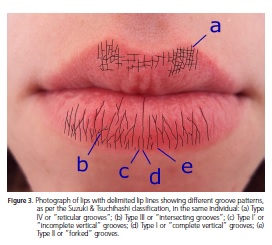
<body><![CDATA[<p><font size="2" face="Verdana, Arial, Helvetica, sans-serif">  Cheiloscopy may also be used to confirm the identity of subjects that leave their lip prints on some objector other, especially at the scene of a crime. In these cases, the marks found are compared with the suspect's lip lines.</font></p>     <p><font size="2" face="Verdana, Arial, Helvetica, sans-serif">  Detailed conventional examinations to compare photographs of lips and lip prints, and between two prints, can involve the aid of magnifying lenses and tracing on cellophane paper. These analyses are applied with the aimof ascertaining the features present and to classify them   according to types defined by experts on the subject, such   as Suzuki &amp; Tsuchihashi<sup>3</sup>, as well as making a more timely   identification<sup>4-5</sup>.</font></p>     <p><font size="2" face="Verdana, Arial, Helvetica, sans-serif">  With the advancement of technology, there   has been a tendency to make use of digital means that   facilitate analysis and provide identification in a quicker and   more reliable way<sup>6</sup>. In the field of cheiloscopy, the use of   digital means as a resource for analysis has already been   mentioned in scientific studies. These citations only make   reference to the use of software applications for magnifying   the photographs of prints for a better view of the details   of grooves. However no work has been found to date that   addresses the superimposition of images using computer   programs so that coincident points between two prints can   be determined.</font></p>     <p><font size="2" face="Verdana, Arial, Helvetica, sans-serif">  The aim of this study is to perform a review of the   literature on cheiloscopy and its use in human identification,   using both traditional and digital methods.</font></p>     <p><font size="2" face="Verdana, Arial, Helvetica, sans-serif"><B> History and classification of lip lines</B></font></p>     <p><font size="2" face="Verdana, Arial, Helvetica, sans-serif">  In 1902, an anthropologist called Fisher observed   and described the biological characteristics of human lips   in terms of the organization of their furrows. It was only in   1930, however, with Diou de Lille, that these furrows were   regarded as potentially useful elements in criminology, using   lip prints. Two years later, one of France's most renowned   criminologists, Edmond Locard, confirmed the importance of   the study of cheiloscopy and its application<sup>1,4,7</sup>.</font></p>     <p><font size="2" face="Verdana, Arial, Helvetica, sans-serif">  The concept that wrinkles in the lips could identify   people was suggested in 1950 by Le Moyne Snyder, a   forensic expert from California, in his book entitled"  Homicide Investigation"<sup>8-9</sup>. He presented a case stating that   these structures possessed individual features in the same   way as fingerprints do. He is now regarded as the father of   cheiloscopy<sup>3-5</sup>.</font></p>     <p><font size="2" face="Verdana, Arial, Helvetica, sans-serif">  In Hungary, interest in the study of lip prints began   in 1961 with a homicide case. The perpetrator of the crime   left a delicate lip print on a glass door that he had opened   using his head because his hands were covered in blood. Lip   prints began to attract attention in Poland in 1966 when this   form of evidence was discovered on a glass window at the   scene of a robbery<sup>7</sup>.</font></p>     <p><font size="2" face="Verdana, Arial, Helvetica, sans-serif">  In 1966, Clauco Martins Santos, professor of Forensic   Dentistry at the Federal University of Rio de Janeiro (UFRJ)   in Brazil, advocated that a set of lip wrinkles and grooves   could be divided into different groups and he proposed a   classification. According to the author, there were simple types (formed by a single element) and composite types   (several elements). With the simple type, the element could   be a straight line, a curve, an angular shape or a sinusoidal   shape. Composite types would include bifurcated, trifurcated   or irregular shapes<sup>1,4,7,9-11</sup>.</font></p>     <p><font size="2" face="Verdana, Arial, Helvetica, sans-serif">  In Japan, Suzuki &amp; Tsuchihashi<sup>3</sup> conducted studies   based on a classification conceived by Martin Santos and   discovered an individual peculiarity in the morphology of   lip grooves. Suzuki &amp; Tsuchihashi<sup>3,12</sup> called these lip grooves   sulci labiorum rubrorum and the image formed by them   was called figura linearum labiorum rubrorum, i.e. the" lip   print". The authors developed a new classification for lip   prints based on groove shape and direction. They gave the   description "Type I" to lip prints with patterns of grooves   in a straight line, arranged vertically and running along   the entire width of the red part of the lip, "Type I'" to   prints whose groove patterns were also in a straight line   though not covering the entire width of the lip, just one   half of it, "Type II" when the grooves were bifurcated or   forked, "Type III" for crisscrossing grooves, "Type IV" for   reticulate or "web-shaped" grooves and "Type V" for lines   with other shapes not matching any of the other types   mentioned<sup>1,3,5,11,13-14</sup>.</font></p>     ]]></body>
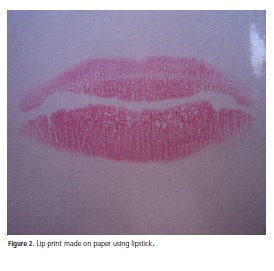
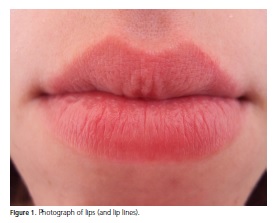
<body><![CDATA[<p><font size="2" face="Verdana, Arial, Helvetica, sans-serif">  Using the aforementioned classification, studies   were conducted on 280 individuals as well as 18 pairs   of monozygotic, or identical, twins, and later on with a   sample of 1,364 Japanese; after recording the lip prints,   it was established that each of the individuals had his/   her own lip print. A relationship was also observed of lip   prints with genetic factors and it was concluded that the   lip print pattern of monozygotic twins was not perfectly   identical, though extremely similar to that of the parents.   In addition, the lip prints of 7 individuals were collected   every month for three years and no change was noted in   the print pattern during this time. Another observation   that was reported was that when an individual caught cold   during the period of the study, the shape of the furrows   was somewhat altered, interfering with the lip prints, but   they returned to the original pattern after recovery<sup>2-3,10</sup>.</font></p>     <p><font size="2" face="Verdana, Arial, Helvetica, sans-serif">  In 1968, the technique helped the Tokyo police to   eliminate the hypothesis of two suspects who had been   detained being the owners of lip prints left on a letter in   which there was a threat to blow up police headquarters.   Also in Tokyo, another case involved the death of a   woman: a piece of tissue with a lipstick mark was found at   the scene of the crime and was used to identify a criminal   and also prove the innocence of a suspect<sup>8,12</sup>.</font></p>     <p><font size="2" face="Verdana, Arial, Helvetica, sans-serif">  A study was carried out in 1972 by Renaud with   four thousand lip prints, that confirmed their uniqueness</font><font size="2" face="Verdana, Arial, Helvetica, sans-serif">and he formulated a separateclassification<sup>1</sup>. The grooves   were organized by shape into ten types: "Type A" for   complete, vertical grooves, "Type B" incomplete vertical   grooves, "Type C" complete bifurcated, "Type D"  incomplete bifurcated, "Type E" complete forked, "Type   F" incomplete forked, "Type G" reticular grooves, "Type   H" grooves in the shape of a comma or "x", "Type I"  horizontal grooves and "Type J" grooves for other shapes   such as elliptical, triangular, microfurrows<sup>1,11</sup>.</font></p>     <p><font size="2" face="Verdana, Arial, Helvetica, sans-serif">  Figures <a href="#fig01">1</a> and <a href="#fig02">2</a>,below, show the lips (and lip lines)   and lip print of the same individual. <a href="#fig03">Figure 3</a> illustrates   various types of lip grooves in the same individual,   according to the Suzuki &amp; Tsuchihashi classification<sup>3</sup>.</font></p>     <p>&nbsp;</p>     <p><a name="fig01"></a></p>     <p>&nbsp; </p>     <p align="center"><img src="/img/revistas/rgo/v61n1/a15fig01.jpg">     <p>&nbsp;</p>     <p><a name="fig02"></a></p>     ]]></body>
<body><![CDATA[<p>&nbsp; </p>     <p align="center"><img src="/img/revistas/rgo/v61n1/a15fig02.jpg">     <p>&nbsp;</p>     <p><a name="fig03"></a></p>     <p>&nbsp; </p>     <p align="center"><img src="/img/revistas/rgo/v61n1/a15fig03.jpg">     <p>&nbsp;</p>     <p><font size="2" face="Verdana, Arial, Helvetica, sans-serif"><B> Latent lip prints</B></font></p>     <p><font size="2" face="Verdana, Arial, Helvetica, sans-serif"> In criminal investigations, lip prints left on objects   such as drinking glasses, paper napkins, cigarette ends,   tissues, CDs, DVDs or other objects, will show a link   between the subject and the scene of a crime. These   prints are usually found as visible lipstick marks. With   advancements in the cosmetics industry, the use of   lipsticks that do not leave marks is increasingly common;   they are called "permanent orlong-lasting lipsticks" thus   necessitating reagent substances that reveal them for analysis, tested and described in several articles<sup>9,16-17</sup>.</font></p>     <p><font size="2" face="Verdana, Arial, Helvetica, sans-serif">  In the middle of the 1970s, a group of researchers   in Spain developed a number of studies on lip prints made   with lipsticks that do not leave visible marks<sup>9</sup>. In one such   study, lip prints were made with this type of lipstick on   a variety of surfaces and were developed using specific   powders. As a conclusion, they found that the method to   develop lip prints was similar to that of fingerprints and   that some developers were considered to be more effective   than others depending on the surface where the print was   found<sup>9,17</sup>.</font></p>     ]]></body>
<body><![CDATA[<p><font size="2" face="Verdana, Arial, Helvetica, sans-serif">  A lipstick usually consists of a solid base of   waxes, oils, dissolved dyes, hydrocarbons and sometimes   perfumes. Persistent or long-lasting lipsticks contain   minimal quantities of these "fatty substances" and the   development of lip prints using conventional powders   might not be very effective<sup>1,18</sup>.</font></p>     <p><font size="2" face="Verdana, Arial, Helvetica, sans-serif">  Latent lip prints are also produced using the   humidity present in lips through saliva, mixed with   the oiliness secreted by neighboring saliva glands and   sebaceous glands. These substances, particularly the lipidsand fatty acids, transferred to an object throughlip contact,   can be developed and made visible<sup>1,19</sup>. Therefore another   method for developing that is more sensitive to fatty acids   is required. Lysochromes are compounds with the ability   to stain fatty acids because they display a portion that   dissolves in contact with the fat and another that stains,   and they therefore help to develop latent lip prints<sup>19</sup>.</font></p>     <p><font size="2" face="Verdana, Arial, Helvetica, sans-serif">  In a study by Castell&oacute; et al.<sup>19</sup>, the effectiveness   was tested of three differently so chromes in the form of   powder and solution, versus three fingerprint developing   powders. They concluded that conventional powders   were less effective for older prints when compared to   lysochromes, and that the latter were effective for the two   surfaces tested as well as producing good development of   both recent and old prints. The best of these was Sudan   black.</font></p>     <p><font size="2" face="Verdana, Arial, Helvetica, sans-serif">  Navarro et al.<sup>20</sup> studied invisible lip prints using   human skin as the target surface. Of the lysochromatic   reagents used, Sudan black provided the best results. These   results are in respect of recent lip prints and the experts   state that the investigation of old prints is very difficult   using this type of surface.</font></p>     <p><font size="2" face="Verdana, Arial, Helvetica, sans-serif">  Singh et al.<sup>21</sup> used Vermilion and Indigo, which   are natural, non-toxic substances available in India, on   visible lip prints on different types of surface. The results   compared well to those of Sudan black.</font></p>     <p><font size="2" face="Verdana, Arial, Helvetica, sans-serif">  Luminescence is another useful property when   trying to uncover evidence invisible to the naked eye, such   as latent lip prints15. The Spanish researchers Castell&oacute; et   al.<sup>15</sup> studied latent lip print susing the reagent Nile Red on   different surfaces (colored paper napkins, dyed cotton wool   and satin tissue) and light to view the prints. The lip prints   were old and were developed on all the surfaces used.   They concluded that Nile Red is an effective fluorescent   reagent for latent evidence.</font></p>     <p><font size="2" face="Verdana, Arial, Helvetica, sans-serif">  Navarro et al.<sup>16</sup> tested the efficacy of the   fluorescent reagents Nile Red and REDescent Fluorescent   Latent Print Powder, on lip prints made on the skin of 40   corpses. Positive photographs were obtained for all lip   prints, developed with REDescent Fluorescent Latent Print   Powder and only three prints were developed using Nile   Red. </font></p>     <p><font size="2" face="Verdana, Arial, Helvetica, sans-serif"><B> Lip lines, gender and heredity</B></font></p>     <p><font size="2" face="Verdana, Arial, Helvetica, sans-serif">Lip prints are unique to each individual and do   not change throughout one's lifetime. When lip grooves   suffer some type of alteration such as, for example,   inflammation, a tiny injury, pathology such as labial herpes,   the groove morphology pattern soon reverts. On the other   hand, when the lip is exposed to repeated damage, scars   may be left in the location, causing changes in the shape   of the groove. Similarities between the grooves of parents   and their children were also seen, and recent studies have   suggested variations in the patterns between men and women, that helped with gender identification<sup>14,22</sup>.</font></p>     <p><font size="2" face="Verdana, Arial, Helvetica, sans-serif">  In this regard, Augustine et al.<sup>14</sup> conducted a   study with 600 individuals from India (280 men and 320   women), from whom lip prints were taken and scanned   to provide a better view and to ensure records were made   without any loss of detail. Adobe Photoshop&reg; 7.0 software   was used to analyze the lip prints. These were divided as   for the dental formula (four quadrants); they noticed that   there was no single type of groove in each part, but in fact   a combination of types (using as a basis the groove types   in the Suzuki &amp; Tsuchihashi classification<sup>3</sup>). The researchers   reported that, in this population, amongst men and   women, type III was the most common, while type IV was   more common in the upper lateral regions of the lip prints   of women and type I more common in the same locations   in males.</font></p>     ]]></body>
<body><![CDATA[<p><font size="2" face="Verdana, Arial, Helvetica, sans-serif">  Another study conducted in India by Sharma   et al.<sup>23</sup> verified the potential of lip prints for identifying   gender by means of the morphology of the grooves. Lip   prints were obtained from 50 women and 50 men. The   middle section of the lower lip was the area studied   because this fragment is almost always present in lip prints   and they used the Suzuki &amp; Tsuchihashi classification<sup>3</sup>.   The researchers concluded that types I and I' were mostly   observed in females while type IV was observed more   often in males. The gender of 44 women and 45 men was   correctly determined.</font></p>     <p><font size="2" face="Verdana, Arial, Helvetica, sans-serif">  The question of grooves to identify sex aroused   the interest of other experts in India. Gondivkar et al.<sup>22</sup>   analyzed the lip prints of 70 males and 70 females. Gender   was correctly diagnosed in 65 men and 67 women. The   predominant groove type for males in the group studied,   using the Suzuki &amp; Tsuchihashi classification<sup>3</sup>, was type III,   while for females, type II was the most commonly found.   One other piece of information observed was that all four   quadrants, when presenting the same types of grooves,   belonged to the female sex.</font></p>     <p><font size="2" face="Verdana, Arial, Helvetica, sans-serif">  In a study conducted by Domiaty et al.<sup>11</sup>, individuals   from Saudi Arabia also had their lip prints analyzed. Taking   part in the study were 540 women, 426 men, 13 identical   twins and 19 families. The researchers divided each lip   into three parts with the aim of studying them separately   and determining the groove pattern in each each region.   The two vertical traces tarted from the continuation of thephiltrum. They adopted Renaud's classification in the   analyses, with just a slight modification to "Type J". The   predominant typein each area of the prints was noted.   No identical lip print patterns were found amongst the   subjects. However, more than one subject exhibited the   same groove pattern in the same areas of the lips. In   these, this peculiarity was present in the forked or reticular   pattern of the grooves. The present study showed that   type J (horizontal with other shapes) and type C (complete   bifurcated) are the most prevalent types in Saudi men and   women. Type I (horizontal) grooves were the least frequent   and were only found in the top lips in women. </font></p>     <p><font size="2" face="Verdana, Arial, Helvetica, sans-serif"><B> Use of cheiloscopy by the Forensic Sciences</B></font></p>     <p><font size="2" face="Verdana, Arial, Helvetica, sans-serif">Lip prints have been admissible as evidence in   courts in the USA since 1923, there being a general acceptance by the scientific community<sup>9</sup>.</font></p>     <p><font size="2" face="Verdana, Arial, Helvetica, sans-serif">  The method of identifying people through an   analysis of the lips is of little interest in terms of human   remains because it is easier to obtain other types of   ante-mortem data. However, corpses have been used to   study lip prints. Utsuno et al.<sup>24</sup> carried out a study with   the aim of evaluating the reduction or enlargement of lip   prints and the morphological changes in groove patterns.   The lip prints of 20 corpses were collected at two points   in time: within 24 hours of death (before being fixed in   formaldehyde at 10%) and 48 hours after fixing. The prints   taken prior to fixing coincided with those taken after fixing   in 6 out of 20 cases. As for the size (width and height) of the prints, no significant changes were observed.</font></p>     <p><font size="2" face="Verdana, Arial, Helvetica, sans-serif">  When a lip print is found, the result is a piece of   evidence that must be recorded and kept for legal analysis   and testing. When the lip print is visible to the naked eye,   it is recommended that firstly a photograph of it should   be taken on the surface itself, with and without a scale,   up close and at distance, and should be tagged1. The   procedure for cases of latent lip impressions is the use of   developers. With this, prints may be photographed and   magnified for study.</font></p>     <p><font size="2" face="Verdana, Arial, Helvetica, sans-serif">  Human identification through cheiloscopic study   is a comparative process. The lip print, whether or not it   is visible, which is found in a certain location is compared   with the lip print of an individual and coincident points are   sought between the grooves in the two records. In general,   the two lip prints are placed side by side for analysis and   may be photographed and blown up or observed with   the aid of a magnifying glass. Cellophane paper may be   used with the aim of establishing an outline of the most   characteristic groove layouts in the lip print, for subsequent   comparison<sup>4,7</sup>. The format and number of grooves are   looked for as well as the coincident points and random   characteristics. The search for exact dimensions between   the two prints should not be performed because they   are produced by the moving part of the lip, which makes   it possible for the same lip to produce different prints,   depending on the pressure exerted on the object's surface,   or because the lip increased in size due to normal growth<sup>1</sup>.</font></p>     <p><font size="2" face="Verdana, Arial, Helvetica, sans-serif">  The amount of lipstick applied is also a complication   that could alter the lip print<sup>9</sup>. It is recommended that several   lip prints be taken until the entire substance is consumed   by the surface. Moreover, the method used to obtain the   print may affect the recording. As far as the analysis is   concerned, according to Caldas et al.<sup>1</sup>, manual records of   overlapping prints are a problem due to the subjectivity of   the analysis. The use of the overlapping technique using   software applications is an alternative that aims to afford   greater objectivity to cheiloscopic study.</font></p>     <p><font size="2" face="Verdana, Arial, Helvetica, sans-serif">  Although identification by lip print appears in   the literature, further studies could provide support for   Suzuki's theory of uniqueness of lip grooves and to the   lip print collection and comparison methodologies. Andre   Moessens, professor of Law at the University of Missouri   (USA) and author of a book entitled "Scientific Evidence in   Civil and Criminal Cases", believes that, given the scientific   base that exists in Cheiloscopy, this should be readily   accepted as a method of human identification in all courts   of law<sup>9</sup>.</font></p>     ]]></body>
<body><![CDATA[<p><font size="2" face="Verdana, Arial, Helvetica, sans-serif">  Advances in Information Technology have had   a significant impactin the realm of human identification.   The use of digital media could, in some cases, provide   more objective, quick and reliable ways of identification<sup>6</sup>.   Image manipulation software, such as Adobe Photoshop,   possesses tools that permit size normalization and   improvements in the sharpness, contrast and brilliance of   the image of lips and/or lip prints<sup>13</sup>. It is also possible with   these tools to analyze photographs and the overlapping of   images to help with forensic identification. The freeware   known as GIMP (GNU Image Manipulation Program) also   provides this possibility. The digital analysis method using   GIMP, being free of charge, is an interesting option for   Coroners Offices, Institutes of Jurisprudence and other   services that may wish to use it, being more economically   viable and without the need to pay for software licenses.</font></p>     <p>&nbsp;</p>     <p><font size="3" face="Verdana, Arial, Helvetica, sans-serif"><B> DISCUSSION</B></font></p>     <p><font size="2" face="Verdana, Arial, Helvetica, sans-serif">Legal Dentistry is a science that establishes a   relationship between dental and legal knowledge and   applies it in the service of the Law. In the majority of cases,   it is only related to cases of identification of deceased   individuals. However, the investigation and identification   of living people may also be carried out within this area<sup>3</sup>.   It is not only hard tissue such as teeth or bones that can   provide information on a specific person or situation;   other soft tissue structures such as the labial semi-mucous   membrane and the hard palate are capable of assisting effectively in the process of identification.</font></p>     <p><font size="2" face="Verdana, Arial, Helvetica, sans-serif">  Cheiloscopy is mainly used to investigate crimes   against individuals or property in which lip prints are   involved. These prints are left by the perpetrator of the   crime and/or the victim on objects such as drinking glasses,   cigarette butts, envelopes or paper napkins, on the victim's   body or even on materials like clothing or cushions used in   cases of suffocation, and are used to reconstruct events in   order to establish accounts and identify suspects<sup>22</sup>.</font></p>     <p><font size="2" face="Verdana, Arial, Helvetica, sans-serif">  The lips are made up of lines that personify and   characterize an individual, in other words no two individuals   exist with the same number, shape and arrangement of   lip grooves; they are unique to each person. The lip print   produced, therefore, as with fingerprints, represents a   personal uniqueness and Cheiloscopy, as a method for   identification via the study of lips, plays an important role   in the forensic field.</font></p>     <p><font size="2" face="Verdana, Arial, Helvetica, sans-serif">  The huge number of lip print studies carried out   by the Japanese researchers Suzuki &amp; Tsuchihashi, between   1968 and 1971, confirm the individuality of the set of lines   on the surface of the lips, even between identical twins10.   In this case, the method of identifying human beings   through the analysis of genetic material is not effective   because the DNA of twin siblings is exactly the same.   Unlike with DNA, lip lines can resolve such cases as they   are not identical.</font></p>     <p><font size="2" face="Verdana, Arial, Helvetica, sans-serif">  However, the techniques of cheiloscopic   identification were mostly explored by a group of   Spaniards at the start of the 1970s. These researchers   became responsible, in the main, for latent lip prints, i.e.   prints that do not leave visible marks and in their studies   they used developers of different types to establish the   analyses. They found that some developers were more   effective than others, depending on two factors: type of   surface where the print is located and the time elapsed   since the print was made<sup>21</sup>. In order to develop latent lip   prints recently made on smoother surfaces, aluminum and   magnetic powders, which are used to develop fingerprints,   were more favored. Aluminum powders highlight lip prints   on dark surfaces, reflective surfaces (crystal), mirrors, while   magnetic powders are very visible on paper<sup>9,17</sup>.</font></p>     <p><font size="2" face="Verdana, Arial, Helvetica, sans-serif">  Moreover, when latent prints were old and   located on porous surfaces, lysochromatic substances such   as Sudan Black were used by some authors. Lysochrome   provides evidence of fatty acids of lipsticks, saliva glands   and sebaceous glands surrounding the lips, being   important in the development of lip prints made using only   the oiliness of the lips mixed with the saliva. On the other   hand, other authors used natural, non-toxic substances   from India, namely Vermilion and Indigo, which provided   similar results to those of Sudan Black<sup>19-21</sup>, serving as an   alternative resource.</font></p>     <p><font size="2" face="Verdana, Arial, Helvetica, sans-serif">  Also on the subject of old latent lip prints on porous   surfaces, fluorescent reagents were applied, the most wellknown   being Nile Red. Nevertheless, its usefulness is far   greater when the surface, in addition to being porous, is   stained, and the print is revealed by the reagent with the   help of forensic ultraviolet light<sup>15-16</sup>.</font></p>     ]]></body>
<body><![CDATA[<p><font size="2" face="Verdana, Arial, Helvetica, sans-serif">  The lips are made up of several types of grooves   and the number of these grooves, their morphology and   layout, characterize an individual<sup>11,14,22-23,25-26</sup>. As with   Forensic Anthropology, where the differentiation, made   by measuring skeletal components (pelvis, glabella, etc.),   establishes the most probable identification of the sex of   an individual, the existence of different patterns of grooves   between men and women in a single population has great   value for human identification. The same idea is valid for   different arrangement patterns between one population   and another, perhaps due to heredity<sup>27</sup>.</font></p>     <p><font size="2" face="Verdana, Arial, Helvetica, sans-serif">  Comparative studies are involved in cheiloscopic   analysis: the print that is found is compared with the lip   print of a suspect, by looking for coincident points between   the lip grooves. To this end, it is necessary for these prints   to be photographed.</font></p>     <p><font size="2" face="Verdana, Arial, Helvetica, sans-serif">  Two analytical methods exist: conventional and   digital. The conventional method includes the observation   of corresponding grooves through photographs laid side   by side, enlarged or examined with magnifying glasses.   Cellophane paper may complement this identification   process as it helps with tracings of the most characteristic   sets of grooves on the print for subsequent comparison.   The digital method, currently in the developmental   phase, makes it possible to compare lip grooves through   the manipulation of images using software applications   using overlapping techniques. It is a method that provides   objectivity, rapidness and reliability in specific cases, which   facilitates the process of identification<sup>1,6</sup>.</font></p>     <p>&nbsp;</p>     <p><font size="3" face="Verdana, Arial, Helvetica, sans-serif"><B> FINAL CONSIDERATIONS</B></font></p>     <p><font size="2" face="Verdana, Arial, Helvetica, sans-serif">Effective scientific interest in the application of lip   lines and prints in the area of forensic science is recent,   dating back to the 1970s. Nevertheless, the literature is   lacking in work in this field. The advent of new digital   technology maybe able to help with the performance   of this investigation technique, generating speed and   objectivity. New studies are required, particularly with the   development of digital methods.   The application of cheiloscopy may be of great   help to the Law, in the identification of living suspects and   deceased subjects. At the end of the day, it will be society as a whole that benefits.</font></p>     <p><font size="2" face="Verdana, Arial, Helvetica, sans-serif"><B> Collaborators</B></font></p>       <p><font size="2" face="Verdana, Arial, Helvetica, sans-serif">LM HERRERA, CMS FERNANDES e MC SERRA   participated in all phases of preparation of this article, from conception to the final redaction of same. </font></p>     <p>&nbsp;</p>     <p><font size="3" face="Verdana, Arial, Helvetica, sans-serif"><B>REFERENCES </B></font></p>     ]]></body>
<body><![CDATA[<!-- ref --><p><font size="2" face="Verdana, Arial, Helvetica, sans-serif">1. Caldas IM, Magalh&atilde;es T, Afonso A. Establishing identity using   cheiloscopy and palatoscopy. Forensic Sci Int. 2007;165(1):1-9. doi: 10.1016/j.forsciint.2006.04.010.    &nbsp;&nbsp;&nbsp;&nbsp;&nbsp;&nbsp;&nbsp;&nbsp;[&#160;<a href="javascript:void(0);" onclick="javascript: window.open('/scielo.php?script=sci_nlinks&ref=207209&pid=S1981-8637201300010001500001&lng=','','width=640,height=500,resizable=yes,scrollbars=1,menubar=yes,');">Links</a>&#160;]<!-- end-ref --></font></p>     <!-- ref --><p><font size="2" face="Verdana, Arial, Helvetica, sans-serif"> 2. Sivapathasundharam B, Prakash PA, Sivakumar G. Lip prints   (Cheiloscopy). Indian J Dent Res. 2001;12(4):234-7.    &nbsp;&nbsp;&nbsp;&nbsp;&nbsp;&nbsp;&nbsp;&nbsp;[&#160;<a href="javascript:void(0);" onclick="javascript: window.open('/scielo.php?script=sci_nlinks&ref=207211&pid=S1981-8637201300010001500002&lng=','','width=640,height=500,resizable=yes,scrollbars=1,menubar=yes,');">Links</a>&#160;]<!-- end-ref --></font></p>     <!-- ref --><p><font size="2" face="Verdana, Arial, Helvetica, sans-serif"> 3. Suzuki K, Tsuchihashi Y. New attempt of personal identification   by means of lip print. J Indian Dent Assoc. 1970;42(1):8-9.    &nbsp;&nbsp;&nbsp;&nbsp;&nbsp;&nbsp;&nbsp;&nbsp;[&#160;<a href="javascript:void(0);" onclick="javascript: window.open('/scielo.php?script=sci_nlinks&ref=207213&pid=S1981-8637201300010001500003&lng=','','width=640,height=500,resizable=yes,scrollbars=1,menubar=yes,');">Links</a>&#160;]<!-- end-ref --></font></p>     <!-- ref --><p><font size="2" face="Verdana, Arial, Helvetica, sans-serif"> 4. SaraswathiTR, Mishra G, Ranganathan K. Study of lip prints.   J Forensic Dent Sci. 2009;1(1):28-31. doi: 10.4103/0974-   2948.50885.    &nbsp;&nbsp;&nbsp;&nbsp;&nbsp;&nbsp;&nbsp;&nbsp;[&#160;<a href="javascript:void(0);" onclick="javascript: window.open('/scielo.php?script=sci_nlinks&ref=207215&pid=S1981-8637201300010001500004&lng=','','width=640,height=500,resizable=yes,scrollbars=1,menubar=yes,');">Links</a>&#160;]<!-- end-ref --></font></p>     <!-- ref --><p><font size="2" face="Verdana, Arial, Helvetica, sans-serif"> 5. Sharma P, Saxena S, Rathod V. Comparative reliability of   cheiloscopy and palatoscopy in human identification. Indian J   Dent Res. 2009;20(4):453-7. doi: 10.4103/0970-9290.59451.    &nbsp;&nbsp;&nbsp;&nbsp;&nbsp;&nbsp;&nbsp;&nbsp;[&#160;<a href="javascript:void(0);" onclick="javascript: window.open('/scielo.php?script=sci_nlinks&ref=207217&pid=S1981-8637201300010001500005&lng=','','width=640,height=500,resizable=yes,scrollbars=1,menubar=yes,');">Links</a>&#160;]<!-- end-ref --></font></p>     ]]></body>
<body><![CDATA[<!-- ref --><p><font size="2" face="Verdana, Arial, Helvetica, sans-serif"> 6. Fernandes CMF, Serra MC. Novas tecnologias de informa&ccedil;&atilde;o   aplicadas &agrave; Odontologia Legal no processo de identifica&ccedil;&atilde;o   humana. Odontol Sociedade. 2010;12(2):87-9.    &nbsp;&nbsp;&nbsp;&nbsp;&nbsp;&nbsp;&nbsp;&nbsp;[&#160;<a href="javascript:void(0);" onclick="javascript: window.open('/scielo.php?script=sci_nlinks&ref=207219&pid=S1981-8637201300010001500006&lng=','','width=640,height=500,resizable=yes,scrollbars=1,menubar=yes,');">Links</a>&#160;]<!-- end-ref --></font></p>     <!-- ref --><p><font size="2" face="Verdana, Arial, Helvetica, sans-serif"> 7. Kasprzak J. Possibilities of cheiloscopy. Forensic Sci Int.   1990;46(1):145-51. doi: 10.1016/0379-0738(90)90154-Q.    &nbsp;&nbsp;&nbsp;&nbsp;&nbsp;&nbsp;&nbsp;&nbsp;[&#160;<a href="javascript:void(0);" onclick="javascript: window.open('/scielo.php?script=sci_nlinks&ref=207221&pid=S1981-8637201300010001500007&lng=','','width=640,height=500,resizable=yes,scrollbars=1,menubar=yes,');">Links</a>&#160;]<!-- end-ref --></font></p>     <!-- ref --><p><font size="2" face="Verdana, Arial, Helvetica, sans-serif"> 8. Lip prints are new criminology tool. Dent Stud. 1971;49(7):50-1.    &nbsp;&nbsp;&nbsp;&nbsp;&nbsp;&nbsp;&nbsp;&nbsp;[&#160;<a href="javascript:void(0);" onclick="javascript: window.open('/scielo.php?script=sci_nlinks&ref=207223&pid=S1981-8637201300010001500008&lng=','','width=640,height=500,resizable=yes,scrollbars=1,menubar=yes,');">Links</a>&#160;]<!-- end-ref --></font></p>     <!-- ref --><p><font size="2" face="Verdana, Arial, Helvetica, sans-serif"> 9. Ball J. The current status of lip prints and their use for   identification. J Forensic Odontostomatol. 2002;20(2):43-6.    &nbsp;&nbsp;&nbsp;&nbsp;&nbsp;&nbsp;&nbsp;&nbsp;[&#160;<a href="javascript:void(0);" onclick="javascript: window.open('/scielo.php?script=sci_nlinks&ref=207225&pid=S1981-8637201300010001500009&lng=','','width=640,height=500,resizable=yes,scrollbars=1,menubar=yes,');">Links</a>&#160;]<!-- end-ref --></font></p>     <!-- ref --><p><font size="2" face="Verdana, Arial, Helvetica, sans-serif"> 10. Tsuchihashi Y. Studies on personal identification by means of   lip prints. Forensic Sci. 1974;3:233-48. doi: 10.1016/0300-   9432(74)90034-X.    &nbsp;&nbsp;&nbsp;&nbsp;&nbsp;&nbsp;&nbsp;&nbsp;[&#160;<a href="javascript:void(0);" onclick="javascript: window.open('/scielo.php?script=sci_nlinks&ref=207227&pid=S1981-8637201300010001500010&lng=','','width=640,height=500,resizable=yes,scrollbars=1,menubar=yes,');">Links</a>&#160;]<!-- end-ref --></font></p>     ]]></body>
<body><![CDATA[<p><font size="2" face="Verdana, Arial, Helvetica, sans-serif"> 11. Domiaty MAE, Al-gaidi SA, Elayat AA, SafwatMDE, Galal SA.   Morphological patterns of lip prints in Saudi Arabia at Almadinah   Almonawarah province. Forensic Sci Int. 2010;200(1):179e1-    <br>   e9. doi: 10.1016/j.forsciint.2010.03.042.</font></p>     <!-- ref --><p><font size="2" face="Verdana, Arial, Helvetica, sans-serif"> 12. Suzuki K, Tsuchihashi Y. Two criminal cases on lip print. Forensic   Sci. 1975;5:171.    &nbsp;&nbsp;&nbsp;&nbsp;&nbsp;&nbsp;&nbsp;&nbsp;[&#160;<a href="javascript:void(0);" onclick="javascript: window.open('/scielo.php?script=sci_nlinks&ref=207231&pid=S1981-8637201300010001500012&lng=','','width=640,height=500,resizable=yes,scrollbars=1,menubar=yes,');">Links</a>&#160;]<!-- end-ref --></font></p>     <!-- ref --><p><font size="2" face="Verdana, Arial, Helvetica, sans-serif"> 13. Coward RC. The stability of lip pattern characteristics over time.   J Forensic Odontostomatol. 2007;25(2):40-56.    &nbsp;&nbsp;&nbsp;&nbsp;&nbsp;&nbsp;&nbsp;&nbsp;[&#160;<a href="javascript:void(0);" onclick="javascript: window.open('/scielo.php?script=sci_nlinks&ref=207233&pid=S1981-8637201300010001500013&lng=','','width=640,height=500,resizable=yes,scrollbars=1,menubar=yes,');">Links</a>&#160;]<!-- end-ref --></font></p>     <!-- ref --><p><font size="2" face="Verdana, Arial, Helvetica, sans-serif"> 14. Augustine J, BarpandeSR, TupkariJV. Cheiloscopy as an adjunct   to forensic identification: a study of 600 individuals. J Forensic   Odontostomastol. 2008;26(2):44-52.    &nbsp;&nbsp;&nbsp;&nbsp;&nbsp;&nbsp;&nbsp;&nbsp;[&#160;<a href="javascript:void(0);" onclick="javascript: window.open('/scielo.php?script=sci_nlinks&ref=207235&pid=S1981-8637201300010001500014&lng=','','width=640,height=500,resizable=yes,scrollbars=1,menubar=yes,');">Links</a>&#160;]<!-- end-ref --></font></p>     <!-- ref --><p><font size="2" face="Verdana, Arial, Helvetica, sans-serif"> 15. Castell&oacute; A, Alvarez M, Verd&uacute; F. Luminous lip-prints as criminal   evidence. Forensic Sci Int. 2005;155(2-3):185-7. doi: 10.1016/j.   forsciint.2004.12.005.    &nbsp;&nbsp;&nbsp;&nbsp;&nbsp;&nbsp;&nbsp;&nbsp;[&#160;<a href="javascript:void(0);" onclick="javascript: window.open('/scielo.php?script=sci_nlinks&ref=207237&pid=S1981-8637201300010001500015&lng=','','width=640,height=500,resizable=yes,scrollbars=1,menubar=yes,');">Links</a>&#160;]<!-- end-ref --></font></p>     ]]></body>
<body><![CDATA[<!-- ref --><p><font size="2" face="Verdana, Arial, Helvetica, sans-serif"> 16. Navarro E, Castell&oacute; A, L&oacute;pez JA, Verd&uacute; F. More about the   developing of invisible lipstick-contaminated lipmarks on human   skin: the usefulness of fluorescent dyes. J Forensic Leg Med.   2007;14(6):340-2. doi: 10.1016/j.jcfm.2006.10.010</font>&nbsp;&nbsp;&nbsp;&nbsp;&nbsp;&nbsp;&nbsp;&nbsp;[&#160;<a href="javascript:void(0);" onclick="javascript: window.open('/scielo.php?script=sci_nlinks&ref=207239&pid=S1981-8637201300010001500016&lng=','','width=640,height=500,resizable=yes,scrollbars=1,menubar=yes,');">Links</a>&#160;]<!-- end-ref --><p><font size="2" face="Verdana, Arial, Helvetica, sans-serif">17. Segu&iacute; MA, Feucht MM, Ponce AC, Pascual FAV. Persistent   lipsticks and their lip prints: new hidden evidence at the crime   scene. Forensic Sci Int. 2000;112(1):41-7. doi: 10.1016/S0379-    <br>   0738(00)00173-0.</font></p>     <!-- ref --><p><font size="2" face="Verdana, Arial, Helvetica, sans-serif"> 18. Andrasko J. Forensic analysis of lipsticks. Forensic Sci Int.   1981;17(3):235-51. doi: 10.1016/0379-0738(81)90173-0.    &nbsp;&nbsp;&nbsp;&nbsp;&nbsp;&nbsp;&nbsp;&nbsp;[&#160;<a href="javascript:void(0);" onclick="javascript: window.open('/scielo.php?script=sci_nlinks&ref=207242&pid=S1981-8637201300010001500018&lng=','','width=640,height=500,resizable=yes,scrollbars=1,menubar=yes,');">Links</a>&#160;]<!-- end-ref --></font></p>     <!-- ref --><p><font size="2" face="Verdana, Arial, Helvetica, sans-serif"> 19. Castell&oacute; A, Alvarez M, Miquel M, Verd&uacute; F. Long-lasting lipsticks   and latent prints. Forensic Sci Communic. 2002;4:2.    &nbsp;&nbsp;&nbsp;&nbsp;&nbsp;&nbsp;&nbsp;&nbsp;[&#160;<a href="javascript:void(0);" onclick="javascript: window.open('/scielo.php?script=sci_nlinks&ref=207244&pid=S1981-8637201300010001500019&lng=','','width=640,height=500,resizable=yes,scrollbars=1,menubar=yes,');">Links</a>&#160;]<!-- end-ref --></font></p>     <!-- ref --><p><font size="2" face="Verdana, Arial, Helvetica, sans-serif"> 20. Navarro E, Castell&oacute; A, L&oacute;pez JL, Verd&uacute; F. Criminalystic:   effectiveness of lysochromes on the developing of invisible   lipstick-contaminated lipmarks on human skin. A preliminary   study. Forensic Sci Int. 2006;158(1):9-13. doi: 10.1016/j.   forsciint.2005.05.002.    &nbsp;&nbsp;&nbsp;&nbsp;&nbsp;&nbsp;&nbsp;&nbsp;[&#160;<a href="javascript:void(0);" onclick="javascript: window.open('/scielo.php?script=sci_nlinks&ref=207246&pid=S1981-8637201300010001500020&lng=','','width=640,height=500,resizable=yes,scrollbars=1,menubar=yes,');">Links</a>&#160;]<!-- end-ref --></font></p>     <!-- ref --><p><font size="2" face="Verdana, Arial, Helvetica, sans-serif"> 21. Singh NN, Brave VR, Khanna S. Natural dyes versus lysochrome   dyes in cheiloscopy: a comparative evaluation. J Forensic Dent   Sci. 2010;2(1):11-7. doi: doi: 10.4103/0974-2948.71051.    &nbsp;&nbsp;&nbsp;&nbsp;&nbsp;&nbsp;&nbsp;&nbsp;[&#160;<a href="javascript:void(0);" onclick="javascript: window.open('/scielo.php?script=sci_nlinks&ref=207248&pid=S1981-8637201300010001500021&lng=','','width=640,height=500,resizable=yes,scrollbars=1,menubar=yes,');">Links</a>&#160;]<!-- end-ref --></font></p>     <!-- ref --><p><font size="2" face="Verdana, Arial, Helvetica, sans-serif"> 22. Gondivkar SM, Indurkar A, Degwekar S, Bhowate R. Cheiloscopy   for sex determination. J Forensic Dent Sci. 2009;1:56-60. doi:   10.4103/0974-2948.60374.    &nbsp;&nbsp;&nbsp;&nbsp;&nbsp;&nbsp;&nbsp;&nbsp;[&#160;<a href="javascript:void(0);" onclick="javascript: window.open('/scielo.php?script=sci_nlinks&ref=207250&pid=S1981-8637201300010001500022&lng=','','width=640,height=500,resizable=yes,scrollbars=1,menubar=yes,');">Links</a>&#160;]<!-- end-ref --></font></p>     <!-- ref --><p><font size="2" face="Verdana, Arial, Helvetica, sans-serif"> 23. Sharma P, Saxena S, Rathod V. Cheiloscopy: The study of lip   prints in sex identification. J Forensic Dent Sci. 2009;1(1):24-7. doi: 10.4103/0974-2948.50884.    &nbsp;&nbsp;&nbsp;&nbsp;&nbsp;&nbsp;&nbsp;&nbsp;[&#160;<a href="javascript:void(0);" onclick="javascript: window.open('/scielo.php?script=sci_nlinks&ref=207252&pid=S1981-8637201300010001500023&lng=','','width=640,height=500,resizable=yes,scrollbars=1,menubar=yes,');">Links</a>&#160;]<!-- end-ref --></font></p>     <!-- ref --><p><font size="2" face="Verdana, Arial, Helvetica, sans-serif"> 24. Utsuno H, Kanoh T, Tadokoro O, Inoue K. Preliminary study   of post mortem identification using lip prints. Forensic Sci Int. 2005;149(2-3):129-32. doi: 10.1016/j.forsciint.2004.05.013.    &nbsp;&nbsp;&nbsp;&nbsp;&nbsp;&nbsp;&nbsp;&nbsp;[&#160;<a href="javascript:void(0);" onclick="javascript: window.open('/scielo.php?script=sci_nlinks&ref=207254&pid=S1981-8637201300010001500024&lng=','','width=640,height=500,resizable=yes,scrollbars=1,menubar=yes,');">Links</a>&#160;]<!-- end-ref --></font></p>     <!-- ref --><p><font size="2" face="Verdana, Arial, Helvetica, sans-serif"> 25. Kaur R, Garg RK. Personal identification from lip prints. Forensic   Sci Int. 2007;4:106.    &nbsp;&nbsp;&nbsp;&nbsp;&nbsp;&nbsp;&nbsp;&nbsp;[&#160;<a href="javascript:void(0);" onclick="javascript: window.open('/scielo.php?script=sci_nlinks&ref=207256&pid=S1981-8637201300010001500025&lng=','','width=640,height=500,resizable=yes,scrollbars=1,menubar=yes,');">Links</a>&#160;]<!-- end-ref --></font></p>     <!-- ref --><p><font size="2" face="Verdana, Arial, Helvetica, sans-serif"> 26. Castell&oacute; A, Alvarez M, Verd&uacute; F. Just lip prints? No: there could   be something else. FASEB J. 2004;18(6):615-6. doi: 10.1096/ fj.03-0938lfe.    &nbsp;&nbsp;&nbsp;&nbsp;&nbsp;&nbsp;&nbsp;&nbsp;[&#160;<a href="javascript:void(0);" onclick="javascript: window.open('/scielo.php?script=sci_nlinks&ref=207258&pid=S1981-8637201300010001500026&lng=','','width=640,height=500,resizable=yes,scrollbars=1,menubar=yes,');">Links</a>&#160;]<!-- end-ref --></font></p>     <!-- ref --><p><font size="2" face="Verdana, Arial, Helvetica, sans-serif"> 27. Vanrell JP. Odontologia legal e antropologia forense. 2&ordf; ed. Rio   de Janeiro: Guanabara Koogan; 2009</font><font size="2" face="Verdana,    &nbsp;&nbsp;&nbsp;&nbsp;&nbsp;&nbsp;&nbsp;&nbsp;[&#160;<a href="javascript:void(0);" onclick="javascript: window.open('/scielo.php?script=sci_nlinks&ref=207260&pid=S1981-8637201300010001500027&lng=','','width=640,height=500,resizable=yes,scrollbars=1,menubar=yes,');">Links</a>&#160;]<!-- end-ref --> Arial, Helvetica, sans-serif">.</font></p>     <p>&nbsp;</p>     <p>&nbsp;</p>     <p><font size="2" face="Verdana, Arial, Helvetica, sans-serif"><a name="back"/></a><a href="#top"><img src="/img/revistas/rgo/v61n1/seta.jpg" border="0" align="absmiddle"/></a><b>Correspondence to:</b>    <br>   </font><font size="2" face="Verdana, Arial, Helvetica, sans-serif">MC SERRA    <br>   Rua Humait&aacute;, 1680, 14801-903, Araraquara, SP, Brasil</font><font size="2" face="Verdana, Arial, Helvetica, sans-serif">    <br>   e-mail: </font><font size="2" face="Verdana, Arial, Helvetica, sans-serif"><a href="mailto:mcserra@foar.unesp.br" target="_blank">mcserra@foar.unesp.br</a></font></p>     <p>&nbsp;</p>       ]]></body>
<body><![CDATA[<p><font face="Verdana, Arial, Helvetica, sans-serif" size="2"><b>Received on:</b> 30/8/2011<br/>  <b>Approved on:</b> 6/10/2011</font></p>     <p>&nbsp;</p>      ]]></body>
<back>
<ref-list>
<ref id="B1">
<label>1</label><nlm-citation citation-type="journal">
<person-group person-group-type="author">
<name>
<surname><![CDATA[Caldas]]></surname>
<given-names><![CDATA[IM]]></given-names>
</name>
<name>
<surname><![CDATA[Magalhães]]></surname>
<given-names><![CDATA[T]]></given-names>
</name>
<name>
<surname><![CDATA[Afonso]]></surname>
<given-names><![CDATA[A]]></given-names>
</name>
</person-group>
<article-title xml:lang="en"><![CDATA[Establishing identity using cheiloscopy and palatoscopy]]></article-title>
<source><![CDATA[Forensic Sci Int]]></source>
<year>2007</year>
<volume>165</volume>
<numero>1</numero>
<issue>1</issue>
<page-range>1-9</page-range></nlm-citation>
</ref>
<ref id="B2">
<label>2</label><nlm-citation citation-type="journal">
<person-group person-group-type="author">
<name>
<surname><![CDATA[Sivapathasundharam]]></surname>
<given-names><![CDATA[B]]></given-names>
</name>
<name>
<surname><![CDATA[Prakash]]></surname>
<given-names><![CDATA[PA]]></given-names>
</name>
<name>
<surname><![CDATA[Sivakumar]]></surname>
<given-names><![CDATA[G]]></given-names>
</name>
</person-group>
<article-title xml:lang="en"><![CDATA[Lip prints (Cheiloscopy)]]></article-title>
<source><![CDATA[Indian J Dent Res]]></source>
<year>2001</year>
<volume>12</volume>
<numero>4</numero>
<issue>4</issue>
<page-range>234-7</page-range></nlm-citation>
</ref>
<ref id="B3">
<label>3</label><nlm-citation citation-type="journal">
<person-group person-group-type="author">
<name>
<surname><![CDATA[Suzuki]]></surname>
<given-names><![CDATA[K]]></given-names>
</name>
<name>
<surname><![CDATA[Tsuchihashi]]></surname>
<given-names><![CDATA[Y]]></given-names>
</name>
</person-group>
<article-title xml:lang="en"><![CDATA[New attempt of personal identification by means of lip print]]></article-title>
<source><![CDATA[J Indian Dent Assoc]]></source>
<year>1970</year>
<volume>42</volume>
<numero>1</numero>
<issue>1</issue>
<page-range>8-9</page-range></nlm-citation>
</ref>
<ref id="B4">
<label>4</label><nlm-citation citation-type="journal">
<person-group person-group-type="author">
<name>
<surname><![CDATA[Saraswathi]]></surname>
<given-names><![CDATA[TR]]></given-names>
</name>
<name>
<surname><![CDATA[Mishra]]></surname>
<given-names><![CDATA[G]]></given-names>
</name>
<name>
<surname><![CDATA[Ranganathan]]></surname>
<given-names><![CDATA[K]]></given-names>
</name>
</person-group>
<article-title xml:lang="en"><![CDATA[Study of lip prints]]></article-title>
<source><![CDATA[J Forensic Dent Sci]]></source>
<year>2009</year>
<volume>1</volume>
<numero>1</numero>
<issue>1</issue>
<page-range>28-31</page-range></nlm-citation>
</ref>
<ref id="B5">
<label>5</label><nlm-citation citation-type="journal">
<person-group person-group-type="author">
<name>
<surname><![CDATA[Sharma]]></surname>
<given-names><![CDATA[P]]></given-names>
</name>
<name>
<surname><![CDATA[Saxena]]></surname>
<given-names><![CDATA[S]]></given-names>
</name>
<name>
<surname><![CDATA[Rathod]]></surname>
<given-names><![CDATA[V]]></given-names>
</name>
</person-group>
<article-title xml:lang="en"><![CDATA[Comparative reliability of cheiloscopy and palatoscopy in human identification]]></article-title>
<source><![CDATA[Indian J Dent Res]]></source>
<year>2009</year>
<volume>20</volume>
<numero>4</numero>
<issue>4</issue>
<page-range>453-7</page-range></nlm-citation>
</ref>
<ref id="B6">
<label>6</label><nlm-citation citation-type="journal">
<person-group person-group-type="author">
<name>
<surname><![CDATA[Fernandes]]></surname>
<given-names><![CDATA[CMF]]></given-names>
</name>
<name>
<surname><![CDATA[Serra]]></surname>
<given-names><![CDATA[MC]]></given-names>
</name>
</person-group>
<article-title xml:lang="pt"><![CDATA[Novas tecnologias de informação aplicadas à Odontologia Legal no processo de identificação humana]]></article-title>
<source><![CDATA[Odontol Sociedade]]></source>
<year>2010</year>
<volume>12</volume>
<numero>2</numero>
<issue>2</issue>
<page-range>87-9</page-range></nlm-citation>
</ref>
<ref id="B7">
<label>7</label><nlm-citation citation-type="journal">
<person-group person-group-type="author">
<name>
<surname><![CDATA[Kasprzak]]></surname>
<given-names><![CDATA[J]]></given-names>
</name>
</person-group>
<article-title xml:lang="en"><![CDATA[Possibilities of cheiloscopy]]></article-title>
<source><![CDATA[Forensic Sci Int]]></source>
<year>1990</year>
<volume>46</volume>
<numero>1</numero>
<issue>1</issue>
<page-range>145-51</page-range></nlm-citation>
</ref>
<ref id="B8">
<label>8</label><nlm-citation citation-type="journal">
<article-title xml:lang="en"><![CDATA[Lip prints are new criminology tool.]]></article-title>
<source><![CDATA[Dent Stud]]></source>
<year>1971</year>
<volume>49</volume>
<numero>7</numero>
<issue>7</issue>
<page-range>50-1</page-range></nlm-citation>
</ref>
<ref id="B9">
<label>9</label><nlm-citation citation-type="journal">
<person-group person-group-type="author">
<name>
<surname><![CDATA[Ball]]></surname>
<given-names><![CDATA[J]]></given-names>
</name>
</person-group>
<article-title xml:lang="en"><![CDATA[The current status of lip prints and their use for identification]]></article-title>
<source><![CDATA[J Forensic Odontostomatol]]></source>
<year>2002</year>
<volume>20</volume>
<numero>2</numero>
<issue>2</issue>
<page-range>43-6</page-range></nlm-citation>
</ref>
<ref id="B10">
<label>10</label><nlm-citation citation-type="journal">
<person-group person-group-type="author">
<name>
<surname><![CDATA[Tsuchihashi]]></surname>
<given-names><![CDATA[Y]]></given-names>
</name>
</person-group>
<article-title xml:lang="en"><![CDATA[Studies on personal identification by means of lip prints]]></article-title>
<source><![CDATA[Forensic Sci]]></source>
<year>1974</year>
<volume>3</volume>
<page-range>233-48</page-range></nlm-citation>
</ref>
<ref id="B11">
<label>11</label><nlm-citation citation-type="journal">
<person-group person-group-type="author">
<name>
<surname><![CDATA[Domiaty]]></surname>
<given-names><![CDATA[MAE]]></given-names>
</name>
<name>
<surname><![CDATA[Al-gaidi]]></surname>
<given-names><![CDATA[SA]]></given-names>
</name>
<name>
<surname><![CDATA[Elayat]]></surname>
<given-names><![CDATA[AA]]></given-names>
</name>
<name>
<surname><![CDATA[Safwat]]></surname>
<given-names><![CDATA[MDE]]></given-names>
</name>
<name>
<surname><![CDATA[Galal]]></surname>
<given-names><![CDATA[SA]]></given-names>
</name>
</person-group>
<article-title xml:lang="en"><![CDATA[Morphological patterns of lip prints in Saudi Arabia at Almadinah Almonawarah province]]></article-title>
<source><![CDATA[Forensic Sci Int]]></source>
<year>2010</year>
<volume>200</volume>
<numero>1</numero>
<issue>1</issue>
<page-range>179e1-e9</page-range></nlm-citation>
</ref>
<ref id="B12">
<label>12</label><nlm-citation citation-type="journal">
<person-group person-group-type="author">
<name>
<surname><![CDATA[Suzuki]]></surname>
<given-names><![CDATA[K]]></given-names>
</name>
<name>
<surname><![CDATA[Tsuchihashi]]></surname>
<given-names><![CDATA[Y]]></given-names>
</name>
</person-group>
<article-title xml:lang="en"><![CDATA[Two criminal cases on lip print]]></article-title>
<source><![CDATA[Forensic Sci]]></source>
<year>1975</year>
<volume>5</volume>
<page-range>171</page-range></nlm-citation>
</ref>
<ref id="B13">
<label>13</label><nlm-citation citation-type="journal">
<person-group person-group-type="author">
<name>
<surname><![CDATA[Coward]]></surname>
<given-names><![CDATA[RC]]></given-names>
</name>
</person-group>
<article-title xml:lang="en"><![CDATA[The stability of lip pattern characteristics over time]]></article-title>
<source><![CDATA[J Forensic Odontostomatol]]></source>
<year>2007</year>
<volume>25</volume>
<numero>2</numero>
<issue>2</issue>
<page-range>40-56</page-range></nlm-citation>
</ref>
<ref id="B14">
<label>14</label><nlm-citation citation-type="journal">
<person-group person-group-type="author">
<name>
<surname><![CDATA[Augustine]]></surname>
<given-names><![CDATA[J]]></given-names>
</name>
<name>
<surname><![CDATA[Barpande]]></surname>
<given-names><![CDATA[SR]]></given-names>
</name>
<name>
<surname><![CDATA[Tupkari]]></surname>
<given-names><![CDATA[JV]]></given-names>
</name>
</person-group>
<article-title xml:lang="en"><![CDATA[Cheiloscopy as an adjunct to forensic identification: a study of 600 individuals]]></article-title>
<source><![CDATA[J Forensic Odontostomastol]]></source>
<year>2008</year>
<volume>26</volume>
<numero>2</numero>
<issue>2</issue>
<page-range>44-52</page-range></nlm-citation>
</ref>
<ref id="B15">
<label>15</label><nlm-citation citation-type="journal">
<person-group person-group-type="author">
<name>
<surname><![CDATA[Castelló]]></surname>
<given-names><![CDATA[A]]></given-names>
</name>
<name>
<surname><![CDATA[Alvarez]]></surname>
<given-names><![CDATA[M]]></given-names>
</name>
<name>
<surname><![CDATA[Verdú]]></surname>
<given-names><![CDATA[F]]></given-names>
</name>
</person-group>
<article-title xml:lang="en"><![CDATA[Luminous lip-prints as criminal evidence]]></article-title>
<source><![CDATA[Forensic Sci Int]]></source>
<year>2005</year>
<volume>155</volume>
<numero>2-3</numero>
<issue>2-3</issue>
<page-range>185-7</page-range></nlm-citation>
</ref>
<ref id="B16">
<label>16</label><nlm-citation citation-type="journal">
<person-group person-group-type="author">
<name>
<surname><![CDATA[Navarro]]></surname>
<given-names><![CDATA[E]]></given-names>
</name>
<name>
<surname><![CDATA[Castelló]]></surname>
<given-names><![CDATA[A]]></given-names>
</name>
<name>
<surname><![CDATA[López]]></surname>
<given-names><![CDATA[JA]]></given-names>
</name>
<name>
<surname><![CDATA[Verdú]]></surname>
<given-names><![CDATA[F]]></given-names>
</name>
</person-group>
<article-title xml:lang="en"><![CDATA[More about the developing of invisible lipstick-contaminated lipmarks on human skin: the usefulness of fluorescent dyes]]></article-title>
<source><![CDATA[J Forensic Leg Med]]></source>
<year>2007</year>
<volume>14</volume>
<numero>6</numero>
<issue>6</issue>
<page-range>340-2</page-range></nlm-citation>
</ref>
<ref id="B17">
<label>17</label><nlm-citation citation-type="journal">
<person-group person-group-type="author">
<name>
<surname><![CDATA[Seguí]]></surname>
<given-names><![CDATA[MA]]></given-names>
</name>
<name>
<surname><![CDATA[Feucht]]></surname>
<given-names><![CDATA[MM]]></given-names>
</name>
<name>
<surname><![CDATA[Ponce]]></surname>
<given-names><![CDATA[AC]]></given-names>
</name>
<name>
<surname><![CDATA[Pascual]]></surname>
<given-names><![CDATA[FAV]]></given-names>
</name>
</person-group>
<article-title xml:lang="en"><![CDATA[Persistent lipsticks and their lip prints: new hidden evidence at the crime scene]]></article-title>
<source><![CDATA[Forensic Sci Int]]></source>
<year>2000</year>
<volume>112</volume>
<numero>1</numero>
<issue>1</issue>
<page-range>41-7</page-range></nlm-citation>
</ref>
<ref id="B18">
<label>18</label><nlm-citation citation-type="journal">
<person-group person-group-type="author">
<name>
<surname><![CDATA[Andrasko]]></surname>
<given-names><![CDATA[J]]></given-names>
</name>
</person-group>
<article-title xml:lang="en"><![CDATA[Forensic analysis of lipsticks]]></article-title>
<source><![CDATA[Forensic Sci Int]]></source>
<year>1981</year>
<volume>17</volume>
<numero>3</numero>
<issue>3</issue>
<page-range>235-51</page-range><page-range>10.1016/0379-0738(81)90173-0.</page-range></nlm-citation>
</ref>
<ref id="B19">
<label>19</label><nlm-citation citation-type="journal">
<person-group person-group-type="author">
<name>
<surname><![CDATA[Castelló]]></surname>
<given-names><![CDATA[A]]></given-names>
</name>
<name>
<surname><![CDATA[Alvarez]]></surname>
<given-names><![CDATA[M]]></given-names>
</name>
<name>
<surname><![CDATA[Miquel]]></surname>
<given-names><![CDATA[M]]></given-names>
</name>
<name>
<surname><![CDATA[Verdú]]></surname>
<given-names><![CDATA[F]]></given-names>
</name>
</person-group>
<article-title xml:lang="en"><![CDATA[Long-lasting lipsticks and latent prints]]></article-title>
<source><![CDATA[Forensic Sci Communic]]></source>
<year>2002</year>
<volume>4</volume>
<page-range>2</page-range></nlm-citation>
</ref>
<ref id="B20">
<label>20</label><nlm-citation citation-type="journal">
<person-group person-group-type="author">
<name>
<surname><![CDATA[Navarro]]></surname>
<given-names><![CDATA[E]]></given-names>
</name>
<name>
<surname><![CDATA[Castelló]]></surname>
<given-names><![CDATA[A]]></given-names>
</name>
<name>
<surname><![CDATA[López]]></surname>
<given-names><![CDATA[JL]]></given-names>
</name>
<name>
<surname><![CDATA[Verdú]]></surname>
<given-names><![CDATA[F]]></given-names>
</name>
</person-group>
<article-title xml:lang="en"><![CDATA[Criminalystic: effectiveness of lysochromes on the developing of invisible lipstick-contaminated lipmarks on human skin. A preliminary study]]></article-title>
<source><![CDATA[Forensic Sci Int]]></source>
<year>2006</year>
<volume>158</volume>
<numero>1</numero>
<issue>1</issue>
<page-range>9-13</page-range></nlm-citation>
</ref>
<ref id="B21">
<label>21</label><nlm-citation citation-type="journal">
<person-group person-group-type="author">
<name>
<surname><![CDATA[Singh]]></surname>
<given-names><![CDATA[NN]]></given-names>
</name>
<name>
<surname><![CDATA[Brave]]></surname>
<given-names><![CDATA[VR]]></given-names>
</name>
<name>
<surname><![CDATA[Khanna]]></surname>
<given-names><![CDATA[S]]></given-names>
</name>
</person-group>
<article-title xml:lang="en"><![CDATA[Natural dyes versus lysochrome dyes in cheiloscopy: a comparative evaluation]]></article-title>
<source><![CDATA[J Forensic Dent Sci]]></source>
<year>2010</year>
<volume>2</volume>
<numero>1</numero>
<issue>1</issue>
<page-range>11-7</page-range></nlm-citation>
</ref>
<ref id="B22">
<label>22</label><nlm-citation citation-type="journal">
<person-group person-group-type="author">
<name>
<surname><![CDATA[Gondivkar]]></surname>
<given-names><![CDATA[SM]]></given-names>
</name>
<name>
<surname><![CDATA[Indurkar]]></surname>
<given-names><![CDATA[A]]></given-names>
</name>
<name>
<surname><![CDATA[Degwekar]]></surname>
<given-names><![CDATA[S]]></given-names>
</name>
<name>
<surname><![CDATA[Bhowate]]></surname>
<given-names><![CDATA[R]]></given-names>
</name>
</person-group>
<article-title xml:lang="en"><![CDATA[Cheiloscopy for sex determination]]></article-title>
<source><![CDATA[J Forensic Dent Sci]]></source>
<year>2009</year>
<volume>1</volume>
<page-range>56-60</page-range></nlm-citation>
</ref>
<ref id="B23">
<label>23</label><nlm-citation citation-type="journal">
<person-group person-group-type="author">
<name>
<surname><![CDATA[Sharma]]></surname>
<given-names><![CDATA[P]]></given-names>
</name>
<name>
<surname><![CDATA[Saxena]]></surname>
<given-names><![CDATA[S]]></given-names>
</name>
<name>
<surname><![CDATA[Rathod]]></surname>
<given-names><![CDATA[V]]></given-names>
</name>
</person-group>
<article-title xml:lang="en"><![CDATA[Cheiloscopy: The study of lip prints in sex identification]]></article-title>
<source><![CDATA[J Forensic Dent Sci]]></source>
<year>2009</year>
<volume>1</volume>
<numero>1</numero>
<issue>1</issue>
<page-range>24-7</page-range></nlm-citation>
</ref>
<ref id="B24">
<label>24</label><nlm-citation citation-type="journal">
<person-group person-group-type="author">
<name>
<surname><![CDATA[Utsuno]]></surname>
<given-names><![CDATA[H]]></given-names>
</name>
<name>
<surname><![CDATA[Kanoh]]></surname>
<given-names><![CDATA[T]]></given-names>
</name>
<name>
<surname><![CDATA[Tadokoro]]></surname>
<given-names><![CDATA[O]]></given-names>
</name>
<name>
<surname><![CDATA[Inoue]]></surname>
<given-names><![CDATA[K]]></given-names>
</name>
</person-group>
<article-title xml:lang="en"><![CDATA[Preliminary study of post mortem identification using lip prints]]></article-title>
<source><![CDATA[Forensic Sci Int]]></source>
<year>2005</year>
<volume>149</volume>
<numero>2-3</numero>
<issue>2-3</issue>
<page-range>129-32</page-range></nlm-citation>
</ref>
<ref id="B25">
<label>25</label><nlm-citation citation-type="journal">
<person-group person-group-type="author">
<name>
<surname><![CDATA[Kaur]]></surname>
<given-names><![CDATA[R]]></given-names>
</name>
<name>
<surname><![CDATA[Garg]]></surname>
<given-names><![CDATA[RK]]></given-names>
</name>
</person-group>
<article-title xml:lang="en"><![CDATA[Personal identification from lip prints]]></article-title>
<source><![CDATA[Forensic Sci Int]]></source>
<year>2007</year>
<volume>4</volume>
<page-range>106</page-range></nlm-citation>
</ref>
<ref id="B26">
<label>26</label><nlm-citation citation-type="journal">
<person-group person-group-type="author">
<name>
<surname><![CDATA[Castelló]]></surname>
<given-names><![CDATA[A]]></given-names>
</name>
<name>
<surname><![CDATA[Alvarez]]></surname>
<given-names><![CDATA[M]]></given-names>
</name>
<name>
<surname><![CDATA[Verdú]]></surname>
<given-names><![CDATA[F]]></given-names>
</name>
</person-group>
<article-title xml:lang="en"><![CDATA[Just lip prints? No: there could be something else]]></article-title>
<source><![CDATA[FASEB J]]></source>
<year>2004</year>
<volume>18</volume>
<numero>6</numero>
<issue>6</issue>
<page-range>615-6</page-range></nlm-citation>
</ref>
<ref id="B27">
<label>27</label><nlm-citation citation-type="book">
<person-group person-group-type="author">
<name>
<surname><![CDATA[Vanrell]]></surname>
<given-names><![CDATA[JP]]></given-names>
</name>
</person-group>
<source><![CDATA[Odontologia legal e antropologia forense]]></source>
<year>2009</year>
<edition>2ª ed</edition>
<publisher-loc><![CDATA[Rio de Janeiro ]]></publisher-loc>
<publisher-name><![CDATA[Guanabara Koogan]]></publisher-name>
</nlm-citation>
</ref>
</ref-list>
</back>
</article>