Prosthodontists' perception of the forensic dentistry aspects of dental records
Percepção dos protesistas sobre os aspectos odontolegais do prontuário odontológico
Mário Marques FERNANDESI; Rachel Ribeiro Lima TINOCOII; Luiz Renato PARANHOSIII; Luiz FRANCESQUINI JÚNIORII; Eduardo DARUGE JÚNIORII
I Associação Brasileira de Odontologia, Seção do Rio Grande do Sul, Departamento de Odontologia Legal. Rua Andrade Neves, 106, 12º andar, Centro, 90010-210, Porto Alegre, RS, Brasil.
II Universidade Estadual de Campinas, Faculdade de Odontologia, Departamento de Odontologia Social, Área de Odontologia Legal. Piracicaba, SP, Brasil. ]]>
III Universidade Federal de Sergipe, Núcleo de Odontologia, Lagarto, SE, Brasil.
ABSTRACT
Objective
To verify the perception of prosthodontists regarding the forensic dentistry aspects of the rehabilitation treatment data stored in the dental records of their patients.
Methods ]]> This is a prospective study of 222 male and female dental surgeons from the city of Porto Alegre, RS, Brazil, who specialize in dental prosthesis. The study used a questionnaire with 41 structured questions and two open questions, totaling 43 questions. After descriptive analysis, the data were compared by the Fisher's exact test.
Results
A total of 143 questionnaires were answered, representing 64.4% of the existing dental surgeons at the time of the study. Most respondents (86.7%), and females more so than males (p=0.046), did follow-up or maintenance of the treatments provided. The study also found that dental surgeons 50 years old or younger follow their patients regularly but as they get older, the follow-up frequency decreases (p=0.019).
Conclusion
The study experts have partial knowledge of the forensic dentistry aspects of the records of the rehabilitation treatments they provided. Their experience had a significant impact on their legal awareness and on the quality of the data they recorded regarding the procedures that suggest greater care.
Indexing terms: Dental records. Dental prosthesis. Forensic dentistry. Expert testimony. Knowledge.
RESUMO
Objetivo
Verificar a percepção dos protesistas sobre aspectos odontolegais envolvendo os registros relativos aos trabalhos reabilitadores no prontuário odontológico.
Resultados
A amostra pesquisada constituiu-se de 143 questionários respondidos (n=143), ou seja, 64,4% do número de profissionais existentes à época. Observou-se que o acompanhamento ou manutenção periódica dos trabalhos realizados mostrou um alto escore (86,7%), sendo significativamente maior para os profissionais do sexo feminino, em comparação com os profissionais do sexo masculino (p=0,046). O estudo estatístico mostrou também que o acompanhamento é constante nas faixas etárias de profissionais até os 50 anos de idade, decaindo com o passar dos anos (p=0,019).
Conclusão
Existe entre os especialistas pesquisados um conhecimento parcial sobre aspectos odontolegais que permeiam os registros relativos aos trabalhos reabilitadores no prontuário odontológico, sendo que houve diferença significativa entre os grupos com diferentes tempos de experiência, no que tange a alguns procedimentos que sugerem maior cautela, bem como ao conhecimento de normas legais.
Termos de indexação: Registros odontológicos. Prótese dentária. Odontologia legal. Prova pericial. Conhecimento.
INTRODUCTION
]]> Many technical criteria have been used to assess the efficacy and longevity of fixed dental prostheses, making sure the result is always aesthetic and functional. The need of replacing the prosthesis periodically often causes the loss of dental tissue, even when the parts are crafted by experts. Therefore, dental surgeons (DDS) must always try to minimize failures while making prostheses and pay attention to the responsibilities of all the individuals involved: DDS, dental laboratory technician (DLT), and patient1.Since the enactment of the Consumer Protection and Defense Code2, complemented by the Brazilian Civil Code3, the number of lawsuits against DDS in Brazil has been increasing, and one of the reasons for this growth is that the people are exercising their right to demand reparations for something they believe has been done wrongly4. These lawsuits usually involve civil courts. When a reverse burden of proof is granted, the DDS must prove that the prosthesis meets a minimum acceptable standard5. In this situation, it is essential to have as much dental documentation as possible, such as frequent entries in the dental records, plaster models, photographs, and imaging tests, thereby enabling and facilitating the work of an expert witness, which is to analyze the case as accurately as possible6.
Because of this need, the present study investigated how prosthodontists perceive the forensic dentistry aspects of dental rehabilitation records.
METHODS
The present study was approved by the Research Ethics Committee of the School of Dentistry of Piracicaba, State University of Campinas, under protocol number 118/2007. Questionnaires and informed consent forms were then sent by mail or delivered in person by the researcher to DDS from the city of Porto Alegre, RS, Brazil, who specialize in dental prostheses. DDS names and addresses were provided by the Regional Dentistry Board (CRO-RS) totaling 222 prosthodontists. An instrument with 41 structured questions and 2 open questions, totaling 43 questions, was developed for the study. More than one answer was possible for some of the structured questions. After descriptive analysis, the collected data were compared by the Fisher's exact test and the significance level was set at 5% (p≤0.05).
RESULTS
A total of 184 questionnaires were mailed back to the researchers. Of these, 41 were blank, three reported DDS change of address, and one was classified as addressee unknown by the Brazilian mail company (ECT). Therefore, the study sample consisted of 143 filled out questionnaires (n=143), representing 64.4% of the prosthodontists working in Porto Alegre at the time.
Most respondents were females (n=77, 53.8%), but two (1.4%) did not inform their gender; 53.8% (n=77) worked in the private sector, 20.3% (n=29) worked in the private and public sectors, 7% (n=10) worked in the public sector, and 18.9% (n=27) did not answer this question.
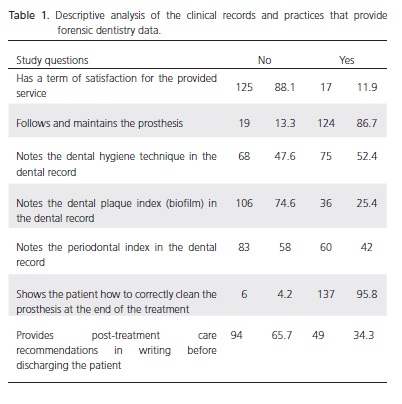
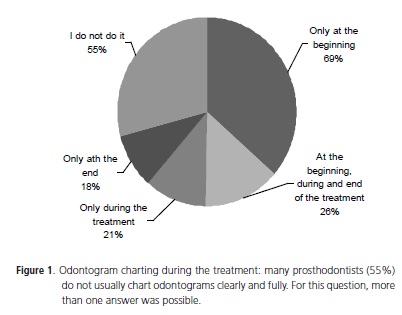
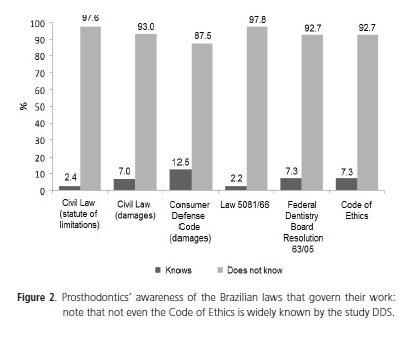
]]> Most respondents were aged 31 to 40 years and most had been prosthodontists for 16 to 20 years. Sixtyeight (47.6%) respondents informed that their colleges did not provide forensic dentistry classes, 21.7% (n=31) had had such classes during their undergraduate studies, 18.2% (n=26) learned the subject in extracurricular courses, 11.9% (n=17) did not answer this question, and 0.7% (n=1) specialized in forensic dentistry and dental prosthesis.The respondents were also asked if they recorded data or clinical information that could be useful in a court of law. Figure 1 and 2 and Table 1 show the results - 0.7% of the questions were left blank.
 ]]>
]]>
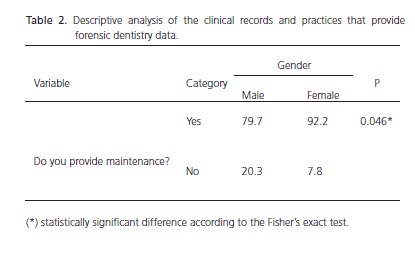
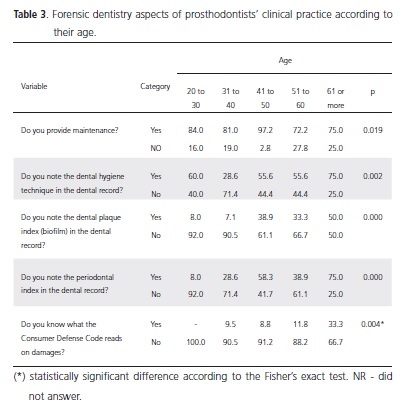
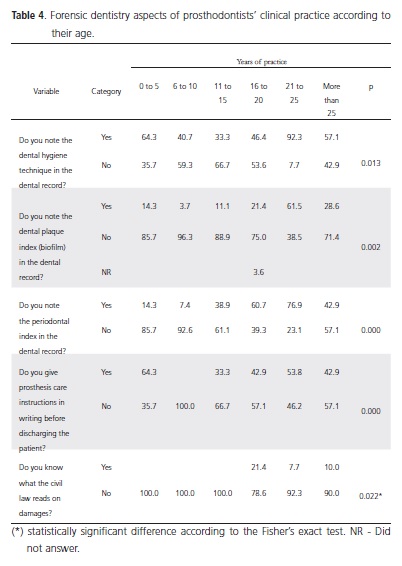
The Fisher's exact test determined the significance of the findings, shown in Table 2, 3, and 4 below.
]]>
DISCUSSION
Forensic dentistry has shown the importance of knowing the civil responsibility of DDS and the relevant laws to prevent lawsuits7. Regarding professional responsibility or errors associated with dental prosthesis rehabilitations, prosthodontics has the highest number of complaints in the ethical and administrative spheres8 and appears among the specialties with numerous malpractice lawsuits4.
]]> Considering the sample's profile, those who did not return the questionnaires may be unknowledgeable about the subject, fact supported by the significant number of respondents (47.6%) who had never had forensic dentistry classes. The answers some respondents gave to the open questions on the forensic dentistry content of their undergraduate education is noteworthy: "poor," "I do not remember any deeper approach," "incomplete and superficial," and "insufficient."The age distribution of the sample was also uniform, with three age groups (20 to 30 years, 51 to 60 years, and 61 or more years) presenting a variation of roughly 10%. Most respondents (54.6%) were aged 31 to 50 years. The fact that 17.5% of the respondents were 20 to 30 years old suggests a demand for immediate specialization after graduation.
Most respondents (74.1%) work exclusively in the private sector or in the mixed sector, having private offices. However, 27.3% work in the public sector or in the mixed sector, showing a general change of behavior within the dentistry scope, that is, dental surgeons working within a global health context.
The patient's satisfaction with the treatment is directly related with the likelihood of him taking legal action against the DDS, a fact also supported by lawyers, since lawyers believe that satisfied patients are unlikely to resort to lawsuits9. However, patient satisfaction is not only related to the clinical quality of the treatment, but also to quality of the relationship he has with his DDS10. In the present study, only 11.9% (n=17) of the respondents made some sort of term of satisfaction for the prosthesis; the other 88.1% remained vulnerable to a possible lawsuit, since the said term establishes the initial date for the statute of limitations provided by the Consumer Protection and Defense Code11. From the clinical point of view, DDS who do not follow the patients do not know if they are feeling well and are satisfied with the prostheses.
In addition to satisfaction, another important point to consider is the periodic maintenance of the prosthesis. Most respondents (86.7%) provide maintenance to the prosthesis, females significantly more so than males (p=0.046). According to the literature, the genders do not differ in this respect, but females seem to be careful than males.
Respondents 50 years old or younger provide maintenance regularly but the frequency of follow-up visits drops for older respondents, either because older patients are less interested in their oral health or because patients in general seek other professionals (p=0.019). The scheduled follow-up visits were not uniform among the respondents: 11.9% scheduled a 6-month follow-up, as recommended by Lechner12, 33.6% scheduled a 12-month follow-up, as recommended by Bergman et al.13, and most respondents chose the option "other." The respondents often reported that follow-up visits relied on the patient's needs, that is, these DDS clearly transferred to the patient a practice that should be defined clinically, and which may benefit the DDS and the patient should the prosthesis maintenance protocol be done as suggested by Brewer (1970): the follow-up schedule should be one week, one month, six months, twelve months, and 24 months. Hence, clinical practice supports this study protocol.
The present study investigated whether the sample looked into and recorded their patients' oral hygiene techniques to verify whether the techniques changed after treatment. Although 52.4% of the respondents recorded the oral hygiene techniques used by their patients, a striking 74.6% did not record the plaque index. Importantly, the number of 31-40-year-olds who did not record the oral hygiene techniques used by their patients differed significantly from those aged 61 years or more who did so consistently (p=0.002). More experienced DDS tend not only to record more general data, but also to record the plaque and periodontal indices more often (p=0.002). DDS with 6 to 10 years of practice tended not to record these data, contrary to those with 21 to 25 years of practice. Most DDS (58%) did not record the periodontal index, so they would not be able to compare the baseline periodontal index of their patients with post-treatment indices. From the ethical and legal viewpoint, having these records would prove good professional practice14.
On the other hand, the fact that many DDS (47.6%) did not have a solid and consistent education on the ethical and legal aspects of their profession reflected directly on the number of DDS who answered the question about the use of odontograms. This shows the lack of quality and the damages to good routine practice regarding prostheses, whether because of administrative, clinical, or legal issues1.
According to the Federal Dentistry Board (CFO), the essential document is the clinical record containing the identification of the DDS and patient, patient's history, clinical examination, and treatment progress and intercurrences. The complementary documents are a) prescriptions; b) certificates; c) contract for the provision of dental treatment; and d) complementary tests15-16. In addition to these documents, the patient should sign an informed consent form agreeing with the proposed treatment6.
The levels of unawareness of the dentistryrelated laws indicate the risk to which these professionals are exposed. Surprisingly, the law that establishes and regulates the DDS profession is reportedly the one DDS are most unaware of, with only 2.2% (n=3) of the respondents declaring awareness. The level of awareness of the six related codes (Civil Law regarding the statute of limitations and damages; Consumer Protection and Defense Code;
]]> Law number 5081/66 which governs the profession; Dentist Code of Ethics; and the Code of Standards for Board Procedures or Resolution 63/2005 which provides the attributions of prosthodontists) did not exceed 12.5%. It is noteworthy that DDS aged 20to 30 years were more unaware of the codes than other age groups (p=0.004). Another finding worthy of mention is the knowledge that DDS with 16 to 20 years of practice have about damages, as opposed to other age groups (p=0.022). These data reinforce the importance of legal awareness of the laws that impact the profession.CONCLUSION
The study experts have partial knowledge of the forensic dentistry aspects of the rehabilitation treatment information entered in the dental records. Their experience had a significant impact on their legal awareness and on the quality of the data they recorded regarding the procedures that suggest greater care.
Acknowledgements
The authors thank the translator Luiza Modesto for her collaboration.
Collaborators
MM FERNANDES, RRL TINOCO, LR PARANHOS, L FRANCESQUINI JÚNIOR and E DARUGE JÚNIOR participated in all the stages associated with the writing of this article.
REFERENCES
1. Francesquini Jr L. Parâmetros de qualidade em prótese parcial removível e a responsabilidade civil [tese]. Piracicaba: Universidade Estadual de Campinas; 2004. [ Links ]
]]> 2. Brasil. Lei n. 8.078 de 11 de setembro de 1990. Dispõe sobre a proteção do consumidor e dá outras providências. Diário Oficial da União, Brasília (DF); 1990 Set 12, suplemento [citado 2010 Nov 11]. Disponível em: < http://www.planalto.gov.br/ccivil_03/ leis/l8078.htm>.3. Brasil. Lei n. 10.406 de 10 de janeiro de 2002. Institui o Código Civil. Diário Oficial da União, Brasília (DF); 2002 Jan 11 [citado 2010 Nov 11]. Disponível em: <http://www.planalto.gov.br/ ccivil_03/leis/2002/l10406.htm>.
4. De Paula FJ. Levantamento das jurisprudências de processos de responsabilidade civil contra o cirurgião-dentista nos tribunais do Brasil por meio da internet [tese]. São Paulo: Universidade de São Paulo; 2007.
5. Lucato MC. Responsabilidade profissional do cirurgião-dentista. J Bras Clín Odont Int. 2004;8(47):367.
6. Cruz RM, Cruz CPAC. Gerenciamento de riscos na prática ortodôntica: como se proteger de eventuais problemas legais. Rev Dental Press Ortodon Ortop Facial. 2008;13(1):124-40. doi: 10.1590/S1415-54192008000100015.
7. Silva M. Das perícias odontolegais. In: Silva M. Compêndio de odontologia legal. Rio de Janeiro: Medsi; 1997. p. 415-73. 8. Oliveira OF, Kairalla SA, Kairalla RA, Torres FC, Paranhos LR. Perfil das denúncias éticas realizadas ao Conselho Regional de Odontologia: uma reflexão. Rev Assoc Paul Cir Dent. 2011;65(2):142-4.
9. Garbin CAS, Garbin AJI, Rovida TAS, Saliba MTA, Dossi AP. A responsabilidade profissional do cirurgião-dentista segundo a opinião de advogados. Rev Odontol UNESP. 2009;38(2):129-34.
10. Frank RP, Brudvik JS, Leroux B, Milgrom P, Hawkins N. Relationship between the standarts of removable partial denture construction, clinical acceptability, and patient satisfaction. J Prosthet Dent. 2000;5(83):521-27.
11. Fernandes MM, Bragança DPP, Paranhos LR, Francesquini Jr L, Daruge E, Daruge Jr E. Reflexão odontolegal sobre o tempo de guarda da documentação dos pacientes. RFO UPF. 2011;16(1):7- 12.
12. Lechner SK. A longitudinal survey of removable partial dentures. I. patient assessment of dentures. Aust Dent J. 1985;30(2):112- 17. doi: 10.1111/j.1834-7819.1985.tb05353.x
]]> 13. Bergman B, Hugoson A, Olsson CO. Caries, periodontal and prosthetic findings in patients with removable partial dentures: a tem -year longitudinal study. J Prosthet Dent. 1982;48(5):506- 14.14. Vassão SAS, Carvalho RB, Medeiros UV, Santos KT. Prevenção a riscos jurídicos no exercício da odontologia: o que o cirurgiãodentista deve saber. Rev Assoc Paul Cir Dent. 2009;63(5):390-4.
15. Paranhos LR, Daruge Jr E, Fernandes MM, Joias RM, Joias RP. Orientações odontolegais de interesse para o especialista em prótese dentária. Pro-Odonto Prótese. 2009;2(1):141-76.
16. Almeida CAP, Zimmermann RD, Cerveira JGV, Julivaldo FSN. Prontuário odontológico: uma orientação para o cumprimento da exigência contida no inciso VIII do art. 5º do Código de Ética Odontológica. Brasília: Conselho Federal de Odontologia; 2004.
 Endereço para correspondência:
MM FERNANDES
e-mail: mfmario@mp.rs.gov.br
]]> Received on: 24/10/2011
]]>