Evaluation of radiographic waste management in dental offices and radiology clinics of São Luís (MA)
Marcos André dos Santos da Silva I; Oswaldo Serra dos Santos-Neto I; Jefson Moraes Amorim I; José Bauer II
II Federal University of Maranhão, School of Dentistry - São luis - MA - Brazil.
]]>
ABSTRACT
Introduction: Lack of information continues to lead the professionals of various areas to contribute to environment degradation, and Dentistry is a potential source of contamination through chemical residues resulting from radiographic procedures. Objective:To evaluate the management of residues resulting from radiographic processing in dental radiology clinics and dental offices in São Luís – MA, Brazil. Material and methods: A semi-structured questionnaire was prepared with the aim of characterizing the behavior of professionals and their procedures for discarding the processing solutions (developer, fixer, and water) and radiographic packing materials. A sample of 100 individuals represented 7.8% of the total number of 1,281 dentists in the city of São Luís.Results: A total of 92% of the participants believed that radiographic effluents could cause damage to the environment. Concerning to the fixer discarding, 43% affirmed that they threw the solution directly through the sink, 36% diluted the fixer in water and threw it into the sink, 14% used a specialized company to discard it and 7% used other means. The developer was discarded as follows: 42% threw it down the sink, 36% diluted it in water before throwing it into the sink, 13% used a specialized company to discard it and 9% used other ways. Considering to the discarding of the packing of the radiographic films, 51% threw them into the trash and 49% used a specialized disposal company. Conclusion: Large portions of dentists do not discard radiographic processing residues and films correctly.
Keywords: environment; radiology; water pollutants; raw effluents; Dentistry.
Introduction
]]> Currently, the contamination of the environment has been a constant concern and this is not only more a desire of a small group of environmentalists but raises the global attention, even with the adoption of governmental policies. The pollution of rivers, lakes, coastal areas, and bays has resulted in environmental degradation due to the discard of increasing volumes of industrial residues. The releasing of untreated sewage drastically increase in the last decades.The radiographic images are indispensible tools for the proper diagnosis, both in Medicine and Dentistry. Basically, the technique performed to obtain the radiographic images comprises the emission of x-rays into radiographic films followed by the conventional processing of the films. This traditional processing procedure involves the steps of image developing, washing, fixing, final washing and drying 10.
During the radiographic processing in a dental office or clinic, residues are originated which must follow their proper handling and discarding, aiming to minimize the environmental impacts 10. The chemical residues presenting risks to either the human health or the environment should be submitted to specific final treatments when they do not undergo reutilization, recuperation, or recycling 5,10.
The effluents coming from radiographic processing comprise solutions with high concentrations of silver and other chemical substances highly toxic to the environmental health 9,12,15. Additionally, a solid residue causing great concern is the lead found in the packing of the radiographic films. This material is classified as dangerous because of its chemical toxicity 20.
The current concern in altering the system of radiographic film processing by new products or less pollutant techniques may decrease the environmental contamination. The technological advancements and the increasing investments in radiology has been addressed to improve the devices and to discover new ways to obtain images free of radiographic solutions 6. However, little has been done still to minimize the environmental impacts caused by the radiographic films, developer, and fixer solutions, and radiographic water 13. On the other hand, the proper treatment of the developer and fixer solutions may generate inputs and strengthen the economy by the possibility of being reused 9,11.
Some institutions released in the environment the effluents and solid residues coming from the radiology clinics without any type of treatment 2,9. On the other hand, others contract suppliers of electrolytic separator to recover the silver from the used fixer solution, but the other effluents are discarding into the sewage 9.
The treatment of the residues is performed in silver separators mostly poorly designed, which showed unsatisfactory results. Consequently, the residues are released into the sewage with the highest chemical oxygen demand (COD), high pH and silver concentrations above those permitted by the policies 2,3,9,13. The high silver concentration is harmful for the human beings and may be toxic to several organisms 11. Therefore, studies on the knowledge of the treatment given to the solid and liquid residues are very important.
Thus, the aim of this study was to evaluate the residue management of dental offices and radiology clinics in São Luís, Maranhao, Brazil.
Material and methods
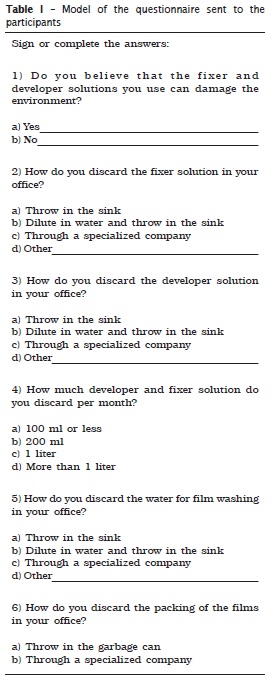
]]> This study was submitted and approved by the Ethical Committee in Research of the University Center of Maranhão (short Uniceuma), under protocol #0067707/2008. A semi-structured questionnaire was elaborated (table I) to characterize the behavior of the dentists and their procedures towards the discard of the developer and fixer solutions, radiographic films and their packing, and the water used in the film washing. Among the questions, two evaluated the amount of developer and fixer solutions and the packing of radiographic films used during a month; and one evaluated the degree of knowledge of the dentist on the processing solutions.
The questionnaire was randomly applied to a sample of 100 subjects, who comprised a total of 7,8% of the 1,281 dentists of de São Luís – MA, Brazil (Regional Council of Dentistry, 2008). The participants were informed on the objectives of the study and agreed in participating by signing a free and clarified consent form, in which was assured the confidentiality of the information.
The dentists were instructed to fill in the questionnaire by themselves although in many of the offices, the handling and discarding of the radiographic residues is performed by the auxiliary team. Notwithstanding, the dentists are directly responsible for both the team and the residues generated in their offices. After the filling of the questionnaire, the dentists were instructed on how to perform the appropriated discard of the effluents.
Data were submitted to descriptive quantitative analysis and were expressed in percentage.
]]> Results
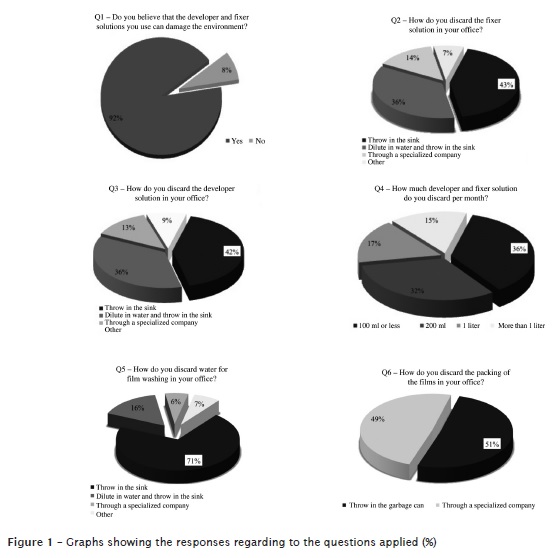
A total of 92% of the participants affirmed to believe that the radiographic effluents may cause damage to the environment, and only 8% affirmed not to believe (figure 1, Q 1).
Considering to the fixer discarding, 43% affirmed throwing it directly into the sink; 36% diluted the fixer into water and then threw in the sink; 14% performed the discard through a specialized company and 7% uses another way (figure 1, Q 2).
The developer is discarded by 42% into the sink; 36% diluted in water and then threw in the sink; 13% performed the discarding through a specialized company; and 9% used another method (figure 1, Q 3).
The amount of developer and fixer solutions discarded per month was 100 ml or less for 36% of the participants; 200 ml for 32%; 1 liter for 17%; and more than 1 liter for 15% (figure 1, Q 4).
Concerning to the water used for the washing of the films, 71% affirmed they threw it into the sink; 16% diluted in water and threw in the sink; 6% discarded through a specialized company; and 7% discarded through another method (figure 1, Q 5).
Concerning to the discarding of the films, 51% threw directly into the garbage can and 49% discarded through a specialized company (figure 1, Q 6).
]]>
Discussion
The radiographic examination is a fundamental tool in Dentistry, especially during patient’s treatment and following-up. Several advancements in this area regarding to technology, devices and techniques have collaborated to the reduction of the patient’s exposure doses and improved the image quality 23.
Consequently, the possibility of performing radiographic examinations through digitized images appear and eliminate the necessity of the conventional films with lead pellicle and the further processing procedures with chemical solutions (developer and fixer), which are normally discarded in the sewage after their use 16.
Therefore, the use of the digital device may be an effective way to solve the problem of the effluents coming from the radiographic processing. In Brazil, few specialized centers of excellence already used the digital systems, but they involve high costs, which makes their acquisition difficult 12.
According to Kizlary et al. 17, the solid residues of dental origin comprise three categories: infecting, non-infecting, and domestic. Some of these residues are extremely toxic, as heavy metals and chemical solutions, which put the health at risk and my cause serious environmental damages 14.
This present study only focused on the non infecting residues, that is, the chemical solutions and the packing of the films used in the radiographic processing. This present study shows that the dental community believes in the harmful potential of the radiographic effluents to the environment (figure 1, Q 1). Therefore, before their discarding, the dentists must use any procedure which makes these residues less harmful. However, according to the results, even knowing the damages caused by the radiographic residues, the dentists mostly discarded them incorrectly (figure 1, Q 2, Q 3, Q 5 and Q 6).
Some authors who conducted studies in radiology clinics found different results, in which 60 to 80% of the participants used the service of a specialized company to discard the effluents 7,12.
]]> The large amount of radiographic solutions and their incorrect handling are of great concern, and the governmental agencies should supervise such actions to protect both the health and the environment 13.According to the results, during the period of a month, about one hundred dentists discarded approximately 57 liters of developer and fixer solutions. A total of 1,281 dentists working in the city of São Luís, according to the Regional Council, will discard about 730 liters of developer and fixer solutions per month, directly into the environment, which is not in agreement with the guidelines of the Brazilian Council on the Environment 3.
This could be solved through contracting companies specialized in the treatment of this type of residue. According to Kontogianni et al. 18 it is essential that the government not only supervise but also support financially the creation of these companies.
The fixer solution is a liquid which contains silver and requires a treatment prior to its discard, instead of only its dilution in water 1,4. Additionally, there are several techniques to retrieve the silver within the fixer solution; some of these methods are able to recover up 99% of the metal 11.
The developer solution should be neutralized prior to its discard because it has a pH around 11 to 12, that is, it is a highly basic solution, which is also composed by aromatic phenolic compounds and amino acid salts. Its COD is also very high: about twenty times above that allowed by the law for discarding 15. Therefore, this solution should also be treated before discarding in the sewage because it contains several components or forms products in its reactions, which are harmful to the environment, such as hydroquinone, quinone, methol, sodium thiosulfate, sodium sulfite, elemental sulfur, acetic acid, sodium acetate, boric acid among others, as well as silver, in the form of complex ions (S2O3-¹) 15.
It is also known that great volumes of water used in the washing of the radiographs have been daily released in the sewage (figure 1, Q 5). This water normally shows high levels of silver, well above the allowed value 2,13, which was similar to the results of other studies 2,9,12.
Concerning to the packing of the films, a large number of dentists perform it wrongly (figure 2, Q 6). According to the technical guideline (RDC number 306, from December, 7, 2004) from the Brazilian Agency of Sanitary Surveillance (short Anvisa), the residues should be referred to landfills of Class I hazardous waste 4. The large amount of subjects discarding the film packing in the garbage may cause a serious environmental damage due to the presence of lead. Acordem to Tsuji et al. 22, although a service for the collection of this material is available, the dentists prefer to discard it in the common garbage, maybe motivated by the small amount of examinations they performed. 19. The former president of the Canadian Dental Association stated that “as a group, we dentist should responsibly act to minimize the environmental impact of the dentistry practice” and at the same time to protect the human health 8.
Carvalho et al. 7 verified that more than 72% of the participants recycle or reuse the lead laminas. However, it has been observed that most part of the participants reuses the laminas for bite registration, which put at risk the patient’s health, once lead can be easily dissolve by human saliva 21.
The results of this present study corroborate those of Fernandes et al. 9, who found many irregularities in the handling and discarding of the radiographic residues. The lack of care in the handling of the dental residues may cause serious damage to the workers who executed the garbage collection, the population and to the environment, which could be avoided by a system of previous separation of this material 24.
Considering the aforementioned discussion, it is clear the need of greater attention by the public agencies, such as the environmental and sanitary surveillance, regarding to the residues of radiographic processing. These agencies should stimulate the silver retrieving from the fixer solution and the water used for film washing, therefore reducing the environmental damages and the costs and enabling the reutilization of this water in the process. Also, the agencies should require the treatment of the developer and fixer solutions in order to reach a less harmful way of discarding, aiming to reduce the impact on the public health and environment. ]]>
Conclusion
Considering the methodology employed and the results obtained, it can be concluded that most of the dentists of the city of São Luis did not perform the discarding of the radiographic processing residues and the radiographic films properly.
Acknowledegments
We thank to the Foundation For Research and Scientific and Technological Development of Maranhão (short Fapema – grant #1027/10, PS 0085/2010 and 617/2011).
References
1. Bendassolli JA, Tavares GA, Ignoto RF, Rosseti ALRM. Procedimentos para recuperação de Ag de resíduos líquidos e sólidos. Quím Nova. 2005;26(4):578-81. [ Links ]
]]> 2. Bortoletto EC, Igarashi-Mafra L, Sorbo ACAC, Galliani NA, Barros MASD, Tavares CRG. Remoção da prata em efluentes radiográficos. Acta Sci Technol. 2007;29(1):37-41.3. Brasil. Conselho Nacional do Meio Ambiente (Conama). Resolução n.º 358, de 29 de abril de 2005. Dispõe sobre o tratamento e a disposição final dos resíduos dos serviços de saúde e dá outras providências. Diário Oficial da União. 2005 May 4.
4. Brasil. Agência Nacional de Vigilância Sanitária (Anvisa). Resolução da Diretoria Colegiada – RDC – 306, de 7 de dezembro de 2004. Dispõe sobre o regulamento técnico para o gerenciamento de resíduos de serviço de saúde. Diário Oficial da União. 2004 Dec 10.
5. Brasil. Ministério da Saúde. Agência Nacional de Vigilância Sanitária (Anvisa). Serviços odontológicos: prevenção e controle de riscos. Brasília. Série A. Normas e Manuais Técnicos; 2006.
6. Braunschweig R, Pistitsch C, Nissen-Meyer S. Digital radiography. Cost-benefit analysis. Radiologe. 1996;36:306-14.
7. Carvalho PL, Antoniazzzzi MCC, Medeiros JMF, Zollner NA. Situação dos resíduos gerados em radiologia odontológica. Rev Bioc. 2006;12(3-4): 131-6.
8. Diggens J. Dealing with amalgam waste. J Can Dent Assoc. 2000;66(3):121.
9. Fernandes GS, Azevedo ACP, Carvalho ACP, Pinto MLC. Análise e gerenciamento de efluentes de serviço de radiologia. Radiol Bras. 2005;38(5):355-8.
10. Freitas A, Rosa JE, Souza IF. Radiologia odontológica. 6. ed. São Paulo: Artes Médicas; 2004.
11. Goshima T, Hori K, Yamamoto A. Recovery of silver from radiographic fixer. Oral Surg Oral Med Oral Pathol. 1994;77(6):684-8.
]]> 12. Grigoletto JC, Santos CB, Albertini LB, Takayanagui AMM. Radiographic processing effluents management status in healthcare centers. Radiol Bras. 2011;44(5):301-7.13. Grigoletto JC, Segura-Muñoz SI, Barbosa-Junior F, Sanches SM, Takayanagui AM. Silver discharged in effluents from image-processing services: a risk to human and environmental health. Biol Trace Elem Res. 2011;144(1-3):316-26.
14. Hiltz M. The environmental impact of dentistry. J Can Dent Assoc. 2007;73(1):59-62.
15. Hocevar CM, Rodrigues MTR. Avaliação do impacto ambiental gerado por efluentes fotográficos, gráficos e radiológicos em Porto Alegre, RS, Brasil. Eng Sanit Ambient. 2002;7(3):139-43.
16. Hokett SD, Honey JR, Ruiz F, Baisden MK, Hoen MM. Assessing the effectiveness of direct digital radiography barrier sheaths and finger cots. J Am Dent Assoc. 2000;131(4):463-7.
17. Kizlary E, Iosifidis N, Voudrias E, Panagiotakopoulos D. Composition and production rate of dental solid waste in Xanthi, Greece: variability among dentist groups. Waste Management. 2005;25(6):582-91.
18. Kontogianni S, Xirogiannopoulou A, Karagiannidis A. Investigating solid waste production and associated management practices in private dental units. Waste Management. 2008;28(8):1441-8.
19. Manzi FR, Guedes FR, Ambrosano GVB, Almeida SM. Estudo do destino dado aos resíduos dos materiais radiográficos pelo cirurgião-dentista. Rev Assoc Paul Cir Dent. 2005;59(3):213-6.
20. Ozbek M, Sanin FD. A study of the dental solid waste produced in a school of dentistry in Turkey. Waste Management. 2004;24(4):339-45.
21. Tsuji LJ, Fletcher GG, Nieboer E. Dissolution of lead pellets in saliva: a source of lead exposure in children. Bull Environ Contam Toxicol. 2002;68(1):1-7.
]]> 22. Tsuji LJ, Wainman BC, Jayasinghe RK, Van Spronsen E, Nieboer E. Foil backing used in intraoral radiographic dental film: a source of environmental lead. J Can Dent Assoc. 2005;71(1):35-8.23. Tugnait A, Clerehugh V, Hirschmann PN. Radiographic equipment and techniques used in general dental practice: a survey of general dental practitioners in England and Wales. J Dent. 2004;32(1):17-25.
24. Vieira CD. Composition analysis of dental solid waste in Brazil. Waste Management. 2009;29(4):1388-91.
 Correspondence:
José Bauer
Universidade Federal do Maranhão – Curso de Odontologia
Campus Universitário do Bacanga
Rua dos Portugueses, s/n.º
CEP 65080-805 – São Luís – MA – Brasil
E-mail:bauer@ufma.br
Received for publication: August 15, 2011.
Accepted for publication: February 06, 2012.