Accuracy evaluation of three electronic apex locators in teeth with immature apices
Bruno Martini Guimarães I; Marcelo de Morais Vitoriano I; Claudio Maniglia-Ferreira II; Fabio de Almeida-Gomes II; Marina Angélica Marciano I; Clovis Monteiro Bramante I; Marco Antonio Hungaro Duarte I
I Department of Endodontics, School of Dentistry of Bauru, University of São Paulo – Bauru – SP – Brazil
II School of Dentistry, University of Fortaleza – Fortaleza – CE – Brazil
Introduction and Objective: The aim of this randomized controlled study was to evaluate the accuracy of Root ZX, iPex and YS-RZ-A apex locators in tooth with incomplete apices. Material and methods: Thirty human mandibular pre-molars without dental caries, fracture and with 1-3mm apical diameter and ¾ of root development stage were used. After coronal access, tooth length was determined with the visualization of a K-file, compatible with the root canal diameter, at the apex. To determine the root canal length using electronic methods, the teeth were included in alginate. The 30 teeth were measured with the three apex locators until achieving the apex foramen. During the measurement, the canals were inundated with 1% sodium hypochlorite. Statistical analysis was performed using Qui-square test (p < 0.05). Results: The Root ZX apex locator showed the higher accuracy (53.3%), with statistical difference in relation to iPex apex locator (33.3%) and YS-RZ-A apex locator (26.7%) (p < 0.05). Regarding the security limit of ±1 mm, the Root ZX apex locator did not show statistical difference in comparison with iPex apex locator (p > 0.05), but both were statistically different in relation to YS-RZ-A apex locator (p < 0.05). Conclusion: The results showed that all the studied apex locators were efficient in determining the root canal length in tooth with incomplete apex, considering the tolerance of ±1 mm. The Root ZX apex locator showed the highest accuracy with 100% of agreement.
Keywords: odontometry; Endodontics; tooth apex.
Introduction
One of the first phases of endodontic treatment is to determine the working length (WL) which delimitates the instrumentation during chemicalmechanical preparation. By accurately determining this measurement, unpleasant consequences are avoided, among them: formation of steps on root canal walls, improper instrumentation and obturation, root perforation, and symptomatic post-operative period 8.
Studies similar to that of Kuttler 19 indicated the junction of dentin and cementum canal as landmark to limit endodontic treatment, an area so-called dentincementum canal (DCC). Notwithstanding, DCC limit does not precisely locate the apical foramen 7.
Many methods have been proposed to determine the working length of root canal from the patient's response to the pain provoked by surpassing the instrument through the apex foramen to the use of either conventional or digital radiographs 21.
The radiographic method is the technique most employed in working length determination, and some factors such as angulations, technical variables, interference of anatomic structures, and professional's interpretation may lead to errors 12. Aiming to help the dentists in determining the apical limits, some devices have been developed to establish the canal length 3.
]]> In 1918, Custer firstly conducted studies to determine root canal working length through electrical current, but only in 1942, Suzuki continued the studies and exposed a device measuring the electrical resistance between the periodontal ligament and oral mucosa. This study enabled the development of the first apical locator by Sunada, in 1962 22.With the appearance of electronic apex locators (EAL), an auxiliary tool was available in the endodontic armamentarium aiming at the correct odontometry 12. The search for the reliability of these devices was determinant to develop the third-generation locators 3.
The main advantage of third-generation apical locators is that they detect the apical constriction, which is not possible through radiographs. Moreover, by using the electronic method in WL determination, the patient's exposure to radiation can be reduced because of the smaller number of radiographic shots. Other advantage is the shorter and lower-cost endodontic treatment by optimizing the working time of the dentist 18.
In teeth with incomplete apices the exact WL determination is indispensable for endodontic treatment success, either apexification or revascularization 23. Notwithstanding, WL establishment in teeth with incomplete apices is still challenging for endodontic treatment because of the anatomic features of this area 17,26. Many authors have suggested that when root resorption is present, the use of apical locators is reliable when certain degree of apical tapering exists 1,11,25.
In light of this, this study aimed to evaluate the in vitro accuracy of three apical locators – Root ZX (J. Morita Corp., Kyoto, Japan), iPex (NSK, Tokyo, Japan), and YS-RZ-A (Baistra, Henan, China) – in teeth with immature apices.
Material and methods
Thirty human single-rooted mandibular premolars, without caries, fracture and with 1-3 mm apical diameter, and at ¾ of root development with incomplete apices were used. All teeth had their extractions correctly indicated due to orthodontic reasons. All patients read and signed a Tooth Donation and Clarified Consent Forms. This study was submitted and approved by the Ethical Committee in Research of the University of Fortaleza (protocol no. #139/2009).
Crown accesses were performed with the aid of round diamond bur (KG Sorensen, Petrópolis, RJ, Brazil) at high speed and Endo Z drill (Dentsply Maillefer, Ballaigues, Switzerland). Irrigation was obtained through 1% sodium hypochlorite, and then, the canal was negotiated with the aid of size #15 K files. The teeth were numbered from 1 to 30 to allow the record of the WL obtained with each electrical apical locator.
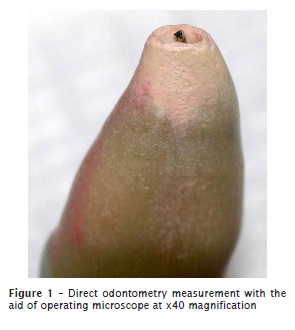
Direct tooth measurement was carried out by placing a K file compatible with the root canal diameter, until the file was seen in the apex with the aid of an operating microscope at x40 magnification (DF Vasconcelos M9000, SP, Brazil) (figure 1).
]]>
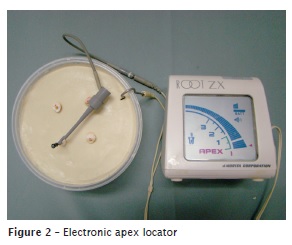
Next, the teeth were placed into glass flasks filled with alginate (Jeltrate-Dentsplay, Petrópolis, RJ, Brazil), so that the crown was visible thus avoiding that the alginate penetrated inside the canal. The labial clamp of EAL was inserted into the alginate. The electronic odontometry was obtained in each canal based on the methodology proposed by et al. 15. All measurements were executed by a single operator, previously calibrated, to avoid discrepancies. The following apex locators were tested: Root ZX (J. Morita, Kyoto, Japan), iPex (NSK, Tokyo, Japan), and YS-RZ-A (Baistra, Henan, China). The reading of the apical foramen position was performed by introducing the file coupled to EAL inside root canal. The file was slowly moved towards apical direction until each device showed the correspondent sign of apical location (figure 2). Once the zero position was reached by the device, the file was disconnected and measured with the aid of a millimetric endodontic ruler. All canals were filled with 1% sodium hypochlorite during the measurements.
 ]]>
]]>
The data obtained from the three apex locators were classified in scores (accurate or inaccurate), paired in two-column tables, and analyzed by Chi-square test to compare the electronic with the direct measurements (p < 0.05).
Results
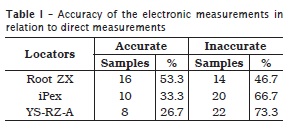
The electronic measurements of the 30 teeth are expressed in table 1. A greater coincidence between the direct and electronic measurement was seen with Root ZX locator (53.3%), followed by iPex locator (33.3%), and YS-RZ-A locator, the less accurate (26.7%).
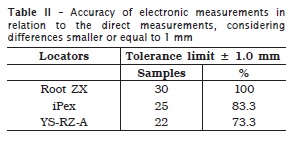
]]> Taking into consideration the tolerance limit of ±1mm, Root ZX locator showed an accuracy of 100%, iPex locator of 83.3%, and YS-RZ-A locator of 73.3% (table 2).
The analysis of the results obtained by the electronic measurements coinciding to the real measurements through Chi-square test showed that Root ZX locator had statistically higher results than did iPex and YS-RZ-A locators; iPex locator results were statistically higher than YR-RZ-A locator results.
Taking into consideration the tolerance limit of ±1 mm, Root ZX locator results were statistically similar to iPex locator result; but these results were statistically significant different from those of YS-RZ-A locator.
Discussion
]]> In this present study, by comparing the real measurements of the examined teeth with the measurements obtained by the apex locators, it could be observed that Root Zx locator exhibited 100% of accuracy at a tolerance limit of ± 1.0 mm. These findings are in agreement with the study conducted by Heidemann et al. 13, who also compared the real and electronic odontometry with an accuracy of 100%. Dandempally et al. 5 found an accuracy of 96.77% for Root Zx locator in primary teeth with root resorption.Concerning to iPex locator, the results pointed out an accuracy of 83.3% inside the tolerance limit of ±1.0 mm. These results corroborate those found by Heidemann et al. 13, who reported an accuracy of 90%; and those found by Dandempally et al. 5, who reported an accuracy of 90.32%. It is noteworthy to mention that these authors analyzed teeth with complete apices.
As far as we are concerned, no studies on YS-RZ-A apex locator accuracy were found in the literature. In this present study, this apex locator showed an accuracy of 73.3% within the tolerance limit of ± 1.0 mm.
Root Zx and iPex locators did not exhibit statistically significant differences in the study conducted by Heidemann et al. 13, proving that iPex locators is as reliable as Root ZX locator, and corroborating the results of this present study.
Moore et al. 24 and Fouad et al. 9 affirmed that marked apical foramen openings may result in inaccurate measurements when EAL are used, highlighting the cases of incomplete rhizogenesis or pulp necrosis with periapical lesions involving bone and root resorptions. Frank and Torabinejad 10 verified that EAL ineffectiveness in determine WL in teeth with immature apices and that the file taper did not interfere in the readings of the devices. Likely, Herrera et al. 14 affirmed that the accuracy of Root ZX locator varied in function of the diameter of apical constriction. In these cases, the association of the radiograph and EAL is indicated to determine WL and provide a more accurate result 17.
Spironelli Ramos and Bramante 26 emphasized the difficulty in performing the electronic odontometry in teeth with immature apices by the lack of apical constriction. The use of alginate for the teeth insertion followed the suggestions of the studies of Czerw et al. 4, Baldi et al. 2, and Lipski et al. 20, which highlighted the advantage of this medium in in vitro studies on apical locators.
It is noteworthy to mention the importance that one single operator handled the EALs to obtained the results because according to Kielbassa et al. 16, two or more operators resulted in a significant difference in the WL measurements that disguised the real study result.
The results of this present study demonstrated the reliability of EALs in determining the working length in teeth with incomplete rhizogenesis. Although the results proved this effectiveness, most of the authors agree that EALs do not eliminate the need of taking a radiograph to determine the working length and root canal anatomy and morphology. Accordingly, the association of the radiograph and apical locator is the ideal method.
Conclusion
]]> The results of this present study demonstrated that the analyzed apex locators were effective in determining accurately the working length of teeth with incomplete apices when a tolerance limit of ± 1.0 mm was taken into consideration. Root ZX apex locator was the most accurate with 100% of agreement.
References
1. Angwaravong O, Panitvisai P. Accuracy of an electronic apex locator in primary teeth with root resorption. Int Endod J. 2009 Feb;42(2):115-21. [ Links ]
2. Baldi JV, Victorino FR, Bernardes RA, de Moraes IG, Bramante CM, Garcia RB et al. Influence of embedding media on the assessment of electronic apex locators. J Endod. 2007 Apr;33(4):476-9.
3. Chita JJ, Silva PG, Pereira KFS, Onoda HK, Borba Junior JC, Ramos CAS. Precisão e confiabilidade de um novo localizador foraminal eletrônico. Pesq Bras Odontoped Clín Integr. 2012 Oct-Dec;12(4):457-63.
4. Czerw RJ, Fulkerson MS, Donnelly JC. An in vitro test of a simplified model to demonstrate the operation of electronic root canal measuring devices. J Endod. 1994 Sep;20(12):605-6.
5. Dandempally A, Muppa R, Duddu MK, Bhupatiraju P, Nallanchakrava S. Formulating a regression equation for determination of working length in primary molars using apex locators: a clinical study. Eur Arch Paediatr Dent. 2013 Dec;14(6):369-74.
6. Donnelly JC. A simplified model to demonstrate the operation of electronic root canal measuring devices. J Endod. 1993 Nov;19(11):579-80.
]]> 7. Dummer PM, McGinn JH, Rees DG. The position and topography of the apical canal constriction and apical foramen. Int Endod J. 1984 Oct;17(4):192-8.8 . Ferreira C, Froner I, Bernardineli N. Utilização de duas técnicas alternativas para localização do forame apical em endodontia: avaliação clínica e radiográfica. Rev Odonto Univ São Paulo. 1998 Aug;12(3):241-6.
9. Fouad AF, Rivera EM, Krell KV. Accuracy of the Endex with variations in canal irrigants and foramen size. J Endod. 1993 Feb;19(2):63-7.
10. Frank AL, Torabinejad M. An in vivo evaluation of Endex electronic apex locator. J Endod. 1993 Apr;19(4):177-9.
11. Goldberg F, De Silvio AC, Manfré S, Nastri N. In vitro measurement accuracy of an electronic apex locator in teeth with simulated apical root resorption. J Endod. 2002 Jun;28(6):461-3.
12. Guimarães BM, Marciano MA, Amoroso-Silva PA, Alcalde MP, Bramante CM, Duarte MAH. O uso dos localizadores foraminais na endodontia: revisão de literatura. Rev Odontol Bras Central. 2014 Aug;23(64):2-7.
13. Heidemann R, Vailati F, Teixeira CS, Pasternak Junior B, Oliveira CAP. Análise comparativa ex vivo da eficiência na odontometria de três localizadores apicais eletrônicos: Root ZX, Bingo 1020 e Ipex. RSBO. 2009;6(1):7-12.
14. Herrera M, Abalos C, Planas AJ, Llamas R. Influence of apical constriction diameter on Root ZX apex locator precision. J Endod. 2007 Aug;33(8):995-8.
15. Kaufman AY, Keila S, Yoshpe M. Accuracy of a new apex locator: an in vitro study. Int Endod J. 2002 Feb;35(2):186-92.
16. Kielbassa AM, Muller U, Munz I, Monting JS. Clinical evaluation of the measuring accuracy of Root ZX in primary teeth. Oral Surg Oral Med Oral Pathol Oral Radiol Endod. 2003 Jan;95(1):94-100.
]]> 17. Kim Y-JA, Chandler NP. Determination of working length for teeth with wide or immature apices: a review. Int Endod J. 2013 Jun;46(6):483-91.18. Kobayashi C. Electronic canal length measurement. Oral Surg Oral Med Oral Pathol Oral Radiol Endod. 1995 Feb;79(2):226-31.
19. Kuttler Y. Microscopic investigation of root apexes. J Am Dent Assoc. 1955 May;50(5):544-52.
20. Lipski M, Trąbska-Świstelnicka M, Woźniak K, Dembowska E, Droździk A. Evaluation of alginate as a substitute for root-surrounding tissues in electronic root canal measurements. Aust Endod J. 2013 Dec;39(3):155-8.
21. Mandlik J, Shah N, Pawar K, Gupta P, Singh S, Shaik SA. An in vivo evaluation of different methods of working length determination. J Contemp Dent Pract. 2013 Jul;14(4):644-8.
22. Mattar R, Almeida CC. Análise da interferência em localizador apical eletrônico, modelo Root ZX, quando utilizado em dentes com reabsorção simulada. Rev Odontol Bras Central. 2008 Mar;17(43):13-21.
23. Miyashin M. Determination of H-file sizes being more suitable for measuring of working length in immature teeth using an EAL. Pediatric Dental Journal. 2014 Apr;24(1):53-7.
24. Moore A, Howley MF, O'Connell AC. Treatment of open apex teeth using two types of white mineral trioxide aggregate after initial dressing with calcium hydroxide in children. Dent Traumatol. 2011 Jun;27(3):166-73.
25. Odabaş ME, Bodur H, Tulunoğlu O, Alaçam A. Accuracy of an electronic apex locator: a clinical evaluation in primary molars with and without resorption. J Clin Pediatr Dent. 2011 Spring;35(3):255-8.
26. Spironelli Ramos CA, Bramante CM. Odontometria – fundamentos e técnicas. São Paulo: Santos; 2005.
]]>
 Corresponding author:
Bruno Martini Guimarães
Al. Octavio Pinheiro Brisola, 9-75 – Vila Universitária
CEP 17012-901 – Bauru – SP – Brasil
E-mail: brunomgui@usp.br
Received for publication: March 31, 2014
Accepted for publication: September 1, 2014