<?xml version="1.0" encoding="ISO-8859-1"?><article xmlns:mml="http://www.w3.org/1998/Math/MathML" xmlns:xlink="http://www.w3.org/1999/xlink" xmlns:xsi="http://www.w3.org/2001/XMLSchema-instance">
<front>
<journal-meta>
<journal-id>1984-5685</journal-id>
<journal-title><![CDATA[RSBO (Online)]]></journal-title>
<abbrev-journal-title><![CDATA[RSBO (Online)]]></abbrev-journal-title>
<issn>1984-5685</issn>
<publisher>
<publisher-name><![CDATA[Universidade da Região de Joinville- Univille]]></publisher-name>
</publisher>
</journal-meta>
<article-meta>
<article-id>S1984-56852016000100002</article-id>
<title-group>
<article-title xml:lang="en"><![CDATA[Influence of atmospheric temperature on the occurrence of irreversible pulpitis clinical cases]]></article-title>
</title-group>
<contrib-group>
<contrib contrib-type="author">
<name>
<surname><![CDATA[Sausen]]></surname>
<given-names><![CDATA[Bianca Pauline]]></given-names>
</name>
<xref ref-type="aff" rid="A01"/>
</contrib>
<contrib contrib-type="author">
<name>
<surname><![CDATA[Melo]]></surname>
<given-names><![CDATA[Tiago André Fontoura de]]></given-names>
</name>
<xref ref-type="aff" rid="A01"/>
</contrib>
<contrib contrib-type="author">
<name>
<surname><![CDATA[Kunert]]></surname>
<given-names><![CDATA[Itaborai Revoredo]]></given-names>
</name>
<xref ref-type="aff" rid="A01"/>
</contrib>
<contrib contrib-type="author">
<name>
<surname><![CDATA[Kunert]]></surname>
<given-names><![CDATA[Gustavo Golgo]]></given-names>
</name>
<xref ref-type="aff" rid="A01"/>
</contrib>
</contrib-group>
<aff id="A01">
<institution><![CDATA[,São Leopoldo Mandic Dental School Clinical Department]]></institution>
<addr-line><![CDATA[Porto Alegre RS]]></addr-line>
<country>Brazil</country>
</aff>
<pub-date pub-type="pub">
<day>00</day>
<month>03</month>
<year>2016</year>
</pub-date>
<pub-date pub-type="epub">
<day>00</day>
<month>03</month>
<year>2016</year>
</pub-date>
<volume>13</volume>
<numero>1</numero>
<fpage>05</fpage>
<lpage>10</lpage>
<copyright-statement/>
<copyright-year/>
<self-uri xlink:href="http://revodonto.bvsalud.org/scielo.php?script=sci_arttext&amp;pid=S1984-56852016000100002&amp;lng=en&amp;nrm=iso"></self-uri><self-uri xlink:href="http://revodonto.bvsalud.org/scielo.php?script=sci_abstract&amp;pid=S1984-56852016000100002&amp;lng=en&amp;nrm=iso"></self-uri><self-uri xlink:href="http://revodonto.bvsalud.org/scielo.php?script=sci_pdf&amp;pid=S1984-56852016000100002&amp;lng=en&amp;nrm=iso"></self-uri><abstract abstract-type="short" xml:lang="en"><p><![CDATA[Introduction and Objective: The present study aimed to examine the correlation between atmospheric temperature and the occurrence of irreversible pulpitis. Material and methods: Data was collected from the Department of Dentistry, Moinhos de Vento Hospital, Porto Alegre between July 2011 and December 2012. A total of 52 pulpitis clinical cases were examined in 529 days in this study. Data on the atmospheric temperature in Porto Alegre on each day was collected from the Porto Alegre Meteorology Institute. Results and Conclusion: Correlation analysis of the temperature data and pulpitis cases was conducted using Student's t-test, with a significance level of 5%. Although no correlation was observed between the occurrence of irreversible pulpitis and atmospheric temperature, the incidence rates were higher on days when the average temperature was greater than 25ºC.]]></p></abstract>
<kwd-group>
<kwd lng="en"><![CDATA[endodontics]]></kwd>
<kwd lng="en"><![CDATA[pulpitis]]></kwd>
<kwd lng="en"><![CDATA[toothache]]></kwd>
<kwd lng="en"><![CDATA[climatology.]]></kwd>
</kwd-group>
</article-meta>
</front><body><![CDATA[ <p align="right"><font face="Verdana, Arial, Helvetica, sans-serif" size="2"><b>ORIGINAL    RESEARCH ARTICLE</b></font></p>     <p>&nbsp;</p>     <p><font face="Verdana, Arial, Helvetica, sans-serif" size="4"><a name="top"/></a><b>Influence of atmospheric temperature on the occurrence of irreversible pulpitis clinical cases</b></font></p>     <p>&nbsp;</p>     <p>&nbsp;</p>     <p><font face="Verdana, Arial, Helvetica, sans-serif" size="2"><b>Bianca Pauline Sausen <sup>I</sup>; Tiago Andr&eacute; Fontoura de Melo<sup> I</sup>; Itaborai Revoredo Kunert <sup>I</sup>; Gustavo Golgo Kunert <sup>I</sup></b></font></p>     <p>&nbsp;</p>     <p><font face="Verdana, Arial, Helvetica, sans-serif" size="2"><sup>I </sup>Clinical Department, Post-Graduate Program, Dental School, S&atilde;o Leopoldo Mandic/SP Post-Graduation Center, Porto Alegre unit &ndash; Porto Alegre &ndash; RS &ndash; Brazil<br/> </font></p>     <p><font face="Verdana, Arial, Helvetica, sans-serif" size="2"><a href="#back">Correspondence</a></font></p>     <p>&nbsp;</p>     ]]></body>
<body><![CDATA[<p>&nbsp;</p> <hr noshade size="1">     <p><font face="Verdana, Arial, Helvetica, sans-serif" size="2"><b>ABSTRACT</b></font></p>     <p><font face="Verdana, Arial, Helvetica, sans-serif" size="2">Introduction and Objective: The present study aimed to examine the correlation between atmospheric temperature and the occurrence of irreversible pulpitis. Material and methods: Data was collected from the Department of Dentistry, Moinhos de Vento Hospital, Porto Alegre between July 2011 and December 2012. A total of 52 pulpitis clinical cases were examined in 529 days in this study. Data on the atmospheric temperature in Porto Alegre on each day was collected from the Porto Alegre Meteorology Institute. Results and Conclusion: Correlation analysis of the temperature data and pulpitis cases was conducted using Student's t-test, with a significance level of 5%. Although no correlation was observed between the occurrence of irreversible pulpitis and atmospheric temperature, the incidence rates were higher on days when the average temperature was greater than 25&ordm;C.</font></p>     <p><font face="Verdana, Arial, Helvetica, sans-serif" size="2"><b>Keywords:</b>    endodontics; pulpitis; toothache; climatology.</font></p> <hr noshade size="1">     <p>&nbsp;</p>     <p>&nbsp;</p>     <p><font face="Verdana, Arial, Helvetica, sans-serif" size="3"><b>Introduction</b></font></p>     <p><font face="Verdana, Arial, Helvetica, sans-serif" size="2">Atmospheric temperature can affect human health in different ways and influence the manifestation of many diseases <sup>4</sup>. For example, climate variation influences high blood pressure by causing dilation or constriction of the blood vessels <sup>12</sup>. </font></p>     <p><font face="Verdana, Arial, Helvetica, sans-serif" size="2">The pulp is the organ responsible for vascularization and innervation of the tooth, and it is located between the dentinal walls, which are rigid and inelastic. K&ouml;ling <sup>9</sup> and Abd-Elmeguid and Yu <sup>1</sup> reported that mechanical, electrical, thermal, and chemical stimuli can trigger an inflammatory process in the pulp tissue, leading to pain generation by the nerve fibers caused by high tissue pressure within the pulp cavity. </font></p>     <p><font face="Verdana, Arial, Helvetica, sans-serif" size="2">According to Locker and Grushka <sup>10</sup>, dental pain was one of the main factors associated with </font><font face="Verdana, Arial, Helvetica, sans-serif" size="2">demand for emergency services. As a result, most epidemiological studies examining odontogenic pain focus on analysis of its prevalence <sup>16</sup>. </font></p>     ]]></body>
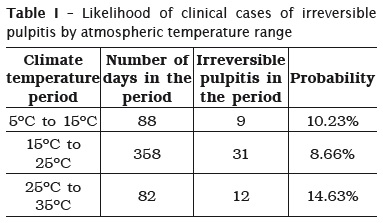
<body><![CDATA[<p><font face="Verdana, Arial, Helvetica, sans-serif" size="2">Basu and Samet <sup>6</sup> reported that thermal and humidity conditions of the atmosphere influence on the manifestation of many diseases, epidemics, and endemics. According to these researchers, human health is affected more by weather than any other element of the environment. </font></p>     <p><font face="Verdana, Arial, Helvetica, sans-serif" size="2">Auciliems <sup>2</sup> reported that combinations of low temperatures with strong winds induced a feeling of thermal discomfort and increased the risk of hypothermia (body temperature below 35&deg;C). Thus, the heart rate also tends to become lower, breathing slows down, and the blood vessels constrict, resulting in increased blood pressure. According to studies by Sharovsky et al. <sup>15</sup> and Basu <sup>5</sup>, extreme atmospheric temperatures were related to a greater number of hospitalizations and deaths among individuals with heart failure. </font></p>     <p><font face="Verdana, Arial, Helvetica, sans-serif" size="2">However, studies examining the influence of weather conditions on dental health are limited. Therefore, the current study aimed to analyze the correlation between atmospheric temperature and the occurrence of clinical cases of irreversible pulpitis in a dental care service over a period of 529 days.</font></p>     <p>&nbsp;</p>     <p><font face="Verdana, Arial, Helvetica, sans-serif" size="3"><b>Material and    methods</b></font></p>        <p><font face="Verdana, Arial, Helvetica, sans-serif" size="2">We analyzed the medical records of 52 patients presenting with irreversible pulpitis at the Department of Dentistry, Moinhos de Vento Hospital between July 21st, 2011 and December 30th, 2012. We also collected data on the average daily temperature for 529 days from the national weather service in Porto Alegre, Brazil (INMET). For analytical purposes, the temperature ranges collected from the INMET were split into periods as follows. Initially, three temperature zones were created ranging from 5&deg;C to 35&deg;C, with amplitude of 10&ordm;C. Thereafter, 22 additional groups were created with temperature ranging from 6&deg;C to 28&deg;C, with amplitude of 1&deg;C. </font></p>     <p><font face="Verdana, Arial, Helvetica, sans-serif" size="2">Study variables were analyzed using parametric Student's t-test with a significance level of 5%.</font></p>     <p>&nbsp;</p>     <p><font face="Verdana, Arial, Helvetica, sans-serif" size="3"><b>Results</b></font></p>     <p><font face="Verdana, Arial, Helvetica, sans-serif" size="2"> On examining the three temperature zones with amplitude of 10&deg;C, a greater likelihood of admission of cases of irreversible pulpitis was observed on days with average temperature higher than 25&deg;C to 35&deg;C (<a href="#tab01">table 1</a>).</font></p>     ]]></body>
<body><![CDATA[<p>&nbsp;</p>     <p><a name="tab01"></a></p>     <p>&nbsp; </p>     <p align="center"><img src="/img/revistas/rsbo/v13n1/a02tab01.jpg">     <p>&nbsp;</p>     <p><font face="Verdana, Arial, Helvetica, sans-serif" size="2"> <a href="#fig01">Figure 1</a> presents a generalized linear statistical model, represented by the line equation Y = 0.002x + 0.067. The statistical model assumes a linear trend of increased likelihood of admission of clinical cases of irreversible pulpitis (determination coefficient = 0.505). In other words, the odds of endodontic care increased with higher daily average temperatures in this study. </font></p>     <p>&nbsp;</p>     <p><a name="fig01"></a></p>     <p>&nbsp; </p>     <p align="center"><img src="/img/revistas/rsbo/v13n1/a02fig01.jpg">     ]]></body>
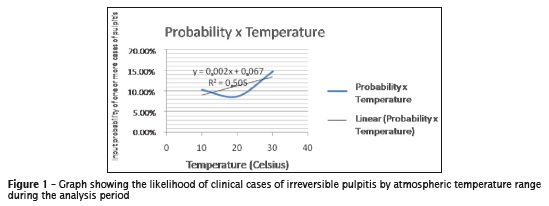
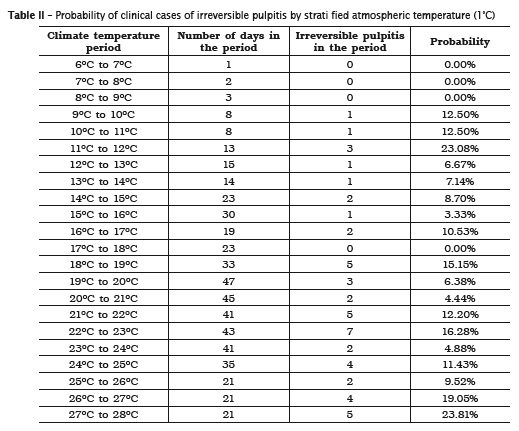
<body><![CDATA[<p>&nbsp;</p>     <p><font face="Verdana, Arial, Helvetica, sans-serif" size="2">In addition, the blue curve in <a href="#fig01">figure 1</a> shows a trend for increased likelihood of er at extremes of atmospheric temperature, which relates the probability of admission of cases of irreversible pulpitis to different daily average temperatures. </font></p>     <p><font face="Verdana, Arial, Helvetica, sans-serif" size="2">Therefore, we found it appropriate to analyze further stratified data comprising 22 temperature ranges, varying from 6&deg;C to 28&deg;C with amplitude of 1&deg;C (<a href="#tab02">table 2</a>). </font></p>     <p>&nbsp;</p>     <p><a name="tab02"></a></p>     <p>&nbsp; </p>     <p align="center"><img src="/img/revistas/rsbo/v13n1/a02tab02.jpg">     <p>&nbsp;</p>     <p><font face="Verdana, Arial, Helvetica, sans-serif" size="2">Based on the data provided in <a href="#tab02">table 2</a>, <a href="#fig02">figure 2</a> presents a generalized linear statistical model represented by the line equation Y = 0.005x + 0.010. The linear trend of increased likelihood of cases of irreversible pulpitis was seen to increase with average daily temperature (determination coefficient = 0.205). On comparing with the linear statistical model proposed in <a href="#tab01">table 1</a>, the stratification of the data decreased the strength of the model and the change in the independent variable could explain only 20.5% of the change in the dependent variable. </font></p>     <p>&nbsp;</p>     ]]></body>
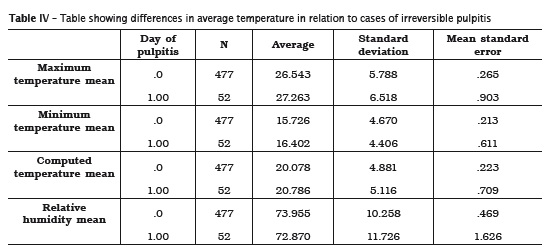
<body><![CDATA[<p><a name="fig02"></a></p>     <p>&nbsp; </p>     <p align="center"><img src="/img/revistas/rsbo/v13n1/a02fig02.jpg">    <p>&nbsp;</p>     <p><font face="Verdana, Arial, Helvetica, sans-serif" size="2">To identify the power of the sample, the average temperature was evaluated using parametric Student's t-test, and data from the days when no cases of irreversible pulpitis occurred (valid 0), days in which there was one case (valid 1), and days when there were two cases of pulpitis (valid 2) were compared. </font></p>     <p><font face="Verdana, Arial, Helvetica, sans-serif" size="2"><a href="#tab03">Table 3</a> shows the frequency observed in each situation, whereas <a href="#tab04">table 4</a> shows that the average of the variable "average temperature" on the days when there were cases of irreversible pulpitis is higher than the average on days that did not have any cases. </font></p>     <p>&nbsp;</p>     <p><a name="tab03"></a></p>     <p>&nbsp; </p>     <p align="center"><img src="/img/revistas/rsbo/v13n1/a02tab03.jpg">      ]]></body>

<body><![CDATA[<p>&nbsp;</p>     <p><a name="tab04"></a></p>     <p>&nbsp; </p>     <p align="center"><img src="/img/revistas/rsbo/v13n1/a02tab04.jpg">     <p>&nbsp;</p>     <p><font face="Verdana, Arial, Helvetica, sans-serif" size="2">However, the t-test, with a significance level of 5%, showed no statistically significant differences in the average of variables on the days with nonoccurrence of irreversible pulpitis.</font></p>     <p>&nbsp;</p>     <p><font face="Verdana, Arial, Helvetica, sans-serif" size="3"><b>Discussion</b></font></p>     <p><font face="Verdana, Arial, Helvetica, sans-serif" size="2">Ayoade supported the idea of atmospheric temperature significantly affecting the health of human beings since 1986 <sup>3</sup>. Extremes in temperature weaken the ability of the body to combat diseases and also intensify the inflammatory process <sup>3</sup>. </font></p>     <p><font face="Verdana, Arial, Helvetica, sans-serif" size="2">A drop in body temperature causes systemic changes such as vasoconstriction, increased flow density and blood pressure, modified endocrine function, and nervous system reactions <sup>8,11</sup>, thus validating further examination of this correlation with symptoms. </font></p>     ]]></body>
<body><![CDATA[<p><font face="Verdana, Arial, Helvetica, sans-serif" size="2">Porto Alegre is located in the southern region of Brazil and has a subtropical climate. Hence, the city experiences extremely rigorous winters and exhibits record maximum temperatures in summer. Extreme temperatures are also observed between autumn and spring, often resulting in abrupt changes throughout the hours <sup>14</sup>. According to the information given in the city hall, the annual average temperature in the municipality is 19.5&deg;C, ranging from 10&deg;C to 25&deg;C in autumn, 2&deg;C to 20&deg;C in winter, 15&deg;C to 30&deg;C in spring, and 25&deg;C to 35&deg;C in summer. </font></p>     <p><font face="Verdana, Arial, Helvetica, sans-serif" size="2">Thus, the results reported in this study reinforce the hypothesis of a correlation between atmospheric temperature and the occurrence of irreversible pulpitis, along with the possibility of deleterious effects on this condition in extreme temperatures. Stands out from these results, the greater likelihood of pulpitis cases at temperatures considered high, above 25&deg;C. </font></p>     <p><font face="Verdana, Arial, Helvetica, sans-serif" size="2">A study conducted in Europe showed that the largest number of urgent dental care cases occurred in the months of June, July, and August, corresponding with the European summer <sup>13</sup>. </font></p>     <p><font face="Verdana, Arial, Helvetica, sans-serif" size="2">Another explanation for this increased trend is the noxious stimulation of pulpal receivers, such as that caused by large thermal variations <sup>7</sup> resulting from increased intake of ice cream on hot days. This may have some correlation with the fact that the pulp is exposed to temperature peaks, triggering pain. However, it is noteworthy that climatic elements are not solely responsible for the development of diseases. </font></p>     <p><font face="Verdana, Arial, Helvetica, sans-serif" size="2">However, when linked to physical, psychological, and social characteristics, resulting in a further contributor to your aggravation. High blood pressure, for example, depends on several factors such as thermal amplitude resulting in vasodilatation and vasoconstriction of the circulatory system <sup>12</sup>.</font></p>     <p>&nbsp;</p>     <p><font face="Verdana, Arial, Helvetica, sans-serif" size="3"><b>Conclusion</b></font></p>     <p><font face="Verdana, Arial, Helvetica, sans-serif" size="2">Based on the results of this study, we may conclude that although there was no statistically significant correlation between the occurrence of irreversible pulpitis and atmospheric temperature, a higher incidence of pulpitis was observed on days with average temperature exceeding 25&deg;C. </font></p>     <p>&nbsp;</p>     <p><font face="Verdana, Arial, Helvetica, sans-serif" size="3"><b>References</b></font></p>     ]]></body>
<body><![CDATA[<!-- ref --><p><font face="Verdana, Arial, Helvetica, sans-serif" size="2">1. Abd-Elmeguid A, Yu DC. Dental pul p neurophysiology: part 1. Clinical and diagnostic implications. J Can Dent Assoc. 2009;75(1):55-9.    &nbsp;&nbsp;&nbsp;&nbsp;&nbsp;&nbsp;&nbsp;&nbsp;[&#160;<a href="javascript:void(0);" onclick="javascript: window.open('/scielo.php?script=sci_nlinks&ref=327597&pid=S1984-5685201600010000200001&lng=','','width=640,height=500,resizable=yes,scrollbars=1,menubar=yes,');">Links</a>&#160;]<!-- end-ref --> </font></p>     <p><font face="Verdana, Arial, Helvetica, sans-serif" size="2">2. Auliciems A. Comfort, clothing and health. In: Thompson RD, Perry A (eds.). Applied climatology, principles and practice. London / New York; 1997. </font></p>     <p><font face="Verdana, Arial, Helvetica, sans-serif" size="2">3. Ayoade JO. Introdu&ccedil;&atilde;o &agrave; climatologia para os tr&oacute;picos. 12. ed. Rio de Janeiro: Bertrand; 2007. </font></p>     <p><font face="Verdana, Arial, Helvetica, sans-serif" size="2">4. Barcellos C, Monteiro AMV, Corval&aacute;n C, Gurgel HC, Carvalho MS, Artaxo P et al. Mudan&ccedil;as clim&aacute;ticas e ambientais e as doen&ccedil;as infecciosas: cen&aacute;rios e incertezas para o Brasil. Epidemiol Serv Sa&uacute;de. 2009;18(3):285-304. </font></p>     <p><font face="Verdana, Arial, Helvetica, sans-serif" size="2">5. Basu R. High ambient temperature and mortality: a review of epidemiologic studies from 2001 to 2008. Environ Health. 2009;8:40. </font></p>     <p><font face="Verdana, Arial, Helvetica, sans-serif" size="2">6. Basu R, Samet JM. Relation between elevated ambient temperature and mortality: a review of the epidemiologic evidence. Epidemiol Rev. 2002;24(2):190-202. </font></p>     <p><font face="Verdana, Arial, Helvetica, sans-serif" size="2">7. Bell WE. Dores orofaciais: classifica&ccedil;&atilde;o, diagn&oacute;stico, tratamento. 3. ed. Rio de Janeiro: Quintessence Books; 1991. </font></p>     <p><font face="Verdana, Arial, Helvetica, sans-serif" size="2">8. Keatinge WR, Coleshaw SR, Easton JC, Cotter F, Mattock MB, Chelliah R. Increased platelet and red cell counts, blood viscosity, and plasma cholesterol levels during heat stress, and mortality from coronary and cerebral thrombosis. Am J Med. 1986;81(5):795-800. </font></p>     <p><font face="Verdana, Arial, Helvetica, sans-serif" size="2">9. K&ouml;ling A. Structural relationships in the human odontoblast layer, as demonstrated by freeze-fracture electron microscopy. J Endod. 1988;14(5):239-46. </font></p>     ]]></body>
<body><![CDATA[<p><font face="Verdana, Arial, Helvetica, sans-serif" size="2">10. Locker D, Grushka M. The impacto f dental and facial pain. J Dent Res. 1987;66(9):1414-7. </font></p>     <p><font face="Verdana, Arial, Helvetica, sans-serif" size="2">11. Lorenzo F, Sharma V, Scully M, Kakkar V. Cold adaptation and the seasonal distribution of acute myocardial infarction. QJM. 1999;92(12): 747-51. </font></p>     <p><font face="Verdana, Arial, Helvetica, sans-serif" size="2">12. Murara PG, Amorim MCCT. Clima e sa&uacute;de: varia&ccedil;&otilde;es atmosf&eacute;ricas e &oacute;bitos por doen&ccedil;as circulat&oacute;rias. RB Clima. 2010;6:79-92. </font></p>     <p><font face="Verdana, Arial, Helvetica, sans-serif" size="2">13. Plamping D, Williamson JD. A community study of nonscheduled dental appointments. Br. Dent J. 1977;142(6):197-200. </font></p>     <p><font face="Verdana, Arial, Helvetica, sans-serif" size="2">14. Prefeitura Municipal de Porto Alegre. Geografia de Porto Alegre &#91;cited 2014 Feb 20&#93;. Available from: URL:http://portoalegre-rs.com/turismo/cidade/ geografia/. </font></p>     <p><font face="Verdana, Arial, Helvetica, sans-serif" size="2">15. Sharovsky R, C&eacute;sar LA, Ramires JA. Temperature, air pollution, and mortality from myocardial infarction in S&atilde;o Paulo, Brazil. Braz J Med Biol Res. 2004;37(11):1651-7. </font></p>     <p><font face="Verdana, Arial, Helvetica, sans-serif" size="2">16. Shepherd MA, Nadanovsky P, Sheiham A. The prevalence and impact of dental pain in 8-year-old school children in Harrow, England. Br Dent J. 1999;187(1):38-41.</font></p>     <p>&nbsp;</p>     <p>&nbsp;</p>     <p><font face="Verdana, Arial, Helvetica, sans-serif" size="2"><a name="back"/></a><a href="#top"><img src="/img/revistas/rsbo/v13n1/seta.jpg" border="0" align="absmiddle"/></a>    <b>Corresponding author:</b> <br/>   Gustavo Golgo Kunert     ]]></body>
<body><![CDATA[<br>   Rua Florencio Ygartua, 271, sala 201    <br>   CEP 90430-010 &ndash; Porto Alegre &ndash; RS &ndash; Brasil     <br>   E-mail: <a href="mailto:gustavogkunert@gmail.com">gustavogkunert@gmail.com</a></font></p>      <p>&nbsp;</p>     <p>&nbsp;</p>     <p><font face="Verdana, Arial, Helvetica, sans-serif" size="2"><b>Received for    publication:</b> December 28, 2015<br/>   <b>Accepted for publication:</b> January 25, 2016</font></p>      ]]></body>
<back>
<ref-list>
<ref id="B1">
<label>1</label><nlm-citation citation-type="journal">
<person-group person-group-type="author">
<name>
<surname><![CDATA[Abd-Elmeguid]]></surname>
<given-names><![CDATA[A]]></given-names>
</name>
<name>
<surname><![CDATA[Yu]]></surname>
</name>
<name>
<surname><![CDATA[DC.]]></surname>
</name>
</person-group>
<article-title xml:lang="en"><![CDATA[Dental pul p neurophysiology: part 1. Clinical and diagnostic implications.]]></article-title>
<source><![CDATA[J Can Dent Assoc.]]></source>
<year>2009</year>
<volume>75</volume>
<numero>1</numero>
<issue>1</issue>
<page-range>55-9.</page-range></nlm-citation>
</ref>
</ref-list>
</back>
</article>