<?xml version="1.0" encoding="ISO-8859-1"?><article xmlns:mml="http://www.w3.org/1998/Math/MathML" xmlns:xlink="http://www.w3.org/1999/xlink" xmlns:xsi="http://www.w3.org/2001/XMLSchema-instance">
<front>
<journal-meta>
<journal-id>1519-4442</journal-id>
<journal-title><![CDATA[Stomatos]]></journal-title>
<abbrev-journal-title><![CDATA[Stomatos]]></abbrev-journal-title>
<issn>1519-4442</issn>
<publisher>
<publisher-name><![CDATA[ULBRA]]></publisher-name>
</publisher>
</journal-meta>
<article-meta>
<article-id>S1519-44422012000200003</article-id>
<title-group>
<article-title xml:lang="en"><![CDATA[Diagnosing and Raising Awareness about Oral and Cervicovaginal Diseases]]></article-title>
<article-title xml:lang="pt"><![CDATA[Diagnosticando e Alertando para as Enfermidades Bucais e Cérvico-Vaginais]]></article-title>
</title-group>
<contrib-group>
<contrib contrib-type="author">
<name>
<surname><![CDATA[Figueiredo]]></surname>
<given-names><![CDATA[Márcia Cançado]]></given-names>
</name>
<xref ref-type="aff" rid="A01"/>
</contrib>
<contrib contrib-type="author">
<name>
<surname><![CDATA[Marset]]></surname>
<given-names><![CDATA[Viviane Martinez]]></given-names>
</name>
<xref ref-type="aff" rid="A02"/>
</contrib>
<contrib contrib-type="author">
<name>
<surname><![CDATA[Kuroczka]]></surname>
<given-names><![CDATA[Wladimir Fabre]]></given-names>
</name>
<xref ref-type="aff" rid="A02"/>
</contrib>
<contrib contrib-type="author">
<name>
<surname><![CDATA[Silva]]></surname>
<given-names><![CDATA[Kátia Valença Correia Leandro da]]></given-names>
</name>
<xref ref-type="aff" rid="A03"/>
</contrib>
</contrib-group>
<aff id="A01">
<institution><![CDATA[,Universidade de São Paulo School of Dentistry of Bauru Odontopediatrics]]></institution>
<addr-line><![CDATA[ ]]></addr-line>
</aff>
<aff id="A02">
<institution><![CDATA[,Universidade Federal do Rio Grande do Sul School of Dentistry ]]></institution>
<addr-line><![CDATA[ ]]></addr-line>
</aff>
<aff id="A03">
<institution><![CDATA[,Universidade Federal do Rio Grande do Sul Institute of Biosciences ]]></institution>
<addr-line><![CDATA[ ]]></addr-line>
</aff>
<pub-date pub-type="pub">
<day>00</day>
<month>06</month>
<year>2012</year>
</pub-date>
<pub-date pub-type="epub">
<day>00</day>
<month>06</month>
<year>2012</year>
</pub-date>
<volume>18</volume>
<numero>34</numero>
<fpage>16</fpage>
<lpage>28</lpage>
<copyright-statement/>
<copyright-year/>
<self-uri xlink:href="http://revodonto.bvsalud.org/scielo.php?script=sci_arttext&amp;pid=S1519-44422012000200003&amp;lng=en&amp;nrm=iso"></self-uri><self-uri xlink:href="http://revodonto.bvsalud.org/scielo.php?script=sci_abstract&amp;pid=S1519-44422012000200003&amp;lng=en&amp;nrm=iso"></self-uri><self-uri xlink:href="http://revodonto.bvsalud.org/scielo.php?script=sci_pdf&amp;pid=S1519-44422012000200003&amp;lng=en&amp;nrm=iso"></self-uri><abstract abstract-type="short" xml:lang="en"><p><![CDATA[Little is known today about the possible correlations between oral and cervicovaginal diseases although some diseases affect these two regions of the human body. This study extensively investigated the pathologies caused by the Candida fungus and the herpes virus to establish the correlation between oral and cervicovaginal diseases. A questionnaire and a cytopathology test (Pap smear) were used to collect data from 118 women whose mean age was 41.51 years and who lived in the coastal city of Xangri-La, Brazil. Descriptive statistics and the Pearson correlation coefficient were used to analyze data (p=0.3 to p=0.7). The Pearson correlation coefficient showed that 16.9% of the women had oral herpes and oral candidiasis. Of the women who had oral herpes, 10% also had genital herpes, but there was no significant correlation between these diseases (&#967;2 = 0.255, p = 0.614); of those with oral candidiasis, 15% also had vaginal candidiasis, but there was also no significant correlation between these diseases (&#967;2 = 0.558, p = 0.455). After the cytopathology (Pap smear) results were reviewed, 45.8% of the women in the sample were referred to a gynecologist. Oral and cervicovaginal diseases, especially those that are sexually transmitted, have gained great importance in public health due to their growing incidence and because they affect women in all age groups. Their sequelae may be irreversible and, therefore, should be considered by dentists that treat women.]]></p></abstract>
<abstract abstract-type="short" xml:lang="pt"><p><![CDATA[Pouco se sabe hoje em dia sobre possíveis correlações entre doenças bucais e as doenças cérvico-vaginais. Pode-se afirmar, contudo, que existem doenças que atingem ambas as regiões do corpo humano. O presente estudo foi direcionado para o aprofundado das patologias geradas por fungos Candida e vírus Herpes, com o objetivo de realizar uma correlação entre a presença e ausência de enfermidades bucais e cervico-vaginais, a partir de dados obtidos através de questionário e do exame citopatológico (Papanicolau) coletado de 118 mulheres, com uma média de idade de 41,51 anos, residentes na cidade litorânea de Xangri-Lá, Rio Grande do Sul. O teste de correlação de Pearson demonstrou que 16,9% das mulheres já tiveram herpes labial e candidíase bucal, sendo as mulheres que já apresentaram herpes labial, 10% apresentaram herpes vaginal, mas o resultado não apresentou correlação signifi cativa entre estas doenças (&#967;2=0,255; p=0,614) e, das mulheres que apresentaram candidíase bucal, 15% já tiveram candidíase vaginal, mas também não se encontrou correlação significativa entre as mesmas (&#967;2=0,558; p=0,455). 45,8% das mulheres da amostra foram encaminhados para um ginecologista. As enfermidades bucais e cérvico-vaginais femininas, em especial as sexualmente transmissíveis, adquiriram uma grande importância na área de saúde pública por sua crescente incidência, e, por acometerem mulheres em todas as faixas etárias. Suas sequelas podem ser irreversíveis e, deste modo, torna-se importante à atuação do cirurgião dentista durante o atendimento a estas mulheres no sentido de dar-lhes informações mediante a estas enfermidades bucais.]]></p></abstract>
<kwd-group>
<kwd lng="en"><![CDATA[Candidiasis]]></kwd>
<kwd lng="en"><![CDATA[herpes]]></kwd>
<kwd lng="en"><![CDATA[cytopathology test]]></kwd>
<kwd lng="pt"><![CDATA[Candidíase]]></kwd>
<kwd lng="pt"><![CDATA[herpes]]></kwd>
<kwd lng="pt"><![CDATA[exame citopatológico]]></kwd>
</kwd-group>
</article-meta>
</front><body><![CDATA[ <p align="right"><font size="2" face="Verdana, Arial, Helvetica, sans-serif"><b>SCIENTIFIC ARTICLE</b></font></p>     <p>&nbsp;</p>     <p><font size="4" face="Verdana, Arial, Helvetica, sans-serif"><a name="top"></a><B>Diagnosing and Raising Awareness about Oral and Cervicovaginal Diseases</B></font></p>     <p>&nbsp;</p>     <p><font size="3" face="Verdana, Arial, Helvetica, sans-serif"><b>Diagnosticando e Alertando para as Enfermidades Bucais e C&eacute;rvico-Vaginais</b></font></p>     <p>&nbsp;</p>     <p>&nbsp;</p>     <p><font size="2" face="Verdana, Arial, Helvetica, sans-serif"><b>M&aacute;rcia Can&ccedil;ado Figueiredo<sup>1</sup>; Viviane Martinez Marset<sup>2</sup>;  Wladimir Fabre Kuroczka<sup>2</sup>; K&aacute;tia Valen&ccedil;a Correia Leandro da Silva<sup>3</sup></b></font></p>     <p><font size="2" face="Verdana, Arial, Helvetica, sans-serif"><sup>1</sup>Associate Professor, Universidade Federal do Rio Grande do Sul, Porto Alegre,   Brazil; PhD in Odontopediatrics, School of Dentistry of Bauru, Universidade de S&atilde;o Paulo (USP), Bauru, Brazil.    <br> <sup>2</sup>Undergraduate students, School of Dentistry, Universidade   Federal do Rio Grande do Sul, Porto Alegre, Brazil.    ]]></body>
<body><![CDATA[<br> <sup>3</sup>Associate Professor, Institute of Biosciences, Universidade Federal do Rio Grande do Sul, Porto Alegre, Brazil.</font></p> </font><font size="2" face="Verdana, Arial, Helvetica, sans-serif"><a href="#back">Corresponding Author:</a></font></p>     <p>&nbsp;</p>     <p>&nbsp;</p> <hr size="1" noshade>     <p><font size="2" face="Verdana, Arial, Helvetica, sans-serif"><b>ABSTRACT</b> </font></p>     <p><font size="2" face="Verdana, Arial, Helvetica, sans-serif">Little is known today about the possible correlations between oral and cervicovaginal diseases   although some diseases affect these two regions of the human body. This study extensively   investigated the pathologies caused by the Candida fungus and the herpes virus to establish the   correlation between oral and cervicovaginal diseases. A questionnaire and a cytopathology   test (Pap smear) were used to collect data from 118 women whose mean age was 41.51 years   and who lived in the coastal city of Xangri-La, Brazil. Descriptive statistics and the Pearson   correlation coefficient were used to analyze data (p=0.3 to p=0.7). The Pearson correlation   coefficient showed that 16.9% of the women had oral herpes and oral candidiasis. Of the   women who had oral herpes, 10% also had genital herpes, but there was no significant   correlation between these diseases (&chi;2 = 0.255, p = 0.614); of those with oral candidiasis, 15%   also had vaginal candidiasis, but there was also no significant correlation between these   diseases (&chi;2 = 0.558, p = 0.455). After the cytopathology (Pap smear) results were   reviewed, 45.8% of the women in the sample were referred to a gynecologist. Oral and   cervicovaginal diseases, especially those that are sexually transmitted, have gained great   importance in public health due to their growing incidence and because they affect women   in all age groups. Their sequelae may be irreversible and, therefore, should be considered by dentists that treat women.</font></p>     <p><font size="2" face="Verdana, Arial, Helvetica, sans-serif"><B>Keywords: </B>Candidiasis, herpes, cytopathology test.</font></p> <hr size="1" noshade>     <p><font size="2" face="Verdana, Arial, Helvetica, sans-serif"><B>RESUMO</B> </font></p>     <p><font size="2" face="Verdana, Arial, Helvetica, sans-serif">Pouco se sabe hoje em dia sobre poss&iacute;veis correla&ccedil;&otilde;es entre doen&ccedil;as bucais e as doen&ccedil;as c&eacute;rvico-vaginais. Pode-se afirmar, contudo, que existem doen&ccedil;as que atingem ambas as regi&otilde;es do corpo humano. O presente estudo foi direcionado para o aprofundado das patologias geradas por fungos <i>Candida</i> e v&iacute;rus Herpes, com o objetivo de realizar uma correla&ccedil;&atilde;o entre a presen&ccedil;a e aus&ecirc;ncia de enfermidades bucais e cervico-vaginais, a partir de dados obtidos atrav&eacute;s de question&aacute;rio e do exame citopatol&oacute;gico (Papanicolau) coletado de 118 mulheres, com uma m&eacute;dia de idade de 41,51 anos, residentes na cidade litor&acirc;nea de Xangri-L&aacute;, Rio Grande do Sul. O teste de correla&ccedil;&atilde;o de Pearson demonstrou que 16,9% das mulheres j&aacute; tiveram herpes labial e candid&iacute;ase bucal, sendo as mulheres que j&aacute; apresentaram herpes labial, 10% apresentaram herpes vaginal, mas o resultado n&atilde;o apresentou correla&ccedil;&atilde;o signifi cativa entre estas doen&ccedil;as (&chi;2=0,255; p=0,614) e, das mulheres que apresentaram candid&iacute;ase bucal, 15% j&aacute; tiveram candid&iacute;ase vaginal, mas tamb&eacute;m n&atilde;o se encontrou correla&ccedil;&atilde;o significativa entre as mesmas (&chi;2=0,558; p=0,455). 45,8% das mulheres da amostra foram encaminhados para um ginecologista. As enfermidades bucais e c&eacute;rvico-vaginais femininas, em especial as sexualmente transmiss&iacute;veis, adquiriram uma grande import&acirc;ncia na &aacute;rea de sa&uacute;de p&uacute;blica por sua crescente incid&ecirc;ncia, e, por acometerem mulheres em todas as faixas et&aacute;rias. Suas sequelas podem ser irrevers&iacute;veis e, deste modo, torna-se importante &agrave; atua&ccedil;&atilde;o do cirurgi&atilde;o dentista durante o atendimento a estas mulheres no sentido de dar-lhes informa&ccedil;&otilde;es mediante a estas enfermidades bucais.</font></p>     <p><font size="2" face="Verdana, Arial, Helvetica, sans-serif"><B>Palavras-chave: </B>Candid&iacute;ase, herpes, exame citopatol&oacute;gico.</font></p> <hr noshade size="1">     <p>&nbsp;</p>     ]]></body>
<body><![CDATA[<p>&nbsp;</p>     <p><font size="3" face="Verdana, Arial, Helvetica, sans-serif"><B>INTRODUCTION</B></font></p>     <p><font size="2" face="Verdana, Arial, Helvetica, sans-serif"><i>Candida albicans</i> is, undoubtedly, the most frequent species isolated in superficial   and invasive infections in different anatomic sites and in patients all over the world.   They form a group of 602 types of yeast that have a well-known pathological potential.   Their main pathogenic and virulent factors are their capacity to adhere to different types   of mucosa and epithelial tissues, their dimorphism and the production of filamentous   structures that support tissue invasion, their significant thermal tolerance, and the   production of enzymes, such as proteinases and phospholipases.<sup>1</sup> Candida may be   a normal component of the oral microflora and not cause inflammation. Its incidence   increases in the oral microflora with age, and is more often found in the elderly than in younger individuals.<sup>2</sup></font></p>     <p><font size="2" face="Verdana, Arial, Helvetica, sans-serif">Oral herpes disseminates by means of intact particles of the virus in saliva in about   2% to 10% of all healthy adults without the clinical disease. The risk of infection from   individuals that have the microorganism to other individuals has not been assessed, but   is it likely to be low and dependent on the number of virus particles and susceptibility   of the host.<sup>3</sup></font></p>     <p><font size="2" face="Verdana, Arial, Helvetica, sans-serif">Most individuals (up to 90%) have antibodies against the herpes simplex virus   (HSV), and about 40% of these individuals may develop secondary herpes. In Brazil, oral   herpes affects 85% of the population, symptoms are seen in 50% of those infected with   the virus every years, and about 5% to 10% have more than six recurrences per year.<sup>3</sup> Human beings are the only natural reservoirs, and all HSV are capable of living during   their whole life in infected hosts.<sup>2</sup></font></p>     <p><font size="2" face="Verdana, Arial, Helvetica, sans-serif">Low socioeconomic and cultural conditions are correlated with early exposure   to HSV. Currently, the prevalence of contaminated individuals is greater in developing   than in developed countries. This incidence increases with age in both types of countries.<sup>2</sup></font></p>     <p><font size="2" face="Verdana, Arial, Helvetica, sans-serif">Vulvovaginitis may be caused by bacteria, fungus, protozoa, or even a   noninfectious cause.<sup>4</sup> According to Oliveira et al.<sup>5</sup>, cytopathology tests, also   known as Pap smears, are internationally accepted as the most appropriate and least   expensive instrument to screen changes in cervical cells. The Unified Healthcare System   in Brazil (SUS) provides this test as a screening procedure for all Brazilian women   registered in the system.<sup>6</sup></font></p>     <p><font size="2" face="Verdana, Arial, Helvetica, sans-serif">There are other risk factors for the development of cervical cancer: genetic   predisposition, early onset of sexual activity, multiple sex partners, malnutrition,   smoking and infection by the human papilloma virus (HPV).<sup>7</sup></font></p>     <p><font size="2" face="Verdana, Arial, Helvetica, sans-serif">HPV, the name assigned to a group of over 100 types of viruses, is etiologically   important in the onset of cervical cancer.<sup>5</sup> HPV infection is transmitted sexually<sup>8</sup>, and Brazil is one of the countries with the highest HPV incidence, and 50% to   80% of all sexually active women will be infected by one or more types of HPV at   some time in their lives.<sup>9</sup> In Brazil, cervical cancer is the cause of death of 10 to   12 women per day. In the state of Rio Grande do Sul, 4 women are diagnosed with   this type of cancer every day.<sup>10</sup></font></p>     <p><font size="2" face="Verdana, Arial, Helvetica, sans-serif">In contrast, some factors associated with vaginal herpes are also associated with   cervical cancer, such as early initiation of sex activities, early pregnancy, multiparity,   personal or the partner&rsquo;s promiscuity, viral infections by HPV types 16, 18, 31 or 33,   by HSV-2 and by cytomegalovirus, smoking, immune deficiency, use of contraception,   ionizing radiation and vitamin A and C deficiencies.<sup>11</sup></font></p>     ]]></body>
<body><![CDATA[<p><font size="2" face="Verdana, Arial, Helvetica, sans-serif">Studies in the literature confirmed that there is a direct association between these   diseases. HSV-1 disseminates predominantly by means of infected saliva or active   perioral lesions. HSV-2 adapts better to the genital region, is transmitted predominantly   by means of sexual contact and is characterized by the involvement of the genitals   and the skin below the waist. There may be exceptions to these characteristics, and   HSV-1 may have a pattern similar to that of the HSV-2, and vice-versa. Clinical   lesions and tissue changes due to the two HSV types are identical.<sup>2</sup></font></p>     <p><font size="2" face="Verdana, Arial, Helvetica, sans-serif">Most of the oral herpes correlations are assigned to HSV-1, although a small   percentage may be caused by the HSV-2 as a result of orogenital contact. Previous   infection by HSV-1 may provide some protection against infection by HSV-2 due to   antibody cross-reactivity.<sup>3</sup></font></p>     <p><font size="2" face="Verdana, Arial, Helvetica, sans-serif">In contrast, patients with a clinical diagnosis of vulvovaginal candidiasis present   with greater quantities of Candida albicans, both in the vagina and the oral cavity,   and have lower levels of anti-Candida IgA antibodies in saliva.<sup>12</sup></font></p>     <p><font size="2" face="Verdana, Arial, Helvetica, sans-serif">This study established the correlation between presence and absence of oral   and cervicovaginal disease according to data collected using a questionnaire and   the cytopathological test (Pap smear) of 118 women residing in the coastal city of Xangri-La, in the state of Rio Grande do Sul, Brazil.</font></p>     <p>&nbsp;</p>     <p><font size="3" face="Verdana, Arial, Helvetica, sans-serif"><B>METHODOLOGY</B></font></p>     <p><font size="2" face="Verdana, Arial, Helvetica, sans-serif">This study was approved by the Ethics in Research Committee of the city   government of Porto Alegre, Brazil, registered under CEP 557 number 001.048.151.10.6   on October 10, 2010, and conducted in the Guar&aacute; Basic Healthcare Unit (UBS Guar&aacute;)   in the city of Xangri-L&aacute;, Brazil, where cervical cancer screening is provided for women living in the region.</font></p>     <p><font size="2" face="Verdana, Arial, Helvetica, sans-serif">One hundred and fifty women were invited to participate in the study, and 118   accepted to be interviewed in a room assigned for that purpose before they underwent   cervical cancer screening and collection of vaginal secretion samples in the UBS   Guar&aacute;.</font></p>     <p><font size="2" face="Verdana, Arial, Helvetica, sans-serif">Data about oral and cervicovaginal diseases were collected using a semistructured   questionnaire, a type of instrument to facilitate the communication   between researchers that aim to collect information about a certain phenomenon and   individuals that have this information and may convey it.<sup>13</sup> A structured form with   25 closed items was used for that. Each item approached one topic about women&rsquo;s   health: menstruation, hormone replacement, sexual activity, childbirth, gestations,   contraception, sex partners, chronic diseases, breast self-exam, mammogram, pap   smear, cervical diseases and oral health, which included oral lesions, oral herpes and   oral candidiasis (<a href="#fig01">Figure 1</a>).</font></p>     <p>&nbsp;</p>     ]]></body>
<body><![CDATA[<p><a name="fig01"></a></p>     <p>&nbsp;</p>     <p align="center"><img src="/img/revistas/sto/v18n34/a03fig01.jpg">     <p>&nbsp;</p>     <p><font size="2" face="Verdana, Arial, Helvetica, sans-serif">All women that accepted to participate in the study were informed about the   protocol and signed an informed consent term before the interview and the collection of the sample for analysis.</font></p>     <p><font size="2" face="Verdana, Arial, Helvetica, sans-serif">The collection of vaginal secretion took a few minutes and was performed in the   office of the UBS Guar&aacute; gynecologist by only one nurse trained for that. Each sample   was handled as usual in the Xangri-L&aacute; healthcare service. The samples were:</font></p>     <p><font size="2" face="Verdana, Arial, Helvetica, sans-serif">a) fixed and correctly labeled by the nurse in charge;</font></p>     <p><font size="2" face="Verdana, Arial, Helvetica, sans-serif">b) sent to the clinical laboratory authorized by the SUS to perform Pap staining   and cytopathological (CP) examination;</font></p>     <p><font size="2" face="Verdana, Arial, Helvetica, sans-serif">c) Results were printed and sent to the UBS Guar&aacute; 15 days after the examination   was performed.</font></p>     <p><font size="2" face="Verdana, Arial, Helvetica, sans-serif">Data about the epidemiological profile and the Pap smear were recorded and stored   in a Microsoft Office Excel 2010 database for later analysis using descriptive statistics   and the Pearson correlation coefficient (p=0.3 to p=0.7).</font></p>     ]]></body>
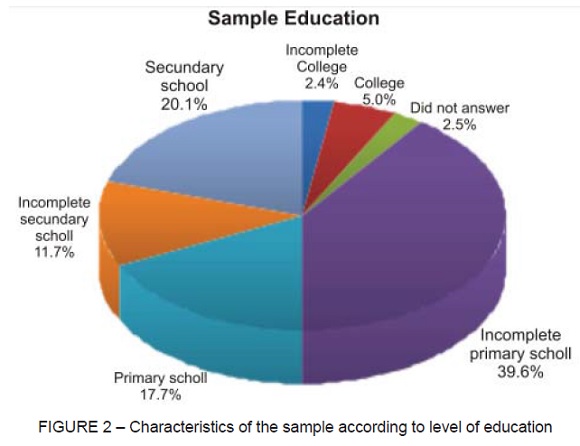
<body><![CDATA[<p>&nbsp;</p>     <p><font size="3" face="Verdana, Arial, Helvetica, sans-serif"><B>RESULTS</B></font></p>     <p><font size="2" face="Verdana, Arial, Helvetica, sans-serif">This study enrolled a final sample of 118 women that were examined and interviewed. Their ages ranged from 16 to 79 years, and mean age was 41.51 years.</font></p>     <p><font size="2" face="Verdana, Arial, Helvetica, sans-serif">The interviews provided information about the socioeconomic, cultural and health   status of the women in the sample and revealed that 29.5% were housewives (n=35) and   22%, janitors (n=26). Most women (39.6%) had not finished primary school (n=47),   20.1% finished secondary school (n=24), 17.7% (n=21) finished only primary school,   11.7% did not finish high school, 5% (n=6) had a college education, 2.4% (n=3) did not   finish college, and 2.5% (n=3) did not answer (<a href="#fig02">Figure 2</a>).</font></p>     <p>&nbsp;</p>     <p><a name="fig02"></a></p>     <p>&nbsp;</p>     <p align="center"><img src="/img/revistas/sto/v18n34/a03fig02.jpg">     <p>&nbsp;</p>     <p><font size="2" face="Verdana, Arial, Helvetica, sans-serif">When asked about their marital status, 62.7% (n=74) reported being married or   having a regular partner for at least one year and 22.8% (n=27), single or having a   partner for less than one year. The other results were divided into divorced, separated   and widowed. Their religion was Catholic for 75.4% (n=89), and their self-reported skin   color was white for 91.5% (n=108). Most (36.3%, n=43) had a family per capita income   of two to three minimum wages according to the current value of the minimum wage in the state of Rio Grande do Sul, defined by Law 13.715, passed on April 13, 2011.</font></p>     ]]></body>
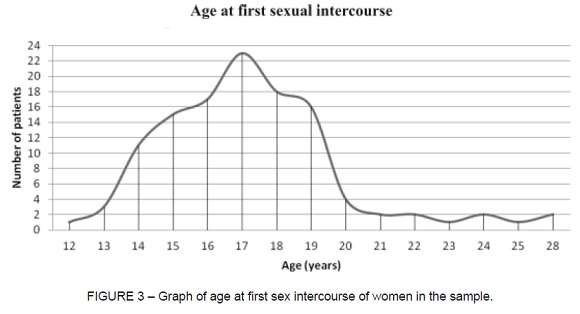
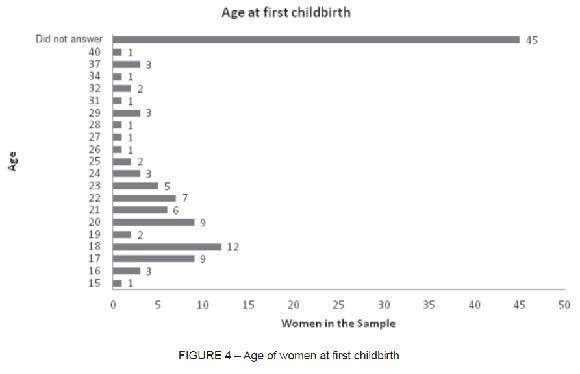
<body><![CDATA[<p><font size="2" face="Verdana, Arial, Helvetica, sans-serif">The analysis of data about health and self-care revealed that 61.9% (n=73) still   menstruate and 95.8% (n=113) never received hormone replacement. Their age at first   sexual intercourse ranged from 12 to 28 years and mean age was 17.2 years (<a href="#fig03">Figure 3</a>); 10.2% (n=12) had the first child at 18 years, but 37.3% (n=44) did not answer this   questions (<a href="#fig04">Figure 4</a>); 28% (n=33) had two pregnancies, and mean number of pregnancies   ranged from zero to eight, but 12.7% (n=15) did not answer this question; 50.9% of the   sample reported not using any contraceptive method, whereas 45.8% did, and 3.3% did   not answer the question; 36.4% (n=43) had only one sex partner along their lives, and   number of partners ranged from zero (2.5%) to 18 (0.8%) in all the sample.</font></p>     <p>&nbsp;</p>     <p><a name="fig03"></a></p>     <p>&nbsp;</p>     <p align="center"><img src="/img/revistas/sto/v18n34/a03fig03.jpg">     <p>&nbsp;</p>     <p><font size="2" face="Verdana, Arial, Helvetica, sans-serif">Data also showed that 19.5% of the women smoked, 58.5% did not practice physical   exercises, 71.2% never had any chronic diseases, and of those that had chronic diseases,   12.7% had only one chronic disease, a percentage that reached 0.8% for 3 chronic diseases according to self-report.</font></p>     <p><font size="2" face="Verdana, Arial, Helvetica, sans-serif">When asked to evaluate their health, 55.9% said they had good health according to   the choices of excellent, very good, good, average, poor and very poor, described here   in decreasing order of quality.</font></p>     <p><font size="2" face="Verdana, Arial, Helvetica, sans-serif">When asked about whether they performed breast self-exam, 57.8% answered yes   and 46.6% had performed it in the previous month. About 62.7% had already undergone cervical cancer screening before, and 28.8% of them had it up to one year ago, and 19.4%,   to 3 years ago. In the sample, 89.6% of the women believed that this screening test was   a form of prevention, when choosing from prevention, treatment or duty.</font></p>     <p>&nbsp;</p>     ]]></body>
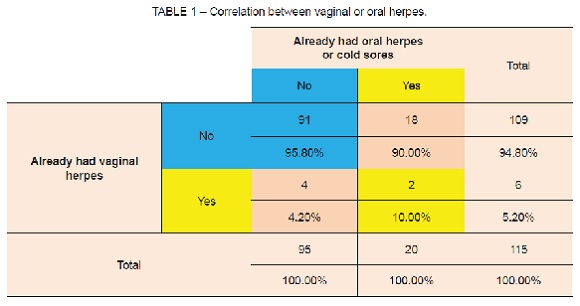
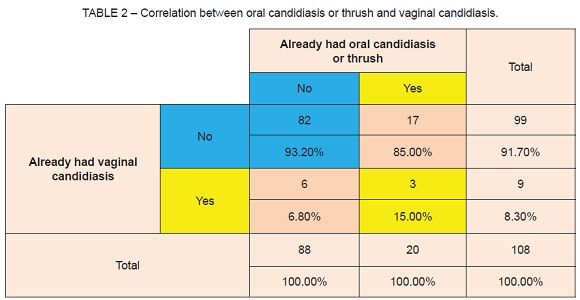
<body><![CDATA[<p><a name="fig04"></a></p>     <p>&nbsp;</p>     <p align="center"><img src="/img/revistas/sto/v18n34/a03fig04.jpg">     <p>&nbsp;</p>     <p><font size="2" face="Verdana, Arial, Helvetica, sans-serif">The analysis of oral diseases revealed that 29.7% (n=35) reported having had some   type of oral lesion, of whom 16.9% (n=20) already had oral herpes and 8.5% (n=10) had   it since childhood. For 6.7% (n=8), the frequency of herpes recurrence in the current year   was 2 times; 16.9% (n-20) of the women also reported already having had oral candidiasis   or thrush, and 11% (n=13) had it during childhood; 59.3% (n=70) reported having these diseases because of their weakened immunity.</font></p>     <p><font size="2" face="Verdana, Arial, Helvetica, sans-serif">When asked about whether they had already had HPV, syphilis, candidiasis, genital   herpes, AIDS/HIV, gonorrhea or Chlamydia infection and whether they had undergone   treatment, we found that 5.1% (n=6) had genital herpes and received treatment, 9.3%   (n=11) had candidiasis and received treatment and 5.1% (n=6) had Chlamydia infection   and received treatment.</font></p>     <p><font size="2" face="Verdana, Arial, Helvetica, sans-serif">The cytopathological test revealed that 51.6% (n=61) of the samples examined were   within normal limits and 36.4% (n=43) had inflammation. Vaginal Candida was found   in 1.7% (n=2) of the test samples.</font></p>     <p><font size="2" face="Verdana, Arial, Helvetica, sans-serif">After the results of cytopathological tests were reviewed, 45.8% (n=54) of the   women were referred to a gynecologist.</font></p>     <p><font size="2" face="Verdana, Arial, Helvetica, sans-serif">Statistical analysis showed that of the women that never had oral herpes or cold   sores, 4.2% (n=4) had already had vaginal herpes, and of the women that had oral herpes, 10% (n=2) had vaginal herpes, with no significant correlation between diseases (&chi;2=0.255;   p=0.614), as shown in <a href="#tab01">Table 1</a>. Of the women that had never had oral candidiasis or thrush,   6.8% (n=6) had already had vaginal candidiasis, and of the women that had had oral   candidiasis or thrush, 15% (n=3) had already had vaginal candidiasis, with no significant   correlation between the diseases (&chi;2=0.558; p=0.455), as shown in <a href="#tab02">Table 2</a>.</font></p>     <p>&nbsp;</p>     ]]></body>
<body><![CDATA[<p><a name="tab01"></a></p>     <p>&nbsp;</p>     <p align="center"><img src="/img/revistas/sto/v18n34/a03tab01.jpg">     <p>&nbsp;</p>     <p><a name="tab02"></a></p>     <p>&nbsp;</p>     <p align="center"><img src="/img/revistas/sto/v18n34/a03tab02.jpg">     <p>&nbsp;</p>     <p><font size="3" face="Verdana, Arial, Helvetica, sans-serif"><B>DISCUSSION</B></font></p>     <p><font size="2" face="Verdana, Arial, Helvetica, sans-serif">A large number of vulvovaginites are seen in clinical medicine. They are one of the   main reasons for a woman to seek a gynecologist or obstetrician. They may be caused by bacteria, fungi, protozoa or even noninfectious causes. The main infectious agents are Candida albicans, Gardnerella vaginalis and Trichomonas vaginalis. However, only in the last years has Candida albicans been diagnosed in the same group, and there has been a significant increase of the number of cases elucidated recently.<sup>4</sup> These three agents were the most representative microorganisms found in our sample, in about 12.5% of the patients, which is in agreement with numbers in the literature. However, Gardnerella vaginalis was the most frequent agent, found in 9.3% of the cases, in agreement with findings reported by Ribeiro et al.<sup>6</sup>, who found that the total prevalence of infection by Gardnerella vaginalis, Candida albicans and Trichomonas vaginalis were 20%, 8% and 2%.</font></p>     ]]></body>
<body><![CDATA[<p><font size="2" face="Verdana, Arial, Helvetica, sans-serif">Factors in the life style of women may favor the appearance of infectious   cervicovaginal lesions, such as underwear made of synthetic fabrics, inadequate hygiene   habits, oral contraceptives, pregnancy, positive HIV and HPV and infections, particularly   by Candida albicans. In our study, 45.8% of the women reported using contraception, but only 4.2% had vaginal herpes and 6.8%, candidiasis.</font></p>     <p><font size="2" face="Verdana, Arial, Helvetica, sans-serif">Female sex hormones stimulate the production of lactobacilli that produce lactic   acid in the normal vaginal microbiota, which results in an acid pH in the vagina and   prevents the proliferation of most pathogens. However, yeasts are an exception because   they can proliferate extensively in environments with an acid pH.<sup>15</sup> Only 3.4% of the   patients received hormone replacement, which was a risk factor of little relevance in our sample.</font></p>     <p><font size="2" face="Verdana, Arial, Helvetica, sans-serif">In the premenstrual period, there is an elevation in the production of female   hormones, particularly progesterone, which increases the availability of glycogen in the   vaginal region. This environment is favorable for the development of candidiasis because   there is an increase of the nutritive substrate for yeasts, which will function as an excellent   source of carbon for growth and gemination. Therefore, vaginal candidiasis is associated   with regular menstrual cycles.<sup>16-17</sup> As 73% of the women still menstruated, this might have been a factor that influenced its development in our sample.</font></p>     <p><font size="2" face="Verdana, Arial, Helvetica, sans-serif">Yeasts such as Candida albicans are found in the oral cavity of 3% to 48% of all   adults and 45% to 65% of all healthy children.<sup>18</sup> Of our sample, 98.4% of the participants   were adults, and 16.9% reported already having had some pathological episode of oral   candidiasis or thrush, which does not mean that the microflora in the other patients may   have Candida. In different types of mucosa of healthy individuals, yeasts of the Candida albicans genus are found as part of the microbiota and do not trigger infection.</font></p>     <p><font size="2" face="Verdana, Arial, Helvetica, sans-serif">Neville et al.<sup>2</sup> reported that the incidence of Candida albicans increases with age,   and its presence in the oral cavity may reach 60% among dentate patients older than 60   years who have no signs of lesions in the oral mucosa. Similarly, in our study 6.4% were   60 years or older, and 25% of them reported already having had at least one episode of   oral candidiasis. Candida albicans may be found in the oral mucosa of 25% to 75% of   healthy individuals. This variation is assigned to population sample size and the sensitivity of the method used to collect and retrieve these microorganisms.<sup>19-20</sup></font></p>     <p><font size="2" face="Verdana, Arial, Helvetica, sans-serif">In the analysis of clinical diagnoses of vulvovaginal candidiasis, Silva et al.<sup>12</sup>   reported that women have greater colonization by Candida albicans, both in the vagina and the oral cavity, and lower levels of anti-Candida IgA antibodies in saliva. Of the women   that had already had oral candidiasis, 15% had also had vaginal candidiasis. Although   there was no statistically significant correlation between them, these women had both   oral and vaginal candidiasis due to different etiological agents, but they should always be instructed to keep good hygiene habits.</font></p>     <p><font size="2" face="Verdana, Arial, Helvetica, sans-serif">Of all women, 16% already had at least one episode of oral herpes in their lives   and, according to Regenzi et al.<sup>3</sup>, most individuals (up to 90%) have antibodies against HSV, and about 40% of these individuals may develop secondary herpes.</font></p>     <p><font size="2" face="Verdana, Arial, Helvetica, sans-serif">Low socioeconomic and cultural conditions are correlated with early exposure   to HSV-1. In developing countries, over 50%of the population are exposed at 5 years,   95% at 15 years, and practically 100% at about 30 years of age.<sup>2</sup> Data collected in   our study showed that women had a low socioeconomic status, as 39.6% had not even   finished primary school, 62.3% had a monthly income of up to three minimum wages   only, and 68.6% had more than two children. However, they did not have an elevated   rate of oral and cervicovaginal diseases, which may be justified by the small sample   size or the little education of the participants, who did not know how to differentiate   oral candidiasis and herpes because they did not know what the characteristics of these two diseases were.</font></p>     <p><font size="2" face="Verdana, Arial, Helvetica, sans-serif">HSV-1 disseminates predominantly by means of infected saliva or active perioral   lesions. HSV-2 adapts better to the genital region, is transmitted predominantly by means   of sexual contact and is characterized by the involvement of the genitals and the skin   below the waist. There may be exceptions to these characteristics, and the HSV-1 may   have a pattern similar to that of the HSV-2, or vice-versa. Clinical lesions and tissue   changes due to the two types of virus are identical.<sup>2</sup> In our study, no correlation was   found between oral and vaginal herpes because of the small number of patients with   the diseases under study. Only 16.9% of the women reported already having had oral   herpes, and only 6% had already had vaginal herpes. A larger convenience sample only   with patients that had one of the two diseases would be necessary to establish a better correlation between vaginal and oral herpes.</font></p>     <p><font size="2" face="Verdana, Arial, Helvetica, sans-serif">Most of the oral herpes correlations are assigned to HSV-1, although a small   percentage may be caused by the HSV-2 as a result of orogenital contact. Previous infection by HSV-1 may provide some protection against infection by HSV-2 due to antibody crossreactivity.<sup>3</sup> Of the patients with this oral disease, 10% had vaginal herpes.</font></p>     ]]></body>
<body><![CDATA[<p><font size="2" face="Verdana, Arial, Helvetica, sans-serif">In conclusion, oral and cervicovaginal diseases in women, particularly those   sexually transmitted, are important in public health because of their growing incidence   and because they affect women in all age groups. Sequelae may be irreversible and,   therefore, dentists should be among the first to provide healthcare to these women and   to provide information about oral diseases found during consultation before sample   collection. In this study, 15% of these women needed coherent and relevant information   adapted to their level of knowledge. The instructions provided by dentists should not be   a regressive measure of social control, but, rather, an instrument to enable these women   to understand and perceive their own reality.</font></p>     <p><font size="2" face="Verdana, Arial, Helvetica, sans-serif">Therefore, dentistry should act in favor of women&rsquo;s health in prevention, education   and healing, providing humanitarian support, and also promoting the qualification and training of a larger number of professionals that are prepared to understand women&rsquo;s needs.</font></p>     <p>&nbsp;</p>     <p><font size="3" face="Verdana, Arial, Helvetica, sans-serif"><B>CONCLUSION</B></font></p>     <p><font size="2" face="Verdana, Arial, Helvetica, sans-serif">No significant correlation was found between cervicovaginal and oral diseases in   this study. The small sample size may explain this conclusion, and future studies should enroll more female participants with a history of having the diseases under study.</font></p>     <p>&nbsp;</p>     <p><font size="3" face="Verdana, Arial, Helvetica, sans-serif"><B>ACKNOWLEDGEMENTS</B></font></p>     <p><font size="2" face="Verdana, Arial, Helvetica, sans-serif">The authors thank the collaboration of the Department of Health of the city of   Xangri-L&aacute;, in the state of Rio Grande do Sul, Brazil, and especially Rosana Fraga, the nurse responsible for the performance of cytopathological tests (Pap smears) in that city.</font></p>     <p>&nbsp;</p>     <p>&nbsp;</p>     ]]></body>
<body><![CDATA[<p><font size="3" face="Verdana, Arial, Helvetica, sans-serif"><B>REFERENCES</B></font></p>     <!-- ref --><p><font size="2" face="Verdana, Arial, Helvetica, sans-serif">1. Dignani MC, Solomkin JS, Anaissie E. Candida. In: Anaissie E, McGinnis MR, Pfaller MA. Medical Mycology. Filad&eacute;lfia: Livingstone; 2003. P. 195-239.    &nbsp;&nbsp;&nbsp;&nbsp;&nbsp;&nbsp;&nbsp;&nbsp;[&#160;<a href="javascript:void(0);" onclick="javascript: window.open('/scielo.php?script=sci_nlinks&ref=489085&pid=S1519-4442201200020000300001&lng=','','width=640,height=500,resizable=yes,scrollbars=1,menubar=yes,');">Links</a>&#160;]<!-- end-ref --></font></p>     <!-- ref --><p><font size="2" face="Verdana, Arial, Helvetica, sans-serif">2. Neville BW, Damm DD, Allen CM, Bouquot JE. Patologia Oral &amp; Maxilo Facial. 2&ordf;  ed. Rio de Janeiro: Guanabara Koogan; 2004. 972p.    &nbsp;&nbsp;&nbsp;&nbsp;&nbsp;&nbsp;&nbsp;&nbsp;[&#160;<a href="javascript:void(0);" onclick="javascript: window.open('/scielo.php?script=sci_nlinks&ref=489087&pid=S1519-4442201200020000300002&lng=','','width=640,height=500,resizable=yes,scrollbars=1,menubar=yes,');">Links</a>&#160;]<!-- end-ref --></font></p>     <p><font size="2" face="Verdana, Arial, Helvetica, sans-serif">3. Regenzi JA, Sciubba JJ, Jordan R. Patologia oral &ndash; correla&ccedil;&otilde;es clinicopatol&oacute;gicas. 5&ordf;  ed. Rio de Janeiro: Elsevier; 2008. 512p.</font></p>     <p><font size="2" face="Verdana, Arial, Helvetica, sans-serif">4. Zhou X, Westman R, Hickey R, Hansmann MA, Kennedy C, Osborn TW, Forney LJ.   Vaginal microbiota of women with frequent vulvovaginal candidiasis. Infect. Immun. 2009;77:4130&ndash;35.</font></p>     <!-- ref --><p><font size="2" face="Verdana, Arial, Helvetica, sans-serif">5. De Oliveira, MM , Da Silva ENF, Pinto IC, Coimbra VCC. C&acirc;ncer c&eacute;rvico uterino: um   olhar cr&iacute;tico sobre a preven&ccedil;&atilde;o. Revista Ga&uacute;cha Enferm. 2004;25(2):176-83.    &nbsp;&nbsp;&nbsp;&nbsp;&nbsp;&nbsp;&nbsp;&nbsp;[&#160;<a href="javascript:void(0);" onclick="javascript: window.open('/scielo.php?script=sci_nlinks&ref=489091&pid=S1519-4442201200020000300005&lng=','','width=640,height=500,resizable=yes,scrollbars=1,menubar=yes,');">Links</a>&#160;]<!-- end-ref --></font></p>     <!-- ref --><p><font size="2" face="Verdana, Arial, Helvetica, sans-serif">6. Ribeiro LP, Maradei CM, Da Silva CL, Tombolato RM, Vieira EM. Preven&ccedil;&atilde;o do   c&acirc;ncer de colo uterino em uma &aacute;rea do programa de sa&uacute;de da fam&iacute;lia em Ribeir&atilde;o Preto.   Revista de APS. 2004;7(2):91-95.    &nbsp;&nbsp;&nbsp;&nbsp;&nbsp;&nbsp;&nbsp;&nbsp;[&#160;<a href="javascript:void(0);" onclick="javascript: window.open('/scielo.php?script=sci_nlinks&ref=489093&pid=S1519-4442201200020000300006&lng=','','width=640,height=500,resizable=yes,scrollbars=1,menubar=yes,');">Links</a>&#160;]<!-- end-ref --></font></p>     <!-- ref --><p><font size="2" face="Verdana, Arial, Helvetica, sans-serif">7. Greenwood SA, Machado MFAS, Sampaio NMV. Motivos que levam mulheres a   n&atilde;o retornarem para receber o resultado do exame papanicolau. Rev Latino-am Enferm.   2006;14(4):503-9.    &nbsp;&nbsp;&nbsp;&nbsp;&nbsp;&nbsp;&nbsp;&nbsp;[&#160;<a href="javascript:void(0);" onclick="javascript: window.open('/scielo.php?script=sci_nlinks&ref=489095&pid=S1519-4442201200020000300007&lng=','','width=640,height=500,resizable=yes,scrollbars=1,menubar=yes,');">Links</a>&#160;]<!-- end-ref --></font></p>     <p><font size="2" face="Verdana, Arial, Helvetica, sans-serif">8. Smeltzer SC, Bare BG. Brunner &amp; Suddarth &ndash; Tratado de enfermagem m&eacute;dico-cir&uacute;rgica.   10&ordf; ed. Rio de Janeiro: Guanabara Koogan; 2005. 5573p.</font></p>     <p><font size="2" face="Verdana, Arial, Helvetica, sans-serif">9. INCA. Estimativa 2008 &ndash; Incid&ecirc;ncia de c&acirc;ncer no Brasil. INCA &#91;internet&#93;. 2007   &#91;Citado em dezembro de 2011&#93;;1:1-96. Dispon&iacute;vel em www.inca.gov.br/estimativa/2008/ versaofinal.pdf.</font></p>     <!-- ref --><p><font size="2" face="Verdana, Arial, Helvetica, sans-serif">10. INCOLO. Instituto de preven&ccedil;&atilde;o do c&acirc;ncer do colo do &uacute;tero. Porto Alegre: Instituto   de preven&ccedil;&atilde;o do c&acirc;ncer do colo do &uacute;tero; &#91;atualizada em 2010; acessado em 15 setembro 2009&#93;. Dispon&iacute;vel em: www.incolo.com.br/index.php?option=com_content&amp;task=view  &amp;id=91&amp;Itemid=1.    &nbsp;&nbsp;&nbsp;&nbsp;&nbsp;&nbsp;&nbsp;&nbsp;[&#160;<a href="javascript:void(0);" onclick="javascript: window.open('/scielo.php?script=sci_nlinks&ref=489099&pid=S1519-4442201200020000300010&lng=','','width=640,height=500,resizable=yes,scrollbars=1,menubar=yes,');">Links</a>&#160;]<!-- end-ref --></font></p>     <!-- ref --><p><font size="2" face="Verdana, Arial, Helvetica, sans-serif">11. Halbe HW. Tratado de ginecologia. 3&ordf; ed. S&atilde;o Paulo: Roca; 2000. 1118p.    &nbsp;&nbsp;&nbsp;&nbsp;&nbsp;&nbsp;&nbsp;&nbsp;[&#160;<a href="javascript:void(0);" onclick="javascript: window.open('/scielo.php?script=sci_nlinks&ref=489101&pid=S1519-4442201200020000300011&lng=','','width=640,height=500,resizable=yes,scrollbars=1,menubar=yes,');">Links</a>&#160;]<!-- end-ref --></font></p>     <!-- ref --><p><font size="2" face="Verdana, Arial, Helvetica, sans-serif">12. Silva IS, Koifman F, Koifman RJ. Contribui&ccedil;&atilde;o dos fatores cl&iacute;nicos, epidemiol&oacute;gicos   e gen&eacute;ticos na evolu&ccedil;&atilde;o das les&otilde;es precursoras do c&acirc;ncer do colo de &uacute;tero. &#91;Tese de   Doutorado&#93;. Rio de Janeiro: Funda&ccedil;&atilde;o Oswado Cruz, Escola Nacional de Sa&uacute;de P&uacute;blica,   Departamento de epidemiologia e m&eacute;todos quantitativos em sa&uacute;de; 2008.    &nbsp;&nbsp;&nbsp;&nbsp;&nbsp;&nbsp;&nbsp;&nbsp;[&#160;<a href="javascript:void(0);" onclick="javascript: window.open('/scielo.php?script=sci_nlinks&ref=489103&pid=S1519-4442201200020000300012&lng=','','width=640,height=500,resizable=yes,scrollbars=1,menubar=yes,');">Links</a>&#160;]<!-- end-ref --></font></p>     <!-- ref --><p><font size="2" face="Verdana, Arial, Helvetica, sans-serif">13. Chizzotti A. Pesquisa em ci&ecirc;ncias humanas. 10&ordf; ed. S&atilde;o Paulo: Cortez; 2009. 164p.    &nbsp;&nbsp;&nbsp;&nbsp;&nbsp;&nbsp;&nbsp;&nbsp;[&#160;<a href="javascript:void(0);" onclick="javascript: window.open('/scielo.php?script=sci_nlinks&ref=489105&pid=S1519-4442201200020000300013&lng=','','width=640,height=500,resizable=yes,scrollbars=1,menubar=yes,');">Links</a>&#160;]<!-- end-ref --></font></p>     <p><font size="2" face="Verdana, Arial, Helvetica, sans-serif">14. Mendes CL, Ara&uacute;jo AA, De Sena KXFR Chiappeta AA. Preval&ecirc;ncia de C&acirc;ndida sp.   em infec&ccedil;&otilde;es vaginais. Revista Newslab. 2005; 68:104&ndash;112.</font></p>     <!-- ref --><p><font size="2" face="Verdana, Arial, Helvetica, sans-serif">15. &Aacute;lvares CA, Svidzinki TI, Consolaro ME. Candid&iacute;ase vulvovaginal: fatores   predisponentes do hospedeiro e virul&ecirc;ncia das leveduras. Jornal Brasileiro de Patologia   e Medicina Laboratorial. 2007; 43(5): 319-327.    &nbsp;&nbsp;&nbsp;&nbsp;&nbsp;&nbsp;&nbsp;&nbsp;[&#160;<a href="javascript:void(0);" onclick="javascript: window.open('/scielo.php?script=sci_nlinks&ref=489108&pid=S1519-4442201200020000300015&lng=','','width=640,height=500,resizable=yes,scrollbars=1,menubar=yes,');">Links</a>&#160;]<!-- end-ref --></font></p>     <!-- ref --><p><font size="2" face="Verdana, Arial, Helvetica, sans-serif">16. Sobel JD. Vulvovaginal candidosis. The Lancet &#91;internet&#93;. 2007 june &#91;citado em   dezembro 2011&#93;; 369:9577:1961-71. Dispon&iacute;vel em http://www.thelancet.com/journals/lancet/article/PIIS0140-6736%2807%2960917-9/fulltext.    &nbsp;&nbsp;&nbsp;&nbsp;&nbsp;&nbsp;&nbsp;&nbsp;[&#160;<a href="javascript:void(0);" onclick="javascript: window.open('/scielo.php?script=sci_nlinks&ref=489110&pid=S1519-4442201200020000300016&lng=','','width=640,height=500,resizable=yes,scrollbars=1,menubar=yes,');">Links</a>&#160;]<!-- end-ref --></font></p>     <!-- ref --><p><font size="2" face="Verdana, Arial, Helvetica, sans-serif">17. Ferraza MHSH, Malufi MLF, Consolaro MEL, Shinobu CS, Svidzinski TIE, Batista   MR. Caracteriza&ccedil;&atilde;o de leveduras isoladas da vagina e sua associa&ccedil;&atilde;o com candid&iacute;ase   vulvovaginal em duas cidades do sul do Brasil. Revista Brasileira de Ginecologia e   Obstetr&iacute;cia. 2005; 27(2):58-63.    &nbsp;&nbsp;&nbsp;&nbsp;&nbsp;&nbsp;&nbsp;&nbsp;[&#160;<a href="javascript:void(0);" onclick="javascript: window.open('/scielo.php?script=sci_nlinks&ref=489112&pid=S1519-4442201200020000300017&lng=','','width=640,height=500,resizable=yes,scrollbars=1,menubar=yes,');">Links</a>&#160;]<!-- end-ref --></font></p>     ]]></body>
<body><![CDATA[<!-- ref --><p><font size="2" face="Verdana, Arial, Helvetica, sans-serif">18. Samaranayake YH, Samarayake LP. Experimental Oral Candidiasis. Clin Microbiol   Ver. 2001;14(2):398-429.    &nbsp;&nbsp;&nbsp;&nbsp;&nbsp;&nbsp;&nbsp;&nbsp;[&#160;<a href="javascript:void(0);" onclick="javascript: window.open('/scielo.php?script=sci_nlinks&ref=489114&pid=S1519-4442201200020000300018&lng=','','width=640,height=500,resizable=yes,scrollbars=1,menubar=yes,');">Links</a>&#160;]<!-- end-ref --></font></p>     <!-- ref --><p><font size="2" face="Verdana, Arial, Helvetica, sans-serif">19. Williams DW, Potts AJ, Wilson MJ, Matthews JB, Lewis MA. Characterisation of   the inflammatory cell infiltrate in chronic hyperplastic candidosis of the oral mucosa. J   Oral Pathol Med. 1997;26(2):83-9.    &nbsp;&nbsp;&nbsp;&nbsp;&nbsp;&nbsp;&nbsp;&nbsp;[&#160;<a href="javascript:void(0);" onclick="javascript: window.open('/scielo.php?script=sci_nlinks&ref=489116&pid=S1519-4442201200020000300019&lng=','','width=640,height=500,resizable=yes,scrollbars=1,menubar=yes,');">Links</a>&#160;]<!-- end-ref --></font></p>     <!-- ref --><p><font size="2" face="Verdana, Arial, Helvetica, sans-serif">20. Sherman RG, Prusinki L, Ravenel MC, Joralmon RA. Oral candidosis. Quintessense   Int. 2002;33(7):521-32.    &nbsp;&nbsp;&nbsp;&nbsp;&nbsp;&nbsp;&nbsp;&nbsp;[&#160;<a href="javascript:void(0);" onclick="javascript: window.open('/scielo.php?script=sci_nlinks&ref=489118&pid=S1519-4442201200020000300020&lng=','','width=640,height=500,resizable=yes,scrollbars=1,menubar=yes,');">Links</a>&#160;]<!-- end-ref --></font></p>     <p>&nbsp;</p>     <p>&nbsp;</p>     <p><font size="2" face="Verdana, Arial, Helvetica, sans-serif"><a name="back"/></a><a href="#top"><img src="/img/revistas/sto/v18n34/seta.jpg" border="0" align="absmiddle"/></a><b>Corresponding Author:</b></a>    <br>M&aacute;rcia Can&ccedil;ado Figueiredo    ]]></body>
<body><![CDATA[<br> Faculdade de Odontologia    <br> Universidade Federal do Rio Grande do Sul    <br>  Rua Ramiro Barcelos, 2492    <br> CEP 90003&ndash;035 &ndash; Porto Alegre, RS, Brazil    <br> Phone: +55 51 3308.5026    <br>  E-mail:<a href="mailto:mcf1958@gmail.com">mcf1958@gmail.com</a></font>    <p>      ]]></body>
<back>
<ref-list>
<ref id="B1">
<label>1</label><nlm-citation citation-type="book">
<person-group person-group-type="author">
<name>
<surname><![CDATA[Dignani]]></surname>
<given-names><![CDATA[MC]]></given-names>
</name>
<name>
<surname><![CDATA[Solomkin]]></surname>
<given-names><![CDATA[JS]]></given-names>
</name>
<name>
<surname><![CDATA[Anaissie]]></surname>
<given-names><![CDATA[E]]></given-names>
</name>
</person-group>
<article-title xml:lang="en"><![CDATA[Candida]]></article-title>
<person-group person-group-type="editor">
<name>
<surname><![CDATA[Anaissie]]></surname>
<given-names><![CDATA[E]]></given-names>
</name>
<name>
<surname><![CDATA[McGinnis]]></surname>
<given-names><![CDATA[MR]]></given-names>
</name>
<name>
<surname><![CDATA[Pfaller]]></surname>
<given-names><![CDATA[MA]]></given-names>
</name>
</person-group>
<source><![CDATA[Medical Mycology]]></source>
<year>2003</year>
<page-range>195-239</page-range><publisher-loc><![CDATA[Filadélfia ]]></publisher-loc>
<publisher-name><![CDATA[Livingstone]]></publisher-name>
</nlm-citation>
</ref>
<ref id="B2">
<label>2</label><nlm-citation citation-type="book">
<person-group person-group-type="author">
<name>
<surname><![CDATA[Neville]]></surname>
<given-names><![CDATA[BW]]></given-names>
</name>
<name>
<surname><![CDATA[Damm]]></surname>
<given-names><![CDATA[DD]]></given-names>
</name>
<name>
<surname><![CDATA[Allen]]></surname>
<given-names><![CDATA[CM]]></given-names>
</name>
<name>
<surname><![CDATA[Bouquot]]></surname>
<given-names><![CDATA[JE]]></given-names>
</name>
</person-group>
<source><![CDATA[Patologia Oral & Maxilo Facial]]></source>
<year>2004</year>
<edition>2ª ed</edition>
<page-range>972p</page-range><publisher-loc><![CDATA[Rio de Janeiro ]]></publisher-loc>
<publisher-name><![CDATA[Guanabara Koogan]]></publisher-name>
</nlm-citation>
</ref>
<ref id="B3">
<label>3</label><nlm-citation citation-type="book">
<person-group person-group-type="author">
<name>
<surname><![CDATA[Regenzi]]></surname>
<given-names><![CDATA[JA]]></given-names>
</name>
<name>
<surname><![CDATA[Sciubba]]></surname>
<given-names><![CDATA[JJ]]></given-names>
</name>
<name>
<surname><![CDATA[Jordan]]></surname>
<given-names><![CDATA[R]]></given-names>
</name>
</person-group>
<source><![CDATA[Patologia oral: correlações clinicopatológicas]]></source>
<year>2008</year>
<edition>5ª ed</edition>
<page-range>512p</page-range><publisher-loc><![CDATA[Rio de Janeiro ]]></publisher-loc>
<publisher-name><![CDATA[Elsevier]]></publisher-name>
</nlm-citation>
</ref>
<ref id="B4">
<label>4</label><nlm-citation citation-type="journal">
<person-group person-group-type="author">
<name>
<surname><![CDATA[Zhou]]></surname>
<given-names><![CDATA[X]]></given-names>
</name>
<name>
<surname><![CDATA[Westman]]></surname>
<given-names><![CDATA[R]]></given-names>
</name>
<name>
<surname><![CDATA[Hickey]]></surname>
<given-names><![CDATA[R]]></given-names>
</name>
<name>
<surname><![CDATA[Hansmann]]></surname>
<given-names><![CDATA[MA]]></given-names>
</name>
<name>
<surname><![CDATA[Kennedy]]></surname>
<given-names><![CDATA[C]]></given-names>
</name>
<name>
<surname><![CDATA[Osborn]]></surname>
<given-names><![CDATA[TW]]></given-names>
</name>
<name>
<surname><![CDATA[Forney]]></surname>
<given-names><![CDATA[LJ]]></given-names>
</name>
</person-group>
<article-title xml:lang="en"><![CDATA[Vaginal microbiota of women with frequent vulvovaginal candidiasis]]></article-title>
<source><![CDATA[Infect. Immun]]></source>
<year>2009</year>
<volume>77</volume>
<page-range>4130-35</page-range></nlm-citation>
</ref>
<ref id="B5">
<label>5</label><nlm-citation citation-type="journal">
<person-group person-group-type="author">
<name>
<surname><![CDATA[De Oliveira]]></surname>
<given-names><![CDATA[MM]]></given-names>
</name>
<name>
<surname><![CDATA[Da Silva]]></surname>
<given-names><![CDATA[ENF]]></given-names>
</name>
<name>
<surname><![CDATA[Pinto]]></surname>
<given-names><![CDATA[IC]]></given-names>
</name>
<name>
<surname><![CDATA[Coimbra]]></surname>
<given-names><![CDATA[VCC]]></given-names>
</name>
</person-group>
<article-title xml:lang="pt"><![CDATA[Câncer cérvico uterino: um olhar crítico sobre a prevenção]]></article-title>
<source><![CDATA[Revista Gaúcha Enferm]]></source>
<year>2004</year>
<volume>25</volume>
<numero>2</numero>
<issue>2</issue>
<page-range>176-83</page-range></nlm-citation>
</ref>
<ref id="B6">
<label>6</label><nlm-citation citation-type="journal">
<person-group person-group-type="author">
<name>
<surname><![CDATA[Ribeiro]]></surname>
<given-names><![CDATA[LP]]></given-names>
</name>
<name>
<surname><![CDATA[Maradei]]></surname>
<given-names><![CDATA[CM]]></given-names>
</name>
<name>
<surname><![CDATA[Da Silva]]></surname>
<given-names><![CDATA[CL]]></given-names>
</name>
<name>
<surname><![CDATA[Tombolato]]></surname>
<given-names><![CDATA[RM]]></given-names>
</name>
<name>
<surname><![CDATA[Vieira]]></surname>
<given-names><![CDATA[EM]]></given-names>
</name>
</person-group>
<article-title xml:lang="pt"><![CDATA[Prevenção do câncer de colo uterino em uma área do programa de saúde da família em Ribeirão Preto]]></article-title>
<source><![CDATA[Revista de APS]]></source>
<year>2004</year>
<volume>7</volume>
<numero>2</numero>
<issue>2</issue>
<page-range>91-95</page-range></nlm-citation>
</ref>
<ref id="B7">
<label>7</label><nlm-citation citation-type="journal">
<person-group person-group-type="author">
<name>
<surname><![CDATA[Greenwood]]></surname>
<given-names><![CDATA[SA]]></given-names>
</name>
<name>
<surname><![CDATA[Machado]]></surname>
<given-names><![CDATA[MFAS]]></given-names>
</name>
<name>
<surname><![CDATA[Sampaio]]></surname>
<given-names><![CDATA[NMV]]></given-names>
</name>
</person-group>
<article-title xml:lang="pt"><![CDATA[Motivos que levam mulheres a não retornarem para receber o resultado do exame papanicolau]]></article-title>
<source><![CDATA[Rev Latino-am Enferm]]></source>
<year>2006</year>
<volume>14</volume>
<numero>4</numero>
<issue>4</issue>
<page-range>503-9</page-range></nlm-citation>
</ref>
<ref id="B8">
<label>8</label><nlm-citation citation-type="book">
<person-group person-group-type="author">
<name>
<surname><![CDATA[Smeltzer]]></surname>
<given-names><![CDATA[SC]]></given-names>
</name>
<name>
<surname><![CDATA[Bare]]></surname>
<given-names><![CDATA[BG]]></given-names>
</name>
</person-group>
<source><![CDATA[Brunner & Suddarth - Tratado de enfermagem médico-cirúrgica]]></source>
<year>2005</year>
<edition>10ª ed</edition>
<page-range>5573p</page-range><publisher-loc><![CDATA[Rio de Janeiro ]]></publisher-loc>
<publisher-name><![CDATA[Guanabara Koogan]]></publisher-name>
</nlm-citation>
</ref>
<ref id="B9">
<label>9</label><nlm-citation citation-type="journal">
<collab>INCA</collab>
<article-title xml:lang="pt"><![CDATA[Estimativa 2008: Incidência de câncer no Brasil]]></article-title>
<source><![CDATA[INCA]]></source>
<year>2007</year>
<volume>1</volume>
<page-range>1-96</page-range></nlm-citation>
</ref>
<ref id="B10">
<label>10</label><nlm-citation citation-type="book">
<collab>INCOLO</collab>
<source><![CDATA[Instituto de prevenção do câncer do colo do útero]]></source>
<year>2010</year>
<publisher-loc><![CDATA[Porto Alegre ]]></publisher-loc>
<publisher-name><![CDATA[Instituto de prevenção do câncer do colo do útero]]></publisher-name>
</nlm-citation>
</ref>
<ref id="B11">
<label>11</label><nlm-citation citation-type="book">
<person-group person-group-type="author">
<name>
<surname><![CDATA[Halbe]]></surname>
<given-names><![CDATA[HW]]></given-names>
</name>
</person-group>
<source><![CDATA[Tratado de ginecologia]]></source>
<year>2000</year>
<edition>3ª ed</edition>
<page-range>1118p</page-range><publisher-loc><![CDATA[São Paulo ]]></publisher-loc>
<publisher-name><![CDATA[Roca]]></publisher-name>
</nlm-citation>
</ref>
<ref id="B12">
<label>12</label><nlm-citation citation-type="">
<person-group person-group-type="author">
<name>
<surname><![CDATA[Silva]]></surname>
<given-names><![CDATA[IS]]></given-names>
</name>
<name>
<surname><![CDATA[Koifman]]></surname>
<given-names><![CDATA[F]]></given-names>
</name>
<name>
<surname><![CDATA[Koifman]]></surname>
<given-names><![CDATA[RJ]]></given-names>
</name>
</person-group>
<source><![CDATA[Contribuição dos fatores clínicos, epidemiológicos e genéticos na evolução das lesões precursoras do câncer do colo de útero.]]></source>
<year></year>
</nlm-citation>
</ref>
<ref id="B13">
<label>13</label><nlm-citation citation-type="book">
<person-group person-group-type="author">
<name>
<surname><![CDATA[Chizzotti]]></surname>
<given-names><![CDATA[A]]></given-names>
</name>
</person-group>
<source><![CDATA[Pesquisa em ciências humanas]]></source>
<year>2009</year>
<edition>10ª ed</edition>
<page-range>164p</page-range><publisher-loc><![CDATA[São Paulo ]]></publisher-loc>
<publisher-name><![CDATA[Cortez]]></publisher-name>
</nlm-citation>
</ref>
<ref id="B14">
<label>14</label><nlm-citation citation-type="journal">
<person-group person-group-type="author">
<name>
<surname><![CDATA[Mendes]]></surname>
<given-names><![CDATA[CL]]></given-names>
</name>
<name>
<surname><![CDATA[Araújo]]></surname>
<given-names><![CDATA[AA]]></given-names>
</name>
<name>
<surname><![CDATA[De Sena]]></surname>
<given-names><![CDATA[KXFR]]></given-names>
</name>
<name>
<surname><![CDATA[Chiappeta]]></surname>
<given-names><![CDATA[AA]]></given-names>
</name>
</person-group>
<article-title xml:lang="pt"><![CDATA[Prevalência de Cândida sp. em infecções vaginais]]></article-title>
<source><![CDATA[Revista Newslab]]></source>
<year>2005</year>
<volume>68</volume>
<page-range>104-112</page-range></nlm-citation>
</ref>
<ref id="B15">
<label>15</label><nlm-citation citation-type="journal">
<person-group person-group-type="author">
<name>
<surname><![CDATA[Álvares]]></surname>
<given-names><![CDATA[CA]]></given-names>
</name>
<name>
<surname><![CDATA[Svidzinki]]></surname>
<given-names><![CDATA[TI]]></given-names>
</name>
<name>
<surname><![CDATA[Consolaro]]></surname>
<given-names><![CDATA[ME]]></given-names>
</name>
</person-group>
<article-title xml:lang="pt"><![CDATA[Candidíase vulvovaginal: fatores predisponentes do hospedeiro e virulência das leveduras]]></article-title>
<source><![CDATA[Jornal Brasileiro de Patologia e Medicina Laboratorial]]></source>
<year>2007</year>
<volume>43</volume>
<numero>5</numero>
<issue>5</issue>
<page-range>319-327</page-range></nlm-citation>
</ref>
<ref id="B16">
<label>16</label><nlm-citation citation-type="journal">
<person-group person-group-type="author">
<name>
<surname><![CDATA[Sobel]]></surname>
<given-names><![CDATA[JD]]></given-names>
</name>
</person-group>
<article-title xml:lang="en"><![CDATA[Vulvovaginal candidosis]]></article-title>
<source><![CDATA[The Lancet]]></source>
<year>2007</year>
<volume>369</volume>
<numero>9577</numero>
<issue>9577</issue>
<page-range>1961-71</page-range></nlm-citation>
</ref>
<ref id="B17">
<label>17</label><nlm-citation citation-type="journal">
<person-group person-group-type="author">
<name>
<surname><![CDATA[Ferraza]]></surname>
<given-names><![CDATA[MHSH]]></given-names>
</name>
<name>
<surname><![CDATA[Malufi]]></surname>
<given-names><![CDATA[MLF]]></given-names>
</name>
<name>
<surname><![CDATA[Consolaro]]></surname>
<given-names><![CDATA[MEL]]></given-names>
</name>
<name>
<surname><![CDATA[Shinobu]]></surname>
<given-names><![CDATA[CS]]></given-names>
</name>
<name>
<surname><![CDATA[Svidzinski]]></surname>
<given-names><![CDATA[TIE]]></given-names>
</name>
<name>
<surname><![CDATA[Batista]]></surname>
<given-names><![CDATA[MR]]></given-names>
</name>
</person-group>
<article-title xml:lang="pt"><![CDATA[Caracterização de leveduras isoladas da vagina e sua associação com candidíase vulvovaginal em duas cidades do sul do Brasil]]></article-title>
<source><![CDATA[Revista Brasileira de Ginecologia e Obstetrícia]]></source>
<year>2005</year>
<volume>27</volume>
<numero>2</numero>
<issue>2</issue>
<page-range>58-63</page-range></nlm-citation>
</ref>
<ref id="B18">
<label>18</label><nlm-citation citation-type="journal">
<person-group person-group-type="author">
<name>
<surname><![CDATA[Samaranayake]]></surname>
<given-names><![CDATA[YH]]></given-names>
</name>
<name>
<surname><![CDATA[Samarayake]]></surname>
<given-names><![CDATA[LP]]></given-names>
</name>
</person-group>
<article-title xml:lang="en"><![CDATA[Experimental Oral Candidiasis]]></article-title>
<source><![CDATA[Clin Microbiol Ver]]></source>
<year>2001</year>
<volume>14</volume>
<numero>2</numero>
<issue>2</issue>
<page-range>398-429</page-range></nlm-citation>
</ref>
<ref id="B19">
<label>19</label><nlm-citation citation-type="journal">
<person-group person-group-type="author">
<name>
<surname><![CDATA[Williams]]></surname>
<given-names><![CDATA[DW]]></given-names>
</name>
<name>
<surname><![CDATA[Potts]]></surname>
<given-names><![CDATA[AJ]]></given-names>
</name>
<name>
<surname><![CDATA[Wilson]]></surname>
<given-names><![CDATA[MJ]]></given-names>
</name>
<name>
<surname><![CDATA[Matthews]]></surname>
<given-names><![CDATA[JB]]></given-names>
</name>
<name>
<surname><![CDATA[Lewis]]></surname>
<given-names><![CDATA[MA]]></given-names>
</name>
</person-group>
<article-title xml:lang="en"><![CDATA[Characterisation of the inflammatory cell infiltrate in chronic hyperplastic candidosis of the oral mucosa]]></article-title>
<source><![CDATA[J Oral Pathol Med]]></source>
<year>1997</year>
<volume>26</volume>
<numero>2</numero>
<issue>2</issue>
<page-range>83-9</page-range></nlm-citation>
</ref>
<ref id="B20">
<label>20</label><nlm-citation citation-type="journal">
<person-group person-group-type="author">
<name>
<surname><![CDATA[Sherman]]></surname>
<given-names><![CDATA[RG]]></given-names>
</name>
<name>
<surname><![CDATA[Prusinki]]></surname>
<given-names><![CDATA[L]]></given-names>
</name>
<name>
<surname><![CDATA[Ravenel]]></surname>
<given-names><![CDATA[MC]]></given-names>
</name>
<name>
<surname><![CDATA[Joralmon]]></surname>
<given-names><![CDATA[RA]]></given-names>
</name>
</person-group>
<article-title xml:lang="en"><![CDATA[Oral candidosis]]></article-title>
<source><![CDATA[Quintessense Int]]></source>
<year>2002</year>
<volume>33</volume>
<numero>7</numero>
<issue>7</issue>
<page-range>521-32</page-range></nlm-citation>
</ref>
</ref-list>
</back>
</article>