<?xml version="1.0" encoding="ISO-8859-1"?><article xmlns:mml="http://www.w3.org/1998/Math/MathML" xmlns:xlink="http://www.w3.org/1999/xlink" xmlns:xsi="http://www.w3.org/2001/XMLSchema-instance">
<front>
<journal-meta>
<journal-id>1808-5210</journal-id>
<journal-title><![CDATA[Revista de Cirurgia e Traumatologia Buco-maxilo-facial]]></journal-title>
<abbrev-journal-title><![CDATA[Rev. cir. traumatol. buco-maxilo-fac.]]></abbrev-journal-title>
<issn>1808-5210</issn>
<publisher>
<publisher-name><![CDATA[Universidade de Pernambuco]]></publisher-name>
</publisher>
</journal-meta>
<article-meta>
<article-id>S1808-52102012000400003</article-id>
<title-group>
<article-title xml:lang="en"><![CDATA[Surgical mangement of fracture of unilateral genial tubercles]]></article-title>
<article-title xml:lang="pt"><![CDATA[O tratamento cirúrgico de fratura de tubérculos Geni unilaterais]]></article-title>
</title-group>
<contrib-group>
<contrib contrib-type="author">
<name>
<surname><![CDATA[Elshal]]></surname>
<given-names><![CDATA[Elsherbini]]></given-names>
</name>
<xref ref-type="aff" rid="AFF"/>
</contrib>
</contrib-group>
<aff id="AF1">
<institution><![CDATA[,Cirurgiã-dentista  ]]></institution>
<addr-line><![CDATA[ ]]></addr-line>
</aff>
<pub-date pub-type="pub">
<day>00</day>
<month>12</month>
<year>2012</year>
</pub-date>
<pub-date pub-type="epub">
<day>00</day>
<month>12</month>
<year>2012</year>
</pub-date>
<volume>12</volume>
<numero>4</numero>
<fpage>17</fpage>
<lpage>20</lpage>
<copyright-statement/>
<copyright-year/>
<self-uri xlink:href="http://revodonto.bvsalud.org/scielo.php?script=sci_arttext&amp;pid=S1808-52102012000400003&amp;lng=en&amp;nrm=iso"></self-uri><self-uri xlink:href="http://revodonto.bvsalud.org/scielo.php?script=sci_abstract&amp;pid=S1808-52102012000400003&amp;lng=en&amp;nrm=iso"></self-uri><self-uri xlink:href="http://revodonto.bvsalud.org/scielo.php?script=sci_pdf&amp;pid=S1808-52102012000400003&amp;lng=en&amp;nrm=iso"></self-uri><abstract abstract-type="short" xml:lang="en"><p><![CDATA[Traumatic fracture of unilateral genial tubercles and displacement to the mid-floor is rarely reported. These tubercles are attached to the geniohyoid and genioglossus muscles. Separation of these unilateral tubercles can lead to sublingual pain, dysfagia and difficulty in swallowing. A 28-year-old patient was admitted for sublingual pain. A fracture of the genial tubercle segment was discovered beneath the tongue. Surgical correction of this separated bone to allow it to return to its original position was performed without divulsion of the attached muscles. No evidence of complications from separated genial tubercles has been found after 3 years of follow-up]]></p></abstract>
<abstract abstract-type="short" xml:lang="pt"><p><![CDATA[Fratura traumática de tubérculos geni unilateral e deslocamento para o meio do assoalho bucal são raramente relatados. Esses tubérculos são presos pelos músculos genio-hioideo e genioglosso. A separação desses tubérculos unilaterais leva à dor sublingual, disfagia e dificuldade de deglutição. Paciente de 28 anos foi admitido devido à dor sublingual. A fratura do tubérculo geni foi descoberta debaixo da língua. A correção cirúrgica do osso fraturado pode ser feita sem a divulsão da musculatura anexa. Não há evidência de complicações de tubérculos geni não reduzidos após 3 anos de acompanhamento neste caso]]></p></abstract>
<kwd-group>
<kwd lng="en"><![CDATA[genial tubercles]]></kwd>
<kwd lng="en"><![CDATA[fracture mandible]]></kwd>
<kwd lng="en"><![CDATA[symphysis]]></kwd>
<kwd lng="pt"><![CDATA[Tubérculos geni]]></kwd>
<kwd lng="pt"><![CDATA[fratura mandibular]]></kwd>
<kwd lng="pt"><![CDATA[sínfise]]></kwd>
</kwd-group>
</article-meta>
</front><body><![CDATA[ <p>&nbsp;</p>     <p><font size="4" face="Verdana, Arial, Helvetica, sans-serif"><a name="top"/></a><B>Surgical mangement of fracture of unilateral genial tubercles</B></font></p>     <p>&nbsp;</p>     <p><font size="3" face="Verdana, Arial, Helvetica, sans-serif"><b>O tratamento cir&uacute;rgico de fratura de tub&eacute;rculos Geni unilaterais</b> </font></p>     <p>&nbsp;</p>     <p>&nbsp;</p>     <p><font size="2" face="Verdana, Arial, Helvetica, sans-serif"><b>Elsherbini Elshal<sup>I</sup></b></font></p>     <p><font size="2" face="Verdana, Arial, Helvetica, sans-serif"><sup>I</sup> DDS, PhD. </font></p>     <p><font size="2" face="Verdana, Arial, Helvetica, sans-serif"><a href="#back">Endere&ccedil;o para correspond&ecirc;ncia</a></font></p>     <p>&nbsp;</p>     ]]></body>
<body><![CDATA[<p>&nbsp;</p> <hr size="1" noshade>     <p><font size="2" face="Verdana, Arial, Helvetica, sans-serif"><b>ABSTRACT</b> </font></p>     <p><font size="2" face="Verdana, Arial, Helvetica, sans-serif">Traumatic fracture of unilateral genial tubercles and displacement to the mid-floor is rarely reported. These tubercles are attached to the geniohyoid and genioglossus muscles. Separation of these unilateral tubercles can lead to sublingual pain, dysfagia and difficulty in swallowing. A 28-year-old patient was admitted for sublingual pain. A fracture of the genial tubercle segment was discovered beneath the tongue. Surgical correction of this separated bone to allow it to return to its original position was performed without divulsion of the attached muscles. No evidence of complications from separated genial tubercles has been found after 3 years of follow-up. </font></p>     <p><font size="2" face="Verdana, Arial, Helvetica, sans-serif"><B>Descritores: </B>genial tubercles, fracture mandible, symphysis.</font></p> <hr size="1" noshade>     <p><font size="2" face="Verdana, Arial, Helvetica, sans-serif"><B>RESUMO</B> </font></p>     <p><font size="2" face="Verdana, Arial, Helvetica, sans-serif">Fratura traum&aacute;tica de tub&eacute;rculos geni unilateral e deslocamento para o meio do assoalho bucal s&atilde;o raramente relatados. Esses tub&eacute;rculos s&atilde;o presos pelos m&uacute;sculos genio-hioideo e genioglosso. A separa&ccedil;&atilde;o desses tub&eacute;rculos unilaterais leva &agrave; dor sublingual, disfagia e dificuldade de degluti&ccedil;&atilde;o. Paciente de 28 anos foi admitido devido &agrave; dor sublingual. A fratura do tub&eacute;rculo geni foi descoberta debaixo da l&iacute;ngua. A corre&ccedil;&atilde;o cir&uacute;rgica do osso fraturado pode ser feita sem a divuls&atilde;o da musculatura anexa. N&atilde;o h&aacute; evid&ecirc;ncia de complica&ccedil;&otilde;es de tub&eacute;rculos geni n&atilde;o reduzidos ap&oacute;s 3 anos de acompanhamento neste caso.</font></p>     <p><font size="2" face="Verdana, Arial, Helvetica, sans-serif"><B>Keywords: </B>Tub&eacute;rculos geni; fratura mandibular; s&iacute;nfise.</font> </p> <hr noshade size="1">     <p>&nbsp;</p>     <p>&nbsp;</p>     <p><font size="3" face="Verdana, Arial, Helvetica, sans-serif"><B> Introduction</B></font></p>     ]]></body>
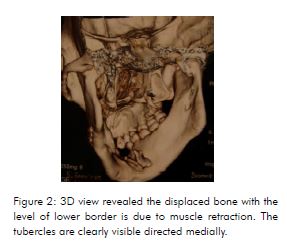
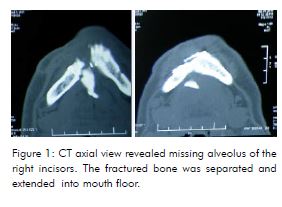
<body><![CDATA[<p><font size="2" face="Verdana, Arial, Helvetica, sans-serif">The genial tubercles are a group of four bony extensions that surround the lingual foramen bilaterally on the lingual surface of the mandible, situated midway between the superior and inferior borders of the mandible<sup>1,2</sup>. They act as the insertion for the geniohyoid muscles (lower genial tubercles) and genioglossus muscles (upper genial tubercles). The action of these muscles is related to lingual mobility and deglutition, being important for speech and feeding. The genial tubercles are affected in mandibular fractures of the symphysis region<sup>3</sup>. The majority of cases described in the literature refer to spontaneous fractures in atrophic edentulous mandibles (4-8). The treatment is controversial, with the majority of authors arguing for conservative treatment without the excision of the fractured tubercles from the floor of the mouth<sup>3,5,6</sup> or without replacement of the fractured tubercles and of the muscles inserted in them<sup>1,3</sup>. This clinical report describes the surgical management of the unilateral fracture of genial tubercles</font></p>     <p>&nbsp;</p>     <p><font size="3" face="Verdana, Arial, Helvetica, sans-serif"><B> Case report</B></font></p>     <p><font size="2" face="Verdana, Arial, Helvetica, sans-serif">Two years post-accident 28-year-old man was referred to the oral and maxillofacial department of our hospital. His complaint was difficult of speech, swallowing, snoring and sublingual pain. Clinical examination revealed preoral scar and missing lower right canine and lateral incisor in addition to lower left molars. Alveolar bone defect in the missing incisors is detected. The teeth around the defect are deviated and have a little mobility. Occlusion seems to be satisfied with mandibular retrognathia. The lingual frenium is attached onto the missing alveolus. Chronic inflammatory sinus in the vestibule of the missing incisors was detected. A panoramic radiograph revealed 3 miniplates, 2 in the symphesis and one at the right angle. The Computerized Tomography (CT) showed a separation of the lingual plate of the sympheseal region including the right side of the genial tubercles to right first premolar. Marked posterior displacement of the genial segment to reach the middle of the mouth floor (Figures <a href="#fig01">1</a> and <a href="#fig02">2</a>). The displaced bone was recognized at the lower part of the mandible. The mouth floor was hard and movement of the tongue was limited.</font></p>     <p>&nbsp;</p>     <p><a name="fig01"></a></p>     <p>&nbsp;</p>     <p align="center"><img src="/img/revistas/rctbmf/v12n4/a03fig01.jpg"></p>     <p>&nbsp;</p>     <p><a name="fig02"></a></p>     ]]></body>
<body><![CDATA[<p>&nbsp;</p>     <p align="center"><img src="/img/revistas/rctbmf/v12n4/a03fig02.jpg"></p>     <p>&nbsp;</p>     <p><font size="2" face="Verdana, Arial, Helvetica, sans-serif">  An operation was done for correction of the displaced bone, not for removal. Vestibular incision was done in the sympheseal region through the mentalis muscle. The plates were removed and clean the granulation tissue in the area of fracture. The mandible was separated at the missing alveolus by electrical saw. The separated lingual bone was hold with wire. The mandible was fixed with miniplate. The lingual bone was placed into its original place with position screw. The tubercles on the midline felt in place being parallel to the level of other side. The mentalis muscle was sutured with 2-0 vecryl. The patient was discharged from hospital in the next day. Follow-up at 6 months revealed complete symptomatic recovery, and improved normal mobility of the tongue.</font></p>       <p>&nbsp;</p>     <p><font size="3" face="Verdana, Arial, Helvetica, sans-serif"><B> Discussion</B></font></p>     <p><font size="2" face="Verdana, Arial, Helvetica, sans-serif">The mandibular genial tubercles serve as the insertion of the geniohyoid and genioglossus muscles. The genioglossus muscle protrudes the tongue and raises the tip of the tongue, facilitating the passage of the food bolus to the pharynx (buccal phase of deglutition). Part of its middle fibers continue in the pharyngoglossus muscle, constituting Winslow's geniopharyngeous muscle, which favors the passage of the food bolus through the pharynx (pharyngeal phase of deglutition). The geniohyoid muscle contributes to the laryngeal closure, as it lowers the epiglottis by raising the hyoideus<sup>10</sup>.</font></p>     <p><font size="2" face="Verdana, Arial, Helvetica, sans-serif"> Fracture of the genial tubercles associated with bloc symphyseal fractures is commonly occurred but separation of these tubercles during trauma seems to be rarely happened. This kind of fracture occurred when the mandible was compressed between two hard objects. Pathological fracture of genial tubercles has been reported only 11 cases in the literature<sup>1-11</sup>. The majority of cases described refer to spontaneous fractures in elderly patients with atrophic edentulous mandibles, predominantly female<sup>2,4,9</sup>. It appears that fracture of the genial tubercles in an atrophied mandible can occur under normal masticator forces, which are delivered through the mandible denture<sup>3</sup>. </font></p>     <p><font size="2" face="Verdana, Arial, Helvetica, sans-serif">Fracture of the genial tubercles resulted in pain, limited tongue mobility and dysphagia<sup>11</sup>. The fractured bone may produce a chronic irritant effect on the floor of the mouth resulted in a malignant neoplasm<sup>7</sup>. Treatment of lingual fracture is controversial, conservative treatment <sup>1,3,7</sup> or removal of the fractured bone fragments<sup>2,6</sup>. In this case the displaced bone with their attached muscle was replaced and fixed in the normal place to restore tongue function and relieve pain. The importance given to repositioning the muscular fascicles to their place of origin is supported by avoids the limitation on lingual protrusion, deglutition and speech<sup>3</sup>. Although, the function of these muscles is synergic with other muscle groups; the non-repositioning of these to a stable origin will generate at least a certain degree of discomfort. It seems reasonable to adopt a conservative treatment approach and postpone surgical treatment on the basis of functional restriction<sup>6,11</sup>.</font></p>     <p>&nbsp;</p>     ]]></body>
<body><![CDATA[<p><font size="3" face="Verdana, Arial, Helvetica, sans-serif"><B>REFER&Ecirc;NCIAS BIBLIOGR&Aacute;FICAS </B></font></p>     <!-- ref --><p><font size="2" face="Verdana, Arial, Helvetica, sans-serif">1. Goebel WM. Fractured genial tubercles. J Prosthet Dent. 39(6):603-4. 1978 </font>&nbsp;&nbsp;&nbsp;&nbsp;&nbsp;&nbsp;&nbsp;&nbsp;[&#160;<a href="javascript:void(0);" onclick="javascript: window.open('/scielo.php?script=sci_nlinks&ref=463023&pid=S1808-5210201200040000300001&lng=','','width=640,height=500,resizable=yes,scrollbars=1,menubar=yes,');">Links</a>&#160;]<!-- end-ref --><p><font size="2" face="Verdana, Arial, Helvetica, sans-serif">2. Reifman S. Genial tubercle fracture. Report of a case. Oral Surg Oral Med Oral Pathol. 27(5):595-7.1969 </font></p>     <p><font size="2" face="Verdana, Arial, Helvetica, sans-serif">3. Maw RB, Lindsay JS. Conservative management of genial tubercle fractures. Oral Surg Oral Med Oral Pathol. 30(4):445-9.1970 </font></p>     <p><font size="2" face="Verdana, Arial, Helvetica, sans-serif">4. Carroll MJ. Spontaneous fracture of the genial tubercles. Br Dent J. 22;154(2):47-8. 1983 </font></p>     <p><font size="2" face="Verdana, Arial, Helvetica, sans-serif">5. Santos-Oller JM. Spontaneous fracture of hypertrophied genial tubercles. Oral Surg Oral Med Oral Pathol. 74(1):28-9. 1992. </font></p>     <p><font size="2" face="Verdana, Arial, Helvetica, sans-serif">6. Shipman B. Genial tubercle fracture: a case. Va Dent J. 53(3):7. 1976.</font></p>     <p><font size="2" face="Verdana, Arial, Helvetica, sans-serif"> 7. Smyd S. Fracture of the genial tubercles. J Am Dental Assoc. 55: 136, 1957 </font></p>     <p><font size="2" face="Verdana, Arial, Helvetica, sans-serif">8. Youngs R, Albert D. Fractured genial tubercles. J Laryngol Otol. 98(10):1047-8.1984. </font></p>     <p><font size="2" face="Verdana, Arial, Helvetica, sans-serif">9. Burnett CA, Clifford TJ. A case of fractured genial tubercles. Dent Update. 20(5):219. </font></p>     ]]></body>
<body><![CDATA[<p><font size="2" face="Verdana, Arial, Helvetica, sans-serif">10. Shohat I, Shoshani Y, Taicher S. Fracture of the genial tubercles associated with a mandibular denture: a clinical report. J Prosthet Dent. 2003 Mar;89(3):232-3. </font></p>     <p><font size="2" face="Verdana, Arial, Helvetica, sans-serif">11. Yassutaka Faria. Spontaneous fracture of genial tubercles: case report. Quintessence Int.37(9):737-9.2006</font></p>      <p>&nbsp;</p>     <p>&nbsp;</p>     <p><font size="2" face="Verdana, Arial, Helvetica, sans-serif"><a name="back"/></a><a href="#top"><img src="/img/revistas/rctbmf/v12n4/seta.jpg" border="0" align="absmiddle"/></a><b>Endere&ccedil;o para correspond&ecirc;ncia:</b>    <br>   Consultant of Oral and Maxillofacial Surgery; Monsoura    <br>   International Hospital, Mansoura City; Egypt.</font><font size="2" face="Verdana, Arial, Helvetica, sans-serif">    <br>   e-mail: </font><font size="2" face="Verdana, Arial, Helvetica, sans-serif"><a href="mailto:shalsakran@yahoo.com." target="_blank">shalsakran@yahoo.com.</a></font></p>     <p>&nbsp;</p>        ]]></body>
<back>
<ref-list>
<ref id="B1">
<label>1</label><nlm-citation citation-type="journal">
<person-group person-group-type="author">
<name>
<surname><![CDATA[Goebel]]></surname>
<given-names><![CDATA[WM]]></given-names>
</name>
</person-group>
<article-title xml:lang="en"><![CDATA[Fractured genial tubercles]]></article-title>
<source><![CDATA[J Prosthet Dent]]></source>
<year>1978</year>
<volume>39</volume>
<numero>6</numero>
<issue>6</issue>
<page-range>603-4</page-range></nlm-citation>
</ref>
</ref-list>
</back>
</article>