<?xml version="1.0" encoding="ISO-8859-1"?><article xmlns:mml="http://www.w3.org/1998/Math/MathML" xmlns:xlink="http://www.w3.org/1999/xlink" xmlns:xsi="http://www.w3.org/2001/XMLSchema-instance">
<front>
<journal-meta>
<journal-id>1980-6523</journal-id>
<journal-title><![CDATA[Revista Odonto Ciência (Online)]]></journal-title>
<abbrev-journal-title><![CDATA[Rev. odonto ciênc. (Online)]]></abbrev-journal-title>
<issn>1980-6523</issn>
<publisher>
<publisher-name><![CDATA[Pontifícia Universidade Católica do Rio Grande do Sul]]></publisher-name>
</publisher>
</journal-meta>
<article-meta>
<article-id>S1980-65232010000300019</article-id>
<title-group>
<article-title xml:lang="en"><![CDATA[Orthodontic treatment of a midline diastema related to mesiodens and thumb-sucking habit]]></article-title>
<article-title xml:lang="pt"><![CDATA[Tratamento ortodôntico de um diastema mediano relacionado a mesiodens e hábito de sucção digital]]></article-title>
</title-group>
<contrib-group>
<contrib contrib-type="author">
<name>
<surname><![CDATA[Machado]]></surname>
<given-names><![CDATA[André Wilson]]></given-names>
</name>
<xref ref-type="aff" rid="A01"/>
<xref ref-type="aff" rid="A02"/>
</contrib>
<contrib contrib-type="author">
<name>
<surname><![CDATA[Ambrosio]]></surname>
<given-names><![CDATA[Aldrieli Regina]]></given-names>
</name>
<xref ref-type="aff" rid="A02"/>
</contrib>
<contrib contrib-type="author">
<name>
<surname><![CDATA[Caldas]]></surname>
<given-names><![CDATA[Sergei Godeiro F. Rabelo]]></given-names>
</name>
<xref ref-type="aff" rid="A02"/>
</contrib>
<contrib contrib-type="author">
<name>
<surname><![CDATA[Gandini Júnior]]></surname>
<given-names><![CDATA[Luiz Gonzaga]]></given-names>
</name>
<xref ref-type="aff" rid="A02"/>
</contrib>
</contrib-group>
<aff id="A01">
<institution><![CDATA[,Federal University of Bahia Dental School ]]></institution>
<addr-line><![CDATA[Salvador BA]]></addr-line>
<country>Brazil</country>
</aff>
<aff id="A02">
<institution><![CDATA[,UNESP Araraquara Dental School Department of Pediatric Dentistry]]></institution>
<addr-line><![CDATA[Araraquara SP]]></addr-line>
<country>Brazil</country>
</aff>
<pub-date pub-type="pub">
<day>00</day>
<month>09</month>
<year>2010</year>
</pub-date>
<pub-date pub-type="epub">
<day>00</day>
<month>09</month>
<year>2010</year>
</pub-date>
<volume>25</volume>
<numero>3</numero>
<fpage>314</fpage>
<lpage>318</lpage>
<copyright-statement/>
<copyright-year/>
<self-uri xlink:href="http://revodonto.bvsalud.org/scielo.php?script=sci_arttext&amp;pid=S1980-65232010000300019&amp;lng=en&amp;nrm=iso"></self-uri><self-uri xlink:href="http://revodonto.bvsalud.org/scielo.php?script=sci_abstract&amp;pid=S1980-65232010000300019&amp;lng=en&amp;nrm=iso"></self-uri><self-uri xlink:href="http://revodonto.bvsalud.org/scielo.php?script=sci_pdf&amp;pid=S1980-65232010000300019&amp;lng=en&amp;nrm=iso"></self-uri><abstract abstract-type="short" xml:lang="en"><p><![CDATA[PURPOSE: Midline diastema due to simultaneous interplay of mesiodens and thumb-sucking habit is a very uncommon situation and can represent negative impact on esthetics and function. The purpose of this article is to describe a case report of a 9 year-old boy with a 9-mm midline diastema and an anterior open bite treated with an interceptive orthodontic approach. CASE DESCRIPTION: After orthodontic diagnosis, treatment undertaken was the surgical removal of the mesiodens and the use of a palatal crib therapy in order to discontinue the thumb habit. Then, orthodontic brackets were bonded on maxillary central incisors and the diastema closed allowing the spontaneous irruption of the maxillary laterals incisors. When acceptable levels of overbite and overjet were achieved and the habit was controlled, the orthodontic treatment was discontinued. CONCLUSION: To assure good results in managing pathological midline diastemas the diagnosis and treatment should be performed as early as possible.]]></p></abstract>
<abstract abstract-type="short" xml:lang="pt"><p><![CDATA[OBJETIVO: A associação de mesiodens com hábito de sucção digital como fatores etiológicos de diastemas medianos é uma situação clínica incomum e, quando presente, provoca um comprometimento estético e funcional. O objetivo desse trabalho é descrever o caso clínico de um paciente, aos 9 anos de idade, com mordida aberta anterior e um diastema mediano de 9 mm. DESCRIÇÃO DO CASO: Após o diagnóstico ortodôntico, a conduta terapêutica foi a exodontia do mesiodens e instalação de uma grade palatina fixa para controle do hábito de sucção digital. Em seguida, bráquetes ortodônticos foram colados nos incisivos centrais superiores e o diastema foi fechado possibilitando a irrupção espontânea dos incisivos laterais. Quando adequados níveis de trespasse vertical e horizontal entre os incisivos foi alcançado e o hábito removido, o tratamento foi finalizado. CONCLUSÃO: É importante ressaltar que com o objetivo de alcançar resultados estéticos e funcionais satisfatórios, minimizando sequelas ao desenvolvimento da oclusão deve-se realizar o diagnóstico precoce e intervenção imediata dos diastemas medianos patológicos.]]></p></abstract>
<kwd-group>
<kwd lng="en"><![CDATA[Diastema]]></kwd>
<kwd lng="en"><![CDATA[interceptive orthodontics]]></kwd>
<kwd lng="en"><![CDATA[malocclusion]]></kwd>
<kwd lng="pt"><![CDATA[Diastema]]></kwd>
<kwd lng="pt"><![CDATA[Ortodontia Interceptora]]></kwd>
<kwd lng="pt"><![CDATA[má oclusão]]></kwd>
</kwd-group>
</article-meta>
</front><body><![CDATA[ <p align="right"><font size="2" face="Verdana"><B>CASE REPORT</B></font></p>    <p>&nbsp;</p>    <p><font size="4" face="verdana"><a name="tx"></a><b>Orthodontic  treatment of a midline diastema related to mesiodens and thumb&#45;sucking habit  </b></font></p>    <p>&nbsp;</p>    <p><font size="3" face="Verdana"><b>Tratamento ortod&ocirc;ntico  de um diastema mediano relacionado a mesiodens e h&aacute;bito de suc&ccedil;&atilde;o  digital</b></font></p>    <p>&nbsp;</p>    <p>&nbsp;</p>    <p><font size="2" face="Verdana"><b>Andr&eacute;  Wilson Machado<Sup>I,II</Sup>; Aldrieli Regina Ambrosio<Sup>II</Sup>; Sergei Godeiro  F. Rabelo Caldas<Sup>II</Sup>; Luiz Gonzaga Gandini J&uacute;nior<Sup>II</Sup></b>  </font></p>    <p><font size="2" face="Verdana"><Sup>I</Sup>Graduate Program in Orthodontics,  Dental School, Federal University of Bahia, Salvador, BA, Brazil    <br> <Sup>II</Sup>Department  of Pediatric Dentistry, Araraquara Dental School, UNESP, Araraquara, SP, Brazil</font></p>    ]]></body>
<body><![CDATA[<p><font size="2" face="Verdana"><a href="#nt">Correspondence</a></font></p>    <p>&nbsp;</p>    <p>&nbsp;</p><hr size="1" noshade>      <p><font size="2" face="Verdana"><B>ABSTRACT</B></font></p>    <p><font size="2" face="Verdana"><B>PURPOSE:  </B> Midline diastema due to simultaneous interplay of mesiodens and thumb&#45;sucking  habit is a very uncommon situation and can represent negative impact on esthetics  and function. The purpose of this article is to describe a case report of a 9  year&#45;old boy with a 9&#45;mm midline diastema and an anterior open bite treated  with an interceptive orthodontic approach.     <br> <b>CASE DESCRIPTION:</b> After  orthodontic diagnosis, treatment undertaken was the surgical removal of the mesiodens  and the use of a palatal crib therapy in order to discontinue the thumb habit.  Then, orthodontic brackets were bonded on maxillary central incisors and the diastema  closed allowing the spontaneous irruption of the maxillary laterals incisors.  When acceptable levels of overbite and overjet were achieved and the habit was  controlled, the orthodontic treatment was discontinued.    <BR> <B>CONCLUSION: </B>  To assure good results in managing pathological midline diastemas the diagnosis  and treatment should be performed as early as possible.</font></p>    <p><font size="2" face="Verdana"><B>Key  words: </B> Diastema; interceptive orthodontics; malocclusion</font></p><hr size="1" noshade>      <p><font size="2" face="Verdana"><B>RESUMO</B></font></p>    <p><font size="2" face="Verdana"><B>OBJETIVO:  </B> A associa&ccedil;&atilde;o de mesiodens com h&aacute;bito de suc&ccedil;&atilde;o  digital como fatores etiol&oacute;gicos de diastemas medianos &eacute; uma situa&ccedil;&atilde;o  cl&iacute;nica incomum e, quando presente, provoca um comprometimento est&eacute;tico  e funcional. O objetivo desse trabalho &eacute; descrever o caso cl&iacute;nico  de um paciente, aos 9 anos de idade, com mordida aberta anterior e um diastema  mediano de 9 mm.    ]]></body>
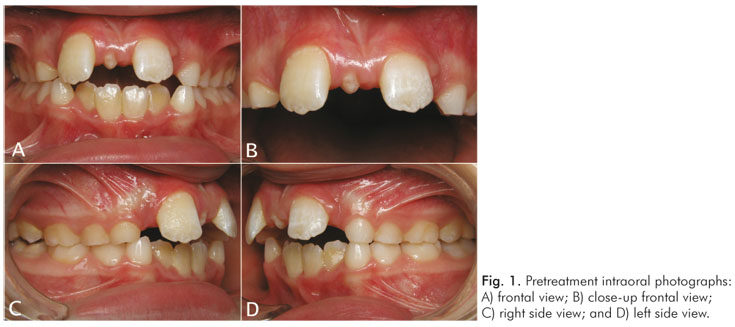
<body><![CDATA[<br> <b>DESCRI&Ccedil;&Atilde;O DO CASO:</b> Ap&oacute;s o diagn&oacute;stico  ortod&ocirc;ntico, a conduta terap&ecirc;utica foi a exodontia do mesiodens e  instala&ccedil;&atilde;o de uma grade palatina fixa para controle do h&aacute;bito  de suc&ccedil;&atilde;o digital. Em seguida, br&aacute;quetes ortod&ocirc;nticos  foram colados nos incisivos centrais superiores e o diastema foi fechado possibilitando  a irrup&ccedil;&atilde;o espont&acirc;nea dos incisivos laterais. Quando adequados  n&iacute;veis de trespasse vertical e horizontal entre os incisivos foi alcan&ccedil;ado  e o h&aacute;bito removido, o tratamento foi finalizado.    <BR> <B>CONCLUS&Atilde;O:  </B> &Eacute; importante ressaltar que com o objetivo de alcan&ccedil;ar resultados  est&eacute;ticos e funcionais satisfat&oacute;rios, minimizando sequelas ao desenvolvimento  da oclus&atilde;o deve&#45;se realizar o diagn&oacute;stico precoce e interven&ccedil;&atilde;o  imediata dos diastemas medianos patol&oacute;gicos. </font></p>    <p><font size="2" face="Verdana"><B>Palavras&#45;chave:  </B> Diastema; Ortodontia Interceptora; m&aacute; oclus&atilde;o</font></p><hr size="1" noshade>      <p>&nbsp;</p>    <p>&nbsp;</p>    <p><font size="3" face="Verdana"><B>Introduction</B></font></p>    <p><font size="2" face="Verdana">During  dental development the presence of a midline diastema and a supernumerary in the  maxillary arch could be deleterious from the esthetic and functional views. Although  the literature associates those problems as etiological factors to midline diastema,  the presence of both situations in the same patient is very uncommon (1).</font></p>    <p><font size="2" face="Verdana">Supernumerary  teeth are teeth in excess of the normal number (2). When located in the maxillary  central incisor region a supernumerary tooth is called mesiodens and its prevalence  has been estimated to be 0.15 to 2.2% of the population with a preference of male  (3). Mesiodens is usually found to be impacted but also fully or ectopic erupted  (3,4).</font></p>    <p><font size="2" face="Verdana">It is strongly advised that  the diagnosis of mesiodens should be made as early as possible due to its associating  with disturbances in tooth eruption such as delayed eruption of the permanent  incisors, crowding or interference with the alignment of the maxillary incisors,  dental impaction, resorption of adjacent tooth, development of dentigerous cist  and one of the most common sequel, a midline diastema (2&#45;4).</font></p>    <p><font size="2" face="Verdana">This  last condition should be proper investigated since midline diastema larger than  2 mm in the mixed dentition should be fully investigated due to its relation to  some disturbances in tooth eruption. In those situations, the main causes of midline  diastemas are not only mesiodens but also congenitally missing teeth, peg&#45;shaped  lateral incisors, labial frenum, ethnic and racial characteristics, certain pathologic  conditions and thumb&#45;sucking habit (5).</font></p>    ]]></body>
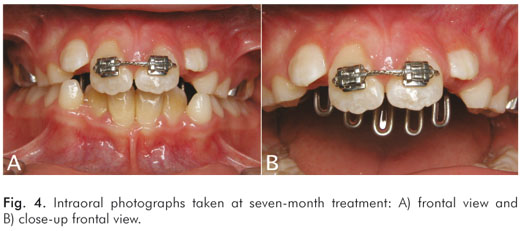
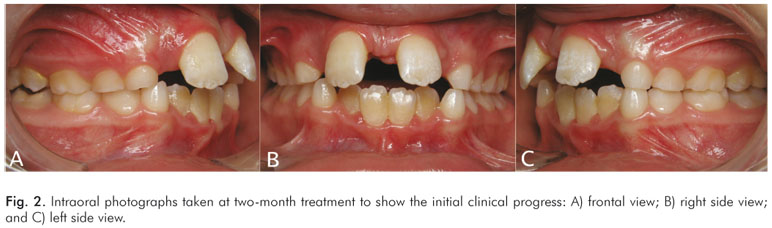
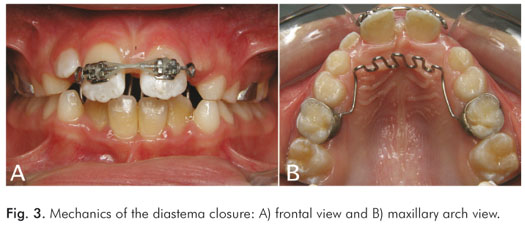
<body><![CDATA[<p><font size="2" face="Verdana">Literature  brings different approaches to solve mesiodens, midline diastemas and anterior  open bite. Ultimately, options are the mesiodens removal, the orthodontic space  closure of the diastema and the use of physical and psychological techniques to  correct the cause of the thumb habit. It should be stated that the ultimate goal  is to reestablish the normal dental development.</font></p>    <p><font size="2" face="Verdana">Since  there is a lack of information in the literature regarding patients with midline  diastemas associated to mesiodens, it is necessary to report clinical cases in  order to facilitate the knowledge of this issue (6&#45;8). </font></p>    <p><font size="2" face="Verdana">The  purpose of this article is to show a case report of a 9 year&#45;old boy with  a Class II malocclusion with a 9&#45;mm midline diastema and anterior open bite  which was treated with a simple orthodontic interceptive approach achieving satisfactory  results. </font></p>    <p>&nbsp;</p>    <p><font size="3" face="Verdana"><B>Description of  the case</B></font></p>    <p><font size="2" face="Verdana">A Brazilian boy, aged  9 years and 7 months, of mixed ethnic background (black and white), was referred  to the private office of the first author. His chief complaint was the presence  of a large midline diastema. His medical and dental histories were uneventful.</font></p>    <p><font size="2" face="Verdana">Intraoral  examination showed that the patient was in the mixed dentition, with the permanent  maxillary central incisors and first molars already erupted. In addition, there  was a 9&#45;mm midline diastema associated with an erupted mesiodens. Moreover,  there was an anterior open bite associated with thumb&#45;sucking habit and a  delay in the maxillary lateral incisors eruption. The molars on the right side  were in Class I relationship, whereas in the left side were in Class II leading  to a Class II, division 1 malocclusion (<a href="/img/revistas/roc/v25n3/a19fig01.jpg">Fig.  1</a>).</font></p>    <p><font size="2" face="Verdana">The treatment plan was designed  to accomplish some clinical objectives such as the removal of the mesiodens, the  discontinuation f the thumb&#45;sucking habit to correct the open bite and the  orthodontic closure of the midline diastema to allow proper eruption of the maxillary  lateral incisors.</font></p>    <p><font size="2" face="Verdana">The first step in  interception treatment was to proper inform the patient and his parents the need  of discontinuing the thumb&#45;sucking habit in order to reestablish the normal  dental development. Surgical removal of the mesiodens was then performed, and  after 2 months the diastema had spontaneous closed 1.5 mm (<a href="/img/revistas/roc/v25n3/a19fig02.jpg">Fig.  2</a>). At this stage, a palatal crib was placed to assist in the thumb&#45;sucking  habit control and tongue thrusting. Next, orthodontic 0.022" brackets were bonded  on the labial surface of the maxillary central incisors, and a passive 0.021&#215;0.025"  sectional stainless steel archwire with chain elastics were placed to close the  diastema (<a href="#fig03">Fig. 3</a>).</font></p>    <p><a name="fig03"></a></p>    ]]></body>
<body><![CDATA[<p>&nbsp;</p>    <p align="center"><img src="/img/revistas/roc/v25n3/a19fig03.jpg"></p>    <p>&nbsp;</p>    <p><font size="2" face="Verdana">After  five months, overjet and overbite were corrected, and diastema was closed leading  to a spontaneous eruption of the maxillary lateral incisors (<a href="#fig04">Fig.  4</a>). At this stage, palatal crib was removed as well as the orthodontic brackets,  and a palatal bonded retention was placed in the maxillary central incisors to  avoid relapse.</font></p>    <p><a name="fig04"></a></p>    <p>&nbsp;</p>    <p align="center"><img src="/img/revistas/roc/v25n3/a19fig04.jpg"></p>    <p>&nbsp;</p>    <p><font size="2" face="Verdana">The  analysis of the final photographs shows the reestablishment of normal dental development  highlighting the efficiency and effectiveness of the treatment (<a href="/img/revistas/roc/v25n3/a19fig05.jpg">Fig.  5</a>). Furthermore, due to the esthetics improvement of the smile, the patient  reported a higher level of self&#45;confidence and was generally happier than  in the original situation (<a href="#fig06">Fig. 6</a>).</font></p>    <p><a name="fig06"></a></p>    ]]></body>
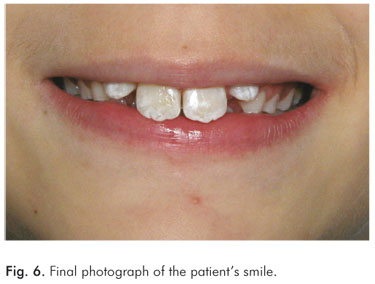
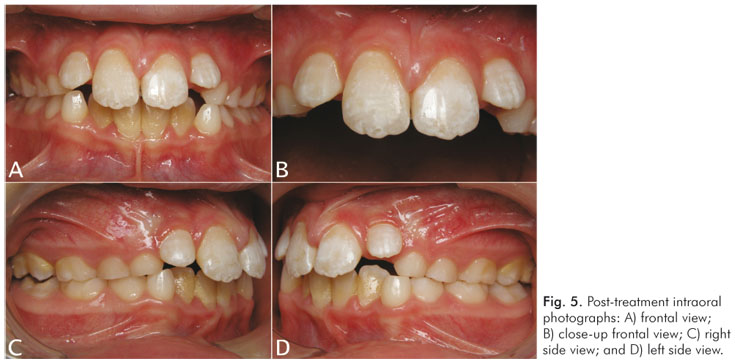
<body><![CDATA[<p>&nbsp;</p>    <p align="center"><img src="/img/revistas/roc/v25n3/a19fig06.jpg"></p>    <p>&nbsp;</p>    <p><font size="3" face="Verdana"><B>Discussion  </B></font></p>    <p><font size="2" face="Verdana">During dental development the  interplay of different factors can cause some malocclusion. The case described  here involved an interaction of two major factors, a mesiodens and a thumb&#45;sucking  habit leading to a 9&#45;mm midline diastema and an anterior open bite. </font></p>    <p><font size="2" face="Verdana">The  early diagnosis of large midline diastemas and erupted mesiodens is more common  because they are located in the maxillary anterior region and are easily noticed  by parents or general practitioners or pediatric dentists (9). Conversely, the  case described here does not corroborate this idea because patient was referred  to the orthodontist at the age of 9 years and 7 months, and theoretically the  diastema and the mesiodens were present, according to the literature since 7.27  years, the physiological age of maxillary central incisors eruption (10).</font></p>    <p><font size="2" face="Verdana">Along  with this problem since maxillary lateral incisors did not erupt in the dental  arch at an expected age, which is 8.2 years (10), it can be characterized as an  eruption delay. The reason of this situation was the presence of the mesiodens  and diastema, which block the space for the lateral eruption. A simple orthodontic  space opening could encourage the spontaneous eruption, which is a more logical  and conservative approach (11).</font></p>    <p><font size="2" face="Verdana">The  literature supports the cause/effect relation between the mesiodens and the midline  diastema (6&#45;8). The present clinical case shows this association, which was  aggravated by the thumb&#45;sucking habit.</font></p>    <p><font size="2" face="Verdana">Thus,  there was a need of closing the diastema related to a mesiodens and a thumb&#45;sucking  habit. For the first problem the clinical option was the surgical removal of the  mesiodens followed by the orthodontic closure of the remaining space. Interestingly,  after the mesiodens removal, there was a 1.5 mm reduction in the diastema, which  is probably related to the action of trans&#45;septal fibers maintaining the dental  aligning.</font></p>    <p><font size="2" face="Verdana">Although the physiological  tendency is the spontaneous closure of the midline diastema after the eruption  of the maxillary canines (5,6,12), in the case described a orthodontic approach  was necessary to allow the eruption of the maxillary lateral incisors. Thus, orthodontic  brackets were used achieving a satisfactory result, which is a simple and fast  method (6&#45;8). Since the rate of orthodontic diastema closure relapse is found  to be 49% (13), a bonded retainer was used in the lingual surface of the maxillary  central incisors.</font></p>    ]]></body>
<body><![CDATA[<p><font size="2" face="Verdana">In order to correct  the thumb&#45;sucking habit the treatment was based on two strategies. First the  patient and his parents were informed about the deleterious effects of the habit  and the need of stopping it in order to reestablish the normal dental development.  In addition, a palatal crib was used for two reasons: as a reminder therapy and  as a barrier to avoid tongue thrusting. The treatment objective was completely  achieved in 5 months with the habit discontinued and the open bite closure showing  the efficacy and efficiency of the approach undertaken. It is necessary to remember  that in order to achieve good results patient compliance is of fundamental importance.  The analysis of the esthetics results showed that not only the smile aspect was  enhanced but also the patient reported a higher level of self&#45;confidence and  was generally happier, which is the ultimate treatment goal even in young patients  (14,15). </font></p>    <p><font size="2" face="Verdana">In summary, although a simultaneous  midline diastema and a mesiodens in the same patient is a very uncommon situation,  it could be negative in the esthetic and functional views. There is a consensus  in the literature towards an early diagnosis and treatment which increases the  possibility of good clinical results and the reestablishment of normal dental  development.</font></p>    <p>&nbsp;</p>    <p><font size="3" face="Verdana"><B>References</B></font></p>    <!-- ref --><p><font size="2" face="Verdana">1.  Yamaoka M, Furusa K, Yasuda W. Effects of maxillary anterior supernumerary impacted  teeth on diastema. Oral Surg Oral Med Oral Pathol Oral Radiol Endod. 1995;80:252.    &nbsp;&nbsp;&nbsp;&nbsp;&nbsp;&nbsp;&nbsp;&nbsp;[&#160;<a href="javascript:void(0);" onclick="javascript: window.open('/scielo.php?script=sci_nlinks&ref=366146&pid=S1980-6523201000030001900001&lng=','','width=640,height=500,resizable=yes,scrollbars=1,menubar=yes,');">Links</a>&#160;]<!-- end-ref -->  </font></p>    <!-- ref --><p><font size="2" face="Verdana">2. Russel KA, Folwarczna MA. Mesiodens  &#150; diagnosis and manage ment of a common supernumerary tooth. J Can Dent Assoc  2003; 69:362&#45;6.    &nbsp;&nbsp;&nbsp;&nbsp;&nbsp;&nbsp;&nbsp;&nbsp;[&#160;<a href="javascript:void(0);" onclick="javascript: window.open('/scielo.php?script=sci_nlinks&ref=366148&pid=S1980-6523201000030001900002&lng=','','width=640,height=500,resizable=yes,scrollbars=1,menubar=yes,');">Links</a>&#160;]<!-- end-ref --></font></p>    <!-- ref --><p><font size="2" face="Verdana">3. G&uuml;nd&uuml;z  K, &Ccedil;elenk P, Zengin Z, S&uuml;mer P. Mesiodens: a radiographic study in  children. J Oral Sci 2008;50:287&#45;91.    &nbsp;&nbsp;&nbsp;&nbsp;&nbsp;&nbsp;&nbsp;&nbsp;[&#160;<a href="javascript:void(0);" onclick="javascript: window.open('/scielo.php?script=sci_nlinks&ref=366150&pid=S1980-6523201000030001900003&lng=','','width=640,height=500,resizable=yes,scrollbars=1,menubar=yes,');">Links</a>&#160;]<!-- end-ref --></font></p>    ]]></body>
<body><![CDATA[<!-- ref --><p><font size="2" face="Verdana">4.  Roychoudhury A, Gupta Y, Parkash H. Mesiodens: a retrospective study of fifty  teeth. J Indian Soc Pedo Prev Dent 2000;18:144&#45;6.    &nbsp;&nbsp;&nbsp;&nbsp;&nbsp;&nbsp;&nbsp;&nbsp;[&#160;<a href="javascript:void(0);" onclick="javascript: window.open('/scielo.php?script=sci_nlinks&ref=366152&pid=S1980-6523201000030001900004&lng=','','width=640,height=500,resizable=yes,scrollbars=1,menubar=yes,');">Links</a>&#160;]<!-- end-ref --></font></p>    <!-- ref --><p><font size="2" face="Verdana">5.  Proffit WR, Fields HW. Ortodontia Contempor&acirc;nea. 3ed. Rio de Janeiro: Guanabara  Koogan; 2002.    &nbsp;&nbsp;&nbsp;&nbsp;&nbsp;&nbsp;&nbsp;&nbsp;[&#160;<a href="javascript:void(0);" onclick="javascript: window.open('/scielo.php?script=sci_nlinks&ref=366154&pid=S1980-6523201000030001900005&lng=','','width=640,height=500,resizable=yes,scrollbars=1,menubar=yes,');">Links</a>&#160;]<!-- end-ref --></font></p>    <!-- ref --><p><font size="2" face="Verdana">6. Almeida RR, Garib  DG, Almeida&#45;Pedrin RR, Almeida MR, Pinzan A, Junqueira MHZ. Diastema Interincisivos  centrais superiores: quando e como intervir? Rev Dental Press Ortodon Ortoped  Facial 2004;9:137&#45;56.    &nbsp;&nbsp;&nbsp;&nbsp;&nbsp;&nbsp;&nbsp;&nbsp;[&#160;<a href="javascript:void(0);" onclick="javascript: window.open('/scielo.php?script=sci_nlinks&ref=366156&pid=S1980-6523201000030001900006&lng=','','width=640,height=500,resizable=yes,scrollbars=1,menubar=yes,');">Links</a>&#160;]<!-- end-ref --></font></p>    <!-- ref --><p><font size="2" face="Verdana">7. Tostes  MA, Fernandes KP. Dente supranumer&aacute;rio e diastema mediano superior/ Supernumerary  tooth and superior median diastema. RGO 1996;44:220&#45;3.    &nbsp;&nbsp;&nbsp;&nbsp;&nbsp;&nbsp;&nbsp;&nbsp;[&#160;<a href="javascript:void(0);" onclick="javascript: window.open('/scielo.php?script=sci_nlinks&ref=366158&pid=S1980-6523201000030001900007&lng=','','width=640,height=500,resizable=yes,scrollbars=1,menubar=yes,');">Links</a>&#160;]<!-- end-ref --></font></p>    <!-- ref --><p><font size="2" face="Verdana">8.  Heluy DB, Portella W, Gleiser R. Supranumer&aacute;rio (mesiodente) e sua influ&ecirc;ncia  no diastema mediano superior: relato de um caso na F.O.UFRJ. Rev odontopediatr  1993;2:165&#45;70.    &nbsp;&nbsp;&nbsp;&nbsp;&nbsp;&nbsp;&nbsp;&nbsp;[&#160;<a href="javascript:void(0);" onclick="javascript: window.open('/scielo.php?script=sci_nlinks&ref=366160&pid=S1980-6523201000030001900008&lng=','','width=640,height=500,resizable=yes,scrollbars=1,menubar=yes,');">Links</a>&#160;]<!-- end-ref --></font></p>    ]]></body>
<body><![CDATA[<!-- ref --><p><font size="2" face="Verdana">9. Uematsu S, Uematsu  T, Furusawa K, Degushi T, Kurihara S. Orthodontic treatment of an impacted dilacerated  maxillary central incisor combined with surgical exposure and apicoectomy. Angle  Orthod 2004;74:132&#45;6.    &nbsp;&nbsp;&nbsp;&nbsp;&nbsp;&nbsp;&nbsp;&nbsp;[&#160;<a href="javascript:void(0);" onclick="javascript: window.open('/scielo.php?script=sci_nlinks&ref=366162&pid=S1980-6523201000030001900009&lng=','','width=640,height=500,resizable=yes,scrollbars=1,menubar=yes,');">Links</a>&#160;]<!-- end-ref --></font></p>    <!-- ref --><p><font size="2" face="Verdana">10. Moyers  RE. Ortodontia. 4. ed. Rio de Janeiro: Guanabara Koogan; 1991.    &nbsp;&nbsp;&nbsp;&nbsp;&nbsp;&nbsp;&nbsp;&nbsp;[&#160;<a href="javascript:void(0);" onclick="javascript: window.open('/scielo.php?script=sci_nlinks&ref=366164&pid=S1980-6523201000030001900010&lng=','','width=640,height=500,resizable=yes,scrollbars=1,menubar=yes,');">Links</a>&#160;]<!-- end-ref --></font></p>    <!-- ref --><p><font size="2" face="Verdana">11.  Becker A. Early treatment for impacted maxillary incisors. Am J Orthod Dentofac  Orthop 2002;121:586&#45;7.    &nbsp;&nbsp;&nbsp;&nbsp;&nbsp;&nbsp;&nbsp;&nbsp;[&#160;<a href="javascript:void(0);" onclick="javascript: window.open('/scielo.php?script=sci_nlinks&ref=366166&pid=S1980-6523201000030001900011&lng=','','width=640,height=500,resizable=yes,scrollbars=1,menubar=yes,');">Links</a>&#160;]<!-- end-ref --></font></p>    <!-- ref --><p><font size="2" face="Verdana">12. Kurol  J. Early treatment of tooth&#45;eruption disturbances. Am J Orthod Dentofac Orthop  2002;121:588&#45;91.    &nbsp;&nbsp;&nbsp;&nbsp;&nbsp;&nbsp;&nbsp;&nbsp;[&#160;<a href="javascript:void(0);" onclick="javascript: window.open('/scielo.php?script=sci_nlinks&ref=366168&pid=S1980-6523201000030001900012&lng=','','width=640,height=500,resizable=yes,scrollbars=1,menubar=yes,');">Links</a>&#160;]<!-- end-ref --></font></p>    <!-- ref --><p><font size="2" face="Verdana">13. Shashua D,  Artun J. Relapse after orthodontic correction of maxillary median diastema: A  follow&#45;up evaluation of consecutive cases. Angle Orthod 1999;69:257&#45;63.    &nbsp;&nbsp;&nbsp;&nbsp;&nbsp;&nbsp;&nbsp;&nbsp;[&#160;<a href="javascript:void(0);" onclick="javascript: window.open('/scielo.php?script=sci_nlinks&ref=366170&pid=S1980-6523201000030001900013&lng=','','width=640,height=500,resizable=yes,scrollbars=1,menubar=yes,');">Links</a>&#160;]<!-- end-ref --></font></p>    ]]></body>
<body><![CDATA[<!-- ref --><p><font size="2" face="Verdana">14.  Machado AW, Loriato L, Souki B, Junqueira, T. Erup&ccedil;&atilde;o espont&acirc;nea  de incisivos centrais superiores impactados ap&oacute;s a abertura ortod&ocirc;ntica  de espa&ccedil;o. Rev Clin Ortodon Dental Press 2007;5: 43&#45;52.    &nbsp;&nbsp;&nbsp;&nbsp;&nbsp;&nbsp;&nbsp;&nbsp;[&#160;<a href="javascript:void(0);" onclick="javascript: window.open('/scielo.php?script=sci_nlinks&ref=366172&pid=S1980-6523201000030001900014&lng=','','width=640,height=500,resizable=yes,scrollbars=1,menubar=yes,');">Links</a>&#160;]<!-- end-ref --></font></p>    <!-- ref --><p><font size="2" face="Verdana">15.  Crawford LD. Impacted maxillary central incisor in mixed dentition treatment.  Am J Orthod Dentofacial Orthop 1997;112:1&#45;7.    &nbsp;&nbsp;&nbsp;&nbsp;&nbsp;&nbsp;&nbsp;&nbsp;[&#160;<a href="javascript:void(0);" onclick="javascript: window.open('/scielo.php?script=sci_nlinks&ref=366174&pid=S1980-6523201000030001900015&lng=','','width=640,height=500,resizable=yes,scrollbars=1,menubar=yes,');">Links</a>&#160;]<!-- end-ref --></font></p>    <p>&nbsp;</p>    <p>&nbsp;</p>    <p><font size="2" face="Verdana"><A NAME="nt"></A><a href="#tx"><img src="/img/revistas/roc/v25n3/seta.jpg" border="0"></a>  <b>Correspondence:</b>    <br> Andr&eacute; Wilson Machado    <br> R. Eduardo Jos&eacute;  dos Santos, 147, salas 810/811    <br> Salvador, BA &#150; Brazil    ]]></body>
<body><![CDATA[<br> 41940&#45;455    <br>  E&#45;mail: <a href="mailto:andre@andrewmachado.com.br">andre@andrewmachado.com.br</a></font></p>    <p><font size="2" face="Verdana">Received:  November 4, 2009    <br> Accepted: April 9, 2010</font></p>    <p>&nbsp;</p>    <p>&nbsp;</p>    <p><font size="2" face="Verdana"><b>Conflict  of Interest Statement: </b>The authors state that there are no financial and personal  conflicts of interest that could have inappropriately influenced their work. </font></p>      ]]></body>
<back>
<ref-list>
<ref id="B1">
<label>1</label><nlm-citation citation-type="journal">
<person-group person-group-type="author">
<name>
<surname><![CDATA[Yamaoka]]></surname>
<given-names><![CDATA[M]]></given-names>
</name>
<name>
<surname><![CDATA[Furusa]]></surname>
<given-names><![CDATA[K]]></given-names>
</name>
<name>
<surname><![CDATA[Yasuda]]></surname>
<given-names><![CDATA[W]]></given-names>
</name>
</person-group>
<article-title xml:lang="en"><![CDATA[Effects of maxillary anterior supernumerary impacted teeth on diastema]]></article-title>
<source><![CDATA[Oral Surg Oral Med Oral Pathol Oral Radiol Endod]]></source>
<year>1995</year>
<volume>80</volume>
<page-range>252</page-range></nlm-citation>
</ref>
<ref id="B2">
<label>2</label><nlm-citation citation-type="journal">
<person-group person-group-type="author">
<name>
<surname><![CDATA[Russel]]></surname>
<given-names><![CDATA[KA]]></given-names>
</name>
<name>
<surname><![CDATA[Folwarczna]]></surname>
<given-names><![CDATA[MA]]></given-names>
</name>
</person-group>
<article-title xml:lang="en"><![CDATA[Mesiodens - diagnosis and manage ment of a common supernumerary tooth]]></article-title>
<source><![CDATA[J Can Dent Assoc]]></source>
<year>2003</year>
<volume>69</volume>
<page-range>362-6</page-range></nlm-citation>
</ref>
<ref id="B3">
<label>3</label><nlm-citation citation-type="journal">
<person-group person-group-type="author">
<name>
<surname><![CDATA[Gündüz]]></surname>
<given-names><![CDATA[K]]></given-names>
</name>
<name>
<surname><![CDATA[Çelenk]]></surname>
<given-names><![CDATA[P]]></given-names>
</name>
<name>
<surname><![CDATA[Zengin]]></surname>
<given-names><![CDATA[Z]]></given-names>
</name>
<name>
<surname><![CDATA[Sümer]]></surname>
<given-names><![CDATA[P]]></given-names>
</name>
</person-group>
<article-title xml:lang="en"><![CDATA[Mesiodens: a radiographic study in children]]></article-title>
<source><![CDATA[J Oral Sci]]></source>
<year>2008</year>
<volume>50</volume>
<page-range>287-91</page-range></nlm-citation>
</ref>
<ref id="B4">
<label>4</label><nlm-citation citation-type="journal">
<person-group person-group-type="author">
<name>
<surname><![CDATA[Roychoudhury]]></surname>
<given-names><![CDATA[A]]></given-names>
</name>
<name>
<surname><![CDATA[Gupta]]></surname>
<given-names><![CDATA[Y]]></given-names>
</name>
<name>
<surname><![CDATA[Parkash]]></surname>
<given-names><![CDATA[H]]></given-names>
</name>
</person-group>
<article-title xml:lang="en"><![CDATA[Mesiodens: a retrospective study of fifty teeth]]></article-title>
<source><![CDATA[J Indian Soc Pedo Prev Dent]]></source>
<year>2000</year>
<volume>18</volume>
<page-range>144-6</page-range></nlm-citation>
</ref>
<ref id="B5">
<label>5</label><nlm-citation citation-type="book">
<person-group person-group-type="author">
<name>
<surname><![CDATA[Proffit]]></surname>
<given-names><![CDATA[WR]]></given-names>
</name>
<name>
<surname><![CDATA[Fields]]></surname>
<given-names><![CDATA[HW]]></given-names>
</name>
</person-group>
<source><![CDATA[Ortodontia Contemporânea.]]></source>
<year>2002</year>
<edition>3ed</edition>
<publisher-loc><![CDATA[Rio de Janeiro ]]></publisher-loc>
<publisher-name><![CDATA[Guanabara Koogan]]></publisher-name>
</nlm-citation>
</ref>
<ref id="B6">
<label>6</label><nlm-citation citation-type="journal">
<person-group person-group-type="author">
<name>
<surname><![CDATA[Almeida]]></surname>
<given-names><![CDATA[RR]]></given-names>
</name>
<name>
<surname><![CDATA[Garib]]></surname>
<given-names><![CDATA[DG]]></given-names>
</name>
<name>
<surname><![CDATA[Almeida-Pedrin]]></surname>
<given-names><![CDATA[RR]]></given-names>
</name>
<name>
<surname><![CDATA[Almeida]]></surname>
<given-names><![CDATA[MR]]></given-names>
</name>
<name>
<surname><![CDATA[Pinzan]]></surname>
<given-names><![CDATA[A]]></given-names>
</name>
<name>
<surname><![CDATA[Junqueira]]></surname>
<given-names><![CDATA[MHZ]]></given-names>
</name>
</person-group>
<article-title xml:lang="pt"><![CDATA[Diastema Interincisivos centrais superiores: quando e como intervir?]]></article-title>
<source><![CDATA[Rev Dental Press Ortodon Ortoped Facial]]></source>
<year>2004</year>
<volume>9</volume>
<page-range>137-56</page-range></nlm-citation>
</ref>
<ref id="B7">
<label>7</label><nlm-citation citation-type="journal">
<person-group person-group-type="author">
<name>
<surname><![CDATA[Tostes]]></surname>
<given-names><![CDATA[MA]]></given-names>
</name>
<name>
<surname><![CDATA[Fernandes]]></surname>
<given-names><![CDATA[KP]]></given-names>
</name>
</person-group>
<article-title xml:lang="en"><![CDATA[Dente supranumerário e diastema mediano superior/ Supernumerary tooth and superior median diastema]]></article-title>
<source><![CDATA[RGO]]></source>
<year>1996</year>
<volume>44</volume>
<page-range>220-3</page-range></nlm-citation>
</ref>
<ref id="B8">
<label>8</label><nlm-citation citation-type="journal">
<person-group person-group-type="author">
<name>
<surname><![CDATA[Heluy]]></surname>
<given-names><![CDATA[DB]]></given-names>
</name>
<name>
<surname><![CDATA[Portella]]></surname>
<given-names><![CDATA[W]]></given-names>
</name>
<name>
<surname><![CDATA[Gleiser]]></surname>
<given-names><![CDATA[R]]></given-names>
</name>
</person-group>
<article-title xml:lang="pt"><![CDATA[Supranumerário (mesiodente) e sua influência no diastema mediano superior: relato de um caso na F.O.UFRJ]]></article-title>
<source><![CDATA[Rev odontopediatr]]></source>
<year>1993</year>
<volume>2</volume>
<page-range>165-70</page-range></nlm-citation>
</ref>
<ref id="B9">
<label>9</label><nlm-citation citation-type="journal">
<person-group person-group-type="author">
<name>
<surname><![CDATA[Uematsu]]></surname>
<given-names><![CDATA[S]]></given-names>
</name>
<name>
<surname><![CDATA[Uematsu]]></surname>
<given-names><![CDATA[T]]></given-names>
</name>
<name>
<surname><![CDATA[Furusawa]]></surname>
<given-names><![CDATA[K]]></given-names>
</name>
<name>
<surname><![CDATA[Degushi]]></surname>
<given-names><![CDATA[T]]></given-names>
</name>
<name>
<surname><![CDATA[Kurihara]]></surname>
<given-names><![CDATA[S]]></given-names>
</name>
</person-group>
<article-title xml:lang="en"><![CDATA[Orthodontic treatment of an impacted dilacerated maxillary central incisor combined with surgical exposure and apicoectomy]]></article-title>
<source><![CDATA[Angle Orthod]]></source>
<year>2004</year>
<volume>74</volume>
<page-range>132-6</page-range></nlm-citation>
</ref>
<ref id="B10">
<label>10</label><nlm-citation citation-type="book">
<person-group person-group-type="author">
<name>
<surname><![CDATA[Moyers]]></surname>
<given-names><![CDATA[RE]]></given-names>
</name>
</person-group>
<source><![CDATA[Ortodontia]]></source>
<year>1991</year>
<edition>4</edition>
<publisher-loc><![CDATA[Rio de Janeiro ]]></publisher-loc>
<publisher-name><![CDATA[Guanabara Koogan]]></publisher-name>
</nlm-citation>
</ref>
<ref id="B11">
<label>11</label><nlm-citation citation-type="journal">
<person-group person-group-type="author">
<name>
<surname><![CDATA[Becker]]></surname>
<given-names><![CDATA[A]]></given-names>
</name>
</person-group>
<article-title xml:lang="en"><![CDATA[Early treatment for impacted maxillary incisors]]></article-title>
<source><![CDATA[Am J Orthod Dentofac Orthop]]></source>
<year>2002</year>
<volume>121</volume>
<page-range>586-7</page-range></nlm-citation>
</ref>
<ref id="B12">
<label>12</label><nlm-citation citation-type="journal">
<person-group person-group-type="author">
<name>
<surname><![CDATA[Kurol]]></surname>
<given-names><![CDATA[J]]></given-names>
</name>
</person-group>
<article-title xml:lang="en"><![CDATA[Early treatment of tooth-eruption disturbances]]></article-title>
<source><![CDATA[Am J Orthod Dentofac Orthop]]></source>
<year>2002</year>
<volume>121</volume>
<page-range>588-91</page-range></nlm-citation>
</ref>
<ref id="B13">
<label>13</label><nlm-citation citation-type="journal">
<person-group person-group-type="author">
<name>
<surname><![CDATA[Shashua]]></surname>
<given-names><![CDATA[D]]></given-names>
</name>
<name>
<surname><![CDATA[Artun]]></surname>
<given-names><![CDATA[J]]></given-names>
</name>
</person-group>
<article-title xml:lang="en"><![CDATA[Relapse after orthodontic correction of maxillary median diastema: A follow-up evaluation of consecutive cases]]></article-title>
<source><![CDATA[Angle Orthod]]></source>
<year>1999</year>
<volume>69</volume>
<page-range>257-63</page-range></nlm-citation>
</ref>
<ref id="B14">
<label>14</label><nlm-citation citation-type="journal">
<person-group person-group-type="author">
<name>
<surname><![CDATA[Machado]]></surname>
<given-names><![CDATA[AW]]></given-names>
</name>
<name>
<surname><![CDATA[Loriato]]></surname>
<given-names><![CDATA[L]]></given-names>
</name>
<name>
<surname><![CDATA[Souki]]></surname>
<given-names><![CDATA[B]]></given-names>
</name>
<name>
<surname><![CDATA[Junqueira]]></surname>
</name>
</person-group>
<collab>T</collab>
<article-title xml:lang="pt"><![CDATA[Erupção espontânea de incisivos centrais superiores impactados após a abertura ortodôntica de espaço]]></article-title>
<source><![CDATA[Rev Clin Ortodon Dental Press]]></source>
<year>2007</year>
<volume>5</volume>
<page-range>43-52</page-range></nlm-citation>
</ref>
<ref id="B15">
<label>15</label><nlm-citation citation-type="journal">
<person-group person-group-type="author">
<name>
<surname><![CDATA[Crawford]]></surname>
<given-names><![CDATA[LD]]></given-names>
</name>
</person-group>
<article-title xml:lang="en"><![CDATA[Impacted maxillary central incisor in mixed dentition treatment]]></article-title>
<source><![CDATA[Am J Orthod Dentofacial Orthop]]></source>
<year>1997</year>
<volume>112</volume>
<page-range>1-7</page-range></nlm-citation>
</ref>
</ref-list>
</back>
</article>