<?xml version="1.0" encoding="ISO-8859-1"?><article xmlns:mml="http://www.w3.org/1998/Math/MathML" xmlns:xlink="http://www.w3.org/1999/xlink" xmlns:xsi="http://www.w3.org/2001/XMLSchema-instance">
<front>
<journal-meta>
<journal-id>1413-4012</journal-id>
<journal-title><![CDATA[RFO UPF]]></journal-title>
<abbrev-journal-title><![CDATA[RFO UPF]]></abbrev-journal-title>
<issn>1413-4012</issn>
<publisher>
<publisher-name><![CDATA[Faculdade de Odontologia da UPF]]></publisher-name>
</publisher>
</journal-meta>
<article-meta>
<article-id>S1413-40122010000300010</article-id>
<title-group>
<article-title xml:lang="en"><![CDATA[Evaluation of the mechanical properties of light-cure composite resins submitted to post-cure]]></article-title>
<article-title xml:lang="pt"><![CDATA[Avaliação das propriedades mecânicas de resinas compostas fotoativáveis submetidas a ativação complementar]]></article-title>
</title-group>
<contrib-group>
<contrib contrib-type="author">
<name>
<surname><![CDATA[Martins Junior]]></surname>
<given-names><![CDATA[Luciano de Oliveira]]></given-names>
</name>
<xref ref-type="aff" rid="A01"/>
</contrib>
<contrib contrib-type="author">
<name>
<surname><![CDATA[Mota]]></surname>
<given-names><![CDATA[João Maurício Lima de Figueiredo]]></given-names>
</name>
<xref ref-type="aff" rid="A02"/>
</contrib>
<contrib contrib-type="author">
<name>
<surname><![CDATA[Vaz]]></surname>
<given-names><![CDATA[Ricardo Rodrigues]]></given-names>
</name>
<xref ref-type="aff" rid="A03"/>
</contrib>
<contrib contrib-type="author">
<name>
<surname><![CDATA[Campos]]></surname>
<given-names><![CDATA[Wagner Reis da Costa]]></given-names>
</name>
<xref ref-type="aff" rid="A04"/>
</contrib>
</contrib-group>
<aff id="A01">
<institution><![CDATA[,Universidade Vale do Rio Verde de Três Corações Faculdade de Odontologia ]]></institution>
<addr-line><![CDATA[Belo Horizonte MG]]></addr-line>
<country>Brasil</country>
</aff>
<aff id="A02">
<institution><![CDATA[,Universidade Federal de Minas Gerais Faculdade de Odontologia Departamento de Odontologia Restauradora]]></institution>
<addr-line><![CDATA[Belo Horizonte MG]]></addr-line>
<country>Brasil</country>
</aff>
<aff id="A03">
<institution><![CDATA[,Universidade Federal de Minas Gerais Faculdade de Odontologia Departamento de Odontologia Restauradora]]></institution>
<addr-line><![CDATA[Belo Horizonte MG]]></addr-line>
<country>Brasil</country>
</aff>
<aff id="A04">
<institution><![CDATA[,Centro de Desenvolvimento da Tecnologia Nuclear  ]]></institution>
<addr-line><![CDATA[Belo Horizonte MG]]></addr-line>
<country>Brasil</country>
</aff>
<pub-date pub-type="pub">
<day>00</day>
<month>12</month>
<year>2010</year>
</pub-date>
<pub-date pub-type="epub">
<day>00</day>
<month>12</month>
<year>2010</year>
</pub-date>
<volume>15</volume>
<numero>3</numero>
<fpage>273</fpage>
<lpage>278</lpage>
<copyright-statement/>
<copyright-year/>
<self-uri xlink:href="http://revodonto.bvsalud.org/scielo.php?script=sci_arttext&amp;pid=S1413-40122010000300010&amp;lng=en&amp;nrm=iso"></self-uri><self-uri xlink:href="http://revodonto.bvsalud.org/scielo.php?script=sci_abstract&amp;pid=S1413-40122010000300010&amp;lng=en&amp;nrm=iso"></self-uri><self-uri xlink:href="http://revodonto.bvsalud.org/scielo.php?script=sci_pdf&amp;pid=S1413-40122010000300010&amp;lng=en&amp;nrm=iso"></self-uri><abstract abstract-type="short" xml:lang="en"><p><![CDATA[OBJECTIVE: This study evaluated the flexural strength and Vickers hardness of a direct restorative composite resin (Filtek P-60TM), submitted or not to the post-cure, and a laboratory composite resin (ArtglassTM). METHODS: The flexural strength tests followed the ISO 4049:1988 regulations, and the Vickers microhardness tests the ASTM E-384:1999 regulations. The Filtek P-60TM composite resin was cure activated as follows: Group I - conventional light cure; Group II - conventional light cure followed by post-cure with dry heat; Group III - conventional light cure followed by post-cure in a stroboscopic light unit; Group IV - ArtglassTM composite resin was light cured in a stroboscopic unit. After cure activation procedures, the samples were kept in deionized water at 37 ± 1 ºC for 24h and protected from light. Results were submitted to Anova and Duncan's test and revealed an increase in flexural strength and Vickers microhardness test after Filtek P-60TM post-cure. RESULTS AND CONCLUSION: It is possible to conclude that the Vickers microhardness values for Filtek P-60TM samples were superior to the ArtglassTM composite resin values; and that the flexural resistance values for Filtek P-60TM submitted to post-cure were superior to the ArtglassTM resin values.]]></p></abstract>
<abstract abstract-type="short" xml:lang="pt"><p><![CDATA[OBJETIVO: Este estudo avaliou a resistência à flexão e microdureza Vickers de uma resina composta direta (Filtek P-60®), submetida ou não a ativação complementar, e uma resina composta laboratorial (Artglass®). MÉTODOS: Os ensaios de resistência à flexão seguiram a normatização ISO 4049:1988, e os ensaios de microdureza Vickers seguiram a normatização ASTM E-389:1999. A resina composta Filtek P-60® foi ativada da seguinte forma: Grupo I - fotoativação convencional; Grupo II - fotoativação convencional seguida por ativação complementar com calor seco; Grupo III - fotoativação convencional seguida por ativação complementar com luz estroboscópica. O Grupo IV foi composto pela resina composta laboratorial Artglass® fotoativada numa unidade de luz estroboscópica. Após os procedimentos de ativação as amostras foram armazenadas em água deionizada a 37 ± 1 ºC por 24h num recipiente fechado, protegido de luz. RESULTADOS E CONCLUSÃO: Os resultados foram submetidos aos testes Anova e Duncan, que revelaram um aumento na resistência à flexão e microdureza Vickers para a resina composta Filtek P-60® submetida à ativação complementar.]]></p></abstract>
<kwd-group>
<kwd lng="en"><![CDATA[Resin composite]]></kwd>
<kwd lng="en"><![CDATA[Mechanical properties]]></kwd>
<kwd lng="en"><![CDATA[Post-cure]]></kwd>
<kwd lng="pt"><![CDATA[Resina composta]]></kwd>
<kwd lng="pt"><![CDATA[Ativação complementar]]></kwd>
<kwd lng="pt"><![CDATA[Propriedades mecânicas]]></kwd>
</kwd-group>
</article-meta>
</front><body><![CDATA[ <p><a name="top"></a><font face="Verdana, Arial, Helvetica, sans-serif" size="4"><b>Evaluation    of the mechanical properties of light-cure composite resins submitted to post-cure</b></font></p>     <p>&nbsp;</p>     <p><font face="Verdana, Arial, Helvetica, sans-serif" size="3"><b>Avalia&ccedil;&atilde;o    das propriedades mec&acirc;nicas de resinas compostas fotoativ&aacute;veis submetidas    a ativa&ccedil;&atilde;o complementar</b></font></p>     <p>&nbsp;</p>     <p>&nbsp;</p>     <p><font face="Verdana, Arial, Helvetica, sans-serif" size="2"><b>Luciano de Oliveira    Martins Junior<sup>I</sup>; Jo&atilde;o Maur&iacute;cio Lima de Figueiredo Mota<sup>II</sup>;    Ricardo Rodrigues Vaz<sup>III</sup>; Wagner Reis da Costa Campos<sup>IV</sup></b></font></p>     <p><font face="Verdana, Arial, Helvetica, sans-serif" size="2"><sup>I</sup>Mestre    em Materiais Dent&aacute;rios, Faculdade de Odontologia da Universidade Vale    do Rio Verde de Tr&ecirc;s Cora&ccedil;&otilde;es, Departamento de Odontologia    Restauradora, Belo Horizonte, MG, Brasil    <br>   <sup>II</sup>Mestre e Doutor em Materiais Dent&aacute;rios, Faculdade de Odontologia    da Universidade Federal de Minas Gerais, Departamento de Odontologia Restauradora,    Belo Horizonte, MG, Brasil    <br>   <sup>III</sup>Mestre em Reabilita&ccedil;&atilde;o Oral e Doutor em Materiais    Dent&aacute;rios, Faculdade de Odontologia da Universidade Federal de Minas    Gerais, Departamento de Odontologia Restauradora, Belo Horizonte, MG, Brasil    <br>   <sup>IV</sup>Doutor em Metalurgia, Comiss&atilde;o Nacional de Energia Nuclear/Centro    de Desenvolvimento da Tecnologia Nuclear, Belo Horizonte, MG, Brasil</font></p>     ]]></body>
<body><![CDATA[<p><font face="Verdana, Arial, Helvetica, sans-serif" size="2"><a href="#back">Correspondence    to</a></font></p>     <p>&nbsp;</p>     <p>&nbsp;</p> <hr size="1" noshade>     <p><font face="Verdana, Arial, Helvetica, sans-serif" size="2"><b>ABSTRACT</b></font></p>     <p><font face="Verdana, Arial, Helvetica, sans-serif" size="2"><b>OBJECTIVE:</b>    This study evaluated the flexural strength and Vickers hardness of a direct    restorative composite resin (Filtek P-60<sup>TM</sup>), submitted or not to    the post-cure, and a laboratory composite resin (Artglass<sup>TM</sup>).    <br>   <b>METHODS:</b> The flexural strength tests followed the ISO 4049:1988 regulations,    and the Vickers microhardness tests the ASTM E-384:1999 regulations. The Filtek    P-60<sup>TM</sup> composite resin was cure activated as follows: Group I - conventional    light cure; Group II - conventional light cure followed by post-cure with dry    heat; Group III - conventional light cure followed by post-cure in a stroboscopic    light unit; Group IV - Artglass<sup>TM</sup> composite resin was light cured    in a stroboscopic unit. After cure activation procedures, the samples were kept    in deionized water at 37 &plusmn; 1 ºC for 24h and protected from light. Results    were submitted to Anova and Duncan's test and revealed an increase in flexural    strength and Vickers microhardness test after Filtek P-60<sup>TM</sup> post-cure.    <br>   <b>RESULTS AND CONCLUSION:</b> It is possible to conclude that the Vickers microhardness    values for Filtek P-60<sup>TM</sup> samples were superior to the Artglass<sup>TM</sup>    composite resin values; and that the flexural resistance values for Filtek P-60<sup>TM</sup>    submitted to post-cure were superior to the Artglass<sup>TM</sup> resin values.</font></p>     <p><font face="Verdana, Arial, Helvetica, sans-serif" size="2"><b>Key words:</b>    Resin composite. Mechanical properties. Post-cure.</font></p> <hr size="1" noshade>     <p><font face="Verdana, Arial, Helvetica, sans-serif" size="2"><b>RESUMO</b></font></p>     <p><font face="Verdana, Arial, Helvetica, sans-serif" size="2"><b>OBJETIVO:</b>    Este estudo avaliou a resist&ecirc;ncia &agrave; flex&atilde;o e microdureza    Vickers de uma resina composta direta (Filtek P-60<sup>&reg;</sup>), submetida    ou n&atilde;o a ativa&ccedil;&atilde;o complementar, e uma resina composta laboratorial    (Artglass<sup>&reg;</sup>).    ]]></body>
<body><![CDATA[<br>   <b>M&Eacute;TODOS:</b> Os ensaios de resist&ecirc;ncia &agrave; flex&atilde;o    seguiram a normatiza&ccedil;&atilde;o ISO 4049:1988, e os ensaios de microdureza    Vickers seguiram a normatiza&ccedil;&atilde;o ASTM E-389:1999. A resina composta    Filtek P-60<sup>&reg;</sup> foi ativada da seguinte forma: Grupo I - fotoativa&ccedil;&atilde;o    convencional; Grupo II - fotoativa&ccedil;&atilde;o convencional seguida por    ativa&ccedil;&atilde;o complementar com calor seco; Grupo III - fotoativa&ccedil;&atilde;o    convencional seguida por ativa&ccedil;&atilde;o complementar com luz estrobosc&oacute;pica.    O Grupo IV foi composto pela resina composta laboratorial Artglass<sup>&reg;</sup>    fotoativada numa unidade de luz estrobosc&oacute;pica. Ap&oacute;s os procedimentos    de ativa&ccedil;&atilde;o as amostras foram armazenadas em &aacute;gua deionizada    a 37 &plusmn; 1 ºC por 24h num recipiente fechado, protegido de luz.    <br>   <b>RESULTADOS E CONCLUS&Atilde;O:</b> Os resultados foram submetidos aos testes    Anova e Duncan, que revelaram um aumento na resist&ecirc;ncia &agrave; flex&atilde;o    e microdureza Vickers para a resina composta Filtek P-60<sup>&reg;</sup> submetida    &agrave; ativa&ccedil;&atilde;o complementar.</font></p>     <p><font face="Verdana, Arial, Helvetica, sans-serif" size="2"><b>Palavras-chave:</b>    Resina composta. Ativa&ccedil;&atilde;o complementar. Propriedades mec&acirc;nicas.</font></p> <hr size="1" noshade>     <p>&nbsp;</p>     <p>&nbsp;</p>     <p><font face="Verdana, Arial, Helvetica, sans-serif" size="3"><b>Introduction</b></font></p>     <p><font face="Verdana, Arial, Helvetica, sans-serif" size="2">Since the introduction    of composite resins in Dentistry, significant advances have been observed in    the sense of improving their physical and mechanical characteristics. However,    composite resins still present limitations such as polymerization contraction,    difficulties in establishing proximal contacts with adjacent teeth through direct    techniques, color instability, post-operative sensitivity and inadequate resistance    to abrasion<sup>1-3</sup>.</font></p>     <p><font face="Verdana, Arial, Helvetica, sans-serif" size="2">Flexural strength    can be understood as the collective measurement of tensile, compression and    shear stresses while hardness can be defined as the resistance a material has    towards indentation of its surface<sup>4</sup>. Flexural strength and hardness    tests are of great relevance or the evaluation of restorative material resistance,    being the materials that present elevated flexural resistance are less prone    to fractures<sup>5</sup>. The durability of esthetic restorations in composite    resin is directly influenced by the polymerization of the material. Proper polymerization    represents one of the main causes for clinical failure of these materials, disabling    the capacity of achieving desirable physical, mechanical and biological properties<sup>3,6</sup>.</font></p>     <p><font face="Verdana, Arial, Helvetica, sans-serif" size="2">With the objective    of enhancing properties such as flexural strength, microhardness and color stability,    some direct composite resin systems are based on light-cure activation followed    by a complementary activation with laboratory light-cure units, heating or the    combination of both, named as complementary activation or post-cure<sup>7-12</sup>.    There is a consensus in literature that the heat increase the mechanical properties    of cured composites with improved conversion degree and a consequent reduction    of unreacted monomers<sup>2,3,13</sup>.</font></p>     <p><font face="Verdana, Arial, Helvetica, sans-serif" size="2">Thus, the aim of    this study was to verify the influence of two post-cure techniques on flexural    resistance and Vickers microhardness of a light-cure composite resin as well    as to compare these properties to those of a laboratory composite resin processed    according to the manufacturer's instructions, testing the hypotheses that the    composite resin submitted the post-cure produce higher flexural strength and    microhardness values than laboratory composite.</font></p>     ]]></body>
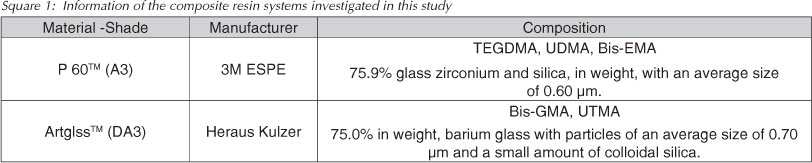
<body><![CDATA[<p>&nbsp;</p>     <p><font face="Verdana, Arial, Helvetica, sans-serif" size="3"><b>Materials and    method</b></font></p>     <p><font face="Verdana, Arial, Helvetica, sans-serif" size="2">This study was    performed with the composite resin Filtek P-60<sup>TM</sup> (3M Dental Products,    St. Paul, MN, EUA)<sup>14</sup>; shade A3, indicated for direct and indirect    fillings, and the composite resin Artglass<sup>TM</sup> (Heraus Kulzer, Wehrhein,    Hessen, Germany), shade DA3, indicated for indirect restorations (<a href="/img/revistas/rfo/v15n3/10s01.jpg">Square    1</a>).</font></p>     <p><font face="Verdana, Arial, Helvetica, sans-serif" size="2">The flexural strength    tests were accomplished according to ISO 4049:2000 criteria. The samples were    obtained through a metallic matrix split in two, forming a rectangular cavity    with 25 mm length X 2 mm width X 2 mm high dimensions<sup>15</sup>.</font></p>     <p><font face="Verdana, Arial, Helvetica, sans-serif" size="2">Thirty samples    of resin composite Filtek P-60<sup>TM</sup> were confectioned and randomly distributed    in three experimental groups with 10 samples each: Group I - conventional light-cure;    Group II post-cure with dry heat after conventional light-cure; Group III -    post-cure with a laboratory light-cure unit after conventional light-cure. The    composite resin Filtek P-60<sup>TM</sup> was incrementally placed in the metallic    matrix and a glass lamina was positioned over the composite resin using digital    pressure. In Group I, conventional light-cure was performed by using two Optlight    Plus<sup>TM</sup> (Gnatus, Ribeir&atilde;o Preto, SP, Brazil) light-cure units,    with a pointer of 10 mm of diameter, with a irradiance of 500 mW/cm<sup>2</sup>;    checked by the radiometer Gnatus<sup>TM</sup>. Light-cure initially occurred    at the center of the metallic matrix for 40s, and then towards both extremities,    with the aid of both light-cure units for a further 40s each. The sample was    then removed from the metallic matrix, placed up-side-down and the previously    described light-cure procedure was achieved, totalizing 240s for each sample.    In Group II, post-cure with heat was applied by using a Dental Klin<sup>TM</sup>    (Odontobr&aacute;s, Ribeir&atilde;o Preto, SP, Brazil), previously calibrated    to generate dry heat at 120 ºC for 600s. In Group III, post-cure with light    was performed with a UniXS<sup>TM</sup> (Heraus Kulzer, Wehrhein, Hessen, Germany)    light unit with two xenon stroboscopic light bulbs, for 180s in each side of    the sample.</font></p>     <p><font face="Verdana, Arial, Helvetica, sans-serif" size="2">The laboratory    composite resin Artglass<sup>TM</sup> was incrementally placed in the metallic    matrix and a glass lamina was placed over it, using digital pressure. After    the insertion of the composite resin, light-cure was performed by using a UniXS<sup>TM</sup>    laboratory light-cure unit for 180s. The matrix was then turned up-side-down,    and the light-cure procedure described was repeated, totalizing 360s for each    sample. Ten samples were confectioned with Artglass<sup>TM</sup> laboratorial    composite resin (Group IV).</font></p>     <p><font face="Verdana, Arial, Helvetica, sans-serif" size="2">After the activation    procedures, the samples were kept in deionized water at 37 &plusmn; 1 ºC for    24h, in a biological kiln, in a dark receptacle, protected from light.</font></p>     <p><font face="Verdana, Arial, Helvetica, sans-serif" size="2">Flexure tests were    fulfilled by means of a universal testing machine Instron which was charged    with a cell of load of 100N at a cross-head speed of 0.5 mm/min.</font></p>     <p><font face="Verdana, Arial, Helvetica, sans-serif" size="2">Vickers micro-hardness    testing followed the ASTM E-384:1999 criteria. Samples were confectioned with    the aid of a PVC matrix with a diameter of 5 mm and 2 mm thick placed over a    glass slab<sup>16</sup>.</font></p>     <p><font face="Verdana, Arial, Helvetica, sans-serif" size="2">Filtek P-60<sup>TM</sup>    composite resin was incrementally placed inside the PVC matrix and a glass lamina    was placed over it. After insertion with composite resin, conventional light-cure    was performed by using the Optlight<sup>TM</sup> light-cure unit. The matrix    was then turned up-side-down, and the previously described light-cure procedure    was repeated, totalizing 80s of light exposure for each sample. The post-cure    method was the same as that performed for the flexure test. Fifteen samples    were confectioned with Filtek P-60<sup>TM</sup> composite resin and were randomly    distributed in three experimental groups previously described.</font></p>     ]]></body>
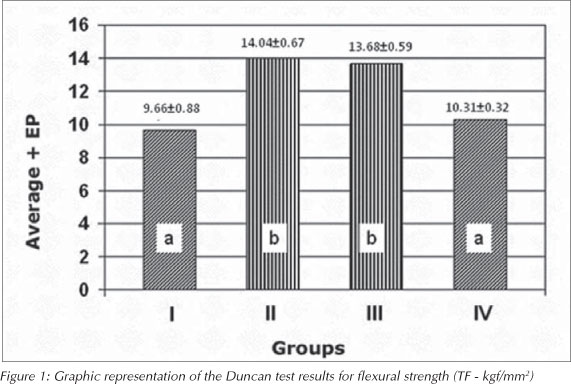
<body><![CDATA[<p><font face="Verdana, Arial, Helvetica, sans-serif" size="2">The laboratory    composite resin, Artglass<sup>TM</sup>; was incrementally placed inside the    PVC matrix and a glass lamina was placed over it using digital pressure. After    the insertion of composite resin, light-cure was accomplished by using a UniXS<sup>TM</sup>    laboratory light-cure unit for 180s. The matrix was then turned up-side-down,    and the light-cure procedure described was repeated, totalizing 360s for each    sample. Five samples were confectioned with Artglass<sup>TM</sup> laboratorial    composite resin (Group IV).</font></p>     <p><font face="Verdana, Arial, Helvetica, sans-serif" size="2">After activation,    all samples were kept in deionized water at 37 &plusmn; 1 ºC for 24 hours in    a bacteriological kiln, in dark receptacles, protected from light.</font></p>     <p><font face="Verdana, Arial, Helvetica, sans-serif" size="2">Vickers micro-hardness    tests were performed by using a Durimet (Vickers Leitz<sup>TM</sup>; Wetzlar,    Hessen, Germany) microhardness tester with a 50 gF load, for 15s. Five indentations    marks were made on one surface of the each sample.</font></p>     <p><font face="Verdana, Arial, Helvetica, sans-serif" size="2">The flexural strength    and Vickers microhardness values were submitted to statistic analysis and the    averages to Duncan's multiple comparison tests (<i>p</i> &lt; 0.05).</font></p>     <p><font face="Verdana, Arial, Helvetica, sans-serif" size="2">In order to evaluate    differences in the interest averages between groups, Anova models and Duncan's    multiple comparison tests to compare treatments (groups) in pairs were used.    The results are shown on <a href="#f1">Figures 1</a> and <a href="#f2">2</a>.    The analysis was performed with the SPSS 11.5 Inc. software (<i>Statistical    Package for Social Sciences</i>).</font></p>     <p><font face="Verdana, Arial, Helvetica, sans-serif" size="2">Different colors    indicate statistically significant differences</font></p>     <p><a name="f1"></a></p>     <p>&nbsp;</p>     <p align="center"><img src="/img/revistas/rfo/v15n3/10f01.jpg"></p>     <p>&nbsp;</p>     ]]></body>
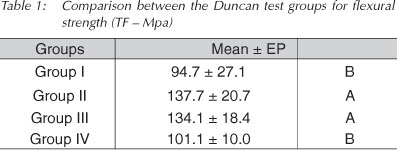
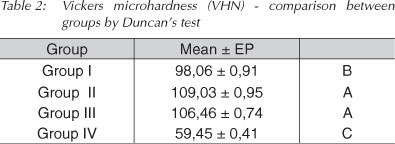
<body><![CDATA[<p><font face="Verdana, Arial, Helvetica, sans-serif" size="2">Different colors    indicate statistically significant differences</font></p>     <p><a name="f2"></a></p>     <p>&nbsp;</p>     <p align="center"><img src="/img/revistas/rfo/v15n3/10f02.jpg"></p>     <p>&nbsp;</p>     <p><font face="Verdana, Arial, Helvetica, sans-serif" size="3"><b>Results</b></font></p>     <p><font face="Verdana, Arial, Helvetica, sans-serif" size="2">The mean values    and standard deviations of flexural strength and microhardness and statistical    grouping are shown in <a href="#t1">Tables 1</a> and <a href="#t2">2</a>.</font></p>     <p><a name="t1"></a></p>     <p>&nbsp;</p>     <p align="center"><img src="/img/revistas/rfo/v15n3/10t01.jpg"></p>     ]]></body>
<body><![CDATA[<p>&nbsp;</p>     <p><font face="Verdana, Arial, Helvetica, sans-serif" size="2">Different letters    indicate statistically significant differences between groups (<i>p</i> &lt;    0.05)</font></p>     <p><a name="t2"></a></p>     <p>&nbsp;</p>     <p align="center"><img src="/img/revistas/rfo/v15n3/10t02.jpg"></p>     <p>&nbsp;</p>     <p><font face="Verdana, Arial, Helvetica, sans-serif" size="2">Different letters    indicate statistically significant differences between groups (<i>p</i> &lt;    0.05)</font></p>     <p>&nbsp;</p>     <p><font face="Verdana, Arial, Helvetica, sans-serif" size="3"><b>Discussion</b></font></p>     <p><font face="Verdana, Arial, Helvetica, sans-serif" size="2">The direct composite    system studied submitted to post-cure produced values of flexural strength and    microhardness higher than the laboratory composite resin, thus confirming the    study hypotheses.</font></p>     ]]></body>
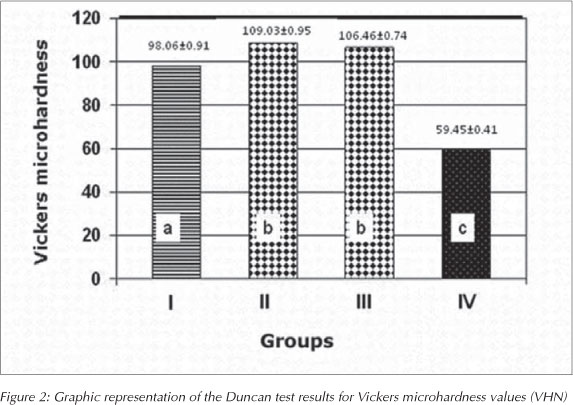
<body><![CDATA[<p><font face="Verdana, Arial, Helvetica, sans-serif" size="2">Among the esthetic    materials available in the market, the choice frequently lies between ceramic    or indirect resin restorations. History has shown that throughout time, interest    as regards dental ceramics has been inconstant. Even so, this material became    established as the first choice for reproducing natural teeth. Ceramics may    be considered as an excellent option for esthetic restorative material. They    are biocompatible, resistant to compression, have heat conductivity similar    to that one of dental tissues, marginal integrity, color stability, good resistance    to abrasion, and retain less bacterial plaque. Nevertheless, there are still    limitations, such as technique sensitivity, high cost, and when compared with    laboratory resin composites they are not effectively repaired<sup>17,18</sup>    <sub>.</sub></font></p>     <p><font face="Verdana, Arial, Helvetica, sans-serif" size="2">Post-cure with    100 &deg;C during seven minutes, between five and thirty minutes after initial    activation, was responsible for a higher increase in flexural strenght<sup>19</sup>.    Also, post-cure between 125 &deg;C and 150 &deg;C during one hour on an experimental    composite, resulted in higher values of flexural strength. However, the values    found were not statistically different when post-cure lasted 10 min<sup>2</sup>    only. Therefore, in this study, 10 min post-cure with heat was used, in order    to considerably increase bending and hardness strength of the studied composite    during a short period. This reduction in time is important to allow the dental    surgeon to perform a faster procedure.</font></p>     <p><font face="Verdana, Arial, Helvetica, sans-serif" size="2">The present study    both groups submitted to complementary activation (Groups II and III) showed    a statistically similar increase in flexural strength: around 35% in comparison    with the control group (Group I) and with the laboratorial composite resin Artglass<sup>TM</sup>    (Group IV). Composite resins submitted to post-cure, regardless the activation    method, showed an increase of 11% on flexural strength<sup>11</sup>.</font></p>     <p><font face="Verdana, Arial, Helvetica, sans-serif" size="2">In this study,    the composite resin Filtek P-60<sup>TM</sup>; which was not submitted to post-cure    (Group I), and the composite resin Artglass<sup>TM</sup> (Group IV), showed    statistically similar mean bending strength values. It was possible to conclude    that different chemical compositions and different activation units showed statistically    similar flexural strength values. Another study evaluated the flexural strength    and hardness of direct and indirect composites, and concludes that the direct    composite systems with higher filler contents had higher mean and values than    the indirect composites<sup>20</sup>.</font></p>     <p><font face="Verdana, Arial, Helvetica, sans-serif" size="2">Groups II and III,    submitted to post-cure, showed mean flexural strength values and were not statistically    different. Three post-cure methods using light and heat, heat and pressure and    microwave cycles, did not reveal statistical differences in flexural strength    of composite resins<sup>7</sup>.</font></p>     <p><font face="Verdana, Arial, Helvetica, sans-serif" size="2">Previous studies    has widely described that particle incorporation in composite matrixes provide    better mechanical properties<sup>9</sup>. No direct relation between the inorganic    particle content of composite resins and flexural strength was found<sup>5,21</sup>.    This fact makes it important to analysis the organic matrix formulation of composite    resin, source, time, intensity and direction of light-cure and presence of complementary    activation for the evaluation of the mechanical properties of composites.</font></p>     <p><font face="Verdana, Arial, Helvetica, sans-serif" size="2">Hardness reflects    the conversion degree of composite resins and is more related to the organic    matrix content of composite resins<sup>22</sup>. The presence of unpolymerize    monomers in the matrix may induce surface degradation of the composite resins<sup>23</sup>.    The results of the present study showed that the Vickers microhardness values    for Group I were highly superior to the Vickers microhardness values found for    Group IV. Therefore, the organic matrix of the composite resin Filtek P-60<sup>TM</sup>    is more susceptible to the monomeric conversion than the laboratorial composite    resin Artglass<sup>TM</sup>. Another study found that the Vickers microhardness    values for the composite resin Artglass<sup>TM</sup> inferior to the values    found for the direct composite resin Heliomolar<sup>TM</sup> (Ivoclar-Vivadent),    with an organic matrix basically composed of Bis-GMA and UDMA<sup>24</sup>.</font></p>     <p><font face="Verdana, Arial, Helvetica, sans-serif" size="2">Similar results    were observed when the direct/indirect composite resins TPH<sup>TM</sup> (Dentsply)    and Filtek P-60<sup>TM</sup> (3M ESPE) were submitted to post-cure. They showed    better mechanical properties (hardness and diametral strength) than the laboratorial    composite resin Solidex<sup>TM</sup> (Shofu) which has an organic matrix basically    composed of multifunctional resin co-polymers and UDMA<sup>3</sup>.</font></p>     <p><font face="Verdana, Arial, Helvetica, sans-serif" size="2">Evaluation of the    clinical heat post-cure performance of the composite resin Oclusin<sup>TM</sup>;    by using the US Public Health Service criteria, showed that it was responsible    for making the resin matrix more resistant to intra-oral fractures, improved    the marginal integrity and reduced the rates of post-operatory sensibility.    However, these results did not persist after 12 months<sup>25</sup>. Further    clinical evaluations must be undertaken periodically in order to verify the    maintenance of the increase in bending strength and Vickers microhardness of    composite resin Filtek P-60<sup>TM</sup> submitted to post-cure.</font></p>     <p>&nbsp;</p>     ]]></body>
<body><![CDATA[<p><font face="Verdana, Arial, Helvetica, sans-serif" size="3"><b>Conclusions</b></font></p> <ul>       <li><font face="Verdana, Arial, Helvetica, sans-serif" size="2">Post-cure of      the composite resin Filtek P-60<sup>TM</sup>; either by light or heat, increased      flexural strength and Vickers microhardness with statistically significant      values compared to conventional activation.</font></li>       <li><font face="Verdana, Arial, Helvetica, sans-serif" size="2">Flexural strength      values for the composite resin Filtek P-60<sup>TM</sup>; submitted to conventional      activation only, were statistically similar to flexural strength values of      the laboratorial composite resin Artglass<sup>TM</sup>.</font></li>       <li><font face="Verdana, Arial, Helvetica, sans-serif" size="2">Vickers microhardness      values of the composite resin Filtek P-60<sup>TM</sup>; submitted to conventional      activation only, were statistically superior to the Vickers microhardness      values of the laboratorial composite resin Artglass<sup>TM</sup>.</font></li>     </ul>     <p>&nbsp;</p>     <p><font face="Verdana, Arial, Helvetica, sans-serif" size="3"><b>References</b></font></p>     <!-- ref --><p><font face="Verdana, Arial, Helvetica, sans-serif" size="2">1. Kawano F, Ohguri    T, Ichikawa T, Matsumoto N. Influence of thermal cycles in water on flexural    strength of laboratory-processed composite resin. J Oral Rehabil 2001; 28(8):    703-7.    &nbsp;&nbsp;&nbsp;&nbsp;&nbsp;&nbsp;&nbsp;&nbsp;[&#160;<a href="javascript:void(0);" onclick="javascript: window.open('/scielo.php?script=sci_nlinks&ref=138205&pid=S1413-4012201000030001000001&lng=','','width=640,height=500,resizable=yes,scrollbars=1,menubar=yes,');">Links</a>&#160;]<!-- end-ref --></font></p>     <!-- ref --><p><font face="Verdana, Arial, Helvetica, sans-serif" size="2">2. Peutzfeldt A,    Asmussen E. Effect of temperature and duration of post-cure on selected mechanical    properties of resin composites containing carboxylic anhydrides Scand J Dent    Res 1992; 100(5):296-8.    &nbsp;&nbsp;&nbsp;&nbsp;&nbsp;&nbsp;&nbsp;&nbsp;[&#160;<a href="javascript:void(0);" onclick="javascript: window.open('/scielo.php?script=sci_nlinks&ref=138207&pid=S1413-4012201000030001000002&lng=','','width=640,height=500,resizable=yes,scrollbars=1,menubar=yes,');">Links</a>&#160;]<!-- end-ref --></font></p>     <!-- ref --><p><font face="Verdana, Arial, Helvetica, sans-serif" size="2">3. Soares C J,    Pizi ECG, Fonseca RB, Martins LRM. Mechanical properties of light-cured composites    polymerized with several additional post-curing methods. Oper Dent 2005; 30(3):389-94.    &nbsp;&nbsp;&nbsp;&nbsp;&nbsp;&nbsp;&nbsp;&nbsp;[&#160;<a href="javascript:void(0);" onclick="javascript: window.open('/scielo.php?script=sci_nlinks&ref=138209&pid=S1413-4012201000030001000003&lng=','','width=640,height=500,resizable=yes,scrollbars=1,menubar=yes,');">Links</a>&#160;]<!-- end-ref --></font></p>     <!-- ref --><p><font face="Verdana, Arial, Helvetica, sans-serif" size="2">4. Anusavice K    J. Phillip's Science of Dental Materials, 10. edition. W.B.: Saunders Co.; 1996.    &nbsp;&nbsp;&nbsp;&nbsp;&nbsp;&nbsp;&nbsp;&nbsp;[&#160;<a href="javascript:void(0);" onclick="javascript: window.open('/scielo.php?script=sci_nlinks&ref=138211&pid=S1413-4012201000030001000004&lng=','','width=640,height=500,resizable=yes,scrollbars=1,menubar=yes,');">Links</a>&#160;]<!-- end-ref --></font></p>     <!-- ref --><p><font face="Verdana, Arial, Helvetica, sans-serif" size="2">5. Ersoy M, Civelek    A, L'Hotelier E, Say EC, Soyman M. Physical properties of different composites.    Dent. Mat. Journal 2004; 23(3):278-84.    &nbsp;&nbsp;&nbsp;&nbsp;&nbsp;&nbsp;&nbsp;&nbsp;[&#160;<a href="javascript:void(0);" onclick="javascript: window.open('/scielo.php?script=sci_nlinks&ref=138213&pid=S1413-4012201000030001000005&lng=','','width=640,height=500,resizable=yes,scrollbars=1,menubar=yes,');">Links</a>&#160;]<!-- end-ref --></font></p>     <!-- ref --><p><font face="Verdana, Arial, Helvetica, sans-serif" size="2">6. Oertli D C B,    Mandarino F, Guerreiro M C. Study of different polymerization systems for indirect    aesthetic restorations. Rev Bras Odontol 2002; 59(1):61-4.    &nbsp;&nbsp;&nbsp;&nbsp;&nbsp;&nbsp;&nbsp;&nbsp;[&#160;<a href="javascript:void(0);" onclick="javascript: window.open('/scielo.php?script=sci_nlinks&ref=138215&pid=S1413-4012201000030001000006&lng=','','width=640,height=500,resizable=yes,scrollbars=1,menubar=yes,');">Links</a>&#160;]<!-- end-ref --></font></p>     <!-- ref --><p><font face="Verdana, Arial, Helvetica, sans-serif" size="2">7. Galafassi D,    Gon&ccedil;alves LS , Spazzin AO, Carlini Jr. B. Influence analisys of three    pos-polymerization methods in relation to flexural strenght of a clinical composite.    Rev Dental Press Estet 2006; 3(3):37-42.    &nbsp;&nbsp;&nbsp;&nbsp;&nbsp;&nbsp;&nbsp;&nbsp;[&#160;<a href="javascript:void(0);" onclick="javascript: window.open('/scielo.php?script=sci_nlinks&ref=138217&pid=S1413-4012201000030001000007&lng=','','width=640,height=500,resizable=yes,scrollbars=1,menubar=yes,');">Links</a>&#160;]<!-- end-ref --></font></p>     <!-- ref --><p><font face="Verdana, Arial, Helvetica, sans-serif" size="2">8. Kildal KK, Ruyter    IE. How different curing methods affect mechanical properties of composites    for inlays when tested in dry and wet conditions. Eur J Oral Sci 1997; 105(4):    353-61.    &nbsp;&nbsp;&nbsp;&nbsp;&nbsp;&nbsp;&nbsp;&nbsp;[&#160;<a href="javascript:void(0);" onclick="javascript: window.open('/scielo.php?script=sci_nlinks&ref=138219&pid=S1413-4012201000030001000008&lng=','','width=640,height=500,resizable=yes,scrollbars=1,menubar=yes,');">Links</a>&#160;]<!-- end-ref --></font></p>     <!-- ref --><p><font face="Verdana, Arial, Helvetica, sans-serif" size="2">9. Peutzfeldt A,    Asmussen E. Influence of carboxylic anhydrides on selected mechanical properties    of heat-cured resin composites. J Dent Res 1991; 70(12):1537-41.    &nbsp;&nbsp;&nbsp;&nbsp;&nbsp;&nbsp;&nbsp;&nbsp;[&#160;<a href="javascript:void(0);" onclick="javascript: window.open('/scielo.php?script=sci_nlinks&ref=138221&pid=S1413-4012201000030001000009&lng=','','width=640,height=500,resizable=yes,scrollbars=1,menubar=yes,');">Links</a>&#160;]<!-- end-ref --></font></p>     <!-- ref --><p><font face="Verdana, Arial, Helvetica, sans-serif" size="2">10. Peutzfeldt    A, Asmussen E. The effect of postcuring on quantity of remaining double bonds,    mechanical properties, and <i>in vitro</i> wear of two resin composites. J Dent    2000; 28(6):447-52.    &nbsp;&nbsp;&nbsp;&nbsp;&nbsp;&nbsp;&nbsp;&nbsp;[&#160;<a href="javascript:void(0);" onclick="javascript: window.open('/scielo.php?script=sci_nlinks&ref=138223&pid=S1413-4012201000030001000010&lng=','','width=640,height=500,resizable=yes,scrollbars=1,menubar=yes,');">Links</a>&#160;]<!-- end-ref --></font></p>     <!-- ref --><p><font face="Verdana, Arial, Helvetica, sans-serif" size="2">11. Reinhardt JW,    Boyer DB, Stephens NH. Effects of secondary curing on indirect posterior composite    resins. Oper Dent 1994; 19(6): 217-20.    &nbsp;&nbsp;&nbsp;&nbsp;&nbsp;&nbsp;&nbsp;&nbsp;[&#160;<a href="javascript:void(0);" onclick="javascript: window.open('/scielo.php?script=sci_nlinks&ref=138225&pid=S1413-4012201000030001000011&lng=','','width=640,height=500,resizable=yes,scrollbars=1,menubar=yes,');">Links</a>&#160;]<!-- end-ref --></font></p>     <!-- ref --><p><font face="Verdana, Arial, Helvetica, sans-serif" size="2">12. Wendt SL. The    effect of heat used as secondary cure upon the physical properties of three    composite resins. II. Wear, hardness, and color stability. Quintessence Int    1987; 18(5):351-6.    &nbsp;&nbsp;&nbsp;&nbsp;&nbsp;&nbsp;&nbsp;&nbsp;[&#160;<a href="javascript:void(0);" onclick="javascript: window.open('/scielo.php?script=sci_nlinks&ref=138227&pid=S1413-4012201000030001000012&lng=','','width=640,height=500,resizable=yes,scrollbars=1,menubar=yes,');">Links</a>&#160;]<!-- end-ref --></font></p>     <!-- ref --><p><font face="Verdana, Arial, Helvetica, sans-serif" size="2">13. Santana IL,    Lodovici E, Matos JR, Medeiros IS, Miyasaki C, Rodrigues-Filho LE. Effect of    experimental heat treatment on mechanical properties of resin composites. Braz    Dent J 2009; 20(3):205-10.    &nbsp;&nbsp;&nbsp;&nbsp;&nbsp;&nbsp;&nbsp;&nbsp;[&#160;<a href="javascript:void(0);" onclick="javascript: window.open('/scielo.php?script=sci_nlinks&ref=138229&pid=S1413-4012201000030001000013&lng=','','width=640,height=500,resizable=yes,scrollbars=1,menubar=yes,');">Links</a>&#160;]<!-- end-ref --></font></p>     <!-- ref --><p><font face="Verdana, Arial, Helvetica, sans-serif" size="2">14. Technical Product    Profile. Filtek&#153; P60 Posterior Restorative System. 3M Catalogue; 1998.    &nbsp;&nbsp;&nbsp;&nbsp;&nbsp;&nbsp;&nbsp;&nbsp;[&#160;<a href="javascript:void(0);" onclick="javascript: window.open('/scielo.php?script=sci_nlinks&ref=138231&pid=S1413-4012201000030001000014&lng=','','width=640,height=500,resizable=yes,scrollbars=1,menubar=yes,');">Links</a>&#160;]<!-- end-ref --></font></p>     <!-- ref --><p><font face="Verdana, Arial, Helvetica, sans-serif" size="2">15. International    Organization For Standardization (1988). <i>Dentistry - Resin-Based Filling-Materials</i>.    ISO 4049:1988 (E).    &nbsp;&nbsp;&nbsp;&nbsp;&nbsp;&nbsp;&nbsp;&nbsp;[&#160;<a href="javascript:void(0);" onclick="javascript: window.open('/scielo.php?script=sci_nlinks&ref=138233&pid=S1413-4012201000030001000015&lng=','','width=640,height=500,resizable=yes,scrollbars=1,menubar=yes,');">Links</a>&#160;]<!-- end-ref --></font></p>     <!-- ref --><p><font face="Verdana, Arial, Helvetica, sans-serif" size="2">16. Astm E-384.    "Standard test method for microhardness of materials". American Society for    Testing and Materials ASTM, Annual Book of Standards, v. 3; 1999.    &nbsp;&nbsp;&nbsp;&nbsp;&nbsp;&nbsp;&nbsp;&nbsp;[&#160;<a href="javascript:void(0);" onclick="javascript: window.open('/scielo.php?script=sci_nlinks&ref=138235&pid=S1413-4012201000030001000016&lng=','','width=640,height=500,resizable=yes,scrollbars=1,menubar=yes,');">Links</a>&#160;]<!-- end-ref --></font></p>     <!-- ref --><p><font face="Verdana, Arial, Helvetica, sans-serif" size="2">17. Montenegro    AC, Couto CF, Ventura PRR, Gouvea CVD, Machado AN. <i>In vitro</i> comparative    analysis of resistance to compression of laboratory resin composites and ceramic    system. Indian J Dent Res 2010; 21:68-71.    &nbsp;&nbsp;&nbsp;&nbsp;&nbsp;&nbsp;&nbsp;&nbsp;[&#160;<a href="javascript:void(0);" onclick="javascript: window.open('/scielo.php?script=sci_nlinks&ref=138237&pid=S1413-4012201000030001000017&lng=','','width=640,height=500,resizable=yes,scrollbars=1,menubar=yes,');">Links</a>&#160;]<!-- end-ref --></font></p>     <!-- ref --><p><font face="Verdana, Arial, Helvetica, sans-serif" size="2">18. Faria ACL,    Benassi UM, Rodrigues RCS, Ribeiro RF, Mattos MGC. Analysis of relationship    between the surface hardness an wear resistance of indirect composites used    as veneer materials. Braz Dent J 2007; 18(1):60-4.    &nbsp;&nbsp;&nbsp;&nbsp;&nbsp;&nbsp;&nbsp;&nbsp;[&#160;<a href="javascript:void(0);" onclick="javascript: window.open('/scielo.php?script=sci_nlinks&ref=138239&pid=S1413-4012201000030001000018&lng=','','width=640,height=500,resizable=yes,scrollbars=1,menubar=yes,');">Links</a>&#160;]<!-- end-ref --></font></p>     <!-- ref --><p><font face="Verdana, Arial, Helvetica, sans-serif" size="2">19. Loza-Herrero    MA, Rueggeberg FA, Caughman WF, Shuster GS, Lefebvre CA, Gardner FM. Effect    of heating delay on conversion and strength of a post-cured resin composite.    J Dent Res 1998; 77(2):426-31.    &nbsp;&nbsp;&nbsp;&nbsp;&nbsp;&nbsp;&nbsp;&nbsp;[&#160;<a href="javascript:void(0);" onclick="javascript: window.open('/scielo.php?script=sci_nlinks&ref=138241&pid=S1413-4012201000030001000019&lng=','','width=640,height=500,resizable=yes,scrollbars=1,menubar=yes,');">Links</a>&#160;]<!-- end-ref --></font></p>     <!-- ref --><p><font face="Verdana, Arial, Helvetica, sans-serif" size="2">20. Borba M, Della    Bona A, Cecchetti D. Flexural strength and hardness of direct and indirect composites.    Braz Oral Res 2009; 23(1):5-10.    &nbsp;&nbsp;&nbsp;&nbsp;&nbsp;&nbsp;&nbsp;&nbsp;[&#160;<a href="javascript:void(0);" onclick="javascript: window.open('/scielo.php?script=sci_nlinks&ref=138243&pid=S1413-4012201000030001000020&lng=','','width=640,height=500,resizable=yes,scrollbars=1,menubar=yes,');">Links</a>&#160;]<!-- end-ref --></font></p>     <!-- ref --><p><font face="Verdana, Arial, Helvetica, sans-serif" size="2">21. Adabo GL, Cruz    CAS, Fonseca RG, Vaz LG. The volumetric fraction of inorganic particles and    the flexural strength of composites for posterior teeth. J. Dent 2003; 31(5):353-9.    &nbsp;&nbsp;&nbsp;&nbsp;&nbsp;&nbsp;&nbsp;&nbsp;[&#160;<a href="javascript:void(0);" onclick="javascript: window.open('/scielo.php?script=sci_nlinks&ref=138245&pid=S1413-4012201000030001000021&lng=','','width=640,height=500,resizable=yes,scrollbars=1,menubar=yes,');">Links</a>&#160;]<!-- end-ref --></font></p>     <!-- ref --><p><font face="Verdana, Arial, Helvetica, sans-serif" size="2">22. Loguercio AD,    Poskus ARLT, Rodrigues Filho LE, Busato ALS, Bauer JRO. Evaluation of the mechanical    properties of different composite resins. Rev Bras Odontol 2001; 58(6):382-5.    &nbsp;&nbsp;&nbsp;&nbsp;&nbsp;&nbsp;&nbsp;&nbsp;[&#160;<a href="javascript:void(0);" onclick="javascript: window.open('/scielo.php?script=sci_nlinks&ref=138247&pid=S1413-4012201000030001000022&lng=','','width=640,height=500,resizable=yes,scrollbars=1,menubar=yes,');">Links</a>&#160;]<!-- end-ref --></font></p>     <!-- ref --><p><font face="Verdana, Arial, Helvetica, sans-serif" size="2">23. Satsukawa H,    Hiroyasu K, Naomi T, Mika N, Tomohisa O, Hideo M. Properties of an indirect    composite material polymerized with two different laboratory polymerinzing system.    Dent Mater J 2005; 24(3):377-81.    &nbsp;&nbsp;&nbsp;&nbsp;&nbsp;&nbsp;&nbsp;&nbsp;[&#160;<a href="javascript:void(0);" onclick="javascript: window.open('/scielo.php?script=sci_nlinks&ref=138249&pid=S1413-4012201000030001000023&lng=','','width=640,height=500,resizable=yes,scrollbars=1,menubar=yes,');">Links</a>&#160;]<!-- end-ref --></font></p>     <!-- ref --><p><font face="Verdana, Arial, Helvetica, sans-serif" size="2">24. Mandikos MN,    McGivney GP, Davis E, Bush PJ, Carter JM. A comparison of the wear resistance    and hardness of indirect composite resins. J Prosthet Dent 2001; 85(4):386-95.    &nbsp;&nbsp;&nbsp;&nbsp;&nbsp;&nbsp;&nbsp;&nbsp;[&#160;<a href="javascript:void(0);" onclick="javascript: window.open('/scielo.php?script=sci_nlinks&ref=138251&pid=S1413-4012201000030001000024&lng=','','width=640,height=500,resizable=yes,scrollbars=1,menubar=yes,');">Links</a>&#160;]<!-- end-ref --></font></p>     <!-- ref --><p><font face="Verdana, Arial, Helvetica, sans-serif" size="2">25. Wendt SL, Leinfelder    KF. The clinical evaluation of heat-treated composite resin inlays. J Am Dent    Assoc 1990; 20(2):177-81.    &nbsp;&nbsp;&nbsp;&nbsp;&nbsp;&nbsp;&nbsp;&nbsp;[&#160;<a href="javascript:void(0);" onclick="javascript: window.open('/scielo.php?script=sci_nlinks&ref=138253&pid=S1413-4012201000030001000025&lng=','','width=640,height=500,resizable=yes,scrollbars=1,menubar=yes,');">Links</a>&#160;]<!-- end-ref --></font></p>     <p>&nbsp;</p>     <p>&nbsp;</p>     <p><font face="Verdana, Arial, Helvetica, sans-serif" size="2"><b><a name="back"></a><a href="#top"><img src="/img/revistas/rfo/v15n3/seta.jpg" border="0"></a>    Correspondence to:</b>     ]]></body>
<body><![CDATA[<br>   Luciano de Oliveira Martins Junior    <br>   Rua Dos Otoni, 428/402 - Santa Efig&ecirc;nia    <br>   30150-270 Belo Horizonte - MG    <br>   Fones: (31) 3241-1177    <br>   E-mail: <a href="mailto:lomjrodontologia@gmail.com">lomjrodontologia@gmail.com</a></font></p>     <p><font face="Verdana, Arial, Helvetica, sans-serif" size="2">Recebido: 06.12.2009    <br>   Aceito: 14.07.2010</font></p>      ]]></body>
<back>
<ref-list>
<ref id="B1">
<label>1</label><nlm-citation citation-type="journal">
<person-group person-group-type="author">
<name>
<surname><![CDATA[Kawano]]></surname>
<given-names><![CDATA[F]]></given-names>
</name>
<name>
<surname><![CDATA[Ohguri]]></surname>
<given-names><![CDATA[T]]></given-names>
</name>
<name>
<surname><![CDATA[Ichikawa]]></surname>
<given-names><![CDATA[T]]></given-names>
</name>
<name>
<surname><![CDATA[Matsumoto]]></surname>
<given-names><![CDATA[N]]></given-names>
</name>
</person-group>
<article-title xml:lang="en"><![CDATA[Influence of thermal cycles in water on flexural strength of laboratory-processed composite resin]]></article-title>
<source><![CDATA[J Oral Rehabil]]></source>
<year>2001</year>
<volume>28</volume>
<numero>8</numero>
<issue>8</issue>
<page-range>703-7</page-range></nlm-citation>
</ref>
<ref id="B2">
<label>2</label><nlm-citation citation-type="journal">
<person-group person-group-type="author">
<name>
<surname><![CDATA[Peutzfeldt]]></surname>
<given-names><![CDATA[A]]></given-names>
</name>
<name>
<surname><![CDATA[Asmussen]]></surname>
<given-names><![CDATA[E]]></given-names>
</name>
</person-group>
<article-title xml:lang="en"><![CDATA[Effect of temperature and duration of post-cure on selected mechanical properties of resin composites containing carboxylic anhydrides Scand]]></article-title>
<source><![CDATA[J Dent Res]]></source>
<year>1992</year>
<volume>100</volume>
<numero>5</numero>
<issue>5</issue>
<page-range>296-8</page-range></nlm-citation>
</ref>
<ref id="B3">
<label>3</label><nlm-citation citation-type="journal">
<person-group person-group-type="author">
<name>
<surname><![CDATA[Soares C]]></surname>
<given-names><![CDATA[J]]></given-names>
</name>
<name>
<surname><![CDATA[Pizi]]></surname>
<given-names><![CDATA[ECG]]></given-names>
</name>
<name>
<surname><![CDATA[Fonseca]]></surname>
<given-names><![CDATA[RB]]></given-names>
</name>
<name>
<surname><![CDATA[Martins]]></surname>
<given-names><![CDATA[LRM]]></given-names>
</name>
</person-group>
<article-title xml:lang="en"><![CDATA[Mechanical properties of light-cured composites polymerized with several additional post-curing methods]]></article-title>
<source><![CDATA[Oper Dent]]></source>
<year>2005</year>
<volume>30</volume>
<numero>3</numero>
<issue>3</issue>
<page-range>389-94</page-range></nlm-citation>
</ref>
<ref id="B4">
<label>4</label><nlm-citation citation-type="book">
<person-group person-group-type="author">
<name>
<surname><![CDATA[Anusavice K]]></surname>
<given-names><![CDATA[J]]></given-names>
</name>
</person-group>
<source><![CDATA[Phillip's Science of Dental Materials]]></source>
<year>1996</year>
<edition>10</edition>
<publisher-loc><![CDATA[^eW.B. W.B.]]></publisher-loc>
<publisher-name><![CDATA[Saunders Co.]]></publisher-name>
</nlm-citation>
</ref>
<ref id="B5">
<label>5</label><nlm-citation citation-type="journal">
<person-group person-group-type="author">
<name>
<surname><![CDATA[Ersoy]]></surname>
<given-names><![CDATA[M]]></given-names>
</name>
<name>
<surname><![CDATA[Civelek]]></surname>
<given-names><![CDATA[A]]></given-names>
</name>
<name>
<surname><![CDATA[L'Hotelier]]></surname>
<given-names><![CDATA[E]]></given-names>
</name>
<name>
<surname><![CDATA[Say]]></surname>
<given-names><![CDATA[EC]]></given-names>
</name>
<name>
<surname><![CDATA[Soyman]]></surname>
<given-names><![CDATA[M]]></given-names>
</name>
</person-group>
<article-title xml:lang="en"><![CDATA[Physical properties of different composites]]></article-title>
<source><![CDATA[Dent. Mat. Journal]]></source>
<year>2004</year>
<volume>23</volume>
<numero>3</numero>
<issue>3</issue>
<page-range>278-84</page-range></nlm-citation>
</ref>
<ref id="B6">
<label>6</label><nlm-citation citation-type="journal">
<person-group person-group-type="author">
<name>
<surname><![CDATA[Oertli D C]]></surname>
<given-names><![CDATA[B]]></given-names>
</name>
<name>
<surname><![CDATA[Mandarino]]></surname>
<given-names><![CDATA[F]]></given-names>
</name>
<name>
<surname><![CDATA[Guerreiro M]]></surname>
<given-names><![CDATA[C]]></given-names>
</name>
</person-group>
<article-title xml:lang="en"><![CDATA[Study of different polymerization systems for indirect aesthetic restorations]]></article-title>
<source><![CDATA[Rev Bras Odontol]]></source>
<year>2002</year>
<volume>59</volume>
<numero>1</numero>
<issue>1</issue>
<page-range>61-4</page-range></nlm-citation>
</ref>
<ref id="B7">
<label>7</label><nlm-citation citation-type="journal">
<person-group person-group-type="author">
<name>
<surname><![CDATA[Galafassi]]></surname>
<given-names><![CDATA[D]]></given-names>
</name>
<name>
<surname><![CDATA[Gonçalves]]></surname>
<given-names><![CDATA[LS]]></given-names>
</name>
<name>
<surname><![CDATA[Spazzin]]></surname>
<given-names><![CDATA[AO]]></given-names>
</name>
<name>
<surname><![CDATA[Carlini Jr.]]></surname>
<given-names><![CDATA[B.]]></given-names>
</name>
</person-group>
<article-title xml:lang="en"><![CDATA[Influence analisys of three pos-polymerization methods in relation to flexural strenght of a clinical composite]]></article-title>
<source><![CDATA[Rev Dental Press Estet]]></source>
<year>2006</year>
<volume>3</volume>
<numero>3</numero>
<issue>3</issue>
<page-range>37-42</page-range></nlm-citation>
</ref>
<ref id="B8">
<label>8</label><nlm-citation citation-type="journal">
<person-group person-group-type="author">
<name>
<surname><![CDATA[Kildal]]></surname>
<given-names><![CDATA[KK]]></given-names>
</name>
<name>
<surname><![CDATA[Ruyter]]></surname>
<given-names><![CDATA[IE]]></given-names>
</name>
</person-group>
<article-title xml:lang="en"><![CDATA[How different curing methods affect mechanical properties of composites for inlays when tested in dry and wet conditions]]></article-title>
<source><![CDATA[Eur J Oral Sci]]></source>
<year>1997</year>
<volume>105</volume>
<numero>4</numero>
<issue>4</issue>
<page-range>353-61</page-range></nlm-citation>
</ref>
<ref id="B9">
<label>9</label><nlm-citation citation-type="journal">
<person-group person-group-type="author">
<name>
<surname><![CDATA[Peutzfeldt]]></surname>
<given-names><![CDATA[A]]></given-names>
</name>
<name>
<surname><![CDATA[Asmussen]]></surname>
<given-names><![CDATA[E]]></given-names>
</name>
</person-group>
<article-title xml:lang="en"><![CDATA[Influence of carboxylic anhydrides on selected mechanical properties of heat-cured resin composites]]></article-title>
<source><![CDATA[J Dent Res]]></source>
<year>1991</year>
<volume>70</volume>
<numero>12</numero>
<issue>12</issue>
<page-range>1537-41</page-range></nlm-citation>
</ref>
<ref id="B10">
<label>10</label><nlm-citation citation-type="journal">
<person-group person-group-type="author">
<name>
<surname><![CDATA[Peutzfeldt]]></surname>
<given-names><![CDATA[A]]></given-names>
</name>
<name>
<surname><![CDATA[Asmussen]]></surname>
<given-names><![CDATA[E]]></given-names>
</name>
</person-group>
<article-title xml:lang="en"><![CDATA[The effect of postcuring on quantity of remaining double bonds, mechanical properties, and in vitro wear of two resin composites]]></article-title>
<source><![CDATA[J Dent]]></source>
<year>2000</year>
<volume>28</volume>
<numero>6</numero>
<issue>6</issue>
<page-range>447-52</page-range></nlm-citation>
</ref>
<ref id="B11">
<label>11</label><nlm-citation citation-type="journal">
<person-group person-group-type="author">
<name>
<surname><![CDATA[Reinhardt]]></surname>
<given-names><![CDATA[JW]]></given-names>
</name>
<name>
<surname><![CDATA[Boyer]]></surname>
<given-names><![CDATA[DB]]></given-names>
</name>
<name>
<surname><![CDATA[Stephens]]></surname>
<given-names><![CDATA[NH]]></given-names>
</name>
</person-group>
<article-title xml:lang="en"><![CDATA[Effects of secondary curing on indirect posterior composite resins]]></article-title>
<source><![CDATA[Oper Dent]]></source>
<year>1994</year>
<volume>19</volume>
<numero>6</numero>
<issue>6</issue>
<page-range>217-20</page-range></nlm-citation>
</ref>
<ref id="B12">
<label>12</label><nlm-citation citation-type="journal">
<person-group person-group-type="author">
<name>
<surname><![CDATA[Wendt]]></surname>
<given-names><![CDATA[SL]]></given-names>
</name>
</person-group>
<article-title xml:lang="en"><![CDATA[The effect of heat used as secondary cure upon the physical properties of three composite resins: II. Wear, hardness, and color stability]]></article-title>
<source><![CDATA[Quintessence Int]]></source>
<year>1987</year>
<volume>18</volume>
<numero>5</numero>
<issue>5</issue>
<page-range>351-6</page-range></nlm-citation>
</ref>
<ref id="B13">
<label>13</label><nlm-citation citation-type="journal">
<person-group person-group-type="author">
<name>
<surname><![CDATA[Santana]]></surname>
<given-names><![CDATA[IL]]></given-names>
</name>
<name>
<surname><![CDATA[Lodovici]]></surname>
<given-names><![CDATA[E]]></given-names>
</name>
<name>
<surname><![CDATA[Matos]]></surname>
<given-names><![CDATA[JR]]></given-names>
</name>
<name>
<surname><![CDATA[Medeiros]]></surname>
<given-names><![CDATA[IS]]></given-names>
</name>
<name>
<surname><![CDATA[Miyasaki]]></surname>
<given-names><![CDATA[C]]></given-names>
</name>
<name>
<surname><![CDATA[Rodrigues-Filho]]></surname>
<given-names><![CDATA[LE]]></given-names>
</name>
</person-group>
<article-title xml:lang="en"><![CDATA[Effect of experimental heat treatment on mechanical properties of resin composites]]></article-title>
<source><![CDATA[Braz Dent J]]></source>
<year>2009</year>
<volume>20</volume>
<numero>3</numero>
<issue>3</issue>
<page-range>205-10</page-range></nlm-citation>
</ref>
<ref id="B14">
<label>14</label><nlm-citation citation-type="book">
<collab>Technical Product Profile</collab>
<source><![CDATA[Filtek™ P60 Posterior Restorative System]]></source>
<year>1998</year>
<publisher-name><![CDATA[3M Catalogue]]></publisher-name>
</nlm-citation>
</ref>
<ref id="B15">
<label>15</label><nlm-citation citation-type="">
<collab>International Organization For Standardization</collab>
<source><![CDATA[Dentistry - Resin-Based Filling-Materials]]></source>
<year>1988</year>
<month>19</month>
<day>88</day>
</nlm-citation>
</ref>
<ref id="B16">
<label>16</label><nlm-citation citation-type="journal">
<collab>Astm E-384</collab>
<article-title xml:lang="en"><![CDATA["Standard test method for microhardness of materials": American Society for Testing and Materials ASTM]]></article-title>
<source><![CDATA[Annual Book of Standards]]></source>
<year>1999</year>
<volume>3</volume>
</nlm-citation>
</ref>
<ref id="B17">
<label>17</label><nlm-citation citation-type="journal">
<person-group person-group-type="author">
<name>
<surname><![CDATA[Montenegro]]></surname>
<given-names><![CDATA[AC]]></given-names>
</name>
<name>
<surname><![CDATA[Couto]]></surname>
<given-names><![CDATA[CF]]></given-names>
</name>
<name>
<surname><![CDATA[Ventura]]></surname>
<given-names><![CDATA[PRR]]></given-names>
</name>
<name>
<surname><![CDATA[Gouvea]]></surname>
<given-names><![CDATA[CVD]]></given-names>
</name>
<name>
<surname><![CDATA[Machado]]></surname>
<given-names><![CDATA[AN]]></given-names>
</name>
</person-group>
<article-title xml:lang="en"><![CDATA[In vitro comparative analysis of resistance to compression of laboratory resin composites and ceramic system]]></article-title>
<source><![CDATA[Indian J Dent Res]]></source>
<year>2010</year>
<volume>21</volume>
<page-range>68-71</page-range></nlm-citation>
</ref>
<ref id="B18">
<label>18</label><nlm-citation citation-type="journal">
<person-group person-group-type="author">
<name>
<surname><![CDATA[Faria]]></surname>
<given-names><![CDATA[ACL]]></given-names>
</name>
<name>
<surname><![CDATA[Benassi]]></surname>
<given-names><![CDATA[UM]]></given-names>
</name>
<name>
<surname><![CDATA[Rodrigues]]></surname>
<given-names><![CDATA[RCS]]></given-names>
</name>
<name>
<surname><![CDATA[Ribeiro]]></surname>
<given-names><![CDATA[RF]]></given-names>
</name>
<name>
<surname><![CDATA[Mattos]]></surname>
<given-names><![CDATA[MGC]]></given-names>
</name>
</person-group>
<article-title xml:lang="en"><![CDATA[Analysis of relationship between the surface hardness an wear resistance of indirect composites used as veneer materials]]></article-title>
<source><![CDATA[Braz Dent J]]></source>
<year>2007</year>
<volume>18</volume>
<numero>1</numero>
<issue>1</issue>
<page-range>60-4</page-range></nlm-citation>
</ref>
<ref id="B19">
<label>19</label><nlm-citation citation-type="journal">
<person-group person-group-type="author">
<name>
<surname><![CDATA[Loza-Herrero]]></surname>
<given-names><![CDATA[MA]]></given-names>
</name>
<name>
<surname><![CDATA[Rueggeberg]]></surname>
<given-names><![CDATA[FA]]></given-names>
</name>
<name>
<surname><![CDATA[Caughman]]></surname>
<given-names><![CDATA[WF]]></given-names>
</name>
<name>
<surname><![CDATA[Shuster]]></surname>
<given-names><![CDATA[GS]]></given-names>
</name>
<name>
<surname><![CDATA[Lefebvre]]></surname>
<given-names><![CDATA[CA]]></given-names>
</name>
<name>
<surname><![CDATA[Gardner]]></surname>
<given-names><![CDATA[FM]]></given-names>
</name>
</person-group>
<article-title xml:lang="en"><![CDATA[Effect of heating delay on conversion and strength of a post-cured resin composite]]></article-title>
<source><![CDATA[J Dent Res]]></source>
<year>1998</year>
<volume>77</volume>
<numero>2</numero>
<issue>2</issue>
<page-range>426-31</page-range></nlm-citation>
</ref>
<ref id="B20">
<label>20</label><nlm-citation citation-type="journal">
<person-group person-group-type="author">
<name>
<surname><![CDATA[Borba]]></surname>
<given-names><![CDATA[M]]></given-names>
</name>
<name>
<surname><![CDATA[Della Bona]]></surname>
<given-names><![CDATA[A]]></given-names>
</name>
<name>
<surname><![CDATA[Cecchetti]]></surname>
<given-names><![CDATA[D]]></given-names>
</name>
</person-group>
<article-title xml:lang="en"><![CDATA[Flexural strength and hardness of direct and indirect composites]]></article-title>
<source><![CDATA[Braz Oral Res]]></source>
<year>2009</year>
<volume>23</volume>
<numero>1</numero>
<issue>1</issue>
<page-range>5-10</page-range></nlm-citation>
</ref>
<ref id="B21">
<label>21</label><nlm-citation citation-type="journal">
<person-group person-group-type="author">
<name>
<surname><![CDATA[Adabo]]></surname>
<given-names><![CDATA[GL]]></given-names>
</name>
<name>
<surname><![CDATA[Cruz]]></surname>
<given-names><![CDATA[CAS]]></given-names>
</name>
<name>
<surname><![CDATA[Fonseca]]></surname>
<given-names><![CDATA[RG]]></given-names>
</name>
<name>
<surname><![CDATA[Vaz]]></surname>
<given-names><![CDATA[LG]]></given-names>
</name>
</person-group>
<article-title xml:lang="en"><![CDATA[The volumetric fraction of inorganic particles and the flexural strength of composites for posterior teeth]]></article-title>
<source><![CDATA[J. Dent]]></source>
<year>2003</year>
<volume>31</volume>
<numero>5</numero>
<issue>5</issue>
<page-range>353-9</page-range></nlm-citation>
</ref>
<ref id="B22">
<label>22</label><nlm-citation citation-type="journal">
<person-group person-group-type="author">
<name>
<surname><![CDATA[Loguercio]]></surname>
<given-names><![CDATA[AD]]></given-names>
</name>
<name>
<surname><![CDATA[Poskus]]></surname>
<given-names><![CDATA[ARLT]]></given-names>
</name>
<name>
<surname><![CDATA[Rodrigues Filho]]></surname>
<given-names><![CDATA[LE]]></given-names>
</name>
<name>
<surname><![CDATA[Busato]]></surname>
<given-names><![CDATA[ALS]]></given-names>
</name>
<name>
<surname><![CDATA[Bauer]]></surname>
<given-names><![CDATA[JRO]]></given-names>
</name>
</person-group>
<article-title xml:lang="en"><![CDATA[Evaluation of the mechanical properties of different composite resins]]></article-title>
<source><![CDATA[Rev Bras Odontol]]></source>
<year>2001</year>
<volume>58</volume>
<numero>6</numero>
<issue>6</issue>
<page-range>382-5</page-range></nlm-citation>
</ref>
<ref id="B23">
<label>23</label><nlm-citation citation-type="journal">
<person-group person-group-type="author">
<name>
<surname><![CDATA[Satsukawa]]></surname>
<given-names><![CDATA[H]]></given-names>
</name>
<name>
<surname><![CDATA[Hiroyasu]]></surname>
<given-names><![CDATA[K]]></given-names>
</name>
<name>
<surname><![CDATA[Naomi]]></surname>
<given-names><![CDATA[T]]></given-names>
</name>
<name>
<surname><![CDATA[Mika]]></surname>
<given-names><![CDATA[N]]></given-names>
</name>
<name>
<surname><![CDATA[Tomohisa]]></surname>
<given-names><![CDATA[O]]></given-names>
</name>
<name>
<surname><![CDATA[Hideo]]></surname>
<given-names><![CDATA[M]]></given-names>
</name>
</person-group>
<article-title xml:lang="en"><![CDATA[Properties of an indirect composite material polymerized with two different laboratory polymerinzing system]]></article-title>
<source><![CDATA[Dent Mater J]]></source>
<year>2005</year>
<volume>24</volume>
<numero>3</numero>
<issue>3</issue>
<page-range>377-81</page-range></nlm-citation>
</ref>
<ref id="B24">
<label>24</label><nlm-citation citation-type="journal">
<person-group person-group-type="author">
<name>
<surname><![CDATA[Mandikos]]></surname>
<given-names><![CDATA[MN]]></given-names>
</name>
<name>
<surname><![CDATA[McGivney]]></surname>
<given-names><![CDATA[GP]]></given-names>
</name>
<name>
<surname><![CDATA[Davis]]></surname>
<given-names><![CDATA[E]]></given-names>
</name>
<name>
<surname><![CDATA[Bush]]></surname>
<given-names><![CDATA[PJ]]></given-names>
</name>
<name>
<surname><![CDATA[Carter]]></surname>
<given-names><![CDATA[JM]]></given-names>
</name>
</person-group>
<article-title xml:lang="en"><![CDATA[A comparison of the wear resistance and hardness of indirect composite resins]]></article-title>
<source><![CDATA[J Prosthet Dent]]></source>
<year>2001</year>
<volume>85</volume>
<numero>4</numero>
<issue>4</issue>
<page-range>386-95</page-range></nlm-citation>
</ref>
<ref id="B25">
<label>25</label><nlm-citation citation-type="journal">
<person-group person-group-type="author">
<name>
<surname><![CDATA[Wendt]]></surname>
<given-names><![CDATA[SL]]></given-names>
</name>
<name>
<surname><![CDATA[Leinfelder]]></surname>
<given-names><![CDATA[KF]]></given-names>
</name>
</person-group>
<article-title xml:lang="en"><![CDATA[The clinical evaluation of heat-treated composite resin inlays]]></article-title>
<source><![CDATA[J Am Dent Assoc]]></source>
<year>1990</year>
<volume>20</volume>
<numero>2</numero>
<issue>2</issue>
<page-range>177-81</page-range></nlm-citation>
</ref>
</ref-list>
</back>
</article>