<?xml version="1.0" encoding="ISO-8859-1"?><article xmlns:mml="http://www.w3.org/1998/Math/MathML" xmlns:xlink="http://www.w3.org/1999/xlink" xmlns:xsi="http://www.w3.org/2001/XMLSchema-instance">
<front>
<journal-meta>
<journal-id>1413-4012</journal-id>
<journal-title><![CDATA[RFO UPF]]></journal-title>
<abbrev-journal-title><![CDATA[RFO UPF]]></abbrev-journal-title>
<issn>1413-4012</issn>
<publisher>
<publisher-name><![CDATA[Faculdade de Odontologia da UPF]]></publisher-name>
</publisher>
</journal-meta>
<article-meta>
<article-id>S1413-40122010000300012</article-id>
<title-group>
<article-title xml:lang="en"><![CDATA[Effect of different elastomers on cervical fit of full metal crowns]]></article-title>
<article-title xml:lang="pt"><![CDATA[Efeito de diferentes elastômeros na adaptação cervical de coroas totais metálicas]]></article-title>
</title-group>
<contrib-group>
<contrib contrib-type="author">
<name>
<surname><![CDATA[Pereira]]></surname>
<given-names><![CDATA[Jefferson Ricardo]]></given-names>
</name>
<xref ref-type="aff" rid="A01"/>
</contrib>
<contrib contrib-type="author">
<name>
<surname><![CDATA[Gavazzoni]]></surname>
<given-names><![CDATA[Alessandro]]></given-names>
</name>
<xref ref-type="aff" rid="A02"/>
</contrib>
<contrib contrib-type="author">
<name>
<surname><![CDATA[Lopes]]></surname>
<given-names><![CDATA[José Fernando Scarelli]]></given-names>
</name>
<xref ref-type="aff" rid="A02"/>
</contrib>
<contrib contrib-type="author">
<name>
<surname><![CDATA[Valle]]></surname>
<given-names><![CDATA[Accácio Lins do]]></given-names>
</name>
<xref ref-type="aff" rid="A03"/>
</contrib>
<contrib contrib-type="author">
<name>
<surname><![CDATA[Pinto]]></surname>
<given-names><![CDATA[João Henrique Nogueira]]></given-names>
</name>
<xref ref-type="aff" rid="A02"/>
</contrib>
</contrib-group>
<aff id="A01">
<institution><![CDATA[,University of South of Santa Catarina Dental School Departament of Prosthodontics]]></institution>
<addr-line><![CDATA[Tubarão SC]]></addr-line>
<country>Brazil</country>
</aff>
<aff id="A02">
<institution><![CDATA[,University of São Paulo Hospital Rehabilitation of Craniofacial Anomalies Departament of Prosthodontics]]></institution>
<addr-line><![CDATA[Bauru SP]]></addr-line>
<country>Brazil</country>
</aff>
<aff id="A03">
<institution><![CDATA[,University of São Paulo Bauru Dental School Departament of Prosthodontics]]></institution>
<addr-line><![CDATA[Bauru SP]]></addr-line>
<country>Brazil</country>
</aff>
<pub-date pub-type="pub">
<day>00</day>
<month>12</month>
<year>2010</year>
</pub-date>
<pub-date pub-type="epub">
<day>00</day>
<month>12</month>
<year>2010</year>
</pub-date>
<volume>15</volume>
<numero>3</numero>
<fpage>284</fpage>
<lpage>287</lpage>
<copyright-statement/>
<copyright-year/>
<self-uri xlink:href="http://revodonto.bvsalud.org/scielo.php?script=sci_arttext&amp;pid=S1413-40122010000300012&amp;lng=en&amp;nrm=iso"></self-uri><self-uri xlink:href="http://revodonto.bvsalud.org/scielo.php?script=sci_abstract&amp;pid=S1413-40122010000300012&amp;lng=en&amp;nrm=iso"></self-uri><self-uri xlink:href="http://revodonto.bvsalud.org/scielo.php?script=sci_pdf&amp;pid=S1413-40122010000300012&amp;lng=en&amp;nrm=iso"></self-uri><abstract abstract-type="short" xml:lang="en"><p><![CDATA[OBJECTIVE: The aim of this study was to evaluate the cervical fit of full metal crowns using four different elastomers. METHODS: A stainless steel metallic die similar to a prepared first upper molar was obtained. Four different elastomeric impression materials were utilized: polysulfide (A), polyether (B), condensation silicone (C) and addition silicone (D). Forty molds were created, 10 for each group. It was obtained 40 gypsum abutments. After the end of this stage, it was performed complete metal crowns on all specimens. Crown displacement was measured through a comparative microscope, obtaining diametrically opposite points. RESULTS: The results were the following: Group D (31.97 &#956;m), Group B (49.57 &#956;m), Group A (51.12 &#956;m), Group C (61.12 &#956;m). The analysis of variance (ANOVA) test and a Tukey test for multiple comparisons were used to analyze the results. CONCLUSIONS: There were significant differences among all groups, except for Groups A and B. The major result of displacement was Group C. The best results were shown by Group D (p < 0.05).]]></p></abstract>
<abstract abstract-type="short" xml:lang="pt"><p><![CDATA[OBJETIVO: O objetivo deste estudo foi avaliar o desajuste cervical de coroas metálicas utilizando quatro diferentes materiais elastoméricos. MATERIAIS E MÉTODO: Foi confeccionado um troquel metálico de aço inoxidável semelhante a um primeiro molar superior preparado. Quatro diferentes materiais de moldagem elastoméricos foram utilizados: polissulfeto (A), poliéster (B), silicone de condensação (C) e silicone de adição (D). Quarenta moldes foram obtidos, sendo dez para cada grupo. Desses foram obtidos quarenta troqueis de gesso. Após o término desta fase, foram confeccionadas coroas totais metálicas em todas as amostras. O deslocamento da coroa foi medida com um microscópio comparador, obtendo-se pontos diametralmente opostos. RESULTADOS: Foram os seguintes: Grupo D (31.97 &#956;m), Grupo B (49.57 &#956;m), Grupo A (51.12 &#956;m), Grupo C (61.12 &#956;m). A análise de variância (ANOVA) e o teste de Tukey para comparações múltiplas foram utilizados para análise dos resultados. CONCLUSÕES: Houve diferenças significativas entre os grupos, exceto para os Grupos A e B. O maior resultado de deslocamento foi para o Grupo C, e os melhores resultados foram apresentados pelo Grupo D (p < 0,05).]]></p></abstract>
<kwd-group>
<kwd lng="en"><![CDATA[Dental impression materials]]></kwd>
<kwd lng="en"><![CDATA[Dental impression technique]]></kwd>
<kwd lng="en"><![CDATA[Dental prosthesis]]></kwd>
<kwd lng="pt"><![CDATA[Materiais para moldagem odontológica]]></kwd>
<kwd lng="pt"><![CDATA[Técnica de moldagem odontológica]]></kwd>
<kwd lng="pt"><![CDATA[Prótese dentária]]></kwd>
</kwd-group>
</article-meta>
</front><body><![CDATA[ <p><a name="top"></a><font face="Verdana, Arial, Helvetica, sans-serif" size="4"><b>Effect    of different elastomers on cervical fit of full metal crowns</b></font></p>     <p>&nbsp;</p>     <p><font face="Verdana, Arial, Helvetica, sans-serif" size="3"><b>Efeito de diferentes    elast&ocirc;meros na adapta&ccedil;&atilde;o cervical de coroas totais met&aacute;licas</b></font></p>     <p>&nbsp;</p>     <p>&nbsp;</p>     <p><font face="Verdana, Arial, Helvetica, sans-serif" size="2"><b>Jefferson Ricardo    Pereira<sup>I</sup>; Alessandro Gavazzoni<sup>II</sup>; Jos&eacute; Fernando    Scarelli Lopes<sup>III</sup>; Acc&aacute;cio Lins do Valle<sup>IV</sup>; Jo&atilde;o    Henrique Nogueira Pinto<sup>III</sup></b></font></p>     <p><font face="Verdana, Arial, Helvetica, sans-serif" size="2"><sup>I</sup>Professor,    Departament of Prosthodontics, Dental School - University of South of Santa    Catarina - Unisul, Tubar&atilde;o, SC, Brazil    <br>   <sup>II</sup>Pos-graduated student, Departament of Prosthodontics, Hospital    Rehabilitation of Craniofacial Anomalies - University of S&atilde;o Paulo, Bauru,    SP, Brazil    <br>   <sup>III</sup>Professor, Departament of Prosthodontics, Hospital Rehabilitation    of Craniofacial anomalies - University of S&atilde;o Paulo, Bauru, SP, Brazil    <br>   <sup>IV</sup>Professor, Departament of Prosthodontics, Bauru Dental School -    University of S&atilde;o Paulo, Bauru, SP, Brazil</font></p>     ]]></body>
<body><![CDATA[<p><font face="Verdana, Arial, Helvetica, sans-serif" size="2"><a href="#back">Correspondece    to</a></font></p>     <p>&nbsp;</p>     <p>&nbsp;</p> <hr size="1" noshade>     <p><font face="Verdana, Arial, Helvetica, sans-serif" size="2"><b>ABSTRACT</b></font></p>     <p><font face="Verdana, Arial, Helvetica, sans-serif" size="2"><b>OBJECTIVE:</b>    The aim of this study was to evaluate the cervical fit of full metal crowns    using four different elastomers.    <br>   <b>METHODS:</b> A stainless steel metallic die similar to a prepared first upper    molar was obtained. Four different elastomeric impression materials were utilized:    polysulfide (A), polyether (B), condensation silicone (C) and addition silicone    (D). Forty molds were created, 10 for each group. It was obtained 40 gypsum    abutments. After the end of this stage, it was performed complete metal crowns    on all specimens. Crown displacement was measured through a comparative microscope,    obtaining diametrically opposite points.    <br>   <b>RESULTS:</b> The results were the following: Group D (31.97 </font><font size="2">&#956;</font><font face="Verdana, Arial, Helvetica, sans-serif" size="2">m),    Group B (49.57 </font><font size="2">&#956;</font><font face="Verdana, Arial, Helvetica, sans-serif" size="2">m),    Group A (51.12 </font><font size="2">&#956;</font><font face="Verdana, Arial, Helvetica, sans-serif" size="2">m),    Group C (61.12 </font><font size="2">&#956;</font><font face="Verdana, Arial, Helvetica, sans-serif" size="2">m).    The analysis of variance (ANOVA) test and a Tukey test for multiple comparisons    were used to analyze the results.    <br>   <b>CONCLUSIONS:</b> There were significant differences among all groups, except    for Groups A and B. The major result of displacement was Group C. The best results    were shown by Group D (p &lt; 0.05).</font></p>     <p><font face="Verdana, Arial, Helvetica, sans-serif" size="2"><b>Key words:</b>    Dental impression materials. Dental impression technique. Dental prosthesis.</font></p> <hr size="1" noshade>     <p><font face="Verdana, Arial, Helvetica, sans-serif" size="2"><b>RESUMO</b></font></p>     ]]></body>
<body><![CDATA[<p><font face="Verdana, Arial, Helvetica, sans-serif" size="2"><b>OBJETIVO:</b>    O objetivo deste estudo foi avaliar o desajuste cervical de coroas met&aacute;licas    utilizando quatro diferentes materiais elastom&eacute;ricos.    <br>   <b>MATERIAIS E M&Eacute;TODO:</b> Foi confeccionado um troquel met&aacute;lico    de a&ccedil;o inoxid&aacute;vel semelhante a um primeiro molar superior preparado.    Quatro diferentes materiais de moldagem elastom&eacute;ricos foram utilizados:    polissulfeto (A), poli&eacute;ster (B), silicone de condensa&ccedil;&atilde;o    (C) e silicone de adi&ccedil;&atilde;o (D). Quarenta moldes foram obtidos, sendo    dez para cada grupo. Desses foram obtidos quarenta troqueis de gesso. Ap&oacute;s    o t&eacute;rmino desta fase, foram confeccionadas coroas totais met&aacute;licas    em todas as amostras. O deslocamento da coroa foi medida com um microsc&oacute;pio    comparador, obtendo-se pontos diametralmente opostos.    <br>   <b>RESULTADOS:</b> Foram os seguintes: Grupo D (31.97 </font><font size="2">&#956;</font><font face="Verdana, Arial, Helvetica, sans-serif" size="2">m),    Grupo B (49.57 </font><font size="2">&#956;</font><font face="Verdana, Arial, Helvetica, sans-serif" size="2">m),    Grupo A (51.12 </font><font size="2">&#956;</font><font face="Verdana, Arial, Helvetica, sans-serif" size="2">m),    Grupo C (61.12 </font><font size="2">&#956;</font><font face="Verdana, Arial, Helvetica, sans-serif" size="2">m).    A an&aacute;lise de vari&acirc;ncia (ANOVA) e o teste de Tukey para compara&ccedil;&otilde;es    m&uacute;ltiplas foram utilizados para an&aacute;lise dos resultados.    <br>   <b>CONCLUS&Otilde;ES:</b> Houve diferen&ccedil;as significativas entre os grupos,    exceto para os Grupos A e B. O maior resultado de deslocamento foi para o Grupo    C, e os melhores resultados foram apresentados pelo Grupo D (p &lt; 0,05).</font></p>     <p><font face="Verdana, Arial, Helvetica, sans-serif" size="2"><b>Palavras-chave:    </b> Materiais para moldagem odontol&oacute;gica. T&eacute;cnica de moldagem    odontol&oacute;gica. Pr&oacute;tese dent&aacute;ria.</font></p> <hr size="1" noshade>     <p>&nbsp;</p>     <p>&nbsp;</p>     <p><font face="Verdana, Arial, Helvetica, sans-serif" size="3"><b>Introduction</b></font></p>     <p><font face="Verdana, Arial, Helvetica, sans-serif" size="2">The preparation    of a fixed prosthesis is a very detailed sequence of procedures whose steps    are completely interdependent. The technique of casting stands out as one of    the most important clinical interventions for the success of the fixed prosthesis;    it is the link between the laboratory and the clinical stage<sup>1</sup>.</font></p>     <p><font face="Verdana, Arial, Helvetica, sans-serif" size="2">The procedure of    taking impressions has been known since antiquity. However, only since the 1950s,    with the appearance of polysulfide, have the materials begun to be improve in    an attempt to achieve "ideal" characteristics. At approximately the same time,    around 1960, silicone was developed and work began on the marketing of polyether.    Since then, the clinician has been facing a new era with regard to impression    techniques, mainly due to the wide variety of materials and trademarks. Currently,    the most commonly used materials in fixed prosthodontics are polyether, polysulfide,    condensation silicone and addition silicone.</font></p>     ]]></body>
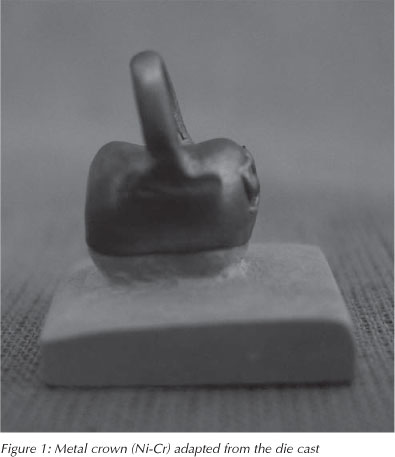
<body><![CDATA[<p><font face="Verdana, Arial, Helvetica, sans-serif" size="2">Addition silicone    and polyether are the materials that have the best characteristics and dimensional    stability, fidelity of copied details, elastic recovery, and lower values of    deformation<sup>2</sup>. Polysulfide has advantages such as good working time,    low cost and good resistance to tear, which is very important considering the    impression is made with individual coping, where a small amount of material    is used to reduce distortion and to resist tearing<sup>3,4</sup>. The disadvantages    are unpleasant odor, ability to stain and impaired elastic memory<sup>3</sup>.    Condensation silicone is a material widely used by professionals due to its    ease of use and low cost. However, it has low resistance to tear than other    elastomers and exaggerated distortion when stored for subsequent pouring<sup>2,5-7</sup>.</font></p>     <p><font face="Verdana, Arial, Helvetica, sans-serif" size="2">Therefore, the    aim of this study was to provide greater knowledge of the physical characteristics    of such materials so that they can, ideally, be used optimally in various situations    of dental treatment. The hypothesis was that there was significant difference    on cervical fit of full metal crowns in gypsum dies obtained with different    elastomeric materials.</font></p>     <p>&nbsp;</p>     <p><font face="Verdana, Arial, Helvetica, sans-serif" size="3"><b>Materials and    method</b></font></p>     <p><font face="Verdana, Arial, Helvetica, sans-serif" size="2">It was used a standard    metal made of stainless steel with features of the upper first molar, which    was impressioned with four different rubber-based materials: Group 1 - polysulfide    (Permlastic<sup>TM</sup>; Kerr, West Collins Orange - CA, EUA), Group 2 - polyether    (Impregum F<sup>TM</sup>; 3M, St. Paul - MM, EUA), Group 3 - condensation silicone    (Optosil-Xantopren<sup>TM</sup>; 3M, Schurz - Stra&szlig;e - NEUSS, Germany)    and Group 4 - addition silicone (Aquasil<sup>TM</sup>; Dentsply, De-Trey-Stra&szlig;e    - Konstanz, Germany). From this pattern, it was obtained 40 gypsum abutments    divided in four groups, 10 for each material. After the end of this stage, it    was performed the same procedure for the complete metal crowns on all specimens.</font></p>     <p><font face="Verdana, Arial, Helvetica, sans-serif" size="2">To create molding    using polyether and polysulfide, it was made individual copings, which were    made on the standard abutment in chemically activated acrylic resin (CAAR) (Cl&aacute;ssico    - Articles Dental S / A, Sao Paulo - SP, Brazil), with standard internal relief    of 0.5 mm, and readapted with acrylic resin (Duralay, Reliance Dental Mfg Co    Worth, Alsip - IL, EUA). Subsequently, It was done wax relief, with thickness    of 3 mm, on the whole abutment<sup>3</sup> an individual coping being made in    individual CAAR trays (Cl&aacute;ssico - Articles Dental S / A, Sao Paulo -    SP, Brazil), not perforated.</font></p>     <p><font face="Verdana, Arial, Helvetica, sans-serif" size="2">For molding with    addition and condensation silicone it was used individual perforated RAAQ trays    (Cl&aacute;ssico - Articles Dental S / A, Sao Paulo - SP, Brazil), made in a    similar manner to that described previously. The technique of double mixing    is the technique of choice for these two materials, and the relief from the    heavy and light material was achieved by the interposition of a polyethylene    film with 0.2 mm thickness.</font></p>     <p><font face="Verdana, Arial, Helvetica, sans-serif" size="2">The patterns obtained    by the four groups were assessed and, if they were not satisfactory, would be    discarded and a new procedure would be performed. The manipulation of both the    material and the plaster casting followed the recommendations of the manufacturers.    The molds of polyether, polysulfide and condensation silicone were poured, after    the prey of these materials, with type IV plaster (Durone<sup>TM</sup>; Dentsply,    Petropolis - RJ, Brazil); thus reducing the occurrence of dimensional changes    in the models obtained<sup>8</sup>. For the addition silicone mold, the pouring    was performed after 1 hour of prey of the material to avoid the occurrence of    pores in plaster abutments due to the release of H<sub>2</sub><sup>9,10</sup><sub>.</sub>    The conditions of temperature (23 &plusmn; 2 &deg;C) and humidity (50 + / -    10%) were the same for all materials.</font></p>     <p><font face="Verdana, Arial, Helvetica, sans-serif" size="2">Forty metal crowns    were obtained by the technique of lost wax. The wax patterns were sprued, invested    (Cristobalite<sup>TM</sup>; Whip Mix Corp, Louisville, KY, USA), and cast using    standard Ni-Cr alloy (Durabond, Sao Paulo, Brazil). After finishing and polishing,    the crowns were seated on the standard model (<a href="#f1">Fig. 1</a>) with    a load of adjustment of 9 kg, maintained for 1 min<sup>11</sup>. After this    time, the specimen was taken to the microscope optical comparator (Mitutoyo<sup>TM</sup>;    Mitutoyo Manufacturing Co., Tokyo - Tokyo, Japan) to perform measurements of    cervical misfit in four diametrically opposite points, located on the vestibular,    palatal, mesial and distal faces. There were three measurements for each point    and the average was considered as cervical misfit.</font></p>     <p><a name="f1"></a></p>     ]]></body>
<body><![CDATA[<p>&nbsp;</p>     <p align="center"><img src="/img/revistas/rfo/v15n3/12f01.jpg"></p>     <p>&nbsp;</p>     <p><font face="Verdana, Arial, Helvetica, sans-serif" size="3"><b>Results</b></font></p>     <p><font face="Verdana, Arial, Helvetica, sans-serif" size="2">The analysis of    variance (Anova) test and a Tukey test for multiple comparisons were used to    analyze the results. In all cases it was adopted a significance level of 5%    (p &lt; 0.05). The addition silicone obtained lower mean misfit (31.97 </font><font size="2">&#956;</font><font face="Verdana, Arial, Helvetica, sans-serif" size="2">m),    followed by the polyether (49.57 </font><font size="2">&#956;</font><font face="Verdana, Arial, Helvetica, sans-serif" size="2">m),    polysulfide (51.12 </font><font size="2">&#956;</font><font face="Verdana, Arial, Helvetica, sans-serif" size="2">m)    and the condensation silicone (61.12 </font><font size="2">&#956;</font><font face="Verdana, Arial, Helvetica, sans-serif" size="2">m).    There were statistically significant differences between all groups, except    between polysulfide (Group A) and polyether (Group B). The condensation silicone    (Group C) displayed greater mismatch. The addition silicone (Group D) had a    lower cervical misfit.</font></p>     <p>&nbsp;</p>     <p><font face="Verdana, Arial, Helvetica, sans-serif" size="3"><b>Discussion</b></font></p>     <p><font face="Verdana, Arial, Helvetica, sans-serif" size="2">Professionals achieve    satisfactory outcomes, thorough knowledge of different techniques and impression    materials, with respect to the type of tooth preparation (partial or total)    or the cervical end level (supragingival or subgingival), aside from the need    for technical skills to perform the procedure correctly.</font></p>     <p><font face="Verdana, Arial, Helvetica, sans-serif" size="2">The results of    this study showed that the addition silicone performed superiorly to other materials    (31.97 </font><font size="2">&#956;</font><font face="Verdana, Arial, Helvetica, sans-serif" size="2">m),    probably due to its high dimensional stability and lower permanent deformation,    a fact confirmed by Craig and Sun<sup>9</sup>. The material does not release    sub products after its polymerization, as reported by Rubel<sup>6</sup> (2007);    it also has low polymerization contraction and good elastic recovery<sup>2,12</sup>.</font></p>     <p><font face="Verdana, Arial, Helvetica, sans-serif" size="2">The materials molded    by individual copings (polyether and polysulfide) showed similar results, although    polyether is more accurate and dimensionally stable than polysulfide<sup>13</sup>.    This can be explained by the fact that the individual coping technique allows    only a small amount of material to be used and thereby promotes a smaller dimensional    change<sup>4,14</sup>. The similarity of results between these two groups is    in agreement with results obtained by Boulton et al.<sup>15</sup> (1996).</font></p>     ]]></body>
<body><![CDATA[<p><font face="Verdana, Arial, Helvetica, sans-serif" size="2">Condensation silicone    presented the worst results with respect to cervical fit (61.12 </font><font size="2">&#956;</font><font face="Verdana, Arial, Helvetica, sans-serif" size="2">m),    when compared to the other three materials. Rubel<sup>6</sup> (2007) explained    that the high degree of contraction is caused by the release of by-products    (alcohol) during its prey reaction. This feature was confirmed by Johnson and    Craig e Sun<sup>9</sup> (1994) and Myers and Peyton<sup>16</sup> (1959) who    compared addition and condensation silicone, and indicated the former as the    material of choice.</font></p>     <p><font face="Verdana, Arial, Helvetica, sans-serif" size="2">Although addition    silicone performed superiorly to other materials it is necessary a waiting time    of 1 hour to be poured to avoid bubbles caused by hydrogen released, the others    could be poured immediately. Moreover the individual coping technique allows    a small amount of material to be used and thereby promotes a smaller dimensional    change when polyether and polysulfide are selected.<sup>4</sup></font></p>     <p><font face="Verdana, Arial, Helvetica, sans-serif" size="2">It is interesting    to note that even if introduction of a range of variables difficult to control,    such as wax, coating, casting or other processes could also show differences    in the cervical adaptation of total metal crowns of Ni-Cr using different types    of elastomeric materials. Although there is a statistically significant difference    between the addition silicone and polyether and polysulfide groups, the clinical    use of any of these materials can be indicated, and it is a professional's responsibility    to choose the material that has higher affinity, according to cost, work time    and number of prepared teeth<sup>17,18</sup>.</font></p>     <p>&nbsp;</p>     <p><font face="Verdana, Arial, Helvetica, sans-serif" size="3"><b>Conclusions</b></font></p>     <p><font face="Verdana, Arial, Helvetica, sans-serif" size="2">Within the limits    of this study, the following conclusions were drawn:</font></p> <ul>       <li><font face="Verdana, Arial, Helvetica, sans-serif" size="2">There were statistically      significant differences between all groups, except between polysulfide (Group      A) and polyether (Group B).</font></li>       <li><font face="Verdana, Arial, Helvetica, sans-serif" size="2">The condensation      silicone (Group C) displayed greater mismatch.</font></li>       <li><font face="Verdana, Arial, Helvetica, sans-serif" size="2">The addition      silicone (Group D) had a lower cervical misfit.</font></li>     </ul>     ]]></body>
<body><![CDATA[<p>&nbsp;</p>     <p><font face="Verdana, Arial, Helvetica, sans-serif" size="3"><b>References</b></font></p>     <!-- ref --><p><font face="Verdana, Arial, Helvetica, sans-serif" size="2">1. Bull AW, Brinsden    GI. Gingival tissue retraction for the elastic impression materials. Aust Dent    J 1967; 12:310-3.    &nbsp;&nbsp;&nbsp;&nbsp;&nbsp;&nbsp;&nbsp;&nbsp;[&#160;<a href="javascript:void(0);" onclick="javascript: window.open('/scielo.php?script=sci_nlinks&ref=138506&pid=S1413-4012201000030001200001&lng=','','width=640,height=500,resizable=yes,scrollbars=1,menubar=yes,');">Links</a>&#160;]<!-- end-ref --></font></p>     <!-- ref --><p><font face="Verdana, Arial, Helvetica, sans-serif" size="2">2. Faria ACL, Rodrigues    RCS, Macedo AP, Mattos MGC, Ribeiro RF. Accuracy of stone casts obtained by    different impression materials. Braz Oral Res 2008; 22(4):293-8.    &nbsp;&nbsp;&nbsp;&nbsp;&nbsp;&nbsp;&nbsp;&nbsp;[&#160;<a href="javascript:void(0);" onclick="javascript: window.open('/scielo.php?script=sci_nlinks&ref=138508&pid=S1413-4012201000030001200002&lng=','','width=640,height=500,resizable=yes,scrollbars=1,menubar=yes,');">Links</a>&#160;]<!-- end-ref --></font></p>     <!-- ref --><p><font face="Verdana, Arial, Helvetica, sans-serif" size="2">3. Walters RA,    Spurrier S. An effect of tray design and material retention on the linear dimensional    changes in polysulfide impressions. J Prosthet Dent 1990; 63(3):277-81.    &nbsp;&nbsp;&nbsp;&nbsp;&nbsp;&nbsp;&nbsp;&nbsp;[&#160;<a href="javascript:void(0);" onclick="javascript: window.open('/scielo.php?script=sci_nlinks&ref=138510&pid=S1413-4012201000030001200003&lng=','','width=640,height=500,resizable=yes,scrollbars=1,menubar=yes,');">Links</a>&#160;]<!-- end-ref --></font></p>     <!-- ref --><p><font face="Verdana, Arial, Helvetica, sans-serif" size="2">4. Millstein P,    Maya A, Segura C. Determining the accuracy of stock and custom tray impression/casts.    J Oral Rehabil 1998; 25(8):645-8.    &nbsp;&nbsp;&nbsp;&nbsp;&nbsp;&nbsp;&nbsp;&nbsp;[&#160;<a href="javascript:void(0);" onclick="javascript: window.open('/scielo.php?script=sci_nlinks&ref=138512&pid=S1413-4012201000030001200004&lng=','','width=640,height=500,resizable=yes,scrollbars=1,menubar=yes,');">Links</a>&#160;]<!-- end-ref --></font></p>     ]]></body>
<body><![CDATA[<!-- ref --><p><font face="Verdana, Arial, Helvetica, sans-serif" size="2">5. Donovan TE,    Chee WW. A review of contemporary impression materials and techniques. Dent    Clin North Am 2004; 48(2):445-70.    &nbsp;&nbsp;&nbsp;&nbsp;&nbsp;&nbsp;&nbsp;&nbsp;[&#160;<a href="javascript:void(0);" onclick="javascript: window.open('/scielo.php?script=sci_nlinks&ref=138514&pid=S1413-4012201000030001200005&lng=','','width=640,height=500,resizable=yes,scrollbars=1,menubar=yes,');">Links</a>&#160;]<!-- end-ref --></font></p>     <!-- ref --><p><font face="Verdana, Arial, Helvetica, sans-serif" size="2">6. Rubel BS. Impression    materials: a comparative review of impression materials most commonly used in    restorative dentistry. Dent Clin North Am 2007; 51(3):629-42.    &nbsp;&nbsp;&nbsp;&nbsp;&nbsp;&nbsp;&nbsp;&nbsp;[&#160;<a href="javascript:void(0);" onclick="javascript: window.open('/scielo.php?script=sci_nlinks&ref=138516&pid=S1413-4012201000030001200006&lng=','','width=640,height=500,resizable=yes,scrollbars=1,menubar=yes,');">Links</a>&#160;]<!-- end-ref --></font></p>     <!-- ref --><p><font face="Verdana, Arial, Helvetica, sans-serif" size="2">7. Johnson GH,    Craig RG. Accuracy of addiction silicone as a function of technique. J Prosthet    Dent 1986; 55:197-203.    &nbsp;&nbsp;&nbsp;&nbsp;&nbsp;&nbsp;&nbsp;&nbsp;[&#160;<a href="javascript:void(0);" onclick="javascript: window.open('/scielo.php?script=sci_nlinks&ref=138518&pid=S1413-4012201000030001200007&lng=','','width=640,height=500,resizable=yes,scrollbars=1,menubar=yes,');">Links</a>&#160;]<!-- end-ref --></font></p>     <!-- ref --><p><font face="Verdana, Arial, Helvetica, sans-serif" size="2">8. Eames WB, Wallace    SW, Suway NB, Rogers LB. Accuracy and dimensional stability of elastomeric impression    materials. J Prosthet Dent 1979; 42:159-62.    &nbsp;&nbsp;&nbsp;&nbsp;&nbsp;&nbsp;&nbsp;&nbsp;[&#160;<a href="javascript:void(0);" onclick="javascript: window.open('/scielo.php?script=sci_nlinks&ref=138520&pid=S1413-4012201000030001200008&lng=','','width=640,height=500,resizable=yes,scrollbars=1,menubar=yes,');">Links</a>&#160;]<!-- end-ref --></font></p>     <!-- ref --><p><font face="Verdana, Arial, Helvetica, sans-serif" size="2">9. Craig RG, Sun    Z. Trends in elastomeric impression materials. Oper Dent 1994; 19: 138-45.    &nbsp;&nbsp;&nbsp;&nbsp;&nbsp;&nbsp;&nbsp;&nbsp;[&#160;<a href="javascript:void(0);" onclick="javascript: window.open('/scielo.php?script=sci_nlinks&ref=138522&pid=S1413-4012201000030001200009&lng=','','width=640,height=500,resizable=yes,scrollbars=1,menubar=yes,');">Links</a>&#160;]<!-- end-ref --></font></p>     ]]></body>
<body><![CDATA[<!-- ref --><p><font face="Verdana, Arial, Helvetica, sans-serif" size="2">10. Nicholson JW,    Medlock JW, Norling BK. Quantifying gas evolution from addition silicone elastomers.    J Dent Res (Special Issue ) 1985; 64:243.    &nbsp;&nbsp;&nbsp;&nbsp;&nbsp;&nbsp;&nbsp;&nbsp;[&#160;<a href="javascript:void(0);" onclick="javascript: window.open('/scielo.php?script=sci_nlinks&ref=138524&pid=S1413-4012201000030001200010&lng=','','width=640,height=500,resizable=yes,scrollbars=1,menubar=yes,');">Links</a>&#160;]<!-- end-ref --></font></p>     <!-- ref --><p><font face="Verdana, Arial, Helvetica, sans-serif" size="2">11. Grieve AR.    A study of dental cements. Brit Dent J 1969; 127:405-10.    &nbsp;&nbsp;&nbsp;&nbsp;&nbsp;&nbsp;&nbsp;&nbsp;[&#160;<a href="javascript:void(0);" onclick="javascript: window.open('/scielo.php?script=sci_nlinks&ref=138526&pid=S1413-4012201000030001200011&lng=','','width=640,height=500,resizable=yes,scrollbars=1,menubar=yes,');">Links</a>&#160;]<!-- end-ref --></font></p>     <!-- ref --><p><font face="Verdana, Arial, Helvetica, sans-serif" size="2">12. Araujo PA,    Jorgensen KD. Effect of material bulk and undercuts on the accuracy of impression    materials. J Prosthet Dent 1985; 54:11-2.    &nbsp;&nbsp;&nbsp;&nbsp;&nbsp;&nbsp;&nbsp;&nbsp;[&#160;<a href="javascript:void(0);" onclick="javascript: window.open('/scielo.php?script=sci_nlinks&ref=138528&pid=S1413-4012201000030001200012&lng=','','width=640,height=500,resizable=yes,scrollbars=1,menubar=yes,');">Links</a>&#160;]<!-- end-ref --></font></p>     <!-- ref --><p><font face="Verdana, Arial, Helvetica, sans-serif" size="2">13. Ciesco JN,    Malone WF, Sandrik JL, Mazur B. Comparison of elastomeric impression materials    used in fixed prosthodontics. J Prosthet Dent 1981; 45:89-94.    &nbsp;&nbsp;&nbsp;&nbsp;&nbsp;&nbsp;&nbsp;&nbsp;[&#160;<a href="javascript:void(0);" onclick="javascript: window.open('/scielo.php?script=sci_nlinks&ref=138530&pid=S1413-4012201000030001200013&lng=','','width=640,height=500,resizable=yes,scrollbars=1,menubar=yes,');">Links</a>&#160;]<!-- end-ref --></font></p>     <!-- ref --><p><font face="Verdana, Arial, Helvetica, sans-serif" size="2">14. Schenell RJ,    Phillips RW. Dimensional stability of rubber-base impressions and certain other    factors affecting accuracy. J Am Dent Assoc 1958; 57:39-48.    &nbsp;&nbsp;&nbsp;&nbsp;&nbsp;&nbsp;&nbsp;&nbsp;[&#160;<a href="javascript:void(0);" onclick="javascript: window.open('/scielo.php?script=sci_nlinks&ref=138532&pid=S1413-4012201000030001200014&lng=','','width=640,height=500,resizable=yes,scrollbars=1,menubar=yes,');">Links</a>&#160;]<!-- end-ref --></font></p>     ]]></body>
<body><![CDATA[<!-- ref --><p><font face="Verdana, Arial, Helvetica, sans-serif" size="2">15. Boulton JL,    Cage JP, Vincent PF, Basford KE. A laboratory study of dimensional changes for    three elastomeric impression materials using custom and stock trays. Aust Dent    J 1996; 41:398-404.    &nbsp;&nbsp;&nbsp;&nbsp;&nbsp;&nbsp;&nbsp;&nbsp;[&#160;<a href="javascript:void(0);" onclick="javascript: window.open('/scielo.php?script=sci_nlinks&ref=138534&pid=S1413-4012201000030001200015&lng=','','width=640,height=500,resizable=yes,scrollbars=1,menubar=yes,');">Links</a>&#160;]<!-- end-ref --></font></p>     <!-- ref --><p><font face="Verdana, Arial, Helvetica, sans-serif" size="2">16. Myers GE, Peyton    FA. Clinical and physical studies of the silicone rubber impression materials.    J Prosthet Dent 1959; 9:315-24.    &nbsp;&nbsp;&nbsp;&nbsp;&nbsp;&nbsp;&nbsp;&nbsp;[&#160;<a href="javascript:void(0);" onclick="javascript: window.open('/scielo.php?script=sci_nlinks&ref=138536&pid=S1413-4012201000030001200016&lng=','','width=640,height=500,resizable=yes,scrollbars=1,menubar=yes,');">Links</a>&#160;]<!-- end-ref --></font></p>     <!-- ref --><p><font face="Verdana, Arial, Helvetica, sans-serif" size="2">17. Lepers E. A    method for more exact impressions of fixed partial dentures. Quintessence Int    1971; 1:39-56.    &nbsp;&nbsp;&nbsp;&nbsp;&nbsp;&nbsp;&nbsp;&nbsp;[&#160;<a href="javascript:void(0);" onclick="javascript: window.open('/scielo.php?script=sci_nlinks&ref=138538&pid=S1413-4012201000030001200017&lng=','','width=640,height=500,resizable=yes,scrollbars=1,menubar=yes,');">Links</a>&#160;]<!-- end-ref --></font></p>     <!-- ref --><p><font face="Verdana, Arial, Helvetica, sans-serif" size="2">18. Livatidis GJ.    Comparison of the new matrix system with traditional fixed prosthodontic impression    procedures. J Prosthet Dent 1998; 79:200-7.    &nbsp;&nbsp;&nbsp;&nbsp;&nbsp;&nbsp;&nbsp;&nbsp;[&#160;<a href="javascript:void(0);" onclick="javascript: window.open('/scielo.php?script=sci_nlinks&ref=138540&pid=S1413-4012201000030001200018&lng=','','width=640,height=500,resizable=yes,scrollbars=1,menubar=yes,');">Links</a>&#160;]<!-- end-ref --></font></p>     <p>&nbsp;</p>     <p>&nbsp;</p>     ]]></body>
<body><![CDATA[<p><font face="Verdana, Arial, Helvetica, sans-serif" size="2"><b><a name="back"></a><a href="#top"><img src="/img/revistas/rfo/v15n3/seta.jpg" border="0"></a>    Correspondece to:    <br>   </b> Jefferson Ricardo Pereira    <br>   Av. Rio Grande do Sul, 1901 / 303, Mar Grosso    <br>   88790000 Laguna - SC    <br>   Fones: (48) 3647 1571 Fax: (48) 3626 4088    <br>   Email: <a href="mailto:jeffripe@rocketmail.com">jeffripe@rocketmail.com</a></font></p>     <p><font face="Verdana, Arial, Helvetica, sans-serif" size="2">Recebido: 12.04.2010    <br>   Aceito: 13.09.2010</font></p>      ]]></body>
<back>
<ref-list>
<ref id="B1">
<label>1</label><nlm-citation citation-type="journal">
<person-group person-group-type="author">
<name>
<surname><![CDATA[Bull]]></surname>
<given-names><![CDATA[AW]]></given-names>
</name>
<name>
<surname><![CDATA[Brinsden]]></surname>
<given-names><![CDATA[GI]]></given-names>
</name>
</person-group>
<article-title xml:lang="en"><![CDATA[Gingival tissue retraction for the elastic impression materials]]></article-title>
<source><![CDATA[Aust Dent J]]></source>
<year>1967</year>
<volume>12</volume>
<page-range>310-3</page-range></nlm-citation>
</ref>
<ref id="B2">
<label>2</label><nlm-citation citation-type="journal">
<person-group person-group-type="author">
<name>
<surname><![CDATA[Faria]]></surname>
<given-names><![CDATA[ACL]]></given-names>
</name>
<name>
<surname><![CDATA[Rodrigues]]></surname>
<given-names><![CDATA[RCS]]></given-names>
</name>
<name>
<surname><![CDATA[Macedo]]></surname>
<given-names><![CDATA[AP]]></given-names>
</name>
<name>
<surname><![CDATA[Mattos]]></surname>
<given-names><![CDATA[MGC]]></given-names>
</name>
<name>
<surname><![CDATA[Ribeiro]]></surname>
<given-names><![CDATA[RF]]></given-names>
</name>
</person-group>
<article-title xml:lang="en"><![CDATA[Accuracy of stone casts obtained by different impression materials]]></article-title>
<source><![CDATA[Braz Oral Res]]></source>
<year>2008</year>
<volume>22</volume>
<numero>4</numero>
<issue>4</issue>
<page-range>293-8</page-range></nlm-citation>
</ref>
<ref id="B3">
<label>3</label><nlm-citation citation-type="journal">
<person-group person-group-type="author">
<name>
<surname><![CDATA[Walters]]></surname>
<given-names><![CDATA[RA]]></given-names>
</name>
<name>
<surname><![CDATA[Spurrier]]></surname>
<given-names><![CDATA[S]]></given-names>
</name>
</person-group>
<article-title xml:lang="en"><![CDATA[An effect of tray design and material retention on the linear dimensional changes in polysulfide impressions]]></article-title>
<source><![CDATA[J Prosthet Dent]]></source>
<year>1990</year>
<volume>63</volume>
<numero>3</numero>
<issue>3</issue>
<page-range>277-81</page-range></nlm-citation>
</ref>
<ref id="B4">
<label>4</label><nlm-citation citation-type="journal">
<person-group person-group-type="author">
<name>
<surname><![CDATA[Millstein]]></surname>
<given-names><![CDATA[P]]></given-names>
</name>
<name>
<surname><![CDATA[Maya]]></surname>
<given-names><![CDATA[A]]></given-names>
</name>
<name>
<surname><![CDATA[Segura]]></surname>
<given-names><![CDATA[C]]></given-names>
</name>
</person-group>
<article-title xml:lang="en"><![CDATA[Determining the accuracy of stock and custom tray impression/casts]]></article-title>
<source><![CDATA[J Oral Rehabil]]></source>
<year>1998</year>
<volume>25</volume>
<numero>8</numero>
<issue>8</issue>
<page-range>645-8</page-range></nlm-citation>
</ref>
<ref id="B5">
<label>5</label><nlm-citation citation-type="journal">
<person-group person-group-type="author">
<name>
<surname><![CDATA[Donovan]]></surname>
<given-names><![CDATA[TE]]></given-names>
</name>
<name>
<surname><![CDATA[Chee]]></surname>
<given-names><![CDATA[WW]]></given-names>
</name>
</person-group>
<article-title xml:lang="en"><![CDATA[A review of contemporary impression materials and techniques]]></article-title>
<source><![CDATA[Dent Clin North Am]]></source>
<year>2004</year>
<volume>48</volume>
<numero>2</numero>
<issue>2</issue>
<page-range>445-70</page-range></nlm-citation>
</ref>
<ref id="B6">
<label>6</label><nlm-citation citation-type="journal">
<person-group person-group-type="author">
<name>
<surname><![CDATA[Rubel]]></surname>
<given-names><![CDATA[BS]]></given-names>
</name>
</person-group>
<article-title xml:lang="en"><![CDATA[Impression materials: a comparative review of impression materials most commonly used in restorative dentistry]]></article-title>
<source><![CDATA[Dent Clin North Am]]></source>
<year>2007</year>
<volume>51</volume>
<numero>3</numero>
<issue>3</issue>
<page-range>629-42</page-range></nlm-citation>
</ref>
<ref id="B7">
<label>7</label><nlm-citation citation-type="journal">
<person-group person-group-type="author">
<name>
<surname><![CDATA[Johnson]]></surname>
<given-names><![CDATA[GH]]></given-names>
</name>
<name>
<surname><![CDATA[Craig]]></surname>
<given-names><![CDATA[RG]]></given-names>
</name>
</person-group>
<article-title xml:lang="en"><![CDATA[Accuracy of addiction silicone as a function of technique]]></article-title>
<source><![CDATA[J Prosthet Dent]]></source>
<year>1986</year>
<volume>55</volume>
<page-range>197-203</page-range></nlm-citation>
</ref>
<ref id="B8">
<label>8</label><nlm-citation citation-type="journal">
<person-group person-group-type="author">
<name>
<surname><![CDATA[Eames]]></surname>
<given-names><![CDATA[WB]]></given-names>
</name>
<name>
<surname><![CDATA[Wallace]]></surname>
<given-names><![CDATA[SW]]></given-names>
</name>
<name>
<surname><![CDATA[Suway]]></surname>
<given-names><![CDATA[NB]]></given-names>
</name>
<name>
<surname><![CDATA[Rogers]]></surname>
<given-names><![CDATA[LB]]></given-names>
</name>
</person-group>
<article-title xml:lang="en"><![CDATA[Accuracy and dimensional stability of elastomeric impression materials]]></article-title>
<source><![CDATA[J Prosthet Dent]]></source>
<year>1979</year>
<volume>42</volume>
<page-range>159-62</page-range></nlm-citation>
</ref>
<ref id="B9">
<label>9</label><nlm-citation citation-type="journal">
<person-group person-group-type="author">
<name>
<surname><![CDATA[Craig]]></surname>
<given-names><![CDATA[RG]]></given-names>
</name>
<name>
<surname><![CDATA[Sun]]></surname>
<given-names><![CDATA[Z]]></given-names>
</name>
</person-group>
<article-title xml:lang="en"><![CDATA[Trends in elastomeric impression materials]]></article-title>
<source><![CDATA[Oper Dent]]></source>
<year>1994</year>
<volume>19</volume>
<page-range>138-45</page-range></nlm-citation>
</ref>
<ref id="B10">
<label>10</label><nlm-citation citation-type="journal">
<person-group person-group-type="author">
<name>
<surname><![CDATA[Nicholson]]></surname>
<given-names><![CDATA[JW]]></given-names>
</name>
<name>
<surname><![CDATA[Medlock]]></surname>
<given-names><![CDATA[JW]]></given-names>
</name>
<name>
<surname><![CDATA[Norling]]></surname>
<given-names><![CDATA[BK]]></given-names>
</name>
</person-group>
<article-title xml:lang="en"><![CDATA[Quantifying gas evolution from addition silicone elastomers]]></article-title>
<source><![CDATA[J Dent Res]]></source>
<year>1985</year>
<volume>64</volume>
<numero>Special Issue</numero>
<issue>Special Issue</issue>
<page-range>243</page-range></nlm-citation>
</ref>
<ref id="B11">
<label>11</label><nlm-citation citation-type="journal">
<person-group person-group-type="author">
<name>
<surname><![CDATA[Grieve]]></surname>
<given-names><![CDATA[AR]]></given-names>
</name>
</person-group>
<article-title xml:lang="en"><![CDATA[A study of dental cements]]></article-title>
<source><![CDATA[Brit Dent J]]></source>
<year>1969</year>
<volume>127</volume>
<page-range>405-10</page-range></nlm-citation>
</ref>
<ref id="B12">
<label>12</label><nlm-citation citation-type="journal">
<person-group person-group-type="author">
<name>
<surname><![CDATA[Araujo]]></surname>
<given-names><![CDATA[PA]]></given-names>
</name>
<name>
<surname><![CDATA[Jorgensen]]></surname>
<given-names><![CDATA[KD]]></given-names>
</name>
</person-group>
<article-title xml:lang="en"><![CDATA[Effect of material bulk and undercuts on the accuracy of impression materials]]></article-title>
<source><![CDATA[J Prosthet Dent]]></source>
<year>1985</year>
<volume>54</volume>
<page-range>11-2</page-range></nlm-citation>
</ref>
<ref id="B13">
<label>13</label><nlm-citation citation-type="journal">
<person-group person-group-type="author">
<name>
<surname><![CDATA[Ciesco]]></surname>
<given-names><![CDATA[JN]]></given-names>
</name>
<name>
<surname><![CDATA[Malone]]></surname>
<given-names><![CDATA[WF]]></given-names>
</name>
<name>
<surname><![CDATA[Sandrik]]></surname>
<given-names><![CDATA[JL]]></given-names>
</name>
<name>
<surname><![CDATA[Mazur]]></surname>
<given-names><![CDATA[B]]></given-names>
</name>
</person-group>
<article-title xml:lang="en"><![CDATA[Comparison of elastomeric impression materials used in fixed prosthodontics]]></article-title>
<source><![CDATA[J Prosthet Dent]]></source>
<year>1981</year>
<volume>45</volume>
<page-range>89-94</page-range></nlm-citation>
</ref>
<ref id="B14">
<label>14</label><nlm-citation citation-type="journal">
<person-group person-group-type="author">
<name>
<surname><![CDATA[Schenell]]></surname>
<given-names><![CDATA[RJ]]></given-names>
</name>
<name>
<surname><![CDATA[Phillips]]></surname>
<given-names><![CDATA[RW]]></given-names>
</name>
</person-group>
<article-title xml:lang="en"><![CDATA[Dimensional stability of rubber-base impressions and certain other factors affecting accuracy]]></article-title>
<source><![CDATA[J Am Dent Assoc]]></source>
<year>1958</year>
<volume>57</volume>
<page-range>39-48</page-range></nlm-citation>
</ref>
<ref id="B15">
<label>15</label><nlm-citation citation-type="journal">
<person-group person-group-type="author">
<name>
<surname><![CDATA[Boulton]]></surname>
<given-names><![CDATA[JL]]></given-names>
</name>
<name>
<surname><![CDATA[Cage]]></surname>
<given-names><![CDATA[JP]]></given-names>
</name>
<name>
<surname><![CDATA[Vincent]]></surname>
<given-names><![CDATA[PF]]></given-names>
</name>
<name>
<surname><![CDATA[Basford]]></surname>
<given-names><![CDATA[KE]]></given-names>
</name>
</person-group>
<article-title xml:lang="en"><![CDATA[A laboratory study of dimensional changes for three elastomeric impression materials using custom and stock trays]]></article-title>
<source><![CDATA[Aust Dent J]]></source>
<year>1996</year>
<volume>41</volume>
<page-range>398-404</page-range></nlm-citation>
</ref>
<ref id="B16">
<label>16</label><nlm-citation citation-type="journal">
<person-group person-group-type="author">
<name>
<surname><![CDATA[Myers]]></surname>
<given-names><![CDATA[GE]]></given-names>
</name>
<name>
<surname><![CDATA[Peyton]]></surname>
<given-names><![CDATA[FA]]></given-names>
</name>
</person-group>
<article-title xml:lang="en"><![CDATA[Clinical and physical studies of the silicone rubber impression materials]]></article-title>
<source><![CDATA[J Prosthet Dent]]></source>
<year>1959</year>
<volume>9</volume>
<page-range>315-24</page-range></nlm-citation>
</ref>
<ref id="B17">
<label>17</label><nlm-citation citation-type="journal">
<person-group person-group-type="author">
<name>
<surname><![CDATA[Lepers]]></surname>
<given-names><![CDATA[E]]></given-names>
</name>
</person-group>
<article-title xml:lang="en"><![CDATA[A method for more exact impressions of fixed partial dentures]]></article-title>
<source><![CDATA[Quintessence Int]]></source>
<year>1971</year>
<volume>1</volume>
<page-range>39-56</page-range></nlm-citation>
</ref>
<ref id="B18">
<label>18</label><nlm-citation citation-type="journal">
<person-group person-group-type="author">
<name>
<surname><![CDATA[Livatidis]]></surname>
<given-names><![CDATA[GJ]]></given-names>
</name>
</person-group>
<article-title xml:lang="en"><![CDATA[Comparison of the new matrix system with traditional fixed prosthodontic impression procedures]]></article-title>
<source><![CDATA[J Prosthet Dent]]></source>
<year>1998</year>
<volume>79</volume>
<page-range>200-7</page-range></nlm-citation>
</ref>
</ref-list>
</back>
</article>
