<?xml version="1.0" encoding="ISO-8859-1"?><article xmlns:mml="http://www.w3.org/1998/Math/MathML" xmlns:xlink="http://www.w3.org/1999/xlink" xmlns:xsi="http://www.w3.org/2001/XMLSchema-instance">
<front>
<journal-meta>
<journal-id>1413-4012</journal-id>
<journal-title><![CDATA[RFO UPF]]></journal-title>
<abbrev-journal-title><![CDATA[RFO UPF]]></abbrev-journal-title>
<issn>1413-4012</issn>
<publisher>
<publisher-name><![CDATA[Faculdade de Odontologia da UPF]]></publisher-name>
</publisher>
</journal-meta>
<article-meta>
<article-id>S1413-40122012000100004</article-id>
<title-group>
<article-title xml:lang="en"><![CDATA[Evaluation of the National Program of Oral Health Promotion (NPOHP) at schools in Castelo Branco, Portugal]]></article-title>
<article-title xml:lang="pt"><![CDATA[Avaliação do Programa Nacional de Promoção em Saúde Oral (NPOHP) em escolares de Castelo Branco, Portugal]]></article-title>
</title-group>
<contrib-group>
<contrib contrib-type="author">
<name>
<surname><![CDATA[Silva]]></surname>
<given-names><![CDATA[Solange Monteiro Fernandes da]]></given-names>
</name>
<xref ref-type="aff" rid="A01"/>
</contrib>
<contrib contrib-type="author">
<name>
<surname><![CDATA[Pardi]]></surname>
<given-names><![CDATA[Vanessa]]></given-names>
</name>
<xref ref-type="aff" rid="A02"/>
</contrib>
<contrib contrib-type="author">
<name>
<surname><![CDATA[Vazquez]]></surname>
<given-names><![CDATA[Fabiana de Lima]]></given-names>
</name>
<xref ref-type="aff" rid="A03"/>
</contrib>
<contrib contrib-type="author">
<name>
<surname><![CDATA[Ambrosano]]></surname>
<given-names><![CDATA[Gláucia Maria Bovi]]></given-names>
</name>
<xref ref-type="aff" rid="A04"/>
</contrib>
<contrib contrib-type="author">
<name>
<surname><![CDATA[Meneghim]]></surname>
<given-names><![CDATA[Marcelo de Castro]]></given-names>
</name>
<xref ref-type="aff" rid="A04"/>
</contrib>
<contrib contrib-type="author">
<name>
<surname><![CDATA[Pereira]]></surname>
<given-names><![CDATA[Antonio Carlos]]></given-names>
</name>
<xref ref-type="aff" rid="A04"/>
</contrib>
</contrib-group>
<aff id="A01">
<institution><![CDATA[,University of Lisbon Faculty of Dental Medicine ]]></institution>
<addr-line><![CDATA[ ]]></addr-line>
</aff>
<aff id="A02">
<institution><![CDATA[,State University of Campinas Piracicaba Dental School ]]></institution>
<addr-line><![CDATA[ ]]></addr-line>
</aff>
<aff id="A03">
<institution><![CDATA[,State University of Campinas Piracicaba Dental School ]]></institution>
<addr-line><![CDATA[ ]]></addr-line>
</aff>
<aff id="A04">
<institution><![CDATA[,State University of Campinas Piracicaba Dental School ]]></institution>
<addr-line><![CDATA[ ]]></addr-line>
</aff>
<pub-date pub-type="pub">
<day>00</day>
<month>04</month>
<year>2012</year>
</pub-date>
<pub-date pub-type="epub">
<day>00</day>
<month>04</month>
<year>2012</year>
</pub-date>
<volume>17</volume>
<numero>1</numero>
<fpage>18</fpage>
<lpage>25</lpage>
<copyright-statement/>
<copyright-year/>
<self-uri xlink:href="http://revodonto.bvsalud.org/scielo.php?script=sci_arttext&amp;pid=S1413-40122012000100004&amp;lng=en&amp;nrm=iso"></self-uri><self-uri xlink:href="http://revodonto.bvsalud.org/scielo.php?script=sci_abstract&amp;pid=S1413-40122012000100004&amp;lng=en&amp;nrm=iso"></self-uri><self-uri xlink:href="http://revodonto.bvsalud.org/scielo.php?script=sci_pdf&amp;pid=S1413-40122012000100004&amp;lng=en&amp;nrm=iso"></self-uri><abstract abstract-type="short" xml:lang="en"><p><![CDATA[Aim: to evaluate the impact of the National Program of Oral Health Promotion (NPOHP) in children from Castelo Branco (Portugal) through the evaluation of DMFT/dmft indexes and the association between these indicators and different socioeconomic variables. Methodology: One hundred and thirty-five children aging 6-7 and 169 aging 11-12 years from public schools (urban and rural region) of Castelo Branco (Portugal) were randomly selected in the sample. Forty-nine percent of the children aging 6-7 and 55.0% aging 11-12 from the sample participated in the program. A semi-structured questionnaire was applied to get information about socioeconomic, behavior and knowledge factors regarding to oral health. Univariate and multivariate analyses were applied. Results: the dependent variable was "dmft+DMFT". Statistically significant differences were verified for both ages to the dmft+DMFT indexes means between the group that was assisted by the program and that one unassisted. Children assisted by NPOHP showed lower caries prevalence. Two independent variables (study group and father's occupation) were statistically associated to caries experience (children aging 6-7). For children aging 11-12, caries experience was statistically associated to the study group, dwelling and father's occupation. In the multivariate analysis, the variable "study group" remained in the model for both age groups. Conclusion: the children who were included in the NPOHP program showed lower dental caries prevalence; therefore, it is crucial that children unassisted by the NPOHP program join it.]]></p></abstract>
<abstract abstract-type="short" xml:lang="pt"><p><![CDATA[Objetivo: avaliar o impacto do Programa Nacional de Promoção da Saúde Oral (NPOHP) em escolares de Castelo Branco (Portugal) por meio do uso do índice CPOD/ceod e associações entre esses indicadores em diferentes classes socioeconômicas. Metodologia: foram selecionadas de modo aleatório para constituir a amostra 135 crianças com idades entre 6 e 7 anos e 167 crianças entre 11 e 12 anos de escolas públicas (zona urbana e rural) de Castelo Branco (Portugal). Crianças de 6-7 anos (49%) e com idade de 11-12 anos (55%) participaram da amostra. Foi elaborado um questionário semiestruturado para a coleta de informações sobre a situação socioeconômica, comportamento e condições de saúde oral. Foram utilizadas análises e multivariadas no estudo. Resultados: a variável "ceod + CPOD" foi a variável de resposta. Foram encontradas diferenças estatisticamente significantes em ambas as idades para o índice CPOD/ceod entre os grupos acompanhados pelo programa e o grupo de controle. Crianças acompanhadas pelo NPOHP apresentaram índice de cárie menor. Duas variáveis independentes (grupo de estudo e a ocupação do pai) foram estatisticamente associadas à experiência de cárie (crianças de 6-7 anos). Em crianças de 11-12 anos, a experiência de cárie foi associada ao grupo de estudo, habitação e ocupação do pai. Na análise multivariada, a variável grupo de estudo permaneceu no modelo para ambos os grupos etários. Conclusão: as crianças inseridas no NPOHP apresentaram menor prevalência de cárie dental. Dessa forma, é importante que as crianças não assistidas pelo NPOHP sejam incluídas no programa.]]></p></abstract>
<kwd-group>
<kwd lng="en"><![CDATA[DMF index]]></kwd>
<kwd lng="en"><![CDATA[Oral health]]></kwd>
<kwd lng="en"><![CDATA[Socioeconomic factors]]></kwd>
<kwd lng="pt"><![CDATA[Fatores socioeconômicos]]></kwd>
<kwd lng="pt"><![CDATA[Índice CPO]]></kwd>
<kwd lng="pt"><![CDATA[Saúde bucal]]></kwd>
</kwd-group>
</article-meta>
</front><body><![CDATA[ <p>&nbsp;</p>     <p>&nbsp;</p>     <p><font size="4" face="Verdana"><a name="tx"></a><B>Evaluation of the National Program   of Oral Health Promotion (NPOHP)   at schools in Castelo Branco, Portugal</B></font></p>     <p>&nbsp;</p>     <p><font size="3" face="Verdana"><B>Avalia&ccedil;&atilde;o do Programa Nacional de Promo&ccedil;&atilde;o em Sa&uacute;de Oral (NPOHP) em escolares de Castelo Branco, Portugal</B></font></p>     <p>&nbsp;</p>     <p>&nbsp;</p>     <p><font size="2" face="Verdana"><b>Solange Monteiro Fernandes da Silva<sup>I</sup>; Vanessa Pardi<sup>II</sup>; Fabiana de Lima Vazquez<sup>III</sup>; Gl&aacute;ucia Maria Bovi Ambrosano<sup>IV</sup>; Marcelo de Castro Meneghim<sup>IV</sup>; Antonio Carlos Pereira<sup>IV</sup></b></font></p>     <p><font size="2" face="Verdana"><sup>I</sup>MS, Faculty of Dental Medicine, University of Lisbon, Lisbon, Lisbon District, Portugal.    <br>   <sup>II</sup>PhD, Postdoctoral student, Piracicaba Dental School, State University of Campinas, Piracicaba, S&atilde;o Paulo, Brazil.    ]]></body>
<body><![CDATA[<br> <sup>III</sup>PhD student, Piracicaba Dental School, State University of Campinas.    <br> <sup>IV</sup>Professors at Piracicaba Dental School, State University of Campinas.</font></p>     <p><font size="2" face="Verdana"><a href="#back">Correspondence</a></font></p>     <p>&nbsp;</p>     <p>&nbsp;</p> <hr size="1" noshade>     <p>&nbsp;</p>     <p><font size="2" face="Verdana"><b>ABSTRACT</b> </font></p>     <p><font size="2" face="Verdana">Aim: to evaluate the impact of the National Program   of Oral Health Promotion (NPOHP) in children from   Castelo Branco (Portugal) through the evaluation of   DMFT/dmft indexes and the association between these   indicators and different socioeconomic variables. Methodology:   One hundred and thirty-five children aging   6-7 and 169 aging 11-12 years from public schools (urban   and rural region) of Castelo Branco (Portugal) were   randomly selected in the sample. Forty-nine percent of   the children aging 6-7 and 55.0% aging 11-12 from the   sample participated in the program. A semi-structured   questionnaire was applied to get information about socioeconomic,   behavior and knowledge factors regarding   to oral health. Univariate and multivariate analyses   were applied. Results: the dependent variable was  "dmft+DMFT". Statistically significant differences were   verified for both ages to the dmft+DMFT indexes means   between the group that was assisted by the program   and that one unassisted. Children assisted by NPOHP   showed lower caries prevalence. Two independent variables   (study group and father's occupation) were statistically   associated to caries experience (children aging   6-7). For children aging 11-12, caries experience was   statistically associated to the study group, dwelling and father's occupation. In the multivariate analysis, the variable "study group" remained in the model for both age groups. Conclusion: the children who were included in the NPOHP program showed lower dental caries prevalence; therefore, it is crucial that children unassisted by the NPOHP program join it.</font></p>     <p><font size="2" face="Verdana"><b>Keywords</b>: </B>DMF index. Oral health. Socioeconomic factors.</font></p> <hr size="1" noshade>     <p>&nbsp;</p>     ]]></body>
<body><![CDATA[<p><font size="2" face="Verdana"><B>RESUMO</B> </font></p>     <p><font size="2" face="Verdana">Objetivo: avaliar o impacto do Programa Nacional de   Promo&ccedil;&atilde;o da Sa&uacute;de Oral (NPOHP) em escolares de   Castelo Branco (Portugal) por meio do uso do &iacute;ndice   CPOD/ceod e associa&ccedil;&otilde;es entre esses indicadores em   diferentes classes socioecon&ocirc;micas. Metodologia: foram   selecionadas de modo aleat&oacute;rio para constituir a   amostra 135 crian&ccedil;as com idades entre 6 e 7 anos e 167   crian&ccedil;as entre 11 e 12 anos de escolas p&uacute;blicas (zona   urbana e rural) de Castelo Branco (Portugal). Crian&ccedil;as   de 6-7 anos (49%) e com idade de 11-12 anos (55%)   participaram da amostra. Foi elaborado um question&aacute;rio   semiestruturado para a coleta de informa&ccedil;&otilde;es sobre   a situa&ccedil;&atilde;o socioecon&ocirc;mica, comportamento e condi&ccedil;&otilde;es   de sa&uacute;de oral. Foram utilizadas an&aacute;lises e multivariadas   no estudo. Resultados: a vari&aacute;vel "ceod + CPOD"  foi a vari&aacute;vel de resposta. Foram encontradas diferen&ccedil;as   estatisticamente significantes em ambas as idades para   o &iacute;ndice CPOD/ceod entre os grupos acompanhados   pelo programa e o grupo de controle. Crian&ccedil;as acompanhadas   pelo NPOHP apresentaram &iacute;ndice de c&aacute;rie   menor. Duas vari&aacute;veis independentes (grupo de estudo   e a ocupa&ccedil;&atilde;o do pai) foram estatisticamente associadas  &agrave; experi&ecirc;ncia de c&aacute;rie (crian&ccedil;as de 6-7 anos). Em crian&ccedil;as   de 11-12 anos, a experi&ecirc;ncia de c&aacute;rie foi associada   ao grupo de estudo, habita&ccedil;&atilde;o e ocupa&ccedil;&atilde;o do pai. Na   an&aacute;lise multivariada, a vari&aacute;vel grupo de estudo permaneceu   no modelo para ambos os grupos et&aacute;rios. Conclus&atilde;o:   as crian&ccedil;as inseridas no NPOHP apresentaram   menor preval&ecirc;ncia de c&aacute;rie dental. Dessa forma, &eacute; importante   que as crian&ccedil;as n&atilde;o assistidas pelo NPOHP sejam inclu&iacute;das no programa.</font></p>     <p><font size="2" face="Verdana"><B>Palavras-chave: </B>Fatores socioecon&ocirc;micos. &Iacute;ndice CPO.   Sa&uacute;de bucal.</font> </p> <hr noshade size="1">     <p>&nbsp;</p>     <p>&nbsp;</p>     <p><font size="3" face="Verdana"><B> Introduction</B></font></p>     <p><font size="2" face="Verdana">The definition of prevention and promotion in   oral health, as well as the service care plans, should   be guided by the epidemiological studies results.   These studies should be done periodically at local,   regional and national level to identify, evaluate and   check the distribution and trends of the severity and prevalence of disease<sup>1</sup>.</font></p>     <p><font size="2" face="Verdana">The school is a particular environment to the   development of health programs since there are   children in ages that are favorable to the assimilation   of preventive behavior, as oral hygiene and diet<sup>2-4</sup>.</font></p>     <p><font size="2" face="Verdana">It has been reported in the literature that educative   and preventive programs are effective to   dental plaque control. The interventions applied   in these programs to achieve a better oral hygiene   can induce a significant reduction of the gingival inflammation and periodontal disease<sup>5,6</sup>.</font></p>     <p><font size="2" face="Verdana">Since 1986, in Portugal, the Health General   Direction (Dire&ccedil;&atilde;o Geral de Sa&uacute;de) has applied   proposals to the National Program of Oral Health   Promotion (NPOHP). This program has been developed   by the public services in central, regional and   local level. Different activities in education and promotion   of oral health, including fluoride use, have   been useful to the improvement of the oral health   in Portuguese students<sup>7</sup>.</font></p>     ]]></body>
<body><![CDATA[<p><font size="2" face="Verdana">The aims of the NPOHP are: improve the knowledge   and behaviour regarding to oral hygiene,   decrease the incidence and prevalence of dental caries,   increase the percentage of caries-free children,   generate a national oral health database, attend   children with disabilities and people who are deprived,   and go to the public schools and institutions<sup>8</sup>.</font></p>     <p><font size="2" face="Verdana">In the present study the objectives were to evaluate   the impact of the National Program of Oral   Health Promotion (NPOHP) through the evaluation   of dmft + DMFT indices and the association    <br>   between these indicators and different socioeconomic   variables.</font></p>     <p>&nbsp;</p>     <p><font size="3" face="Verdana"><b>Materials and method</b> </font></p>     <p><font size="2" face="Verdana">This study was approved by the Research Ethics   Committee of the School of Medicine and Dentistry   of University of Lisbon. The schoolchildren were   examined after the signature of the Informed Consent by their parents.</font></p>     <p><font size="2" face="Verdana"><b>Sample</b> </font></p>     <p><font size="2" face="Verdana">One hundred and thirty-five children aged 6-7   and 169 aged 11-12 years-old from public schools   (urban and rural region) of Castelo Branco (Portugal)   who may or may have not been assisted by   the National Program of Oral Health Promotion   (NPOHP) in 2006 were randomly elected in the sample for this cross-sectional study (n total = 304)<sup>8</sup>.</font></p>     <p><font size="2" face="Verdana"><b>Clinical exams</b> </font></p>     <p><font size="2" face="Verdana">The clinical exams were performed at school,   under artificial lighting and using probe (WHO   621) and buccal mirrors. WHO criteria for caries diagnosis were applied (1997).</font></p>     ]]></body>
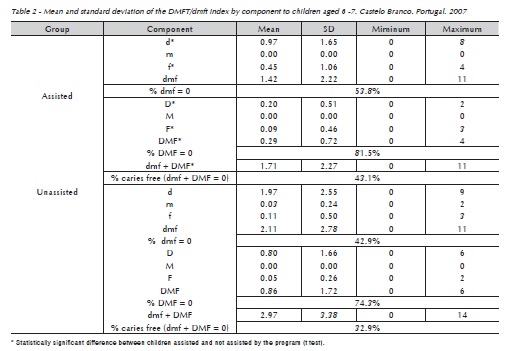
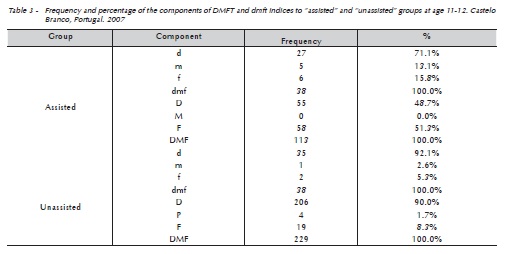
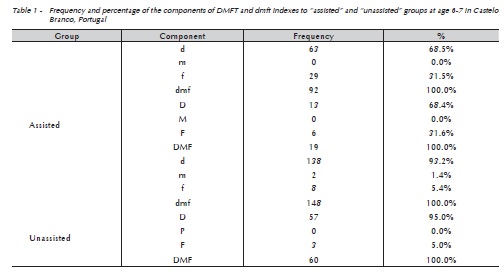
<body><![CDATA[<p><font size="2" face="Verdana"><b>Questionnaire</b> </font></p>     <p><font size="2" face="Verdana">A previous tested questionnaire was applied to   the legal representant with eight closed questions   adopted from Arnrup et al. (2001).<sup>10</sup> The following   information was collected: whether the children   were assisted by the program, parent's occupation   and urban or rural habitation, Communitary Periodontal   Index, diet, toothbrushing frequency, perception about importance of the PPSO.</font></p>     <p><font size="2" face="Verdana"><b>Statistical analysis</b> </font></p>     <p><font size="2" face="Verdana">A descriptive analysis of the data was done. The   mean of DMFT and dmft were calculated. Thereafter   T "student" and Chi-square test were applied   (p = 0,05). The dependent variable dmft + DMFT   (caries prevalence) was dichotomized by the median   to apply the univariate analysis. The logistic   regression models were adjusted by estimating the   Odds Ratios (OR), their 95% confidence intervals   (CI), and significance levels. Statistical analyses   were performed using the SAS 9.1.3 (SAS Campus   Drive, Cary, North Carolina, USA) at a 5% significance level.</font></p>     <p>&nbsp;</p>     <p><font size="3" face="Verdana"><B>Results</B> </font></p>     <p><font size="2" face="Verdana">One hundred and eight schoolchildren aged 6-7   and 118 aged 11-12 years were from urban area   (n = 226) and 27 children aged 6-7 and 51 aged 11-12 were from rural area (n = 78). Within the group   of 6-7 years old, sixty five children were assisted by   NPOHP and 70 were not (n = 135); while in the 11-12 years old group, 93 were assisted by the program and 76 were not (n = 169).</font></p>     <p><font size="2" face="Verdana">The percentages of the components of the DMFT   and dmft indices to the children aged 6-7 are presented   in <a href="#tab01">Table 1</a>.</font></p>     <p><font size="2" face="Verdana">The mean of the dmft+DMFT indices by component   are presented in <a href="#tab02">Table 2</a>. The means of the   components d, f, D, F, DMFT and dmft + DMFT showed   statistically significant differences between the   groups. The group who was assisted by NPOHP was   shown to be 43.1% caries free, while the unassisted   group was 32.9% caries free.</font></p>     <p><font size="2" face="Verdana"><a href="#tab03">Table 3</a> shows the percentage of the components   of the DMFT and dmft indices for children aged 11 and 12 with respect to the two groups.</font></p>     ]]></body>
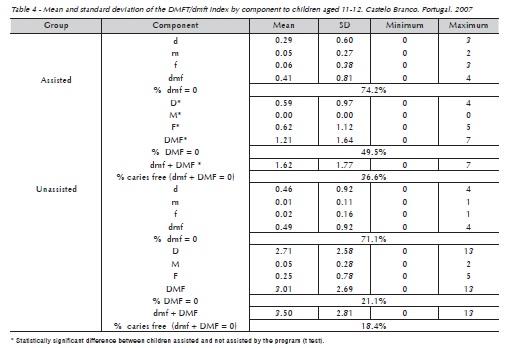
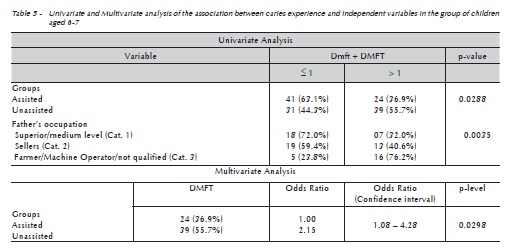
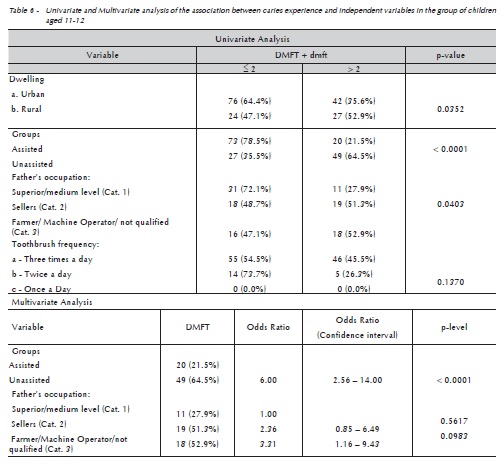
<body><![CDATA[<p><font size="2" face="Verdana"><a href="#tab04">Table 4</a> shows the DMFT and dmft means by   component to both groups of children. Statistically   significant differences were verified between the   groups when the means of DMFT and dmft were   added, respectively 1.62 for assisted children and   3.50 for unassisted children, as well differences for   all DMFT components between these groups.</font></p>     <p><font size="2" face="Verdana">Three hundred and four questionnaires were   sent to the legal representative of the children and   188 were given back (61.8%). Univariate and multivariate   analyses regarding the association between   the independent variables and the dependent variable  "caries prevalence" (dmft + DMFT) are shown   in <a href="#tab05">Table 5</a>. A statistically association was verified   between caries experience (dependent variable) and  "study group" and father's occupation. The variables with p &gt; 0.15 in the univariate analysis were   tested in the logistic regression model. Only "study   group" remained statistically significant (p = 0.05).   In the logistic regression analysis, unassisted children   showed a 2.15 times greater chance of having   dental caries than the assisted children.</font></p>     <p><font size="2" face="Verdana"><a href="#tab06">Table 6</a> shows the result of univariate and   multivariate analyses for children of age<sup>11-12</sup>. A   statistically significant difference was verified between  "study group", house and father's occupation   with the dependent variable "caries prevalence". In   the multivariate analysis only the variable "study   group" was retained in the model. The unassisted   children by NPOHP showed a 6.0 times greater   chance of having a dmft + DMFT &gt; 2 in comparison   to that ones assisted by the health program.</font></p>     <p>&nbsp;</p>     <p><a name="tab01"></a></p>     <p>&nbsp;</p>     <p align="center"><img src="/img/revistas/rfo/v17n1/a04tab01.jpg"></p>     <p>&nbsp;</p>     <p><a name="tab02"></a></p>     <p>&nbsp;</p>     ]]></body>
<body><![CDATA[<p align="center"><img src="/img/revistas/rfo/v17n1/a04tab02.jpg"></p>     <p>&nbsp;</p>     <p><a name="tab03"></a></p>     <p>&nbsp;</p>     <p align="center"><img src="/img/revistas/rfo/v17n1/a04tab03.jpg"></p>     <p>&nbsp;</p>     <p><a name="tab04"></a></p>     <p>&nbsp;</p>     <p align="center"><img src="/img/revistas/rfo/v17n1/a04tab04.jpg"></p>     <p>&nbsp;</p>     ]]></body>
<body><![CDATA[<p><a name="tab05"></a></p>     <p>&nbsp;</p>     <p align="center"><img src="/img/revistas/rfo/v17n1/a04tab05.jpg"></p>     <p>&nbsp;</p>     <p><a name="tab06"></a></p>     <p>&nbsp;</p>     <p align="center"><img src="/img/revistas/rfo/v17n1/a04tab06.jpg"></p>     <p>&nbsp;</p>          <p><font size="3" face="Verdana"><B>Discussion</B> </font></p>     <p><font size="2" face="Verdana">In the present study, children assisted by the   program showed lower percentage of dental decay   and more filled teeth (Table <a href="#tab02">2</a> ad <a href="#tab03">3</a>) in comparison   to children who were not assisted. This confirms the   importance and value of educative and preventive   oral health programs. In the group of assisted children   lower means of dental caries experience was   verified, with respect to the components of the dmft + DMFT index.</font></p>     ]]></body>
<body><![CDATA[<p><font size="2" face="Verdana">In 1999, Almeida et al.<sup>11</sup> (2003) verified in a   sample of 1599 schoolchildren in Portugal that   53.1% of the children aged 6 were caries-free and   showed a dmft index of 2.1, value that is similar   to the children not assisted by the program in the   present study. Regarding to children aged 12, 47.1%   were caries-free and the DMFT index was 1.5 with   a mean value similar to that one for children who   were assisted by NPOHP.</font></p>     <p><font size="2" face="Verdana">A national study, called "National study in the   dental caries prevalence in schoolchildren"<sup>12</sup> verified   higher values of the dmft (3.56) and DMFT   (2.95) indices, respectively for 6 and 12 year olds.   In other national study<sup>13</sup> conducted between 2005   and 2006, it is possible verify a decrease in dental   caries experience since the mean dmft index was   2.10 for children aged 6 and the mean DMFT index   was 1.48 for children aged 12. In this last study, a   dmft of 1.90 and a DMFT of 1.48, for children aged   6 and 12, respectively, was verified in the central   region of Portugal, where the city of Castelo Branco   is located.</font></p>     <p><font size="2" face="Verdana">The percentage of caries-free children were   33.0% and 27.0%, respectively for children aged 6   and 12 in 2000 in Portugal<sup>12</sup>. In the last national   study, these values were, 51.0% and 44.0%, respectively<sup>13</sup>.   Costa et al.<sup>14</sup>, 2008, verified in Leiria, Portugal,   that 52% of children aged 6 and 67% aged 12   were caries-free. In Castelo Branco, forty-three percent   of children aged 6-7 who were assisted by the   program were caries free, whereas 32.9% of unassisted   children presented no tooth decay. Of the assisted   and unassisted children aged 12, 36.6% and   18.4% were caries free, respectively,</font></p>     <p><font size="2" face="Verdana">In the present study that was carried out between   2006 and 2007, it is shown in tables <a href="#tab02">2</a> and <a href="#tab04">4</a> that   children who were assisted by the program showed   caries experience similar to that demonstrated for   Portugal<sup>13</sup>. However, children who were not taking   part of the program showed values similar to that   ones demonstrated in the study of DGS in 2000<sup>12</sup>.</font></p>     <p><font size="2" face="Verdana">The European strategy and the defined goals for   oral health established by World Health Organization   (WHO) point out that in 2020 at least 80.0% of   children aged 6 will be caries free and for children   aged 12, the DMFT index should not be higher than   1.515. Although Portugal has achieved this value of   DMFT, a good recommendation would be to implement   the NPOHP in Castelo Branco for those unassisted   children.</font></p>     <p><font size="2" face="Verdana">The socio-economical level has been pointed out   as a relevant determinant of dental caries. Different   studies have approached the correlation between   the social level and dental caries and periodontal   disease<sup>16-21</sup>.</font></p>     <p><font size="2" face="Verdana">Nowadays it is clear the polarization group that   retained the higher level of dental caries prevalence   in a population. The socio familiar determinants   settle the individual behaviors, for example to oral   hygiene practices, food intake habits and preventive   care<sup>22,23</sup>.</font></p>     <p><font size="2" face="Verdana">According to the questionnaire about socioeconomic   factors applied during the National study,   the parents of schoolchildren aged 12 had the most   basic education and worked in occupation of intermediate   level. In the present study, for children   aged 6-7 a statistically significant association was   observed between the "father's occupation" and "caries   experience". In this group, 72% of the children   with dmft/DMFT &#61603; 2 had father that worked in a   professional category of medium to high level. This   suggests a clear relation between the socioeconomic   level and disease prevalence. This association was   also verified for age 11-12.</font></p>     <p><font size="2" face="Verdana">The significant association observed between   the profession of the parents and the caries experience   has been verified in various studies<sup>18,23,24</sup>.   The mother's profession can be more relevant regarding   the behavior aspects than to socioeconomic   level, since if they do not have sufficient understanding   on oral health they are not able to inform their   children about oral health prevention<sup>25</sup>.</font></p>     <p><font size="2" face="Verdana">In the present study, for children aged 11-12,   a statistically significant association was verified   between the variable "dwelling" and "caries experience".   Sixty four percent of children from urban   areas showed dmft/DMFT &#61603; 2, whereas 52.9% of   the children from rural area showed dmft/DMFT&gt;  2. Almeida et al. (2003)<sup>11</sup> verified that children aged   6 that lived in periurban and rural areas presented   higher caries experience in comparison to children   living in urban areas.</font></p>     ]]></body>
<body><![CDATA[<p><font size="2" face="Verdana">According to the recommendations of NPOHP,   the National Study carried out in 2005/2006<sup>13</sup>, health   determinants, including the behaviors regarding   oral health and food intake by children and young   should be evaluated. The percentage of children   aged 6 who brushed their teeth more than once per   day was 74% and for children aged 12, the value   was 89%. In the present study, regarding this topic,   82.5% of the parents of the children aged 6-7 asserted   that the teeth were brushed three times a day.   Twice a day was the frequency that prevailed in the   parents of children aged 11-12.</font></p>     <p><font size="2" face="Verdana">In the present study, the NPOHP was considered   very important to parents of the children that   composed the sample and they asserted they took   their kids to take part of the program. This fact isrelevant since the familiar environment is fundamental   to the development of a health care consciousness.</font></p>     <p>&nbsp;</p>     <p><font size="3" face="Verdana"><B>Conclusions</B> </font></p>     <p><font size="2" face="Verdana">It was verified that there is a positive impact on   the preventive oral health care service and preventive   program in Castelo Branco, due to the significant   improvement of oral health in children 6-7 and   11-12 years old who were assisted by this program   Therefore, it is crucial that children who are not assisted by the NPOHP join the program.</font></p>     <p>&nbsp;</p>     <p><font size="3" face="Verdana"><B>Acknowledgment</B> </font></p>     <p><font size="2" face="Verdana">We are grateful to Thomas W. Brown III for his   editorial assistance and proofreading for correct English.</font></p>     <p>&nbsp;</p>     <p><font size="3" face="Verdana"><B>References</B></font></p>     ]]></body>
<body><![CDATA[<!-- ref --><p><font size="2" face="Verdana">1. Baldani MH, Narvai PC, Antunes JLF. Dental caries and   socioeconomic conditions in the State of Paran&aacute;, Brazil. Cad Saude Publica 2002; 18(3):755-63.    &nbsp;&nbsp;&nbsp;&nbsp;&nbsp;&nbsp;&nbsp;&nbsp;[&#160;<a href="javascript:void(0);" onclick="javascript: window.open('/scielo.php?script=sci_nlinks&ref=140457&pid=S1413-4012201200010000400001&lng=','','width=640,height=500,resizable=yes,scrollbars=1,menubar=yes,');">Links</a>&#160;]<!-- end-ref --></font></p>     <!-- ref --><p><font size="2" face="Verdana">2. Almas K, Al-Malik TM, Al-Shehri MA, Skaug N. The knowledge   and practices of oral hygiene methods and attendance   pattern among school teachers in Riyadh, Saudi Arabia.   Saudi Med J 2003; 24(10):1087-91.    &nbsp;&nbsp;&nbsp;&nbsp;&nbsp;&nbsp;&nbsp;&nbsp;[&#160;<a href="javascript:void(0);" onclick="javascript: window.open('/scielo.php?script=sci_nlinks&ref=140459&pid=S1413-4012201200010000400002&lng=','','width=640,height=500,resizable=yes,scrollbars=1,menubar=yes,');">Links</a>&#160;]<!-- end-ref --></font></p>     <!-- ref --><p><font size="2" face="Verdana">3. Mastrantonio SS, Garcia PPNS. Programas educativos em   sa&uacute;de bucal - revis&atilde;o de Literatura. JBP j bras odontopediatr   odontol beb&ecirc; 2002; 5(25):215-22.    &nbsp;&nbsp;&nbsp;&nbsp;&nbsp;&nbsp;&nbsp;&nbsp;[&#160;<a href="javascript:void(0);" onclick="javascript: window.open('/scielo.php?script=sci_nlinks&ref=140461&pid=S1413-4012201200010000400003&lng=','','width=640,height=500,resizable=yes,scrollbars=1,menubar=yes,');">Links</a>&#160;]<!-- end-ref --></font></p>     <!-- ref --><p><font size="2" face="Verdana">4. Vasconcelos RMML, Pordeus IA, Paiva SM. Escola: um espa&ccedil;o   importante de informa&ccedil;&auml;o em sa&uacute;de bucal para a popula&ccedil;&atilde;o   infantil. Rev Fac Odontol S&atilde;o Jos&eacute; dos Campos 2001;   4(3):43-8.    &nbsp;&nbsp;&nbsp;&nbsp;&nbsp;&nbsp;&nbsp;&nbsp;[&#160;<a href="javascript:void(0);" onclick="javascript: window.open('/scielo.php?script=sci_nlinks&ref=140463&pid=S1413-4012201200010000400004&lng=','','width=640,height=500,resizable=yes,scrollbars=1,menubar=yes,');">Links</a>&#160;]<!-- end-ref --></font></p>     <!-- ref --><p><font size="2" face="Verdana">5. Kay EJ, Locker D. Is dental health education effective: a   systematic review of current evidence. Community Dent   Oral Epidemiol 1996; 24(4):231-5.    &nbsp;&nbsp;&nbsp;&nbsp;&nbsp;&nbsp;&nbsp;&nbsp;[&#160;<a href="javascript:void(0);" onclick="javascript: window.open('/scielo.php?script=sci_nlinks&ref=140465&pid=S1413-4012201200010000400005&lng=','','width=640,height=500,resizable=yes,scrollbars=1,menubar=yes,');">Links</a>&#160;]<!-- end-ref --></font></p>     ]]></body>
<body><![CDATA[<!-- ref --><p><font size="2" face="Verdana">6. Zanin L, Meneghim MC, Assaf AV, Cortellazzi KL, Pereira   AC. Evaluation of an educational program for children with   high risk of caries. J Clin Pediatr Dent. 2007; 31(4):246-50.    &nbsp;&nbsp;&nbsp;&nbsp;&nbsp;&nbsp;&nbsp;&nbsp;[&#160;<a href="javascript:void(0);" onclick="javascript: window.open('/scielo.php?script=sci_nlinks&ref=140467&pid=S1413-4012201200010000400006&lng=','','width=640,height=500,resizable=yes,scrollbars=1,menubar=yes,');">Links</a>&#160;]<!-- end-ref --></font></p>     <!-- ref --><p><font size="2" face="Verdana">7. DGS. Programa Nacional de Promo&ccedil;&atilde;o da Sa&uacute;de Oral nas   Crian&ccedil;as e Adolescentes.Circular Normativa n&ordm; 6/ DSE -   20/05/99. Lisboa: Direc&ccedil;&atilde;o Geral de Sa&uacute;de, 1999. Dispon&iacute;vel   em URL: <a href="http://www.dgs.pt/" target="_blank">http://www.dgs.pt/</a>.    &nbsp;&nbsp;&nbsp;&nbsp;&nbsp;&nbsp;&nbsp;&nbsp;[&#160;<a href="javascript:void(0);" onclick="javascript: window.open('/scielo.php?script=sci_nlinks&ref=140469&pid=S1413-4012201200010000400007&lng=','','width=640,height=500,resizable=yes,scrollbars=1,menubar=yes,');">Links</a>&#160;]<!-- end-ref --></font></p>     <p><font size="2" face="Verdana">8. DGS. Programa Nacional de Promo&ccedil;&atilde;o da Sa&uacute;de Oral. Circular   Normativa - n&ordm; 01/ DSE &ndash; 18/01/2005. Lisboa: Direc&ccedil;&atilde;o   Geral de Sa&uacute;de, 2005. Dispon&iacute;vel em URL: <a href="http://www.dgs.pt/" target="_blank">http://www.dgs.pt/</a></font></p>     <p><font size="2" face="Verdana">9. World Health Organization &ndash; WHO. Oral health surveys:   basic methods. Geneva. WHO. 1997.</font></p>     <!-- ref --><p><font size="2" face="Verdana">10. Arnrup K, Berggren U, Broberg AG. Usefulness of a psichometric   questionnaire in exploring parenteral attitudes in   children&acute;s dental care. Acta Odontol Scand. 2001; 59(1):14-20.    &nbsp;&nbsp;&nbsp;&nbsp;&nbsp;&nbsp;&nbsp;&nbsp;[&#160;<a href="javascript:void(0);" onclick="javascript: window.open('/scielo.php?script=sci_nlinks&ref=140473&pid=S1413-4012201200010000400010&lng=','','width=640,height=500,resizable=yes,scrollbars=1,menubar=yes,');">Links</a>&#160;]<!-- end-ref --></font></p>     <!-- ref --><p><font size="2" face="Verdana">11. Almeida CM, Petersen PE, Andr&eacute; SJ, Toscano A. Changing   oral health status of 6- and 12-year-old schoolchildren in   Portugal. Community Dent Health. 2003; 20(4):211-6.    &nbsp;&nbsp;&nbsp;&nbsp;&nbsp;&nbsp;&nbsp;&nbsp;[&#160;<a href="javascript:void(0);" onclick="javascript: window.open('/scielo.php?script=sci_nlinks&ref=140475&pid=S1413-4012201200010000400011&lng=','','width=640,height=500,resizable=yes,scrollbars=1,menubar=yes,');">Links</a>&#160;]<!-- end-ref --></font></p>     ]]></body>
<body><![CDATA[<!-- ref --><p><font size="2" face="Verdana">12. DGS. Estudo Nacional de preval&ecirc;ncia da c&aacute;rie dent&aacute;ria na   popula&ccedil;&atilde;o escolarizada. Divis&atilde;o de Sa&uacute;de Escolar. Lisboa:   Direc&ccedil;&atilde;o Geral de Sa&uacute;de, 2000. Dispon&iacute;vel em URL: <a href="http://www.dgs.pt/" target="_blank">http://www.dgs.pt/</a>.    &nbsp;&nbsp;&nbsp;&nbsp;&nbsp;&nbsp;&nbsp;&nbsp;[&#160;<a href="javascript:void(0);" onclick="javascript: window.open('/scielo.php?script=sci_nlinks&ref=140477&pid=S1413-4012201200010000400012&lng=','','width=640,height=500,resizable=yes,scrollbars=1,menubar=yes,');">Links</a>&#160;]<!-- end-ref --></font></p>     <!-- ref --><p><font size="2" face="Verdana">13. DGS. Estudo Nacional de Preval&ecirc;ncia das Doen&ccedil;as Orais.   Programa de Promo&ccedil;&atilde;o da Sa&uacute;de Oral nas Escolas. Lisboa:   Direc&ccedil;&atilde;o Geral de Sa&uacute;de, 2008. Dispon&iacute;vel em URL: <a href="http://www.dgs.pt/" target="_blank">http://www.dgs.pt/</a>.    &nbsp;&nbsp;&nbsp;&nbsp;&nbsp;&nbsp;&nbsp;&nbsp;[&#160;<a href="javascript:void(0);" onclick="javascript: window.open('/scielo.php?script=sci_nlinks&ref=140479&pid=S1413-4012201200010000400013&lng=','','width=640,height=500,resizable=yes,scrollbars=1,menubar=yes,');">Links</a>&#160;]<!-- end-ref --></font></p>     <!-- ref --><p><font size="2" face="Verdana">14. Costa C, Pereira M, Passadouro R, Spencer B. Children's   oral hygiene: healthy mouth, families supervise? Acta Med   Port. 2008; 21(5):467-74.    &nbsp;&nbsp;&nbsp;&nbsp;&nbsp;&nbsp;&nbsp;&nbsp;[&#160;<a href="javascript:void(0);" onclick="javascript: window.open('/scielo.php?script=sci_nlinks&ref=140481&pid=S1413-4012201200010000400014&lng=','','width=640,height=500,resizable=yes,scrollbars=1,menubar=yes,');">Links</a>&#160;]<!-- end-ref --></font></p>     <p><font size="2" face="Verdana">15. WHO. Health 21 - Health for all in the 21st century: An   introduction to the health for all policy framework for the   WHO European region. European Health for all series. n.5.   Copenhagen. World Health Organization Regional Office for Europe. 1998.</font></p>     <!-- ref --><p><font size="2" face="Verdana">16. Jones CM, Worthington H. Water fluoridation, poverty and   tooth decay in 12-year-old children. J Dent 2000; 28(6):389-93.    &nbsp;&nbsp;&nbsp;&nbsp;&nbsp;&nbsp;&nbsp;&nbsp;[&#160;<a href="javascript:void(0);" onclick="javascript: window.open('/scielo.php?script=sci_nlinks&ref=140484&pid=S1413-4012201200010000400016&lng=','','width=640,height=500,resizable=yes,scrollbars=1,menubar=yes,');">Links</a>&#160;]<!-- end-ref --></font></p>     <!-- ref --><p><font size="2" face="Verdana">17. Campus G, Lumbau A, Lai S, Solinas G, Castiglia P. Socio-economic and behavioural factors related to caries in twelve-year-old Sardinian children. Caries Res 2001; 35(6):427-34.    &nbsp;&nbsp;&nbsp;&nbsp;&nbsp;&nbsp;&nbsp;&nbsp;[&#160;<a href="javascript:void(0);" onclick="javascript: window.open('/scielo.php?script=sci_nlinks&ref=140486&pid=S1413-4012201200010000400017&lng=','','width=640,height=500,resizable=yes,scrollbars=1,menubar=yes,');">Links</a>&#160;]<!-- end-ref --></font></p>     <!-- ref --><p><font size="2" face="Verdana">18. Bastos JL, Nomura LH, Peres MA. Dental caries and associated   factors among young male adults between 1999 and   2003 in Southern Brazil. Community Dent Health 2007; 24(2):122-7.    &nbsp;&nbsp;&nbsp;&nbsp;&nbsp;&nbsp;&nbsp;&nbsp;[&#160;<a href="javascript:void(0);" onclick="javascript: window.open('/scielo.php?script=sci_nlinks&ref=140488&pid=S1413-4012201200010000400018&lng=','','width=640,height=500,resizable=yes,scrollbars=1,menubar=yes,');">Links</a>&#160;]<!-- end-ref --></font></p>     <!-- ref --><p><font size="2" face="Verdana">19. Pereira SM, Tagliaferro EP, Ambrosano GM, Cortelazzi KL,   Meneghim Mde C, Pereira AC. Dental caries in 12-year-old schoolchildren and its relationship with socioeconomic   and behavioural variables. Oral Health Prev Dent. 2007;   5(4):299-306.    &nbsp;&nbsp;&nbsp;&nbsp;&nbsp;&nbsp;&nbsp;&nbsp;[&#160;<a href="javascript:void(0);" onclick="javascript: window.open('/scielo.php?script=sci_nlinks&ref=140490&pid=S1413-4012201200010000400019&lng=','','width=640,height=500,resizable=yes,scrollbars=1,menubar=yes,');">Links</a>&#160;]<!-- end-ref --></font></p>     <!-- ref --><p><font size="2" face="Verdana">20. Peres MA, Peres KG, de Barros AJ, Victora CG. The relation   between family socioeconomic trajectories from childhood   to adolescence and dental caries and associated oral behaviours. J Epidemiol Community Health 2007; 61(2):141-5.    &nbsp;&nbsp;&nbsp;&nbsp;&nbsp;&nbsp;&nbsp;&nbsp;[&#160;<a href="javascript:void(0);" onclick="javascript: window.open('/scielo.php?script=sci_nlinks&ref=140492&pid=S1413-4012201200010000400020&lng=','','width=640,height=500,resizable=yes,scrollbars=1,menubar=yes,');">Links</a>&#160;]<!-- end-ref --></font></p>     <!-- ref --><p><font size="2" face="Verdana">21. Peres MA, Barros AJ, Peres KG, Ara&uacute;jo CL, Menezes AM.   Life course dental caries determinants and predictors in   children aged 12 years: a population-based birth cohort.   Community Dent Oral Epidemiol 2009; 37(2):123-33.    &nbsp;&nbsp;&nbsp;&nbsp;&nbsp;&nbsp;&nbsp;&nbsp;[&#160;<a href="javascript:void(0);" onclick="javascript: window.open('/scielo.php?script=sci_nlinks&ref=140494&pid=S1413-4012201200010000400021&lng=','','width=640,height=500,resizable=yes,scrollbars=1,menubar=yes,');">Links</a>&#160;]<!-- end-ref --></font></p>     <p><font size="2" face="Verdana">22. Matos M, Sim&otilde;es C, Tom&eacute; G, Silva M, Gaspar T, Diniz JA.   Aventura Social &amp; Sa&uacute;de. Indicadores de Sa&uacute;de dos Adolescentes   Portugueses. Relat&oacute;rio Preliminar HBSC 2006.   Dispon&iacute;vel em URL: &lt;<a href="http://www.fmh.utl.pt/aventurasocial/pdf/Indicadores_de_Saude.pdf" target="_blank">http://www.fmh.utl.pt/aventurasocial/pdf/Indicadores_de_Saude.pdf</a>&gt;</font></p>     ]]></body>
<body><![CDATA[<!-- ref --><p><font size="2" face="Verdana">23. Tagliaferro EPS, Pereira AC, Meneghim MC, Ambrosano   GMB. Assessment of dental caries predictors in a seven-year: longitudinal study. J Public Health Dent. 2006;   66(3):169-73.    &nbsp;&nbsp;&nbsp;&nbsp;&nbsp;&nbsp;&nbsp;&nbsp;[&#160;<a href="javascript:void(0);" onclick="javascript: window.open('/scielo.php?script=sci_nlinks&ref=140497&pid=S1413-4012201200010000400023&lng=','','width=640,height=500,resizable=yes,scrollbars=1,menubar=yes,');">Links</a>&#160;]<!-- end-ref --></font></p>     <!-- ref --><p><font size="2" face="Verdana">24. Khan MN, Cleaton-Jones PE. Dental caries in African preschool   children: social factors as disease markers. J Public   Health Dent 1998; 58(1):7-11.    &nbsp;&nbsp;&nbsp;&nbsp;&nbsp;&nbsp;&nbsp;&nbsp;[&#160;<a href="javascript:void(0);" onclick="javascript: window.open('/scielo.php?script=sci_nlinks&ref=140499&pid=S1413-4012201200010000400024&lng=','','width=640,height=500,resizable=yes,scrollbars=1,menubar=yes,');">Links</a>&#160;]<!-- end-ref --></font></p>     <!-- ref --><p><font size="2" face="Verdana">25. Tagliaferro EP, Ambrosano GM, Meneghim M de C, Pereira   AC. Risk indicators and risk predictors of dental caries in schoolchildren. J Appl Oral Sci 2008; 16(6):408-13.    &nbsp;&nbsp;&nbsp;&nbsp;&nbsp;&nbsp;&nbsp;&nbsp;[&#160;<a href="javascript:void(0);" onclick="javascript: window.open('/scielo.php?script=sci_nlinks&ref=140501&pid=S1413-4012201200010000400025&lng=','','width=640,height=500,resizable=yes,scrollbars=1,menubar=yes,');">Links</a>&#160;]<!-- end-ref --></font></p>     <p>&nbsp;</p>     <p>&nbsp;</p>     <p><font size="2" face="Verdana"><a name="back"/></a><a href="#top"><img src="/img/revistas/rfo/v17n1/seta.jpg" border="0" align="absmiddle"/></a><b>Correspondence author:</b>    <br>   </font><font size="2" face="Verdana">Antonio Carlos Pereira    ]]></body>
<body><![CDATA[<br>   Av. Limeira, s/n Bairro   Are&atilde;o 13414-903    <br> Piracicaba, S&atilde;o Paulo,    <br>   Brazil</font><font size="2" face="Verdana">    <br> e-mail: <a href="mailto:apereira@fop.unicamp.br" target="_blank">apereira@fop.unicamp.br</a></font></p>     <p><font size="2" face="Verdana">Recebido: 17/11/2011    <br> Aceito: 21/03/2012</b></font></p>     <p>&nbsp;</p>       ]]></body>
<back>
<ref-list>
<ref id="B1">
<label>1</label><nlm-citation citation-type="journal">
<person-group person-group-type="author">
<name>
<surname><![CDATA[Baldani]]></surname>
<given-names><![CDATA[MH]]></given-names>
</name>
<name>
<surname><![CDATA[Narvai]]></surname>
<given-names><![CDATA[PC]]></given-names>
</name>
<name>
<surname><![CDATA[Antunes]]></surname>
<given-names><![CDATA[JLF]]></given-names>
</name>
</person-group>
<article-title xml:lang="en"><![CDATA[Dental caries and socioeconomic conditions in the State of Paraná, Brazil]]></article-title>
<source><![CDATA[Cad Saude Publica]]></source>
<year>2002</year>
<volume>18</volume>
<numero>3</numero>
<issue>3</issue>
<page-range>755-63</page-range></nlm-citation>
</ref>
<ref id="B2">
<label>2</label><nlm-citation citation-type="journal">
<person-group person-group-type="author">
<name>
<surname><![CDATA[Almas]]></surname>
<given-names><![CDATA[K]]></given-names>
</name>
<name>
<surname><![CDATA[Al-Malik]]></surname>
<given-names><![CDATA[TM]]></given-names>
</name>
<name>
<surname><![CDATA[Al-Shehri]]></surname>
<given-names><![CDATA[MA]]></given-names>
</name>
<name>
<surname><![CDATA[Skaug]]></surname>
<given-names><![CDATA[N]]></given-names>
</name>
</person-group>
<article-title xml:lang="en"><![CDATA[The knowledge and practices of oral hygiene methods and attendance pattern among school teachers in Riyadh, Saudi Arabia]]></article-title>
<source><![CDATA[Saudi Med J]]></source>
<year>2003</year>
<volume>24</volume>
<numero>10</numero>
<issue>10</issue>
<page-range>1087-91</page-range></nlm-citation>
</ref>
<ref id="B3">
<label>3</label><nlm-citation citation-type="journal">
<person-group person-group-type="author">
<name>
<surname><![CDATA[Mastrantonio]]></surname>
<given-names><![CDATA[SS]]></given-names>
</name>
<name>
<surname><![CDATA[Garcia]]></surname>
<given-names><![CDATA[PPNS]]></given-names>
</name>
</person-group>
<article-title xml:lang="pt"><![CDATA[Programas educativos em saúde bucal: revisão de Literatura]]></article-title>
<source><![CDATA[JBP j bras odontopediatr odontol bebê]]></source>
<year>2002</year>
<volume>5</volume>
<numero>25</numero>
<issue>25</issue>
<page-range>215-22</page-range></nlm-citation>
</ref>
<ref id="B4">
<label>4</label><nlm-citation citation-type="journal">
<person-group person-group-type="author">
<name>
<surname><![CDATA[Vasconcelos]]></surname>
<given-names><![CDATA[RMML]]></given-names>
</name>
<name>
<surname><![CDATA[Pordeus]]></surname>
<given-names><![CDATA[IA]]></given-names>
</name>
<name>
<surname><![CDATA[Paiva]]></surname>
<given-names><![CDATA[SM]]></given-names>
</name>
</person-group>
<article-title xml:lang="pt"><![CDATA[Escola: um espaço importante de informaçäo em saúde bucal para a população infantil]]></article-title>
<source><![CDATA[Rev Fac Odontol São José dos Campos]]></source>
<year>2001</year>
<volume>4</volume>
<numero>3</numero>
<issue>3</issue>
<page-range>43-8</page-range></nlm-citation>
</ref>
<ref id="B5">
<label>5</label><nlm-citation citation-type="journal">
<person-group person-group-type="author">
<name>
<surname><![CDATA[Kay]]></surname>
<given-names><![CDATA[EJ]]></given-names>
</name>
<name>
<surname><![CDATA[Locker]]></surname>
<given-names><![CDATA[D]]></given-names>
</name>
</person-group>
<article-title xml:lang="en"><![CDATA[Is dental health education effective: a systematic review of current evidence]]></article-title>
<source><![CDATA[Community Dent Oral Epidemiol]]></source>
<year>1996</year>
<volume>24</volume>
<numero>4</numero>
<issue>4</issue>
<page-range>231-5</page-range></nlm-citation>
</ref>
<ref id="B6">
<label>6</label><nlm-citation citation-type="journal">
<person-group person-group-type="author">
<name>
<surname><![CDATA[Zanin]]></surname>
<given-names><![CDATA[L]]></given-names>
</name>
<name>
<surname><![CDATA[Meneghim]]></surname>
<given-names><![CDATA[MC]]></given-names>
</name>
<name>
<surname><![CDATA[Assaf]]></surname>
<given-names><![CDATA[AV]]></given-names>
</name>
<name>
<surname><![CDATA[Cortellazzi]]></surname>
<given-names><![CDATA[KL]]></given-names>
</name>
<name>
<surname><![CDATA[Pereira]]></surname>
<given-names><![CDATA[AC]]></given-names>
</name>
</person-group>
<article-title xml:lang="en"><![CDATA[Evaluation of an educational program for children with high risk of caries]]></article-title>
<source><![CDATA[J Clin Pediatr Dent]]></source>
<year>2007</year>
<volume>31</volume>
<numero>4</numero>
<issue>4</issue>
<page-range>246-50</page-range></nlm-citation>
</ref>
<ref id="B7">
<label>7</label><nlm-citation citation-type="book">
<collab>DGS</collab>
<source><![CDATA[Programa Nacional de Promoção da Saúde Oral nas Crianças e Adolescentes.Circular Normativa nº 6/ DSE - 20/05/99]]></source>
<year>1999</year>
<publisher-loc><![CDATA[Lisboa ]]></publisher-loc>
<publisher-name><![CDATA[Direcção Geral de Saúde]]></publisher-name>
</nlm-citation>
</ref>
<ref id="B8">
<label>8</label><nlm-citation citation-type="book">
<collab>DGS</collab>
<source><![CDATA[Programa Nacional de Promoção da Saúde Oral. Circular Normativa - nº 01/ DSE - 18/01/2005]]></source>
<year>2005</year>
<publisher-loc><![CDATA[Lisboa ]]></publisher-loc>
<publisher-name><![CDATA[Direcção Geral de Saúde]]></publisher-name>
</nlm-citation>
</ref>
<ref id="B9">
<label>9</label><nlm-citation citation-type="book">
<collab>World Health Organization - WHO</collab>
<source><![CDATA[Oral health surveys: basic methods]]></source>
<year>1997</year>
<publisher-loc><![CDATA[Geneva ]]></publisher-loc>
<publisher-name><![CDATA[WHO]]></publisher-name>
</nlm-citation>
</ref>
<ref id="B10">
<label>10</label><nlm-citation citation-type="journal">
<person-group person-group-type="author">
<name>
<surname><![CDATA[Arnrup]]></surname>
<given-names><![CDATA[K]]></given-names>
</name>
<name>
<surname><![CDATA[Berggren]]></surname>
<given-names><![CDATA[U]]></given-names>
</name>
<name>
<surname><![CDATA[Broberg]]></surname>
<given-names><![CDATA[AG]]></given-names>
</name>
</person-group>
<article-title xml:lang="en"><![CDATA[Usefulness of a psichometric questionnaire in exploring parenteral attitudes in children´s dental care]]></article-title>
<source><![CDATA[Acta Odontol Scand]]></source>
<year>2001</year>
<volume>59</volume>
<numero>1</numero>
<issue>1</issue>
<page-range>14-20</page-range></nlm-citation>
</ref>
<ref id="B11">
<label>11</label><nlm-citation citation-type="journal">
<person-group person-group-type="author">
<name>
<surname><![CDATA[Almeida]]></surname>
<given-names><![CDATA[CM]]></given-names>
</name>
<name>
<surname><![CDATA[Petersen]]></surname>
<given-names><![CDATA[PE]]></given-names>
</name>
<name>
<surname><![CDATA[André]]></surname>
<given-names><![CDATA[SJ]]></given-names>
</name>
<name>
<surname><![CDATA[Toscano]]></surname>
<given-names><![CDATA[A]]></given-names>
</name>
</person-group>
<article-title xml:lang="en"><![CDATA[Changing oral health status of 6- and 12-year-old schoolchildren in Portugal]]></article-title>
<source><![CDATA[Community Dent Health]]></source>
<year>2003</year>
<volume>20</volume>
<numero>4</numero>
<issue>4</issue>
<page-range>211-6</page-range></nlm-citation>
</ref>
<ref id="B12">
<label>12</label><nlm-citation citation-type="book">
<collab>DGS</collab>
<source><![CDATA[Estudo Nacional de prevalência da cárie dentária na população escolarizada. Divisão de Saúde Escolar]]></source>
<year>2000</year>
<publisher-loc><![CDATA[Lisboa ]]></publisher-loc>
<publisher-name><![CDATA[Direcção Geral de Saúde]]></publisher-name>
</nlm-citation>
</ref>
<ref id="B13">
<label>13</label><nlm-citation citation-type="book">
<collab>DGS</collab>
<source><![CDATA[Estudo Nacional de Prevalência das Doenças Orais. Programa de Promoção da Saúde Oral nas Escolas]]></source>
<year>2008</year>
<publisher-loc><![CDATA[Lisboa ]]></publisher-loc>
<publisher-name><![CDATA[Direcção Geral de Saúde]]></publisher-name>
</nlm-citation>
</ref>
<ref id="B14">
<label>14</label><nlm-citation citation-type="journal">
<person-group person-group-type="author">
<name>
<surname><![CDATA[Costa]]></surname>
<given-names><![CDATA[C]]></given-names>
</name>
<name>
<surname><![CDATA[Pereira]]></surname>
<given-names><![CDATA[M]]></given-names>
</name>
<name>
<surname><![CDATA[Passadouro]]></surname>
<given-names><![CDATA[R]]></given-names>
</name>
<name>
<surname><![CDATA[Spencer]]></surname>
<given-names><![CDATA[B]]></given-names>
</name>
</person-group>
<article-title xml:lang="en"><![CDATA[Children's oral hygiene: healthy mouth, families supervise?]]></article-title>
<source><![CDATA[Acta Med Port]]></source>
<year>2008</year>
<volume>21</volume>
<numero>5</numero>
<issue>5</issue>
<page-range>467-74</page-range></nlm-citation>
</ref>
<ref id="B15">
<label>15</label><nlm-citation citation-type="book">
<collab>WHO</collab>
<source><![CDATA[Health 21 - Health for all in the 21st century: An introduction to the health for all policy framework for the WHO European region]]></source>
<year>1998</year>
<publisher-loc><![CDATA[Copenhagen ]]></publisher-loc>
<publisher-name><![CDATA[World Health Organization Regional Office for Europe]]></publisher-name>
</nlm-citation>
</ref>
<ref id="B16">
<label>16</label><nlm-citation citation-type="journal">
<person-group person-group-type="author">
<name>
<surname><![CDATA[Jones]]></surname>
<given-names><![CDATA[CM]]></given-names>
</name>
<name>
<surname><![CDATA[Worthington]]></surname>
<given-names><![CDATA[H]]></given-names>
</name>
</person-group>
<article-title xml:lang="en"><![CDATA[Water fluoridation, poverty and tooth decay in 12-year-old children]]></article-title>
<source><![CDATA[J Dent]]></source>
<year>2000</year>
<volume>28</volume>
<numero>6</numero>
<issue>6</issue>
<page-range>389-93</page-range></nlm-citation>
</ref>
<ref id="B17">
<label>17</label><nlm-citation citation-type="journal">
<person-group person-group-type="author">
<name>
<surname><![CDATA[Campus]]></surname>
<given-names><![CDATA[G]]></given-names>
</name>
<name>
<surname><![CDATA[Lumbau]]></surname>
<given-names><![CDATA[A]]></given-names>
</name>
<name>
<surname><![CDATA[Lai]]></surname>
<given-names><![CDATA[S]]></given-names>
</name>
<name>
<surname><![CDATA[Solinas]]></surname>
<given-names><![CDATA[G]]></given-names>
</name>
<name>
<surname><![CDATA[Castiglia]]></surname>
<given-names><![CDATA[P]]></given-names>
</name>
</person-group>
<article-title xml:lang="en"><![CDATA[Socio-economic and behavioural factors related to caries in twelve-year-old Sardinian children]]></article-title>
<source><![CDATA[Caries Res]]></source>
<year>2001</year>
<volume>35</volume>
<numero>6</numero>
<issue>6</issue>
<page-range>427-34</page-range></nlm-citation>
</ref>
<ref id="B18">
<label>18</label><nlm-citation citation-type="journal">
<person-group person-group-type="author">
<name>
<surname><![CDATA[Bastos]]></surname>
<given-names><![CDATA[JL]]></given-names>
</name>
<name>
<surname><![CDATA[Nomura]]></surname>
<given-names><![CDATA[LH]]></given-names>
</name>
<name>
<surname><![CDATA[Peres]]></surname>
<given-names><![CDATA[MA]]></given-names>
</name>
</person-group>
<article-title xml:lang="en"><![CDATA[Dental caries and associated factors among young male adults between 1999 and 2003 in Southern Brazil]]></article-title>
<source><![CDATA[Community Dent Health]]></source>
<year>2007</year>
<volume>24</volume>
<numero>2</numero>
<issue>2</issue>
<page-range>122-7</page-range></nlm-citation>
</ref>
<ref id="B19">
<label>19</label><nlm-citation citation-type="journal">
<person-group person-group-type="author">
<name>
<surname><![CDATA[Pereira]]></surname>
<given-names><![CDATA[SM]]></given-names>
</name>
<name>
<surname><![CDATA[Tagliaferro]]></surname>
<given-names><![CDATA[EP]]></given-names>
</name>
<name>
<surname><![CDATA[Ambrosano]]></surname>
<given-names><![CDATA[GM]]></given-names>
</name>
<name>
<surname><![CDATA[Cortelazzi]]></surname>
<given-names><![CDATA[KL]]></given-names>
</name>
<name>
<surname><![CDATA[Meneghim]]></surname>
<given-names><![CDATA[Mde C]]></given-names>
</name>
<name>
<surname><![CDATA[Pereira]]></surname>
<given-names><![CDATA[AC]]></given-names>
</name>
</person-group>
<article-title xml:lang="en"><![CDATA[Dental caries in 12-year-old schoolchildren and its relationship with socioeconomic and behavioural variables]]></article-title>
<source><![CDATA[Oral Health Prev Dent]]></source>
<year>2007</year>
<volume>5</volume>
<numero>4</numero>
<issue>4</issue>
<page-range>299-306</page-range></nlm-citation>
</ref>
<ref id="B20">
<label>20</label><nlm-citation citation-type="journal">
<person-group person-group-type="author">
<name>
<surname><![CDATA[Peres]]></surname>
<given-names><![CDATA[MA]]></given-names>
</name>
<name>
<surname><![CDATA[Peres]]></surname>
<given-names><![CDATA[KG]]></given-names>
</name>
<name>
<surname><![CDATA[de Barros]]></surname>
<given-names><![CDATA[AJ]]></given-names>
</name>
<name>
<surname><![CDATA[Victora]]></surname>
<given-names><![CDATA[CG]]></given-names>
</name>
</person-group>
<article-title xml:lang="en"><![CDATA[The relation between family socioeconomic trajectories from childhood to adolescence and dental caries and associated oral behaviours]]></article-title>
<source><![CDATA[J Epidemiol Community Health]]></source>
<year>2007</year>
<volume>61</volume>
<numero>2</numero>
<issue>2</issue>
<page-range>141-5</page-range></nlm-citation>
</ref>
<ref id="B21">
<label>21</label><nlm-citation citation-type="journal">
<person-group person-group-type="author">
<name>
<surname><![CDATA[Peres]]></surname>
<given-names><![CDATA[MA]]></given-names>
</name>
<name>
<surname><![CDATA[Barros]]></surname>
<given-names><![CDATA[AJ]]></given-names>
</name>
<name>
<surname><![CDATA[Peres]]></surname>
<given-names><![CDATA[KG]]></given-names>
</name>
<name>
<surname><![CDATA[Araújo]]></surname>
<given-names><![CDATA[CL]]></given-names>
</name>
<name>
<surname><![CDATA[Menezes]]></surname>
<given-names><![CDATA[AM]]></given-names>
</name>
</person-group>
<article-title xml:lang="en"><![CDATA[Life course dental caries determinants and predictors in children aged 12 years: a population-based birth cohort]]></article-title>
<source><![CDATA[Community Dent Oral Epidemiol]]></source>
<year>2009</year>
<volume>37</volume>
<numero>2</numero>
<issue>2</issue>
<page-range>123-33</page-range></nlm-citation>
</ref>
<ref id="B22">
<label>22</label><nlm-citation citation-type="">
<person-group person-group-type="author">
<name>
<surname><![CDATA[Matos]]></surname>
<given-names><![CDATA[M]]></given-names>
</name>
<name>
<surname><![CDATA[Simões]]></surname>
<given-names><![CDATA[C]]></given-names>
</name>
<name>
<surname><![CDATA[Tomé]]></surname>
<given-names><![CDATA[G]]></given-names>
</name>
<name>
<surname><![CDATA[Silva]]></surname>
<given-names><![CDATA[M]]></given-names>
</name>
<name>
<surname><![CDATA[Gaspar]]></surname>
<given-names><![CDATA[T]]></given-names>
</name>
<name>
<surname><![CDATA[Diniz]]></surname>
<given-names><![CDATA[JA]]></given-names>
</name>
</person-group>
<source><![CDATA[Aventura Social & Saúde: Indicadores de Saúde dos Adolescentes Portugueses]]></source>
<year>2006</year>
</nlm-citation>
</ref>
<ref id="B23">
<label>23</label><nlm-citation citation-type="journal">
<person-group person-group-type="author">
<name>
<surname><![CDATA[Tagliaferro]]></surname>
<given-names><![CDATA[EPS]]></given-names>
</name>
<name>
<surname><![CDATA[Pereira]]></surname>
<given-names><![CDATA[AC]]></given-names>
</name>
<name>
<surname><![CDATA[Meneghim]]></surname>
<given-names><![CDATA[MC]]></given-names>
</name>
<name>
<surname><![CDATA[Ambrosano]]></surname>
<given-names><![CDATA[GMB]]></given-names>
</name>
</person-group>
<article-title xml:lang="en"><![CDATA[Assessment of dental caries predictors in a seven-year: longitudinal study]]></article-title>
<source><![CDATA[J Public Health Dent]]></source>
<year>2006</year>
<volume>66</volume>
<numero>3</numero>
<issue>3</issue>
<page-range>169-73</page-range></nlm-citation>
</ref>
<ref id="B24">
<label>24</label><nlm-citation citation-type="journal">
<person-group person-group-type="author">
<name>
<surname><![CDATA[Khan]]></surname>
<given-names><![CDATA[MN]]></given-names>
</name>
<name>
<surname><![CDATA[Cleaton-Jones]]></surname>
<given-names><![CDATA[PE]]></given-names>
</name>
</person-group>
<article-title xml:lang="en"><![CDATA[Dental caries in African preschool children: social factors as disease markers]]></article-title>
<source><![CDATA[J Public Health Dent]]></source>
<year>1998</year>
<volume>58</volume>
<numero>1</numero>
<issue>1</issue>
<page-range>7-11</page-range></nlm-citation>
</ref>
<ref id="B25">
<label>25</label><nlm-citation citation-type="journal">
<person-group person-group-type="author">
<name>
<surname><![CDATA[Tagliaferro]]></surname>
<given-names><![CDATA[EP]]></given-names>
</name>
<name>
<surname><![CDATA[Ambrosano]]></surname>
<given-names><![CDATA[GM]]></given-names>
</name>
<name>
<surname><![CDATA[Meneghim]]></surname>
<given-names><![CDATA[M de C]]></given-names>
</name>
<name>
<surname><![CDATA[Pereira]]></surname>
<given-names><![CDATA[AC]]></given-names>
</name>
</person-group>
<article-title xml:lang="en"><![CDATA[Risk indicators and risk predictors of dental caries in schoolchildren]]></article-title>
<source><![CDATA[J Appl Oral Sci]]></source>
<year>2008</year>
<volume>16</volume>
<numero>6</numero>
<issue>6</issue>
<page-range>408-13</page-range></nlm-citation>
</ref>
</ref-list>
</back>
</article>