The perception of graduate students in early childhood education regarding the oral habits of preschoolers
Percepção de estudantes de pós-graduação em educação infantil sobre hábitos orais de pré escolares
Marcela Oliveira Brant I; Larissa Carcavalli I; Sheyla Marcia Auad II; Saul Martins Paiva II; Isabela Almeida Pordeus II; Junia Maria Serra-Negra II
I Graduate student, Department of Pediatric Dentistry, Universidade Federal de Minas Gerais (UFMG), Belo Horizonte, MG, Brazil
II Department of Pediatric Dentistry, UFMG, Belo Horizonte, Minas Gerais, Brazil
Contacts: marcelabrant@outlook.com, larissacarcavalli@gmail.com, smauadtc@gmail.com, smpaiva@uol.com.br, isabelapordeus@gmail. com
ABSTRACT
Aim: This cross-sectional study aimed to assess the perception of graduate students in early childhood education programs about the oral habits of preschoolers. Methods: All 47 graduate students enrolled in the early childhood education program at the Federal University of Minas Gerais (UFMG), Belo Horizonte, Brazil from 2012 to 2013 participated in the study. Participants were approached during their lecture classes and were asked to respond to a pre-tested self-completion questionnaire. Data analysis involved descriptive statistics. Results: The majority of participants were women (95.7%) between 25 and 46 years of age, with a mean of 32.3 years of age (SD = 4.36). Most believed that all children should be bottle fed (91.5%) and use a pacifier (80.9%). The majority also reported that they would like to receive further information on oral health (91.5%). Conclusion: Graduate students in the early childhood education field can be important allies in promoting oral health. However, they need to acquire further knowledge on the subject during their professional training.
Uniterms: Nursing bottles. Child. Faculty. Habits. Pacifiers.
RESUMO
]]> Objetivo: O objetivo deste estudo transversal foi avaliar a percepção de estudantes de especialização em educação infantil sobre hábitos orais de pré escolares. Material e Métodos: Todos os 47 estudantes de pós-graduação, matriculados no curso de Especialização em Educação Infantil da Universidade Federal de Minas Gerais durante 2012 e 2013, participaram do estudo. Os participantes foram abordados durante as aulas teóricas e responderam a um questionário pré-testado. Os dados foram analisados por análise descritiva. Resultados: A maioria dos participantes era mulher (95,7%), com idade variando de 25 a 46 anos, cuja média foi de 32,3 anos (DP = 4.36). Muitos deles acreditavam que todas as crianças deveriam usar mamadeira (91,5%) e usar chupeta (80,9%). A maioria relatou que gostaria de receber mais informações sobre o tema (91,5%). Conclusão: Estudantes de pós-graduação envolvidos com educação infantil são importantes promotores da saúde bucal. Entretanto, eles necessitam adquirir maiores conhecimentos desta temática.Descritores: Mamadeiras. Criança. Docentes. Hábitos. Chupetas.
INTRODUCTION
Some oral habits are common among children. These habits consist of repetitive behaviors in the oral cavity, such as thumb and pacifier sucking, bottle feeding, biting objects, lip and tongue sucking, nail biting (onychophagy), and bruxism1-4. The deleterious effect of each of these habits depends on factors such as their nature, onset, and duration1-5.
Non-nutritive sucking is part of babies' initial normal development6,7. However, as a child grows, non-nutritive sucking may be pathological and cause damage to the stomatognathic system, such as disharmony in the dental arches (known as malocclusion), as well as swallowing, speech, and breathing problems6,8,9. Malocclusion is part of a group of developmental disorders that arise from multiple causes. These disorders occur in the craniofacial structure, which consists of the mandible, tongue, and facial muscles, and such disorders may cause deformity or functional disturbances10,11. A study encompassing 410 12 to 30-month-old children was conducted in Northern India and found that thumb sucking after 18 months of age favored Class II malocclusion, with incisor protrusion and an open bite6.
A study conducted on 3 to 6-year-old Brazilian children showed that pacifier-sucking was the most prevalent habit and was related to the presence of an open bite9. Children presenting malocclusion in the primary dentition are likely to show the same scenario in the mixed dentition8. Discouraging oral habits and educating the family on this matter may lead to good results in preventing malocclusions2,8,9.
School plays an important role in child development. Children often spend more time at school than they do with their own families12; therefore, teachers and educators are responsible for the teaching-learning process. These professionals deal with children on a daily basis and often influence their behavior, since they have direct and prolonged contact with the children13-15. This prolonged familiarity leads to the unique opportunity these professionals have to get to know the personality of each child and to notice changes in children's behavior16,17. In addition, teachers provide the children with important knowledge17. Since they are important opinion leaders, educators may be great allies in oral habit prevention and, consequently, in the promotion of children's overall health17,18. However, these early childhood educators do not always receive information on oral health during their professional training7. Given the importance of this topic, the current descriptive study aims to evaluate early childhood educators' perceptions concerning the presence of oral habits among preschoolers.
]]> METHODS
Study design and sample
The Ethics Committee on Human Research from the Federal University of Minas Gerais (UFMG), Belo Horizonte, Brazil, granted the approval for the current study (protocol number 0430.0.203.000-10).
A cross-sectional study was conducted with a group of early childhood educators, who were also graduate students at UFMG. The UFMG graduate school's education course curriculum demands that all students participate in the education courses for a minimum of four semesters. All participants worked in public schools in the city and were specializing in early childhood education. The target population consisted of all of the graduate students in education, whose participation in this study was voluntary. Two student groups were evaluated: 23 graduate students enrolled in the first and 24 in the final semester of the course. Data was collected from February to July 2012 and from February to July 2013.
Data collection
Participants were approached during their lecture classes. After signing a written consent form, they were asked to answer a pre-tested selfcompletion questionnaire to collect sociodemographic information and perceptions about children's oral habits. The questionnaire was administered on two different days in order to allow absent graduate students to participate in the study.
The questionnaire was developed by the research team and included 20 questions that gathered participants' personal information, including: age, gender, time since graduation, workplace, length of time they had been teaching children, most common oral habits found among children, and the type of oral habits they deemed normal among children. The specific questions were:
1. Gender, age and time since graduation?
2. Is thumb sucking favorable: yes or no? If your answer was positive, tell us how often.
3. Is pacifier sucking favorable: yes or no? If your answer was positive, tell us how many times. ]]>
4. Does every child use a nursing bottle: yes or no? If your answer was positive, tell us how many times.
5. Is it normal for children to bite objects: yes or no? If your answer was positive, tell us how many times.
6. Is it normal for children to bite their nails: yes or no? If your answer was positive, tell us how many times.
7. Do oral habits lead to crooked teeth: yes or no?
8. Do oral habits hinder hygiene control: yes or no?
9. Do oral habits emotionally affect children: yes or no? If your answer was positive, tell us how many times.
10. Do oral habits affect speech: yes or no?
11. Do oral habits discourage breastfeeding: yes or no. If your answer was “yes”, tell us how many times.
12. Do your current students show oral habits: yes or no?
13. Have you already instructed parents about oral habits: yes or no? ]]>
14. Does your school provide oral health instruction: yes or no?
15. Does your school provide oral health instruction to children’s parents: yes or no?
16. Were you instructed about oral health during your educational training: yes or no?
17. Would you like to get more information on oral health: yes or no?
18. Have you observed some type of oral habit among the children you teach: yes or no?
19. Have you ever advised the parents/caregivers of children with oral habits: yes or no?
20. Does the school you work in provide oral health instruction to parents: yes or no?
Statistical methods
Data organization and statistical analysis were performed using the Statistical Package for the Social Sciences (SPSS for Windows, version 21.0, SPSS Inc., Chicago, IL, USA). Data analysis involved descriptive statistics.
]]> RESULTS
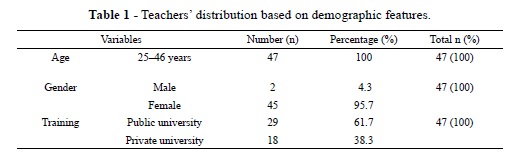
The final sample encompassed 47 participants, mostly women (95.7%), aged between 25 and 46 years, with a mean age of 32.3 years (SD = 4.36) (Table 1).
The participants' response rate was 100%. The time since graduation ranged from 3 to 10 years, with a mean of 5.4 years (SD 1.59). More than half of the participants reported having studied at private universities (62%) (Table 1).
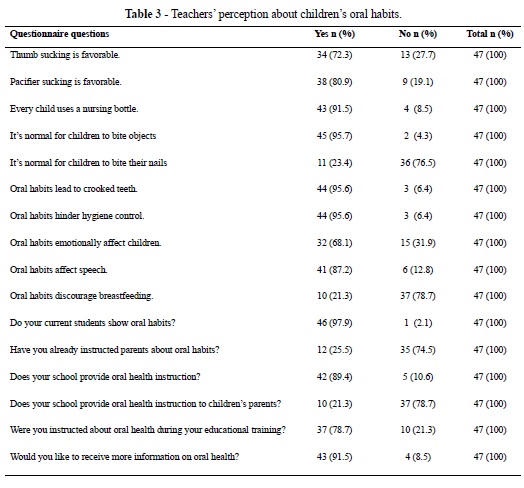
Participants were asked whether they received information or were taught about children's oral health, to which 78.7% reported to have studied the subject during training. Nearly ninety percent (89.4%) of the participants reported that they had used their acquired knowledge on oral health to care for the children within the school environment. However, only 25% reported that they had conveyed the children's oral habits to their parents.
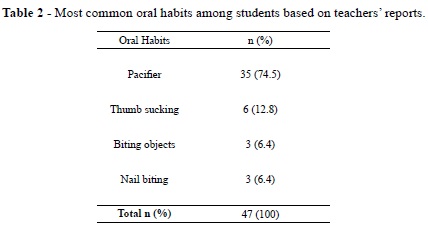
Using a pacifier was the most reported habit (74.5%). Biting objects (6.4%) and nail biting (6.4%) were the least reported by teachers (Table 2).
]]>
Bottle feeding was considered a normal habit by most teachers (91.5%), followed by using a pacifier (80.9%) and thumb sucking habits (72.3%) (Table 3). As for participants' knowledge and perceptions about oral habits, they believed that a sucking habit is normal at the mean age of 2.15 years (SD = 1.14). On the other hand, 53.2% and 48.9% of the participants considered age four to be the age at which children should quit using a pacifier and nursing with a bottle, respectively.
 ]]>
]]>
Overall, 87.2% of the participants reported that oral habits affect speech, and 78.7% reported that non-nutritive sucking habits do not affect breastfeeding (Table 3).
DISCUSSION
School is a fundamental and important environment in the social structuring process. Given its scope, school has been considered a space for developing oral health and hygiene programs18-20. In addition to the image of the teacher and that of the school, work in health education with very young children is highly effective, since children are more receptive and learn faster. Therefore, it is easier to teach them proper habits, especially those related to oral health14,20,21.
The present results confirm the important role of schools in approaching health-related subjects18. Teachers interact with children on a daily basis and, often, for long periods of time throughout the year. However, oral health concepts are usually not discussed at school due to teachers' lack of knowledge about the subject and lack of available time19.
Most participants (78.7%) reported that they had acquired knowledge on oral health instruction during their undergraduate courses. A work with 140 preschool teachers found a similar result as 85.4% of the subjects reported they had received information about the required care for maintaining oral health22. However, a study in the south of Brazil found different results when researchers interviewed 221 preschool teachers, and only 34.8% of them said they were taught about oral health during their training23. These different results may possibly be due to the different curricula adopted by educational institutions.
Although teachers reportedly have this knowledge, only 25.5% of them provided oral health information to parents, i.e., only a few teachers instructed parents about the care that should be taken in order to ensure children's oral health. This finding is of concern, since every educational practice requires parents' active participation22,23. In addition, care and educational practices are inseparable and complement each other18. Thus, the partnership between parents and teachers may result in good health habits in childhood24.
Although only 25.5% of the teachers instructed parents, most of the teachers reported that the children received oral health instruction at school, which runs in line with findings from Martins et al.25 According to them, most teachers (78.4%) reported that they had instructed their students on oral-health-related topics. However, Vasconcelos et al.19 developed a study with 64 teachers from a primary school in the city of Belo Horizonte and found different results. They reported that 64% of the teachers never addressed contents related to general and oral health in the classroom, and 8% of the remaining 36% only did so occasionally. This is justified by the fact that teachers did have not enough knowledge on the topic. In addition, they believed that oral health is not part of the curriculum content19.
Although most teachers had acquired knowledge of oral health, the information they reported contradicts that found in the literature. For example, most participants (78.7%) believed that oral habits do not discourage breastfeeding; however, studies have shown that using the pacifier at the beginning of lactation may affect proper sucking during breastfeeding and contribute to so-called "nipple confusion"26. A cohort study at Pelotas, Brazil, verified that the concomitant presence of breastfeeding for at least 9 months and the nonregular use of a pacifier between 12 months and 4 years of age is necessary to ensure a protective effect for malocclusion in children10. In addition, the World Health Organization27 recommends avoiding pacifiers and the use of nursing bottles in order to prevent early weaning28. It was found that 5.6% of teachers believed that oral habits lead to crooked teeth. However, Moimaz et al.29 claimed that children who quit oral habits up to 2.3 years of age have a greater chance of spontaneously correcting malocclusions derived from these habits.
]]> Among the non-nutritive sucking habits reported by teachers, pacifier use (74.5%) was the most common among children, followed by thumb sucking (12.8%). A study conducted in Belo Horizonte with 211 3 to 5-year-old children found similar results1. According to their results, pacifier use was the most prevalent non-nutritive habit. There was an approximately 75% prevalence in pacifier use, which was followed by onychophagy (10.3%), thumb sucking (10%), and biting objects (6.8%). The pacifier is an object that strongly influences the child's life, as there is a cultural component in its use. It is common for pacifiers and bottles to be part of the trousseau of pregnant women1,2,8,9. Nevertheless, the quantitative assessment performed in the current study may represent a limitation factor. Qualitative studies on the subject should be encouraged in order to stimulate schools' role as health promoters.The development of an oral health theme is not yet a reality within college classrooms30, and this lack limits teachers' knowledge on oral-habit-related issues. Pediatric dentists should work to properly transmit this knowledge to educators so that these professionals will be able teach children and their parents/guardians about the theme in an attempt to help children develop good oral health habits. Using the school as a health promoter is an important strategy to promote public health.
CONCLUSION
It can therefore be concluded that early childhood education teachers are important child health promoters; however, they need to acquire further knowledge on the subject during their professional training. Early childhood teachers can be important allies in promoting health. Educational campaigns should be encouraged in order to establish a partnership between health professionals and early childhood education teachers to strengthen the school's role as a promoter of health.
ACKNOWLEDGEMENTS
This study was supported by the Coordination for the Improvement of Higher Level Education Personnel (CAPES), the National Council for Scientific and Technological Development (CNPq), the State of Minas Gerais Research Foundation (FAPEMIG), and Pro-Reitoria de Pesquisa from the Federal University of Minas Gerais (PRPqUFMG).
REFERENCES
]]>1. Serra-Negra JMC, Pordeus IA, Rocha-Jr JF. Estudo da associação entre aleitamento, hábitos bucais e maloclusões. Rev Odontol Univ São Paulo. 1997; 11(2):79-86. [ Links ]
2. Serra-Negra JMC, Vilela LC, Rosa AR, Andrade ELSP, Paiva SM, Pordeus IA. Hábitos bucais deletérios: os filhos imitam as mães na adoção destes hábitos? Rev Odonto Ciênc. 2006;21(52):146-152.
3. Serra-Negra JM, Paiva SM, Auad SM, Ramos- Jorge ML, Pordeus IA. Signs, symptoms, parafunctions and associated factors of parentreported sleep bruxism in children: a case-control study. Braz Dent J. 2012;23(6):746-52.
4. Macho V, Andrade D, Cristina A, Norton A, Coelho A, Macedo P. Prevalência de hábitos orais deletérios e de anomalias oclusais numa população dos 3 aos 13 anos. Rev Port Estomatol Med Dent Cir Maxilofac. 2012;53(3):143-147.
5. Garde JB, Suryavanshi R, Jawale BA, Deshmukh V, Dadhe DP, Suryavanshi MK. An epidemiological study to know the prevalence of deleterious oral habits among 6 to 12 year old children. J Int Oral Health. 2014;6(1):39-43.
6. Singh SP, Utreja A, Chawla HS. Distribution of malocclusion types among thumb suckers seeking orthodontic treatment. J Indian Soc Pedod Prev Dent. 2012;26(3):114-117.
7. Souza JPO, Prudente AM, Silva DA, Pereira LA, Rinaldi AE. Evaluation of employees in public day care centers knowledge about breastfeeding and complementary feeding. Rev Paul Pediatr. 2013;31(4):480-487.
8. Góis EG, Ribeiro-Júnior HC, Vale MP, Paiva SM, Serra-Negra JMC, Ramos-Jorge ML, et al. Influence of non nutritive sucking habits, breathing pattern and adenoid size on the development of malocclusion. Angle Orthod. 2008;78(4):647-654.
9. Góis EG, Ribeiro-Júnior HC, Vale MP, Paiva SM, Abreu MH, Serra-Negra JM, et al. Incidence of malocclusion between primary and mixed dentitions among Brazilian children: a 5-year longitudinal study. Angle Orthod. 2012;82(3):495- 500.
]]> 10. Peres KG, Barros AJ, Peres MA, Victora CG. Effects of breastfeeding and sucking habits on malocclusion in a birth cohort study. Rev Saúde Pública. 2007;41(3):343-350.11. Peres KG, Cascaes AM, Nascimento GG, Victora CG. Effect of breastfeeding on malocclusions: a systematic review and meta-analysis. Acta Pediatr. 2015;3. doi: 10.1111/apa.13103. [Epub ahead of print].
12. Vozza I, Guerra F, Marchionne M, Bove E, Corridore D, Ottolenghi L. A multimedia oral health promoting project in primary schools in central Italy. Ann Stomatol. 2014;5(3):87-90.
13. Santos PA, Rodrigues JA, Garcia PPNS. Avaliação do conhecimento dos professores do ensino fundamental de escolas particulares sobre saúde bucal. Rev Odontol UNESP. 2002;31(2):205-214.
14. Santos PA, Rodrigues JA, Garcia PPNS. Conhecimento sobre prevenção de cárie e doença periodontal e comportamento de higiene bucal de professores de ensino fundamental. Braz Dent Sci. 2003;6(1):67-74.
15. Ferreto LE, Fagundes ME. Conhecimentos e práticas de saúde bucal de professores dos centros municipais de educação infantil de Francisco Beltrão, PR, Brasil. Rev Faz Ciênc. 2009;11(13):143-158.
16. Temporini ER. Percepção de professores do Sistema de Ensino do Estado de São Paulo sobre o seu preparo em saúde do escolar. Rev Saúde Pública. 1988;22(5):411-421.
17. Fernando S, Kanthi RD, Johnson NW. Preschool teachers as agents of oral health promotion: an intervention study in Sri Lanka. Community Dent Health. 2013;30(3):173-7.
18. HV A, D'Cruz AM, Shirahatti RV. Knowledge, attitude and practice regarding oral health among the rural government primary school teachers of Mangalore. J Dent Hyg. 2013;87(6):362-9.
19. Vasconcelos R, Matta ML, Pordeus IA, Paiva SM. Escola: um espaço importante de informação em saúde bucal para a população infantil. Rev Fac Odontol São José dos Campos. 2001;4(3):43-51.
]]> 20. Vasel J, Bottan ER, Campos L. Dental health education: analysis of knowledge among elementary school teachers in a town in the Vale do Itapocu (SC) region. RSBO. 2008;5(2):12-18.21. Antunes LS, Antunes LAA, Corvino MPF. Educative practices and attitudes within the preschool environment: evaluating the education professionals. Braz Oral Res. 2008;22(4):340-345.
22. Arcieri RM, Rovida TA, Lima DP, Garbin AJ, Garbin CA. Análise do conhecimento de professores de Educação Infantil sobre saúde bucal. Educ Rev. 2013;47: 301-314.
23. Garbin CA, Rovida TA, Peruchini LF, Martins RJ. Conhecimento sobre saúde bucal e práticas desenvolvidas por professores do ensino fundamental e médio. RFO. UPF 2013;18(3):321- 327.
24. Martins SVM, Tavares HM. A família e a escola: desafios para a educação no mundo contemporâneo. Rev Catol. 2010;2(3):256-263.
25. Martins VR, Abrantes FM, Miasato JM. Professores como uma importante fonte de informação e promoção de saúde bucal. Pesq Bras Odontopediatria Clín Integr. 2008;8(1):27-30.
26. Yonezu T, Arano-Kojima T, Kumazawa K, Shintani S. Association between feeding methods and sucking habits: a cross-sectional study of infants in their first 18 months of life. Bull Tokyo Dent Coll. 2013;54(4): 215-221.
27. World Health Organization (WHO). Evidencias científicas dos dez passos para o sucesso do aleitamento materno. Brasília: Organização Pan- Americana de Saúde (OPAS); 2001.
28. Cunha AJL, Leite A, Márcia M. Breastfeeding and pacifier: implications for healthy policy. J Pediatr. 2009;85(5):462-463.
29. Moimaz SAS, Rocha N, Garbin A, Saliba O. The relation between maternal breast feeding and nonnutritive sucking habits. Ciênc Saúde Coletiva. 2011;16(5):2477-2484.
]]> 30. Kassak KM, Dagher R, Doughan B. Oral hygiene and lifestyle correlates among new undergraduate university students in Lebanon. J Am Coll Health. 2001;50(1):15-20.
]]>