<?xml version="1.0" encoding="ISO-8859-1"?><article xmlns:mml="http://www.w3.org/1998/Math/MathML" xmlns:xlink="http://www.w3.org/1999/xlink" xmlns:xsi="http://www.w3.org/2001/XMLSchema-instance">
<front>
<journal-meta>
<journal-id>1677-3225</journal-id>
<journal-title><![CDATA[Brazilian Journal of Oral Sciences]]></journal-title>
<abbrev-journal-title><![CDATA[Braz. j. oral sci.]]></abbrev-journal-title>
<issn>1677-3225</issn>
<publisher>
<publisher-name><![CDATA[Faculdade de Odontologia de Piracicaba, UNICAMP]]></publisher-name>
</publisher>
</journal-meta>
<article-meta>
<article-id>S1677-32252012000100003</article-id>
<title-group>
<article-title xml:lang="en"><![CDATA[Atraumatic Restorative Treatment used for caries control at public schools in Piracicaba, SP, Brazil]]></article-title>
</title-group>
<contrib-group>
<contrib contrib-type="author">
<name>
<surname><![CDATA[Gibilini]]></surname>
<given-names><![CDATA[Cristina]]></given-names>
</name>
<xref ref-type="aff" rid="A01"/>
</contrib>
<contrib contrib-type="author">
<name>
<surname><![CDATA[de Paula]]></surname>
<given-names><![CDATA[Janice Simpson]]></given-names>
</name>
<xref ref-type="aff" rid="A01"/>
</contrib>
<contrib contrib-type="author">
<name>
<surname><![CDATA[Marques]]></surname>
<given-names><![CDATA[Regina]]></given-names>
</name>
<xref ref-type="aff" rid="A02"/>
</contrib>
<contrib contrib-type="author">
<name>
<surname><![CDATA[Sousa]]></surname>
<given-names><![CDATA[Maria da Luz Rosário]]></given-names>
</name>
<xref ref-type="aff" rid="A03"/>
</contrib>
</contrib-group>
<aff id="A01">
<institution><![CDATA[,University of Campinas Piracicaba Dental School Department of Community Dentistry]]></institution>
<addr-line><![CDATA[ ]]></addr-line>
<country>Brazil</country>
</aff>
<aff id="A02">
<institution><![CDATA[,PhD in Public Health and Oral Health Coordinator of the Municipality of São Paulo  ]]></institution>
<addr-line><![CDATA[ ]]></addr-line>
<country>Brazil</country>
</aff>
<aff id="A03">
<institution><![CDATA[,University of Campinas Piracicaba Dental School Department of Community Dentistry]]></institution>
<addr-line><![CDATA[ ]]></addr-line>
<country>Brazil</country>
</aff>
<pub-date pub-type="pub">
<day>00</day>
<month>03</month>
<year>2012</year>
</pub-date>
<pub-date pub-type="epub">
<day>00</day>
<month>03</month>
<year>2012</year>
</pub-date>
<volume>11</volume>
<numero>1</numero>
<fpage>14</fpage>
<lpage>18</lpage>
<copyright-statement/>
<copyright-year/>
<self-uri xlink:href="http://revodonto.bvsalud.org/scielo.php?script=sci_arttext&amp;pid=S1677-32252012000100003&amp;lng=en&amp;nrm=iso"></self-uri><self-uri xlink:href="http://revodonto.bvsalud.org/scielo.php?script=sci_abstract&amp;pid=S1677-32252012000100003&amp;lng=en&amp;nrm=iso"></self-uri><self-uri xlink:href="http://revodonto.bvsalud.org/scielo.php?script=sci_pdf&amp;pid=S1677-32252012000100003&amp;lng=en&amp;nrm=iso"></self-uri><abstract abstract-type="short" xml:lang="en"><p><![CDATA[AIM: The aims of this study were (1) to evaluate the Atraumatic Restorative Treatment (ART) as a measure to control caries at public schools in Piracicaba, SP, Brazil, discussing the importance of the promotion of individual and collective health and (2) to evaluate the longevity of ART restorations in the first six months after placement. METHODS: The sample consisted of 173 schoolchildren aged 5 to 10 years from public schools in Piracicaba, treated according to ART approach and reassessed after six months. RESULTS:It could be observed that after ART, a large part of the students initially fitted into risk E classification (high caries risk) were reclassified into risk B classification (moderate caries), characterized by the presence of restored teeth only (caries free teeth; c = 0). In addition, 81.78% success rate was obtained after six months of ART. CONCLUSIONS: ART was considered effective in health promotion programs, given its importance as a measure to control caries in schoolchildren.]]></p></abstract>
<kwd-group>
<kwd lng="en"><![CDATA[dental atraumatic restorative treatment]]></kwd>
<kwd lng="en"><![CDATA[dental caries]]></kwd>
<kwd lng="en"><![CDATA[public health]]></kwd>
</kwd-group>
</article-meta>
</front><body><![CDATA[ <p align="right"><font face="Verdana, Arial, Helvetica, sans-serif" size="2"><b>ORIGINAL    ARTICLE</b></font></p>     <p>&nbsp;</p>     <p><font face="Verdana, Arial, Helvetica, sans-serif" size="4"><a name="top"/></a><b>Atraumatic Restorative Treatment used   for caries control at public schools in Piracicaba, SP, Brazil</b></font></p>     <p>&nbsp;</p>     <p>&nbsp;</p>     <p><font face="Verdana, Arial, Helvetica, sans-serif" size="2"><b>Cristina Gibilini<sup>I</sup>; Janice Simpson de Paula<sup>I</sup>; Regina Marques<sup>II</sup>; Maria da Luz Ros&aacute;rio Sousa<sup>III</sup></b></font></p>     <p>&nbsp;</p>     <p><font face="Verdana, Arial, Helvetica, sans-serif" size="2"><sup>I</sup>PhD Student, Graduate Program in Dentistry, sub-area Dental Public Health, Department of Community Dentistry, Piracicaba Dental School, University of Campinas, Brazil<br/> <sup>II</sup>PhD in Public Health and Oral Health Coordinator of the Municipality of S&atilde;o Paulo, Brazil<br/> <sup>III</sup>Professor, Department of Community Dentistry, Piracicaba Dental School, University of Campinas, Brazil    <br> </font></p>     <p><font face="Verdana, Arial, Helvetica, sans-serif" size="2"><a href="#back">Correspondence</a></font></p>     ]]></body>
<body><![CDATA[<p>&nbsp;</p>     <p>&nbsp;</p> <hr noshade size="1">     <p><font face="Verdana, Arial, Helvetica, sans-serif" size="2"><b>ABSTRACT</b></font></p>     <p><font face="Verdana, Arial, Helvetica, sans-serif" size="2"><b>AIM:</b> The aims of this study were (1) to evaluate the Atraumatic Restorative Treatment (ART) as   a measure to control caries at public schools in Piracicaba, SP, Brazil, discussing the importance   of the promotion of individual and collective health and (2) to evaluate the longevity of ART   restorations in the first six months after placement.<br/>   <b>METHODS:</b> The sample consisted of 173   schoolchildren aged 5 to 10 years from public schools in Piracicaba, treated according to ART   approach and reassessed after six months.<br/>   <b>RESULTS:</b>It could be observed that after ART, a large   part of the students initially fitted into risk E classification (high caries risk) were reclassified into risk   B classification (moderate caries), characterized by the presence of restored teeth only (caries   free teeth; c = 0). In addition, 81.78% success rate was obtained after six months of ART.<br/>   <b>CONCLUSIONS:</b> ART was considered effective in health promotion programs, given its importance   as a measure to control caries in schoolchildren.</font></p>     <p><font face="Verdana, Arial, Helvetica, sans-serif" size="2"><b>Keywords:</b>    dental atraumatic restorative treatment, dental caries, public health.</font></p> <hr noshade size="1">     <p>&nbsp;</p>     <p>&nbsp;</p>     <p><font face="Verdana, Arial, Helvetica, sans-serif" size="3"><b>Introduction</b></font></p>     <p><font face="Verdana, Arial, Helvetica, sans-serif" size="2">Although dental caries prevalence has declined significantly over the last   few years, it is still considered a public health problem in Brazil and worldwide.   This fact is confirmed when the data of the last national epidemiologic survey   are analyzed, indicating that among 5-year-old children approximately 60%   presented at least one primary tooth with caries experience, and 70% of the 12-year-olds presented caries in their permanent dentition<sup>1</sup>.</font></p>     <p><font face="Verdana, Arial, Helvetica, sans-serif" size="2">In view of this situation, dental control and follow-up are necessary during   childhood and adolescence for preventing or attenuating the affections caused   by caries disease. With the goal of encouraging health promotion measures required   for caries control and prevention, the World Health Organization (WHO) proposed   the program of Atraumatic Restorative Treatment (ART) for countries with   economically underprivileged or marginalized communities<sup>2</sup>. ART has been   considered a feasible treatment option, as it is based on the contemporary   philosophy of minimum intervention and maximum preservation of the tooth,and can be applied to the entire population. ART consists of   a simplified, low-cost technique that uses only hand   instruments in the removal of carious tissues to reduce   contamination and viability of microorganisms<sup>3</sup>, and requires   immediate restoration of the cavity with and adhesive   restorative material, namely glass ionomer. Moreover, the   ART approach causes less anxiety in children than the   traditional restorative approach<sup>2,4</sup>.</font></p>     ]]></body>
<body><![CDATA[<p><font face="Verdana, Arial, Helvetica, sans-serif" size="2">It is worth mentioning that the use of high-viscosity   glass ionomer cements has been outstanding, as it facilitates   the technique and reduces the technical difficulties, especially   in public services<sup>5</sup>. In this context, studies have pointed out   the clinical performance of the glass ionomer cement Ketac   Molar&reg; (3M ESPE)<sup>6-7</sup>. Other studies have found better results   for glass ionomer over conventional amalgam in restorations   in primary teeth<sup>8-10</sup>.</font></p>     <p><font face="Verdana, Arial, Helvetica, sans-serif" size="2">Because of properties such as continuous fluoride release   and fluoride ion recharging capacity, glass ionomer cements   act as a constant reservoir of fluoride in the oral cavity, and   participate in the de- and remineralization processes,   contributing to the good clinical performance of the   restorations<sup>8</sup>.</font></p>     <p><font face="Verdana, Arial, Helvetica, sans-serif" size="2">Various longitudinal studies have been conducted to   assess the efficacy of ART. Frencken et al.<sup>11</sup> (1996) and   Holmgren et al.<sup>12</sup> (2000) evaluated the longevity of restorations   in Class I and II cavities for a period of 3 years with   satisfactory results in 88.3% and 92% of them, respectively,   in primary and permanent teeth. Other longitudinal studies   using ART have shown various long-term success rates using   Ketac Molar&reg; (3M ESPE), with results that reach up to 21%   of success within 36 months in permanent teeth<sup>12</sup>. Van   Germert-Schriks et al.<sup>13</sup> (2007) found 43.4% success for oneface   restorations and 12.2% for two-face restorations, using   the same restorative material and same period of evaluation.</font></p>     <p><font face="Verdana, Arial, Helvetica, sans-serif" size="2">Research studies have indicated ART as an effective   method in the control of caries disease, with low operating   costs, but further studies are necessary to evaluate its   application in public health, including a more comprehensive   assessment of the participants' oral health. It should be noted   that collective environments such as schools are ideal spaces   for oral health promotion actions, as they allow the   development of group activities and contribute to the control   and evaluation of interventions. In this context, the verification   of caries activity is emphasized. The early diagnosis of incipient   caries lesions at a reversible stage not only permits evaluating   the determinant factors, but also helps determining the caries   risk, which makes the treatment simpler, less invasive and   less expensive based on the use of fluoride and changes in   the patient's behavior with respect to diet and oral hygiene<sup>14</sup>.   Thus, careful determination of caries risk is necessary so that   preventive actions and specific control may be directed towards   high-risk individuals even before the lesions develop<sup>15</sup>. Caries   risk assessment can be made both in the clinical environment   and in other collective spaces<sup>16</sup>.</font></p>     <p><font face="Verdana, Arial, Helvetica, sans-serif" size="2">The use of ART in schoolchildren may help fulfilling   the demand in public services as this approach allies a faster   treatment outcome compared with conventional treatment<sup>17-19</sup> with caries control, which is of particular interest for   children at higher risk for developing caries. Thus, the aim   of the present study was to evaluate ART as a measure to   control caries in public schools in Piracicaba, S&atilde;o Paulo,   considering the longevity of restorations in the first six months   after treatment, as well as discussing the importance of   promoting public health.</font></p>     <p>&nbsp;</p>     <p><font face="Verdana, Arial, Helvetica, sans-serif" size="3"><b>Material and    methods</b></font></p>     <p><font face="Verdana, Arial, Helvetica, sans-serif" size="2">The present study was first sent to the Research Ethics   committee of the Piracicaba School of Dentistry (University   of Campinas) for appreciation, and was approved under   Protocol No. 106/2009. The children's and parents'/guardians' consent was obtained.</font></p>     <p><font face="Verdana, Arial, Helvetica, sans-serif" size="2">The convenience sample analyzed 1,167 children in the   age range between 5 and 10 years old. A total of 173   schoolchildren with indication for ART were included,   totalizing 330 teeth. The children came from six public   schools (Ol&iacute;via Capr&acirc;nico, Jos&eacute; Pousa de Toledo, Benedito   de Andrade, Francisco A. Kronka, Ant&ocirc;nio Rodrigues   Domingues and Melita L. Brasiliense) in the municipality of   Piracicaba, S&atilde;o Paulo, which participate in prevention   programs.</font></p>     <p><font face="Verdana, Arial, Helvetica, sans-serif" size="2">The Municipality of Piracicaba is located 160 km from   S&atilde;o Paulo, in the southwestern region of the state, and has   368,029 inhabitants20. It has had fluoridated public water   supplies since 197121 and at present 99.38% of residents are   favored with water supply<sup>20</sup>. The Human Development Index   (HDI) of the municipality was 0.836 in 2000<sup>19-20</sup>. The mean   dmft index ("d"-decayed; "m"-missing;"f"-filled; "t"-teeth)   among preschool children was 1.30 in 2006<sup>22</sup> and 1.32 in   2010<sup>23</sup>.</font></p>     ]]></body>
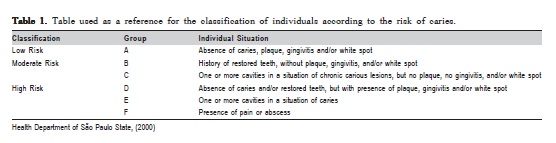
<body><![CDATA[<p><font face="Verdana, Arial, Helvetica, sans-serif" size="2">Before treatment, an epidemiologic survey of dental   caries was conducted to obtain the children's dmft and caries   risk classification, as well as to verify the caries cavities   with indication for ART. The dmft index was determined in   accordance with the WHO criteria<sup>24</sup> and the caries risk   evaluation was obtained in accordance with the criteria of   the State Secretariat of Health<sup>16</sup>, according to which the   schoolchildren are classified into five different categories:   A (healthy teeth), B (presence of restoration), C (presence of   chronic caries), D (presence of plaque, gingivitis or white   spot lesion), E (presence of acute caries) and F (urgency)    <br> (<a href="#tab01">Table 1</a>).</font></p>     <p>&nbsp;</p>     <p><a name="tab01"></a></p>     <p>&nbsp;</p>     <p align="center"><img src="/img/revistas/bjos/v11n1/a03tab01.jpg"></p>     <p>&nbsp;</p>     <p><a name="tab02"></a></p>     <p>&nbsp;</p>     <p align="center"><img src="/img/revistas/bjos/v11n1/a03tab02.jpg"></p>     ]]></body>
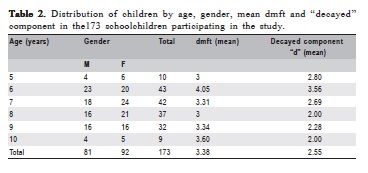
<body><![CDATA[<p>&nbsp;</p>     <p><font face="Verdana, Arial, Helvetica, sans-serif" size="2">    <br>   The criterion used for the indication of ART followed   the criteria described by Frencken et al.<sup>2</sup> (1996), with   evaluation of primary teeth only. Thus, teeth with cavited   dentin caries lesion that could be accessed with a 0.9-mmdiameter   excavator were included. Teeth with evident pulp   involvement or painful symptomatology were excluded from   the sample. A trained dentist performed ART in accordance   with the protocol proposed by Frencken et al.<sup>2</sup> (1996). The   treated caries cavities were restored with glass ionomer Ketac   Molar&reg; (3M ESPE), in accordance with the manufacturer's instructions.</font>     <p><font face="Verdana, Arial, Helvetica, sans-serif" size="2">The longevity of ART restorations at 6 months wasevaluated according to the criteria proposed by Taifour et   al.<sup>8</sup> (2002), with the use of a flat oral mirror and CPI probe   by a single calibrated examiner, with intra-examiner   agreement of 84.2%. The criteria used for evaluating the   restorations were described and grouped into 3 categories<sup>8,25</sup>:   a) success (restorations present with a maximum of 0.5 mm   marginal defect); b) failure (restorations with a marginal defect  &gt;0.5mm, fracture of the restoration or tooth, restoration   completely lost); and c) not evaluated (absent due to natural   exfoliation of the tooth or replacement of the glass ionomer   restoration by another type of restorative material) or   excluded (children who missed the evaluation visit, moved   to another school or completed primary schooling in the period between baseline and reevaluation).</font>     <p><font face="Verdana, Arial, Helvetica, sans-serif" size="2">The data were tabulated and analyzed by descriptive   statistics, using the SPSS software (SPSS Inc., Shicago, IL,   USA) version 17.0.</font>     <p>&nbsp;</p>       <p><font face="Verdana, Arial, Helvetica, sans-serif" size="3"><b>Results</b></font></p>     <p><font face="Verdana, Arial, Helvetica, sans-serif" size="2">It could be observed that among the 173 schoolchildren   subjected to ART, 81 (46.82%) were boys and 92 (53.18%)   were girls. The mean age was 7.36 years (SD 1.36), ranging   between 5 and 10 years. The descriptive data are presented in <a href="#tab02">Table 2</a>.</font></p>     <p><font face="Verdana, Arial, Helvetica, sans-serif" size="2">At the time of the epidemiologic survey (baseline) the   children selected for treatment according to ART presented   a dmft equal to 3.38, with mean number of decayed teeth   equal to 2.55. After treatment, the children were re-evaluated   and presented a mean of the &lsquo;decayed' component of dmft   equal to 0.72.</font></p>     <p><font face="Verdana, Arial, Helvetica, sans-serif" size="2">In addition, in the previous survey, the schoolchildren   were classified with regard to the criterion of risk<sup>16</sup> and   reclassified after ART had been performed. In the first   evaluation, all participants fitted into the risk E classification,   due to the presence of carious teeth. After ART, a large part   of the schoolchildren were re-classified into risk B,   characterized by the presence of restored teeth only (no caries   lesions). Nevertheless, it is worth pointing out that even with   the reclassification, 53.1% of the schoolchildren presented   teeth without indication for ART, but with the need for   curative and/or preventive treatment. Thus, 20.2% of the   participants still presented white spot lesions, plaque or   gingivitis in some teeth, fitting into risk D classification.   The remainder of the schoolchildren (32.9%) still presented   carious teeth with contra-indication for ART, keeping them   in risk E (presence of acute cries), as demonstrated by the   distribution in <a href="#tab03">Table 3</a>.</font></p>     ]]></body>
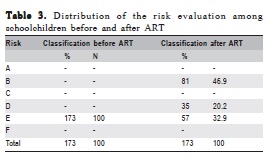
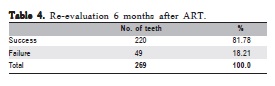
<body><![CDATA[<p>&nbsp;</p>     <p><a name="tab03"></a></p>     <p>&nbsp;</p>     <p align="center"><img src="/img/revistas/bjos/v11n1/a03tab03.jpg"></p>     <p>&nbsp;</p>     <p><a name="tab04"></a></p>     <p>&nbsp;</p>     <p align="center"><img src="/img/revistas/bjos/v11n1/a03tab04.jpg"></p>     <p>&nbsp;</p>     <p><font face="Verdana, Arial, Helvetica, sans-serif" size="2">Six months after the initial treatment, a new evaluation/follow-up was performed (<a href="#tab04">Table 4</a>). Thus, 36 (10.9%) of theteeth re-evaluated presented another type of restorative material, or had exfoliated naturally, and 25 teeth (7.6%) were not evaluated because the children had moved to another school, making longitudinal evaluation of the restoration impossible. Therefore, 269 (81.51%) of the 330 teeth initially treated were re-evaluated 6 months after treatment with a success rate of 81.78%.</font></p>     ]]></body>
<body><![CDATA[<p><font face="Verdana, Arial, Helvetica, sans-serif" size="3"><b>Discussion</b></font></p>     <p><font face="Verdana, Arial, Helvetica, sans-serif" size="2">From the 173 schoolchildren subjected to ART, 67%   shifted from caries risk classification E (acute caries) to risk   classification B (restoration) or D (white spot lesion, plaque   and/or gingivitis). These data demonstrate that ART per se   improved the oral status of a large percentage of the children   treated, as described by Frencken et al.<sup>5</sup> (2010). Nevertheless,   among the schoolchildren that shifted from risk E to risk D   (20.2%), implementation of educational measures allied with   motivation to perform oral hygiene is still necessary to   decrease the prevalence of biofilm, white spot lesions and   gingivitis. Thus, the children fitted into risk D could, by   means of simpler actions than ART, shift into risk B with   improved oral health, and consequently, quality of life.   Therefore, ART must be considered a measure for promoting   public health and should be performed in conjunction with   practices in health education and preventive programs to be   effective in controlling the etiologic factors of caries<sup>26-27</sup>.   Furthermore, in spite of ART, 32.95% of the schoolchildren   remained in the risk E classification, that is, continued to have   caries, which could be justified by two situations: 1) teeth with   cavities with pulp involvement or painful symptomatology   (contraindicated for ART); 2) presence of carious permanent teeth, not included in the indications for ART in this study.</font></p>     <p><font face="Verdana, Arial, Helvetica, sans-serif" size="2">In   spite of the mentioned factors, an improvement in the   schoolchildren's oral health was observed by the reduction in   the mean of the &lsquo;decayed' component of dmft from 2.55 to   0.72, proving the effectiveness of this type of treatment.</font></p>     <p><font face="Verdana, Arial, Helvetica, sans-serif" size="2">ART improves the oral status, preventing caries   progression to more complex levels, such as the need for   endodontic treatment and extractions. This occurs because   ART fits into the concept based on the prevention and early   interception of the caries process, with the goal of performing   interventions that are as conservative as possible<sup>2,11,28</sup>. In   addition, the treatment allows a reduction in the level of   Streptococcus mutans in the oral cavity, and consequently,   the risk of new carious lesions<sup>3</sup>.</font></p>     <p><font face="Verdana, Arial, Helvetica, sans-serif" size="2">Considering the large number of children that wait for   treatment at the Family Health Units or Basic Health Units,   ART can collaborate significantly in fulfilling the demand   of these pediatric patients, being an important form of caries   control and prevention in the Family Health Program<sup>5,29-30</sup>.</font></p>     <p><font face="Verdana, Arial, Helvetica, sans-serif" size="2">It is also worth emphasizing that as a low-cost, simple   and fast (mean of 6 min per restoration) technique ART may   optimize the time and human resources that would be   required, for example, to transport these children to a location   outside the school environment during treatment, as has been   described by Figueiredo et al.<sup>29</sup> (2004); Schriks and   Amerongen<sup>17</sup> (2003) and Pellegrinetti et al.<sup>18</sup> (2005). However,   a limiting factor as far as minimal dental intervention is   concerned, is the overall difficulty of acceptance by dentists.   Rios et al.<sup>31</sup> (2006) evaluated professionals from the public   service in Goi&acirc;nia and found that less than half of the   professionals (42.8%) believed in the efficacy of the technique,   and that more information would be required about the   technique, its efficiency and its use in public service.</font></p>     <p><font face="Verdana, Arial, Helvetica, sans-serif" size="2">In spite of the difficulties encountered, mainly in   following up the restorations, ART continues to provide an   important scope for covering schoolchildren as well as the   community in general, taking into account the shorter time   for performing restorations and its low cost<sup>5</sup>. In this context,   Mickenautsch et al.<sup>32</sup> (2002) reported that the introduction   of ART into a mobile dental assistance program led to a   significant reduction in the percentages of amalgam   restorations and extractions.</font></p>     <p><font face="Verdana, Arial, Helvetica, sans-serif" size="2">According to the results of the present study, ART   appeared as a feasible alternative for caries treatment,   particularly in collective health, with proven efficacy, low   cost and broad improvement in covering dental care to   schoolchildren. These factors may be observed by the   technique simplicity and speed of the procedures and   contribution to the problem of the huge repressed demand   by patients with treatment needs. It could therefore be   concluded from this six-month evaluation that ART was   effective within health promotion programs as an important   measure to control caries disease in schoolchildren.</font></p>     <p>&nbsp;</p>     <p><font face="Verdana, Arial, Helvetica, sans-serif" size="3"><b>Acknowledgements</b></font></p>     ]]></body>
<body><![CDATA[<p><font face="Verdana, Arial, Helvetica, sans-serif" size="2">The authors thank the "Coordena&ccedil;&atilde;o de Aperfei&ccedil;oamento   de Pessoal de N&iacute;vel Superior &ndash; CAPES" for granting   scholarships and for constantly supporting research in   Graduation programs at the Piracicaba School of Dentistry (FOP/Unicamp).</font></p>     <p>&nbsp;</p>     <p><font face="Verdana, Arial, Helvetica, sans-serif" size="3"><b>References</b></font></p>     <!-- ref --><p><font face="Verdana, Arial, Helvetica, sans-serif" size="2">1. Brazil. Ministry of Health. Secretary of Health Care. Department of   Primary Care. Project "SB Brasil" 2003. Oral health status of the Brazilian population 2002-2003: principal results. Bras&iacute;lia: Ministry of Health, 2004.    &nbsp;&nbsp;&nbsp;&nbsp;&nbsp;&nbsp;&nbsp;&nbsp;[&#160;<a href="javascript:void(0);" onclick="javascript: window.open('/scielo.php?script=sci_nlinks&ref=040269&pid=S1677-3225201200010000300001&lng=','','width=640,height=500,resizable=yes,scrollbars=1,menubar=yes,');">Links</a>&#160;]<!-- end-ref --></font></p>     <!-- ref --><p><font face="Verdana, Arial, Helvetica, sans-serif" size="2">2. Frencken JE, Pilot T, Songpaisan Y, Phantumvanit P. Atraumatic   restorative treatment (ART): rationale, technique and development. J Public   Health Dent 1996; 56:135-40.    &nbsp;&nbsp;&nbsp;&nbsp;&nbsp;&nbsp;&nbsp;&nbsp;[&#160;<a href="javascript:void(0);" onclick="javascript: window.open('/scielo.php?script=sci_nlinks&ref=040271&pid=S1677-3225201200010000300002&lng=','','width=640,height=500,resizable=yes,scrollbars=1,menubar=yes,');">Links</a>&#160;]<!-- end-ref --></font></p>     <!-- ref --><p><font face="Verdana, Arial, Helvetica, sans-serif" size="2">3. Roshan NM, Anand LS, Deshpande SD. Microbiological evaluation of   salivary Streptococcus mutans from children of age 5-7 years, pre- and   post-atraumatic restorative treatment. Contemporary Clinical Dentistry   2010; 1(2): 94-7.    &nbsp;&nbsp;&nbsp;&nbsp;&nbsp;&nbsp;&nbsp;&nbsp;[&#160;<a href="javascript:void(0);" onclick="javascript: window.open('/scielo.php?script=sci_nlinks&ref=040273&pid=S1677-3225201200010000300003&lng=','','width=640,height=500,resizable=yes,scrollbars=1,menubar=yes,');">Links</a>&#160;]<!-- end-ref --></font></p>     <!-- ref --><p><font face="Verdana, Arial, Helvetica, sans-serif" size="2">4. Almeida Neves A, Cutinho E, Cardoso MV, Lembrechts P, Van Meerbeek   B. Current concepts and techniques for caries excavation and adhesion to residual dentin. J Adhes Dent 2011 Feb; 13(1): 7-22.    &nbsp;&nbsp;&nbsp;&nbsp;&nbsp;&nbsp;&nbsp;&nbsp;[&#160;<a href="javascript:void(0);" onclick="javascript: window.open('/scielo.php?script=sci_nlinks&ref=040275&pid=S1677-3225201200010000300004&lng=','','width=640,height=500,resizable=yes,scrollbars=1,menubar=yes,');">Links</a>&#160;]<!-- end-ref --></font></p>     <!-- ref --><p><font face="Verdana, Arial, Helvetica, sans-serif" size="2">5. Frencken JE. The ART approach using glass ionomers in relation to   global oral health care. Dental Materials, 2010, 26: 1-6.    &nbsp;&nbsp;&nbsp;&nbsp;&nbsp;&nbsp;&nbsp;&nbsp;[&#160;<a href="javascript:void(0);" onclick="javascript: window.open('/scielo.php?script=sci_nlinks&ref=040277&pid=S1677-3225201200010000300005&lng=','','width=640,height=500,resizable=yes,scrollbars=1,menubar=yes,');">Links</a>&#160;]<!-- end-ref --><!-- ref -->   6. Menezes JPL, Rosenblatt A, Medeiros E. Clinical evaluation of atraumatic   restorations in primary molars: A Comparison Between 2 glass ionomer   cements. Journal of Dentistry for Children 2006; 73:2: 91-7.    &nbsp;&nbsp;&nbsp;&nbsp;&nbsp;&nbsp;&nbsp;&nbsp;[&#160;<a href="javascript:void(0);" onclick="javascript: window.open('/scielo.php?script=sci_nlinks&ref=040278&pid=S1677-3225201200010000300006&lng=','','width=640,height=500,resizable=yes,scrollbars=1,menubar=yes,');">Links</a>&#160;]<!-- end-ref --></font></p>     <!-- ref --><p><font face="Verdana, Arial, Helvetica, sans-serif" size="2">7. Silva RC, Zuanon ACC, Spolidorio DMP, Campos JADB. Antibacterial   activity of four ionomer cements used in atraumatic restorative treatment.   J Mater Sci: Mater Med, 2007; 18: 1859-1862.    &nbsp;&nbsp;&nbsp;&nbsp;&nbsp;&nbsp;&nbsp;&nbsp;[&#160;<a href="javascript:void(0);" onclick="javascript: window.open('/scielo.php?script=sci_nlinks&ref=040280&pid=S1677-3225201200010000300007&lng=','','width=640,height=500,resizable=yes,scrollbars=1,menubar=yes,');">Links</a>&#160;]<!-- end-ref --></font></p>     <p><font face="Verdana, Arial, Helvetica, sans-serif" size="2">8. Taifour D, Francken JE, Beiruti N, van&acute;t Hof MA, Truin GJ. Effectiveness   of glass ionomer (ART) and amalgam restorations in the deciduous dentition:   results after 3 years. Caries Res 2002;36:437&ndash;444.</font></p>     <p><font face="Verdana, Arial, Helvetica, sans-serif" size="2">9. Frencken JE, van't Hof MA, Taifour D, Al-Zaher I. Effectiveness of ART   and traditional amalgam approach in restoring single-surface cavities in   posterior teeth of permanent dentitions in school children after 6.3 years.   Community Dent Oral Epidemiol 2007; 35: 207&ndash;214.</font></p>     <!-- ref --><p><font face="Verdana, Arial, Helvetica, sans-serif" size="2">10. Yu C, Gao XJ, Deng DM et al. Survival of glass ionomer restorations   placed in primary molars using atraumatic restorative treatment (ART)   and conventional cavity preparations: 2- year results. Int Dent J 2004;   54:42-46.    &nbsp;&nbsp;&nbsp;&nbsp;&nbsp;&nbsp;&nbsp;&nbsp;[&#160;<a href="javascript:void(0);" onclick="javascript: window.open('/scielo.php?script=sci_nlinks&ref=040284&pid=S1677-3225201200010000300010&lng=','','width=640,height=500,resizable=yes,scrollbars=1,menubar=yes,');">Links</a>&#160;]<!-- end-ref --></font></p>     ]]></body>
<body><![CDATA[<!-- ref --><p><font face="Verdana, Arial, Helvetica, sans-serif" size="2">11. Frencken JE, Makoni F, Sithole WD. ART restorations and glass ionomer   sealants in Zimbabwe: survival after 3 years. Community Dent Oral   Epidemiol 1998; 26: 372-81.    &nbsp;&nbsp;&nbsp;&nbsp;&nbsp;&nbsp;&nbsp;&nbsp;[&#160;<a href="javascript:void(0);" onclick="javascript: window.open('/scielo.php?script=sci_nlinks&ref=040286&pid=S1677-3225201200010000300011&lng=','','width=640,height=500,resizable=yes,scrollbars=1,menubar=yes,');">Links</a>&#160;]<!-- end-ref --></font></p>     <p><font face="Verdana, Arial, Helvetica, sans-serif" size="2">12. Holmgren CJ, Lo ECM, Hu DY, Wan HC: ART restorations and sealants   placed in Chinese school children &ndash; results after three years. Community   Dent Oral Epidemiol 2000; 28: 314&ndash;20</font></p>     <p><font face="Verdana, Arial, Helvetica, sans-serif" size="2">13. van Gemert-Schriks MCM, van Amerongen WE, ten Cate JM, Aartman   IHA. Three-year survival of single- and two-surface ART restorations in   a high-caries child population. Clin Oral Invest 2007; 11:337&ndash;343.</font></p>     <!-- ref --><p><font face="Verdana, Arial, Helvetica, sans-serif" size="2">14. Couto GBL, Vasconcelos MMVB, Melo MMC, Camelo CAC, Valen&ccedil;a   PAM. Prevalence of caries, white spot and visible plaque in children 0-36 months, assisted by the Family Health Program in the City of   Camaragibe - PE. Odontol Cl&iacute;n-Cient 2005; 4:19-28.    &nbsp;&nbsp;&nbsp;&nbsp;&nbsp;&nbsp;&nbsp;&nbsp;[&#160;<a href="javascript:void(0);" onclick="javascript: window.open('/scielo.php?script=sci_nlinks&ref=040290&pid=S1677-3225201200010000300014&lng=','','width=640,height=500,resizable=yes,scrollbars=1,menubar=yes,');">Links</a>&#160;]<!-- end-ref --></font></p>     <!-- ref --><p><font face="Verdana, Arial, Helvetica, sans-serif" size="2">15. Sant&acute;anna, G.R.; Bonecker, M.J.S.; Diarte, D.A.; Suga, S.N. Book of   Pediatric Dentistry; Sonetos Ed. 2002 apud Martins, A.A., Santos, A.A.;   Barreto, M.A.C.; Oliveira, C.C.C. Table of risk factors for decay applicable   in public health.Odontologic . Cl&iacute;n. Cient&iacute;f., Recife, 2003; 2(1): 37-42,   Jan/Abr.    &nbsp;&nbsp;&nbsp;&nbsp;&nbsp;&nbsp;&nbsp;&nbsp;[&#160;<a href="javascript:void(0);" onclick="javascript: window.open('/scielo.php?script=sci_nlinks&ref=040292&pid=S1677-3225201200010000300015&lng=','','width=640,height=500,resizable=yes,scrollbars=1,menubar=yes,');">Links</a>&#160;]<!-- end-ref --></font></p>     <!-- ref --><p><font face="Verdana, Arial, Helvetica, sans-serif" size="2">16. Ministry of health. SS-95 resolution, 27/06/2000. Recommendations about   the use of fluoride products in the "SUS" / SP according to the risk of dental caries. &#91;on line&#93; Available in URL: http://www.saude.sp.gov.br/fr_sbucal.html.    &nbsp;&nbsp;&nbsp;&nbsp;&nbsp;&nbsp;&nbsp;&nbsp;[&#160;<a href="javascript:void(0);" onclick="javascript: window.open('/scielo.php?script=sci_nlinks&ref=040294&pid=S1677-3225201200010000300016&lng=','','width=640,height=500,resizable=yes,scrollbars=1,menubar=yes,');">Links</a>&#160;]<!-- end-ref --></font></p>     ]]></body>
<body><![CDATA[<p><font face="Verdana, Arial, Helvetica, sans-serif" size="2">17. Schriks MCM, van Amerongen WE. Atraumatic perspective of ART:   psychological and physiological aspects of treatment with and without   rotary instruments. Community Dent Oral Epidemiol 2003; 31: 15&ndash;20.</font></p>     <!-- ref --><p><font face="Verdana, Arial, Helvetica, sans-serif" size="2">18. Pellegrinetti MB, Imparato JCP, Bressan MC, Pinheiro SL, Echeverria   S. Evaluation of the glass ionomer cement retention in cavities restored   by atypical atraumatic restorative technique. Pesq Bras Odontoped Clin   Integr 2005; 5(3): 209-13.    &nbsp;&nbsp;&nbsp;&nbsp;&nbsp;&nbsp;&nbsp;&nbsp;[&#160;<a href="javascript:void(0);" onclick="javascript: window.open('/scielo.php?script=sci_nlinks&ref=040297&pid=S1677-3225201200010000300018&lng=','','width=640,height=500,resizable=yes,scrollbars=1,menubar=yes,');">Links</a>&#160;]<!-- end-ref --></font></p>     <!-- ref --><p><font face="Verdana, Arial, Helvetica, sans-serif" size="2">19. IBGE. Brazilian Institute of Geography and Statistics. Data de Piracicaba.   Available in: <a href="http://www.ibge.gov.br" target="_blank">http://www.ibge.gov.br</a>.    &nbsp;&nbsp;&nbsp;&nbsp;&nbsp;&nbsp;&nbsp;&nbsp;[&#160;<a href="javascript:void(0);" onclick="javascript: window.open('/scielo.php?script=sci_nlinks&ref=040299&pid=S1677-3225201200010000300019&lng=','','width=640,height=500,resizable=yes,scrollbars=1,menubar=yes,');">Links</a>&#160;]<!-- end-ref --></font></p>     <!-- ref --><p><font face="Verdana, Arial, Helvetica, sans-serif" size="2">20. S&atilde;o Paulo (State). Ministry of Economy and Planning. Foundation State   System of Data Analysis. Municipality of Piracicaba Profile &#91;cited in 2011 Nov, 21&#93;. Available em: <a href="http://www.seade.sp.gov.br/produtos/perfil/perfil.php" target="_blank">http://www.seade.sp.gov.br/produtos/perfil/perfil.php</a>.    &nbsp;&nbsp;&nbsp;&nbsp;&nbsp;&nbsp;&nbsp;&nbsp;[&#160;<a href="javascript:void(0);" onclick="javascript: window.open('/scielo.php?script=sci_nlinks&ref=040301&pid=S1677-3225201200010000300020&lng=','','width=640,height=500,resizable=yes,scrollbars=1,menubar=yes,');">Links</a>&#160;]<!-- end-ref --></font></p>     <!-- ref --><p><font face="Verdana, Arial, Helvetica, sans-serif" size="2">21. Basting RT, Pereira AC, Meneghim MC. Evaluation of the dental caries   prevalence in schoolchildren from Piracicaba SP, Brasil, after 25 years of   fluoridation of public water supply. Rev Odontol Univ S&atilde;o Paulo 1997;   11(4):287-92.    &nbsp;&nbsp;&nbsp;&nbsp;&nbsp;&nbsp;&nbsp;&nbsp;[&#160;<a href="javascript:void(0);" onclick="javascript: window.open('/scielo.php?script=sci_nlinks&ref=040303&pid=S1677-3225201200010000300021&lng=','','width=640,height=500,resizable=yes,scrollbars=1,menubar=yes,');">Links</a>&#160;]<!-- end-ref --></font></p>     <!-- ref --><p><font face="Verdana, Arial, Helvetica, sans-serif" size="2">22. Cortellazzi, KL, Tagliaferro EPS, Assaf AV, Ambrosano GMB, Bittar TO,   Meneghim MC, Pereira AC. Influence of socioeconomic, demographic   and clinical experience of dental caries in preschool children in Piracicaba,   SP. Rev Bras Epidemil 2009; 12 (3): 490-500.    &nbsp;&nbsp;&nbsp;&nbsp;&nbsp;&nbsp;&nbsp;&nbsp;[&#160;<a href="javascript:void(0);" onclick="javascript: window.open('/scielo.php?script=sci_nlinks&ref=040305&pid=S1677-3225201200010000300022&lng=','','width=640,height=500,resizable=yes,scrollbars=1,menubar=yes,');">Links</a>&#160;]<!-- end-ref --></font></p>     <!-- ref --><p><font face="Verdana, Arial, Helvetica, sans-serif" size="2">23. Guerra LM, Pereira AC, Pereira SM, Meneghim MC. Assessment of   socioeconomic variables in the caries and fluorosis prevalence in cities   with and without water supply fluoridation. Rev Odontol UNESP. 2010;   39(5): 255-262.    &nbsp;&nbsp;&nbsp;&nbsp;&nbsp;&nbsp;&nbsp;&nbsp;[&#160;<a href="javascript:void(0);" onclick="javascript: window.open('/scielo.php?script=sci_nlinks&ref=040307&pid=S1677-3225201200010000300023&lng=','','width=640,height=500,resizable=yes,scrollbars=1,menubar=yes,');">Links</a>&#160;]<!-- end-ref --></font></p>     <!-- ref --><p><font face="Verdana, Arial, Helvetica, sans-serif" size="2">24. Word Health Organization. Oral health surveys, basics methods. Geneva:   Word Health Organization; 1997.    &nbsp;&nbsp;&nbsp;&nbsp;&nbsp;&nbsp;&nbsp;&nbsp;[&#160;<a href="javascript:void(0);" onclick="javascript: window.open('/scielo.php?script=sci_nlinks&ref=040309&pid=S1677-3225201200010000300024&lng=','','width=640,height=500,resizable=yes,scrollbars=1,menubar=yes,');">Links</a>&#160;]<!-- end-ref --></font></p>     <!-- ref --><p><font face="Verdana, Arial, Helvetica, sans-serif" size="2">25. Sacramento PA, Borges AFS, Puppin Rontani RM. Actuarial analysis in   a comparative study of two glass ionomer cements used in the technique   of ART: direct and indirect assessment after 3 and 6 months. Tev odontol   UNESP 2009; 38(5):291-300.    &nbsp;&nbsp;&nbsp;&nbsp;&nbsp;&nbsp;&nbsp;&nbsp;[&#160;<a href="javascript:void(0);" onclick="javascript: window.open('/scielo.php?script=sci_nlinks&ref=040311&pid=S1677-3225201200010000300025&lng=','','width=640,height=500,resizable=yes,scrollbars=1,menubar=yes,');">Links</a>&#160;]<!-- end-ref --></font></p>     <!-- ref --><p><font face="Verdana, Arial, Helvetica, sans-serif" size="2">26. Lima DC, Saliba NA, Moimaz SAS. Atraumatic restorative treatment and   it aplication in public health. RGO 2008; 56:71-9.    &nbsp;&nbsp;&nbsp;&nbsp;&nbsp;&nbsp;&nbsp;&nbsp;[&#160;<a href="javascript:void(0);" onclick="javascript: window.open('/scielo.php?script=sci_nlinks&ref=040313&pid=S1677-3225201200010000300026&lng=','','width=640,height=500,resizable=yes,scrollbars=1,menubar=yes,');">Links</a>&#160;]<!-- end-ref --></font></p>     <!-- ref --><p><font face="Verdana, Arial, Helvetica, sans-serif" size="2">27. Navarro MFL, Modena KCS, Freitas MCCA, Fagundes TC. Transfering   ART research into education in Brazil. J Appl Oral Sci. 2009; 17(sp   issue): 99-106.    &nbsp;&nbsp;&nbsp;&nbsp;&nbsp;&nbsp;&nbsp;&nbsp;[&#160;<a href="javascript:void(0);" onclick="javascript: window.open('/scielo.php?script=sci_nlinks&ref=040315&pid=S1677-3225201200010000300027&lng=','','width=640,height=500,resizable=yes,scrollbars=1,menubar=yes,');">Links</a>&#160;]<!-- end-ref --></font></p>     <!-- ref --><p><font face="Verdana, Arial, Helvetica, sans-serif" size="2">28. Smales RJ, Yip HK. The atraumatic restorative treatment (ART) approach   for primary teeth; review of literature. Pediatric Dentistry 2000; 22(4):294-8.    &nbsp;&nbsp;&nbsp;&nbsp;&nbsp;&nbsp;&nbsp;&nbsp;[&#160;<a href="javascript:void(0);" onclick="javascript: window.open('/scielo.php?script=sci_nlinks&ref=040317&pid=S1677-3225201200010000300028&lng=','','width=640,height=500,resizable=yes,scrollbars=1,menubar=yes,');">Links</a>&#160;]<!-- end-ref --></font></p>     <!-- ref --><p><font face="Verdana, Arial, Helvetica, sans-serif" size="2">29. Figueiredo CH, Lima FA, Moura KS. Atraumatic Restorative Treatment:   assessment of their suitability as a strategy for controlling dental caries in   public health. RBPS 2003; 17(3);109-18.    &nbsp;&nbsp;&nbsp;&nbsp;&nbsp;&nbsp;&nbsp;&nbsp;[&#160;<a href="javascript:void(0);" onclick="javascript: window.open('/scielo.php?script=sci_nlinks&ref=040319&pid=S1677-3225201200010000300029&lng=','','width=640,height=500,resizable=yes,scrollbars=1,menubar=yes,');">Links</a>&#160;]<!-- end-ref --></font></p>     <!-- ref --><p><font face="Verdana, Arial, Helvetica, sans-serif" size="2">30. Bresciani E. Clinical trials with atraumatic restorative treatment (ART) in   deciduous and permanent teeth. J Appl Oral Sci 2006; 14: 14-9.    &nbsp;&nbsp;&nbsp;&nbsp;&nbsp;&nbsp;&nbsp;&nbsp;[&#160;<a href="javascript:void(0);" onclick="javascript: window.open('/scielo.php?script=sci_nlinks&ref=040321&pid=S1677-3225201200010000300030&lng=','','width=640,height=500,resizable=yes,scrollbars=1,menubar=yes,');">Links</a>&#160;]<!-- end-ref --></font></p>     <!-- ref --><p><font face="Verdana, Arial, Helvetica, sans-serif" size="2">31. Rios LE, Essado REP, Freire MCM. Tratamento restaurador atraum&aacute;tico:   knowledge and attitudes of dentists in the public service of Goi&acirc;nia-GO.   Rev Odontol UNESP 2006; 35(1): 75-80.    &nbsp;&nbsp;&nbsp;&nbsp;&nbsp;&nbsp;&nbsp;&nbsp;[&#160;<a href="javascript:void(0);" onclick="javascript: window.open('/scielo.php?script=sci_nlinks&ref=040323&pid=S1677-3225201200010000300031&lng=','','width=640,height=500,resizable=yes,scrollbars=1,menubar=yes,');">Links</a>&#160;]<!-- end-ref --></font></p>     <!-- ref --><p><font face="Verdana, Arial, Helvetica, sans-serif" size="2">32. Mickenautsch S, Munshi I, Grossman ES. Comparative cost of ART   and conventional treatment within a dental school clinic. SADJ. 2002;   57(2): 52-8.    &nbsp;&nbsp;&nbsp;&nbsp;&nbsp;&nbsp;&nbsp;&nbsp;[&#160;<a href="javascript:void(0);" onclick="javascript: window.open('/scielo.php?script=sci_nlinks&ref=040325&pid=S1677-3225201200010000300032&lng=','','width=640,height=500,resizable=yes,scrollbars=1,menubar=yes,');">Links</a>&#160;]<!-- end-ref --></font></p>     <p>&nbsp;</p>     <p>&nbsp;</p>     <p><font face="Verdana, Arial, Helvetica, sans-serif" size="2"><a name="back"/></a><a href="#top"><img src="/img/revistas/bjos/v12n1/seta.jpg" border="0" align="absmiddle"/></a>    <b>Correspondence:</b> <br/>   Maria da Luz Ros&aacute;rio Sousa    <br>   Faculdade de Odontologia de Piracicaba    <br>   Avenida Limeira 901, Bairro Are&atilde;o.    <br>   CEP 13414-903, Piracicaba, SP, Brazil<br/>   E-mail: <a href="mailto:luzsousa@fop.unicamp.br">luzsousa@fop.unicamp.br</a></font></p>     <p><font face="Verdana, Arial, Helvetica, sans-serif" size="2"><b>Received for    publication:</b> July 12, 2011<br/>   <b>Accepted:</b> January 03, 2012</font></p>      ]]></body>
<back>
<ref-list>
<ref id="B1">
<label>1</label><nlm-citation citation-type="book">
<collab>Brazil^dMinistry of Health. Secretary of Health Care. Department of Primary Care. Project "SB Brasil" 2003</collab>
<source><![CDATA[Oral health status of the Brazilian population 2002-2003: principal results]]></source>
<year>2004</year>
<publisher-loc><![CDATA[Brasília ]]></publisher-loc>
<publisher-name><![CDATA[Ministry of Health]]></publisher-name>
</nlm-citation>
</ref>
<ref id="B2">
<label>2</label><nlm-citation citation-type="journal">
<person-group person-group-type="author">
<name>
<surname><![CDATA[Frencken]]></surname>
<given-names><![CDATA[JE]]></given-names>
</name>
<name>
<surname><![CDATA[Pilot]]></surname>
<given-names><![CDATA[T]]></given-names>
</name>
<name>
<surname><![CDATA[Songpaisan]]></surname>
<given-names><![CDATA[Y]]></given-names>
</name>
<name>
<surname><![CDATA[Phantumvanit]]></surname>
<given-names><![CDATA[P]]></given-names>
</name>
</person-group>
<article-title xml:lang="en"><![CDATA[Atraumatic restorative treatment (ART): rationale, technique and development]]></article-title>
<source><![CDATA[J Public Health Dent]]></source>
<year>1996</year>
<volume>56</volume>
<page-range>135-40</page-range></nlm-citation>
</ref>
<ref id="B3">
<label>3</label><nlm-citation citation-type="journal">
<person-group person-group-type="author">
<name>
<surname><![CDATA[Roshan]]></surname>
<given-names><![CDATA[NM]]></given-names>
</name>
<name>
<surname><![CDATA[Anand]]></surname>
<given-names><![CDATA[LS]]></given-names>
</name>
<name>
<surname><![CDATA[Deshpande]]></surname>
<given-names><![CDATA[SD]]></given-names>
</name>
</person-group>
<article-title xml:lang="en"><![CDATA[Microbiological evaluation of salivary Streptococcus mutans from children of age 5-7 years, pre- and post-atraumatic restorative treatment]]></article-title>
<source><![CDATA[Contemporary Clinical Dentistry]]></source>
<year>2010</year>
<volume>1(2)</volume>
<page-range>94-7</page-range></nlm-citation>
</ref>
<ref id="B4">
<label>4</label><nlm-citation citation-type="journal">
<person-group person-group-type="author">
<name>
<surname><![CDATA[Almeida Neves]]></surname>
<given-names><![CDATA[A]]></given-names>
</name>
<name>
<surname><![CDATA[Cutinho]]></surname>
<given-names><![CDATA[E]]></given-names>
</name>
<name>
<surname><![CDATA[Cardoso]]></surname>
<given-names><![CDATA[MV]]></given-names>
</name>
<name>
<surname><![CDATA[Lembrechts]]></surname>
<given-names><![CDATA[P]]></given-names>
</name>
<name>
<surname><![CDATA[Van Meerbeek]]></surname>
<given-names><![CDATA[B]]></given-names>
</name>
</person-group>
<article-title xml:lang="en"><![CDATA[Current concepts and techniques for caries excavation and adhesion to residual dentin]]></article-title>
<source><![CDATA[J Adhes Dent]]></source>
<year>2011</year>
<month> F</month>
<day>eb</day>
<volume>13(1)</volume>
<page-range>7-22</page-range></nlm-citation>
</ref>
<ref id="B5">
<label>5</label><nlm-citation citation-type="journal">
<person-group person-group-type="author">
<name>
<surname><![CDATA[Frencken]]></surname>
<given-names><![CDATA[JE]]></given-names>
</name>
</person-group>
<article-title xml:lang="en"><![CDATA[The ART approach using glass ionomers in relation to global oral health care]]></article-title>
<source><![CDATA[Dental Materials]]></source>
<year>2010</year>
<volume>26</volume>
<page-range>1-6</page-range></nlm-citation>
</ref>
<ref id="B6">
<label>6</label><nlm-citation citation-type="journal">
<person-group person-group-type="author">
<name>
<surname><![CDATA[Menezes]]></surname>
<given-names><![CDATA[JPL]]></given-names>
</name>
<name>
<surname><![CDATA[Rosenblatt]]></surname>
<given-names><![CDATA[A]]></given-names>
</name>
<name>
<surname><![CDATA[Medeiros]]></surname>
<given-names><![CDATA[E]]></given-names>
</name>
</person-group>
<article-title xml:lang="en"><![CDATA[Clinical evaluation of atraumatic restorations in primary molars: A Comparison Between 2 glass ionomer cements]]></article-title>
<source><![CDATA[Journal of Dentistry for Children]]></source>
<year>2006</year>
<volume>73</volume>
<numero>2</numero>
<issue>2</issue>
<page-range>91-7</page-range></nlm-citation>
</ref>
<ref id="B7">
<label>7</label><nlm-citation citation-type="journal">
<person-group person-group-type="author">
<name>
<surname><![CDATA[Silva]]></surname>
<given-names><![CDATA[RC]]></given-names>
</name>
<name>
<surname><![CDATA[Zuanon]]></surname>
<given-names><![CDATA[ACC]]></given-names>
</name>
<name>
<surname><![CDATA[Spolidorio]]></surname>
<given-names><![CDATA[DMP]]></given-names>
</name>
<name>
<surname><![CDATA[Campos]]></surname>
<given-names><![CDATA[JADB]]></given-names>
</name>
</person-group>
<article-title xml:lang="en"><![CDATA[Antibacterial activity of four ionomer cements used in atraumatic restorative treatment]]></article-title>
<source><![CDATA[J Mater Sci: Mater Med]]></source>
<year>2007</year>
<volume>18</volume>
<page-range>1859-1862</page-range></nlm-citation>
</ref>
<ref id="B8">
<label>8</label><nlm-citation citation-type="journal">
<person-group person-group-type="author">
<name>
<surname><![CDATA[Taifour]]></surname>
<given-names><![CDATA[D]]></given-names>
</name>
<name>
<surname><![CDATA[Francken]]></surname>
<given-names><![CDATA[JE]]></given-names>
</name>
<name>
<surname><![CDATA[Beiruti]]></surname>
<given-names><![CDATA[N]]></given-names>
</name>
<name>
<surname><![CDATA[van´t Hof]]></surname>
<given-names><![CDATA[MA]]></given-names>
</name>
<name>
<surname><![CDATA[Truin]]></surname>
<given-names><![CDATA[GJ]]></given-names>
</name>
</person-group>
<article-title xml:lang="en"><![CDATA[Effectiveness of glass ionomer (ART) and amalgam restorations in the deciduous dentition: results after 3 years]]></article-title>
<source><![CDATA[Caries Res]]></source>
<year>2002</year>
<volume>36</volume>
<page-range>437-444</page-range></nlm-citation>
</ref>
<ref id="B9">
<label>9</label><nlm-citation citation-type="journal">
<person-group person-group-type="author">
<name>
<surname><![CDATA[Frencken]]></surname>
<given-names><![CDATA[JE]]></given-names>
</name>
<name>
<surname><![CDATA[van't Hof]]></surname>
<given-names><![CDATA[MA]]></given-names>
</name>
<name>
<surname><![CDATA[Taifour]]></surname>
<given-names><![CDATA[D]]></given-names>
</name>
<name>
<surname><![CDATA[Al-Zaher]]></surname>
<given-names><![CDATA[I]]></given-names>
</name>
</person-group>
<article-title xml:lang="en"><![CDATA[Effectiveness of ART and traditional amalgam approach in restoring single-surface cavities in posterior teeth of permanent dentitions in school children after 6.3 years]]></article-title>
<source><![CDATA[Community Dent Oral Epidemiol]]></source>
<year>2007</year>
<volume>35</volume>
<page-range>207-214</page-range></nlm-citation>
</ref>
<ref id="B10">
<label>10</label><nlm-citation citation-type="journal">
<person-group person-group-type="author">
<name>
<surname><![CDATA[Yu]]></surname>
<given-names><![CDATA[C]]></given-names>
</name>
<name>
<surname><![CDATA[Gao]]></surname>
<given-names><![CDATA[XJ]]></given-names>
</name>
<name>
<surname><![CDATA[Deng]]></surname>
<given-names><![CDATA[DM]]></given-names>
</name>
</person-group>
<article-title xml:lang="en"><![CDATA[Survival of glass ionomer restorations placed in primary molars using atraumatic restorative treatment (ART) and conventional cavity preparations: 2- year results]]></article-title>
<source><![CDATA[Int Dent J]]></source>
<year>2004</year>
<volume>54</volume>
<page-range>42-46</page-range></nlm-citation>
</ref>
<ref id="B11">
<label>11</label><nlm-citation citation-type="journal">
<person-group person-group-type="author">
<name>
<surname><![CDATA[Frencken]]></surname>
<given-names><![CDATA[JE]]></given-names>
</name>
<name>
<surname><![CDATA[Makoni]]></surname>
<given-names><![CDATA[F]]></given-names>
</name>
<name>
<surname><![CDATA[Sithole]]></surname>
<given-names><![CDATA[WD]]></given-names>
</name>
</person-group>
<article-title xml:lang="en"><![CDATA[ART restorations and glass ionomer sealants in Zimbabwe: survival after 3 years]]></article-title>
<source><![CDATA[Community Dent Oral Epidemiol]]></source>
<year>1998</year>
<volume>26</volume>
<page-range>372-81</page-range></nlm-citation>
</ref>
<ref id="B12">
<label>12</label><nlm-citation citation-type="journal">
<person-group person-group-type="author">
<name>
<surname><![CDATA[Holmgren]]></surname>
<given-names><![CDATA[CJ]]></given-names>
</name>
<name>
<surname><![CDATA[Lo]]></surname>
<given-names><![CDATA[ECM]]></given-names>
</name>
<name>
<surname><![CDATA[Hu]]></surname>
<given-names><![CDATA[DY]]></given-names>
</name>
<name>
<surname><![CDATA[Wan]]></surname>
<given-names><![CDATA[HC]]></given-names>
</name>
</person-group>
<article-title xml:lang="en"><![CDATA[ART restorations and sealants placed in Chinese school children: results after three years]]></article-title>
<source><![CDATA[Community Dent Oral Epidemiol]]></source>
<year>2000</year>
<volume>28</volume>
<page-range>314-20</page-range></nlm-citation>
</ref>
<ref id="B13">
<label>13</label><nlm-citation citation-type="journal">
<person-group person-group-type="author">
<name>
<surname><![CDATA[van Gemert-Schriks]]></surname>
<given-names><![CDATA[MCM]]></given-names>
</name>
<name>
<surname><![CDATA[van Amerongen]]></surname>
<given-names><![CDATA[WE]]></given-names>
</name>
<name>
<surname><![CDATA[ten Cate]]></surname>
<given-names><![CDATA[JM]]></given-names>
</name>
<name>
<surname><![CDATA[Aartman]]></surname>
<given-names><![CDATA[IHA]]></given-names>
</name>
</person-group>
<article-title xml:lang="en"><![CDATA[Three-year survival of single- and two-surface ART restorations in a high-caries child population]]></article-title>
<source><![CDATA[Clin Oral Invest]]></source>
<year>2007</year>
<volume>11</volume>
<page-range>337-343</page-range></nlm-citation>
</ref>
<ref id="B14">
<label>14</label><nlm-citation citation-type="journal">
<person-group person-group-type="author">
<name>
<surname><![CDATA[Couto]]></surname>
<given-names><![CDATA[GBL]]></given-names>
</name>
<name>
<surname><![CDATA[Vasconcelos]]></surname>
<given-names><![CDATA[MMVB]]></given-names>
</name>
<name>
<surname><![CDATA[Melo]]></surname>
<given-names><![CDATA[MMC]]></given-names>
</name>
<name>
<surname><![CDATA[Camelo]]></surname>
<given-names><![CDATA[CAC]]></given-names>
</name>
<name>
<surname><![CDATA[Valença]]></surname>
<given-names><![CDATA[PAM]]></given-names>
</name>
</person-group>
<article-title xml:lang="en"><![CDATA[Prevalence of caries, white spot and visible plaque in children 0-36 months, assisted by the Family Health Program in the City of Camaragibe - PE]]></article-title>
<source><![CDATA[Odontol Clín-Cient]]></source>
<year>2005</year>
<volume>4</volume>
<page-range>19-28</page-range></nlm-citation>
</ref>
<ref id="B15">
<label>15</label><nlm-citation citation-type="book">
<person-group person-group-type="author">
<name>
<surname><![CDATA[Sant´anna]]></surname>
<given-names><![CDATA[G.R.]]></given-names>
</name>
<name>
<surname><![CDATA[Bonecker]]></surname>
<given-names><![CDATA[M.J.S.]]></given-names>
</name>
<name>
<surname><![CDATA[Diarte]]></surname>
<given-names><![CDATA[D.A.]]></given-names>
</name>
<name>
<surname><![CDATA[Suga]]></surname>
<given-names><![CDATA[S.N]]></given-names>
</name>
</person-group>
<source><![CDATA[Book of Pediatric Dentistry]]></source>
<year></year>
<publisher-name><![CDATA[Sonetos]]></publisher-name>
</nlm-citation>
</ref>
<ref id="B16">
<label>16</label><nlm-citation citation-type="">
<collab>Ministry of health</collab>
<source><![CDATA[SS-95 resolution, 27/06/2000: Recommendations about the use of fluoride products in the "SUS" / SP according to the risk of dental caries]]></source>
<year></year>
</nlm-citation>
</ref>
<ref id="B17">
<label>17</label><nlm-citation citation-type="journal">
<person-group person-group-type="author">
<name>
<surname><![CDATA[Schriks]]></surname>
<given-names><![CDATA[MCM]]></given-names>
</name>
<name>
<surname><![CDATA[van Amerongen]]></surname>
<given-names><![CDATA[WE]]></given-names>
</name>
</person-group>
<article-title xml:lang="en"><![CDATA[Atraumatic perspective of ART: psychological and physiological aspects of treatment with and without rotary instruments]]></article-title>
<source><![CDATA[Community Dent Oral Epidemiol]]></source>
<year>2003</year>
<volume>31</volume>
<page-range>15-20</page-range></nlm-citation>
</ref>
<ref id="B18">
<label>18</label><nlm-citation citation-type="journal">
<person-group person-group-type="author">
<name>
<surname><![CDATA[Pellegrinetti]]></surname>
<given-names><![CDATA[MB]]></given-names>
</name>
<name>
<surname><![CDATA[Imparato]]></surname>
<given-names><![CDATA[JCP]]></given-names>
</name>
<name>
<surname><![CDATA[Bressan]]></surname>
<given-names><![CDATA[MC]]></given-names>
</name>
<name>
<surname><![CDATA[Pinheiro]]></surname>
<given-names><![CDATA[SL]]></given-names>
</name>
<name>
<surname><![CDATA[Echeverria]]></surname>
<given-names><![CDATA[S]]></given-names>
</name>
</person-group>
<article-title xml:lang="en"><![CDATA[Evaluation of the glass ionomer cement retention in cavities restored by atypical atraumatic restorative technique]]></article-title>
<source><![CDATA[Pesq Bras Odontoped Clin Integr]]></source>
<year>2005</year>
<volume>5(3)</volume>
<page-range>209-13</page-range></nlm-citation>
</ref>
<ref id="B19">
<label>19</label><nlm-citation citation-type="">
<collab>IBGE^dBrazilian Institute of Geography and Statistics</collab>
<source><![CDATA[]]></source>
<year></year>
</nlm-citation>
</ref>
<ref id="B20">
<label>20</label><nlm-citation citation-type="">
<collab>São Paulo^dMinistry of Economy and Planning. Foundation State System of Data Analysis</collab>
<source><![CDATA[Municipality of Piracicaba Profile]]></source>
<year></year>
</nlm-citation>
</ref>
<ref id="B21">
<label>21</label><nlm-citation citation-type="journal">
<person-group person-group-type="author">
<name>
<surname><![CDATA[Basting]]></surname>
<given-names><![CDATA[RT]]></given-names>
</name>
<name>
<surname><![CDATA[Pereira]]></surname>
<given-names><![CDATA[AC]]></given-names>
</name>
<name>
<surname><![CDATA[Meneghim]]></surname>
<given-names><![CDATA[MC]]></given-names>
</name>
</person-group>
<article-title xml:lang="en"><![CDATA[Evaluation of the dental caries prevalence in schoolchildren from Piracicaba SP, Brasil, after 25 years of fluoridation of public water supply]]></article-title>
<source><![CDATA[Rev Odontol Univ São Paulo]]></source>
<year>1997</year>
<volume>11(4)</volume>
<page-range>287-92</page-range></nlm-citation>
</ref>
<ref id="B22">
<label>22</label><nlm-citation citation-type="journal">
<person-group person-group-type="author">
<name>
<surname><![CDATA[Cortellazzi]]></surname>
<given-names><![CDATA[KL]]></given-names>
</name>
<name>
<surname><![CDATA[Tagliaferro]]></surname>
<given-names><![CDATA[EPS]]></given-names>
</name>
<name>
<surname><![CDATA[Assaf]]></surname>
<given-names><![CDATA[AV]]></given-names>
</name>
<name>
<surname><![CDATA[Ambrosano]]></surname>
<given-names><![CDATA[GMB]]></given-names>
</name>
<name>
<surname><![CDATA[Bittar]]></surname>
<given-names><![CDATA[TO]]></given-names>
</name>
<name>
<surname><![CDATA[Meneghim]]></surname>
<given-names><![CDATA[MC]]></given-names>
</name>
<name>
<surname><![CDATA[Pereira]]></surname>
<given-names><![CDATA[AC]]></given-names>
</name>
</person-group>
<article-title xml:lang="en"><![CDATA[Influence of socioeconomic, demographic and clinical experience of dental caries in preschool children in Piracicaba, SP]]></article-title>
<source><![CDATA[Rev Bras Epidemil]]></source>
<year>2009</year>
<volume>12 (3)</volume>
<page-range>490-500</page-range></nlm-citation>
</ref>
<ref id="B23">
<label>23</label><nlm-citation citation-type="journal">
<person-group person-group-type="author">
<name>
<surname><![CDATA[Guerra]]></surname>
<given-names><![CDATA[LM]]></given-names>
</name>
<name>
<surname><![CDATA[Pereira]]></surname>
<given-names><![CDATA[AC]]></given-names>
</name>
<name>
<surname><![CDATA[Pereira]]></surname>
<given-names><![CDATA[SM]]></given-names>
</name>
<name>
<surname><![CDATA[Meneghim]]></surname>
<given-names><![CDATA[MC]]></given-names>
</name>
</person-group>
<article-title xml:lang="en"><![CDATA[Assessment of socioeconomic variables in the caries and fluorosis prevalence in cities with and without water supply fluoridation]]></article-title>
<source><![CDATA[Rev Odontol UNESP]]></source>
<year>2010</year>
<volume>39(5)</volume>
<page-range>255-262</page-range></nlm-citation>
</ref>
<ref id="B24">
<label>24</label><nlm-citation citation-type="book">
<collab>Word Health Organization</collab>
<source><![CDATA[Oral health surveys, basics methods]]></source>
<year>1997</year>
<publisher-loc><![CDATA[Geneva ]]></publisher-loc>
<publisher-name><![CDATA[Word Health Organization]]></publisher-name>
</nlm-citation>
</ref>
<ref id="B25">
<label>25</label><nlm-citation citation-type="journal">
<person-group person-group-type="author">
<name>
<surname><![CDATA[Sacramento]]></surname>
<given-names><![CDATA[PA]]></given-names>
</name>
<name>
<surname><![CDATA[Borges]]></surname>
<given-names><![CDATA[AFS]]></given-names>
</name>
<name>
<surname><![CDATA[Puppin Rontani]]></surname>
<given-names><![CDATA[RM]]></given-names>
</name>
</person-group>
<article-title xml:lang="en"><![CDATA[Actuarial analysis in a comparative study of two glass ionomer cements used in the technique of ART: direct and indirect assessment after 3 and 6 months]]></article-title>
<source><![CDATA[Tev odontol UNESP]]></source>
<year>2009</year>
<volume>38(5)</volume>
<page-range>291-300</page-range></nlm-citation>
</ref>
<ref id="B26">
<label>26</label><nlm-citation citation-type="journal">
<person-group person-group-type="author">
<name>
<surname><![CDATA[Lima]]></surname>
<given-names><![CDATA[DC]]></given-names>
</name>
<name>
<surname><![CDATA[Saliba]]></surname>
<given-names><![CDATA[NA]]></given-names>
</name>
<name>
<surname><![CDATA[Moimaz]]></surname>
<given-names><![CDATA[SAS]]></given-names>
</name>
</person-group>
<article-title xml:lang="en"><![CDATA[Atraumatic restorative treatment and it aplication in public health]]></article-title>
<source><![CDATA[RGO]]></source>
<year>2008</year>
<volume>56</volume>
<page-range>71-9</page-range></nlm-citation>
</ref>
<ref id="B27">
<label>27</label><nlm-citation citation-type="journal">
<person-group person-group-type="author">
<name>
<surname><![CDATA[Navarro]]></surname>
<given-names><![CDATA[MFL]]></given-names>
</name>
<name>
<surname><![CDATA[Modena]]></surname>
<given-names><![CDATA[KCS]]></given-names>
</name>
<name>
<surname><![CDATA[Freitas]]></surname>
<given-names><![CDATA[MCCA]]></given-names>
</name>
<name>
<surname><![CDATA[Fagundes]]></surname>
<given-names><![CDATA[TC]]></given-names>
</name>
</person-group>
<article-title xml:lang="en"><![CDATA[Transfering ART research into education in Brazil]]></article-title>
<source><![CDATA[J Appl Oral Sci]]></source>
<year>2009</year>
<numero>17</numero>
<issue>17</issue>
<page-range>99-106</page-range></nlm-citation>
</ref>
<ref id="B28">
<label>28</label><nlm-citation citation-type="journal">
<person-group person-group-type="author">
<name>
<surname><![CDATA[Smales]]></surname>
<given-names><![CDATA[RJ]]></given-names>
</name>
<name>
<surname><![CDATA[Yip]]></surname>
<given-names><![CDATA[HK]]></given-names>
</name>
</person-group>
<article-title xml:lang="en"><![CDATA[The atraumatic restorative treatment (ART) approach for primary teeth: review of literature]]></article-title>
<source><![CDATA[Pediatric Dentistry]]></source>
<year>2000</year>
<volume>22(4)</volume>
<page-range>294-8</page-range></nlm-citation>
</ref>
<ref id="B29">
<label>29</label><nlm-citation citation-type="journal">
<person-group person-group-type="author">
<name>
<surname><![CDATA[Figueiredo]]></surname>
<given-names><![CDATA[CH]]></given-names>
</name>
<name>
<surname><![CDATA[Lima]]></surname>
<given-names><![CDATA[FA]]></given-names>
</name>
<name>
<surname><![CDATA[Moura]]></surname>
<given-names><![CDATA[KS]]></given-names>
</name>
</person-group>
<article-title xml:lang="en"><![CDATA[Atraumatic Restorative Treatment: assessment of their suitability as a strategy for controlling dental caries in public health]]></article-title>
<source><![CDATA[RBPS]]></source>
<year>2003</year>
<volume>17(3)</volume>
<page-range>109-18</page-range></nlm-citation>
</ref>
<ref id="B30">
<label>30</label><nlm-citation citation-type="journal">
<person-group person-group-type="author">
<name>
<surname><![CDATA[Bresciani]]></surname>
<given-names><![CDATA[E]]></given-names>
</name>
</person-group>
<article-title xml:lang="en"><![CDATA[Clinical trials with atraumatic restorative treatment (ART) in deciduous and permanent teeth]]></article-title>
<source><![CDATA[J Appl Oral Sci]]></source>
<year>2006</year>
<volume>14</volume>
<page-range>14-9</page-range></nlm-citation>
</ref>
<ref id="B31">
<label>31</label><nlm-citation citation-type="journal">
<person-group person-group-type="author">
<name>
<surname><![CDATA[Rios]]></surname>
<given-names><![CDATA[LE]]></given-names>
</name>
<name>
<surname><![CDATA[Essado]]></surname>
<given-names><![CDATA[REP]]></given-names>
</name>
<name>
<surname><![CDATA[Freire]]></surname>
<given-names><![CDATA[MCM]]></given-names>
</name>
</person-group>
<article-title xml:lang="en"><![CDATA[Tratamento restaurador atraumático: knowledge and attitudes of dentists in the public service of Goiânia-GO]]></article-title>
<source><![CDATA[Rev Odontol UNESP]]></source>
<year>2006</year>
<volume>35(1)</volume>
<page-range>75-80</page-range></nlm-citation>
</ref>
<ref id="B32">
<label>32</label><nlm-citation citation-type="journal">
<person-group person-group-type="author">
<name>
<surname><![CDATA[Mickenautsch]]></surname>
<given-names><![CDATA[S]]></given-names>
</name>
<name>
<surname><![CDATA[Munshi]]></surname>
<given-names><![CDATA[I]]></given-names>
</name>
<name>
<surname><![CDATA[Grossman]]></surname>
<given-names><![CDATA[ES]]></given-names>
</name>
</person-group>
<article-title xml:lang="en"><![CDATA[Comparative cost of ART and conventional treatment within a dental school clinic]]></article-title>
<source><![CDATA[SADJ]]></source>
<year>2002</year>
<volume>57(2)</volume>
<page-range>52-8</page-range></nlm-citation>
</ref>
</ref-list>
</back>
</article>