<?xml version="1.0" encoding="ISO-8859-1"?><article xmlns:mml="http://www.w3.org/1998/Math/MathML" xmlns:xlink="http://www.w3.org/1999/xlink" xmlns:xsi="http://www.w3.org/2001/XMLSchema-instance">
<front>
<journal-meta>
<journal-id>1677-3225</journal-id>
<journal-title><![CDATA[Brazilian Journal of Oral Sciences]]></journal-title>
<abbrev-journal-title><![CDATA[Braz. j. oral sci.]]></abbrev-journal-title>
<issn>1677-3225</issn>
<publisher>
<publisher-name><![CDATA[Faculdade de Odontologia de Piracicaba, UNICAMP]]></publisher-name>
</publisher>
</journal-meta>
<article-meta>
<article-id>S1677-32252012000400002</article-id>
<title-group>
<article-title xml:lang="en"><![CDATA[Anteroposterior dentoalveolar effects with cervical headgear and pendulum appliance: a systematic review]]></article-title>
</title-group>
<contrib-group>
<contrib contrib-type="author">
<name>
<surname><![CDATA[de Lira]]></surname>
<given-names><![CDATA[Ana de Lourdes Sá]]></given-names>
</name>
<xref ref-type="aff" rid="A01"/>
</contrib>
<contrib contrib-type="author">
<name>
<surname><![CDATA[Izquierdo]]></surname>
<given-names><![CDATA[Antonio]]></given-names>
</name>
<xref ref-type="aff" rid="A01"/>
</contrib>
<contrib contrib-type="author">
<name>
<surname><![CDATA[Prado]]></surname>
<given-names><![CDATA[Sávio]]></given-names>
</name>
<xref ref-type="aff" rid="A01"/>
</contrib>
<contrib contrib-type="author">
<name>
<surname><![CDATA[Nojima]]></surname>
<given-names><![CDATA[Matilde]]></given-names>
</name>
<xref ref-type="aff" rid="A02"/>
</contrib>
<contrib contrib-type="author">
<name>
<surname><![CDATA[Maia]]></surname>
<given-names><![CDATA[Lucianne]]></given-names>
</name>
<xref ref-type="aff" rid="A02"/>
</contrib>
</contrib-group>
<aff id="A01">
<institution><![CDATA[,Federal University of Rio de Janeiro Dental School Department of Orthodontics]]></institution>
<addr-line><![CDATA[ RJ]]></addr-line>
<country>Brazil</country>
</aff>
<aff id="A02">
<institution><![CDATA[,Federal University of Rio de Janeiro Dental School Department of Orthodontics]]></institution>
<addr-line><![CDATA[ RJ]]></addr-line>
<country>Brazil</country>
</aff>
<pub-date pub-type="pub">
<day>00</day>
<month>12</month>
<year>2012</year>
</pub-date>
<pub-date pub-type="epub">
<day>00</day>
<month>12</month>
<year>2012</year>
</pub-date>
<volume>11</volume>
<numero>4</numero>
<fpage>433</fpage>
<lpage>439</lpage>
<copyright-statement/>
<copyright-year/>
<self-uri xlink:href="http://revodonto.bvsalud.org/scielo.php?script=sci_arttext&amp;pid=S1677-32252012000400002&amp;lng=en&amp;nrm=iso"></self-uri><self-uri xlink:href="http://revodonto.bvsalud.org/scielo.php?script=sci_abstract&amp;pid=S1677-32252012000400002&amp;lng=en&amp;nrm=iso"></self-uri><self-uri xlink:href="http://revodonto.bvsalud.org/scielo.php?script=sci_pdf&amp;pid=S1677-32252012000400002&amp;lng=en&amp;nrm=iso"></self-uri><abstract abstract-type="short" xml:lang="en"><p><![CDATA[AIM: The aim of this systematic review was to compare the maxillary dental effects of cervical headgear and pendulum appliance during distalization of permanent maxillary first molars. METHODS: A literature survey from databases covering the period from 1956 to August 2008 was carried out. Randomized controlled trials (RCT) and controlled clinical trials (CCT) were included. Two reviewers selected and extracted the data independently, and also assessed the quality of the retrieved studies. RESULTS: The search strategy resulted in 48 articles, of which 3 met the inclusion criteria. Distal molar movement with headgear versus pendulum appliance was identified. In all studies selected, the methods used to detect and analyze the distal molar movement were valid and generally well know. All articles included an error analysis method and considered the risk for confounding factors, but only one study used blinding in measurements. CONCLUSIONS: The studies showed that both cervical headgear with patient compliance and a non-compliance pendulum appliance are very effective in distalizing maxillary molars. However, additional RCTs with larger samples of both molar distalizing appliances are needed to confirm this result and provide further reliable scientific evidence.]]></p></abstract>
<kwd-group>
<kwd lng="en"><![CDATA[distal molar movement]]></kwd>
<kwd lng="en"><![CDATA[cervical traction]]></kwd>
<kwd lng="en"><![CDATA[pendulum appliances]]></kwd>
</kwd-group>
</article-meta>
</front><body><![CDATA[ <p align="right"><font face="Verdana, Arial, Helvetica, sans-serif" size="2"><b>LITERATURE REVIEW</b></font></p>     <p>&nbsp;</p>     <p><font face="Verdana, Arial, Helvetica, sans-serif" size="4"><a name="top"/><b>Anteroposterior dentoalveolar effects with   cervical headgear and pendulum appliance: a systematic review</b></font></p>     <p>&nbsp;</p>     <p>&nbsp;</p>     <p><font face="Verdana, Arial, Helvetica, sans-serif" size="2"><b>Ana de Lourdes S&aacute; de Lira<sup>I</sup>; Antonio Izquierdo<sup>I</sup></sup>; S&aacute;vio Prado<sup>I</sup></sup>; Matilde Nojima<sup>II</sup></sup>; Lucianne Maia<sup>II</sup></sup></b></font></p>     <p><font face="Verdana, Arial, Helvetica, sans-serif" size="2"><sup>I</sup>DDS, MS, PhD student, Department of Orthodontics, Dental School, Federal University of Rio de Janeiro, RJ, Brazil<br/> <sup>II</sup>DDS, PhD, Professor, Department of Orthodontics, Dental School, Federal University of Rio de Janeiro, RJ, Brazil</font></p>     <p><font face="Verdana, Arial, Helvetica, sans-serif" size="2"><a href="#back">Correspondence</a></font></p>     <p>&nbsp;</p>     <p>&nbsp;</p> <hr noshade size="1">     ]]></body>
<body><![CDATA[<p><font face="Verdana, Arial, Helvetica, sans-serif" size="2"><b>ABSTRACT</b></font></p>     <p><font face="Verdana, Arial, Helvetica, sans-serif" size="2">   <b>AIM:</b> The aim of this systematic review was to compare the maxillary dental effects of cervical   headgear and pendulum appliance during distalization of permanent maxillary first molars.<br/>   <b>METHODS:</b> A literature survey from databases covering the period from 1956 to August 2008 was   carried out. Randomized controlled trials (RCT) and controlled clinical trials (CCT) were included.   Two reviewers selected and extracted the data independently, and also assessed the quality of   the retrieved studies.<br/>   <b>RESULTS:</b> The search strategy resulted in 48 articles, of which 3 met the   inclusion criteria. Distal molar movement with headgear versus pendulum appliance was identified.   In all studies selected, the methods used to detect and analyze the distal molar movement were   valid and generally well know. All articles included an error analysis method and considered the   risk for confounding factors, but only one study used blinding in measurements.<br/>   <b>CONCLUSIONS:</b> The studies showed that both cervical headgear with patient compliance and a non-compliance   pendulum appliance are very effective in distalizing maxillary molars. However, additional RCTs   with larger samples of both molar distalizing appliances are needed to confirm this result and   provide further reliable scientific evidence.</font></p>     <p><font face="Verdana, Arial, Helvetica, sans-serif" size="2"><b>Keywords:</b>    distal molar movement, cervical traction, pendulum appliances.</font></p> <hr noshade size="1">     <p>&nbsp;</p>     <p>&nbsp;</p>     <p><font face="Verdana, Arial, Helvetica, sans-serif" size="3"><b>Introduction</b></font></p>     <p><font face="Verdana, Arial, Helvetica, sans-serif" size="2">Maxillary molars can be distally shifted towards a Class I position during   the non-extraction treatment of Class II malocclusion in order to obtain enough   space for the orthodontic retention of canines, incisors and premolars. For example,   distalization can be achieved by using extra-oral traction appliances<sup>1</sup> or intraoral devices such as pendulum appliances<sup>2-4</sup> and superelastic coils.<sup>5,6</sup>.</font></p>     <p><font face="Verdana, Arial, Helvetica, sans-serif" size="2">  Headgear (HG) is effective in maxillary molar distalization, but it depends   greatly on patient cooperation<sup>1</sup>, and its is often unsatisfactory for some patients   from a clinical point of view. Consequently, several distalizing appliances have   been suggested in literature, such as a pendulum appliance (P), which is a toothtissue-borne appliance that includes a Nance button on the palate for intraoral   anchorage and titanium-molybdenum coils, which deliver a mild and continuous   force to the maxillary molars.<sup>2</sup></font></p>     <p><font face="Verdana, Arial, Helvetica, sans-serif" size="2">A number of studies on the usage, function and effectiveness of different   types of molar distalizing appliances have been published despite the difficultyin certain clinical orthodontic applications for some of these   devices. In addition, there is great variability in study designs,   sample size and type of research. Currently, evidence-based   studies have been accepted for publication as the systematic   research review allows identification, selection and evaluation   to be critically performed<sup>7,8</sup>.</font></p>     <p><font face="Verdana, Arial, Helvetica, sans-serif" size="2">There are numerous modifications of the Hilgers9   pendulum that are completely different in terms of   biomechanics<sup>10-12</sup>.</font></p>     ]]></body>
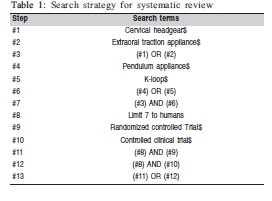
<body><![CDATA[<p><font face="Verdana, Arial, Helvetica, sans-serif" size="2">The literature is vast on studies concerning different   molar distalizing appliances in terms of application, function   and effectiveness. However, it can be difficult for the   orthodontist to interpret the outcomes of these studies because   of the variety of study designs, sample sizes and research   approaches.</font></p>     <p><font face="Verdana, Arial, Helvetica, sans-serif" size="2">The present systematic review aimed to compare the   maxillary dental effects of cervical headgear and pendulum   appliance during distalization of permanent maxillary first   molars.</font></p>     <p>&nbsp;</p>     <p><font face="Verdana, Arial, Helvetica, sans-serif" size="3"><b>Material and    methods</b></font></p>     <p><font face="Verdana, Arial, Helvetica, sans-serif" size="2"><b>Search strategy</b></font></p>       <p><font face="Verdana, Arial, Helvetica, sans-serif" size="2">The strategy for undertaking this systematic review was   mainly influenced by the National Health Service, NHS,   Center for Reviews and Dissemination.<sup>13</sup> To identify all   original research studies that examined orthodontic systems   for maxillary molar distalization and dental changes, a   literature search was carried out in the Medline database   (Entrez Pub Med, www.ncbi.nim.nih.gov) Ovid, Cochrane   Collaboration Oral Health Group Database of Clinical Trials   (<a href="www.cochrane.org" target="_blank">www.cochrane.org</a>), Web of Science, Google Scholar Beta,   Embase, Extenza, Evidence-Based medicine, American and   Caribbean Center on Health Sciences Information and   BIREME, covering the period from 1956 to August (<a href="#tab01">Table 1</a>). The key-words were: Distal molar movement; Cervical traction; Class II malocclusion; Pendulum appliance.</font></p>     <p>&nbsp;</p>     <p><a name="tab01"></a></p>     <p>&nbsp;</p>     <p align="center"><img src="/img/revistas/bjos/v11n4/a02tab01.jpg"></p>     ]]></body>
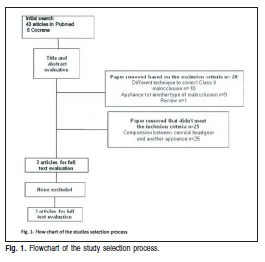
<body><![CDATA[<p>&nbsp;</p>     <p><font face="Verdana, Arial, Helvetica, sans-serif" size="2"><b>Selection criteria</b></font></p>     <p><font face="Verdana, Arial, Helvetica, sans-serif" size="2">For the inclusion criteria, human studies, randomized   controlled trials (RCTs) and controlled clinical trials (CCTs)   comparing the two molar distalizing appliances were selected.   The samples consisted of both male and female individuals   presenting Class II malocclusions in either permanent or mixed   dentition, during growth spurt and as long as there had been   no orthodontic extractions before distalization. Extraoral or   pendulum appliances had to be used for molar distalization.   Prospective and retrospective studies, case reports, abstracts,   review articles, animal studies, in vitro studies, letters and   technical comments on any type of distalizing appliance were   all excluded. A study of the full text was carried out if at least one of the two reviewers considered it to be potentially relevant.</font></p>     <p><font face="Verdana, Arial, Helvetica, sans-serif" size="2">A total of 48 original research studies were thus selected.   After initial selection, articles were read and those that met the   inclusion criteria were carefully analyzed (<a href="#fig01">Figure 1</a>). The searches   were complemented by screening the references of selected   articles to find any that did not appear in the database search.</font></p>     <p><font face="Verdana, Arial, Helvetica, sans-serif" size="2">The reference lists of the retrieved articles were also   checked for additional studies. Two reviewers independently   assessed the articles with respect to the inclusion and   exclusion criteria and the Kappa score measuring the level   of agreement was 0.92 (very good).<sup>14</sup> Any interexaminer   conflicts were resolved by discussion to reach consensus.</font></p>     <p>&nbsp;</p>     <p><a name="fig01"></a></p>     <p>&nbsp;</p>     <p align="center"><img src="/img/revistas/bjos/v11n4/a02fig01.jpg"></p>     <p>&nbsp;</p>     ]]></body>
<body><![CDATA[<p><font face="Verdana, Arial, Helvetica, sans-serif" size="2"><b>Data collection and analysis</b></font></p>     <p><font face="Verdana, Arial, Helvetica, sans-serif" size="2">The following data were gathered: article title, author,   year of publication, type of study, materials, gender, age,   treatment length, type of distalizing appliance, cervical   headgear (CH) or pendulum appliance (P), cephalometric   values of dental changes before and after orthodontic   treatment and differences between the two modalities. The   qualitative evaluation of the methodology applied to the   articles was in accordance with those described by Antczak   et al<sup>15</sup> and Jadad et al<sup>16</sup>. The following eight variables were   assessed: type of study (RCT) = 3 points; (CCT) = 2 points; sample size of whole study&gt; 30 subjects = 1 point; adequatedescription of the sample screening method = 1 point; methodological coherence = 1 point; use of error analysis method = 1 point; blinded measurements = 1 point; adequate statistical tests = 1 point and confounding factors = 1 point. Each article, therefore, could reach a maximum score of 10 points, and they were rated as: below average (score ranging from 0 to 5 points); mean average (score ranging from 6 to 8 points) and above average (score ranging from 9 to 10 points).</font></p>     <p><font face="Verdana, Arial, Helvetica, sans-serif" size="2">The data extraction and quality scoring from each article   were assessed independently by two evaluators and without   blinding. Interexaminer conflicts were resolved by discussion   of each article to reach a consensus. The Kappa scores for levels   of agreement between the two reviewers are shown in <a href="#tab02">Table 2</a>.</font></p>     <p>&nbsp;</p>     <p><a name="tab02"></a></p>     <p>&nbsp;</p>     <p align="center"><img src="/img/revistas/bjos/v11n4/a02tab02.jpg"></p>     <p>&nbsp;</p>       <p><font face="Verdana, Arial, Helvetica, sans-serif" size="3"><b>Results</b></font></p>     <p><font face="Verdana, Arial, Helvetica, sans-serif" size="2">The search yielded 48 results according to inclusion   and exclusion criteria and 3 articles were selected for final   analysis: two CCTs and one RCT. In these 3 articles, the   maxillary second molars were unerupted. The force exerted   with cervical headgear<sup>1</sup> was 500 g with an average use of 14-16 h per day until a Class I molar relationship was achieved   and pendulum appliance, as described by Hilgers<sup>2</sup> was used.   It consisted of an acrylic Nance portion with an expansion   screw and two posteriorly extending TMA coil springs that   were inserted into the lingual sheaths on the first molar bands.   The appliance was anchored to the first and second premolars   with wires bonded to the occlusal surfaces. The pendulum   springs were activated parallel to the palatal midline, with a   mean force of about 250 g, following the activation scheme suggested by Hilgers.<sup>2</sup></font></p>     ]]></body>
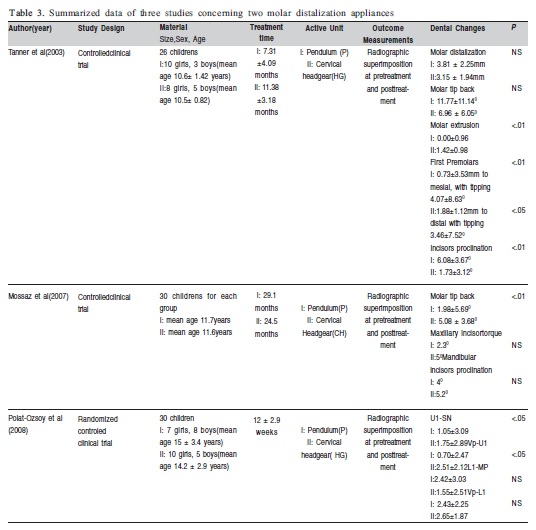
<body><![CDATA[<p><font face="Verdana, Arial, Helvetica, sans-serif" size="2">The measurements were taken before the patients were   treated with fixed appliances and the values given refer to   changes after the first phase of treatment, except in the Mossaz   et al study, where final measurements were taken after active   treatment. There was not an untreated Class II group (control   group) for comparison in this work. However the first and   the second studies were CCT and the third study was RCT   and in all the studies, the pendulum appliance and cervical   traction appliance were compared between themselves. Also   in the third study the sample was randomly divided into two   groups, P group and CH group.</font></p>     <p><font face="Verdana, Arial, Helvetica, sans-serif" size="2"><b>Comparing the two distalization techniques</b></font></p>     <p><font face="Verdana, Arial, Helvetica, sans-serif" size="2">In the study by Tanner et al.<sup>10</sup>, the maxillary   superimposition was performed on the palatal plane registered   at ANS. The dental measurements were obtained through   maxillary superimposition, thereby eliminating the   orthopedic changes of the maxilla during the experimental   period. The long axes of the maxillary first and second molars   were constructed by drawing a line through the mesiobuccal   cusp tip and the mesiobuccal root apex, whereas the long   axis of the first premolar tooth was constructed through the   buccal cusp tip and the apex. The long axis of the incisor   tooth was constructed through the incisal edge and the apex.   The angular differences in tooth position due to first molar   distalization were then measured as the angles between the   long axes of each maxillary tooth at T1 (before first molar   distalization) and T2 (after first molar distalization). The   distances between the most convex distal points on the   crowns of first molar and first premolars at T1 and T2, which   were measured on a line parallel to the palatal plane, were   used to determine the amount of molar distalization. The   vertical movements of teeth were determined by measuring   the perpendicular distances between the mesiobuccal cusp   tip of the molar and incisal edge of the incisor teeth relative to the palatal plane.</font></p>     <p><font face="Verdana, Arial, Helvetica, sans-serif" size="2">Tanner et al<sup>10</sup> showed that the mean amount of   distalization was 3.15 &plusmn; 1.94mm for the CH group and 3.81  &plusmn; 2.25mm for the P group, but the mean difference between   them was not significant. The first premolars moved mesially   in the P group (mean &ndash; 0.73 &plusmn; 3.53 mm) and distally in the   CH (mean 1.88 &plusmn; 1.12 mm) with significance P&lt; .01. The   incisors were proclined a mean of 6.08 &plusmn; 3.670 in the P   group and 1.73 &plusmn; 3.120 in the CH group with significance P  &lt;0.01. The mean sagittal change in incisor position was -   0.42 &plusmn; 1.59mm for CH and 2 &plusmn; 1.54 mm for the P group,   but the mean difference was not statistically significant. The   mean value of the first molar extrusion in the CH group was   1.42 &plusmn; 0.98, whereas in the P group it was 0.00 &plusmn; 0.96,   being significantly different between groups (P &lt; .01). The   differences in the mean values of the vertical position of the   first premolar and the incisor were not statistically different   between the groups (<a href="#tab03">Table 3</a>).</font></p>     <p><font face="Verdana, Arial, Helvetica, sans-serif" size="2">In Mossaz et al's study, at T1 (before molar distalization)   radiograph, an x-y cranial base coordinate was constructed   through the sella with the horizontal x-axis drawn at 70 to   the sella-nasion line and the vertical y-axis passing through   the anterior wall of the sella perpendicular to the x-axis. The   points were transferred to the final head film at T2 (after   fixed appliance therapy) after superimposition on the cranial   base stable structures. Maxillary incisor, mandibular incisors   and molar tip were measured.</font></p>     <p><font face="Verdana, Arial, Helvetica, sans-serif" size="2">Mossaz et al<sup>11</sup> found 5.080 an average of maxillary first   molar tip back for the CH group and 1.980 an average for the   P group, being statistically significant (P &lt; .001). Maxillary   incisor torque control was adequate in both groups (50 in the   CH group and 2.30 in the P group), whereas the mandibular incisors were proclined in both groups (5.20 in the CH group   and 40 in the P group) but the mean difference between them   was not significant in either measurement (<a href="#tab03">Table 3</a>).</font></p>     <p>&nbsp;</p>     <p><a name="tab03"></a></p>     <p>&nbsp;</p>     <p align="center"><img src="/img/revistas/bjos/v11n4/a02tab03.jpg"></p>     ]]></body>
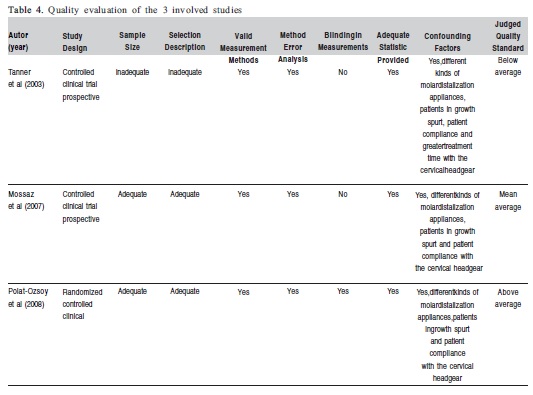
<body><![CDATA[<p>&nbsp;</p>     <p><font face="Verdana, Arial, Helvetica, sans-serif" size="2">    <br>   In the study by Polat-Ozsoy<sup>12</sup>, the cephalograms at T1   (before molar distalization) and T2 (after first molar   distalization) were traced. Two coordinate systems, related   to the cranial base and maxilla, were established: a CT   horizontal reference plane passing through the C point (the   most anterior point of the cribriform plate at the junction   with the nasal bone) and point T (the most superior point of   the anterior wall of the sella turcica at the junction with the   tuberculum sella). A vertical reference plane (Vp) was   constructed perpendicular to the CT horizontal reference line   at the T point. U1-SN angle, L1-MP angle, Vp-U1 (distance   from vertical plane to maxillary incisor crown tip) and Vp-   L1 (distance from vertical plane to lower incisor crown tip).</font></p>     <p><font face="Verdana, Arial, Helvetica, sans-serif" size="2">Polat-Ozsoy et al<sup>12</sup> observed a decrease in the U1-SN   angle and Vp-U1 distance in the CH group greater than in   the P group, showing a statistically significant (P &lt; .05).   The pendulum appliance seemed to have no significant effect   on the maxillary incisor position. Lower incisors were   retruded in both groups, but there was no significant difference   between them (<a href="#tab03">Table 3</a>).</font></p>     <p><font face="Verdana, Arial, Helvetica, sans-serif" size="2"><b>Quality of the studies</b></font></p>     <p><font face="Verdana, Arial, Helvetica, sans-serif" size="2">A quality analysis of the 3 studies involved is   summarized in <a href="#tab04">Table 4</a>. The research quality and methodological soundness were high in last study,<sup>12</sup> medium in second study<sup>11</sup> and low in first one.<sup>10</sup> In all studies selected,<sup>10-12</sup> the methods used to detect and analyze the dental movement were valid and generally well know. All included an error analysis method and just the last study<sup>12</sup> used blinding in measurements (<a href="#tab04">Table 4</a>).</font></p>     <p>&nbsp;</p>     <p><a name="tab04"></a></p>     <p>&nbsp;</p>     <p align="center"><img src="/img/revistas/bjos/v11n4/a02tab04.jpg"></p>     ]]></body>
<body><![CDATA[<p>&nbsp;</p>     <p><font face="Verdana, Arial, Helvetica, sans-serif" size="3"><b>Discussion</b></font></p>     <p><font face="Verdana, Arial, Helvetica, sans-serif" size="2"> Initially, 33 RCTs and twelve CCTs studies of distalizing   appliances for maxillary molars were excluded. The kappa   scores for levels of agreement between the two reviewers in   assessing data extraction and quality scores of the included   articles were in the range of good to very good, thus indicating that the results are reliable (<a href="#tab02">Table 2</a>).</font></p>     <p><font face="Verdana, Arial, Helvetica, sans-serif" size="2">All studies<sup>10-12</sup> showed a heterogeneity, which means that   it was difficult to combine data and draw any consistent   conclusions from these studies. It was difficult to compare   the studies about dental changes during maxillary first molar   distalization because the cephalometric methods used to   measure the amount of distalization were different.</font></p>     <p><font face="Verdana, Arial, Helvetica, sans-serif" size="2">For example, the first one<sup>10</sup> suggested that both the   cervical headgear and the pendulum appliance were capable   of distalizing molars similar amounts. It means that there   was not a significant difference between them. It was observed   that the values were indeed close to each other, 3.15 mm   with the cervical headgear and 3.81 mm with the pendulum   appliance, but the mean treatment time was 11.38&plusmn;3.18   months for the CH group and 7.31&plusmn;4.09 months for P group.   These findings were in agreement with those of other   authors<sup>3,4,17</sup>. Maxillary first molars were tipped distally in both   groups. Even though 11.040 of distal tipping was accomplished   rapidly in the P group, it was not statistically different from   the 6.960 of distal tipping achieved in the CH group. These   findings are in agreement with those of Cook et al,<sup>17</sup> Ghosh   and Nanda,<sup>3</sup> Byloff and Darendeliler<sup>4</sup> and Byloff et all<sup>5</sup>. The   mean extrusion of 1.42 mm in first molar position in the CH   group and vertically stable position in the P group are in   agreement with Ghosh and Nanda.<sup>3</sup> However, the difference   in treatment time between the two groups could have an effect   on first vertical position.</font></p>     <p><font face="Verdana, Arial, Helvetica, sans-serif" size="2">Taner et al<sup>10</sup> showed that spontaneous distalization of   premolars due to molar distalization with CH was an expected   outcome in most instances. But in the P group the anchorage   loss of the first premolar was observed. The mesial movement   was 0.73 mm with 40 of mesial tipping associated to significant   incisor proclination. Similar results were found by Ghosh and   Nanda<sup>3</sup>. Although both the pendulum appliance and cervical   headgear are very effective in distalizing maxillary molars,patient compliance and greater treatment time with the cervical   headgear is necessary. Taner et al<sup>10</sup> also observed that the   indirect effect of the first molar distalization on unerupted   maxillary second molars is the same with both appliances.<sup>10</sup></font></p>     <p><font face="Verdana, Arial, Helvetica, sans-serif" size="2">In the second study, Mossaz et al<sup>11</sup> found that the   cervical headgear group experienced better molar tip back   than the pendulum group. 5.080 of distal root tipping was   observed in the CH group and 1.90 in the P group. Although   the difference between the 2 groups (3.180) was significant   (P&lt;0.01), the authors did not consider it a critical factor in   the choice of the cervical headgear or the pendulum   appliance. Their findings were different from Taner et al,<sup>10</sup>   probably because the values at T2 were registered after the   full treatment, including fixed appliances. Therefore, Mossaz   et al<sup>11</sup> did not find loss of anchorage in the P group, like   mesialization of premolars and incisors.</font></p>     <p><font face="Verdana, Arial, Helvetica, sans-serif" size="2">In the third study, when Polat-Ozsoy et al<sup>12</sup> compared   pendulum appliance to cervical headgear groups, they found   that the latter had a greater amount of retrusion of the   maxillary incisor in comparison to the former, without   mesialization of incisors in the P group. They found that   although cervical headgear had seemed to reduce anchorage   loss and provided the most effective distal molar movement,   the pendulum appliance can be an efficient method for distal   molar movement without resulting in loss of anchorage.</font></p>     <p><font face="Verdana, Arial, Helvetica, sans-serif" size="2">The three studies<sup>10-12</sup> were heterogeneous, but they   concluded that the conventional cervical headgear has been   frequently used to correct Class II malocclusion by restraining   the forward growth of maxilla and by distalizing the maxillary   molars into class I dental relationship. However, the success   depends on the patient's compliance. On the other hand, the   pendulum appliance is fixed, which does not rely on patient   compliance and can distalize molars successfully, but probably   it causes mesial movement of the first premolars and incisors.   The loss of anchorage was found by Tanner et al.<sup>10</sup></font></p>     <p><font face="Verdana, Arial, Helvetica, sans-serif" size="2">Several authors have stated that distal movement of the   first maxillary molars is dependent on the stage of eruption   of the second maxillary molars.<sup>18-21</sup> For young patients, the   best time to start therapy with a pendulum appliance is before   the eruption of the second molars. If distalization of the first   and second molars is to be carried out simultaneously, prior   germectomy of the third molar is recommended.<sup>22</sup></font></p>     ]]></body>
<body><![CDATA[<p><font face="Verdana, Arial, Helvetica, sans-serif" size="2">Taner et al<sup>10</sup> showed that the indirect effect of first molar   distalization on unerupted maxillary second molars is also   the same with both appliances. There were distal tipping   and distal movement of the unerupted maxillary second   molars in both groups similar to the angular changes in   maxillary first molar tooth positions.</font></p>     <p><font face="Verdana, Arial, Helvetica, sans-serif" size="2">Mossaz et al<sup>11</sup> and Polat-Ozsoy et al<sup>12</sup> did not consider   that the eruption stage of the second molars has a qualitative   and quantitative impact on first molar distalization. It means   that the dental stage was not considered a limiting factor to   start treatment in either group.</font></p>     <p><font face="Verdana, Arial, Helvetica, sans-serif" size="2">Several methods and scales to incorporate quality into   systematic reviews have been proposed<sup>15,16</sup> and have been   applied to various RCTs. The quality of the articles was   judge as low, medium or high according to a scoring system   on the basis of the characteristics given in <a href="#tab04">Table 4</a>.</font></p>     <p><font face="Verdana, Arial, Helvetica, sans-serif" size="2">In all studies,<sup>10-12</sup> the methods to analyze maxillary dental   changes were valid and well known. From a methodological   standpoint, it was surprising that only one<sup>12</sup> of the three studies   declared the use of blinding in measurements. RCT with a   blinding design is more likely to show the advantage an   innovation has over a standard treatment method.<sup>23</sup></font></p>     <p><font face="Verdana, Arial, Helvetica, sans-serif" size="2">The findings were conflicting because in the first<sup>10</sup> study   the mean amount of distal molar movement was similar in   both groups, while in the second one<sup>11</sup> the cervical headgear   showed higher distal molar movement and distal tipping than   the pendulum appliance. Polat-Ozsoy et al<sup>12</sup> demonstrated   significant maxillary incisor retrusion in the CH group   without any maxillary incisor protrusion.</font></p>     <p><font face="Verdana, Arial, Helvetica, sans-serif" size="2">In conclusion, the reviewed studies showed that both   cervical headgear with patient compliance and a noncompliance   pendulum appliance are very effective in distalizing   maxillary molars. However, additional RCTs with larger samples   of both molar distalizing appliances are needed to confirm   this result and provide further reliable scientific evidence.</font></p>     <p>&nbsp;</p>     <p><font face="Verdana, Arial, Helvetica, sans-serif" size="3"><b>References</b></font></p>     <!-- ref --><p><font face="Verdana, Arial, Helvetica, sans-serif" size="2">1. Wieslander L. Early or late cervical traction therapy of Class II malocclusion   in the mixed dentition. American Journal of Orthodontics and Dentofacial Orthopedics 1975;67(4):432-439.    &nbsp;&nbsp;&nbsp;&nbsp;&nbsp;&nbsp;&nbsp;&nbsp;[&#160;<a href="javascript:void(0);" onclick="javascript: window.open('/scielo.php?script=sci_nlinks&ref=047460&pid=S1677-3225201200040000200001&lng=','','width=640,height=500,resizable=yes,scrollbars=1,menubar=yes,');">Links</a>&#160;]<!-- end-ref --></font></p>     ]]></body>
<body><![CDATA[<!-- ref --><p><font face="Verdana, Arial, Helvetica, sans-serif" size="2">2. Hilgers JJ. The pendulum appliance for Class II non-compliance therapy.   Journal of Clinical Orthodontics1992;26(11):706-714.    &nbsp;&nbsp;&nbsp;&nbsp;&nbsp;&nbsp;&nbsp;&nbsp;[&#160;<a href="javascript:void(0);" onclick="javascript: window.open('/scielo.php?script=sci_nlinks&ref=047462&pid=S1677-3225201200040000200002&lng=','','width=640,height=500,resizable=yes,scrollbars=1,menubar=yes,');">Links</a>&#160;]<!-- end-ref --></font></p>     <!-- ref --><p><font face="Verdana, Arial, Helvetica, sans-serif" size="2">3. Ghosh J, Nanda RS. Evaluation of an intraoral maxillary molar distalization   technique. American Journal of Orthodontics and Dentofacial Orthopedics   1996;110(6):639-646.    &nbsp;&nbsp;&nbsp;&nbsp;&nbsp;&nbsp;&nbsp;&nbsp;[&#160;<a href="javascript:void(0);" onclick="javascript: window.open('/scielo.php?script=sci_nlinks&ref=047464&pid=S1677-3225201200040000200003&lng=','','width=640,height=500,resizable=yes,scrollbars=1,menubar=yes,');">Links</a>&#160;]<!-- end-ref --></font></p>     <!-- ref --><p><font face="Verdana, Arial, Helvetica, sans-serif" size="2">4. Byloff F, Darendeliler M. Distal molar movement using the pendulum   appliance. Angle Orthodontist 1997;67(3):249-260.    &nbsp;&nbsp;&nbsp;&nbsp;&nbsp;&nbsp;&nbsp;&nbsp;[&#160;<a href="javascript:void(0);" onclick="javascript: window.open('/scielo.php?script=sci_nlinks&ref=047466&pid=S1677-3225201200040000200004&lng=','','width=640,height=500,resizable=yes,scrollbars=1,menubar=yes,');">Links</a>&#160;]<!-- end-ref --></font></p>     <!-- ref --><p><font face="Verdana, Arial, Helvetica, sans-serif" size="2">5. Jones RD, White JM. Rapid Class II molar correction with an open-coil jig.   Journal of Clinical Orthodontics 1992;26(10):661-664.    &nbsp;&nbsp;&nbsp;&nbsp;&nbsp;&nbsp;&nbsp;&nbsp;[&#160;<a href="javascript:void(0);" onclick="javascript: window.open('/scielo.php?script=sci_nlinks&ref=047468&pid=S1677-3225201200040000200005&lng=','','width=640,height=500,resizable=yes,scrollbars=1,menubar=yes,');">Links</a>&#160;]<!-- end-ref --></font></p>     <!-- ref --><p><font face="Verdana, Arial, Helvetica, sans-serif" size="2">6. Bondemark L. A comparative analysis of distal maxillary molar movement   produced by a new lingual intra-arch Ni-Ti coil appliance and a magnetic   appliance. European Journal of Orthodontics 2000;22(6):683-695.    &nbsp;&nbsp;&nbsp;&nbsp;&nbsp;&nbsp;&nbsp;&nbsp;[&#160;<a href="javascript:void(0);" onclick="javascript: window.open('/scielo.php?script=sci_nlinks&ref=047470&pid=S1677-3225201200040000200006&lng=','','width=640,height=500,resizable=yes,scrollbars=1,menubar=yes,');">Links</a>&#160;]<!-- end-ref --></font></p>     ]]></body>
<body><![CDATA[<!-- ref --><p><font face="Verdana, Arial, Helvetica, sans-serif" size="2">7. Needleman I, Moles D, Worthington H. Evidence-based Periodontology,   systematic reviews and research quality. Periodontol 2005;37(1):12-28.    &nbsp;&nbsp;&nbsp;&nbsp;&nbsp;&nbsp;&nbsp;&nbsp;[&#160;<a href="javascript:void(0);" onclick="javascript: window.open('/scielo.php?script=sci_nlinks&ref=047472&pid=S1677-3225201200040000200007&lng=','','width=640,height=500,resizable=yes,scrollbars=1,menubar=yes,');">Links</a>&#160;]<!-- end-ref --></font></p>     <!-- ref --><p><font face="Verdana, Arial, Helvetica, sans-serif" size="2">8. Montenegro R, Needleman I, Moles D, Tonetti M. Quality of RCTs in   periodontology-a systematic review. Journal Dental Research   2002;81(12):866-870.    &nbsp;&nbsp;&nbsp;&nbsp;&nbsp;&nbsp;&nbsp;&nbsp;[&#160;<a href="javascript:void(0);" onclick="javascript: window.open('/scielo.php?script=sci_nlinks&ref=047474&pid=S1677-3225201200040000200008&lng=','','width=640,height=500,resizable=yes,scrollbars=1,menubar=yes,');">Links</a>&#160;]<!-- end-ref --></font></p>     <!-- ref --><p><font face="Verdana, Arial, Helvetica, sans-serif" size="2">9. Hilgers JJ. The pendulum appliance for Class II non-compliance therapy.   Journal Clinical Orthodontic 1992;26(11):706-714.    &nbsp;&nbsp;&nbsp;&nbsp;&nbsp;&nbsp;&nbsp;&nbsp;[&#160;<a href="javascript:void(0);" onclick="javascript: window.open('/scielo.php?script=sci_nlinks&ref=047476&pid=S1677-3225201200040000200009&lng=','','width=640,height=500,resizable=yes,scrollbars=1,menubar=yes,');">Links</a>&#160;]<!-- end-ref --></font></p>     <!-- ref --><p><font face="Verdana, Arial, Helvetica, sans-serif" size="2">10. Tanner T, Yukay F, Pehlivanoglu M, &Ccedil;akirer B. A comparative analysis of   maxillary tooth movement produced by cervical headgear and Pend-X   appliance. Angle Orthodontist 2003;73(6):686-691.    &nbsp;&nbsp;&nbsp;&nbsp;&nbsp;&nbsp;&nbsp;&nbsp;[&#160;<a href="javascript:void(0);" onclick="javascript: window.open('/scielo.php?script=sci_nlinks&ref=047478&pid=S1677-3225201200040000200010&lng=','','width=640,height=500,resizable=yes,scrollbars=1,menubar=yes,');">Links</a>&#160;]<!-- end-ref --></font></p>     <!-- ref --><p><font face="Verdana, Arial, Helvetica, sans-serif" size="2"> 11. Mossaz CF, Byloff FK, Kiliaridis S. Cervical headgear vs pendulum   appliance for the treatment of moderate skeletal Class II malocclusion.   American Journal of Orthodontics and Dentofacial Orthopedics 2007;132(5):616-623.    &nbsp;&nbsp;&nbsp;&nbsp;&nbsp;&nbsp;&nbsp;&nbsp;[&#160;<a href="javascript:void(0);" onclick="javascript: window.open('/scielo.php?script=sci_nlinks&ref=047480&pid=S1677-3225201200040000200011&lng=','','width=640,height=500,resizable=yes,scrollbars=1,menubar=yes,');">Links</a>&#160;]<!-- end-ref --></font></p>     ]]></body>
<body><![CDATA[<!-- ref --><p><font face="Verdana, Arial, Helvetica, sans-serif" size="2">12. Polat-Ozsoy O, Gokcelik A, Gungor-Acar A, Kircelli BH. Soft tissue   profile after distal molar movement with a pendulum K-loop appliance   versus cervical headgear. Angle Orthodontist 2008;78(2):317-323.    &nbsp;&nbsp;&nbsp;&nbsp;&nbsp;&nbsp;&nbsp;&nbsp;[&#160;<a href="javascript:void(0);" onclick="javascript: window.open('/scielo.php?script=sci_nlinks&ref=047482&pid=S1677-3225201200040000200012&lng=','','width=640,height=500,resizable=yes,scrollbars=1,menubar=yes,');">Links</a>&#160;]<!-- end-ref --></font></p>     <!-- ref --><p><font face="Verdana, Arial, Helvetica, sans-serif" size="2">13. Dissemination. NCfRa. Undertaking systematic reviews of research on   effectiveness. CRD's guidance for those carrying out or commissioning   reviews. Available at: <a href="http://www.york.ac.uk/inst/crd/report4.htm" target="_blank">http://www.york.ac.uk/inst/crd/report4.htm</a>. Accessed June 5, 2008.    &nbsp;&nbsp;&nbsp;&nbsp;&nbsp;&nbsp;&nbsp;&nbsp;[&#160;<a href="javascript:void(0);" onclick="javascript: window.open('/scielo.php?script=sci_nlinks&ref=047484&pid=S1677-3225201200040000200013&lng=','','width=640,height=500,resizable=yes,scrollbars=1,menubar=yes,');">Links</a>&#160;]<!-- end-ref --></font></p>     <!-- ref --><p><font face="Verdana, Arial, Helvetica, sans-serif" size="2">14. Landis JR, Koch GG. The measurement of observer agreement for   categorical data. Biometrics 1977;33(1):159-174.    &nbsp;&nbsp;&nbsp;&nbsp;&nbsp;&nbsp;&nbsp;&nbsp;[&#160;<a href="javascript:void(0);" onclick="javascript: window.open('/scielo.php?script=sci_nlinks&ref=047486&pid=S1677-3225201200040000200014&lng=','','width=640,height=500,resizable=yes,scrollbars=1,menubar=yes,');">Links</a>&#160;]<!-- end-ref --></font></p>     <!-- ref --><p><font face="Verdana, Arial, Helvetica, sans-serif" size="2">15. Antczak AA, Tang J, Chalmers TC. Quality assessment of randomized   control trials in dental research. II. Results: periodontal research. Journal Periodontal Research 1986;21(4):315-321.    &nbsp;&nbsp;&nbsp;&nbsp;&nbsp;&nbsp;&nbsp;&nbsp;[&#160;<a href="javascript:void(0);" onclick="javascript: window.open('/scielo.php?script=sci_nlinks&ref=047488&pid=S1677-3225201200040000200015&lng=','','width=640,height=500,resizable=yes,scrollbars=1,menubar=yes,');">Links</a>&#160;]<!-- end-ref --></font></p>     <!-- ref --><p><font face="Verdana, Arial, Helvetica, sans-serif" size="2">16. Jadad AR, Moore RA, Carroll D, Jenkinson C, Reynolds DJ, Gavaghan   DJ et al. Assessing the quality of reports of randomized clinical trials: is   blinding necessary? Control Clinical Trials 1996;17(1):1-12.    &nbsp;&nbsp;&nbsp;&nbsp;&nbsp;&nbsp;&nbsp;&nbsp;[&#160;<a href="javascript:void(0);" onclick="javascript: window.open('/scielo.php?script=sci_nlinks&ref=047490&pid=S1677-3225201200040000200016&lng=','','width=640,height=500,resizable=yes,scrollbars=1,menubar=yes,');">Links</a>&#160;]<!-- end-ref --></font></p>     ]]></body>
<body><![CDATA[<!-- ref --><p><font face="Verdana, Arial, Helvetica, sans-serif" size="2">17. Cook A, Sellke T, Begole E. Control of the vertical dimension in class II   correction using a cervical headgear and lower arch in growing patients   Part I. American Journal of Orthodontics and Dentofacial Orthopedics   1994;106(4):376-388.    &nbsp;&nbsp;&nbsp;&nbsp;&nbsp;&nbsp;&nbsp;&nbsp;[&#160;<a href="javascript:void(0);" onclick="javascript: window.open('/scielo.php?script=sci_nlinks&ref=047492&pid=S1677-3225201200040000200017&lng=','','width=640,height=500,resizable=yes,scrollbars=1,menubar=yes,');">Links</a>&#160;]<!-- end-ref --></font></p>     <!-- ref --><p><font face="Verdana, Arial, Helvetica, sans-serif" size="2">18. Cetlin N, Ten H. Nonextration treatment. Journal of Clinical Orthodontics   1983;17(4):396-413.    &nbsp;&nbsp;&nbsp;&nbsp;&nbsp;&nbsp;&nbsp;&nbsp;[&#160;<a href="javascript:void(0);" onclick="javascript: window.open('/scielo.php?script=sci_nlinks&ref=047494&pid=S1677-3225201200040000200018&lng=','','width=640,height=500,resizable=yes,scrollbars=1,menubar=yes,');">Links</a>&#160;]<!-- end-ref --></font></p>     <!-- ref --><p><font face="Verdana, Arial, Helvetica, sans-serif" size="2">19. Gianelly AA. Distal movement of the maxillary molars. American Journal   of Orthodontics and Dentofacial Orthopedics 1998;114(1):66-72.    &nbsp;&nbsp;&nbsp;&nbsp;&nbsp;&nbsp;&nbsp;&nbsp;[&#160;<a href="javascript:void(0);" onclick="javascript: window.open('/scielo.php?script=sci_nlinks&ref=047496&pid=S1677-3225201200040000200019&lng=','','width=640,height=500,resizable=yes,scrollbars=1,menubar=yes,');">Links</a>&#160;]<!-- end-ref --></font></p>     <!-- ref --><p><font face="Verdana, Arial, Helvetica, sans-serif" size="2">20. Quick AN, Harris AMP. Molar distalization with a modified distal jet   appliance. Journal of Clinical Orthodontics 2000; 34(3):419-423.    &nbsp;&nbsp;&nbsp;&nbsp;&nbsp;&nbsp;&nbsp;&nbsp;[&#160;<a href="javascript:void(0);" onclick="javascript: window.open('/scielo.php?script=sci_nlinks&ref=047498&pid=S1677-3225201200040000200020&lng=','','width=640,height=500,resizable=yes,scrollbars=1,menubar=yes,');">Links</a>&#160;]<!-- end-ref --></font></p>     <!-- ref --><p><font face="Verdana, Arial, Helvetica, sans-serif" size="2">21. Fortini A, Lupoli M, Parri M. The first class appliance for rapid molar   distalization. Journal of Clinical Orthodontics 1999; 33(2):322-328.    &nbsp;&nbsp;&nbsp;&nbsp;&nbsp;&nbsp;&nbsp;&nbsp;[&#160;<a href="javascript:void(0);" onclick="javascript: window.open('/scielo.php?script=sci_nlinks&ref=047500&pid=S1677-3225201200040000200021&lng=','','width=640,height=500,resizable=yes,scrollbars=1,menubar=yes,');">Links</a>&#160;]<!-- end-ref --></font></p>     ]]></body>
<body><![CDATA[<!-- ref --><p><font face="Verdana, Arial, Helvetica, sans-serif" size="2">22. Kinzinger GSM, Fritz UB, Sander FG, Diedrich PR. Efficiency of a   pendulum appliance for molar distalization related to second and third molar   eruption stage. American Journal of Orthodontics and Dentofacial Orthopedics   2004;125(1):8-23.    &nbsp;&nbsp;&nbsp;&nbsp;&nbsp;&nbsp;&nbsp;&nbsp;[&#160;<a href="javascript:void(0);" onclick="javascript: window.open('/scielo.php?script=sci_nlinks&ref=047502&pid=S1677-3225201200040000200022&lng=','','width=640,height=500,resizable=yes,scrollbars=1,menubar=yes,');">Links</a>&#160;]<!-- end-ref --></font></p>     <!-- ref --><p><font face="Verdana, Arial, Helvetica, sans-serif" size="2">23. Colditz G, Miller J, Mosteller F. How study design affects outcomes in   comparisons of therapy. Medical Statement Medicine 1989;8(4):411-454.    &nbsp;&nbsp;&nbsp;&nbsp;&nbsp;&nbsp;&nbsp;&nbsp;[&#160;<a href="javascript:void(0);" onclick="javascript: window.open('/scielo.php?script=sci_nlinks&ref=047504&pid=S1677-3225201200040000200023&lng=','','width=640,height=500,resizable=yes,scrollbars=1,menubar=yes,');">Links</a>&#160;]<!-- end-ref --></font></p>     <p>&nbsp;</p>     <p>&nbsp;</p>     <p><font face="Verdana, Arial, Helvetica, sans-serif" size="2"><a name="back"/></a><a href="#top"><img src="/img/revistas/bjos/v11n4/seta.jpg" border="0" align="absmiddle"/></a>    <b>Correspondence:</b> <br/>   Ana de Lourdes S&aacute; de Lira    <br>   Departamento de Ortodontia,    <br>   Faculdade de Odontologia,    <br>   Universidade Federal do Rio de Janeiro    ]]></body>
<body><![CDATA[<br>   Av. Brigadeiro Trompowsky s/n, CEP: 21941-590    <br>   Ilha do Fund&atilde;o, RJ, Brasil<br/>   E-mail: <a href="mailto:anadelourdessl@hotmail.com">anadelourdessl@hotmail.com</a></font></p>     <p><font face="Verdana, Arial, Helvetica, sans-serif" size="2"><b>Received for    publication:</b> May 02, 2012<br/> <b>Accepted:</b> June 08, 2012</font></p>      ]]></body>
<back>
<ref-list>
<ref id="B1">
<label>1</label><nlm-citation citation-type="journal">
<person-group person-group-type="author">
<name>
<surname><![CDATA[Wieslander]]></surname>
<given-names><![CDATA[L]]></given-names>
</name>
</person-group>
<article-title xml:lang="en"><![CDATA[Early or late cervical traction therapy of Class II malocclusion in the mixed dentition]]></article-title>
<source><![CDATA[American Journal of Orthodontics and Dentofacial Orthopedics]]></source>
<year>1975</year>
<volume>67</volume>
<numero>^s4</numero>
<issue>^s4</issue>
<supplement>4</supplement>
<page-range>432-439</page-range></nlm-citation>
</ref>
<ref id="B2">
<label>2</label><nlm-citation citation-type="journal">
<person-group person-group-type="author">
<name>
<surname><![CDATA[Hilgers]]></surname>
<given-names><![CDATA[JJ]]></given-names>
</name>
</person-group>
<article-title xml:lang="en"><![CDATA[The pendulum appliance for Class II non-compliance therapy]]></article-title>
<source><![CDATA[Journal of Clinical Orthodontics]]></source>
<year>1992</year>
<volume>26</volume>
<numero>^s11</numero>
<issue>^s11</issue>
<supplement>11</supplement>
<page-range>706-714</page-range></nlm-citation>
</ref>
<ref id="B3">
<label>3</label><nlm-citation citation-type="journal">
<person-group person-group-type="author">
<name>
<surname><![CDATA[Ghosh]]></surname>
<given-names><![CDATA[J]]></given-names>
</name>
<name>
<surname><![CDATA[Nanda]]></surname>
<given-names><![CDATA[RS]]></given-names>
</name>
</person-group>
<article-title xml:lang="en"><![CDATA[Evaluation of an intraoral maxillary molar distalization technique]]></article-title>
<source><![CDATA[American Journal of Orthodontics and Dentofacial Orthopedics]]></source>
<year>1996</year>
<volume>110</volume>
<numero>^s6</numero>
<issue>^s6</issue>
<supplement>6</supplement>
<page-range>639-646</page-range></nlm-citation>
</ref>
<ref id="B4">
<label>4</label><nlm-citation citation-type="journal">
<person-group person-group-type="author">
<name>
<surname><![CDATA[Byloff]]></surname>
<given-names><![CDATA[F]]></given-names>
</name>
<name>
<surname><![CDATA[Darendeliler]]></surname>
<given-names><![CDATA[M]]></given-names>
</name>
</person-group>
<article-title xml:lang="en"><![CDATA[Distal molar movement using the pendulum appliance]]></article-title>
<source><![CDATA[Angle Orthodontist]]></source>
<year>1997</year>
<volume>67</volume>
<numero>3</numero>
<issue>3</issue>
<page-range>249-260</page-range></nlm-citation>
</ref>
<ref id="B5">
<label>5</label><nlm-citation citation-type="journal">
<person-group person-group-type="author">
<name>
<surname><![CDATA[Jones]]></surname>
<given-names><![CDATA[RD]]></given-names>
</name>
<name>
<surname><![CDATA[White]]></surname>
<given-names><![CDATA[JM]]></given-names>
</name>
</person-group>
<article-title xml:lang="en"><![CDATA[Rapid Class II molar correction with an open-coil jig]]></article-title>
<source><![CDATA[Journal of Clinical Orthodontics]]></source>
<year>1992</year>
<volume>26</volume>
<numero>^s10</numero>
<issue>^s10</issue>
<supplement>10</supplement>
<page-range>661-664</page-range></nlm-citation>
</ref>
<ref id="B6">
<label>6</label><nlm-citation citation-type="journal">
<person-group person-group-type="author">
<name>
<surname><![CDATA[Bondemark]]></surname>
<given-names><![CDATA[L]]></given-names>
</name>
</person-group>
<article-title xml:lang="en"><![CDATA[A comparative analysis of distal maxillary molar movement produced by a new lingual intra-arch Ni-Ti coil appliance and a magnetic appliance]]></article-title>
<source><![CDATA[European Journal of Orthodontics]]></source>
<year>2000</year>
<volume>22</volume>
<numero>^s6</numero>
<issue>^s6</issue>
<supplement>6</supplement>
<page-range>683-695</page-range></nlm-citation>
</ref>
<ref id="B7">
<label>7</label><nlm-citation citation-type="journal">
<person-group person-group-type="author">
<name>
<surname><![CDATA[Needleman]]></surname>
<given-names><![CDATA[I]]></given-names>
</name>
<name>
<surname><![CDATA[Moles]]></surname>
<given-names><![CDATA[D]]></given-names>
</name>
<name>
<surname><![CDATA[Worthington]]></surname>
<given-names><![CDATA[H]]></given-names>
</name>
</person-group>
<article-title xml:lang="en"><![CDATA[Evidence-based Periodontology, systematic reviews and research quality]]></article-title>
<source><![CDATA[Periodontol]]></source>
<year>2005</year>
<volume>37</volume>
<numero>^s1</numero>
<issue>^s1</issue>
<supplement>1</supplement>
<page-range>12-28</page-range></nlm-citation>
</ref>
<ref id="B8">
<label>8</label><nlm-citation citation-type="journal">
<person-group person-group-type="author">
<name>
<surname><![CDATA[Montenegro]]></surname>
<given-names><![CDATA[R]]></given-names>
</name>
<name>
<surname><![CDATA[Needleman]]></surname>
<given-names><![CDATA[I]]></given-names>
</name>
<name>
<surname><![CDATA[Moles]]></surname>
<given-names><![CDATA[D]]></given-names>
</name>
<name>
<surname><![CDATA[Tonetti]]></surname>
<given-names><![CDATA[M]]></given-names>
</name>
</person-group>
<article-title xml:lang="en"><![CDATA[Quality of RCTs in periodontology: a systematic review]]></article-title>
<source><![CDATA[Journal Dental Research]]></source>
<year>2002</year>
<volume>81</volume>
<numero>^s12</numero>
<issue>^s12</issue>
<supplement>12</supplement>
<page-range>866-870</page-range></nlm-citation>
</ref>
<ref id="B9">
<label>9</label><nlm-citation citation-type="journal">
<person-group person-group-type="author">
<name>
<surname><![CDATA[Hilgers]]></surname>
<given-names><![CDATA[JJ]]></given-names>
</name>
</person-group>
<article-title xml:lang="en"><![CDATA[The pendulum appliance for Class II non-compliance therapy]]></article-title>
<source><![CDATA[Journal Clinical Orthodontic]]></source>
<year>1992</year>
<volume>26</volume>
<numero>^s11</numero>
<issue>^s11</issue>
<supplement>11</supplement>
<page-range>706-714</page-range></nlm-citation>
</ref>
<ref id="B10">
<label>10</label><nlm-citation citation-type="journal">
<person-group person-group-type="author">
<name>
<surname><![CDATA[Tanner]]></surname>
<given-names><![CDATA[T]]></given-names>
</name>
<name>
<surname><![CDATA[Yukay]]></surname>
<given-names><![CDATA[F]]></given-names>
</name>
<name>
<surname><![CDATA[Pehlivanoglu]]></surname>
<given-names><![CDATA[M]]></given-names>
</name>
<name>
<surname><![CDATA[Çakirer]]></surname>
<given-names><![CDATA[B]]></given-names>
</name>
</person-group>
<article-title xml:lang="en"><![CDATA[A comparative analysis of maxillary tooth movement produced by cervical headgear and Pend-X appliance]]></article-title>
<source><![CDATA[Angle Orthodontist]]></source>
<year>2003</year>
<volume>73</volume>
<numero>^s6</numero>
<issue>^s6</issue>
<supplement>6</supplement>
<page-range>686-691</page-range></nlm-citation>
</ref>
<ref id="B11">
<label>11</label><nlm-citation citation-type="journal">
<person-group person-group-type="author">
<name>
<surname><![CDATA[Mossaz]]></surname>
<given-names><![CDATA[CF]]></given-names>
</name>
<name>
<surname><![CDATA[Byloff]]></surname>
<given-names><![CDATA[FK]]></given-names>
</name>
<name>
<surname><![CDATA[Kiliaridis]]></surname>
<given-names><![CDATA[S]]></given-names>
</name>
</person-group>
<article-title xml:lang="en"><![CDATA[Cervical headgear vs pendulum appliance for the treatment of moderate skeletal Class II malocclusion]]></article-title>
<source><![CDATA[American Journal of Orthodontics and Dentofacial Orthopedics]]></source>
<year>2007</year>
<volume>132</volume>
<numero>^s5</numero>
<issue>^s5</issue>
<supplement>5</supplement>
<page-range>616-623</page-range></nlm-citation>
</ref>
<ref id="B12">
<label>12</label><nlm-citation citation-type="journal">
<person-group person-group-type="author">
<name>
<surname><![CDATA[Polat-Ozsoy]]></surname>
<given-names><![CDATA[O]]></given-names>
</name>
<name>
<surname><![CDATA[Gokcelik]]></surname>
<given-names><![CDATA[A]]></given-names>
</name>
<name>
<surname><![CDATA[Gungor-Acar]]></surname>
<given-names><![CDATA[A]]></given-names>
</name>
<name>
<surname><![CDATA[Kircelli]]></surname>
<given-names><![CDATA[BH]]></given-names>
</name>
</person-group>
<article-title xml:lang="en"><![CDATA[Soft tissue profile after distal molar movement with a pendulum K-loop appliance versus cervical headgear]]></article-title>
<source><![CDATA[Angle Orthodontist]]></source>
<year>2008</year>
<volume>78</volume>
<numero>^s2</numero>
<issue>^s2</issue>
<supplement>2</supplement>
<page-range>317-323</page-range></nlm-citation>
</ref>
<ref id="B13">
<label>13</label><nlm-citation citation-type="">
<source><![CDATA[]]></source>
<year></year>
</nlm-citation>
</ref>
<ref id="B14">
<label>14</label><nlm-citation citation-type="journal">
<person-group person-group-type="author">
<name>
<surname><![CDATA[Landis]]></surname>
<given-names><![CDATA[JR]]></given-names>
</name>
<name>
<surname><![CDATA[Koch]]></surname>
<given-names><![CDATA[GG]]></given-names>
</name>
</person-group>
<article-title xml:lang="en"><![CDATA[The measurement of observer agreement for categorical data]]></article-title>
<source><![CDATA[Biometrics]]></source>
<year>1977</year>
<volume>33</volume>
<numero>^s1</numero>
<issue>^s1</issue>
<supplement>1</supplement>
<page-range>159-174</page-range></nlm-citation>
</ref>
<ref id="B15">
<label>15</label><nlm-citation citation-type="journal">
<person-group person-group-type="author">
<name>
<surname><![CDATA[Antczak]]></surname>
<given-names><![CDATA[AA]]></given-names>
</name>
<name>
<surname><![CDATA[Tang]]></surname>
<given-names><![CDATA[J]]></given-names>
</name>
<name>
<surname><![CDATA[Chalmers]]></surname>
<given-names><![CDATA[TC]]></given-names>
</name>
</person-group>
<article-title xml:lang="en"><![CDATA[Quality assessment of randomized control trials in dental research: II. Results: periodontal research]]></article-title>
<source><![CDATA[Journal Periodontal Research]]></source>
<year>1986</year>
<volume>21</volume>
<numero>^s4</numero>
<issue>^s4</issue>
<supplement>4</supplement>
<page-range>315-321</page-range></nlm-citation>
</ref>
<ref id="B16">
<label>16</label><nlm-citation citation-type="journal">
<person-group person-group-type="author">
<name>
<surname><![CDATA[Jadad]]></surname>
<given-names><![CDATA[AR]]></given-names>
</name>
<name>
<surname><![CDATA[Moore]]></surname>
<given-names><![CDATA[RA]]></given-names>
</name>
<name>
<surname><![CDATA[Carroll]]></surname>
<given-names><![CDATA[D]]></given-names>
</name>
<name>
<surname><![CDATA[Jenkinson]]></surname>
<given-names><![CDATA[C]]></given-names>
</name>
<name>
<surname><![CDATA[Reynolds]]></surname>
<given-names><![CDATA[DJ]]></given-names>
</name>
<name>
<surname><![CDATA[Gavaghan]]></surname>
<given-names><![CDATA[DJ]]></given-names>
</name>
</person-group>
<article-title xml:lang="en"><![CDATA[Assessing the quality of reports of randomized clinical trials: is blinding necessary]]></article-title>
<source><![CDATA[Control Clinical Trials]]></source>
<year>1996</year>
<volume>17</volume>
<numero>^s1</numero>
<issue>^s1</issue>
<supplement>1</supplement>
<page-range>1-12</page-range></nlm-citation>
</ref>
<ref id="B17">
<label>17</label><nlm-citation citation-type="journal">
<person-group person-group-type="author">
<name>
<surname><![CDATA[Cook]]></surname>
<given-names><![CDATA[A]]></given-names>
</name>
<name>
<surname><![CDATA[Sellke]]></surname>
<given-names><![CDATA[T]]></given-names>
</name>
<name>
<surname><![CDATA[Begole]]></surname>
<given-names><![CDATA[E]]></given-names>
</name>
</person-group>
<article-title xml:lang="en"><![CDATA[Control of the vertical dimension in class II correction using a cervical headgear and lower arch in growing patients Part I]]></article-title>
<source><![CDATA[American Journal of Orthodontics and Dentofacial Orthopedics]]></source>
<year>1994</year>
<volume>106</volume>
<numero>^s4</numero>
<issue>^s4</issue>
<supplement>4</supplement>
<page-range>376-388</page-range></nlm-citation>
</ref>
<ref id="B18">
<label>18</label><nlm-citation citation-type="journal">
<person-group person-group-type="author">
<name>
<surname><![CDATA[Cetlin]]></surname>
<given-names><![CDATA[N]]></given-names>
</name>
<name>
<surname><![CDATA[Ten]]></surname>
<given-names><![CDATA[H]]></given-names>
</name>
</person-group>
<article-title xml:lang="en"><![CDATA[Nonextration treatment]]></article-title>
<source><![CDATA[Journal of Clinical Orthodontics]]></source>
<year>1983</year>
<volume>17</volume>
<numero>^s4</numero>
<issue>^s4</issue>
<supplement>4</supplement>
<page-range>396-413</page-range></nlm-citation>
</ref>
<ref id="B19">
<label>19</label><nlm-citation citation-type="journal">
<person-group person-group-type="author">
<name>
<surname><![CDATA[Gianelly]]></surname>
<given-names><![CDATA[AA]]></given-names>
</name>
</person-group>
<article-title xml:lang="en"><![CDATA[Distal movement of the maxillary molars]]></article-title>
<source><![CDATA[American Journal of Orthodontics and Dentofacial Orthopedics]]></source>
<year>1998</year>
<volume>114</volume>
<numero>^s1</numero>
<issue>^s1</issue>
<supplement>1</supplement>
<page-range>66-72</page-range></nlm-citation>
</ref>
<ref id="B20">
<label>20</label><nlm-citation citation-type="journal">
<person-group person-group-type="author">
<name>
<surname><![CDATA[Quick]]></surname>
<given-names><![CDATA[AN]]></given-names>
</name>
<name>
<surname><![CDATA[Harris]]></surname>
<given-names><![CDATA[AMP]]></given-names>
</name>
</person-group>
<article-title xml:lang="en"><![CDATA[Molar distalization with a modified distal jet appliance]]></article-title>
<source><![CDATA[Journal of Clinical Orthodontics]]></source>
<year>2000</year>
<volume>34</volume>
<numero>^s3</numero>
<issue>^s3</issue>
<supplement>3</supplement>
<page-range>419-423</page-range></nlm-citation>
</ref>
<ref id="B21">
<label>21</label><nlm-citation citation-type="journal">
<person-group person-group-type="author">
<name>
<surname><![CDATA[Fortini]]></surname>
<given-names><![CDATA[A]]></given-names>
</name>
<name>
<surname><![CDATA[Lupoli]]></surname>
<given-names><![CDATA[M]]></given-names>
</name>
<name>
<surname><![CDATA[Parri]]></surname>
<given-names><![CDATA[M]]></given-names>
</name>
</person-group>
<article-title xml:lang="en"><![CDATA[The first class appliance for rapid molar distalization]]></article-title>
<source><![CDATA[Journal of Clinical Orthodontics]]></source>
<year>1999</year>
<volume>33</volume>
<numero>^s2</numero>
<issue>^s2</issue>
<supplement>2</supplement>
<page-range>322-328</page-range></nlm-citation>
</ref>
<ref id="B22">
<label>22</label><nlm-citation citation-type="journal">
<person-group person-group-type="author">
<name>
<surname><![CDATA[Kinzinger]]></surname>
<given-names><![CDATA[GSM]]></given-names>
</name>
<name>
<surname><![CDATA[Fritz]]></surname>
<given-names><![CDATA[UB]]></given-names>
</name>
<name>
<surname><![CDATA[Sander]]></surname>
<given-names><![CDATA[FG]]></given-names>
</name>
<name>
<surname><![CDATA[Diedrich]]></surname>
<given-names><![CDATA[PR]]></given-names>
</name>
</person-group>
<article-title xml:lang="en"><![CDATA[Efficiency of a pendulum appliance for molar distalization related to second and third molar eruption stage]]></article-title>
<source><![CDATA[American Journal of Orthodontics and Dentofacial Orthopedics]]></source>
<year>2004</year>
<volume>125</volume>
<numero>^s1</numero>
<issue>^s1</issue>
<supplement>1</supplement>
<page-range>8-23</page-range></nlm-citation>
</ref>
<ref id="B23">
<label>23</label><nlm-citation citation-type="journal">
<person-group person-group-type="author">
<name>
<surname><![CDATA[Colditz]]></surname>
<given-names><![CDATA[G]]></given-names>
</name>
<name>
<surname><![CDATA[Miller]]></surname>
<given-names><![CDATA[J]]></given-names>
</name>
<name>
<surname><![CDATA[Mosteller]]></surname>
<given-names><![CDATA[F]]></given-names>
</name>
</person-group>
<article-title xml:lang="en"><![CDATA[How study design affects outcomes in comparisons of therapy]]></article-title>
<source><![CDATA[Medical Statement Medicine]]></source>
<year>1989</year>
<volume>8</volume>
<numero>^s4</numero>
<issue>^s4</issue>
<supplement>4</supplement>
<page-range>411-454</page-range></nlm-citation>
</ref>
</ref-list>
</back>
</article>