<?xml version="1.0" encoding="ISO-8859-1"?><article xmlns:mml="http://www.w3.org/1998/Math/MathML" xmlns:xlink="http://www.w3.org/1999/xlink" xmlns:xsi="http://www.w3.org/2001/XMLSchema-instance">
<front>
<journal-meta>
<journal-id>1677-3225</journal-id>
<journal-title><![CDATA[Brazilian Journal of Oral Sciences]]></journal-title>
<abbrev-journal-title><![CDATA[Braz. j. oral sci.]]></abbrev-journal-title>
<issn>1677-3225</issn>
<publisher>
<publisher-name><![CDATA[Faculdade de Odontologia de Piracicaba, UNICAMP]]></publisher-name>
</publisher>
</journal-meta>
<article-meta>
<article-id>S1677-32252012000400009</article-id>
<title-group>
<article-title xml:lang="en"><![CDATA[Clinical status of permanent first molars in children aged seven to ten years in a Brazilian rural community]]></article-title>
</title-group>
<contrib-group>
<contrib contrib-type="author">
<name>
<surname><![CDATA[Motta]]></surname>
<given-names><![CDATA[Lara Jansiski]]></given-names>
</name>
<xref ref-type="aff" rid="A01"/>
</contrib>
<contrib contrib-type="author">
<name>
<surname><![CDATA[dos Santos]]></surname>
<given-names><![CDATA[Joyce Garcia]]></given-names>
</name>
<xref ref-type="aff" rid="A02"/>
</contrib>
<contrib contrib-type="author">
<name>
<surname><![CDATA[Alfaya]]></surname>
<given-names><![CDATA[Thays Almeida]]></given-names>
</name>
<xref ref-type="aff" rid="A03"/>
</contrib>
<contrib contrib-type="author">
<name>
<surname><![CDATA[Guedes]]></surname>
<given-names><![CDATA[Carolina Cardoso]]></given-names>
</name>
<xref ref-type="aff" rid="A04"/>
</contrib>
<contrib contrib-type="author">
<name>
<surname><![CDATA[de Godoy]]></surname>
<given-names><![CDATA[Camila Haddad Leal]]></given-names>
</name>
<xref ref-type="aff" rid="A05"/>
</contrib>
<contrib contrib-type="author">
<name>
<surname><![CDATA[Bussadori]]></surname>
<given-names><![CDATA[Sandra Kalil]]></given-names>
</name>
<xref ref-type="aff" rid="A06"/>
</contrib>
</contrib-group>
<aff id="A01">
<institution><![CDATA[,Nove de Julho University (UNINOVE) Department of Rehabilitation Sciences Graduation Program Professor of Pediatric Dentistry]]></institution>
<addr-line><![CDATA[São Paulo SP]]></addr-line>
<country>Brazil</country>
</aff>
<aff id="A02">
<institution><![CDATA[,Nove de Julho University (UNINOVE) Department of Rehabilitation Sciences Graduation Program Private Practice]]></institution>
<addr-line><![CDATA[São Paulo SP]]></addr-line>
<country>Brazil</country>
</aff>
<aff id="A03">
<institution><![CDATA[,Fluminense Federal University (UFF) Student of Dental Clinic Graduation Program DDS]]></institution>
<addr-line><![CDATA[Niterói RJ]]></addr-line>
<country>Brazil</country>
</aff>
<aff id="A04">
<institution><![CDATA[,Braz Cubas University Professor of Pediatric Dentistry MS]]></institution>
<addr-line><![CDATA[São Paulo SP]]></addr-line>
<country>Brazil</country>
</aff>
<aff id="A05">
<institution><![CDATA[,Nove de Julho University (UNINOVE) Student of Rehabilitation Sciences Graduation Program DDS]]></institution>
<addr-line><![CDATA[São Paulo SP]]></addr-line>
<country>Brazil</country>
</aff>
<aff id="A06">
<institution><![CDATA[,Nove de Julho University (UNINOVE) Professor of Rehabilitation Sciences Post Graduation Program PhD]]></institution>
<addr-line><![CDATA[São Paulo SP]]></addr-line>
<country>Brazil</country>
</aff>
<pub-date pub-type="pub">
<day>00</day>
<month>12</month>
<year>2012</year>
</pub-date>
<pub-date pub-type="epub">
<day>00</day>
<month>12</month>
<year>2012</year>
</pub-date>
<volume>11</volume>
<numero>4</numero>
<fpage>475</fpage>
<lpage>480</lpage>
<copyright-statement/>
<copyright-year/>
<self-uri xlink:href="http://revodonto.bvsalud.org/scielo.php?script=sci_arttext&amp;pid=S1677-32252012000400009&amp;lng=en&amp;nrm=iso"></self-uri><self-uri xlink:href="http://revodonto.bvsalud.org/scielo.php?script=sci_abstract&amp;pid=S1677-32252012000400009&amp;lng=en&amp;nrm=iso"></self-uri><self-uri xlink:href="http://revodonto.bvsalud.org/scielo.php?script=sci_pdf&amp;pid=S1677-32252012000400009&amp;lng=en&amp;nrm=iso"></self-uri><abstract abstract-type="short" xml:lang="en"><p><![CDATA[AIM: To evaluate the clinical status of permanent first molars and associations with dental caries, gingival bleeding, dental fluorosis and malocclusion. METHODS: An observational study was carried out in a rural community denominated Morro do Saboó in the city of São Roque, state of São Paulo, Brazil. A total of 194 children aged seven to ten years were examined for dental caries using the index proposed by the World Health Organization. Other conditions were determined using the Gingival Alterations Index, Dean's Index and Dental Aesthetic Index. The chi-squared test was used for the statistical analysis of the data. RESULTS: A total of 85.5% of the sample exhibited gingival bleeding and 69.9% exhibited malocclusion. A total of 53.6% had a clinical aspect of normality with regard to dental fluorosis. There was a predominance of sound teeth in the upper arch and teeth with carious lesions in the lower arch. No significant differences were found between sexes regarding gingival bleeding, dental fluorosis or malocclusion. Significant associations were found between tooth status and oral alterations (gingival bleeding, malocclusion and fluorosis) in teeth 16, 26 and 46 and between tooth status and gingival bleeding in tooth 36 (p<0.001). CONCLUSIONS: Caries activity in the permanent first molars was mainly associated with dental fluorosis and malocclusion. Strategies aimed at health promotion should be adopted on a large scale to minimize the prevalence of oral diseases.]]></p></abstract>
<kwd-group>
<kwd lng="en"><![CDATA[dental caries]]></kwd>
<kwd lng="en"><![CDATA[molar]]></kwd>
<kwd lng="en"><![CDATA[fluorosis]]></kwd>
<kwd lng="en"><![CDATA[dental]]></kwd>
<kwd lng="en"><![CDATA[gingivitis]]></kwd>
<kwd lng="en"><![CDATA[malocclusion]]></kwd>
</kwd-group>
</article-meta>
</front><body><![CDATA[ <p align="right"><font face="Verdana, Arial, Helvetica, sans-serif" size="2"><b>ORIGINAL ARTICLE</b></font></p>     <p>&nbsp;</p>     <p><font face="Verdana, Arial, Helvetica, sans-serif" size="4"><a name="top"/><b>Clinical status of permanent first molars in   children aged seven to ten years in a Brazilian rural community</b></font></p>     <p>&nbsp;</p>     <p>&nbsp;</p>     <p><font face="Verdana, Arial, Helvetica, sans-serif" size="2"><b>Lara Jansiski Motta<sup>I</sup>; Joyce Garcia dos Santos<sup>II</sup></sup>; Thays Almeida Alfaya<sup>III</sup>; Carolina Cardoso Guedes<sup>IV</sup>; Camila Haddad Leal de Godoy<sup>V</sup>; Sandra Kalil Bussadori<sup>VI</sup></b></font></p>     <p><font face="Verdana, Arial, Helvetica, sans-serif" size="2"><sup>I</sup>PhD, Professor of Pediatric Dentistry, Department of Rehabilitation Sciences Graduation Program, Nove de Julho University (UNINOVE), S&atilde;o Paulo, SP, Brazil<br/> <sup>II</sup>DDS, Private Practice, Department of Rehabilitation Sciences Post Graduation Program, Nove de Julho University (UNINOVE), S&atilde;o Paulo, SP, Brazil    <br> <sup>III</sup>DDS, Student of Dental Clinic Graduation Program, Fluminense Federal University (UFF), Niter&oacute;i, RJ, Brazil    <br> <sup>IV</sup>MS, Professor of Pediatric Dentistry, Braz Cubas University, S&atilde;o Paulo, SP, Brazil    <br> <sup>V</sup>DDS, Student of Rehabilitation Sciences Graduation Program, Nove de Julho University (UNINOVE), S&atilde;o Paulo, SP, Brazil    ]]></body>
<body><![CDATA[<br>   <sup>VI</sup>PhD, Professor of Rehabilitation Sciences Post Graduation Program, Nove de Julho University (UNINOVE) , S&atilde;o Paulo, SP, Brazil</font></p>     <p><font face="Verdana, Arial, Helvetica, sans-serif" size="2"><a href="#back">Correspondence</a></font></p>     <p>&nbsp;</p>     <p>&nbsp;</p> <hr noshade size="1">     <p><font face="Verdana, Arial, Helvetica, sans-serif" size="2"><b>ABSTRACT</b></font></p>     <p><font face="Verdana, Arial, Helvetica, sans-serif" size="2">   <b>AIM:</b> To evaluate the clinical status of permanent first molars and associations with dental caries,   gingival bleeding, dental fluorosis and malocclusion.    <br>   <b>METHODS:</b> An observational study was   carried out in a rural community denominated Morro do Sabo&oacute; in the city of S&atilde;o Roque, state of   S&atilde;o Paulo, Brazil. A total of 194 children aged seven to ten years were examined for dental   caries using the index proposed by the World Health Organization. Other conditions were   determined using the Gingival Alterations Index, Dean's Index and Dental Aesthetic Index. The   chi-squared test was used for the statistical analysis of the data.<br/>   <b>RESULTS:</b> A total of 85.5% of the   sample exhibited gingival bleeding and 69.9% exhibited malocclusion. A total of 53.6% had a   clinical aspect of normality with regard to dental fluorosis. There was a predominance of sound   teeth in the upper arch and teeth with carious lesions in the lower arch. No significant differences   were found between sexes regarding gingival bleeding, dental fluorosis or malocclusion. Significant   associations were found between tooth status and oral alterations (gingival bleeding, malocclusion   and fluorosis) in teeth 16, 26 and 46 and between tooth status and gingival bleeding in tooth 36   (p&lt;0.001).<br/>   <b>CONCLUSIONS:</b> Caries activity in the permanent first molars was mainly associated   with dental fluorosis and malocclusion. Strategies aimed at health promotion should be adopted   on a large scale to minimize the prevalence of oral diseases.</font></p>     <p><font face="Verdana, Arial, Helvetica, sans-serif" size="2"><b>Keywords:</b>    dental caries, molar, fluorosis, dental, gingivitis, malocclusion.</font></p> <hr noshade size="1">     <p>&nbsp;</p>     <p>&nbsp;</p>     ]]></body>
<body><![CDATA[<p><font face="Verdana, Arial, Helvetica, sans-serif" size="3"><b>Introduction</b></font></p>     <p><font face="Verdana, Arial, Helvetica, sans-serif" size="2">Oral health status is mainly analyzed by the occurrence of dental caries and   periodontal disease. Dental caries is estimated to affect 60 to 90% of children in   industrialized countries and constitutes the most prevalent oral condition in Asia   and Latin America<sup>1</sup>. The establishment of the "Brazil Smiling Program" in 2003   led to the expansion of public dental services in Brazil. This greater access to oral health care (including prevention actions and specialized treatment) hascontributed to an increase in the number of children who are free of caries (44%)<sup>2</sup>.</font></p>     <p><font face="Verdana, Arial, Helvetica, sans-serif" size="2">Permanent first molars play a fundamental role in the   maintenance of the masticatory function. The development of   carious lesions is common during the eruption of the first   molars due characteristics that are favorable to the buildup of   bacterial plaque<sup>3</sup>, such as pits and fissures<sup>4</sup>. In the absence of   preventive measures, these teeth may experience all the   repercussions stemming from the development of caries<sup>5-6</sup>.</font></p>     <p><font face="Verdana, Arial, Helvetica, sans-serif" size="2">Gingivitis is the most common form of periodontal disease   in children and adolescents<sup>1</sup> and is related to the presence of   gingival bleeding. The early onset of aggressive periodontal   disease affects approximately 2% of young patients and can   lead to tooth loss<sup>1</sup>. The increase in the prevalence of gingivitis   from childhood to puberty may be attributed to the number of   sites at risk, with the buildup of bacterial plaque and   inflammatory changes related to the process of exfoliation   and eruption as well as hormonal factors related to age<sup>7</sup>.</font></p>     <p><font face="Verdana, Arial, Helvetica, sans-serif" size="2">While dental caries and periodontal disease are the most   common oral manifestations<sup>1</sup>, other factors should also be   taken into consideration in the analysis of oral health status.   Dental fluorosis is a formation disorder in which the developing   enamel is hypomineralized due to a change in the secretion   of ameloblasts caused by an excess of fluoride ions<sup>8</sup>.   Malocclusion is a growth and development disorder that affects   the occlusion (bite) of the teeth<sup>9</sup> and can have a considerable   impact on affected individuals, causing discomfort as well as   functional and social limitations<sup>10</sup>. These conditions can have   both functional and esthetic repercussions, with an impact on   quality of life<sup>11-12</sup>, and should therefore be identified so that   proper intervention steps can be taken.</font></p>     <p><font face="Verdana, Arial, Helvetica, sans-serif" size="2">The aim of the present study was to evaluate the clinical   status of permanent first molars and associations with dental   caries, gingival bleeding, dental fluorosis and malocclusion.</font></p>     <p>&nbsp;</p>     <p><font face="Verdana, Arial, Helvetica, sans-serif" size="3"><b>Material and    methods</b></font></p>     <p><font face="Verdana, Arial, Helvetica, sans-serif" size="2">An observational study was carried out involving the   analysis of permanent first molars with regard to the presence   of dental caries and other oral problems, such as gingival   bleeding, dental fluorosis and malocclusion, in 194 children   aged seven to ten years at a school located in a rural   community denominated Morro do Sabo&oacute; in the city of S&atilde;o   Roque, state of S&atilde;o Paulo, Brazil, during a collective action.   The study received approval from the Human Research Ethics   Committee of the Universidade Federal de S&atilde;o Paulo, Brazil,   under project number 1374/07. Parents/guardians of the   participants signed a statement of informed consent allowing their children to participate in the study.</font></p>     <p><font face="Verdana, Arial, Helvetica, sans-serif" size="2">The evaluations were performed by a single, calibrated   operator, using a mouth mirror and periodontal probe under   natural light with the child seated and the examiner standing.   The findings of the exam were recorded on an individual   clinical chart for each child.</font></p>     ]]></body>
<body><![CDATA[<p><font face="Verdana, Arial, Helvetica, sans-serif" size="2"><b>Assessment of dental caries</b></font></p>     <p><font face="Verdana, Arial, Helvetica, sans-serif" size="2">The assessment of dental caries was performed on the   permanent first molars (teeth 16, 26, 36 and 46). The following   codes and criteria were used for the classification of the teeth:   (0) sound; (1) with carious lesion; (2) restoration with carious   lesion; (3) restoration without carious lesion; (4) loss due to   caries; (5) loss for other reasons (6); presence of occlusal   sealant; (7) bridge support or crown; (8) non-erupted; (9)   excluded tooth (applied to any tooth that could not be   examined); (T) trauma/fracture. This assessment was based   on the criteria proposed by the World Health Organization<sup>13</sup> and employed in Brazilian Oral Health surveys<sup>14</sup>.</font></p>     <p><font face="Verdana, Arial, Helvetica, sans-serif" size="2"><b>Assessment of gingival bleeding</b></font></p>     <p><font face="Verdana, Arial, Helvetica, sans-serif" size="2">Gingival bleeding was determined with the use of a   periodontal probe, which was lightly inserted in the entrance   of the gingival sulcus and run along its length &ndash; Gingival Alterations Index<sup>15</sup>.</font></p>     <p><font face="Verdana, Arial, Helvetica, sans-serif" size="2"><b>Assessment of Dental fluorosis</b></font></p>     <p><font face="Verdana, Arial, Helvetica, sans-serif" size="2">Dental fluorosis was determined based on Dean's index   and coded as follows: (0) normal; (1) questionable; (2) very mild; (3) mild; (4) moderate; and (5) severe<sup>13</sup>.</font></p>     <p><font face="Verdana, Arial, Helvetica, sans-serif" size="2"><b>Assessment of malocclusion</b></font></p>     <p><font face="Verdana, Arial, Helvetica, sans-serif" size="2">Malocclusion was determined based on the abnormal   positioning of the teeth using the index proposed by Cons   et al. (1989) denominated the Dental Aesthetic Index (DAI)<sup>16</sup>.   The following criteria were used for the classification of   normal occlusion: class I relationship of permanent first   molars; canines in normal relationship (upper canine in the   space between the lower canine and lower first premolar or   primary first molar); absence of anterior or posterior crossbite;   vertical overjet not surpassing 3 mm; horizontal overjet not   surpassing 2 mm; presence or absence of inter-incisor diastema   and primate spaces; absence of crowding; absence of tooth anomalies in shape and number; and absence of tooth rotation.</font></p>     <p><font face="Verdana, Arial, Helvetica, sans-serif" size="2"><b>Statistical analysis</b></font></p>     <p><font face="Verdana, Arial, Helvetica, sans-serif" size="2">Data analysis was performed using the SPSS 17 program   (IBM Corp., Chicago, IL, USA). For such, the chi-squared   test was employed, with the level of significance set to 5% (p &lt; 0.05).</font></p>     ]]></body>
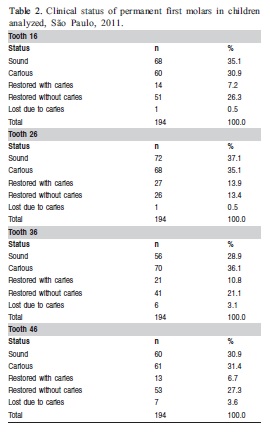
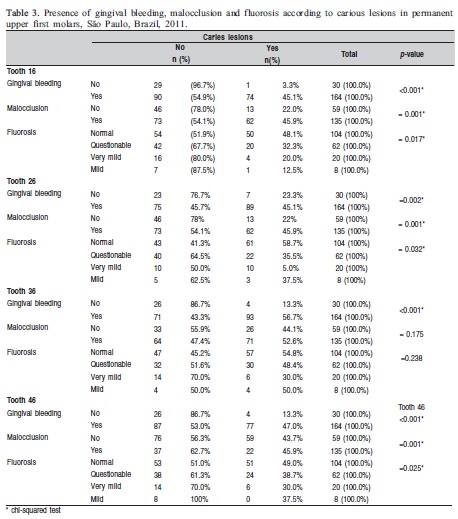
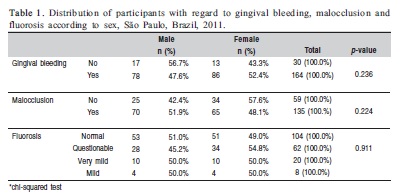
<body><![CDATA[<p>&nbsp;</p>     <p><font face="Verdana, Arial, Helvetica, sans-serif" size="3"><b>Results</b></font></p>     <p><font face="Verdana, Arial, Helvetica, sans-serif" size="2">The sample was made up of 194 children aged seven to   ten years; 51.03% (n = 99) of the children were female. <a href="#tab01">Table 1</a> displays the distribution of the children with regard to gingival   bleeding, malocclusion and fluorosis according to sex. No   significant difference between sexes was found regarding these   oral conditions. A total of 84.5% of the participants (n = 164)   exhibited gingival bleeding and 69.9% exhibited malocclusion   (n = 135). With regard to fluorosis, 53.6% (n = 104) had a   clinical aspect of normality, 32% (n = 62) were classified with   questionable fluorosis, 10.3% (n = 20) were classified with   questionable very mild fluorosis and 4.1% (n = 8) were classified with questionable mild fluorosis.</font></p>     <p>&nbsp;</p>     <p><a name="tab01"></a></p>     <p>&nbsp;</p>     <p align="center"><img src="/img/revistas/bjos/v11n4/a09tab01.jpg"></p>     <p>&nbsp;</p>     <p><font face="Verdana, Arial, Helvetica, sans-serif" size="2"><a href="#tab02">Table 2</a> displays the results of the classification of dental   caries status of the permanent first molars. There was a   predominance of sound teeth in the upper arch and teeth   with carious lesions in the lower arch. Tooth loss was recorded   in both the upper and lower arches. Significant associations   were found between caries activity and oral alterations   (gingival bleeding, malocclusion and fluorosis) in teeth 16,   26 and 46 and between caries activity and gingival bleeding in tooth 36 (<a href="#tab03">Table 3</a>) (p &lt; 0.001).</font></p>     <p>&nbsp;</p>     ]]></body>
<body><![CDATA[<p><a name="tab02"></a></p>     <p>&nbsp;</p>     <p align="center"><img src="/img/revistas/bjos/v11n4/a09tab02.jpg"></p>     <p>&nbsp;</p>     <p><a name="tab03"></a></p>     <p>&nbsp;</p>     <p align="center"><img src="/img/revistas/bjos/v11n4/a09tab03.jpg"></p>     <p>&nbsp;</p>     <p><font face="Verdana, Arial, Helvetica, sans-serif" size="3"><b>Discussion</b></font></p>     <p><font face="Verdana, Arial, Helvetica, sans-serif" size="2"> The present results demonstrate no statistically   significant associations between sex and gingival bleeding,   malocclusion or fluorosis. However, tooth status was   associated with all these conditions in teeth 16, 26 and 46   and with gingival bleeding in tooth 36. There was a   predominance of sound teeth in the upper arch and carious teeth in the lower arch.</font></p>     ]]></body>
<body><![CDATA[<p><font face="Verdana, Arial, Helvetica, sans-serif" size="2">Data from the National Brazilian Oral Health survey   demonstrate an increase in the number of children who are   free of caries<sup>2</sup>. However, variables related to social context   remain predictors of caries, which underscores the need for   integrated health actions, as occurs with other childhood   diseases<sup>17</sup>. The present study revealed a large number of   carious lesions in the sample analyzed, which may be   attributed to the rural region in which the school is located,   which has no access to public health care or fluoridated water.</font></p>     <p><font face="Verdana, Arial, Helvetica, sans-serif" size="2">A previous study involving children and adults in a   rural community in the state of Minas Gerais, Brazil states   that deficient oral health is to be expected in this population   given the fact that preventive and curative care hinges on   access to dental treatment<sup>18</sup>. Another study carried out in a   different region of the same state reports a greater prevalence   of dental caries and lesser access to dental services as well   as evidence of greater social deprivation among rural   schoolchildren in comparison to their urban counterparts<sup>19</sup>.   The findings described in a study carried out by de Abreu et   al. (2004) suggest that underprivileged populations as well   as families with a slightly higher income and greater   schooling are more prone to adopt behavior that leads to   dental caries<sup>20</sup>. However, a study conducted abroad states   that children who participate in preventive oral health   programs made available at school have less caries   experience<sup>21</sup>.</font></p>     <p><font face="Verdana, Arial, Helvetica, sans-serif" size="2">The molars play a fundamental role in the maintenance   of the stomatognathic system<sup>16</sup>. The first molars are the first permanent teeth to erupt and, due to their anatomy, which   includes pits and fissures, these teeth have increased odds of   developing carious lesions<sup>4</sup>. In the present study, the lower   molars had a greater frequency of caries, whereas the upper   molars were, for the most part, sound. The permanent molars   are the teeth most affected by caries<sup>22</sup>. While the location of   the tooth (lower or upper) has no influence on the risk to   dental caries, a number of factors may be related to the   development of this disease in general, such as dietary   habits<sup>23</sup>, caries experience in the deciduous tooth<sup>24</sup> and   parents/guardians' schooling<sup>25</sup>.</font></p>     <p><font face="Verdana, Arial, Helvetica, sans-serif" size="2">Tooth loss was found in the sample in both the upper   and lower arches. According to Gonzalez and Manrrique   (2001), the loss of permanent first molars can lead to a   reduction in local function, the continuous eruption of the   antagonist teeth and tooth deviations<sup>26</sup>. Considering the   consequences of the absence of such teeth to the stomatognathic   system, oral health promotion programs and campaigns aimed   at the prevention of oral health problems should be   established for the population as a whole and schoolchildren   in particular. When performed early, interventions tend to   minimize the impact of treatment and costs<sup>27</sup>.</font></p>     <p><font face="Verdana, Arial, Helvetica, sans-serif" size="2">No significant association was found between dental   fluorosis and sex. However, the prevalence of fluorosis was   relatively low, which may have been due the fact that the   participants lived in a rural environment, where some   communities without access to a fluoridated water supply   make use of artesian wells, mines, rivers, ponds, etc. Fluorosis   has been related to a reduction in caries<sup>28-29</sup>. However, a   significant association was found between these conditionsin three of the four teeth evaluated in the present study.   Changes in diet have been suggested as an explanation for   the increase in the prevalence of caries in groups that also   have contact with fluoride ions<sup>30</sup>. Therefore, a greater   frequency of visits to the dentist and supervision with regard   to sugar intake and brushing should be warrant<sup>21</sup>.</font></p>     <p><font face="Verdana, Arial, Helvetica, sans-serif" size="2">A statistically significant association was found between   gingival bleeding and caries activity. A previous study reports   that the prevalence of gum disease is high among individuals   aged seven to 14 years and is directly related to deficient oral   hygiene<sup>31</sup>. In a systematic review of studies addressing   periodontal disease, Gjermo et al. (2000) report that gingivitis   is the most common periodontal condition among children and   adolescents, especially among males and individuals belonging   to lower socioeconomic strata<sup>32</sup>. The findings of the present   study are in agreement with these statements, except with regard   to sex, for which no significant association was found.</font></p>     <p><font face="Verdana, Arial, Helvetica, sans-serif" size="2">The prevalence of malocclusion in the present study   was high, likely due to the absence of public promotion   measures regarding this aspect of oral health. According to   Dimberg et al. (2011), the early treatment of malocclusion   may be unnecessary if spontaneous correction occurs during   the transition from the primary to the mixed dentition<sup>33</sup>.   However, the present study involved the mixed dentition   and the findings demonstrate treatment needs in this subgroup   of the population. Thus, basic epidemiological surveys are   fundamental to the assessment of the current situation   regarding malocclusion and the drafting of treatment plans   for groups at risk.</font></p>     <p><font face="Verdana, Arial, Helvetica, sans-serif" size="2">Prevention programs should be directed at the population   in both rural and urban environments. The findings of a   longitudinal study demonstrate that children without caries   in the primary dentition tend to remain caries free during   the mixed dentition phase<sup>34</sup>. Strategies aimed at health   promotion should be adopted on a large scale to minimize   the prevalence of oral diseases. Moreover, for cases in which   such conditions have already developed, early detection and   treatment can ensure a future generation of healthy adults   from the dental standpoint.</font></p>     <p>&nbsp;</p>     <p><font face="Verdana, Arial, Helvetica, sans-serif" size="3"><b>References</b></font></p>     ]]></body>
<body><![CDATA[<!-- ref --><p><font face="Verdana, Arial, Helvetica, sans-serif" size="2">1. WHO. World Health Organization. What is the burden of oral disease?  &#91;Cited 2012 Mar 7Available from: <a href="http://www.who.int/oral_health/disease_burden/global/en/" target="_blank">http://www.who.int/oral_health/disease_burden/global/en/</a>.    &nbsp;&nbsp;&nbsp;&nbsp;&nbsp;&nbsp;&nbsp;&nbsp;[&#160;<a href="javascript:void(0);" onclick="javascript: window.open('/scielo.php?script=sci_nlinks&ref=048707&pid=S1677-3225201200040000900001&lng=','','width=640,height=500,resizable=yes,scrollbars=1,menubar=yes,');">Links</a>&#160;]<!-- end-ref --></font></p>     <!-- ref --><p><font face="Verdana, Arial, Helvetica, sans-serif" size="2">2. Brasil. Minist&eacute;rio da Sa&uacute;de. Brasil Sorridente: A sa&uacute;de bucal levada a   s&eacute;rio. &#91;Cited 2012 Mar 28&#93; Available from: http: //dab.saude.gov.br/cnsb/sbbrasil/arquivos/apresentacao_abbrasil_2010.pdf.    &nbsp;&nbsp;&nbsp;&nbsp;&nbsp;&nbsp;&nbsp;&nbsp;[&#160;<a href="javascript:void(0);" onclick="javascript: window.open('/scielo.php?script=sci_nlinks&ref=048709&pid=S1677-3225201200040000900002&lng=','','width=640,height=500,resizable=yes,scrollbars=1,menubar=yes,');">Links</a>&#160;]<!-- end-ref --></font></p>     <!-- ref --><p><font face="Verdana, Arial, Helvetica, sans-serif" size="2">3. Carvalho JC, Ekstrand KR, Thylstrup A. Dental plaque and caries on   occlusal surfaces of first permanent molars in relation to stage of eruption.   J Dent Res. 1989; 68: 773-9.    &nbsp;&nbsp;&nbsp;&nbsp;&nbsp;&nbsp;&nbsp;&nbsp;[&#160;<a href="javascript:void(0);" onclick="javascript: window.open('/scielo.php?script=sci_nlinks&ref=048711&pid=S1677-3225201200040000900003&lng=','','width=640,height=500,resizable=yes,scrollbars=1,menubar=yes,');">Links</a>&#160;]<!-- end-ref --></font></p>     <!-- ref --><p><font face="Verdana, Arial, Helvetica, sans-serif" size="2">4. Pine CM, Pitts NB, Nugent ZJ. British Association for the Study of   Community Dentistry (BASCD) guidance on sampling for surveys of   child dental health. A BASCD coordinated dental epidemiology programme quality standard. Community Dent Health. 1997; 14(Suppl 1): 10-7.    &nbsp;&nbsp;&nbsp;&nbsp;&nbsp;&nbsp;&nbsp;&nbsp;[&#160;<a href="javascript:void(0);" onclick="javascript: window.open('/scielo.php?script=sci_nlinks&ref=048713&pid=S1677-3225201200040000900004&lng=','','width=640,height=500,resizable=yes,scrollbars=1,menubar=yes,');">Links</a>&#160;]<!-- end-ref --></font></p>     <!-- ref --><p><font face="Verdana, Arial, Helvetica, sans-serif" size="2">5. Feldens CA, Kramer PF, Abreu ME, Rosso ED, Ferreira SH, Feldens   EG. Association between caries experience in deciduos molars and first   molar permanents. Pesq Bras Odontoped Clin Integ. 2005; 5: 157-63.    &nbsp;&nbsp;&nbsp;&nbsp;&nbsp;&nbsp;&nbsp;&nbsp;[&#160;<a href="javascript:void(0);" onclick="javascript: window.open('/scielo.php?script=sci_nlinks&ref=048715&pid=S1677-3225201200040000900005&lng=','','width=640,height=500,resizable=yes,scrollbars=1,menubar=yes,');">Links</a>&#160;]<!-- end-ref --></font></p>     ]]></body>
<body><![CDATA[<!-- ref --><p><font face="Verdana, Arial, Helvetica, sans-serif" size="2">6. Quaglio JM, Sousa MB, Ardenghi TM, Mendes FM, Imparato JC, Pinheiro   SL. Association between clinical parameters and the presence of active   caries lesions in first permanent molars. Braz Oral Res. 2006; 20: 358-63.    &nbsp;&nbsp;&nbsp;&nbsp;&nbsp;&nbsp;&nbsp;&nbsp;[&#160;<a href="javascript:void(0);" onclick="javascript: window.open('/scielo.php?script=sci_nlinks&ref=048717&pid=S1677-3225201200040000900006&lng=','','width=640,height=500,resizable=yes,scrollbars=1,menubar=yes,');">Links</a>&#160;]<!-- end-ref --></font></p>     <!-- ref --><p><font face="Verdana, Arial, Helvetica, sans-serif" size="2">7. Jenkins WM, Papapanou PN. Epidemiology of periodontal disease in   children and adolescents. Periodontol 2000. 2001; 26: 16-32.    &nbsp;&nbsp;&nbsp;&nbsp;&nbsp;&nbsp;&nbsp;&nbsp;[&#160;<a href="javascript:void(0);" onclick="javascript: window.open('/scielo.php?script=sci_nlinks&ref=048719&pid=S1677-3225201200040000900007&lng=','','width=640,height=500,resizable=yes,scrollbars=1,menubar=yes,');">Links</a>&#160;]<!-- end-ref --></font></p>     <!-- ref --><p><font face="Verdana, Arial, Helvetica, sans-serif" size="2">8. Fejerskov O, Manji F, Baelum V. The nature and mechanisms of dental   fluorosis in man. J Dent Res. 1990; 69(Spec N.): 692-700; discussion 21.    &nbsp;&nbsp;&nbsp;&nbsp;&nbsp;&nbsp;&nbsp;&nbsp;[&#160;<a href="javascript:void(0);" onclick="javascript: window.open('/scielo.php?script=sci_nlinks&ref=048721&pid=S1677-3225201200040000900008&lng=','','width=640,height=500,resizable=yes,scrollbars=1,menubar=yes,');">Links</a>&#160;]<!-- end-ref --></font></p>     <!-- ref --><p><font face="Verdana, Arial, Helvetica, sans-serif" size="2">9. de Oliveira CM, Sheiham A. Orthodontic treatment and its impact on oral   health-related quality of life in Brazilian adolescents. J Orthod. 2004; 31:   20-7; discussion 15.    &nbsp;&nbsp;&nbsp;&nbsp;&nbsp;&nbsp;&nbsp;&nbsp;[&#160;<a href="javascript:void(0);" onclick="javascript: window.open('/scielo.php?script=sci_nlinks&ref=048723&pid=S1677-3225201200040000900009&lng=','','width=640,height=500,resizable=yes,scrollbars=1,menubar=yes,');">Links</a>&#160;]<!-- end-ref --></font></p>     <!-- ref --><p><font face="Verdana, Arial, Helvetica, sans-serif" size="2">10. Anosike AN, Sanu OO, da Costa OO. Malocclusion and its impact on   quality of life of school children in Nigeria. West Afr J Med. 2010; 29: 417-24.    &nbsp;&nbsp;&nbsp;&nbsp;&nbsp;&nbsp;&nbsp;&nbsp;[&#160;<a href="javascript:void(0);" onclick="javascript: window.open('/scielo.php?script=sci_nlinks&ref=048725&pid=S1677-3225201200040000900010&lng=','','width=640,height=500,resizable=yes,scrollbars=1,menubar=yes,');">Links</a>&#160;]<!-- end-ref --></font></p>     ]]></body>
<body><![CDATA[<!-- ref --><p><font face="Verdana, Arial, Helvetica, sans-serif" size="2">11. Chankanka O, Levy SM, Warren JJ, Chalmers JM. A literature review of   aesthetic perceptions of dental fluorosis and relationships with psychosocial   aspects/oral health-related quality of life. Community Dent Oral Epidemiol.   2010; 38: 97-109.    &nbsp;&nbsp;&nbsp;&nbsp;&nbsp;&nbsp;&nbsp;&nbsp;[&#160;<a href="javascript:void(0);" onclick="javascript: window.open('/scielo.php?script=sci_nlinks&ref=048727&pid=S1677-3225201200040000900011&lng=','','width=640,height=500,resizable=yes,scrollbars=1,menubar=yes,');">Links</a>&#160;]<!-- end-ref --></font></p>     <!-- ref --><p><font face="Verdana, Arial, Helvetica, sans-serif" size="2">12. Marques LS, Ramos-Jorge ML, Paiva SM, Pordeus IA. Malocclusion:   esthetic impact and quality of life among Brazilian schoolchildren. Am J   Orthod Dentofacial Orthop. 2006; 129: 424-7.    &nbsp;&nbsp;&nbsp;&nbsp;&nbsp;&nbsp;&nbsp;&nbsp;[&#160;<a href="javascript:void(0);" onclick="javascript: window.open('/scielo.php?script=sci_nlinks&ref=048729&pid=S1677-3225201200040000900012&lng=','','width=640,height=500,resizable=yes,scrollbars=1,menubar=yes,');">Links</a>&#160;]<!-- end-ref --></font></p>     <!-- ref --><p><font face="Verdana, Arial, Helvetica, sans-serif" size="2">13. WHO. World Health Organization. Oral health surveys: basic methods. 4   ed. Geneva: ORH/EPID; 1997.    &nbsp;&nbsp;&nbsp;&nbsp;&nbsp;&nbsp;&nbsp;&nbsp;[&#160;<a href="javascript:void(0);" onclick="javascript: window.open('/scielo.php?script=sci_nlinks&ref=048731&pid=S1677-3225201200040000900013&lng=','','width=640,height=500,resizable=yes,scrollbars=1,menubar=yes,');">Links</a>&#160;]<!-- end-ref --></font></p>     <p><font face="Verdana, Arial, Helvetica, sans-serif" size="2">14. Brasil. SB Pesquisa nacional de sa&uacute;de bucal. Projeto t&eacute;cnico. Secretaria   Pol&iacute;ticas de Sa&uacute;de, Departamento de Aten&ccedil;&atilde;o B&aacute;sica, &Aacute;rea T&eacute;cnica de   Sa&uacute;de Bucal. &ndash; Bras&iacute;lia: Minist&eacute;rio da Sa&uacute;de; 2010.</font></p>     <p><font face="Verdana, Arial, Helvetica, sans-serif" size="2"> 15. Brasil. Projeto SB 2000: condi&ccedil;&otilde;es de sa&uacute;de bucal da popula&ccedil;&atilde;o brasileira   no ano 2000: manual do examinador / Secretaria Pol&iacute;ticas de Sa&uacute;de,   Departamento de Aten&ccedil;&atilde;o B&aacute;sica, &Aacute;rea T&eacute;cnica de Sa&uacute;de Bucal. &ndash; Bras&iacute;lia:   Minist&eacute;rio da Sa&uacute;de; 2001.</font></p>     <!-- ref --><p><font face="Verdana, Arial, Helvetica, sans-serif" size="2">16. Cons NC, Jenny J, Kohout FJ, Songpaisan Y, Jotikastira D. Utility of the   dental aesthetic index in industrialized and developing countries. J Public   Health Dent. 1989; 49: 163-6.    &nbsp;&nbsp;&nbsp;&nbsp;&nbsp;&nbsp;&nbsp;&nbsp;[&#160;<a href="javascript:void(0);" onclick="javascript: window.open('/scielo.php?script=sci_nlinks&ref=048735&pid=S1677-3225201200040000900016&lng=','','width=640,height=500,resizable=yes,scrollbars=1,menubar=yes,');">Links</a>&#160;]<!-- end-ref --></font></p>     ]]></body>
<body><![CDATA[<!-- ref --><p><font face="Verdana, Arial, Helvetica, sans-serif" size="2">17. Melo MM, Souza WV, Lima ML, Braga C. Factors associated with dental   caries in preschoolers in Recife, Pernambuco State, Brazil. Cad Saude   Publica. 2011; 27: 471-85.    &nbsp;&nbsp;&nbsp;&nbsp;&nbsp;&nbsp;&nbsp;&nbsp;[&#160;<a href="javascript:void(0);" onclick="javascript: window.open('/scielo.php?script=sci_nlinks&ref=048737&pid=S1677-3225201200040000900017&lng=','','width=640,height=500,resizable=yes,scrollbars=1,menubar=yes,');">Links</a>&#160;]<!-- end-ref --></font></p>     <!-- ref --><p><font face="Verdana, Arial, Helvetica, sans-serif" size="2">18. Pallos D, Loberto JCS, Cortelli JR, Cortelli SC, Souza DM, Ricardo LH.   Periodontal disease in a rural community in Minas Gerais, Brazil. Braz J   Oral Sci. 2005; 4: 659-63.    &nbsp;&nbsp;&nbsp;&nbsp;&nbsp;&nbsp;&nbsp;&nbsp;[&#160;<a href="javascript:void(0);" onclick="javascript: window.open('/scielo.php?script=sci_nlinks&ref=048739&pid=S1677-3225201200040000900018&lng=','','width=640,height=500,resizable=yes,scrollbars=1,menubar=yes,');">Links</a>&#160;]<!-- end-ref --></font></p>     <!-- ref --><p><font face="Verdana, Arial, Helvetica, sans-serif" size="2">19. Mello TR, Antunes JL. Prevalence of dental caries in schoolchildren in the   rural area of Itapetininga, Sao Paulo State, Brazil. Cad Saude Publica.   2004; 20: 829-35.    &nbsp;&nbsp;&nbsp;&nbsp;&nbsp;&nbsp;&nbsp;&nbsp;[&#160;<a href="javascript:void(0);" onclick="javascript: window.open('/scielo.php?script=sci_nlinks&ref=048741&pid=S1677-3225201200040000900019&lng=','','width=640,height=500,resizable=yes,scrollbars=1,menubar=yes,');">Links</a>&#160;]<!-- end-ref --></font></p>     <!-- ref --><p><font face="Verdana, Arial, Helvetica, sans-serif" size="2">20. de Abreu MH, Pordeus IA, Modena CM. Dental caries in schoolchildren   from rural communities in Itauna (MG), Brazil. Rev Panam Salud Publica.   2004; 16: 334-44.    &nbsp;&nbsp;&nbsp;&nbsp;&nbsp;&nbsp;&nbsp;&nbsp;[&#160;<a href="javascript:void(0);" onclick="javascript: window.open('/scielo.php?script=sci_nlinks&ref=048743&pid=S1677-3225201200040000900020&lng=','','width=640,height=500,resizable=yes,scrollbars=1,menubar=yes,');">Links</a>&#160;]<!-- end-ref --></font></p>     <!-- ref --><p><font face="Verdana, Arial, Helvetica, sans-serif" size="2">21. Amalia R, Schaub RM, Widyanti N, Stewart R, Groothoff JW. The role of   school-based dental programme on dental caries experience in Yogyakarta   Province, Indonesia. Int J Paediatr Dent. 2012; 22:203-10.    &nbsp;&nbsp;&nbsp;&nbsp;&nbsp;&nbsp;&nbsp;&nbsp;[&#160;<a href="javascript:void(0);" onclick="javascript: window.open('/scielo.php?script=sci_nlinks&ref=048745&pid=S1677-3225201200040000900021&lng=','','width=640,height=500,resizable=yes,scrollbars=1,menubar=yes,');">Links</a>&#160;]<!-- end-ref --></font></p>     ]]></body>
<body><![CDATA[<p><font face="Verdana, Arial, Helvetica, sans-serif" size="2">22. Marthaler TM. Changes in Dental Caries 1953&ndash;2003. Caries Res. 2004;   38: 173-81.</font></p>     <!-- ref --><p><font face="Verdana, Arial, Helvetica, sans-serif" size="2">23. Ohlund I, Holgerson PL, Backman B, Lind T, Hernell O, Johansson I.   Diet intake and caries prevalence in four-year-old children living in a lowprevalence   country. Caries Res. 2007; 41: 26-33.    &nbsp;&nbsp;&nbsp;&nbsp;&nbsp;&nbsp;&nbsp;&nbsp;[&#160;<a href="javascript:void(0);" onclick="javascript: window.open('/scielo.php?script=sci_nlinks&ref=048748&pid=S1677-3225201200040000900023&lng=','','width=640,height=500,resizable=yes,scrollbars=1,menubar=yes,');">Links</a>&#160;]<!-- end-ref --></font></p>     <!-- ref --><p><font face="Verdana, Arial, Helvetica, sans-serif" size="2">24. Li Y, Wang W. Predicting caries in permanent teeth from caries in primary   teeth: an eight-year cohort study. J Dent Res. 2002; 81: 561-6.    &nbsp;&nbsp;&nbsp;&nbsp;&nbsp;&nbsp;&nbsp;&nbsp;[&#160;<a href="javascript:void(0);" onclick="javascript: window.open('/scielo.php?script=sci_nlinks&ref=048750&pid=S1677-3225201200040000900024&lng=','','width=640,height=500,resizable=yes,scrollbars=1,menubar=yes,');">Links</a>&#160;]<!-- end-ref --></font></p>     <!-- ref --><p><font face="Verdana, Arial, Helvetica, sans-serif" size="2">25. Ismail AI, Sohn W. The impact of universal access to dental care on   disparities in caries experience in children. J Am Dent Assoc. 2001; 132:   295-303.    &nbsp;&nbsp;&nbsp;&nbsp;&nbsp;&nbsp;&nbsp;&nbsp;[&#160;<a href="javascript:void(0);" onclick="javascript: window.open('/scielo.php?script=sci_nlinks&ref=048752&pid=S1677-3225201200040000900025&lng=','','width=640,height=500,resizable=yes,scrollbars=1,menubar=yes,');">Links</a>&#160;]<!-- end-ref --></font></p>     <!-- ref --><p><font face="Verdana, Arial, Helvetica, sans-serif" size="2">26. Gonzalez J, Manrrique R. Proyecto Anaco-U.C.V. estudio epidemiol&oacute;gico   sobre la p&eacute;rdida prematura del primer molar permanente en ni&ntilde;os con edades   comprendidas entre 6 y 10 a&ntilde;os. Acta odontol venez. 2001; 39: 42-6.    &nbsp;&nbsp;&nbsp;&nbsp;&nbsp;&nbsp;&nbsp;&nbsp;[&#160;<a href="javascript:void(0);" onclick="javascript: window.open('/scielo.php?script=sci_nlinks&ref=048754&pid=S1677-3225201200040000900026&lng=','','width=640,height=500,resizable=yes,scrollbars=1,menubar=yes,');">Links</a>&#160;]<!-- end-ref --></font></p>     <!-- ref --><p><font face="Verdana, Arial, Helvetica, sans-serif" size="2">27. Singh M, Saini A, Saimbi CS, Bajpai AK. Prevalence of dental diseases   in 5- to 14-year-old school children in rural areas of the Barabanki district,   Uttar Pradesh, India. Indian J Dent Res. 2011; 22: 396-9.    &nbsp;&nbsp;&nbsp;&nbsp;&nbsp;&nbsp;&nbsp;&nbsp;[&#160;<a href="javascript:void(0);" onclick="javascript: window.open('/scielo.php?script=sci_nlinks&ref=048756&pid=S1677-3225201200040000900027&lng=','','width=640,height=500,resizable=yes,scrollbars=1,menubar=yes,');">Links</a>&#160;]<!-- end-ref --></font></p>     <!-- ref --><p><font face="Verdana, Arial, Helvetica, sans-serif" size="2">28. Mascarenhas AK. Risk factors for dental fluorosis: a review of the recent   literature. Pediatr Dent. 2000; 22: 269-77.    &nbsp;&nbsp;&nbsp;&nbsp;&nbsp;&nbsp;&nbsp;&nbsp;[&#160;<a href="javascript:void(0);" onclick="javascript: window.open('/scielo.php?script=sci_nlinks&ref=048758&pid=S1677-3225201200040000900028&lng=','','width=640,height=500,resizable=yes,scrollbars=1,menubar=yes,');">Links</a>&#160;]<!-- end-ref --></font></p>     <!-- ref --><p><font face="Verdana, Arial, Helvetica, sans-serif" size="2">29. McDonagh MS, Whiting PF, Wilson PM, Sutton AJ, Chestnutt I, Cooper J, et al. Systematic review of water fluoridation. BMJ. 2000; 321: 855-9.    &nbsp;&nbsp;&nbsp;&nbsp;&nbsp;&nbsp;&nbsp;&nbsp;[&#160;<a href="javascript:void(0);" onclick="javascript: window.open('/scielo.php?script=sci_nlinks&ref=048760&pid=S1677-3225201200040000900029&lng=','','width=640,height=500,resizable=yes,scrollbars=1,menubar=yes,');">Links</a>&#160;]<!-- end-ref --></font></p>     <!-- ref --><p><font face="Verdana, Arial, Helvetica, sans-serif" size="2">30. Sampaio FC, Hossain AN, von der Fehr FR, Arneberg P. Dental caries and   sugar intake of children from rural areas with different water fluoride levels in   Paraiba, Brazil. Community Dent Oral Epidemiol. 2000; 28: 307-13.    &nbsp;&nbsp;&nbsp;&nbsp;&nbsp;&nbsp;&nbsp;&nbsp;[&#160;<a href="javascript:void(0);" onclick="javascript: window.open('/scielo.php?script=sci_nlinks&ref=048762&pid=S1677-3225201200040000900030&lng=','','width=640,height=500,resizable=yes,scrollbars=1,menubar=yes,');">Links</a>&#160;]<!-- end-ref --></font></p>     <!-- ref --><p><font face="Verdana, Arial, Helvetica, sans-serif" size="2">31. Chambrone L, Macedo SB, Ramalho FC, Trevizani Filho E, Chambrone   LA. &#91;Prevalence and severity of gingivitis among scholars (7-14 years):   local conditions associated to bleeding on probing&#93;. Cien Saude Colet.   2010; 15: 337-43.    &nbsp;&nbsp;&nbsp;&nbsp;&nbsp;&nbsp;&nbsp;&nbsp;[&#160;<a href="javascript:void(0);" onclick="javascript: window.open('/scielo.php?script=sci_nlinks&ref=048764&pid=S1677-3225201200040000900031&lng=','','width=640,height=500,resizable=yes,scrollbars=1,menubar=yes,');">Links</a>&#160;]<!-- end-ref --></font></p>     <!-- ref --><p><font face="Verdana, Arial, Helvetica, sans-serif" size="2">32. Gjermo P, R&ouml;sing CK, Susin C. Periodontal diseases in Central and   South America. Periodontol. 2000; 29: 70-8.    &nbsp;&nbsp;&nbsp;&nbsp;&nbsp;&nbsp;&nbsp;&nbsp;[&#160;<a href="javascript:void(0);" onclick="javascript: window.open('/scielo.php?script=sci_nlinks&ref=048766&pid=S1677-3225201200040000900032&lng=','','width=640,height=500,resizable=yes,scrollbars=1,menubar=yes,');">Links</a>&#160;]<!-- end-ref --></font></p>     <!-- ref --><p><font face="Verdana, Arial, Helvetica, sans-serif" size="2">33. Dimberg L, Lennartsson B, Soderfeldt B, Bondemark L. Malocclusions in   children at 3 and 7 years of age: a longitudinal study. Eur J Orthod. 2011;   Oct 31. &#91;Epub ahead of print&#93;    &nbsp;&nbsp;&nbsp;&nbsp;&nbsp;&nbsp;&nbsp;&nbsp;[&#160;<a href="javascript:void(0);" onclick="javascript: window.open('/scielo.php?script=sci_nlinks&ref=048768&pid=S1677-3225201200040000900033&lng=','','width=640,height=500,resizable=yes,scrollbars=1,menubar=yes,');">Links</a>&#160;]<!-- end-ref -->.</font></p>     <!-- ref --><p><font face="Verdana, Arial, Helvetica, sans-serif" size="2">34. Greenwell AL, Johnsen D, DiSantis TA, Gerstenmaier J, Limbert N.   Longitudinal evaluation of caries patterns form the primary to the mixed   dentition. Pediatr Dent. 1990; 12: 278-82.    &nbsp;&nbsp;&nbsp;&nbsp;&nbsp;&nbsp;&nbsp;&nbsp;[&#160;<a href="javascript:void(0);" onclick="javascript: window.open('/scielo.php?script=sci_nlinks&ref=048770&pid=S1677-3225201200040000900034&lng=','','width=640,height=500,resizable=yes,scrollbars=1,menubar=yes,');">Links</a>&#160;]<!-- end-ref --></font></p>     <p>&nbsp;</p>     <p>&nbsp;</p>     <p><font face="Verdana, Arial, Helvetica, sans-serif" size="2"><a name="back"/></a><a href="#top"><img src="/img/revistas/bjos/v11n4/seta.jpg" border="0" align="absmiddle"/></a>    <b>Correspondence:</b> <br/>   Thays Almeida Alfaya    <br>   Rua Doutor Calandrine 235 A, CEP: 24755-160,    <br>   S&atilde;o Gon&ccedil;alo, RJ, Brasil<br/>   E-mail: <a href="thalfaya@gmail.com">thalfaya@gmail.com</a></font></p>     ]]></body>
<body><![CDATA[<p><font face="Verdana, Arial, Helvetica, sans-serif" size="2"><b>Received for    publication:</b> August 05, 2012<br/> <b>Accepted:</b> December 11, 2012</font></p>      ]]></body>
<back>
<ref-list>
<ref id="B1">
<label>1</label><nlm-citation citation-type="">
<collab>WHO^dWorld Health Organization</collab>
<source><![CDATA[What is the burden of oral disease]]></source>
<year>2012</year>
<month> M</month>
<day>ar</day>
</nlm-citation>
</ref>
<ref id="B2">
<label>2</label><nlm-citation citation-type="">
<collab>Brasil^dMinistério da Saúde</collab>
<source><![CDATA[Brasil Sorridente: A saúde bucal levada a sério]]></source>
<year>2012</year>
<month> M</month>
<day>ar</day>
</nlm-citation>
</ref>
<ref id="B3">
<label>3</label><nlm-citation citation-type="journal">
<person-group person-group-type="author">
<name>
<surname><![CDATA[Carvalho]]></surname>
<given-names><![CDATA[JC]]></given-names>
</name>
<name>
<surname><![CDATA[Ekstrand]]></surname>
<given-names><![CDATA[KR]]></given-names>
</name>
<name>
<surname><![CDATA[Thylstrup]]></surname>
<given-names><![CDATA[A]]></given-names>
</name>
</person-group>
<article-title xml:lang="en"><![CDATA[Dental plaque and caries on occlusal surfaces of first permanent molars in relation to stage of eruption]]></article-title>
<source><![CDATA[J Dent Res]]></source>
<year>1989</year>
<volume>68</volume>
<page-range>773-9</page-range></nlm-citation>
</ref>
<ref id="B4">
<label>4</label><nlm-citation citation-type="journal">
<person-group person-group-type="author">
<name>
<surname><![CDATA[Pine]]></surname>
<given-names><![CDATA[CM]]></given-names>
</name>
<name>
<surname><![CDATA[Pitts]]></surname>
<given-names><![CDATA[NB]]></given-names>
</name>
<name>
<surname><![CDATA[Nugent]]></surname>
<given-names><![CDATA[ZJ]]></given-names>
</name>
</person-group>
<article-title xml:lang="en"><![CDATA[British Association for the Study of Community Dentistry (BASCD) guidance on sampling for surveys of child dental health: A BASCD coordinated dental epidemiology programme quality standard]]></article-title>
<source><![CDATA[Community Dent Health]]></source>
<year>1997</year>
<volume>14</volume>
<numero>^s1</numero>
<issue>^s1</issue>
<supplement>1</supplement>
<page-range>10-7</page-range></nlm-citation>
</ref>
<ref id="B5">
<label>5</label><nlm-citation citation-type="journal">
<person-group person-group-type="author">
<name>
<surname><![CDATA[Feldens]]></surname>
<given-names><![CDATA[CA]]></given-names>
</name>
<name>
<surname><![CDATA[Kramer]]></surname>
<given-names><![CDATA[PF]]></given-names>
</name>
<name>
<surname><![CDATA[Abreu]]></surname>
<given-names><![CDATA[ME]]></given-names>
</name>
<name>
<surname><![CDATA[Rosso]]></surname>
<given-names><![CDATA[ED]]></given-names>
</name>
<name>
<surname><![CDATA[Ferreira]]></surname>
<given-names><![CDATA[SH]]></given-names>
</name>
<name>
<surname><![CDATA[Feldens]]></surname>
<given-names><![CDATA[EG]]></given-names>
</name>
</person-group>
<article-title xml:lang="en"><![CDATA[Association between caries experience in deciduos molars and first molar permanents]]></article-title>
<source><![CDATA[Pesq Bras Odontoped Clin Integ]]></source>
<year>2005</year>
<volume>5</volume>
<page-range>157-63</page-range></nlm-citation>
</ref>
<ref id="B6">
<label>6</label><nlm-citation citation-type="journal">
<person-group person-group-type="author">
<name>
<surname><![CDATA[Quaglio]]></surname>
<given-names><![CDATA[JM]]></given-names>
</name>
<name>
<surname><![CDATA[Sousa]]></surname>
<given-names><![CDATA[MB]]></given-names>
</name>
<name>
<surname><![CDATA[Ardenghi]]></surname>
<given-names><![CDATA[TM]]></given-names>
</name>
<name>
<surname><![CDATA[Mendes]]></surname>
<given-names><![CDATA[FM]]></given-names>
</name>
<name>
<surname><![CDATA[Imparato]]></surname>
<given-names><![CDATA[JC]]></given-names>
</name>
<name>
<surname><![CDATA[Pinheiro]]></surname>
<given-names><![CDATA[SL]]></given-names>
</name>
</person-group>
<article-title xml:lang="en"><![CDATA[Association between clinical parameters and the presence of active caries lesions in first permanent molars]]></article-title>
<source><![CDATA[Braz Oral Res]]></source>
<year>2006</year>
<volume>20</volume>
<page-range>358-63</page-range></nlm-citation>
</ref>
<ref id="B7">
<label>7</label><nlm-citation citation-type="journal">
<person-group person-group-type="author">
<name>
<surname><![CDATA[Jenkins]]></surname>
<given-names><![CDATA[WM]]></given-names>
</name>
<name>
<surname><![CDATA[Papapanou]]></surname>
<given-names><![CDATA[PN]]></given-names>
</name>
</person-group>
<article-title xml:lang="en"><![CDATA[Epidemiology of periodontal disease in children and adolescents]]></article-title>
<source><![CDATA[Periodontol]]></source>
<year>2000</year>
<volume>26</volume>
<page-range>16-32</page-range></nlm-citation>
</ref>
<ref id="B8">
<label>8</label><nlm-citation citation-type="journal">
<person-group person-group-type="author">
<name>
<surname><![CDATA[Fejerskov]]></surname>
<given-names><![CDATA[O]]></given-names>
</name>
<name>
<surname><![CDATA[Manji]]></surname>
<given-names><![CDATA[F]]></given-names>
</name>
<name>
<surname><![CDATA[Baelum]]></surname>
<given-names><![CDATA[V]]></given-names>
</name>
</person-group>
<article-title xml:lang="en"><![CDATA[The nature and mechanisms of dental fluorosis in man]]></article-title>
<source><![CDATA[J Dent Res]]></source>
<year>1990</year>
<volume>69</volume>
<numero>^sN</numero>
<issue>^sN</issue>
<supplement>N</supplement>
<page-range>692-700</page-range></nlm-citation>
</ref>
<ref id="B9">
<label>9</label><nlm-citation citation-type="journal">
<person-group person-group-type="author">
<name>
<surname><![CDATA[de Oliveira]]></surname>
<given-names><![CDATA[CM]]></given-names>
</name>
<name>
<surname><![CDATA[Sheiham]]></surname>
<given-names><![CDATA[A]]></given-names>
</name>
</person-group>
<article-title xml:lang="en"><![CDATA[Orthodontic treatment and its impact on oral health-related quality of life in Brazilian adolescents]]></article-title>
<source><![CDATA[J Orthod]]></source>
<year>2004</year>
<volume>31</volume>
<page-range>20-7</page-range></nlm-citation>
</ref>
<ref id="B10">
<label>10</label><nlm-citation citation-type="journal">
<person-group person-group-type="author">
<name>
<surname><![CDATA[Anosike]]></surname>
<given-names><![CDATA[AN]]></given-names>
</name>
<name>
<surname><![CDATA[Sanu]]></surname>
<given-names><![CDATA[OO]]></given-names>
</name>
<name>
<surname><![CDATA[da Costa]]></surname>
<given-names><![CDATA[OO]]></given-names>
</name>
</person-group>
<article-title xml:lang="en"><![CDATA[Malocclusion and its impact on quality of life of school children in Nigeria]]></article-title>
<source><![CDATA[West Afr J Med]]></source>
<year>2010</year>
<volume>29</volume>
<page-range>417-24</page-range></nlm-citation>
</ref>
<ref id="B11">
<label>11</label><nlm-citation citation-type="journal">
<person-group person-group-type="author">
<name>
<surname><![CDATA[Chankanka]]></surname>
<given-names><![CDATA[O]]></given-names>
</name>
<name>
<surname><![CDATA[Levy]]></surname>
<given-names><![CDATA[SM]]></given-names>
</name>
<name>
<surname><![CDATA[Warren]]></surname>
<given-names><![CDATA[JJ]]></given-names>
</name>
<name>
<surname><![CDATA[Chalmers]]></surname>
<given-names><![CDATA[JM]]></given-names>
</name>
</person-group>
<article-title xml:lang="en"><![CDATA[A literature review of aesthetic perceptions of dental fluorosis and relationships with psychosocial aspects/oral health-related quality of life]]></article-title>
<source><![CDATA[Community Dent Oral Epidemiol]]></source>
<year>2010</year>
<volume>38</volume>
<page-range>97-109</page-range></nlm-citation>
</ref>
<ref id="B12">
<label>12</label><nlm-citation citation-type="journal">
<person-group person-group-type="author">
<name>
<surname><![CDATA[Marques]]></surname>
<given-names><![CDATA[LS]]></given-names>
</name>
<name>
<surname><![CDATA[Ramos-Jorge]]></surname>
<given-names><![CDATA[ML]]></given-names>
</name>
<name>
<surname><![CDATA[Paiva]]></surname>
<given-names><![CDATA[SM]]></given-names>
</name>
<name>
<surname><![CDATA[Pordeus]]></surname>
<given-names><![CDATA[IA]]></given-names>
</name>
</person-group>
<article-title xml:lang="en"><![CDATA[Malocclusion: esthetic impact and quality of life among Brazilian schoolchildren]]></article-title>
<source><![CDATA[Am J Orthod Dentofacial Orthop]]></source>
<year>2006</year>
<volume>129</volume>
<page-range>424-7</page-range></nlm-citation>
</ref>
<ref id="B13">
<label>13</label><nlm-citation citation-type="book">
<collab>WHO^dWorld Health Organization</collab>
<source><![CDATA[Oral health surveys: basic methods]]></source>
<year>1997</year>
<edition>4</edition>
<publisher-loc><![CDATA[Geneva ]]></publisher-loc>
<publisher-name><![CDATA[ORH/EPID]]></publisher-name>
</nlm-citation>
</ref>
<ref id="B14">
<label>14</label><nlm-citation citation-type="book">
<collab>Secretaria Políticas de Saúde, Departamento de Atenção Básica^dÁrea Técnica de Saúde Bucal</collab>
<source><![CDATA[SB Pesquisa nacional de saúde bucal: Projeto técnico]]></source>
<year>2010</year>
<publisher-loc><![CDATA[Brasília ]]></publisher-loc>
<publisher-name><![CDATA[Ministério da Saúde]]></publisher-name>
</nlm-citation>
</ref>
<ref id="B15">
<label>15</label><nlm-citation citation-type="book">
<collab>Secretaria Políticas de Saúde, Departamento de Atenção Básica^dÁrea Técnica de Saúde Bucal</collab>
<source><![CDATA[Projeto SB 2000: condições de saúde bucal da população brasileira no ano 2000: manual do examinador]]></source>
<year>2001</year>
<publisher-loc><![CDATA[Brasília ]]></publisher-loc>
<publisher-name><![CDATA[Ministério da Saúde]]></publisher-name>
</nlm-citation>
</ref>
<ref id="B16">
<label>16</label><nlm-citation citation-type="journal">
<person-group person-group-type="author">
<name>
<surname><![CDATA[Cons]]></surname>
<given-names><![CDATA[NC]]></given-names>
</name>
<name>
<surname><![CDATA[Jenny]]></surname>
<given-names><![CDATA[J]]></given-names>
</name>
<name>
<surname><![CDATA[Kohout]]></surname>
<given-names><![CDATA[FJ]]></given-names>
</name>
<name>
<surname><![CDATA[Songpaisan]]></surname>
<given-names><![CDATA[Y]]></given-names>
</name>
<name>
<surname><![CDATA[Jotikastira]]></surname>
<given-names><![CDATA[D]]></given-names>
</name>
</person-group>
<article-title xml:lang="en"><![CDATA[Utility of the dental aesthetic index in industrialized and developing countries]]></article-title>
<source><![CDATA[J Public Health Dent]]></source>
<year>1989</year>
<volume>49</volume>
<page-range>163-6</page-range></nlm-citation>
</ref>
<ref id="B17">
<label>17</label><nlm-citation citation-type="journal">
<person-group person-group-type="author">
<name>
<surname><![CDATA[Melo]]></surname>
<given-names><![CDATA[MM]]></given-names>
</name>
<name>
<surname><![CDATA[Souza]]></surname>
<given-names><![CDATA[WV]]></given-names>
</name>
<name>
<surname><![CDATA[Lima]]></surname>
<given-names><![CDATA[ML]]></given-names>
</name>
<name>
<surname><![CDATA[Braga]]></surname>
<given-names><![CDATA[C]]></given-names>
</name>
</person-group>
<article-title xml:lang="en"><![CDATA[Factors associated with dental caries in preschoolers in Recife, Pernambuco State, Brazil]]></article-title>
<source><![CDATA[Cad Saude Publica]]></source>
<year>2011</year>
<volume>27</volume>
<page-range>471-85</page-range></nlm-citation>
</ref>
<ref id="B18">
<label>18</label><nlm-citation citation-type="journal">
<person-group person-group-type="author">
<name>
<surname><![CDATA[Pallos]]></surname>
<given-names><![CDATA[D]]></given-names>
</name>
<name>
<surname><![CDATA[Loberto]]></surname>
<given-names><![CDATA[JCS]]></given-names>
</name>
<name>
<surname><![CDATA[Cortelli]]></surname>
<given-names><![CDATA[JR]]></given-names>
</name>
<name>
<surname><![CDATA[Cortelli]]></surname>
<given-names><![CDATA[SC]]></given-names>
</name>
<name>
<surname><![CDATA[Souza]]></surname>
<given-names><![CDATA[DM]]></given-names>
</name>
<name>
<surname><![CDATA[Ricardo]]></surname>
<given-names><![CDATA[LH]]></given-names>
</name>
</person-group>
<article-title xml:lang="en"><![CDATA[Periodontal disease in a rural community in Minas Gerais, Brazil]]></article-title>
<source><![CDATA[Braz J Oral Sci]]></source>
<year>2005</year>
<volume>4</volume>
<page-range>659-63</page-range></nlm-citation>
</ref>
<ref id="B19">
<label>19</label><nlm-citation citation-type="journal">
<person-group person-group-type="author">
<name>
<surname><![CDATA[Mello]]></surname>
<given-names><![CDATA[TR]]></given-names>
</name>
<name>
<surname><![CDATA[Antunes]]></surname>
<given-names><![CDATA[JL]]></given-names>
</name>
</person-group>
<article-title xml:lang="en"><![CDATA[Prevalence of dental caries in schoolchildren in the rural area of Itapetininga, Sao Paulo State, Brazil]]></article-title>
<source><![CDATA[Cad Saude Publica]]></source>
<year>2004</year>
<volume>20</volume>
<page-range>829-35</page-range></nlm-citation>
</ref>
<ref id="B20">
<label>20</label><nlm-citation citation-type="journal">
<person-group person-group-type="author">
<name>
<surname><![CDATA[de Abreu]]></surname>
<given-names><![CDATA[MH]]></given-names>
</name>
<name>
<surname><![CDATA[Pordeus]]></surname>
<given-names><![CDATA[IA]]></given-names>
</name>
<name>
<surname><![CDATA[Modena]]></surname>
<given-names><![CDATA[CM]]></given-names>
</name>
</person-group>
<article-title xml:lang="en"><![CDATA[Dental caries in schoolchildren from rural communities in Itauna (MG), Brazil]]></article-title>
<source><![CDATA[Rev Panam Salud Publica]]></source>
<year>2004</year>
<volume>16</volume>
<page-range>334-44</page-range></nlm-citation>
</ref>
<ref id="B21">
<label>21</label><nlm-citation citation-type="journal">
<person-group person-group-type="author">
<name>
<surname><![CDATA[Amalia]]></surname>
<given-names><![CDATA[R]]></given-names>
</name>
<name>
<surname><![CDATA[Schaub]]></surname>
<given-names><![CDATA[RM]]></given-names>
</name>
<name>
<surname><![CDATA[Widyanti]]></surname>
<given-names><![CDATA[N]]></given-names>
</name>
<name>
<surname><![CDATA[Stewart]]></surname>
<given-names><![CDATA[R]]></given-names>
</name>
<name>
<surname><![CDATA[Groothoff]]></surname>
<given-names><![CDATA[JW]]></given-names>
</name>
</person-group>
<article-title xml:lang="en"><![CDATA[The role of school-based dental programme on dental caries experience in Yogyakarta Province, Indonesia]]></article-title>
<source><![CDATA[Int J Paediatr Dent]]></source>
<year>2012</year>
<volume>22</volume>
<page-range>203-10</page-range></nlm-citation>
</ref>
<ref id="B22">
<label>22</label><nlm-citation citation-type="journal">
<person-group person-group-type="author">
<name>
<surname><![CDATA[Marthaler]]></surname>
<given-names><![CDATA[TM]]></given-names>
</name>
</person-group>
<article-title xml:lang="en"><![CDATA[Changes in Dental Caries 1953-2003]]></article-title>
<source><![CDATA[Caries Res]]></source>
<year>2004</year>
<volume>38</volume>
<page-range>173-81</page-range></nlm-citation>
</ref>
<ref id="B23">
<label>23</label><nlm-citation citation-type="journal">
<person-group person-group-type="author">
<name>
<surname><![CDATA[Ohlund]]></surname>
<given-names><![CDATA[I]]></given-names>
</name>
<name>
<surname><![CDATA[Holgerson]]></surname>
<given-names><![CDATA[PL]]></given-names>
</name>
<name>
<surname><![CDATA[Backman]]></surname>
<given-names><![CDATA[B]]></given-names>
</name>
<name>
<surname><![CDATA[Lind]]></surname>
<given-names><![CDATA[T]]></given-names>
</name>
<name>
<surname><![CDATA[Hernell]]></surname>
<given-names><![CDATA[O]]></given-names>
</name>
<name>
<surname><![CDATA[Johansson]]></surname>
<given-names><![CDATA[I]]></given-names>
</name>
</person-group>
<article-title xml:lang="en"><![CDATA[Diet intake and caries prevalence in four-year-old children living in a lowprevalence country]]></article-title>
<source><![CDATA[Caries Res]]></source>
<year>2007</year>
<volume>41</volume>
<page-range>26-33</page-range></nlm-citation>
</ref>
<ref id="B24">
<label>24</label><nlm-citation citation-type="journal">
<person-group person-group-type="author">
<name>
<surname><![CDATA[Li]]></surname>
<given-names><![CDATA[Y]]></given-names>
</name>
<name>
<surname><![CDATA[Wang]]></surname>
<given-names><![CDATA[W]]></given-names>
</name>
</person-group>
<article-title xml:lang="en"><![CDATA[Predicting caries in permanent teeth from caries in primary teeth: an eight-year cohort study]]></article-title>
<source><![CDATA[J Dent Res]]></source>
<year>2002</year>
<volume>81</volume>
<page-range>561-6</page-range></nlm-citation>
</ref>
<ref id="B25">
<label>25</label><nlm-citation citation-type="journal">
<person-group person-group-type="author">
<name>
<surname><![CDATA[Ismail]]></surname>
<given-names><![CDATA[AI]]></given-names>
</name>
<name>
<surname><![CDATA[Sohn]]></surname>
<given-names><![CDATA[W]]></given-names>
</name>
</person-group>
<article-title xml:lang="en"><![CDATA[The impact of universal access to dental care on disparities in caries experience in children]]></article-title>
<source><![CDATA[J Am Dent Assoc]]></source>
<year>2001</year>
<volume>132</volume>
<page-range>295-303</page-range></nlm-citation>
</ref>
<ref id="B26">
<label>26</label><nlm-citation citation-type="journal">
<person-group person-group-type="author">
<name>
<surname><![CDATA[Gonzalez]]></surname>
<given-names><![CDATA[J]]></given-names>
</name>
<name>
<surname><![CDATA[Manrrique]]></surname>
<given-names><![CDATA[R]]></given-names>
</name>
</person-group>
<article-title xml:lang="es"><![CDATA[Proyecto Anaco-U.C.V. estudio epidemiológico sobre la pérdida prematura del primer molar permanente en niños con edades comprendidas entre 6 y 10 años]]></article-title>
<source><![CDATA[Acta odontol venez]]></source>
<year>2001</year>
<volume>39</volume>
<page-range>42-6</page-range></nlm-citation>
</ref>
<ref id="B27">
<label>27</label><nlm-citation citation-type="journal">
<person-group person-group-type="author">
<name>
<surname><![CDATA[Singh]]></surname>
<given-names><![CDATA[M]]></given-names>
</name>
<name>
<surname><![CDATA[Saini]]></surname>
<given-names><![CDATA[A]]></given-names>
</name>
<name>
<surname><![CDATA[Saimbi]]></surname>
<given-names><![CDATA[CS]]></given-names>
</name>
<name>
<surname><![CDATA[Bajpai]]></surname>
<given-names><![CDATA[AK]]></given-names>
</name>
</person-group>
<article-title xml:lang="en"><![CDATA[Prevalence of dental diseases in 5- to 14-year-old school children in rural areas of the Barabanki district, Uttar Pradesh, India]]></article-title>
<source><![CDATA[Indian J Dent Res]]></source>
<year>2011</year>
<volume>22</volume>
<page-range>396-9</page-range></nlm-citation>
</ref>
<ref id="B28">
<label>28</label><nlm-citation citation-type="journal">
<person-group person-group-type="author">
<name>
<surname><![CDATA[Mascarenhas]]></surname>
<given-names><![CDATA[AK]]></given-names>
</name>
</person-group>
<article-title xml:lang="en"><![CDATA[Risk factors for dental fluorosis: a review of the recent literature]]></article-title>
<source><![CDATA[Pediatr Dent]]></source>
<year>2000</year>
<volume>22</volume>
<page-range>269-77</page-range></nlm-citation>
</ref>
<ref id="B29">
<label>29</label><nlm-citation citation-type="journal">
<person-group person-group-type="author">
<name>
<surname><![CDATA[McDonagh]]></surname>
<given-names><![CDATA[MS]]></given-names>
</name>
<name>
<surname><![CDATA[Whiting]]></surname>
<given-names><![CDATA[PF]]></given-names>
</name>
<name>
<surname><![CDATA[Wilson]]></surname>
<given-names><![CDATA[PM]]></given-names>
</name>
<name>
<surname><![CDATA[Sutton]]></surname>
<given-names><![CDATA[AJ]]></given-names>
</name>
<name>
<surname><![CDATA[Chestnutt]]></surname>
<given-names><![CDATA[I]]></given-names>
</name>
<name>
<surname><![CDATA[Cooper]]></surname>
<given-names><![CDATA[J]]></given-names>
</name>
</person-group>
<article-title xml:lang="en"><![CDATA[Systematic review of water fluoridation]]></article-title>
<source><![CDATA[BMJ]]></source>
<year>2000</year>
<volume>321</volume>
<page-range>855-9</page-range></nlm-citation>
</ref>
<ref id="B30">
<label>30</label><nlm-citation citation-type="journal">
<person-group person-group-type="author">
<name>
<surname><![CDATA[Sampaio]]></surname>
<given-names><![CDATA[FC]]></given-names>
</name>
<name>
<surname><![CDATA[Hossain]]></surname>
<given-names><![CDATA[AN]]></given-names>
</name>
<name>
<surname><![CDATA[von der Fehr]]></surname>
<given-names><![CDATA[FR]]></given-names>
</name>
<name>
<surname><![CDATA[Arneberg]]></surname>
<given-names><![CDATA[P]]></given-names>
</name>
</person-group>
<article-title xml:lang="en"><![CDATA[Dental caries and sugar intake of children from rural areas with different water fluoride levels in Paraiba, Brazil]]></article-title>
<source><![CDATA[Community Dent Oral Epidemiol]]></source>
<year>2000</year>
<volume>28</volume>
<page-range>307-13</page-range></nlm-citation>
</ref>
<ref id="B31">
<label>31</label><nlm-citation citation-type="journal">
<person-group person-group-type="author">
<name>
<surname><![CDATA[Chambrone]]></surname>
<given-names><![CDATA[L]]></given-names>
</name>
<name>
<surname><![CDATA[Macedo]]></surname>
<given-names><![CDATA[SB]]></given-names>
</name>
<name>
<surname><![CDATA[Ramalho]]></surname>
<given-names><![CDATA[FC]]></given-names>
</name>
<name>
<surname><![CDATA[Trevizani Filho]]></surname>
<given-names><![CDATA[E]]></given-names>
</name>
<name>
<surname><![CDATA[Chambrone]]></surname>
<given-names><![CDATA[LA]]></given-names>
</name>
</person-group>
<article-title xml:lang="en"><![CDATA[Prevalence and severity of gingivitis among scholars (7-14 years): local conditions associated to bleeding on probing]]></article-title>
<source><![CDATA[Cien Saude Colet]]></source>
<year>2010</year>
<volume>15</volume>
<page-range>337-43</page-range></nlm-citation>
</ref>
<ref id="B32">
<label>32</label><nlm-citation citation-type="journal">
<person-group person-group-type="author">
<name>
<surname><![CDATA[Gjermo]]></surname>
<given-names><![CDATA[P]]></given-names>
</name>
<name>
<surname><![CDATA[Rösing]]></surname>
<given-names><![CDATA[CK]]></given-names>
</name>
<name>
<surname><![CDATA[Susin]]></surname>
<given-names><![CDATA[C]]></given-names>
</name>
</person-group>
<article-title xml:lang="en"><![CDATA[Periodontal diseases in Central and South America]]></article-title>
<source><![CDATA[Periodontol]]></source>
<year>2000</year>
<volume>29</volume>
<page-range>70-8</page-range></nlm-citation>
</ref>
<ref id="B33">
<label>33</label><nlm-citation citation-type="journal">
<person-group person-group-type="author">
<name>
<surname><![CDATA[Dimberg]]></surname>
<given-names><![CDATA[L]]></given-names>
</name>
<name>
<surname><![CDATA[Lennartsson]]></surname>
<given-names><![CDATA[B]]></given-names>
</name>
<name>
<surname><![CDATA[Soderfeldt]]></surname>
<given-names><![CDATA[B]]></given-names>
</name>
<name>
<surname><![CDATA[Bondemark]]></surname>
<given-names><![CDATA[L]]></given-names>
</name>
</person-group>
<article-title xml:lang="en"><![CDATA[Malocclusions in children at 3 and 7 years of age: a longitudinal study]]></article-title>
<source><![CDATA[Eur J Orthod]]></source>
<year>2011</year>
<month>; </month>
<day>Oc</day>
</nlm-citation>
</ref>
<ref id="B34">
<label>34</label><nlm-citation citation-type="journal">
<person-group person-group-type="author">
<name>
<surname><![CDATA[Greenwell]]></surname>
<given-names><![CDATA[AL]]></given-names>
</name>
<name>
<surname><![CDATA[Johnsen]]></surname>
<given-names><![CDATA[D]]></given-names>
</name>
<name>
<surname><![CDATA[DiSantis]]></surname>
<given-names><![CDATA[TA]]></given-names>
</name>
<name>
<surname><![CDATA[Gerstenmaier]]></surname>
<given-names><![CDATA[J]]></given-names>
</name>
<name>
<surname><![CDATA[Limbert]]></surname>
<given-names><![CDATA[N]]></given-names>
</name>
</person-group>
<article-title xml:lang="en"><![CDATA[Longitudinal evaluation of caries patterns form the primary to the mixed dentition]]></article-title>
<source><![CDATA[Pediatr Dent]]></source>
<year>1990</year>
<volume>12</volume>
<page-range>278-82</page-range></nlm-citation>
</ref>
</ref-list>
</back>
</article>