Influence of adhesive and thermal cycling on the bond strength of ceramic brackets to dental ceramic
Patricia de Fátima FragaI; Ana Paula Terossi de GodoiI; Ana Rosa CostaII; Lourenço Correr-SobrinhoII; Mario Vedovello FilhoI; Heloisa Cristina ValdrighiI
I Fundação Hérminio Ometto - FHO/UNIARARAS, School of Dentistry, Department of Orthodontics, Araras, SP, Brazil
II Universidade Estadual de Campinas – UNICAMP, Piracicaba Dental School, Department of Restorative Dentistry, Area of Dental Materials, Piracicaba, SP, Brazil
ABSTRACT
Aim: This in vitro study investigated the effect of the application of an adhesive, silane and thermal cycling (TC) on the shear bond strength (SBS) of ceramic brackets to feldspathic ceramic. Methods: 16 cylinders of feldspathic ceramic were etched with hydrofluoric acid and divided into four groups (n=4): G1 - silane, without TC; G2 – silane, with TC; G3 - adhesive, without TC; G4 - adhesive, with TC. One layer of silane was applied on the surface of cylinders in G1 and G2 e one layer of photo-activated adhesive Single Bond Universal was used in G3 and G4. Ceramic brackets were bonded using Transbond XT. The SBS data were subjected to two-way ANOVA and Tukey's post hoc test (α=0.05). The Adhesive Remnant Index (ARI) was evaluated at 40× magnification. Results: Silane was more effective than adhesive on the SBS of the brackets to ceramic (p<0.05). TC decreased significantly the SBS values compared with the groups without TC (p<0.05). The ARI results showed predominance of score 0. Conclusion: Groups with silane showed higher SBS than groups with adhesive. TC influence significantly on the bond strength. Regarding ARI, score 0 predominated in all groups.
Keywords: Shear Strength. Adhesives. Ceramics.
Introduction
Ceramics have been used routinely for dental restorations because they provide optimal characteristics such as biocompatibility, mechanical resistance, esthetic similar to natural teeth, color stability, radiopacity and low thermal conductivity1-2. In addition to teeth, ceramic materials may serve as substrates for bonding of orthodontic brackets under clinical conditions. Etching with hydrofluoric acid (HF) promotes dissolution the glass ceramic creating irregularities on the ceramic surface and greater contact surface in the ceramic bonding area, promoting a stronger bond between dental ceramics and composite resin3-6.
]]> Bonding materials need sufficient wettability to completely infiltrate the irregularities of ceramic surface. Normally, silane has been used on the internal ceramic surface prior to applying bonding material because they are capable of forming chemical bonding to the resin material, which improves the durability and bonding strength7-10.However, it is questionable if the silane and resin cement are efficient in wetting ceramic surface3. On the other hand, some clinicians have applied a layer of adhesive on the ceramic surface after the silane, but the literature has little information about luting purposes11. Naves et al. (2010)3 and Sundfeld et al. (2015)11 showed that the use of an adhesive improve bond strength and adaptation of substrates along the ceramic/resin cement interface. Recently, a new adhesive was released on the market to be used without prior application of silane because this material also acts as silane according to the manufacturer. However, the literature has no information about its action for bonding brackets.
Clinically, orthodontic brackets are subjected to physical and mechanical challenges when bonded to ceramic surface in the oral environment. They are exposed to thermal changes, chemical and physical and due to the contact with drinks and food12. Thus, failure can occur at the interface among ceramic, bonding material and orthodontic brackets due to heavy forces produced by an archwire during the orthodontic movement and thermal changes13. Thermal cycling use temperature variations and regimens between 500 and 7,000 cycles to promoted stresses at the interface between bonded materials causing their deteriorations under simulated oral conditions12-17. However, the literature is still not conclusive about silane, adhesive and thermal cycling.
The aim of this present in vitro study was to investigate the effect of the application of the universal adhesive, silane and thermal cycling on the bond strength of ceramic brackets to feldspathic ceramic. The hypotheses tested were: 1) the adhesive is not higher than the silane on the bond strength; and, 2) Thermal cycling does not affect the bond strength.
Material and methods
The surface of 16 feldspathic ceramic glazed cylinders (Certec Advanced Ceramics, Barueri, SP, Brazil; 20 mm high x 13 mm diameter) were cleaned with a rubber cup (KG Sorensen, Cotia, SP, Brazil) and pumice-water slurry (S.S. White, Petropolis, RJ, Brazil) for 30 s, rinsed with air-water spray for 30 s and dried with air for 30 s before testing. The rubber cup was replaced after each cylinder.
The cylinders were randomly assigned into four groups (n=4) according to the treatment of surface: G1 - silane, without thermal cycling; G2 – silane, with thermal cycling; G3 - adhesive, without thermal cycling; and, G4 - adhesive, with thermal cycling. The surface of all the cylinders were etched with 10% hydrofluoric acid gel (Condac; FGM, Joinvile, SC, Brasil)) for 60 s, rinsed with oil-free compressed air/water spray for 60 s and dried with air for 60 s.
One layer of a silane coupling agent RelyX Ceramic Primer (3M ESPE, St. Paul, MN, USA) was applied onto the cylinders surface of the G1 and G2, left in contact for 60 s and dried for 60 s. G3 and G4 received a layer of photo-activated adhesive Single Bond Universal (3M ESPE, St. Paul, MN, USA) and light-cured for 20 s using a LED device Radii Plus (SDI Limited, Bayswater, Victoria, Australia) having an irradiance of 1,200 mW/cm2 as measured using a curing radiometer (model 100, Demetron Research Corporation, Danbury, CT).
After that, Gemini Clear ceramic brackets, standard maxillary premolar (3M Unitek, Monrovia, CA, USA) were positioned and bonded to the curved area of the ceramic cylinders surface using light-cured bonding resin Transbond XT (3M Unitek, Monrovia, CA, USA), according to the manufacturer's instructions. The brackets were seated and positioned firmly on the ceramic surface. Excess of light-cured bonding resin was removed using a microbrush and light-activation was carried out with 4 exposures, one on each side of the bracket, totalizing 40 s using LED device Radii Plus (SDI Limited). Five ceramic brackets were bonded to each ceramic cylinder (n=5) for each treatment of surface and thermal cycling, totalized 80 bonded brackets.
]]> All samples were stored in deionized water for 24 h at 37 oC. After this period, specimens of G2 and G4 were submitted to a 7,000 thermal cycles in a thermal cycler (MSCT 3, Marnucci ME, São Carlos, SP, Brazil) with deionized water between 5 °C and 55 °C (dwell time of 30 s) and transfer time of 10 s between baths.The SBS test was performed in a universal mechanical testing machine (Model 4411; Instron, Canton, MA, USA) using a knife-edged rod at a crosshead speed of 1.0 mm/min until failure. A mounting jig was used for the parallel alignment of the ceramic- bracket interface to the testing device. Results of SBS were submitted to two-way ANOVA and Tukey's post hoc test (α=0.05).
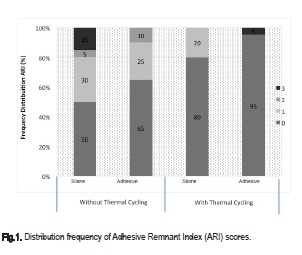
The fractured specimens were observed under optical microscopy (Olympus Corp, Tokyo, Japan) at 40× magnification and the Adhesive Remnant Index (ARI) was used to classify the mode of failure as follows18: score 0: no resin was left on the ceramic; score 1: less than half of the resin was left on the ceramic; score 2: more than half of the resin was left on the ceramic ; and score 3: all resin was left on the ceramic, with a clear impression of the bracket mesh.
Results
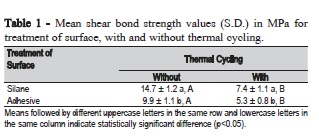
The mean SBS values are shown in Table 1. The interaction between thermal cycling and treatment was significant (p<0.0001). The thermal cycling (p<0.0001) and treatment (p<0.0001) directly influenced the SBS values.
Specimens treated with silane provided significantly higher SBS values than those treated with adhesive alone, with or without thermal cycling (p<0.05). Groups submitted to thermal cycling demonstrated lower SBS values than those without thermal cycling, regardless of the treatment of surface (p<0.05). Figure 1 shows the distribution frequency of ARI. A predominance of score 0 was detected in all groups.
Discussion
Silane is a monomeric species in which silicon is linked to hydrolysable ester groups and reactive organic radicals. The monovalent hydrolysable groups bond chemically to the silicon contained in the glass matrix and lithium disilicate8,1 9. According to Naves et al11, the effectiveness of bonding when using only silane depends on the ability of the resin cement to fill the irregularities and to promoted contact between the resin cement and the ceramic surface.
In the present study, when a silane was used, the SBS values were significantly higher than with adhesive alone, regardless of the thermal cycling. Therefore, the first hypothesis, which stated that the adhesive is not superior to silane in increasing the bond strength was accept. The results of the present study are in agreement with those of a previous study, which also found significant differences when silane was used7,8,20,21. As silane are usually monomeric species, in which silicon is linked to reactive organic radicals and hydrolysable ester groups, the reactive organic groups become chemically bonded to the resin molecules. On the other hand, the hydrolysable groups bond chemically to silicon contained in the glass matrix or lithium disilicate8 and a chemical bond is formed between the silica layer and silane agent on the ceramic surface or the bonding materials.
]]> On the other hand, when the adhesive was applied on the ceramic surface without silane, the SBS decreased significantly compared when silane was applied. According to the manufacturer's instructions, the adhesive could be used without prior application of silane, because the material has silane function. However, in this study it was observed that the adhesive without silane was not able to penetrate completely into the irregularities of the ceramic, probably because in these groups the silane was not used. When, the silane is used the groups monovalent hydrolysable bond chemically to silicon contained in the glass matrix and lithium disilicate3,8. Thus, the results showed that the adhesive was not able to promote the expected union.The clinical success, quality and durability of the bond is determined by the mechanisms of the bond strength among ceramic, bonding materials and orthodontic bracket and may be influenced by some factors such as mechanical properties of composite resin, silane, adhesive, mechanical fatigue and thermal cycling7,9,17. The thermal cycling test has been used to verifiy if changes in temperature can interfere on the reduction on the bond strength among bracket, bonding material and substrate. Probably, the reduction of the mechanical properties of bonding materials is a function of a continuous action of water on the interface among orthodontic bracket, bonding material and substrate. The decrease of bond strength could be caused by hydrolytic degradation of the interface components22 or by the abrupt fall of temperature of the bonding materials with different coefficient of thermal expansion, which can promote thermal stresses at the interface brackets, bonding material and ceramic14.
In relation to the thermal cycling, significant difference was found between thermal cycling and water storage (24 h), regardless of the treatment of ceramic surface. The results indicate that the second hypothesis was rejected. This finding is in agreement with those of previous study showing significant differences in bond strength for specimens subjected to thermal cycling3. However, some studies have found no significant difference for bond strength after thermal cycling5,12,17,23,24. The results of this study suggest that the absence of difference might be explained by the fact that in these studies, the specimens were subjected to a small number of cycles, while in the current study was used a larger number of cycles. According to Gale and Darvell12 (1999) a larger number of cycles are necessary to permit accelerated simulation.
A previous study showed that bond strength values in the range of 6 to 8 MPa are necessary for orthodontic procedures in oral environment25. In this study, brackets bonding to ceramic with strength values lower than 6 MPa were obtained for groups where adhesive was applied without silane after thermal cycling. Therefore, care should be taken when adhesive is used without silane because it has not been acceptable potential to resist clinically bond strengths.
The analysis of failure modes (ARI scores) showed a predominance of failures with score 0 in all groups, with no bonding resin on the ceramic surface. Clinically it may be advantageous because there is less bonding material to remove from the ceramic surface after bracket debonding7,13.
In this context, the present study showed that thermal cycling decreased significantly the bond strength and the use of the silane is decisive factor to obtain improved bond strength of orthodontic brackets to ceramic surfaces. Clinicians should take care during bonding procedures, irrespective of the use of adhesive without silane after thermal cycling. Therefore, the silane should be used after etching ceramic surface with hydrofluoric acid. Thus, additional studies must be performed to investigate other possible factors affecting the clinical performance of bracket bonding to ceramic such as the types of silane and bonding materials.
It may be concluded that the application of silane increased significantly the SBS of brackets to ceramic surface in relation to adhesive alone, with or without thermal cycling. Thermal cycling decreased significantly the SBS in all groups. The ARI results showed predominance of score 0 in all groups.
References
1. Silva NR, Thompson VP, Valverde GB, Coelho PG, Powers JM, Farah JW et al. Comparative reliability analyses of zirconium oxide and lithium disilicate restorations in vitro and in vivo. J Am Dent Assoc. 2011 Apr;142(Suppl. 2):4S-9S. [ Links ]
2. Borges GA, Spohr AM, De Goes MF, Correr-Sobrinho L, Chan DNC. Effect of etching and airborne particle abrasion on the microstructure of different dental ceramics. J Prosthet Dent. 2003 May;89(5):479-88.
3. Sundfeld Neto D, Naves LZ, Costa AR, Correr AB, Consani S, Borges GA et al. The Effect of hydrofluoric acid concentration on the bond strength and morphology of the surface and interface of glass ceramics to a resin cement. Oper Dent. 2015 Sep-Oct;40(5):470-9.
4. Ozcan M, Allahbeickaraghi A, Dündar M. Possible hazardous effects of hydrofluoric acid and recommendations for treatment approach: a review. Clin Oral Investig. 2012 Feb;16(1):15-23.
5. Guarda GB, Correr AB, Gonçalves LS, Costa AR, Borges GA, Sinhoreti MA et al. Effects of surface treatments, thermocycling, and cyclic loading on the bond strength of a resin cement bonded to a lithium disilicate glass ceramic. Oper Dent. 2013 Mar-Apr;38(2):208-17.
6. Sundfeld D, Correr-Sobrinho L, Pini NIP, Costa AR, Sundfeld RH, Pfeifer CS, Martins LRM. Heat treatment-improved bond strength of resin cement to lithium disilicate dental glass-ceramic. Ceramics International 2016;42:10071-10078, http://dx.doi.org/10.1016/j. ceramint.2016.03.112
7. Costa AR, Correr AB, Puppin-Rontani RM, Vedovello SA, Valdrighi HC, Correr-Sobrinho L et al. Effect of bonding material, etching time and silane on the bond strength of metallic orthodontic brackets to ceramic. Braz Dent J. 2012; 23(3): 223-27.
8. Spohr AM, Sobrinho LC, Consani S, Sinhoreti MA, Knowles JC. Influence of surface conditions and silane agent on the bond of resin to IPS Empress 2 ceramic. Int J Prosthodont. 2003 May- Jun;16(3):277-82.
9. Costa AR, Correr AB, Puppin-Rontani RM, Vedovello SA, Valdrighi HC, Correr-Sobrinho L et al. Effects of Thermocycling and Light Source on the Bond Strength of Metallic Brackets to Bovine Teeth. Braz Dent J. 2011;22(6):486-9.
10. Nagai T, Kawamoto Y, Kakehashi Y, Matsumura H. Adhesive bonding of a lithium disilicate ceramic material with resin-based luting agents. J Oral Rehabil. 2005 Aug;32(8):598-605.
]]> 11. Naves LZ, Soares CJ, Moraes RR, Gonçalves LS, Sinhoreti MA, Correr-Sobrinho L. Surface/interface morphology and bond strength to glass ceramic etched for different periods. Oper Dent. 2010 Jul- Aug;35(4):420-7.12. Gale MS, Darvell BW. Thermal cycling procedures for laboratory testing of dental restorations. J Dent. 1999 Feb;27(2):89-99.
13. Abreu Neto HF, Costa AR, Correr AB, Vedovello SA, Valdrighi HC, Santos ECA et al. Influence of light source, thermocycling and silane on the shear bond strength of metallic brackets to ceramic. Braz Dent J. 2015 Nov-Dec;26(6):685-8.
14. Vásquez V, Ozcan M, Nishioka R, Souza R, Mesquita A, Pavanelli C. Mechanical and thermal cycling effects on the flexural strength of glass ceramics fused to titanium. Dent Mater J. 2008 Jan;27(1):7-15.
15. Blatz MB, Sadan A, Martin J, Lang B. In vitro evaluation of shear bond strengths of resin to densely-sintered high-purity zirconium-oxide ceramic after long-term storage and thermal cycling. J Prosthet Dent. 2004 Apr;91(4):356-62.
16. Fisher J, Zbaren C, Stawarczyk B, Hammerle CH. The effect of thermal cycling on metal-ceramic bond strength. J Dent. 2009 Jul; 37(7): 549-53.
17. Yuasa T, Iijima M, Ito S, Muguruma T, Saito T, Mizoguchi I. Effects of long-term storage and thermocycling on bond strength of two selfetching primer adhesive systems. Eur J Orthod. 2010 Jun;32(3):285- 90.
18. Artun J, Bergland S. Clinical trials with crystal growth conditioning as an alternative to acid-etch enamel pretreatment. Am J Orthod. 1984 Apr;85(4):333-40.
19. Chung CH, Cuozzo PT, Mante FK. Shear bond strength of a resinreinforced glass ionomer cement: an in vitro comparative study. Am J Orthod Dentofacial Orthop. 1999 Jan;115(1):52-4.
20. Barceló Santana HF, Hernandez MR, Acosta Torres SL, Sanchez Herrera LM, Fernandez Pedrero AJ, Ortiz Gonzalez R. Evaluation of bond strength of metal brackets by a resin to ceramic surfaces. J Clin Dent. 2006;17(1):5-9.
]]> 21. Eslamian L, Ghassemi A, Amini F, Jafari A, Afrand M. Should silane coupling agents be used when bonding brackets to composite restorations? An in vitro study. Eur J Orthod. 2009 Jun;31(3):266-70.22. De Munck J, Van Landuyt K, Peumans M, Poitevin A, Lambrechts P, Braem M et al. A critical review of the durability of adhesion of tooth tissue: methods and results. J Dent Res. 2005 Feb;84(2):118-32.
23. Yoshida K, Yamashita M, Atsuta M. Zirconate coupling agent for bonding resin luting cement to pure zirconium. Am J Dent. 2004 Aug;17(4):249-52.
24. Bishara SE, Ostby AW, Laffoon JF, Warren J. Shear bond strength comparison of two adhesive systems following thermocycling. Angle Orthod. 2007 Mar;77(2):337-41.
25. Reynolds IR. Composite filling materials as adhesives in orthodontics. Br Dent J. 1975 Feb;138(3):83.
 Corresponding author:
Mario Vedovello Filho
Fundação Hérminio Ometto
FHO/UNIARARAS
Departmento de Ortodontia ]]>
Av. Dr. Maximiliano Baruto, 500 - Jd. Universitário
CEP: 13607-339 Araras, SP, Brasil
E-mail: mario@vedovelloeassociados.com.br
Received for publication: November 15, 2016
Accepted for publication: March 08, 2017