<?xml version="1.0" encoding="ISO-8859-1"?><article xmlns:mml="http://www.w3.org/1998/Math/MathML" xmlns:xlink="http://www.w3.org/1999/xlink" xmlns:xsi="http://www.w3.org/2001/XMLSchema-instance">
<front>
<journal-meta>
<journal-id>1981-8637</journal-id>
<journal-title><![CDATA[RGO.Revista Gaúcha de Odontologia (Online)]]></journal-title>
<abbrev-journal-title><![CDATA[RGO, Rev. gaúch. odontol. (Online)]]></abbrev-journal-title>
<issn>1981-8637</issn>
<publisher>
<publisher-name><![CDATA[Mundi Brasil Gráfica e Editora Ltda.]]></publisher-name>
</publisher>
</journal-meta>
<article-meta>
<article-id>S1981-86372011000300007</article-id>
<title-group>
<article-title xml:lang="en"><![CDATA[Long-term pediatric sugared medicines: knowledge and attitude of medical practitioners at a university hospital]]></article-title>
<article-title xml:lang="pt"><![CDATA[Medicamentos pediátricos de uso prolongado: conhecimento e atitude de médicos de um Hospital Universitário]]></article-title>
</title-group>
<contrib-group>
<contrib contrib-type="author">
<name>
<surname><![CDATA[FARIAS]]></surname>
<given-names><![CDATA[Isabela Albuquerque Passos]]></given-names>
</name>
<xref ref-type="aff" rid="A01"/>
</contrib>
<contrib contrib-type="author">
<name>
<surname><![CDATA[SAMPAIO]]></surname>
<given-names><![CDATA[Fábio Correia]]></given-names>
</name>
<xref ref-type="aff" rid="A01"/>
</contrib>
<contrib contrib-type="author">
<name>
<surname><![CDATA[FREITAS]]></surname>
<given-names><![CDATA[Cláudia Helena Soares de Morais]]></given-names>
</name>
<xref ref-type="aff" rid="A01"/>
</contrib>
</contrib-group>
<aff id="A01">
<institution><![CDATA[,Universidade Federal da Paraíba Departamento de Odontologia Restauradora ]]></institution>
<addr-line><![CDATA[ ]]></addr-line>
</aff>
<pub-date pub-type="pub">
<day>00</day>
<month>12</month>
<year>2011</year>
</pub-date>
<pub-date pub-type="epub">
<day>00</day>
<month>12</month>
<year>2011</year>
</pub-date>
<volume>59</volume>
<numero>4</numero>
<fpage>599</fpage>
<lpage>602</lpage>
<copyright-statement/>
<copyright-year/>
<self-uri xlink:href="http://revodonto.bvsalud.org/scielo.php?script=sci_arttext&amp;pid=S1981-86372011000300007&amp;lng=en&amp;nrm=iso"></self-uri><self-uri xlink:href="http://revodonto.bvsalud.org/scielo.php?script=sci_abstract&amp;pid=S1981-86372011000300007&amp;lng=en&amp;nrm=iso"></self-uri><self-uri xlink:href="http://revodonto.bvsalud.org/scielo.php?script=sci_pdf&amp;pid=S1981-86372011000300007&amp;lng=en&amp;nrm=iso"></self-uri><abstract abstract-type="short" xml:lang="en"><p><![CDATA[Objective The aim of this study was to assess the knowledge and attitude of university hospital pediatricians in respect of the presence of sucrose in medicines used regularly and long-term by children, and to identify the presence of sucrose in frequently prescribed medicines. Methods A questionnaire was applied to all pediatricians at the University Hospital of João Pessoa, Brazil. The medicines were purchased in pharmacies to evaluate the sweeteners listed on the drug labels. The data analysis was carried out by means of descriptive statistics using absolute and percentage values. Results The majority of the professionals (84.2%, n=16) stated they were unaware of the sucrose content in medicines. The instruction for the patients to brush their teeth after using a sweet medicine was reported by one professional only. There was a great variety (20 types) of medicines recommended by medical practitioners. The analysis of 103 medicines revealed that 67 (65.0%) had sucrose in their formula. Conclusion Sucrose is a frequent sweetener in pediatric medicines. In addition, the health professionals interviewed demonstrated insufficient knowledge and attitude in respect of the presence of sucrose in pediatric medicines and the risk of the development of caries. Medical professionals and students should be made aware of the risks when prescribing pediatric sugared medicines for children.]]></p></abstract>
<abstract abstract-type="short" xml:lang="pt"><p><![CDATA[Objetivo Avaliar o conhecimento e a atitude de médicos que atendem crianças sobre a presença de sacarose em medicamentos pediátricos de uso crônico, e identificar a presença de adoçantes nesses medicamentos. Métodos Um questionário foi aplicado a todos os pediatras do Hospital Universitário de João Pessoa, Brasil. Os medicamentos foram adquiridos nas farmácias para avaliação do adoçante relatado na bula dos medicamentos. Foi realizada análise descritiva dos dados por média, distribuição absoluta e percentual. Resultados A maioria dos profissionais (84,2%, n=16) relatou não ter conhecimento sobre a presença de açúcar nos medicamentos. A orientação dos pacientes à escovação dentária, após a administração das doses, foi relatada por apenas um paciente. Os medicamentos indicados por estes apresentaram uma grande variedade (20 tipos), resultando em 103 apresentações das quais 67 (65%) apresentavam sacarose. Conclusão A sacarose é um adoçante frequente nos medicamentos pediátricos; os médicos apresentaram uma atitude de indiferença sobre a presença de sacarose nos medicamentos pediátricos de uso crônico devido o pouco conhecimento sobre o tema. Profissionais e estudantes da área médica devem ser alertados sobre os riscos para cárie dentária diante da prescrição de medicamentos açucarados para crianças.]]></p></abstract>
<kwd-group>
<kwd lng="en"><![CDATA[Oral administration.]]></kwd>
<kwd lng="en"><![CDATA[Dental caries.]]></kwd>
<kwd lng="en"><![CDATA[Child.]]></kwd>
<kwd lng="en"><![CDATA[Sucrose.]]></kwd>
<kwd lng="pt"><![CDATA[Administração oral.]]></kwd>
<kwd lng="pt"><![CDATA[Cárie dentária.]]></kwd>
<kwd lng="pt"><![CDATA[Criança.]]></kwd>
<kwd lng="pt"><![CDATA[Sacarose.]]></kwd>
</kwd-group>
</article-meta>
</front><body><![CDATA[ <p align="right"><font size="2" face="Verdana, Arial, Helvetica, sans-serif"><b>ARTIGO ORIGINAL / ORIGINAL ARTICLE</b></font></p>     <p>&nbsp;</p>     <p><font size="4" face="Verdana, Arial, Helvetica, sans-serif"><a name="top"/></a><B>Long-term pediatric sugared medicines: knowledge and attitude of medical practitioners at a university hospital</B></font></p>     <p>&nbsp;</p>     <p><font size="3" face="Verdana, Arial, Helvetica, sans-serif"><B>Medicamentos pedi&aacute;tricos de uso prolongado: conhecimento e atitude de m&eacute;dicos de um Hospital Universit&aacute;rio</B> </font></p>     <p>&nbsp;</p>     <p>&nbsp;</p>     <p><font size="2" face="Verdana, Arial, Helvetica, sans-serif"><b>Isabela Albuquerque Passos FARIAS<sup>I</sup>; F&aacute;bio Correia SAMPAIO<sup>II</sup> ;Cl&aacute;udia Helena Soares de Morais FREITAS<sup>II</sup></b></font></p>     <p><font size="2" face="Verdana, Arial, Helvetica, sans-serif"><sup>I</sup>Universidade Federal da Para&iacute;ba, Departamento de Odontologia Restauradora.    <br><sup>II</sup>Universidade Federal da Para&iacute;ba, Departamento de Odontologia Cl&iacute;nica e Social</font>     ]]></body>
<body><![CDATA[<p><font size="2" face="Verdana, Arial, Helvetica, sans-serif"><a href="#back">Endere&ccedil;o para correspond&ecirc;ncia</a></font>     <p>&nbsp;</p>     <p>&nbsp;</p> <hr size="1" noshade>     <p>&nbsp;</p>     <p><font size="2" face="Verdana, Arial, Helvetica, sans-serif"><b>ABSTRACT</b> </font></p>     <p><font size="2" face="Verdana, Arial, Helvetica, sans-serif"><b>Objective</b>     <br> The aim of this study was to assess the knowledge and attitude of university hospital pediatricians in respect of the presence of sucrose in medicines used regularly and long-term by children, and to identify the presence of sucrose in frequently prescribed medicines.</font></p>     <p><font size="2" face="Verdana, Arial, Helvetica, sans-serif"> <b>Methods</b>     <br> A questionnaire was applied to all pediatricians at the University Hospital of Jo&atilde;o Pessoa, Brazil. The medicines were purchased in pharmacies to evaluate the sweeteners listed on the drug labels. The data analysis was carried out by means of descriptive statistics using absolute and percentage values.</font></p>     <p><font size="2" face="Verdana, Arial, Helvetica, sans-serif"><b>Results</b>    ]]></body>
<body><![CDATA[<br> The majority of the professionals (84.2%, n=16) stated they were unaware of the sucrose content in medicines. The instruction for the patients to brush their teeth after using a sweet medicine was reported by one professional only. There was a great variety (20 types) of medicines recommended by medical practitioners. The analysis of 103 medicines revealed that 67 (65.0%) had sucrose in their formula. </font></p>     <p><font size="2" face="Verdana, Arial, Helvetica, sans-serif"><b>Conclusion</b>    <br> Sucrose is a frequent sweetener in pediatric medicines. In addition, the health professionals interviewed demonstrated insufficient knowledge and attitude in respect of the presence of sucrose in pediatric medicines and the risk of the development of caries. Medical professionals and students should be made aware of the risks when prescribing pediatric sugared medicines for children.</font></p>     <p><font size="2" face="Verdana, Arial, Helvetica, sans-serif"><B>Indexing terms: </B>Oral administration. Dental caries. Child. Sucrose.</font></p> <hr size="1" noshade>     <p>&nbsp;</p>     <p><font size="2" face="Verdana, Arial, Helvetica, sans-serif"><B>RESUMO</B> </font></p>     <p><font size="2" face="Verdana, Arial, Helvetica, sans-serif"><b>Objetivo </b>    <br> Avaliar o conhecimento e a atitude de m&eacute;dicos que atendem crian&ccedil;as sobre a presen&ccedil;a de sacarose em medicamentos pedi&aacute;tricos de uso cr&ocirc;nico, e identificar a presen&ccedil;a de ado&ccedil;antes nesses medicamentos. </font></p>     <p><font size="2" face="Verdana, Arial, Helvetica, sans-serif"><b>M&eacute;todos</b>    <br> Um question&aacute;rio foi aplicado a todos os pediatras do Hospital Universit&aacute;rio de Jo&atilde;o Pessoa, Brasil. Os medicamentos foram adquiridos nas farm&aacute;cias para avalia&ccedil;&atilde;o do ado&ccedil;ante relatado na bula dos medicamentos. Foi realizada an&aacute;lise descritiva dos dados por m&eacute;dia, distribui&ccedil;&atilde;o absoluta e percentual.</font></p>     ]]></body>
<body><![CDATA[<p><font size="2" face="Verdana, Arial, Helvetica, sans-serif"><b>Resultados </b>    <br> A maioria dos profissionais (84,2%, n=16) relatou n&atilde;o ter conhecimento sobre a presen&ccedil;a de a&ccedil;&uacute;car nos medicamentos. A orienta&ccedil;&atilde;o dos pacientes &agrave; escova&ccedil;&atilde;o dent&aacute;ria, ap&oacute;s a administra&ccedil;&atilde;o das doses, foi relatada por apenas um paciente. Os medicamentos indicados por estes apresentaram uma grande variedade (20 tipos), resultando em 103 apresenta&ccedil;&otilde;es das quais 67 (65%) apresentavam sacarose. </font></p>     <p><font size="2" face="Verdana, Arial, Helvetica, sans-serif"><b>Conclus&atilde;o </b>    <br> A sacarose &eacute; um ado&ccedil;ante frequente nos medicamentos pedi&aacute;tricos; os m&eacute;dicos apresentaram uma atitude de indiferen&ccedil;a sobre a presen&ccedil;a de sacarose nos medicamentos pedi&aacute;tricos de uso cr&ocirc;nico devido o pouco conhecimento sobre o tema. Profissionais e estudantes da &aacute;rea m&eacute;dica devem ser alertados sobre os riscos para c&aacute;rie dent&aacute;ria diante da prescri&ccedil;&atilde;o de medicamentos a&ccedil;ucarados para crian&ccedil;as.</font></p>     <p><font size="2" face="Verdana, Arial, Helvetica, sans-serif"><B>Termos de indexa&ccedil;&atilde;o: </B>Administra&ccedil;&atilde;o oral. C&aacute;rie dent&aacute;ria. Crian&ccedil;a. Sacarose.</font> </p> <hr noshade size="1">     <p>&nbsp;</p>     <p>&nbsp;</p>     <p><font size="3" face="Verdana, Arial, Helvetica, sans-serif"><B> INTRODUCTION</B></font></p>     <p><font size="2" face="Verdana, Arial, Helvetica, sans-serif">Dental caries is still a public health problem in spite of the decline in the prevalence of caries observed in recent decades and the greater access to fluorides<sup>1</sup>. Dental caries is influenced by factors such as the habit of sucrose ingestion between meals, unfavorable maternal social inclusion<sup>2-3</sup> and the use of medicines, and may affect a substantial proportion of the pediatric population in many countries<sup>4</sup>.</font></p>     <p><font size="2" face="Verdana, Arial, Helvetica, sans-serif"> Liquid preparations are usually sweetened with sucrose, which can be readily fermented by oral acidogenic bacteria. Therefore, the frequency of use and the sugar content in pediatric oral medicines can determine their cariogenic potential. The medicines that have sucrose as a sweetening agent possess high viscosity. As a result these medicines have slow salivary clearance and high cariogenic potential<sup>5</sup>. </font></p>     ]]></body>
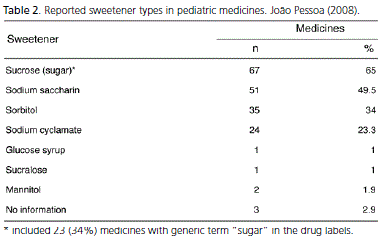
<body><![CDATA[<p><font size="2" face="Verdana, Arial, Helvetica, sans-serif">Pediatricians have the opportunity to followup directly on the general oral health status of children because of early and frequent contact during well-child and chronic condition visits. The early intervention of dental caries and other oral health problems, for children at risk, is important for the outcome of dental treatment. The medical professionals working at university hospitals have an added challenge in the education and practices of future health professionals. Therefore, these professionals play a key role in children's general health. </font></p>     <p><font size="2" face="Verdana, Arial, Helvetica, sans-serif">The aims of this study were: a) to assess the knowledge and attitude of university hospital pediatricians regarding the presence of sucrose in medicines used regularly and long-term by children, and b) to identify the presence of sucrose in frequently prescribed medicines.</font></p>     <p>&nbsp;</p>     <p><font size="3" face="Verdana, Arial, Helvetica, sans-serif"><B>METHODS</B> </font></p>     <p><font size="2" face="Verdana, Arial, Helvetica, sans-serif">The study was carried out in Jo&atilde;o Pessoa, in the Brazilian state of Para&iacute;ba, and was divided into two phases: Phase 1) all pediatricians at the Lauro Wanderley University Hospital, Brazil (n=19) were invited to answer a questionnaire about the most frequently prescribed long-term, pediatric, liquid oral medicines and general information about professional experience. The questions were related to the prescription of medicines available in</font><font size="2" face="Verdana, Arial, Helvetica, sans-serif"> </font><font size="2" face="Verdana, Arial, Helvetica, sans-serif">the Brazilian market, their knowledge of the presence of sucrose in medicine and instructions for children to brush their teeth after using oral medicines. Phase 2) all medicines indicated in phase 1 were purchased in local pharmacies to check the labels to ascertain if sucrose was the sweetener in their formula.</font></p>     <p><font size="2" face="Verdana, Arial, Helvetica, sans-serif"> Medicines that are active in the central nervous system were excluded from the sample since these are restricted products with a system of controlled purchase.</font></p>     <p><font size="2" face="Verdana, Arial, Helvetica, sans-serif"> The data analysis was conducted by means of descriptive statistics using absolute and percentage values. The research was approved by the local ethical committee at the Lauro Wanderley University Hospital/ UFPB/ Brazil (protocol no. 64/06).</font></p>     <p>&nbsp;</p>      <p><font size="3" face="Verdana, Arial, Helvetica, sans-serif"><b>RESULTS</b> </font></p>     <p><font size="2" face="Verdana, Arial, Helvetica, sans-serif">The mean&plusmn;SD professional experience after graduation was 24.8&plusmn;6.8 years. Out of 19 professionals, 16 (84.2%) were resident physicians, followed by those with Master&acute;s degrees (n=2) and one PhD. </font></p>     ]]></body>
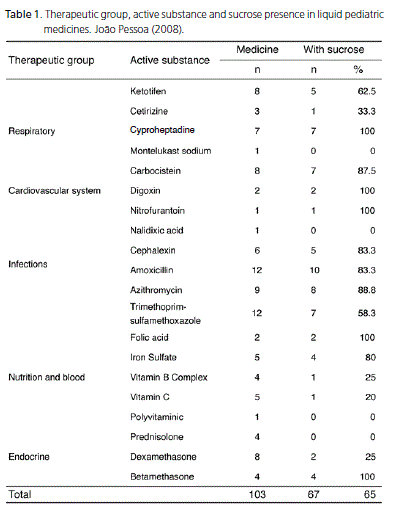
<body><![CDATA[<p><font size="2" face="Verdana, Arial, Helvetica, sans-serif">The medicines prescribed by the pediatricians varied greatly (20 types, according to the active substance). The 103 presentations between generic and commercial medicines are distributed across 6 groups, according to their indication (<a href="#tab01">Table 1</a>).</font></p>     <p><font size="2" face="Verdana, Arial, Helvetica, sans-serif"> In respect of the presence of sucrose in pediatric medicines, 84.21% (n=16) of the medical practitioners replied that they were unaware of this aspect, whereas one was aware of its existence. The instruction to brush the teeth after using medicines was reported by one medical practitioner and the reported reason for that recommendation was solely to reduce the unpleasant taste of the medicines. The frequency of administration was from one to four times daily, following the instructions on the drug labels. </font></p>     <p><font size="2" face="Verdana, Arial, Helvetica, sans-serif">Among the 20 types of pediatric medicines, sucrose was present in the composition of 16 (80%); out of a total of 103 presentations, 67 (65%) contained sucrose (<a href="#tab02">Table 2</a>). Of these, only 2 displayed the sucrose concentration on their labels: 1.94 g/100ml in a suspension of Azithromycin and 300 mg/ml in a solution of Cephalexin. </font></p>     <p><font size="2" face="Verdana, Arial, Helvetica, sans-serif">After sucrose, saccharin was the most common sweetening agent present in the medicines (49.5%), followed by sorbitol (34%) (<a href="#tab02">Table 2</a>).</font> </p>     <p>&nbsp;</p>     <p><a name="tab01"></a></p>     <p>&nbsp; </p>     <p align="center"><img src="/img/revistas/rgo/v59n4/a07tab01.jpg">     <p>&nbsp;</p>     <p><a name="tab02"></a></p>     ]]></body>
<body><![CDATA[<p>&nbsp; </p>     <p align="center"><img src="/img/revistas/rgo/v59n4/a07tab02.jpg">     <p>&nbsp;</p>    <p><font size="3" face="Verdana, Arial, Helvetica, sans-serif"><b>DISCUSSION</b> </font></p>     <p><font size="2" face="Verdana, Arial, Helvetica, sans-serif">Sucrose is a trigger for dental caries6. Nevertheless, few studies have explored the knowledge and attitude of medical professionals towards long-term pediatric medicines with sucrose and the risk of caries in children, particularly in those children using medicines on a daily basis<sup>6-9</sup>. For patients with chronic diseases, the risk of dental caries increases due to the need for frequent and prolonged consumption of medicines. This issue is worthy of investigation since it has already been observed that most pediatric chronic use formulations available in the Brazilian pharmaceuticals market, have this disaccharide as a sweetening agent<sup>10</sup>. </font></p>     <p><font size="2" face="Verdana, Arial, Helvetica, sans-serif">In our study, only one professional was aware of the presence of sucrose in the composition of some pediatric medicines. Indeed, this observation was not even linked to concern for oral hygiene. These health professionals have a golden opportunity to inform and guide the children's parents about the risk of dental caries when sugar medicines are used regularly. Recently, it was estimated that 84.9% of parents do not have professional (medical or dental) guidance for appropriate oral hygiene after the consumption of pediatric medicines8. This seems to be a trend in other parts of Brazil since our data showed that oral hygiene after medication was recommended by only one professional and this was not related to concerns for oral health. </font></p>     <p><font size="2" face="Verdana, Arial, Helvetica, sans-serif">Many pediatric liquid medicines have sweeteners in their composition in order to mask the unpleasant taste of some active ingredients<sup>5</sup>. Medicines with alternative sweetening agents may be an interesting choice for prolonged treatment6. However, Andreatta et al.<sup>11</sup> observed that regular use of artificial sweeteners for 10 years or more, was positively correlated with carcinogenic potential. The search for generic medicines can be fraught due to the fact that prescriptions of medicines without sucrose are most often substituted at pharmacies for less expensive, commercial brands containing sucrose. Amongst all of the sweetening agents, sucrose is the most frequently reported (65%) on drug labels<sup>12</sup>. These values could be even higher. Peres et al.<sup>10</sup>observed that only 50% of medicines containing sugar publicized this information on drug labels. </font></p>     <p><font size="2" face="Verdana, Arial, Helvetica, sans-serif">In addition to sucrose, saccharin and sorbitol are also frequently used<sup>12</sup>. Sorbitol is hypo-acidogenic, and when combined with xylitol (xylitol-sorbite), it presents a non-acidogenic behavior<sup>13</sup>. However, we found that the sucrose concentration was omitted from most of the drug labels in medicines that were sweetened with it. Two factors may be noted about this procedure: the industrial strategy for not exhibiting details of the formula<sup>5</sup> and the lack of demand for this information, since the publication of inactive ingredients in formulas is not compulsory by law<sup>14</sup>. </font></p>     <p><font size="2" face="Verdana, Arial, Helvetica, sans-serif">Our study supports the hypothesis that medical practitioners are unaware of the presence of sucrose in pediatric chronic use medicines. This lack of information may be related to a general lack of interest in addressing</font><font size="2" face="Verdana, Arial, Helvetica, sans-serif"> </font><font size="2" face="Verdana, Arial, Helvetica, sans-serif">this interdisciplinary issue during training programs in medical schools. It is also important to point out that other complications related to frequent sugar consumption (e.g. diabetes, obesity) are already discussed in the medical field. Therefore, its inclusion, in respect of dental caries and other oral health problems (e.g. dental erosion, periodontitis), on the general health agenda can be easily addressed. According to Chung et al.<sup>8</sup>, there is a need to include some aspects of oral health risk assessment, early detection and referral services in the medical education program. The outcome could be positive for dentists and medical professionals that work in both the public and private sectors in Brazil<sup>15</sup>.</font></p>     <p>&nbsp;</p> <font size="3" face="Verdana, Arial, Helvetica, sans-serif"><b>CONCLUSION</b> </font></p>      ]]></body>
<body><![CDATA[<p><font size="2" face="Verdana, Arial, Helvetica, sans-serif">It may be concluded that, even though sucrose is a sweetener frequently used in pediatric medicines, the health professionals interviewed showed insufficient knowledge and attitude with regard to the presence of sucrose in pediatric medicines and the risk of the development of caries. Medical professionals and students should be aware of the risks when prescribing pediatric sugared medicines for children. Acknowledgements </font></p>     <p><font size="2" face="Verdana, Arial, Helvetica, sans-serif">This study was backed by the Brazilian agency CAPES (Coordena&ccedil;&atilde;o de Aperfei&ccedil;oamento de Pessoal de N&iacute;vel Superior).</font></p>     <p>&nbsp;</p>  <font size="3" face="Verdana, Arial, Helvetica, sans-serif"><b>Collaborators</b> </font></p>      <p><font size="2" face="Verdana, Arial, Helvetica, sans-serif">IAP Farias was responsible for conceiving the work, collecting data, reviewing the literature, analyzing the data and writing the manuscript. CHSM FREITAS and FC SAMPAIO participated in the conception of the work, data interpretation, discussion, conclusions and performed a final review of the manuscript.</font></p>     <p>&nbsp;</p>  <font size="3" face="Verdana, Arial, Helvetica, sans-serif"><b>REFERENCES</b> </font></p>      <!-- ref --><p><font size="2" face="Verdana, Arial, Helvetica, sans-serif">1. Weeks JC, Dutt A, Peter GR. Promoting sugar-free medicines: evaluation of a multi-faceted intervention. Community Dent Health. 2003;20(4):246-50.    &nbsp;&nbsp;&nbsp;&nbsp;&nbsp;&nbsp;&nbsp;&nbsp;[&#160;<a href="javascript:void(0);" onclick="javascript: window.open('/scielo.php?script=sci_nlinks&ref=223429&pid=S1981-8637201100030000700001&lng=','','width=640,height=500,resizable=yes,scrollbars=1,menubar=yes,');">Links</a>&#160;]<!-- end-ref --> </font></p>     <p><font size="2" face="Verdana, Arial, Helvetica, sans-serif">2. Fadel CB, Saliba NM. Aspectos s&oacute;cio-dentais e de representa&ccedil;&atilde;o social da c&aacute;rie dent&aacute;ria no contexto materno-infantil. RGO - Rev Ga&uacute;cha Odontol. 2009;57(3):303-9.</font></p>     <p><font size="2" face="Verdana, Arial, Helvetica, sans-serif">3. Kelly A, Soares LF, Pomarico L, Souza IPR. Risco e atividade de c&aacute;rie em crian&ccedil;as com e sem infec&ccedil;&atilde;o pelo HIV. RGO - Rev Ga&uacute;cha Odontol. 2009; 57(2):217-22.</font></p>     <p><font size="2" face="Verdana, Arial, Helvetica, sans-serif"> 4. Bigeard L. The role of medication and sugars in pediatric dental patients. Pediatr Dent. 2000;44(3):443-56.</font></p>     ]]></body>
<body><![CDATA[<p><font size="2" face="Verdana, Arial, Helvetica, sans-serif"> 5. Durward C, Thou T. Dental caries and sugar-containing liquid medicines for children in New Zealand. N Z Dental J. 1997;93(414):124-9. </font></p>     <p><font size="2" face="Verdana, Arial, Helvetica, sans-serif">6. Bradley M, kinirons M. A survey of factors influencing the prescribing of sugar-free medicines for children by a group of general medical practitioners in Northern Ireland. Int J Paediatr Dent. 1996;6(4):261-4. </font></p>     <p><font size="2" face="Verdana, Arial, Helvetica, sans-serif">7. Bradley M, Kinirons M. Choice of sugar-free medicines by a sample of dentists, doctors and pharmacists in Northern Ireland: the views of parents and health professionals. Community Dent Health. 1998;15(2):105-</font></p>     <p><font size="2" face="Verdana, Arial, Helvetica, sans-serif">8. 8. Chung MH, Kaste LM, Koerber A, Fadavi S, Punwani I. Dental and medical students' knowledge and opinions of infant oral health. J Dent Educ. 2006;70(5):511-7.</font></p>     <p><font size="2" face="Verdana, Arial, Helvetica, sans-serif"> 9. Neves BG, Pierro VSS, Maia LC. Perception and attitudes among parents and guardians on the use of pediatric medicines and their cariogenic and erosive potential. Cienc Saude Coletiva. 2007;12(5):1295-300.</font></p>     <p><font size="2" face="Verdana, Arial, Helvetica, sans-serif"> 10. Peres KG, Oliveira CT, Peres MA, Raymundo MS, Fett R. Sugar content in liquid oral medicines for children. Rev Saude Publica. 2005;39(3):486-9.</font></p>     <p><font size="2" face="Verdana, Arial, Helvetica, sans-serif"> 11. Andreatta MM, Mu&ntilde;oz SE, Lantieri MJ, Eynard AR, Navarro A. Artificial sweetener consumption and urinary tract tumors in Cordoba, Argentina. Prev Med. 2008;47(1):136-9. </font></p>     <p><font size="2" face="Verdana, Arial, Helvetica, sans-serif">12. Balbani APS, Stelzer LB, Montovani JC. Pharmaceutical excipients and the information on drug labels. Rev Bras Otorrinolaringol. 2006;72(3):400-6.</font></p>     <p><font size="2" face="Verdana, Arial, Helvetica, sans-serif"> 13. Rekola M. In vivo acid production from medicines in syrup form. Caries Res. 1989;23(3):412-6. </font></p>     <p><font size="2" face="Verdana, Arial, Helvetica, sans-serif">14. Brasil. Minist&eacute;rio da Sa&uacute;de. Ag&ecirc;ncia de Vigil&acirc;ncia Sanit&aacute;ria. Resolu&ccedil;&atilde;o RDC n&ordm; 140 de 29 de Maio de 2003 &#91;citado 2009 Jan 5&#93;. Available at: &lt;http//e-legis.bvs.br/leisref/public/showAct. php?id=6311&gt;.</font></p>     ]]></body>
<body><![CDATA[<p><font size="2" face="Verdana, Arial, Helvetica, sans-serif"> 15. Aerts D, Abegg C, Cesa K. The role of dentists in the Unified Health System (SUS). Cienc Saude Coletiva. 2004;9(1):131-8.</font></p>     <p>&nbsp;</p>     <p>&nbsp;</p>     <p><font size="2" face="Verdana, Arial, Helvetica, sans-serif"><a name="back"/></a><a href="#top"><img src="/img/revistas/rfo/v18n1/seta.jpg" border="0" align="absmiddle"/></a><b>Endere&ccedil;o para correspond&ecirc;ncia:</b>    <br>   </font><font size="2" face="Verdana, Arial, Helvetica, sans-serif">IAP FARIAS    <br>   Universidade Federal da Para&iacute;ba,     <br>Departamento de Odontologia Restauradora.     <br>Campus I, Castelo Branco, 58051-900,     <br>   Jo&atilde;o Pessoa, PB, Brasil. </font><font size="2" face="Verdana, Arial, Helvetica, sans-serif">    <br>   e-mail: </font><font size="2" face="Verdana, Arial, Helvetica, sans-serif"><a href="mailto:isabelaapassos@yahoo.com.br" target="_blank">isabelaapassos@yahoo.com.br</a></font></p>     ]]></body>
<body><![CDATA[<p><font face="Verdana, Arial, Helvetica, sans-serif" size="2"><b>Recebido: 25/7/2010    <br> Aceito: 23/2/2011</b></font></p>       <p>&nbsp;</p>      ]]></body>
<back>
<ref-list>
<ref id="B1">
<label>1</label><nlm-citation citation-type="journal">
<person-group person-group-type="author">
<name>
<surname><![CDATA[Weeks]]></surname>
<given-names><![CDATA[JC]]></given-names>
</name>
<name>
<surname><![CDATA[Dutt]]></surname>
<given-names><![CDATA[A]]></given-names>
</name>
<name>
<surname><![CDATA[Peter]]></surname>
<given-names><![CDATA[GR.]]></given-names>
</name>
</person-group>
<article-title xml:lang="en"><![CDATA[Promoting sugar-free medicines: evaluation of a multi-faceted intervention.]]></article-title>
<source><![CDATA[Community Dent Health.]]></source>
<year>2003</year>
<volume>20</volume>
<numero>4</numero>
<issue>4</issue>
<page-range>246-50</page-range></nlm-citation>
</ref>
</ref-list>
</back>
</article>