Adolescents' knowledge regarding oral health using validated instrument by Item Response Theory
Conhecimento de adolescentes sobre saúde bucal utilizando instrumento validado pela Teoria de Resposta ao Item
Kléryson Martins Soares FRANCISCO I; Maria Lúcia Marçal Mazza SUNDEFELD I; Suzely Adas Saliba MOIMAZ I
I Universidade Estadual Paulista Júlio de Mesquita Filho, Faculdade de Odontologia, Programa de Pós-Graduação em Odontologia Preventiva e Social. Rua José Bonifácio, 1193, 16015-050, Araçatuba, SP, Brasil
]]>
ABSTRACT
Objective
The aim of this study was to evaluate the level of 6th grade of elementary schoolchildren's knowledge at an elementary school in the municipality of Araçatuba, São Paulo, Brazil, using a validated instrument for Item Response Theory.
Methods
A questionnaire was developed based on a literature search of articles in computerized databases such as Pubmed, Bireme and SciELO. We selected questions that had a greater range of adjustments and by applying the Technical Focus Group, these questions were reformulated using language appropriate for the study population. Subsequently the questionnaire was subjected to application of Item Response Theory that was standardized with 19 items. For data processing for correction of the questionnaire, we used the software for analysis and EPI2000 of TRI, BILOG software. A total of 979 questionnaires were applied to adolescents aged 12-14 years who attended the 22 state schools in the city.
Results
The percentage of questionnaires completed was 84.4%. All questionnaire items were discriminatory, yet most needed below average skill of knowledge to be answered correctly. Sixteen percent of correct items received over 75%. Only items 2, 3 and 15 obtained indices close to 50%. Sixteen items had hit percentage above 75%. Only items 2, 3 and 15 had percentages close to 50%.
Conclusion ]]> From the results of this study, we could conclude that the students have a good level of oral health knowledge, however further research is required to spread the use of Item Response Theory in analysis of assessment tools, especially in dentistry.
Indexing terms: Adolescent. Knowledge. Oral health.
RESUMO
Objetivo
Avaliar o nível de conhecimento dos escolares da 6ª série do ensino fundamental do município de Araçatuba, São Paulo, por meio de um instrumento validado pela Teoria de Resposta ao Item.
Métodos
Foi elaborado um questionário baseado em uma pesquisa bibliográfica de artigos em bancos de dados informatizados como Pubmed, Bireme e SciELO. Foram selecionadas as perguntas que possuíam uma maior variação de acertos e por meio da aplicação da Técnica do Grupo Focal, foram reformuladas com uma linguagem adequada à população de estudo. Posteriormente o questionário foi submetido a aplicação da Teoria de Resposta ao Item em que foi padronizado com 19 itens. Para o processamento dos dados para correção do questionário, utilizou-se o software EPI2000 e para as análises da Teoria de Resposta ao Item, o software BILOG. Foram aplicados 979 questionários em adolescentes com idade entre 12 a 14 anos que frequentavam as 22 escolas da rede estadual de ensino do município.
Resultados
A porcentagem de questionários respondidos foi de 84,4%. Todos os itens do questionário foram discriminatórios, no entanto a maioria necessitava de habilidade abaixo da média do conhecimento para serem respondidos corretamente. Dezesseis itens obtiveram porcentagem de acerto acima de 75%. Somente os itens 2, 3 e 15 obtiveram índices próximos de 50%.
Conclusão ]]> Frente aos resultados deste trabalho, pôde-se concluir que os escolares possuem um bom nível de conhecimento sobre saúde bucal. No entanto, pesquisas adicionais são necessárias para disseminar o uso da Teoria de Resposta ao Item em análises de instrumentos de avaliação, especialmente na Odontologia.
Termos de indexação: Adolescente. Conhecimento. Saúde bucal.
INTRODUCTION
During adolescence the search for a good individual's appearance intensifies, which may be influenced by both the family and society. Attitudes, values and behaviors toward health are established at this stage of life. However, adolescence is considered stormy and stressful experience, during which there is a risk of increase in oral diseases because of the physical and emotional changes that are part of this transitional stage, and this may be reflected in the maintenance of oral hygiene, so that it becomes a complex practice for these individuals1-2.
When treating adolescents, the dentist, acting as an educator, must be able not only to perceive dental problems, but encourage them to adopt healthy habits to maintain not only oral health, but overall health. Thus, health promotion actions intended for adolescents are a challenge for the professional and it requires greater skills in terms of personal development than scientific training3-4.
Given the complexity of motivating adolescents, changes in the awareness and ability of professionals are needed, so that they can learn more about how to deliver community oral health and make their teaching more attractive to this audience5-6.
It is imperative to assess the knowledge of oral health of the target population when planning Health Education programs. Information on oral habits of adolescents can help improve not only the knowledge about oral health behaviors during this critical period, but also with developing more effective health education strategies for this group1.
To assess this type of knowledge, the use of appropriate research instruments to investigate the questions is recommended. Preparing a good questionnaire on oral health depends on technical knowledge and experience of the researcher. In the case of the school population, which is numerous and geographically dispersed, the use of a questionnaire becomes feasible. However, undoubtedly, it is essential to follow a method of preparation, since it identifies the basic steps involved in developing an effective instrument7-8.
]]> The Item Response Theory (IRT) is an alternative to develop tools to assess knowledge. The Item Response Theory, called modern psychometric theory, has been gaining attention in health studies, since several studies emphasize its importance as a tool to solve problems that occur when using classical methods of analysis9-10.In Brazil, the Item Response Theory has been used mainly to develop proficiency rates for students who respond to educational assessment tests on a large scale. However, different models can provide indicators with varied purposes in the areas of social sciences, humanities and health sciences11.
Thus, taking into consideration the abovementioned aspects, the aim of this study was to evaluate the level of knowledge of oral health of 6th graders from public schools in the municipality of Araçatuba through a standardized questionnaire using the Item Response Theory.
METHODS
A questionnaire was developed from a literature search using computerized databases such as Pubmed, Bireme and Scielo, selecting studies that had used questionnaires that addressed oral health knowledge. From this, questions that had greater range of correct answers were selected and by means of the Technical Focus Group the language used was rephrased to make it more appropriate for the study population. The Item Response Theory was then applied to the questionnaire until it was standardized.
The study population consisted of 6th grade adolescents in the age-range between 12 and 14 years attending public schools in Araçatuba in the state of São Paulo. The research was conducted using the sampling method and information provided by the Regional Office of Education in Araçatuba in 2008, which stated that 22 state schools offered 6th grade education in the city, totaling 1,981 students.
A pilot study (32 initial items) was conducted with 150 schoolchildren from Araçatuba and 150 from Alfenas, state of Minas Gerais, and found that there was no difference in the results in the two cities. The data were processed for questionnaire correction using the EPI2000 software and the Item Response Theory was analyzed using the BILOG software. After the analysis of the Item Response Theory, 6 items of the pilot questionnaire were excluded.
To select the sample, the following criteria were adopted: the minimum acceptable difference of 0.10 on the percentage of correct answers with the lowest percentage of correct answers in the pilot study corresponding to 32%. A minimum sample size of 816 adolescents was determined. Considering possible drop-outs, 20% was added to the minimum and a random systematic sampling resulted in 979 students in all schools Araçatuba (SP).
Due to the small number of schools, all schools were selected. Each school was considered an extract and the method adopted was the Proportional Allocation to Size Extract, i.e, schools that had a larger number of students received a greater number of questionnaires to be answered.
]]> The questionnaire with 26 items was answered during classes in the classroom. Before the questionnaire was applied, the objective of the research was explained to the students and doubts related to interpretation were made clear. Students that were not randomly selected to answer the questionnaire remained in the classroom.Using the EPI2000 software and the list provided by the Regional Office of Education of Araçatuba, the probabilistic characteristic of the research was maintained. This method facilitated the implementation stage of the questionnaires because the researcher did not need to use random drawing in each class when applying the questionnaire. Thus, 827 questionnaires were answered.
The data processing for questionnaire correction was performed by the EPI2000 software and the Item Response Theory was analyzed using the BILOG software.
The standardization of the questionnaire was conducted through the Item Response Theory, which identified the items that did not have discriminatory ability of respondents on the subject, excluding 7 items. Therefore, the final questionnaire consisted of 19 items.
The research was approved by the Ethics Research Committee of the School of Dentistry of Araçatuba of the Paulista State University "Júlio de Mesquita Filho" under protocol No 2008/01602 and the authorization to apply the questionnaire was provided by the Regional Office of Education of Araçatuba.
RESULTS
The percentage of answers was 84.47% of the 979 adolescents drawn, 827 adolescents answered the questionnaire 404 (48.9%) being boys and 423 (51.1%) girls. The sample was proportionally equal with regard to gender and the answers did not differ statistically.
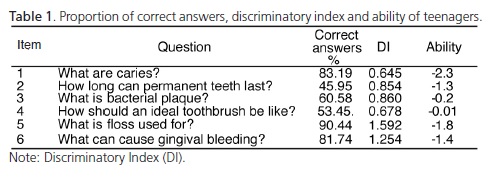
In the first item (What are caries?) 83.19% of the students correctly answered that it is a disease caused by lack of oral hygiene. According to the Item Response Theory analysis, this item had a satisfactory discriminatory index (ID) close to 0.7 (0.645), requiring 2.3 times less abilities than the average (Table 1).
With regard to item 2: "How long can permanent teeth last?", 54.1% of students answered correctly that retention of permanent teeth was connected to a specific duration of time, 45.95% said that the permanent teeth could last a lifetime, and 0,6% did not answer. This item/ The question was considered by the Item Response Theory analysis, which was able to discriminate between the different level of knowledge of the students with DI equal to 0.854 and 1.3 less ability than the average (Table 1).
]]> Item 3 asked the question "What is bacterial plaque?". The results showed that 60.58% of adolescents correctly answered that plaque and a yellowish mass/ biofilm consists of food debris that accumulates on teeth. This question was considered by the Item Response Theory and the study population showed appropriate knowledge of the item with discriminate index equal to 0.860 and a level of knowledge close to average (Table 1).Item 4 "How should an ideal toothbrush be like?", the Item Response Theory analysis showed 53.45% of correct answers, DI of 0.678 (close to 0.7), and ability close to the average (Table 1).
Question 5 "What is floss used for?", 90.44% of the adolescents correctly answered that it is used to remove food remains and bacterial plaque between teeth. The Item Response Theory analysis showed discriminatory index of 1.592 and a level of knowledge was 1.8 times easier than the average level (Table 1).
Item 6 "What causes gingival bleeding?" showed a high rate of correct answers (81.74%), DI = 1.254 and 1.4 times less ability than the average (Table 1).
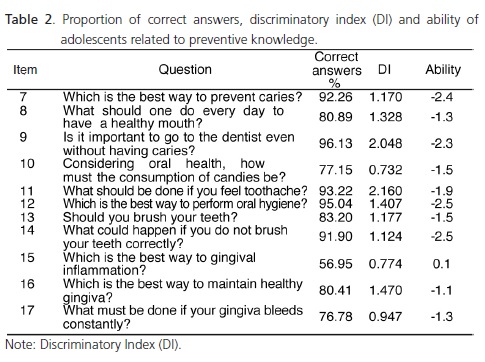
Item 7 (Which is the best way to prevent caries?"), 92.26% answered that caries could be prevented by brushing after the consumption of candy and/or after meals. The Item Response Theory analysis showed discriminatory index of 1.170 and required ability 2.4 times less than the average (Table 2).
The majority of adolescents chose the use of toothbrush and floss as the answer for item 8 "What should one do every day to have a healthy mouth?". The Item Response Theory analysis showed discriminatory index of 1.328. Although it required ability 1.3 times less than the average, it was above the requirement of the previous questions (Table 2).
The majority of the students (96.13%) answered positively to item 9 "Is it important to go to the dentist even without having caries?". In the Item Response Theory analysis showed that the item regarding this response has an excellent discriminatory index (2.048), however it requires a level of ability of students 2.3 times below the average level and therefore, the item is considered easy for the study population (Table 2).
Item 10 (Considering oral health, how must the consumption of candies be?"), 1.9% answered that this is an unfeasible practice at any time of the day, 14.1% answered only after main meals. Whereas 77.15% of adolescents correctly answered that the candy can be eaten at any time, provided that the teeth are brushed after food intake (Table 2).
The majority of adolescents (93.22%) chose the use of toothbrush and floss as the answer for item 11 "What should you do if you feel toothache?". The Item Response Theory analysis showed discriminatory index of 2.160 and ability 1.9 times less than the average (Table 2).
With regard to item 12 "Which is the best way to perform oral hygiene?", 95.0% of the adolescents correctly answered that soft brushing and floss must be used to perform hygiene. This item was able to differentiate between the students different levels of ability by means of the Item Response Theory analysis (DI = 1.407), however it is considered an easy question, as it requires 2.5 times less ability than the average requirement (Table 2).
]]> In item 13 "Should you brush your teeth?", 83.20% answered correctly by stating "one should remove food remains from teeth". This item was also considered by Item Response Theory as a discriminatory item of knowledge of the study population. Item 14 "what could happen if you do not brush your teeth correctly?" the adolescents (91.90%) correctly answered that caries and bad breath would occur. Although this question has a high percentage of correct answers requiring 2.5 times less knowledge than the average requirement, it is a discriminatory item (DI=1.124) among the different levels of knowledge of the students, according to Item Response Theory analysis (Table 2).Regarding the gingival situation, items 15 and 16 addressed "What is the best way to prevent gingival inflammation?" and "What is the best way to maintain your gingiva healthy?" had a DI equal to 0.774 and 1.470. The abilities showed a significant difference close to average (0.1) for item 15 and -1.1 for item 16 (Table 2).
Item 17 asked "What must be done if your gingiva bleeds constantly?". The majority of adolescents (76.78%) answered correctly that they should seek help of a dentist. The discriminatory index was 0.947 and ability was -1.3 indicating that this item has a less difficulty parameter than the average ability of the population studied.
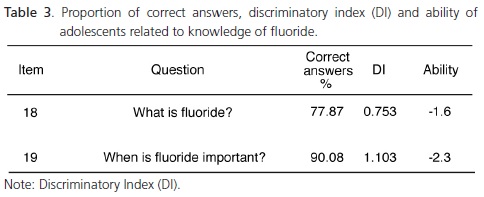
The question in item 18 "What is fluoride?" was correctly answered by 77.87% of the students. The Item Response Theory analysis showed discriminatory index of 0.753 and ability 1.6 times easier than the average level (Table 2). With regard to the importance of fluoride, item 19 had 90.08% of correct answers and ability 2.3 times less than the average (Table 3).
]]>
DISCUSSION
The application of the questionnaire was to assess the oral health knowledge of students from the 6th grades attending public schools of Araçatuba (SP) and it was given priority due to the low cost and the possibility of involving a larger number of individuals, as well as preserving their identity.
The research planning was essential for the good development of the research. The acquisition of the list of schools, the development and validation of the data collection instrument, and attention when delivering and collecting the questionnaires were all essential for reducing possible systematic errors.
]]> Information about oral health, although available in the media, does not reach the entire population in the same way, and it is hardly learned well enough to produce knowledge and autonomy with regard to care12.There are frequent reports on evaluation studies regarding oral health knowledge of adolescents, in which the results show no relationship between knowledge and behavior of the adolescents. This situation can be explained by the behavior of adolescents being determined by factors other information, such as values , beliefs, attitudes and perceptions, which are influenced by social and cultural contexts13-14.
The process of developing oral health knowledge of schoolchildren occurs from contact with family and the school plays an essential role because this environment favors the development of health education activities, since it increases knowledge through collective and participatory studies with students15-16.
Therefore, the school should not be the only place to practice dental hygiene techniques, but rather a place of exchange and cooperation in the development of health education, being part of the school curriculum in a systematic way where teachers can motivate students while they develop a critical awareness and stimulate the interest for maintaining oral health17.
In the present study questions that are used in health education programs for adolescents, especially in schools, were used.
Assessment of oral health knowledge is an important tool for clinical research and for the development of health policies. Oral health as perceived by the adolescent enables the true impact of an illness to be measured and the various domains of the disease to be evaluated, such as physical, emotional, social performance, day-to-day routine, among others.
In general it can be concluded that the Item Response Theory is a promising and useful tool in the analysis of observations generated by instruments designed to assess knowledge, particularly in Dentistry. Even if the results of analysis through classical methods were very similar to the model of Item Response Theory. The latter is preferable, since it uses the information in each item better, differentiating the most important items from the less important ones and it is flexible when dealing with missing data, which does not compromise the application of the item response model as the central aspect are the items and not the instrument as a whole.
The Item Response Theory was used in Dentistry by Castilhoet al.13 when examining the adolescents' knowledge regarding dental reimplantation, in which, unlike the present study, the author concluded that adolescents have a low level of knowledge on the subject.
Finally it is worth noting that the type of data used in the study has limitations inherent to a quantitative research. Nevertheless, this research model is a powerful tool for collecting information in the field of oral health knowledge and it is an important means of testing hypotheses exposed in qualitative research18.
Some items were removed from the final questionnaire because for a better adjustment of the model used, items that would have low values for the estimates of the parameter of discrimination (lower than 0.7) were removed from the scales. This value of 0.7 seems reasonable, since some studies use the same cut-off point of 0.7, which led to the removal of items. However, there is no consensus in the literature about the minimum value of the discrimination parameter9,19-20.
]]>CONCLUSION
Based on the results of this study, it can be concluded that the students have a good level of oral health knowledge, however further research is needed to disseminate the use of the Item Response Theory analysis as an assessment tool, especially in dentistry.
ACKNOWLEDGEMENTS
The authors thank "Coordenação de Aperfeiçoamento de Pessoal de Nível Superior" (CAPES), (Personal Improvement Coordination for Higher Education) for the scholarship. The authors also thank the Regional Office of Education of Araçatuba for their cooperation during the study at the schools.
Collaborators
KMS FRANCISCO, MLMM SUNDEFELD and SAS MOIMAZ participated in the conception, analysis, data interpretation, and final review of the study.
REFERENCES
]]>1. Freire MAC, Aubrey S, Bino YA. Hábitos de higiene bucal e fatores sociodemográficos em adolescentes. Rev Bras Epidemiol. 2007;10(4):606-14. doi: 10.1590/S1415-790X2007000400018. [ Links ]
2. RassialJJ. Entrevista com J.J. Rassial. Rev Assoc Psican Porto Alegre. 1995;5(11):86-100.
3. Vasconcelos A, Vasconcelos GAN. Cidadania, exclusão social e saúde bucal. Rev Educ Saúde Bucal Colet. 1999;2(2):29-32.
4. Wanderley MT, Nosé CC, Corrêa MSNP. Educação e motivação na promoção da saúde bucal. In: Corrêa MSNP. Odontopediatria na primeira infância. 2ª ed. São Paulo: Santos; 1999.
5. Garcia PPNS, Dinelli W, Serra MC, Corona SAM. Saúde bucal: crenças e atitudes, conceitos e educação de pacientes do serviço público. J Assoc Odontol. 2000;3(22):36-41.
6. Petry PC, Pretto SM. Educação e motivação em saúde bucal. In: Kriger L. Promoção de saúde bucal. São Paulo: Artes Médicas; 2003. p. 371-85.
7. Antunes JL, Peres MA. Epidemiologia da saúde bucal. Rio de Janeiro: Guanabara Koogan; 2006.
8. Gunther H. Como elaborar um questionário. Brasília: UnB Laboratório de Psicologia Ambiental; 2003.
9. Hays RD, Lipscomb J. Next steps for use of item response theory in the assessment of health outcomes. Qual Life Res. 2007;16(suppl 1):195-99. doi: 10.1007/s11136-007-9175-7.
]]> 10. Prieto L, Alonso J, Lamarca R. Classical test theory versus Rasch analysis for quality of life questionnaire reduction. Health Qual Life Outcomes. 2003;1:27. doi: 10.1186/1477-7525-1-27.11. Andrade DF, Tavares HR, Valle RC. Teoria de resposta do item: conceitos e aplicações. São Paulo: Associação Brasileira de Estatística; 2000.
12. Granville-Garcia AF, Silva JM, Guinho SF, Menezes V. Conhecimento de professores sobre saúde bucal. RGO - Rev Gaúcha Odontol. 2007;55(1):29-34.
13. Castilho LR, Sundefeld MLM, Andrade DF, Panzarini SR. Evaluation of sixth grade primary schoolchildren s knowledge about avulsion and dental reimplantation. Dental Traumatol. 2009;25(4):429-32. doi: 10.1111/j.1600-9657.2008.00756.x.
14. Figueira T, Leite ICG. Percepções em saúde bucal de escolares. RGO - Rev Gaúcha Odontol. 2008;56(1):27-32.
15. Sheiham A, Moysés SJ. O papel dos profissionais de saúde bucal na promoção de saúde. In: Buisch YP. Promoção de saúde bucal na clínica odontológica. Porto Alegre: Artes Médicas; 2000. p. 23-37.
16. Ferreira JMS, Bezerra IF, Cruz RES, Vieira ITA, Menezes VA, Granville-Garcia AF. Práticas de pais sobre a higiene bucal e dieta de pré-escolares da rede pública. RGO - Rev Gaúcha Odontol. 2011;59(2):265-70.
17. Pauleto AR, Pereira ML, Cyrino EG. Saúde bucal: uma revisão crítica sobre programações educativas para escolas. Ciênc Saúde Coletiva. 2004;9(1):121-30. doi: 10.1590/S1413- 81232004000100012.
18. Ferreira MP. Conhecimento e percepção de risco sobre o HIV/ AIDS: um perfil da população brasileira no ano de 1998. Cad Saúde Pública. 2003;19(2):213-22. doi: 10.1590/S0102- 311X2003000800003.
19. Alexandre JWC, Andrade DF, Vasconcelos AP, Araújo AMS. Uma proposta de análise de um construto para medição dos fatores críticos da gestão pela qualidade por intermédio da Teoria de Resposta ao Item. Gest Prod. 2002;9(2):129-44. doi: 10.1590/ S0104-530X2002000200003.
]]> 20. Noerholm V, Groenvold M, Watt T, Bjorner JB, Rasmussen NA, Bech P. Quality of life in the Danish general population-normative data and validity of WHOQOL-Bref using Rasch and item response theory models. Qual Life Res. 2004;13(2):531-40.
 Correspondence to:
KMS FRANCISCO
e-mail: kmartins@uesb.edu.br
Received on: 26/8/2010
Final version resubmitted on: 28/4/2011
Approved on: 25/7/2011
]]>