<?xml version="1.0" encoding="ISO-8859-1"?><article xmlns:mml="http://www.w3.org/1998/Math/MathML" xmlns:xlink="http://www.w3.org/1999/xlink" xmlns:xsi="http://www.w3.org/2001/XMLSchema-instance">
<front>
<journal-meta>
<journal-id>1981-8637</journal-id>
<journal-title><![CDATA[RGO.Revista Gaúcha de Odontologia (Online)]]></journal-title>
<abbrev-journal-title><![CDATA[RGO, Rev. gaúch. odontol. (Online)]]></abbrev-journal-title>
<issn>1981-8637</issn>
<publisher>
<publisher-name><![CDATA[Mundi Brasil Gráfica e Editora Ltda.]]></publisher-name>
</publisher>
</journal-meta>
<article-meta>
<article-id>S1981-86372012000300015</article-id>
<title-group>
<article-title xml:lang="en"><![CDATA[Transmigrated teeth]]></article-title>
<article-title xml:lang="pt"><![CDATA[Transmigração dentária]]></article-title>
</title-group>
<contrib-group>
<contrib contrib-type="author">
<name>
<surname><![CDATA[CORSI]]></surname>
<given-names><![CDATA[João Renato]]></given-names>
</name>
</contrib>
<contrib contrib-type="author">
<name>
<surname><![CDATA[MORAES]]></surname>
<given-names><![CDATA[Paulo de Camargo]]></given-names>
</name>
</contrib>
<contrib contrib-type="author">
<name>
<surname><![CDATA[TACCHELLI]]></surname>
<given-names><![CDATA[Daniela Prata]]></given-names>
</name>
</contrib>
<contrib contrib-type="author">
<name>
<surname><![CDATA[JODAS]]></surname>
<given-names><![CDATA[Cláudio Roberto Pacheco]]></given-names>
</name>
</contrib>
<contrib contrib-type="author">
<name>
<surname><![CDATA[JUNQUEIRA]]></surname>
<given-names><![CDATA[José Luiz Cintra]]></given-names>
</name>
</contrib>
<contrib contrib-type="author">
<name>
<surname><![CDATA[TEIXEIRA]]></surname>
<given-names><![CDATA[Rubens Gonçalves]]></given-names>
</name>
</contrib>
</contrib-group>
<aff id="A01">
<institution><![CDATA[,Faculdade São Leopoldo Mandic Curso de Odontologia ]]></institution>
<addr-line><![CDATA[Campinas SP]]></addr-line>
<country>Brasil</country>
</aff>
<pub-date pub-type="pub">
<day>00</day>
<month>09</month>
<year>2012</year>
</pub-date>
<pub-date pub-type="epub">
<day>00</day>
<month>09</month>
<year>2012</year>
</pub-date>
<volume>60</volume>
<numero>3</numero>
<fpage>377</fpage>
<lpage>379</lpage>
<copyright-statement/>
<copyright-year/>
<self-uri xlink:href="http://revodonto.bvsalud.org/scielo.php?script=sci_arttext&amp;pid=S1981-86372012000300015&amp;lng=en&amp;nrm=iso"></self-uri><self-uri xlink:href="http://revodonto.bvsalud.org/scielo.php?script=sci_abstract&amp;pid=S1981-86372012000300015&amp;lng=en&amp;nrm=iso"></self-uri><self-uri xlink:href="http://revodonto.bvsalud.org/scielo.php?script=sci_pdf&amp;pid=S1981-86372012000300015&amp;lng=en&amp;nrm=iso"></self-uri><abstract abstract-type="short" xml:lang="en"><p><![CDATA[Pre-eruptive migration of a tooth across the midline is called transmigration. This article reviews the literature on tooth transmigration. In the literature there is no consensus on the definition of true cases of transmigration and impacted teeth. Transmigration is a rare phenomenon that typically affects the mandibular canines. There is no known etiology for its occurrence, however, there are many and varied etiological factors involved in transmigrated teeth, such as ectopic growth of the tooth bud, retention or premature loss of a primary tooth, inadequate eruption space and excessive length of crown. Genetic factors, endocrine disorders and trauma have also been also proposed as etiological factors. In most clinical reports, transmigrated teeth were found in a horizontal position, below the apices of the erupted teeth and in the majority of cases, such a migrated tooth remains impacted; however, it may sometimes erupt later in its new position. When it is diagnosed in radiographic exams, careful evaluation is necessary in order to establish the most adequate treatment. Extraction of the transmigrated tooth appeared to be the only choice of treatment.]]></p></abstract>
<abstract abstract-type="short" xml:lang="pt"><p><![CDATA[A migração pré-eruptiva de um dente através da linha média é chamada de transmigração. O objetivo deste artigo é apresentar uma revisão da literatura sobre a transmigração dentária. Na literatura não há consenso sobre a definição de casos de verdadeiros de transmigração e dentes impactados. Transmigração é um fenômeno raro, que normalmente afeta os caninos inferiores e a sua etiologia é desconhecida, porém vários fatores etiológicos podem estar envolvidos nos casos de transmigração, tais como o crescimento ectópico da raiz do dente, retenção ou perda prematura de um dente decíduo, espaço insuficiente erupção e comprimento excessivo da coroa. Fatores genéticos, doenças endócrinas e trauma também foram citados como possíveis fatores etiológicos. Nos relatos clínicos os dentes transmigrados foram encontrados em posição horizontal, abaixo os ápices dos dentes irrompidos e na maioria das vezes, um dente com transmigração permanece impactado; no entanto, posteriormente, pode irromper em sua nova posição. Quando diagnosticado, por exames radiográficos, é necessário um planejamento criterioso para o estabelecimento do tratamento mais adequado. A exodontia é o tratamento de escolha para os casos de transmigração dentária.]]></p></abstract>
<kwd-group>
<kwd lng="en"><![CDATA[Diagnosis.]]></kwd>
<kwd lng="en"><![CDATA[Impacted Tooth.]]></kwd>
<kwd lng="en"><![CDATA[Tooth Migration.]]></kwd>
<kwd lng="pt"><![CDATA[Diagnóstico.]]></kwd>
<kwd lng="pt"><![CDATA[Dente Impactado.]]></kwd>
<kwd lng="pt"><![CDATA[Migração de Dente.]]></kwd>
</kwd-group>
</article-meta>
</front><body><![CDATA[ <p align="right"><font size="2" face="Verdana, Arial, Helvetica, sans-serif"><b>REVIEW</b> / REVIS&Atilde;O</font></p>     <p>&nbsp;</p>     <p><font size="4" face="Verdana, Arial, Helvetica, sans-serif"><a name="top"/></a><B>Transmigrated teeth</B></font></p>     <p>&nbsp;</p>     <p><font size="3" face="Verdana, Arial, Helvetica, sans-serif"><b>Transmigra&ccedil;&atilde;o dent&aacute;ria</b> </font></p>     <p>&nbsp;</p>     <p>&nbsp;</p>     <p><font size="2" face="Verdana, Arial, Helvetica, sans-serif"><b>Jo&atilde;o Renato CORSI <sup>I</sup>; Paulo de Camargo MORAES <sup>I</sup>; Daniela Prata TACCHELLI<sup> I</sup>; Cl&aacute;udio Roberto Pacheco JODAS <sup>I</sup>; Jos&eacute; Luiz Cintra JUNQUEIRA <sup>I</sup>; Rubens Gon&ccedil;alves TEIXEIRA <sup>I</sup></b></font></p>     <p><font size="2" face="Verdana, Arial, Helvetica, sans-serif"><sup>I</sup> Faculdade S&atilde;o Leopoldo Mandic, Curso de Odontologia. Rua Dr. Jos&eacute; Rocha Junqueira, 13, Swift, 13045-755, Campinas, SP, Brasil</font></p>     <p><font size="2" face="Verdana, Arial, Helvetica, sans-serif"><a href="#back">Correspondence:</a></font></p>     ]]></body>
<body><![CDATA[<p>&nbsp;</p>     <p>&nbsp;</p> <hr size="1" noshade>     <p><font size="3" face="Verdana, Arial, Helvetica, sans-serif"><b>ABSTRACT</b> </font></p>     <p><font size="2" face="Verdana, Arial, Helvetica, sans-serif">Pre-eruptive migration of a tooth across the midline is called transmigration. This article reviews the literature on tooth transmigration. In the literature there is no consensus on the definition of true cases of transmigration and impacted teeth. Transmigration is a rare phenomenon that typically affects the mandibular canines. There is no known etiology for its occurrence, however, there are many and varied etiological factors involved in transmigrated teeth, such as ectopic growth of the tooth bud, retention or premature loss of a primary tooth, inadequate eruption space and excessive length of crown. Genetic factors, endocrine disorders and trauma have also been also proposed as etiological factors. In most clinical reports, transmigrated teeth were found in a horizontal position, below the apices of the erupted teeth and in the majority of cases, such a migrated tooth remains impacted; however, it may sometimes erupt later in its new position. When it is diagnosed in radiographic exams, careful evaluation is necessary in order to establish the most adequate treatment. Extraction of the transmigrated tooth appeared to be the only choice of treatment.</font><font size="2" face="Verdana, Arial, Helvetica, sans-serif"> </font></p>     <p><font size="2" face="Verdana, Arial, Helvetica, sans-serif"><B>Indexing terms: </B>Diagnosis. Impacted Tooth. Tooth Migration.</font></p> <hr size="1" noshade>     <p><font size="3" face="Verdana, Arial, Helvetica, sans-serif"><B>RESUMO</B> </font></p>     <p><font size="2" face="Verdana, Arial, Helvetica, sans-serif">A migra&ccedil;&atilde;o pr&eacute;-eruptiva de um dente atrav&eacute;s da linha m&eacute;dia &eacute; chamada de transmigra&ccedil;&atilde;o. O objetivo deste artigo &eacute; apresentar uma revis&atilde;o da literatura sobre a transmigra&ccedil;&atilde;o dent&aacute;ria. Na literatura n&atilde;o h&aacute; consenso sobre a defini&ccedil;&atilde;o de casos de verdadeiros de transmigra&ccedil;&atilde;o e dentes impactados. Transmigra&ccedil;&atilde;o &eacute; um fen&ocirc;meno raro, que normalmente afeta os caninos inferiores e a sua etiologia &eacute; desconhecida, por&eacute;m v&aacute;rios fatores etiol&oacute;gicos podem estar envolvidos nos casos de transmigra&ccedil;&atilde;o, tais como o crescimento ect&oacute;pico da raiz do dente, reten&ccedil;&atilde;o ou perda prematura de um dente dec&iacute;duo, espa&ccedil;o insuficiente erup&ccedil;&atilde;o e comprimento excessivo da coroa. Fatores gen&eacute;ticos, doen&ccedil;as end&oacute;crinas e trauma tamb&eacute;m foram citados como poss&iacute;veis fatores etiol&oacute;gicos. Nos relatos cl&iacute;nicos os dentes transmigrados foram encontrados em posi&ccedil;&atilde;o horizontal, abaixo os &aacute;pices dos dentes irrompidos e na maioria das vezes, um dente com transmigra&ccedil;&atilde;o permanece impactado; no entanto, posteriormente, pode irromper em sua nova posi&ccedil;&atilde;o. Quando diagnosticado, por exames radiogr&aacute;ficos, &eacute; necess&aacute;rio um planejamento criterioso para o estabelecimento do tratamento mais adequado. A exodontia &eacute; o tratamento de escolha para os casos de transmigra&ccedil;&atilde;o dent&aacute;ria.</font><font size="2" face="Verdana, Arial, Helvetica, sans-serif"> </font></p>     <p><font size="2" face="Verdana, Arial, Helvetica, sans-serif"><B>Termos de indexa&ccedil;&atilde;o: </B>Diagn&oacute;stico. Dente Impactado. Migra&ccedil;&atilde;o de Dente.</font></p> <hr noshade size="1">     <p>&nbsp;</p>     <p>&nbsp;</p>     ]]></body>
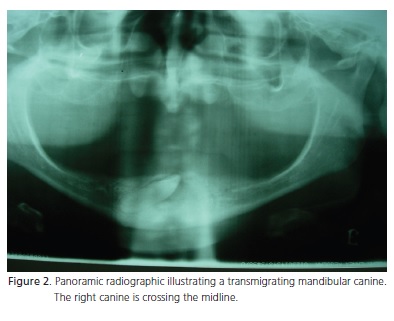
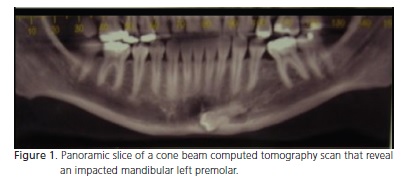
<body><![CDATA[<p><font size="3" face="Verdana, Arial, Helvetica, sans-serif"><B> INTRODUCTION</B></font></p>     <p><font size="2" face="Verdana, Arial, Helvetica, sans-serif">Pre-eruptive migration of a tooth across the midline is called transmigration<sup>1</sup>. Transmigration is a rare phenomenon, which typically affects the mandibular canines, but rarely also occurs in maxillary canines<sup>2</sup>. </font></p>     <p><font size="2" face="Verdana, Arial, Helvetica, sans-serif">There is not a great deal of literature specifically about the incidence of transmigration. A recent study in a Turkish subpopulation, found an incidence of 0.34% of transmigrated maxillary and mandibular canine teeth (17 patients, 12 females and 5 males, with a mean age of 34 years and 0.14 per cent (7 patients, 4 females/3males, with a mean age of 37.1 years<sup>3</sup>, respectively. </font></p>     <p><font size="2" face="Verdana, Arial, Helvetica, sans-serif">The etiology of transmigration is unknown; however, abnormal displacement of the tooth bud or deviation during development is the most commonly accepted explanation<sup>4</sup>. Studies have suggest that proclination of the lower incisors, increased axial inclination of the unerupted canine and an enlarged symphyseal cross-sectional of the chin could play an important role in the mechanism of transmigration. They further stated that it is possible for the unerupted canine to deviate from its normal development site, move to a horizontal position, and migrate through the symphyseal bone, only if there is enough space available in front of the mandibular incisor roots. In the majority of cases, such a migrated tooth remains impacted; however, it may sometimes erupt later in its new position<sup>5</sup>. </font></p>     <p><font size="2" face="Verdana, Arial, Helvetica, sans-serif">In most reports of transmigrated teeth they were found in a horizontal position, below the apices of the erupted teeth<sup>6</sup>. Clinical and radiographic examination is usually required to diagnose transmigrant, because they are usually found within the symphysis of the mandible. Transmigrating teeth usually remain impacted and asymptomatic or they can cause pressure resorption of roots or tilting of adjacent teeth. </font></p>     <p><font size="2" face="Verdana, Arial, Helvetica, sans-serif">Decision on surgical removal depends on the symptoms reported by the patient, the site where the tooth is found, and presence of, or no association with pathologies<sup>7</sup>. <a href="#fig01">Figure 1</a> is a panoramic slice of a cone beam computed tomography scan which revealed an impacted mandibular left premolar. The position of the transversely impacted premolar was unfavorable, so that no orthodontic treatment of this tooth was envisaged and extraction was planned. <a href="#fig02">Figure 2</a> illustrates a transmigrating mandibular canine. The right canine has crossed the midline.</font></p>     <p>&nbsp;</p>     <p><a name="fig01"></a></p>     <p>&nbsp; </p>     <p align="center"><img src="/img/revistas/rgo/v60n3/a15fig01.jpg">     ]]></body>
<body><![CDATA[<p>&nbsp;</p>     <p><a name="fig02"></a></p>     <p>&nbsp; </p>     <p align="center"><img src="/img/revistas/rgo/v60n3/a15fig02.jpg">     <p>&nbsp;</p>     <p><font size="3" face="Verdana, Arial, Helvetica, sans-serif"><B> DISCUSSION</B></font></p>     <p><font size="2" face="Verdana, Arial, Helvetica, sans-serif">Pre-eruptive migration of a tooth across the midline is called transmigration<sup>4-5,8</sup>. Transmigration of teeth has been identified by a variety of names and there are controversies in the literature regarding the precise definition of transmigration. Recently, Vuchkova and Farah<sup>9</sup> reported that a large portion of publications cannot be regarded as true cases of transmigration; this being the case when a canine has crossed the midline by more than half its length. However, Javid<sup>10</sup> mentioned that it is not the distance of migration after crossing the midline, but the tendency of a canine to cross the barrier of the mandibular midline suture that is a more important consideration. In addition, Mupparappu<sup>11</sup> defined five criteria to classify the transmigrated canine according to its patterns of intra-osseous transmigration. </font></p>     <p><font size="2" face="Verdana, Arial, Helvetica, sans-serif">It is essential to differentiate true cases of tooth transmigration from impacted teeth, and there is no consensus about a definition. Comparisons between case reports should be interpreted with caution due to the lack of uniformity in diagnostic criteria and classification adopted. </font></p>     <p><font size="2" face="Verdana, Arial, Helvetica, sans-serif">There are no well established data for the incidence of transmigrated teeth because reports of transmigrated teeth consist of isolated cases8 or small series<sup>6,9</sup>. The incidence of canine transmigration was greater than its occurrence in other teeth<sup>3</sup>. To our knowledge, there is only a case report of transmigration of mandibular second premolar in a patient with cleft lip and palate. The authors affirmed that distal migration of the mandibular left second molar premolar is not associated with presence of cleft lip and palate. With the increased use of panoramic radiographs and tomography, it is inevitable that diagnosis of this anomaly will increase. </font></p>     <p><font size="2" face="Verdana, Arial, Helvetica, sans-serif">There are many and varied etiological factors involved in the transmigration of teeth such as ectopic growth of the tooth bud, retention or premature loss of a primary tooth, inadequate eruption space and excessive length of crown. Genetic factors, endocrine disorders and trauma have also been proposed as etiological factors.</font></p>     ]]></body>
<body><![CDATA[<p>&nbsp;</p>     <p><font size="3" face="Verdana, Arial, Helvetica, sans-serif"><B> CONCLUSION</B></font></p>     <p><font size="2" face="Verdana, Arial, Helvetica, sans-serif">In conclusion, according to literature there is no consensus on the definition of true cases of transmigration and impacted teeth. Treatment considerations for transmigratory teeth depend on the stage of development and distance of migration at the time they are identified. When detected early, the tooth can be surgically exposed and moved using orthodontic forces. In addition, when the root apices are closed, extraction often is the only choice. However, the difficulty in removing the tooth in one piece complicates the procedure. Extraction of the transmigrated tooth appeared to be the only choice of treatment. The early detection of this anomaly in patients with missing permanent teeth is essential to the treatment planning.</font></p>     <p><font size="2" face="Verdana, Arial, Helvetica, sans-serif"><B> Collaborators</B></font></p>       <p><font size="2" face="Verdana, Arial, Helvetica, sans-serif">   JR CORSI, PC MORAES, CRP JODAS, DP TACCHELLI helped with the literature search and writing of the manuscript. JLC JUNQUEIRA and RG TEIXEIRA reviewed the manuscript and helped with the final text. </font></p>     <p>&nbsp;</p>     <p><font size="3" face="Verdana, Arial, Helvetica, sans-serif"><B>REFERENCES </B></font></p>     <!-- ref --><p><font size="2" face="Verdana, Arial, Helvetica, sans-serif">1. Sumer P, Sumer M, Ozden B, Otan F. Transmigration of mandibular canines: a report of six cases and a review of the literature. J Contemp Dent Pract. 2007;8(3):104-10.    &nbsp;&nbsp;&nbsp;&nbsp;&nbsp;&nbsp;&nbsp;&nbsp;[&#160;<a href="javascript:void(0);" onclick="javascript: window.open('/scielo.php?script=sci_nlinks&ref=213734&pid=S1981-8637201200030001500001&lng=','','width=640,height=500,resizable=yes,scrollbars=1,menubar=yes,');">Links</a>&#160;]<!-- end-ref --> </font></p>     <p><font size="2" face="Verdana, Arial, Helvetica, sans-serif">2. Aydin U, Yilmaz HH. Transmigration of impacted canines. Dentomaxillofac Radiol. 2003;32(3):198-200. </font></p>     ]]></body>
<body><![CDATA[<p><font size="2" face="Verdana, Arial, Helvetica, sans-serif">3. Aktan AM, Kara S, Akg&uuml;nl&uuml; F, Malko&ccedil; S. The incidence of canine transmigration and tooth impactation in a Turkish subpopulation. Eur J Orthod. 2010;32(5):575-81. doi: 10.1093/ ejo/cjp151. </font></p>     <p><font size="2" face="Verdana, Arial, Helvetica, sans-serif">4. Alaejos-Algarra C, Berini-Aytes L, Gay-Escoda C. Transmigration of mandibular canines: report of six cases and review of the literature. Quintessence Int. 1998;29(6):395-8. </font></p>     <p><font size="2" face="Verdana, Arial, Helvetica, sans-serif">5. Joshi MR, Shetye SB. Transmigrant mandibular canines: a review of the literature and report of two cases. Quintessence Int 1994;25:291-4. </font></p>     <p><font size="2" face="Verdana, Arial, Helvetica, sans-serif">6. Al-Wahedi EMH. Transmigration of unerupted mandibular canines: a literature review and a report of five cases. Quintessence Int. 1996;27:27-31. </font></p>     <p><font size="2" face="Verdana, Arial, Helvetica, sans-serif">7. Rebellato J, Schabel B. Treatment of a patient with an impacted transmigrant mandibular canine and palatally impacted maxillary canine. Angle Orthod. 2003;73(3):328-36. </font></p>     <p><font size="2" face="Verdana, Arial, Helvetica, sans-serif">8. Camilleri S. Double transmigration and hyperdontia. Angle Orthod. 2007;77(4):742-4. </font></p>     <p><font size="2" face="Verdana, Arial, Helvetica, sans-serif">9. Vuchkova J, Farah CS. Canine transmigration: comprehensive literature review and report of 4 new Australian cases. Oral Surg Oral Med Oral Pathol Oral Radiol Endod. 2010;109(4):e46-53. doi: 10.1016/j.tripleo.2009.12.031. </font></p>     <p><font size="2" face="Verdana, Arial, Helvetica, sans-serif">10. Javid BR. Transmigration of impacted mandibular cuspids. Int J Oral Surg. 1985;14(6):547-9. doi : 10.1016/S0300- 9785(85)80063-6. </font></p>     <p><font size="2" face="Verdana, Arial, Helvetica, sans-serif">11. Mupparappu M. Patterns of intra-osseous transmigration and ectopic eruption of mandibular canines: review of literature and report of nine additional cases. Dentomaxillofac Radiol. 2002;31(6):355-60.</font></p>     <p>&nbsp;</p>     ]]></body>
<body><![CDATA[<p>&nbsp;</p>     <p><font size="2" face="Verdana, Arial, Helvetica, sans-serif"><a name="back"/></a><a href="#top"><img src="/img/revistas/rgo/v60n3/seta.jpg" border="0" align="absmiddle"/></a><b>Correspondence to:</b>    <br>   </font><font size="2" face="Verdana, Arial, Helvetica, sans-serif">RG TEIXEIRA</font><font size="2" face="Verdana, Arial, Helvetica, sans-serif">    <br>   e-mail: </font><font size="2" face="Verdana, Arial, Helvetica, sans-serif"><a href="mailto:rgte@terra.com.br" target="_blank">rgte@terra.com.br</a></font></p>     <p>&nbsp;</p>       <p><font face="Verdana, Arial, Helvetica, sans-serif" size="2"><b>Received on:</b> 24/5/2010<br/> <b>Final version resubmitted on:</b> 26/9/2011<br/> <b>Approved on:</b> 27/11/2011</font></p>     <p>&nbsp;</p>      ]]></body>
<back>
<ref-list>
<ref id="B1">
<label>1</label><nlm-citation citation-type="journal">
<person-group person-group-type="author">
<name>
<surname><![CDATA[Sumer]]></surname>
<given-names><![CDATA[P]]></given-names>
</name>
<name>
<surname><![CDATA[Sumer]]></surname>
<given-names><![CDATA[M]]></given-names>
</name>
<name>
<surname><![CDATA[Ozden]]></surname>
<given-names><![CDATA[B]]></given-names>
</name>
<name>
<surname><![CDATA[Otan]]></surname>
<given-names><![CDATA[F.]]></given-names>
</name>
</person-group>
<article-title xml:lang="en"><![CDATA[Transmigration of mandibular canines: a report of six cases and a review of the literature.]]></article-title>
<source><![CDATA[J Contemp Dent Pract.]]></source>
<year>2007</year>
<volume>8</volume>
<numero>3</numero>
<issue>3</issue>
<page-range>104-10</page-range></nlm-citation>
</ref>
</ref-list>
</back>
</article>