<?xml version="1.0" encoding="ISO-8859-1"?><article xmlns:mml="http://www.w3.org/1998/Math/MathML" xmlns:xlink="http://www.w3.org/1999/xlink" xmlns:xsi="http://www.w3.org/2001/XMLSchema-instance">
<front>
<journal-meta>
<journal-id>1981-8637</journal-id>
<journal-title><![CDATA[RGO.Revista Gaúcha de Odontologia (Online)]]></journal-title>
<abbrev-journal-title><![CDATA[RGO, Rev. gaúch. odontol. (Online)]]></abbrev-journal-title>
<issn>1981-8637</issn>
<publisher>
<publisher-name><![CDATA[Mundi Brasil Gráfica e Editora Ltda.]]></publisher-name>
</publisher>
</journal-meta>
<article-meta>
<article-id>S1981-86372013000100003</article-id>
<title-group>
<article-title xml:lang="en"><![CDATA[Effectiveness of manual and electric brushes in the removal of biofilm from full dentures]]></article-title>
<article-title xml:lang="pt"><![CDATA[Eficácia das escovas manual e elétrica na remoção do biofilme de próteses totais]]></article-title>
</title-group>
<contrib-group>
<contrib contrib-type="author">
<name>
<surname><![CDATA[ANDRADE]]></surname>
<given-names><![CDATA[Ingrid Machado de]]></given-names>
</name>
<xref ref-type="aff" rid="A01"/>
</contrib>
<contrib contrib-type="author">
<name>
<surname><![CDATA[CRUZ]]></surname>
<given-names><![CDATA[Patrícia Costa]]></given-names>
</name>
<xref ref-type="aff" rid="A01"/>
</contrib>
<contrib contrib-type="author">
<name>
<surname><![CDATA[ZAMBONE]]></surname>
<given-names><![CDATA[Bárbara Fuzaro]]></given-names>
</name>
<xref ref-type="aff" rid="A01"/>
</contrib>
<contrib contrib-type="author">
<name>
<surname><![CDATA[SILVA-LOVATO]]></surname>
<given-names><![CDATA[Cláudia Helena]]></given-names>
</name>
<xref ref-type="aff" rid="A01"/>
</contrib>
<contrib contrib-type="author">
<name>
<surname><![CDATA[SOUZA]]></surname>
<given-names><![CDATA[Raphael Freitas de]]></given-names>
</name>
<xref ref-type="aff" rid="A01"/>
</contrib>
<contrib contrib-type="author">
<name>
<surname><![CDATA[SOUZA-GUGELMIN]]></surname>
<given-names><![CDATA[Maria Cristina Monteiro de]]></given-names>
</name>
<xref ref-type="aff" rid="A02"/>
</contrib>
<contrib contrib-type="author">
<name>
<surname><![CDATA[PARANHOS]]></surname>
<given-names><![CDATA[Helena de Freitas Oliveira]]></given-names>
</name>
<xref ref-type="aff" rid="A01"/>
</contrib>
</contrib-group>
<aff id="A01">
<institution><![CDATA[,Universidade de São Paulo Faculdade de Odontologia Departamento de Materiais Dentários e Prótese]]></institution>
<addr-line><![CDATA[ ]]></addr-line>
</aff>
<aff id="A02">
<institution><![CDATA[,Universidade de São Paulo Faculdade de Ciências Farmacêuticas Departamento de Análises Clínicas, Toxicológicas e Bromatológicas]]></institution>
<addr-line><![CDATA[Ribeirão Preto SP]]></addr-line>
<country>Brasil</country>
</aff>
<pub-date pub-type="pub">
<day>00</day>
<month>03</month>
<year>2013</year>
</pub-date>
<pub-date pub-type="epub">
<day>00</day>
<month>03</month>
<year>2013</year>
</pub-date>
<volume>61</volume>
<numero>1</numero>
<fpage>21</fpage>
<lpage>26</lpage>
<copyright-statement/>
<copyright-year/>
<self-uri xlink:href="http://revodonto.bvsalud.org/scielo.php?script=sci_arttext&amp;pid=S1981-86372013000100003&amp;lng=en&amp;nrm=iso"></self-uri><self-uri xlink:href="http://revodonto.bvsalud.org/scielo.php?script=sci_abstract&amp;pid=S1981-86372013000100003&amp;lng=en&amp;nrm=iso"></self-uri><self-uri xlink:href="http://revodonto.bvsalud.org/scielo.php?script=sci_pdf&amp;pid=S1981-86372013000100003&amp;lng=en&amp;nrm=iso"></self-uri><abstract abstract-type="short" xml:lang="en"><p><![CDATA[Objective To evaluate clinically the ability to remove biofilm from complete dentures. Methods Thirty patients, users of full upper dentures, participated in a trial period of 21 days and were instructed to brush the dentures three times a day (after breakfast, lunch and dinner) with water, using a manual, special denture brush (Group I - Control) and electric brush (Group II - Experimental). At night, the patients were instructed to immerse their dentures in a container with filtered water. Before and after the use of these methods for 21 days, the internal surfaces of the complete upper dentures were stained (1% neutral red) and photographed. The areas (total of internal surface and the surface stained with biofilm) were quantified using software (Image Tool 2.02). The percentage of the biofilm was calculated as the ratio of the area of the biofilm multiplied by 100 to the total surface area of the internal base of the dentures. Results The data for the two methods were compared using the Student's t-test (&#945;&#945; = 0.05). There was a mean area of biofilm coverage (%, ± standard deviation) of 12.5 ± 12.8 and 16.9 ± 17.0 for the manual and electric toothbrushes, respectively. The differences were not significant (t = 0.799, P = 0.431). Conclusion It was concluded that both brushes tested showed the same capacity for biofilm removal from complete dentures.]]></p></abstract>
<abstract abstract-type="short" xml:lang="pt"><p><![CDATA[Objetivo Avaliar clinicamente a capacidade de remoção do biofilme de prótese total de dois métodos mecânicos de higiene: escovação manual e elétrica. Métodos Trinta pacientes, usuários de próteses totais superiores, participaram de um período experimental de 21 dias e foram orientados a escovar as próteses três vezes ao dia (após café da manhã, almoço e jantar) com água empregando escova manual específica para próteses totais (Grupo I - Controle) e elétrica (Grupo II - Experimental). Durante o período noturno o paciente foi orientado a imergir suas próteses em recipiente contendo água filtrada. Antes e após o uso dos métodos por 21 dias, as superfícies internas das próteses totais superiores foram evidenciadas (vermelho neutro 1%) e fotografadas. As áreas (total da superfície interna e corada com biofilme) foram quantificadas com um software (Image Tool 2.02). A porcentagem do biofilme foi calculada como a relação entre a área do biofilme multiplicado por 100 e a área da superfície total da base interna da prótese. Resultados Os dados dos dois métodos foram comparados por meio do teste t de Student (&#945;&#945; = 0,05). Observou-se uma área média de cobertura por biofilme (%, ±desvio padrão) de 12,5±12,8 e 16,9±17,0 para a escova elétrica e a manual, respectivamente. As diferenças não foram significantes (t=0,799; p=0,431). Conclusão Concluiu-se que ambas as escovas testadas apresentaram a mesma capacidade de remoção de biofilme das próteses totais.]]></p></abstract>
<kwd-group>
<kwd lng="en"><![CDATA[Biofilm]]></kwd>
<kwd lng="en"><![CDATA[Denture cleansers]]></kwd>
<kwd lng="en"><![CDATA[Denture complete]]></kwd>
<kwd lng="en"><![CDATA[Tooth brushing]]></kwd>
<kwd lng="pt"><![CDATA[Biofilmes]]></kwd>
<kwd lng="pt"><![CDATA[Higienizadores de dentadura]]></kwd>
<kwd lng="pt"><![CDATA[Prótese total]]></kwd>
<kwd lng="pt"><![CDATA[Escovação dentária]]></kwd>
</kwd-group>
</article-meta>
</front><body><![CDATA[ <p align="right"><font size="2" face="Verdana, Arial, Helvetica, sans-serif"><b>ORIGINAL</b> / ORIGINAL</font></p>     <p>&nbsp;</p>     <p><font size="4" face="Verdana, Arial, Helvetica, sans-serif"><a name="top"/></a><B>Effectiveness of manual and electric brushes in the removal of biofilm from full dentures</B></font></p>     <p>&nbsp;</p>     <p><font size="3" face="Verdana, Arial, Helvetica, sans-serif"><b>Efic&aacute;cia das escovas manual e el&eacute;trica na remo&ccedil;&atilde;o do biofilme de pr&oacute;teses totais</b> </font></p>     <p>&nbsp;</p>     <p>&nbsp;</p>     <p><font size="2" face="Verdana, Arial, Helvetica, sans-serif"><b>Ingrid Machado de ANDRADE<sup>I</sup>; Patr&iacute;cia Costa CRUZ<sup>I</sup>; B&aacute;rbara Fuzaro ZAMBONE<sup>I</sup>; Cl&aacute;udia Helena SILVA-LOVATO<sup>I</sup>; Raphael Freitas de SOUZA<sup>I</sup>; Maria Cristina Monteiro de SOUZA-GUGELMIN<sup>II</sup>; Helena de Freitas Oliveira PARANHOS<sup>I</sup></b></font></p>     <p><font size="2" face="Verdana, Arial, Helvetica, sans-serif"><sup>I</sup> Universidade de S&atilde;o Paulo, Faculdade de Odontologia, Departamento de Materiais Dent&aacute;rios e Pr&oacute;tese    <br> <sup> II</sup> Universidade de S&atilde;o Paulo, Faculdade de Ci&ecirc;ncias Farmac&ecirc;uticas, Departamento de An&aacute;lises Cl&iacute;nicas, Toxicol&oacute;gicas e Bromatol&oacute;gicas. Ribeir&atilde;o Preto, SP, Brasil </font></p>     ]]></body>
<body><![CDATA[<p><font size="2" face="Verdana, Arial, Helvetica, sans-serif"><a href="#back">Correspondence:</a></font></p>     <p>&nbsp;</p>     <p>&nbsp;</p> <hr size="1" noshade>     <p><font size="3" face="Verdana, Arial, Helvetica, sans-serif"><b>ABSTRACT</b> </font></p>     <p><font size="2" face="Verdana, Arial, Helvetica, sans-serif"><b>Objective</b>    <br>    </font><font size="2" face="Verdana, Arial, Helvetica, sans-serif">To evaluate clinically the ability to remove biofilm from complete dentures. </font></p>     <p><font size="2" face="Verdana, Arial, Helvetica, sans-serif"><b>Methods</b>    <br>    </font><font size="2" face="Verdana, Arial, Helvetica, sans-serif">Thirty patients, users of full upper dentures, participated in a trial period of 21 days and were instructed to brush the dentures three times a day (after breakfast, lunch and dinner) with water, using a manual, special denture brush (Group I - Control) and electric brush (Group II - Experimental). At night, the patients were instructed to immerse their dentures in a container with filtered water. Before and after the use of these methods for 21 days, the internal surfaces of the complete upper dentures were stained (1% neutral red) and photographed. The areas (total of internal surface and the surface stained with biofilm) were quantified using software (Image Tool 2.02). The percentage of the biofilm was calculated as the ratio of the area of the biofilm multiplied by 100 to the total surface area of the internal base of the dentures. </font></p>     <p><font size="2" face="Verdana, Arial, Helvetica, sans-serif"><b>Results</b>    <br>    </font><font size="2" face="Verdana, Arial, Helvetica, sans-serif">The data for the two methods were compared using the Student's t-test (&alpha;&alpha; = 0.05). There was a mean area of biofilm coverage (%, &plusmn; standard deviation) of 12.5 &plusmn; 12.8 and 16.9 &plusmn; 17.0 for the manual and electric toothbrushes, respectively. The differences were not significant (t = 0.799, P = 0.431). </font></p>     ]]></body>
<body><![CDATA[<p><font size="2" face="Verdana, Arial, Helvetica, sans-serif"><b>Conclusion</b>    <br>    </font><font size="2" face="Verdana, Arial, Helvetica, sans-serif">It was concluded that both brushes tested showed the same capacity for biofilm removal from complete dentures. </font></p>     <p><font size="2" face="Verdana, Arial, Helvetica, sans-serif"><B>Indexing terms: </B>Biofilm. Denture cleansers. Denture complete. Tooth brushing.</font></p> <hr size="1" noshade>     <p><font size="3" face="Verdana, Arial, Helvetica, sans-serif"><B>RESUMO</B> </font></p>     <p><font size="2" face="Verdana, Arial, Helvetica, sans-serif"><b>Objetivo</b>    <br>  </font><font size="2" face="Verdana, Arial, Helvetica, sans-serif">Avaliar clinicamente a capacidade de remo&ccedil;&atilde;o do biofilme de pr&oacute;tese total de dois m&eacute;todos mec&acirc;nicos de higiene: escova&ccedil;&atilde;o manual e el&eacute;trica. </font></p>     <p><font size="2" face="Verdana, Arial, Helvetica, sans-serif"><b>M&eacute;todos</b>    <br>  </font><font size="2" face="Verdana, Arial, Helvetica, sans-serif">Trinta pacientes, usu&aacute;rios de pr&oacute;teses totais superiores, participaram de um per&iacute;odo experimental de 21 dias e foram orientados a escovar as pr&oacute;teses tr&ecirc;s vezes ao dia (ap&oacute;s caf&eacute; da manh&atilde;, almo&ccedil;o e jantar) com &aacute;gua empregando escova manual espec&iacute;fica para pr&oacute;teses totais (Grupo I - Controle) e el&eacute;trica (Grupo II - Experimental). Durante o per&iacute;odo noturno o paciente foi orientado a imergir suas pr&oacute;teses em recipiente contendo &aacute;gua filtrada. Antes e ap&oacute;s o uso dos m&eacute;todos por 21 dias, as superf&iacute;cies internas das pr&oacute;teses totais superiores foram evidenciadas (vermelho neutro 1%) e fotografadas. As &aacute;reas (total da superf&iacute;cie interna e corada com biofilme) foram quantificadas com um software (Image Tool 2.02). A porcentagem do biofilme foi calculada como a rela&ccedil;&atilde;o entre a &aacute;rea do biofilme multiplicado por 100 e a &aacute;rea da superf&iacute;cie total da base interna da pr&oacute;tese. </font></p>     <p><font size="2" face="Verdana, Arial, Helvetica, sans-serif"><b>Resultados</b>    <br>  </font><font size="2" face="Verdana, Arial, Helvetica, sans-serif">Os dados dos dois m&eacute;todos foram comparados por meio do teste t de Student (&alpha;&alpha; = 0,05). Observou-se uma &aacute;rea m&eacute;dia de cobertura por biofilme (%, &plusmn;desvio padr&atilde;o) de 12,5&plusmn;12,8 e 16,9&plusmn;17,0 para a escova el&eacute;trica e a manual, respectivamente. As diferen&ccedil;as n&atilde;o foram significantes (t=0,799; p=0,431). </font></p>     ]]></body>
<body><![CDATA[<p><font size="2" face="Verdana, Arial, Helvetica, sans-serif"><b>Conclus&atilde;o</b>    <br>  </font><font size="2" face="Verdana, Arial, Helvetica, sans-serif">Concluiu-se que ambas as escovas testadas apresentaram a mesma capacidade de remo&ccedil;&atilde;o de biofilme das pr&oacute;teses totais. </font></p>     <p><font size="2" face="Verdana, Arial, Helvetica, sans-serif"><B>Termos de indexa&ccedil;&atilde;o: </B>Biofilmes. Higienizadores de dentadura. Pr&oacute;tese total. Escova&ccedil;&atilde;o dent&aacute;ria.</font></p> <hr noshade size="1">     <p>&nbsp;</p>     <p>&nbsp;</p>     <p><font size="3" face="Verdana, Arial, Helvetica, sans-serif"><B> INTRODUCTION</B></font></p>     <p><font size="2" face="Verdana, Arial, Helvetica, sans-serif">The oral health of elderly individuals who use   complete or partial dentures can be precarious<sup>1-2</sup>, it being   common for lesions associated with trauma and deficient   hygiene to arise<sup>3-4</sup>. These aspects point to a need to   educate the denture user insofar as caring for functional   maintenance of the prosthetic appliance and the health of   oral tissue is concerned. Therefore, the removal of biofilm   by means of proper cleaning is of the utmost importance to the oral health of the complete denture user.</font></p>     <p><font size="2" face="Verdana, Arial, Helvetica, sans-serif">  Biofilm is defined as a dense microbial layer   formed by microorganisms and their metabolites<sup>5</sup>. Correct   removal of biofilm results in reduced accumulation of   organic material and proliferation of bacteria and fungi   that could cause malodour<sup>6</sup>, pigmentation and staining of   the acrylic resin, formation of calculus and development   of Chronic Atrophic Candidiasis<sup>7</sup>. In some cases the    <br>   spreading of microorganisms and the appearance of lung   or gastrointestinal infections may occur<sup>8-9</sup>.</font></p>     <p><font size="2" face="Verdana, Arial, Helvetica, sans-serif">  Two methods are proposed to this end: mechanical   and chemical. The mechanical methods are classified   as brushing (with water, soap, paste or abrasives) and   ultrasonic devices. The chemical methods are classified as   hypochlorites, peroxides, neutral peroxides with enzymes,   enzymes, acids, crude drugs and mouthrinses<sup>8</sup>.</font></p>     ]]></body>
<body><![CDATA[<p><font size="2" face="Verdana, Arial, Helvetica, sans-serif">  There is still no consensus over which method is   the most efficient for oral and denture hygiene, as studies   have demonstrated contradictory results with regard to   these methods; in some cases the chemical method is   superior, in other the mechanical method is better and   in some cases there is little to choose between them in   terms of effectiveness. Netto et al.<sup>10</sup> studied the effect   of chlorhexidine, stannic fluoride and instructed brushing   on the formation of dental biofilm and they observed   that there was no statistical difference between the three    <br>   methods.</font></p>     <p><font size="2" face="Verdana, Arial, Helvetica, sans-serif">  Of all the methods, brushing is the most wellknown   and has the advantage of being simple, inexpensive   and effective<sup>11-12</sup>, however it presents difficulties for   patients with poor motor coordination and produces   roughness on the surface of the acrylic resin<sup>13</sup>. In this way,   it is essential to use brushes and the appropriate auxiliary   agents. According to Naressi &amp; Moreira<sup>14</sup>, to prevent the   buildup of biofilm and the spread of infections in patients,   it is of the utmost importance that the professional   supplies the patient with the proper brush and asks him   to try and remove the biofilm, using his usual brushing   technique and that he then shows him the various areas that failed to be cleaned properly, providing guidance on   the most appropriate way to carry out the brushing.</font></p>     <p><font size="2" face="Verdana, Arial, Helvetica, sans-serif">  It should be stressed that electric brushes can   also be acquired on the market. Brushing with an electric   brush has been put forward as an option, mainly for   patients with motor and cognitive difficulties<sup>15</sup>. Electric   brushes produce fewer grooves on the surface of the   dentures, as the force exerted by the patient is minimal<sup>16</sup>.   However, the cost of these brushes is higher than for    <br>   manual brushes.</font></p>     <p><font size="2" face="Verdana, Arial, Helvetica, sans-serif">  In a clinical evaluation of elderly patients with   lower implant-mucosa-supported dentures, Tawse-Smith   et al.<sup>17</sup> observed that electric and manual brushes were   equally efficient in controlling supragingival biofilm and   tissue inflammation.</font></p>     <p><font size="2" face="Verdana, Arial, Helvetica, sans-serif">  On the other hand, Heasman et al.<sup>16</sup>, comparing   the effectiveness of two electric brushes with one manual   brush, in 75 young patients, noted that after six weeks   of treatment, the electric brush group presented a lower   quantity of biofilm than the manual brushing group, but   the differences were only significant on the proximal   surfaces.</font></p>     <p><font size="2" face="Verdana, Arial, Helvetica, sans-serif">  Electric brushes have been recommended as   important auxiliary agents in controlling the biofilm in   patients with teeth<sup>18-20</sup>; however studies related to the   use of these products by complete denture wearers have   not been reported. Accordingly, the aim of the present   study was to evaluate the effectiveness of the use of   electric brushes in respect of the property of removing   biofilm from complete dentures, and comparing them   with manual brushes.</font><font size="2" face="Verdana, Arial, Helvetica, sans-serif"> </font></p>     <p>&nbsp;</p>     <p><font size="3" face="Verdana, Arial, Helvetica, sans-serif"><B> METHODS</B></font></p>     ]]></body>
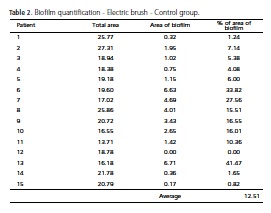
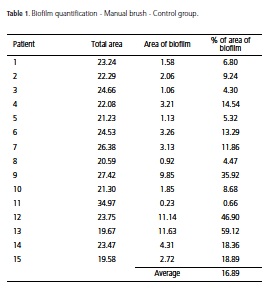
<body><![CDATA[<p><font size="2" face="Verdana, Arial, Helvetica, sans-serif">After the approval of the research project by the   Ethics Committee at the Ribeir&atilde;o Preto Faculty of Dentistry   (USP) (Filing no. 2003.1.1369.58.4), and the signing of a   patient consent form, 30 patients were selected from the   Full Prosthesis clinic, of both sexes, aged between 48 and   84 (average age of 64), with a good overall state of health   and users of full upper dentures made from thermally   polymerized acrylic resin, without cracks or patches and   having used the denture for at least 5 years. As for the   presence of biofilm, the dentures were selected according   to the Ambj&oslash;rnsen Additive Index<sup>21</sup>, and only subjects   wearing upper complete dentures with scores of "1" or higher were selected.</font></p>     <p><font size="2" face="Verdana, Arial, Helvetica, sans-serif"><B> Distribution of patients into groups</B></font></p>     <p><font size="2" face="Verdana, Arial, Helvetica, sans-serif">  The patients were randomly allocated to two   groups: a) control group: denture brushing using a brush   that is specific for complete dentures (Bitufo - Valinhos,   Brazil) and water; b) experimental group: brushing of the   dentures with an electric brush (Oral B - Oral B Servi&ccedil;o, Ind&uacute;stria e Com&eacute;rcio Ltda., S&atilde;o Paulo, Brazil) and water.</font></p>     <p><font size="2" face="Verdana, Arial, Helvetica, sans-serif">  To clean the dentures, the patients were instructed   to brush all surfaces of the complete dentures for 2   minutes, 3 times a day, after meals (breakfast, lunch and   dinner), with the supplied brushes, to rinse the oral cavity   with tap water and after each brushing of the dentures,   immerse the dentures in water overnight.</font></p>     <p><font size="2" face="Verdana, Arial, Helvetica, sans-serif">  By means of a practical demonstration of brushing,   both groups received instruction, observing the following   criteria: Moistening of the bristles with water, holding the   dentures in the palm of the hand over a sink containing   water to avoid damage to the prosthetic appliance in   the event that the denture is dropped during brushing;   brushing of the (internal and external) surfaces of the   dentures for 2 minutes.</font></p>     <p><font size="2" face="Verdana, Arial, Helvetica, sans-serif">  The products were used for 3 consecutive weeks,   i.e. the experiment lasted 21 days. </font></p>     <p><font size="2" face="Verdana, Arial, Helvetica, sans-serif"><B> Disclosure biofilm</B></font></p>     <p><font size="2" face="Verdana, Arial, Helvetica, sans-serif">Initially, the biofilm that was present on the   internal surface was totally removed through professional   cleaning with a brush specific to complete dentures,   (Denture - Condor S.A., S&atilde;o Bento do Sul, Brazil) and   liquid soap (Fennel Liquid Soap - JOB Qu&iacute;mica Produtos   para Limpeza Ltda., Ribeir&atilde;o Preto, Brazil). After 21 days   using the products, disclosure procedure was carried out   using neutral red solution at 1% and a photograph was   taken of the biofilm buildup on the internal surface of   the complete upper dentures. The digital camera (Nikon,   Coolpix 950) was positioned on the stand with the lens   turned towards the internal surface of the denture at an   angle of 45o. The distance was determined by the focus   of the central region of the palate of the largest denture.   Then the stained dentures were cleaned once again by the   professional, using a specific brush (Denture) and liquid   soap (JOB Qu&iacute;mica Produtos para Limpeza Ltda., Ribeir&atilde;o Preto, Brazil) and returned to the patients.</font></p>     <p><font size="2" face="Verdana, Arial, Helvetica, sans-serif"><B> Biofilm quantification</B></font></p>     <p><font size="2" face="Verdana, Arial, Helvetica, sans-serif">  The contours of the total area of the denture and   the area with biofilm, needed to determine the percentage   of biofilm buildup on the denture, were marked on t h e   Image Tool, (Windows version 3.0, The University of Texas   Health Science Center). Once the measurements of the two   areas (total and biofilm) were completed, the percentage   of the surface covered in biofilm was calculated as being   the ratio of the area of biofilm multiplied by 100 to the   total surface area of the internal base of the denture. The   data from the two methods were compared by way of the Student's t-test (p &lt; 0.05).</font></p>     ]]></body>
<body><![CDATA[<p><font size="3" face="Verdana, Arial, Helvetica, sans-serif"><B> RESULTS</B></font></p>     <p><font size="2" face="Verdana, Arial, Helvetica, sans-serif">Employing the Image Tool quantitative method,   the initial results for the areas (total and biofilm) of the   internal surfaces of the full upper dentures, after 21 days using these treatments, are shown in Tables <a href="#tab01">1</a> and <a href="#tab02">2</a>.</font></p>     <p><font size="2" face="Verdana, Arial, Helvetica, sans-serif">  For both groups, the majority of patients (n=12;   80%) had up to 20% of the analyzed area covered by   biofilm. In the manual brushing group, only one patient   (6.7%) presented 50% of the total area of the denture   covered in biofilm. In the group with the electric brushes,   three patients (20%) exhibited biofilm percentages   between 20% and 50%; and just one patient (6.7%)   presented no biofilm on the denture surface. It was noted   that the percentage averages of the areas of biofilm for   the two evaluated groups, i.e. the manual brushing group   and the group with the electric brushes, were 16.9% and   12.5%, respectively.</font></p>     <p>&nbsp;</p>     <p><a name="tab01"></a></p>     <p>&nbsp; </p>     <p align="center"><img src="/img/revistas/rgo/v61n1/a03tab01.jpg">     <p>&nbsp;</p>     <p><a name="tab02"></a></p>     <p>&nbsp; </p>     ]]></body>
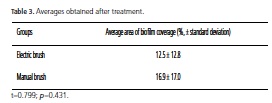
<body><![CDATA[<p align="center"><img src="/img/revistas/rgo/v61n1/a03tab02.jpg">     <p>&nbsp;</p>     <p><font size="2" face="Verdana, Arial, Helvetica, sans-serif"><B> Statistical analysis</B></font></p>     <p><font size="2" face="Verdana, Arial, Helvetica, sans-serif">  The data in the two methods were compared   by means of the Student's t-test (&alpha;&alpha;= 0.05). The software   application SPSS, version 12.0.0 for Windows (SPSS Inc.,   Chicago, Ill, USA) was used for the analysis. An average   area of biofilm coverage was observed (%, &plusmn; standard   deviation) of 12.5 &plusmn; 12.8 and 16.9 &plusmn; 17.0 for the electric   brush and manual brush, respectively (<a href="#tab03">Table 3</a>). The differences were not significant (t=0.799; p=0.431).</font></p>     <p>&nbsp;</p>     <p><a name="tab03"></a></p>     <p>&nbsp; </p>     <p align="center"><img src="/img/revistas/rgo/v61n1/a03tab03.jpg">     <p>&nbsp;</p>     <p><font size="3" face="Verdana, Arial, Helvetica, sans-serif"><B> DISCUSSION</B></font></p>     ]]></body>
<body><![CDATA[<p><font size="2" face="Verdana, Arial, Helvetica, sans-serif">One of the measures of effectiveness of a   complete denture cleaning agent is its ability to remove   biofilm. Nikawa et al.<sup>8</sup> call attention to the need for this   effectiveness to be evaluated through clinical studies as   in vitro results are not always in agreement with clinical reality.</font></p>     <p><font size="2" face="Verdana, Arial, Helvetica, sans-serif">  In the present study, the effectiveness of the   products was evaluated for the internal surfaces of full   upper dentures, as this represents an area of large buildup   of biofilm and great clinical importance in terms of the   relationship to pathologies found in complete denture   wearers. The analysis of the external surfaces was not   included, as it represents an area that is far easier to clean,   with lower levels of biofilm than the corresponding internal   surface<sup>22-23</sup>.</font></p>     <p><font size="2" face="Verdana, Arial, Helvetica, sans-serif">  Studies report greater efficiency with the electric   brush versus the manual brush, principally as far as the   removal of biofilm is concerned<sup>24-25</sup>, while other works   have reported that the electric brush possesses no   advantage over the manual brush<sup>26</sup>. There are no studies in   the literature, however, that have evaluated the efficiency   of the electric brush in removing prosthetic biofilm. The   majority of studies on electric brushes deal with the   removal of biofilm in patients that have teeth, principally   in the periodontal and pediatric areas. Accordingly, the   present study sought to evaluate clinically the effectiveness   of manual and electric brushing in terms of the properties   of biofilm removal of complete dentures.</font></p>     <p><font size="2" face="Verdana, Arial, Helvetica, sans-serif">  In the present study, the statistical analysis   employed (Student's t-test) showed there was no significant   difference between manual and electric brushing. Both   were effective in reducing biofilm when patients brushed   three times a day for 21 days, using only water.</font></p>     <p><font size="2" face="Verdana, Arial, Helvetica, sans-serif">  The results presented here are in agreement with   the study by Moran et al.<sup>27</sup> who compared the effectiveness   of an electric brush with a manual brush with the removal of   chlorhexidine/tea stains from teeth. The authors concluded   that both brushes removed a large part of the stains in just   one brushing session and that the cleaning effectiveness of   the two types of brush was statistically similar.</font></p>     <p><font size="2" face="Verdana, Arial, Helvetica, sans-serif">  In a parallel study, van der Weijden et al.<sup>28</sup> noted,   on comparing the effect of electrical and manual brushes   in removing biofilm and gingivitis in a seven-month clinical   trial, that no improvement was observed after using the   manual brush, bearing in mind that an increase in bleeding   was observed in the test group during the course of the   study. They concluded that no difference was observed   between the brushes during the test period of seven   months.</font></p>     <p><font size="2" face="Verdana, Arial, Helvetica, sans-serif">  It should be stressed, however, that the results   obtained here contradict those observed by Carter et al.<sup>29</sup>,   who concluded that the electric brush may be safely used   and that it promotes additional benefits over the manual   brush in the reduction of the rates of calculus and also   the incidence of biofilm. However, contrary to the present   study, usage instructions were not given for each type of   brush and perhaps the differences in the outcome reflect   this fact.</font></p>     <p><font size="2" face="Verdana, Arial, Helvetica, sans-serif">  The results found by Lazarescu et al.<sup>30</sup>, who   compared the effectiveness of removing biofilm from   electric and manual brushes in the general population and   analyzed the effect of giving instruction on proper usage,   are also in opposition. The authors observed that, after 18 weeks, the biofilm index dropped significantly in   the significantly more effective in removing biofilm and   improving gingival health in the group of patients not   familiar with electrical brushes. It is important to emphasize   that, in the methodology used in this study, a dentrifice   was used for the brushing, which could have produced the   discrepancy in the outcome, in contrast with the present   study.</font></p>     <p><font size="2" face="Verdana, Arial, Helvetica, sans-serif">  Similarly, Heasman et al.<sup>16</sup> concluded in their study   that electric brushes are more effective than manual brushes   in removing biofilm although a statistically significant   difference was only found with the interproximal surfaces.   However, unlike in the present study, a dentrifice was used   in conjunction with the brushes, which could have resulted   in the difference in the efficiency between the two types   of brushes.</font></p>     <p><font size="2" face="Verdana, Arial, Helvetica, sans-serif">  It should be stressed that, in the present study,   there were two limitations: the first limitation relates to   the reduced sample, explained by the difficulty in selecting   complete denture wearers who came within the criteria   demanded by the study in question; the second involves   the low levels of biofilm found after the use of the manual   and electric brushes, which may be explained by the   knowledge acquired by the patients in an earlier study on   proper brushing.</font></p>     ]]></body>
<body><![CDATA[<p><font size="2" face="Verdana, Arial, Helvetica, sans-serif">  So, for future studies, it is proposed to study a more   representative sample of complete denture wearers and a   group that has not received instructions on how to brush,   so as to ascertain the true effectiveness of the manual   and electric brushes when the patient carries out his/her   daily brushing. It is also planned to test the antimicrobial   action after the use of the manual and electric brushes and   ascertain if the electric brush could be recommended as   the standard for the cleaning of complete dentures.</font></p>     <p>&nbsp;</p>     <p><font size="3" face="Verdana, Arial, Helvetica, sans-serif"><B> CONCLUSION</B></font></p>     <p><font size="2" face="Verdana, Arial, Helvetica, sans-serif">Given the limitations of this study, it was possible   to conclude that both methods (manual and electrical   brushing) were equally effective in terms of the removal   of biofilm from complete dentures, and they may be used   as auxiliary agents in maintaining the oral hygiene of complete denture wearers.</font></p>     <p><font size="2" face="Verdana, Arial, Helvetica, sans-serif"><B> Acknowledgements</B></font></p>       <p><font size="2" face="Verdana, Arial, Helvetica, sans-serif">   The present study was carried out with the   backing of FAPESP, the S&atilde;o Paulo Research Foundation (no. 2005/55705-2). </font></p>     <p><font size="2" face="Verdana, Arial, Helvetica, sans-serif"><B> Collaborators</B></font></p>       <p><font size="2" face="Verdana, Arial, Helvetica, sans-serif">   IM ANDRADE and PC CRUZ took part in the   performance of the experimental work in the clinic, the   organization and distribution of the materials, guidance   to patients and were responsible for coordinating the   return visits as well as the composition of the article. BF   ZAMBONE was responsible for measuring the biofilm by   means of a reading of photographs using the image tool,   and the composition of the article. CH Silva-Lovato took   part in the performance of the experimental work in the   clinic, the distribution of materials, guidance for patients   and was responsible for taking the photographs and the   composition of the article. RF SOUZA was responsible for   the statistical analysis and interpretation, took part in the   performance of the experimental work and the composition   of the article. MCM SOUZA-GUGELMIN jointly directed the   study and took part in the performance of the experimental   work and the composition of the article. HFO PARANHOS   directed the work and participated in organizing the   planning of the experiments, the performance of the   experimental work in the clinic and the composition of the   article. </font></p>     <p>&nbsp;</p>     <p><font size="3" face="Verdana, Arial, Helvetica, sans-serif"><B>REFERENCES </B></font></p>     ]]></body>
<body><![CDATA[<!-- ref --><p><font size="2" face="Verdana, Arial, Helvetica, sans-serif">1. Kanli A, Demirel F, Sezgin Y. Oral candidosis, denture cleanliness   and hygiene habits in an elderly population. Aging Clin Exp Res. 2005;17(6):502-7.    &nbsp;&nbsp;&nbsp;&nbsp;&nbsp;&nbsp;&nbsp;&nbsp;[&#160;<a href="javascript:void(0);" onclick="javascript: window.open('/scielo.php?script=sci_nlinks&ref=204826&pid=S1981-8637201300010000300001&lng=','','width=640,height=500,resizable=yes,scrollbars=1,menubar=yes,');">Links</a>&#160;]<!-- end-ref --></font></p>     <p><font size="2" face="Verdana, Arial, Helvetica, sans-serif"> 2. Marchini L, Vieira PC, Bossan TP, Montenegro FL, Cunha VP.   Self-reported oral hygiene habits among institutionalized elderly   and their relationship to the condition of oral tissues in Taubate,    <br>   Brazil. Gerodontology. 2006;23(1):33-7. doi: 10.1111/j.1741-2358.2006.00092.x.</font></p>     <!-- ref --><p><font size="2" face="Verdana, Arial, Helvetica, sans-serif"> 3. Coelho CM, Souza YT, Dare AM. Denture-related oral mucosal   lesions in a Brazilian school of dentistry. J Oral Rehabil.   2004;31(2):135-9. doi: 10.1111/j.1365-2842.2004.01115.x.    &nbsp;&nbsp;&nbsp;&nbsp;&nbsp;&nbsp;&nbsp;&nbsp;[&#160;<a href="javascript:void(0);" onclick="javascript: window.open('/scielo.php?script=sci_nlinks&ref=204830&pid=S1981-8637201300010000300003&lng=','','width=640,height=500,resizable=yes,scrollbars=1,menubar=yes,');">Links</a>&#160;]<!-- end-ref --></font></p>     <!-- ref --><p><font size="2" face="Verdana, Arial, Helvetica, sans-serif"> 4. Marchini L, Tamashiro E, Nascimento DFF, Cunha VP. Selfreported   denture hygiene of a sample of edentulous attendees   at a University dental clinic and the relationship to the condition   of the oral tissues. Gerodontology. 2004;21(4):226-8. doi:   10.1111/j.1741-2358.2004.00026.x.    &nbsp;&nbsp;&nbsp;&nbsp;&nbsp;&nbsp;&nbsp;&nbsp;[&#160;<a href="javascript:void(0);" onclick="javascript: window.open('/scielo.php?script=sci_nlinks&ref=204832&pid=S1981-8637201300010000300004&lng=','','width=640,height=500,resizable=yes,scrollbars=1,menubar=yes,');">Links</a>&#160;]<!-- end-ref --></font></p>     <p><font size="2" face="Verdana, Arial, Helvetica, sans-serif"> 5. Nikawa H, Hamada T, Yamamoto T. Denture plaque&ndash;past and   recent concerns. J Dent. 1998;26(4):299-304. doi: 10.1016/   S0300-5712(97)00026-2.</font></p>     <!-- ref --><p><font size="2" face="Verdana, Arial, Helvetica, sans-serif"> 6. Verran J. Malodour in denture wearers: an ill-defined problem.   Oral Dis. 2005;11(suppl. 1):24-8.    &nbsp;&nbsp;&nbsp;&nbsp;&nbsp;&nbsp;&nbsp;&nbsp;[&#160;<a href="javascript:void(0);" onclick="javascript: window.open('/scielo.php?script=sci_nlinks&ref=204835&pid=S1981-8637201300010000300006&lng=','','width=640,height=500,resizable=yes,scrollbars=1,menubar=yes,');">Links</a>&#160;]<!-- end-ref --></font></p>     <!-- ref --><p><font size="2" face="Verdana, Arial, Helvetica, sans-serif"> 7. Akpan A, Morgan R. Oral candidiasis. Postgrad Med J. 2002;78(1):455-9. doi: 10.1136/pmj.78.922.455.    &nbsp;&nbsp;&nbsp;&nbsp;&nbsp;&nbsp;&nbsp;&nbsp;[&#160;<a href="javascript:void(0);" onclick="javascript: window.open('/scielo.php?script=sci_nlinks&ref=204837&pid=S1981-8637201300010000300007&lng=','','width=640,height=500,resizable=yes,scrollbars=1,menubar=yes,');">Links</a>&#160;]<!-- end-ref --></font></p>     <!-- ref --><p><font size="2" face="Verdana, Arial, Helvetica, sans-serif"> 8. Nikawa H, Hamada T, Yamashiro H, Kumagai H. A review of in   vitro and in vivo methods to evaluate the efficacy of denture   cleansers. Int J Prosthodont. 1999;12(2):153-9.    &nbsp;&nbsp;&nbsp;&nbsp;&nbsp;&nbsp;&nbsp;&nbsp;[&#160;<a href="javascript:void(0);" onclick="javascript: window.open('/scielo.php?script=sci_nlinks&ref=204839&pid=S1981-8637201300010000300008&lng=','','width=640,height=500,resizable=yes,scrollbars=1,menubar=yes,');">Links</a>&#160;]<!-- end-ref --></font></p>     <!-- ref --><p><font size="2" face="Verdana, Arial, Helvetica, sans-serif"> 9. Imsand M, Janssens JP, Auckenthaler R, Mojon P, Budtz-J&oslash;rgensen E. Bronchopneumonia and oral health in hospitalized   older patients: a pilot study. Gerodontology. 2002;19(2):66-72.   doi: 10.1111/j.1741-2358.2002.00066.x.    &nbsp;&nbsp;&nbsp;&nbsp;&nbsp;&nbsp;&nbsp;&nbsp;[&#160;<a href="javascript:void(0);" onclick="javascript: window.open('/scielo.php?script=sci_nlinks&ref=204841&pid=S1981-8637201300010000300009&lng=','','width=640,height=500,resizable=yes,scrollbars=1,menubar=yes,');">Links</a>&#160;]<!-- end-ref --></font></p>     <!-- ref --><p><font size="2" face="Verdana, Arial, Helvetica, sans-serif"> 10. Netto RL, Macedo NL, Lima FR, Souza WLA, Ferreira UR. Efeito   da escova&ccedil;&atilde;o orientada, do fluoreto estanhoso e da clorexidina   sobre a forma&ccedil;&atilde;o da placa bacteriana. RGO - Rev Ga&uacute;cha   Odontol. 1987;35(4):259-63.    &nbsp;&nbsp;&nbsp;&nbsp;&nbsp;&nbsp;&nbsp;&nbsp;[&#160;<a href="javascript:void(0);" onclick="javascript: window.open('/scielo.php?script=sci_nlinks&ref=204843&pid=S1981-8637201300010000300010&lng=','','width=640,height=500,resizable=yes,scrollbars=1,menubar=yes,');">Links</a>&#160;]<!-- end-ref --></font></p>     <!-- ref --><p><font size="2" face="Verdana, Arial, Helvetica, sans-serif"> 11. Paranhos HFO, Silva-Lovato CH, Souza RF, Cruz PC, Freitas KM,   Peracini A. Effects of mechanical and chemical methods on   denture biofilm accumulation. J Oral Rehabil. 2007;34(8):606-   12. doi: 10.1111/j.1365-2842.2007.01753.x.    &nbsp;&nbsp;&nbsp;&nbsp;&nbsp;&nbsp;&nbsp;&nbsp;[&#160;<a href="javascript:void(0);" onclick="javascript: window.open('/scielo.php?script=sci_nlinks&ref=204845&pid=S1981-8637201300010000300011&lng=','','width=640,height=500,resizable=yes,scrollbars=1,menubar=yes,');">Links</a>&#160;]<!-- end-ref --></font></p>     <p><font size="2" face="Verdana, Arial, Helvetica, sans-serif"> 12. Paranhos HFO, Silva-Lovato CH, Venezian GC, Macedo LD,   Souza RF. Distribution of biofilm on internal and external surfaces   of upper complete dentures: the effect of hygiene instruction.    <br>   Gerodontology. 2007;24(3):162-8. doi: 10.1111/j.1741-2358.2007.00177.x.</font></p>     <!-- ref --><p><font size="2" face="Verdana, Arial, Helvetica, sans-serif"> 13. Harrison Z, Johnson A, Douglas CW. An in vitro study into   the effect of a limited range of denture cleaners on surface   roughness and removal of Candida albicans from conventional   heat-cured acrylic resin denture base material. J Oral Rehabil.   2004;31(5):460-7. doi: 10.1111/j.1365-2842.2004.01250.x.    &nbsp;&nbsp;&nbsp;&nbsp;&nbsp;&nbsp;&nbsp;&nbsp;[&#160;<a href="javascript:void(0);" onclick="javascript: window.open('/scielo.php?script=sci_nlinks&ref=204849&pid=S1981-8637201300010000300013&lng=','','width=640,height=500,resizable=yes,scrollbars=1,menubar=yes,');">Links</a>&#160;]<!-- end-ref --></font></p>     <!-- ref --><p><font size="2" face="Verdana, Arial, Helvetica, sans-serif"> 14. Naressi WG, Moreira EJG. Odontologia preventiva. RGO - Rev   Ga&uacute;cha Odontol. 1983;31(3):281-3.    &nbsp;&nbsp;&nbsp;&nbsp;&nbsp;&nbsp;&nbsp;&nbsp;[&#160;<a href="javascript:void(0);" onclick="javascript: window.open('/scielo.php?script=sci_nlinks&ref=204851&pid=S1981-8637201300010000300014&lng=','','width=640,height=500,resizable=yes,scrollbars=1,menubar=yes,');">Links</a>&#160;]<!-- end-ref --></font></p>     <!-- ref --><p><font size="2" face="Verdana, Arial, Helvetica, sans-serif"> 15. Ciancio S. Electric toothbrushes - for whom are they designed? Adv   Dent Res. 2002;16(1):6-8. doi: 10.1177/154407370201600103.    &nbsp;&nbsp;&nbsp;&nbsp;&nbsp;&nbsp;&nbsp;&nbsp;[&#160;<a href="javascript:void(0);" onclick="javascript: window.open('/scielo.php?script=sci_nlinks&ref=204853&pid=S1981-8637201300010000300015&lng=','','width=640,height=500,resizable=yes,scrollbars=1,menubar=yes,');">Links</a>&#160;]<!-- end-ref --></font></p>     <!-- ref --><p><font size="2" face="Verdana, Arial, Helvetica, sans-serif"> 16. Heasman PA, Stacey F, Heasman L, Sellers P, Macgregor IDM, Kelly   PJ. A comparative study of the Philips HP 735, Braun/Oral B D7   and the Oral B 35 Advantage toothbrushes. J Clin Periodontol.   1999;26(2):85-90. doi: 10.1034/j.1600-051X.1999.260204.x.    &nbsp;&nbsp;&nbsp;&nbsp;&nbsp;&nbsp;&nbsp;&nbsp;[&#160;<a href="javascript:void(0);" onclick="javascript: window.open('/scielo.php?script=sci_nlinks&ref=204855&pid=S1981-8637201300010000300016&lng=','','width=640,height=500,resizable=yes,scrollbars=1,menubar=yes,');">Links</a>&#160;]<!-- end-ref --></font></p>     <!-- ref --><p><font size="2" face="Verdana, Arial, Helvetica, sans-serif"> 17. Tawse-Smith A, Duncan WJ, Payne AG, Thomson WM,   Wennstrom JL. Relative effectiveness of powered and manual   toothbrushes in elderly patients with implant-supported   mandibular overdentures. J Clin Periodontol. 2002;29(4):275-80. doi: 10.1034/j.1600-051X.2002.290401.x.    &nbsp;&nbsp;&nbsp;&nbsp;&nbsp;&nbsp;&nbsp;&nbsp;[&#160;<a href="javascript:void(0);" onclick="javascript: window.open('/scielo.php?script=sci_nlinks&ref=204857&pid=S1981-8637201300010000300017&lng=','','width=640,height=500,resizable=yes,scrollbars=1,menubar=yes,');">Links</a>&#160;]<!-- end-ref --></font></p>     <p><font size="2" face="Verdana, Arial, Helvetica, sans-serif"> 18. Cronin MJ, Dembling WZ, Cugini MA, Thompson MC, Warren   PR. Three-month assessment of safety and efficacy of two   electric toothbrushes. J Dent. 2005;33(Suppl 1):23-8. doi:    <br>   10.1016/S0300-5712(05)80004-1.</font></p>     <!-- ref --><p><font size="2" face="Verdana, Arial, Helvetica, sans-serif"> 19. Goyal CR, Sharma NC, Oagish JG, Cugini MA, Thompson MC,   Warren PR. Efficacy of a novel brush head in the comparison of   two power toothbrushes on removal of plaque and naturally   occurring extrinsic stain. J Dent. 2005;33(Suppl. 1):37-43. doi:   10.1016/S0300-5712(05)80006-5.    &nbsp;&nbsp;&nbsp;&nbsp;&nbsp;&nbsp;&nbsp;&nbsp;[&#160;<a href="javascript:void(0);" onclick="javascript: window.open('/scielo.php?script=sci_nlinks&ref=204861&pid=S1981-8637201300010000300019&lng=','','width=640,height=500,resizable=yes,scrollbars=1,menubar=yes,');">Links</a>&#160;]<!-- end-ref --></font></p>     <!-- ref --><p><font size="2" face="Verdana, Arial, Helvetica, sans-serif"> 20. Sharma NC, Oagish JG, Galustians HJ, Goyal CR, Cugini MA,   Thompson MC, et al. Plaque removal efficacy of two electric   toothbrushes with different brush head designs. J Dent.   2005;33(Suppl. 1):17-21.    &nbsp;&nbsp;&nbsp;&nbsp;&nbsp;&nbsp;&nbsp;&nbsp;[&#160;<a href="javascript:void(0);" onclick="javascript: window.open('/scielo.php?script=sci_nlinks&ref=204863&pid=S1981-8637201300010000300020&lng=','','width=640,height=500,resizable=yes,scrollbars=1,menubar=yes,');">Links</a>&#160;]<!-- end-ref --></font></p>     <!-- ref --><p><font size="2" face="Verdana, Arial, Helvetica, sans-serif"> 21. Ambj&oslash;rgensen E, Vauderhaug J, Norheim PW, Fl&oslash;ystrand F.   Assessment of an additive index for plaque accumulation   on complete maxillary dentures. Acta Odontol Scand.   1982;40(4):203-8.    &nbsp;&nbsp;&nbsp;&nbsp;&nbsp;&nbsp;&nbsp;&nbsp;[&#160;<a href="javascript:void(0);" onclick="javascript: window.open('/scielo.php?script=sci_nlinks&ref=204865&pid=S1981-8637201300010000300021&lng=','','width=640,height=500,resizable=yes,scrollbars=1,menubar=yes,');">Links</a>&#160;]<!-- end-ref --></font></p>     <!-- ref --><p><font size="2" face="Verdana, Arial, Helvetica, sans-serif"> 22. Fernandes RAG, Silva-Lovato CH, Paranhos HFO, Ito IY. Efic&aacute;cia   de escovas para pr&oacute;teses totais: propriedade de remo&ccedil;&atilde;o de   biofilme e a&ccedil;&atilde;o antimicrobiana. Braz Oral Res. 2006;20(1):252.    &nbsp;&nbsp;&nbsp;&nbsp;&nbsp;&nbsp;&nbsp;&nbsp;[&#160;<a href="javascript:void(0);" onclick="javascript: window.open('/scielo.php?script=sci_nlinks&ref=204867&pid=S1981-8637201300010000300022&lng=','','width=640,height=500,resizable=yes,scrollbars=1,menubar=yes,');">Links</a>&#160;]<!-- end-ref --></font></p>     <!-- ref --><p><font size="2" face="Verdana, Arial, Helvetica, sans-serif"> 23. Paranhos HFO, Lara EHG, Panzeri H, Candido RC, Ito IY. Capacity   of denture plaque/biofilm removal and antimicrobial action of a   new denture paste. Braz Dent J. 2000;11(2):97-104.    &nbsp;&nbsp;&nbsp;&nbsp;&nbsp;&nbsp;&nbsp;&nbsp;[&#160;<a href="javascript:void(0);" onclick="javascript: window.open('/scielo.php?script=sci_nlinks&ref=204869&pid=S1981-8637201300010000300023&lng=','','width=640,height=500,resizable=yes,scrollbars=1,menubar=yes,');">Links</a>&#160;]<!-- end-ref --></font></p>     <!-- ref --><p><font size="2" face="Verdana, Arial, Helvetica, sans-serif"> 24. van der Weijden GA, Timmerman MF, Reijerse E, Snoek CM,   van der Velden U. Comparison of two electric toothbrushes in   plaque removing ability. Professional and supervised brushing.   J Clin Periodontol. 1995;22(8):648-52. doi: 10.1111/j.1600-051X.1995.tb00819.x</font>&nbsp;&nbsp;&nbsp;&nbsp;&nbsp;&nbsp;&nbsp;&nbsp;[&#160;<a href="javascript:void(0);" onclick="javascript: window.open('/scielo.php?script=sci_nlinks&ref=204871&pid=S1981-8637201300010000300024&lng=','','width=640,height=500,resizable=yes,scrollbars=1,menubar=yes,');">Links</a>&#160;]<!-- end-ref --><!-- ref --><p><font size="2" face="Verdana, Arial, Helvetica, sans-serif"> 25. Quirynen M, Vervliet E, Teerlinck J, Darius P, van Steenberghe D.   Medium - and long-term effectiveness of a counter-rotational   electric toothbrush on plaque removal, gingival bleeding, and   probing pocket depth. Int J Periodontics Restorative Dent.   1994;14(1):364-77.    &nbsp;&nbsp;&nbsp;&nbsp;&nbsp;&nbsp;&nbsp;&nbsp;[&#160;<a href="javascript:void(0);" onclick="javascript: window.open('/scielo.php?script=sci_nlinks&ref=204872&pid=S1981-8637201300010000300025&lng=','','width=640,height=500,resizable=yes,scrollbars=1,menubar=yes,');">Links</a>&#160;]<!-- end-ref --></font></p>     <!-- ref --><p><font size="2" face="Verdana, Arial, Helvetica, sans-serif"> 26. Ainamo J, Hormia M, Kaunisaho K, Sorsa T, Suomalainen K.   Effect of manual versus powered toothbrushes. J Dent Res.   1991;70(1):557.    &nbsp;&nbsp;&nbsp;&nbsp;&nbsp;&nbsp;&nbsp;&nbsp;[&#160;<a href="javascript:void(0);" onclick="javascript: window.open('/scielo.php?script=sci_nlinks&ref=204874&pid=S1981-8637201300010000300026&lng=','','width=640,height=500,resizable=yes,scrollbars=1,menubar=yes,');">Links</a>&#160;]<!-- end-ref --></font></p>     ]]></body>
<body><![CDATA[<!-- ref --><p><font size="2" face="Verdana, Arial, Helvetica, sans-serif"> 27. Moran J, Addy M, Courtney M, Smith S, Newcombe R. A clinical   study to assess the ability of a powered toothbrush to remove   chlorhexidine/tea dental stain. J Clin Periodontol. 2004;31(1):95-8. doi: 10.1111/j.0303-6979.2004.00449.x.    &nbsp;&nbsp;&nbsp;&nbsp;&nbsp;&nbsp;&nbsp;&nbsp;[&#160;<a href="javascript:void(0);" onclick="javascript: window.open('/scielo.php?script=sci_nlinks&ref=204876&pid=S1981-8637201300010000300027&lng=','','width=640,height=500,resizable=yes,scrollbars=1,menubar=yes,');">Links</a>&#160;]<!-- end-ref --></font></p>     <p><font size="2" face="Verdana, Arial, Helvetica, sans-serif"> 28. van der Weijden GA, Timmerman MF, Piscaer M, Snoek I, van der   Velden U, Galgut PN. Effectiveness of an electrically active brush   in the removal of overnight plaque and treatment of gingivitis.    <br>   J Clin Periodontol. 2002;29(1):699-704. doi: 10.1034/j.1600-051X.2002.290806.x.</font></p>     <p><font size="2" face="Verdana, Arial, Helvetica, sans-serif"> 29. Carter K, Landini G, Walmsley AD. Plaque removal characteristics   of electric toothbrushes using an in vitro plaque model. J   Clin Periodontol. 2001;28(11):1045-9. doi: 10.1111/j.1600-    <br>   051X.2001.281109.x.</font></p>     <p><font size="2" face="Verdana, Arial, Helvetica, sans-serif"> 30. Lazarescu D, Boccaneala S, Iliescu A, De Boever JA. Efficacy   of plaque removal and learning effect of a powered and a   manual toothbrush. J Clin Periodontol. 2003;30(8):726-31. doi:    <br>   10.1034/j.1600-051X.2003.00361.x.</font></p>     <p>&nbsp;</p>     <p>&nbsp;</p>     ]]></body>
<body><![CDATA[<p><font size="2" face="Verdana, Arial, Helvetica, sans-serif"><a name="back"/></a><a href="#top"><img src="/img/revistas/rgo/v61n1/seta.jpg" border="0" align="absmiddle"/></a><b>Correspondence to:</b>    <br>   </font><font size="2" face="Verdana, Arial, Helvetica, sans-serif">IM ANDRADE    <br>   Av. do Caf&eacute;, s/n., Monte Alegre, 14040-904, Ribeir&atilde;o Preto, SP, Brasil.</font><font size="2" face="Verdana, Arial, Helvetica, sans-serif">    <br>   e-mail: </font><font size="2" face="Verdana, Arial, Helvetica, sans-serif"><a href="mailto:ingridma76@yahoo.com.br" target="_blank">ingridma76@yahoo.com.br</a></font></p>     <p>&nbsp;</p>       <p><font face="Verdana, Arial, Helvetica, sans-serif" size="2"><b>Received on:</b> 10/6/2009<br/> <b>Final version resubmitted on:</b> 21/10/2009<br/> <b>Approved on:</b> 10/11/2009</font></p>     <p>&nbsp;</p>      ]]></body>
<back>
<ref-list>
<ref id="B1">
<label>1</label><nlm-citation citation-type="journal">
<person-group person-group-type="author">
<name>
<surname><![CDATA[Kanli]]></surname>
<given-names><![CDATA[A]]></given-names>
</name>
<name>
<surname><![CDATA[Demirel]]></surname>
<given-names><![CDATA[F]]></given-names>
</name>
<name>
<surname><![CDATA[Sezgin]]></surname>
<given-names><![CDATA[Y]]></given-names>
</name>
</person-group>
<article-title xml:lang="en"><![CDATA[Oral candidosis, denture cleanliness and hygiene habits in an elderly population]]></article-title>
<source><![CDATA[Aging Clin Exp Res]]></source>
<year>2005</year>
<volume>17</volume>
<numero>6</numero>
<issue>6</issue>
<page-range>502-7</page-range></nlm-citation>
</ref>
<ref id="B2">
<label>2</label><nlm-citation citation-type="journal">
<person-group person-group-type="author">
<name>
<surname><![CDATA[Marchini]]></surname>
<given-names><![CDATA[L]]></given-names>
</name>
<name>
<surname><![CDATA[Vieira]]></surname>
<given-names><![CDATA[PC]]></given-names>
</name>
<name>
<surname><![CDATA[Bossan]]></surname>
<given-names><![CDATA[TP]]></given-names>
</name>
<name>
<surname><![CDATA[Montenegro]]></surname>
<given-names><![CDATA[FL]]></given-names>
</name>
<name>
<surname><![CDATA[Cunha]]></surname>
<given-names><![CDATA[VP]]></given-names>
</name>
</person-group>
<article-title xml:lang="en"><![CDATA[Self-reported oral hygiene habits among institutionalized elderly and their relationship to the condition of oral tissues in Taubate, Brazil]]></article-title>
<source><![CDATA[Gerodontology]]></source>
<year>2006</year>
<volume>23</volume>
<numero>1</numero>
<issue>1</issue>
<page-range>33-7</page-range></nlm-citation>
</ref>
<ref id="B3">
<label>3</label><nlm-citation citation-type="journal">
<person-group person-group-type="author">
<name>
<surname><![CDATA[Coelho]]></surname>
<given-names><![CDATA[CM]]></given-names>
</name>
<name>
<surname><![CDATA[Souza]]></surname>
<given-names><![CDATA[YT]]></given-names>
</name>
<name>
<surname><![CDATA[Dare]]></surname>
<given-names><![CDATA[AM]]></given-names>
</name>
</person-group>
<article-title xml:lang="en"><![CDATA[Denture-related oral mucosal lesions in a Brazilian school of dentistry]]></article-title>
<source><![CDATA[J Oral Rehabil]]></source>
<year>2004</year>
<volume>31</volume>
<numero>2</numero>
<issue>2</issue>
<page-range>135-9</page-range></nlm-citation>
</ref>
<ref id="B4">
<label>4</label><nlm-citation citation-type="journal">
<person-group person-group-type="author">
<name>
<surname><![CDATA[Marchini]]></surname>
<given-names><![CDATA[L]]></given-names>
</name>
<name>
<surname><![CDATA[Tamashiro]]></surname>
<given-names><![CDATA[E]]></given-names>
</name>
<name>
<surname><![CDATA[Nascimento]]></surname>
<given-names><![CDATA[DFF]]></given-names>
</name>
<name>
<surname><![CDATA[Cunha]]></surname>
<given-names><![CDATA[VP]]></given-names>
</name>
</person-group>
<article-title xml:lang="en"><![CDATA[Selfreported denture hygiene of a sample of edentulous attendees at a University dental clinic and the relationship to the condition of the oral tissues]]></article-title>
<source><![CDATA[Gerodontology]]></source>
<year>2004</year>
<volume>21</volume>
<numero>4</numero>
<issue>4</issue>
<page-range>226-8</page-range></nlm-citation>
</ref>
<ref id="B5">
<label>5</label><nlm-citation citation-type="journal">
<person-group person-group-type="author">
<name>
<surname><![CDATA[Nikawa]]></surname>
<given-names><![CDATA[H]]></given-names>
</name>
<name>
<surname><![CDATA[Hamada]]></surname>
<given-names><![CDATA[T]]></given-names>
</name>
<name>
<surname><![CDATA[Yamamoto]]></surname>
<given-names><![CDATA[T]]></given-names>
</name>
</person-group>
<article-title xml:lang="en"><![CDATA[Denture plaque-past and recent concerns]]></article-title>
<source><![CDATA[J Dent]]></source>
<year>1998</year>
<volume>26</volume>
<numero>4</numero>
<issue>4</issue>
<page-range>299-304</page-range></nlm-citation>
</ref>
<ref id="B6">
<label>6</label><nlm-citation citation-type="journal">
<person-group person-group-type="author">
<name>
<surname><![CDATA[Verran]]></surname>
<given-names><![CDATA[J]]></given-names>
</name>
</person-group>
<article-title xml:lang="en"><![CDATA[Malodour in denture wearers: an ill-defined problem]]></article-title>
<source><![CDATA[Oral Dis]]></source>
<year>2005</year>
<volume>11</volume>
<numero>^s1</numero>
<issue>^s1</issue>
<supplement>1</supplement>
<page-range>24-8</page-range></nlm-citation>
</ref>
<ref id="B7">
<label>7</label><nlm-citation citation-type="journal">
<person-group person-group-type="author">
<name>
<surname><![CDATA[Akpan]]></surname>
<given-names><![CDATA[A]]></given-names>
</name>
<name>
<surname><![CDATA[Morgan]]></surname>
<given-names><![CDATA[R]]></given-names>
</name>
</person-group>
<article-title xml:lang="en"><![CDATA[Oral candidiasis]]></article-title>
<source><![CDATA[Postgrad Med J]]></source>
<year>2002</year>
<volume>78</volume>
<numero>1</numero>
<issue>1</issue>
<page-range>455-9</page-range></nlm-citation>
</ref>
<ref id="B8">
<label>8</label><nlm-citation citation-type="journal">
<person-group person-group-type="author">
<name>
<surname><![CDATA[Nikawa]]></surname>
<given-names><![CDATA[H]]></given-names>
</name>
<name>
<surname><![CDATA[Hamada]]></surname>
<given-names><![CDATA[T]]></given-names>
</name>
<name>
<surname><![CDATA[Yamashiro]]></surname>
<given-names><![CDATA[H]]></given-names>
</name>
<name>
<surname><![CDATA[Kumagai]]></surname>
<given-names><![CDATA[H]]></given-names>
</name>
</person-group>
<article-title xml:lang="en"><![CDATA[A review of in vitro and in vivo methods to evaluate the efficacy of denture cleansers]]></article-title>
<source><![CDATA[Int J Prosthodont]]></source>
<year>1999</year>
<volume>12</volume>
<numero>2</numero>
<issue>2</issue>
<page-range>153-9</page-range></nlm-citation>
</ref>
<ref id="B9">
<label>9</label><nlm-citation citation-type="journal">
<person-group person-group-type="author">
<name>
<surname><![CDATA[Imsand]]></surname>
<given-names><![CDATA[M]]></given-names>
</name>
<name>
<surname><![CDATA[Janssens]]></surname>
<given-names><![CDATA[JP]]></given-names>
</name>
<name>
<surname><![CDATA[Auckenthaler]]></surname>
<given-names><![CDATA[R]]></given-names>
</name>
<name>
<surname><![CDATA[Mojon]]></surname>
<given-names><![CDATA[P]]></given-names>
</name>
<name>
<surname><![CDATA[Budtz-Jørgensen]]></surname>
<given-names><![CDATA[E]]></given-names>
</name>
</person-group>
<article-title xml:lang="en"><![CDATA[Bronchopneumonia and oral health in hospitalized older patients: a pilot study]]></article-title>
<source><![CDATA[Gerodontology]]></source>
<year>2002</year>
<volume>19</volume>
<numero>2</numero>
<issue>2</issue>
<page-range>66-72</page-range></nlm-citation>
</ref>
<ref id="B10">
<label>10</label><nlm-citation citation-type="journal">
<person-group person-group-type="author">
<name>
<surname><![CDATA[Netto]]></surname>
<given-names><![CDATA[RL]]></given-names>
</name>
<name>
<surname><![CDATA[Macedo]]></surname>
<given-names><![CDATA[NL]]></given-names>
</name>
<name>
<surname><![CDATA[Lima]]></surname>
<given-names><![CDATA[FR]]></given-names>
</name>
<name>
<surname><![CDATA[Souza]]></surname>
<given-names><![CDATA[WLA]]></given-names>
</name>
<name>
<surname><![CDATA[Ferreira]]></surname>
<given-names><![CDATA[UR]]></given-names>
</name>
</person-group>
<article-title xml:lang="pt"><![CDATA[Efeito da escovação orientada, do fluoreto estanhoso e da clorexidina sobre a formação da placa bacteriana]]></article-title>
<source><![CDATA[RGO - Rev Gaúcha Odontol]]></source>
<year>1987</year>
<volume>35</volume>
<numero>4</numero>
<issue>4</issue>
<page-range>259-63</page-range></nlm-citation>
</ref>
<ref id="B11">
<label>11</label><nlm-citation citation-type="journal">
<person-group person-group-type="author">
<name>
<surname><![CDATA[Paranhos]]></surname>
<given-names><![CDATA[HFO]]></given-names>
</name>
<name>
<surname><![CDATA[Silva-Lovato]]></surname>
<given-names><![CDATA[CH]]></given-names>
</name>
<name>
<surname><![CDATA[Souza]]></surname>
<given-names><![CDATA[RF]]></given-names>
</name>
<name>
<surname><![CDATA[Cruz]]></surname>
<given-names><![CDATA[PC]]></given-names>
</name>
<name>
<surname><![CDATA[Freitas]]></surname>
<given-names><![CDATA[KM]]></given-names>
</name>
<name>
<surname><![CDATA[Peracini]]></surname>
<given-names><![CDATA[A]]></given-names>
</name>
</person-group>
<article-title xml:lang="en"><![CDATA[Effects of mechanical and chemical methods on denture biofilm accumulation]]></article-title>
<source><![CDATA[J Oral Rehabil]]></source>
<year>2007</year>
<volume>34</volume>
<numero>8</numero>
<issue>8</issue>
<page-range>606- 12</page-range></nlm-citation>
</ref>
<ref id="B12">
<label>12</label><nlm-citation citation-type="journal">
<person-group person-group-type="author">
<name>
<surname><![CDATA[Paranhos]]></surname>
<given-names><![CDATA[HFO]]></given-names>
</name>
<name>
<surname><![CDATA[Silva-Lovato]]></surname>
<given-names><![CDATA[CH]]></given-names>
</name>
<name>
<surname><![CDATA[Venezian]]></surname>
<given-names><![CDATA[GC]]></given-names>
</name>
<name>
<surname><![CDATA[Macedo]]></surname>
<given-names><![CDATA[LD]]></given-names>
</name>
<name>
<surname><![CDATA[Souza]]></surname>
<given-names><![CDATA[RF]]></given-names>
</name>
</person-group>
<article-title xml:lang="en"><![CDATA[Distribution of biofilm on internal and external surfaces of upper complete dentures: the effect of hygiene instruction]]></article-title>
<source><![CDATA[Gerodontology]]></source>
<year>2007</year>
<volume>24</volume>
<numero>3</numero>
<issue>3</issue>
<page-range>162-8</page-range></nlm-citation>
</ref>
<ref id="B13">
<label>13</label><nlm-citation citation-type="journal">
<person-group person-group-type="author">
<name>
<surname><![CDATA[Harrison]]></surname>
<given-names><![CDATA[Z]]></given-names>
</name>
<name>
<surname><![CDATA[Johnson]]></surname>
<given-names><![CDATA[A]]></given-names>
</name>
<name>
<surname><![CDATA[Douglas]]></surname>
<given-names><![CDATA[CW]]></given-names>
</name>
</person-group>
<article-title xml:lang="en"><![CDATA[An in vitro study into the effect of a limited range of denture cleaners on surface roughness and removal of Candida albicans from conventional heat-cured acrylic resin denture base material]]></article-title>
<source><![CDATA[J Oral Rehabil]]></source>
<year>2004</year>
<volume>31</volume>
<numero>5</numero>
<issue>5</issue>
<page-range>460-7</page-range></nlm-citation>
</ref>
<ref id="B14">
<label>14</label><nlm-citation citation-type="journal">
<person-group person-group-type="author">
<name>
<surname><![CDATA[Naressi]]></surname>
<given-names><![CDATA[WG]]></given-names>
</name>
<name>
<surname><![CDATA[Moreira]]></surname>
<given-names><![CDATA[EJG]]></given-names>
</name>
</person-group>
<article-title xml:lang="pt"><![CDATA[Odontologia preventiva]]></article-title>
<source><![CDATA[RGO - Rev Gaúcha Odontol]]></source>
<year>1983</year>
<volume>31</volume>
<numero>3</numero>
<issue>3</issue>
<page-range>281-3</page-range></nlm-citation>
</ref>
<ref id="B15">
<label>15</label><nlm-citation citation-type="journal">
<person-group person-group-type="author">
<name>
<surname><![CDATA[Ciancio]]></surname>
<given-names><![CDATA[S]]></given-names>
</name>
</person-group>
<article-title xml:lang="en"><![CDATA[Electric toothbrushes: for whom are they designed?]]></article-title>
<source><![CDATA[Adv Dent Res]]></source>
<year>2002</year>
<volume>16</volume>
<numero>1</numero>
<issue>1</issue>
<page-range>6-8</page-range></nlm-citation>
</ref>
<ref id="B16">
<label>16</label><nlm-citation citation-type="journal">
<person-group person-group-type="author">
<name>
<surname><![CDATA[Heasman]]></surname>
<given-names><![CDATA[PA]]></given-names>
</name>
<name>
<surname><![CDATA[Stacey]]></surname>
<given-names><![CDATA[F]]></given-names>
</name>
<name>
<surname><![CDATA[Heasman]]></surname>
<given-names><![CDATA[L]]></given-names>
</name>
<name>
<surname><![CDATA[Sellers]]></surname>
<given-names><![CDATA[P]]></given-names>
</name>
<name>
<surname><![CDATA[Macgregor]]></surname>
<given-names><![CDATA[IDM]]></given-names>
</name>
<name>
<surname><![CDATA[Kelly]]></surname>
<given-names><![CDATA[PJ]]></given-names>
</name>
</person-group>
<article-title xml:lang="en"><![CDATA[A comparative study of the Philips HP 735, Braun/Oral B D7 and the Oral B 35 Advantage toothbrushes]]></article-title>
<source><![CDATA[J Clin Periodontol]]></source>
<year>1999</year>
<volume>26</volume>
<numero>2</numero>
<issue>2</issue>
<page-range>85-90</page-range></nlm-citation>
</ref>
<ref id="B17">
<label>17</label><nlm-citation citation-type="journal">
<person-group person-group-type="author">
<name>
<surname><![CDATA[Tawse-Smith]]></surname>
<given-names><![CDATA[A]]></given-names>
</name>
<name>
<surname><![CDATA[Duncan]]></surname>
<given-names><![CDATA[WJ]]></given-names>
</name>
<name>
<surname><![CDATA[Payne]]></surname>
<given-names><![CDATA[AG]]></given-names>
</name>
<name>
<surname><![CDATA[Thomson]]></surname>
<given-names><![CDATA[WM]]></given-names>
</name>
<name>
<surname><![CDATA[Wennstrom]]></surname>
<given-names><![CDATA[JL]]></given-names>
</name>
</person-group>
<article-title xml:lang="en"><![CDATA[Relative effectiveness of powered and manual toothbrushes in elderly patients with implant-supported mandibular overdentures]]></article-title>
<source><![CDATA[J Clin Periodontol]]></source>
<year>2002</year>
<volume>29</volume>
<numero>4</numero>
<issue>4</issue>
<page-range>275-80</page-range></nlm-citation>
</ref>
<ref id="B18">
<label>18</label><nlm-citation citation-type="journal">
<person-group person-group-type="author">
<name>
<surname><![CDATA[Cronin]]></surname>
<given-names><![CDATA[MJ]]></given-names>
</name>
<name>
<surname><![CDATA[Dembling]]></surname>
<given-names><![CDATA[WZ]]></given-names>
</name>
<name>
<surname><![CDATA[Cugini]]></surname>
<given-names><![CDATA[MA]]></given-names>
</name>
<name>
<surname><![CDATA[Thompson]]></surname>
<given-names><![CDATA[MC]]></given-names>
</name>
<name>
<surname><![CDATA[Warren]]></surname>
<given-names><![CDATA[PR]]></given-names>
</name>
</person-group>
<article-title xml:lang="en"><![CDATA[Three-month assessment of safety and efficacy of two electric toothbrushes]]></article-title>
<source><![CDATA[J Dent]]></source>
<year>2005</year>
<volume>33</volume>
<numero>^s1</numero>
<issue>^s1</issue>
<supplement>1</supplement>
<page-range>23-8</page-range></nlm-citation>
</ref>
<ref id="B19">
<label>19</label><nlm-citation citation-type="journal">
<person-group person-group-type="author">
<name>
<surname><![CDATA[Goyal]]></surname>
<given-names><![CDATA[CR]]></given-names>
</name>
<name>
<surname><![CDATA[Sharma]]></surname>
<given-names><![CDATA[NC]]></given-names>
</name>
<name>
<surname><![CDATA[Oagish]]></surname>
<given-names><![CDATA[JG]]></given-names>
</name>
<name>
<surname><![CDATA[Cugini]]></surname>
<given-names><![CDATA[MA]]></given-names>
</name>
<name>
<surname><![CDATA[Thompson]]></surname>
<given-names><![CDATA[MC]]></given-names>
</name>
<name>
<surname><![CDATA[Warren]]></surname>
<given-names><![CDATA[PR]]></given-names>
</name>
</person-group>
<article-title xml:lang="en"><![CDATA[Efficacy of a novel brush head in the comparison of two power toothbrushes on removal of plaque and naturally occurring extrinsic stain]]></article-title>
<source><![CDATA[J Dent]]></source>
<year>2005</year>
<volume>33</volume>
<numero>^s1</numero>
<issue>^s1</issue>
<supplement>1</supplement>
<page-range>37-43</page-range></nlm-citation>
</ref>
<ref id="B20">
<label>20</label><nlm-citation citation-type="journal">
<person-group person-group-type="author">
<name>
<surname><![CDATA[Sharma]]></surname>
<given-names><![CDATA[NC]]></given-names>
</name>
<name>
<surname><![CDATA[Oagish]]></surname>
<given-names><![CDATA[JG]]></given-names>
</name>
<name>
<surname><![CDATA[Galustians]]></surname>
<given-names><![CDATA[HJ]]></given-names>
</name>
<name>
<surname><![CDATA[Goyal]]></surname>
<given-names><![CDATA[CR]]></given-names>
</name>
<name>
<surname><![CDATA[Cugini]]></surname>
<given-names><![CDATA[MA]]></given-names>
</name>
<name>
<surname><![CDATA[Thompson]]></surname>
<given-names><![CDATA[MC]]></given-names>
</name>
</person-group>
<article-title xml:lang="en"><![CDATA[Plaque removal efficacy of two electric toothbrushes with different brush head designs]]></article-title>
<source><![CDATA[J Dent]]></source>
<year>2005</year>
<volume>33</volume>
<numero>^s1</numero>
<issue>^s1</issue>
<supplement>1</supplement>
<page-range>17-21</page-range></nlm-citation>
</ref>
<ref id="B21">
<label>21</label><nlm-citation citation-type="journal">
<person-group person-group-type="author">
<name>
<surname><![CDATA[Ambjørgensen]]></surname>
<given-names><![CDATA[E]]></given-names>
</name>
<name>
<surname><![CDATA[Vauderhaug]]></surname>
<given-names><![CDATA[J]]></given-names>
</name>
<name>
<surname><![CDATA[Norheim]]></surname>
<given-names><![CDATA[PW]]></given-names>
</name>
<name>
<surname><![CDATA[Fløystrand]]></surname>
<given-names><![CDATA[F]]></given-names>
</name>
</person-group>
<article-title xml:lang="en"><![CDATA[Assessment of an additive index for plaque accumulation on complete maxillary dentures]]></article-title>
<source><![CDATA[Acta Odontol Scand]]></source>
<year>1982</year>
<volume>40</volume>
<numero>4</numero>
<issue>4</issue>
<page-range>203-8</page-range></nlm-citation>
</ref>
<ref id="B22">
<label>22</label><nlm-citation citation-type="journal">
<person-group person-group-type="author">
<name>
<surname><![CDATA[Fernandes]]></surname>
<given-names><![CDATA[RAG]]></given-names>
</name>
<name>
<surname><![CDATA[Silva-Lovato]]></surname>
<given-names><![CDATA[CH]]></given-names>
</name>
<name>
<surname><![CDATA[Paranhos]]></surname>
<given-names><![CDATA[HFO]]></given-names>
</name>
<name>
<surname><![CDATA[Ito]]></surname>
<given-names><![CDATA[IY]]></given-names>
</name>
</person-group>
<article-title xml:lang="pt"><![CDATA[Eficácia de escovas para próteses totais: propriedade de remoção de biofilme e ação antimicrobiana]]></article-title>
<source><![CDATA[Braz Oral Res]]></source>
<year>2006</year>
<volume>20</volume>
<numero>1</numero>
<issue>1</issue>
<page-range>252</page-range></nlm-citation>
</ref>
<ref id="B23">
<label>23.</label><nlm-citation citation-type="journal">
<person-group person-group-type="author">
<name>
<surname><![CDATA[Paranhos]]></surname>
<given-names><![CDATA[HFO]]></given-names>
</name>
<name>
<surname><![CDATA[Lara]]></surname>
<given-names><![CDATA[EHG]]></given-names>
</name>
<name>
<surname><![CDATA[Panzeri]]></surname>
<given-names><![CDATA[H]]></given-names>
</name>
<name>
<surname><![CDATA[Candido]]></surname>
<given-names><![CDATA[RC]]></given-names>
</name>
<name>
<surname><![CDATA[Ito]]></surname>
<given-names><![CDATA[IY]]></given-names>
</name>
</person-group>
<article-title xml:lang="en"><![CDATA[Capacity of denture plaque/biofilm removal and antimicrobial action of a new denture paste]]></article-title>
<source><![CDATA[Braz Dent J]]></source>
<year>2000</year>
<volume>11</volume>
<numero>2</numero>
<issue>2</issue>
<page-range>97-104</page-range></nlm-citation>
</ref>
<ref id="B24">
<label>24</label><nlm-citation citation-type="journal">
<person-group person-group-type="author">
<name>
<surname><![CDATA[van der Weijden]]></surname>
<given-names><![CDATA[GA]]></given-names>
</name>
<name>
<surname><![CDATA[Timmerman]]></surname>
<given-names><![CDATA[MF]]></given-names>
</name>
<name>
<surname><![CDATA[Reijerse]]></surname>
<given-names><![CDATA[E]]></given-names>
</name>
<name>
<surname><![CDATA[Snoek]]></surname>
<given-names><![CDATA[CM]]></given-names>
</name>
<name>
<surname><![CDATA[van der Velden]]></surname>
<given-names><![CDATA[U]]></given-names>
</name>
</person-group>
<article-title xml:lang="en"><![CDATA[Comparison of two electric toothbrushes in plaque removing ability: Professional and supervised brushing]]></article-title>
<source><![CDATA[J Clin Periodontol]]></source>
<year>1995</year>
<volume>22</volume>
<numero>8</numero>
<issue>8</issue>
<page-range>648-52</page-range></nlm-citation>
</ref>
<ref id="B25">
<label>25</label><nlm-citation citation-type="journal">
<person-group person-group-type="author">
<name>
<surname><![CDATA[Quirynen]]></surname>
<given-names><![CDATA[M]]></given-names>
</name>
<name>
<surname><![CDATA[Vervliet]]></surname>
<given-names><![CDATA[E]]></given-names>
</name>
<name>
<surname><![CDATA[Teerlinck]]></surname>
<given-names><![CDATA[J]]></given-names>
</name>
<name>
<surname><![CDATA[Darius]]></surname>
</name>
<name>
<surname><![CDATA[van Steenberghe]]></surname>
<given-names><![CDATA[D]]></given-names>
</name>
</person-group>
<article-title xml:lang="en"><![CDATA[Medium: and long-term effectiveness of a counter-rotational electric toothbrush on plaque removal, gingival bleeding, and probing pocket depth]]></article-title>
<source><![CDATA[Int J Periodontics Restorative Dent]]></source>
<year>1994</year>
<volume>14</volume>
<numero>1</numero>
<issue>1</issue>
<page-range>364-77</page-range></nlm-citation>
</ref>
<ref id="B26">
<label>26</label><nlm-citation citation-type="journal">
<person-group person-group-type="author">
<name>
<surname><![CDATA[Ainamo]]></surname>
<given-names><![CDATA[J]]></given-names>
</name>
<name>
<surname><![CDATA[Hormia]]></surname>
<given-names><![CDATA[M]]></given-names>
</name>
<name>
<surname><![CDATA[Kaunisaho]]></surname>
<given-names><![CDATA[K]]></given-names>
</name>
<name>
<surname><![CDATA[Sorsa]]></surname>
<given-names><![CDATA[T]]></given-names>
</name>
<name>
<surname><![CDATA[Suomalainen]]></surname>
<given-names><![CDATA[K]]></given-names>
</name>
</person-group>
<article-title xml:lang="en"><![CDATA[Effect of manual versus powered toothbrushes]]></article-title>
<source><![CDATA[J Dent Res]]></source>
<year>1991</year>
<volume>70</volume>
<numero>1</numero>
<issue>1</issue>
<page-range>557</page-range></nlm-citation>
</ref>
<ref id="B27">
<label>27</label><nlm-citation citation-type="journal">
<person-group person-group-type="author">
<name>
<surname><![CDATA[Moran]]></surname>
<given-names><![CDATA[J]]></given-names>
</name>
<name>
<surname><![CDATA[Addy]]></surname>
<given-names><![CDATA[M]]></given-names>
</name>
<name>
<surname><![CDATA[Courtney]]></surname>
<given-names><![CDATA[M]]></given-names>
</name>
<name>
<surname><![CDATA[Smith]]></surname>
<given-names><![CDATA[S]]></given-names>
</name>
<name>
<surname><![CDATA[Newcombe]]></surname>
<given-names><![CDATA[R]]></given-names>
</name>
</person-group>
<article-title xml:lang="en"><![CDATA[A clinical study to assess the ability of a powered toothbrush to remove chlorhexidine/tea dental stain]]></article-title>
<source><![CDATA[J Clin Periodontol]]></source>
<year>2004</year>
<volume>31</volume>
<numero>1</numero>
<issue>1</issue>
<page-range>95-8</page-range></nlm-citation>
</ref>
<ref id="B28">
<label>28</label><nlm-citation citation-type="journal">
<person-group person-group-type="author">
<name>
<surname><![CDATA[van der Weijden]]></surname>
<given-names><![CDATA[GA]]></given-names>
</name>
<name>
<surname><![CDATA[Timmerman]]></surname>
<given-names><![CDATA[MF]]></given-names>
</name>
<name>
<surname><![CDATA[Piscaer]]></surname>
<given-names><![CDATA[M]]></given-names>
</name>
<name>
<surname><![CDATA[Snoek]]></surname>
<given-names><![CDATA[I]]></given-names>
</name>
<name>
<surname><![CDATA[van der Velden]]></surname>
<given-names><![CDATA[U]]></given-names>
</name>
<name>
<surname><![CDATA[Galgut]]></surname>
<given-names><![CDATA[PN]]></given-names>
</name>
</person-group>
<article-title xml:lang="en"><![CDATA[Effectiveness of an electrically active brush in the removal of overnight plaque and treatment of gingivitis]]></article-title>
<source><![CDATA[J Clin Periodontol]]></source>
<year>2002</year>
<volume>29</volume>
<numero>1</numero>
<issue>1</issue>
<page-range>699-704</page-range></nlm-citation>
</ref>
<ref id="B29">
<label>29</label><nlm-citation citation-type="journal">
<person-group person-group-type="author">
<name>
<surname><![CDATA[Carter]]></surname>
<given-names><![CDATA[K]]></given-names>
</name>
<name>
<surname><![CDATA[Landini]]></surname>
<given-names><![CDATA[G]]></given-names>
</name>
<name>
<surname><![CDATA[Walmsley]]></surname>
<given-names><![CDATA[AD]]></given-names>
</name>
</person-group>
<article-title xml:lang="en"><![CDATA[Plaque removal characteristics of electric toothbrushes using an in vitro plaque model]]></article-title>
<source><![CDATA[J Clin Periodontol]]></source>
<year>2001</year>
<volume>28</volume>
<numero>11</numero>
<issue>11</issue>
<page-range>1045-9</page-range></nlm-citation>
</ref>
<ref id="B30">
<label>30</label><nlm-citation citation-type="journal">
<person-group person-group-type="author">
<name>
<surname><![CDATA[Lazarescu]]></surname>
<given-names><![CDATA[D]]></given-names>
</name>
<name>
<surname><![CDATA[Boccaneala]]></surname>
<given-names><![CDATA[S]]></given-names>
</name>
<name>
<surname><![CDATA[Iliescu]]></surname>
<given-names><![CDATA[A]]></given-names>
</name>
<name>
<surname><![CDATA[De Boever]]></surname>
<given-names><![CDATA[JA]]></given-names>
</name>
</person-group>
<article-title xml:lang="en"><![CDATA[Efficacy of plaque removal and learning effect of a powered and a manual toothbrush]]></article-title>
<source><![CDATA[J Clin Periodontol]]></source>
<year>2003</year>
<volume>30</volume>
<numero>8</numero>
<issue>8</issue>
<page-range>726-31</page-range></nlm-citation>
</ref>
</ref-list>
</back>
</article>