<?xml version="1.0" encoding="ISO-8859-1"?><article xmlns:mml="http://www.w3.org/1998/Math/MathML" xmlns:xlink="http://www.w3.org/1999/xlink" xmlns:xsi="http://www.w3.org/2001/XMLSchema-instance">
<front>
<journal-meta>
<journal-id>1981-8637</journal-id>
<journal-title><![CDATA[RGO.Revista Gaúcha de Odontologia (Online)]]></journal-title>
<abbrev-journal-title><![CDATA[RGO, Rev. gaúch. odontol. (Online)]]></abbrev-journal-title>
<issn>1981-8637</issn>
<publisher>
<publisher-name><![CDATA[Mundi Brasil Gráfica e Editora Ltda.]]></publisher-name>
</publisher>
</journal-meta>
<article-meta>
<article-id>S1981-86372013000100017</article-id>
<title-group>
<article-title xml:lang="en"><![CDATA[Implant-supported removable partial denture]]></article-title>
<article-title xml:lang="pt"><![CDATA[Prótese parcial removível retida por implante]]></article-title>
</title-group>
<contrib-group>
<contrib contrib-type="author">
<name>
<surname><![CDATA[AQUINO]]></surname>
<given-names><![CDATA[Ana Rafaela Luz de]]></given-names>
</name>
<xref ref-type="aff" rid="A01"/>
</contrib>
<contrib contrib-type="author">
<name>
<surname><![CDATA[SOUSA]]></surname>
<given-names><![CDATA[Samira Albuquerque de]]></given-names>
</name>
<xref ref-type="aff" rid="A02"/>
</contrib>
<contrib contrib-type="author">
<name>
<surname><![CDATA[CARREIRO]]></surname>
<given-names><![CDATA[Adriana da Fonte Porto]]></given-names>
</name>
<xref ref-type="aff" rid="A03"/>
</contrib>
<contrib contrib-type="author">
<name>
<surname><![CDATA[GERMANO]]></surname>
<given-names><![CDATA[Adriano Rocha]]></given-names>
</name>
<xref ref-type="aff" rid="A03"/>
</contrib>
<contrib contrib-type="author">
<name>
<surname><![CDATA[MENDONÇA]]></surname>
<given-names><![CDATA[Steyner Lima]]></given-names>
</name>
<xref ref-type="aff" rid="A02"/>
</contrib>
<contrib contrib-type="author">
<name>
<surname><![CDATA[HOLANDA]]></surname>
<given-names><![CDATA[Danielle Vanessa Miranda de]]></given-names>
</name>
<xref ref-type="aff" rid="A04"/>
</contrib>
</contrib-group>
<aff id="A01">
<institution><![CDATA[,Universidade do Estado do Rio Grande do Norte  ]]></institution>
<addr-line><![CDATA[ ]]></addr-line>
</aff>
<aff id="A02">
<institution><![CDATA[,Universidade Potiguar  ]]></institution>
<addr-line><![CDATA[ ]]></addr-line>
</aff>
<aff id="A03">
<institution><![CDATA[,Universidade Federal do Rio Grande do Norte  ]]></institution>
<addr-line><![CDATA[ ]]></addr-line>
</aff>
<aff id="A04">
<institution><![CDATA[,Academia Norte-Rio-Grandense de Odontologia  ]]></institution>
<addr-line><![CDATA[ ]]></addr-line>
</aff>
<pub-date pub-type="pub">
<day>00</day>
<month>03</month>
<year>2013</year>
</pub-date>
<pub-date pub-type="epub">
<day>00</day>
<month>03</month>
<year>2013</year>
</pub-date>
<volume>61</volume>
<numero>1</numero>
<fpage>127</fpage>
<lpage>132</lpage>
<copyright-statement/>
<copyright-year/>
<self-uri xlink:href="http://revodonto.bvsalud.org/scielo.php?script=sci_arttext&amp;pid=S1981-86372013000100017&amp;lng=en&amp;nrm=iso"></self-uri><self-uri xlink:href="http://revodonto.bvsalud.org/scielo.php?script=sci_abstract&amp;pid=S1981-86372013000100017&amp;lng=en&amp;nrm=iso"></self-uri><self-uri xlink:href="http://revodonto.bvsalud.org/scielo.php?script=sci_pdf&amp;pid=S1981-86372013000100017&amp;lng=en&amp;nrm=iso"></self-uri><abstract abstract-type="short" xml:lang="en"><p><![CDATA[The absence of lower posterior teeth makes the planning and control of removable partial dentures difficult since support is provided by teeth and mucosa, which present different anatomical characteristics. The planning of removable partial dentures supported on a distal implant renders tooth-implant-supported rather than tooth-mucosa-support dentures an option in distal extension cases. In the present case report, a patient with a Kennedy class II dental arch was rehabilitated using a distal implant-supported removable partial denture. Fitting of the implant resulted in more stable occlusion, improving the functionality of the denture and providing greater comfort to the patient. This approach might be a suitable treatment alternative because of its low cost compared to implant-retained dentures. However, long-term follow-up of a series of cases is necessary for the routine use of this treatment method.]]></p></abstract>
<abstract abstract-type="short" xml:lang="pt"><p><![CDATA[A ausência de dentes posteriores inferiores representa dificuldades no planejamento e controle de próteses parciais removíveis, pois o suporte é proporcionado por dentes e mucosa, que apresentam características anatômicas diferentes. O planejamento de próteses parciais removíveis apoiadas sobre implantes na região distal torna a prótese dento-implanto-suportada e não dento-muco-suportada sendo, uma opção aos casos de extremidade livre. Por meio deste relato de caso, um paciente portador de arco classe II de Kennedy foi reabilitado com prótese parcial removível apoiada sobre implante na região distal. A colocação do implante resultou em uma oclusão mais estável, o que melhorou a funcionalidade da prótese e proporcionou maior conforto ao paciente. Observou-se que esta resolução pode ser uma alternativa viável de tratamento, pois apresenta custo reduzido em relação à prótese fixa sobre implantes, entretanto, requer um acompanhamento em longo prazo com uma série de casos para tornar-se um método rotineiro de tratamento.]]></p></abstract>
<kwd-group>
<kwd lng="en"><![CDATA[Dental esthetics.]]></kwd>
<kwd lng="en"><![CDATA[Dental implants.]]></kwd>
<kwd lng="en"><![CDATA[Removable partial denture.]]></kwd>
<kwd lng="pt"><![CDATA[Estética dentária.]]></kwd>
<kwd lng="pt"><![CDATA[Implantes dentários.]]></kwd>
<kwd lng="pt"><![CDATA[Prótese parcial removível.]]></kwd>
</kwd-group>
</article-meta>
</front><body><![CDATA[ <p align="right"><font size="2" face="Verdana, Arial, Helvetica, sans-serif"><b>CLINICAL </b>/ CL&Iacute;NICO</font></p>     <p>&nbsp;</p>     <p><font size="4" face="Verdana, Arial, Helvetica, sans-serif"><a name="top"/></a><B>Implant-supported removable partial denture</B></font></p>     <p>&nbsp;</p>     <p><font size="3" face="Verdana, Arial, Helvetica, sans-serif"><b>Pr&oacute;tese parcial remov&iacute;vel retida por implante</b> </font></p>     <p>&nbsp;</p>     <p>&nbsp;</p>     <p><font size="2" face="Verdana, Arial, Helvetica, sans-serif"><b>Ana Rafaela Luz de AQUINO<sup>I</sup>; Samira Albuquerque de SOUSA<sup>II</sup>; Adriana da Fonte Porto CARREIRO<sup>III</sup>; Adriano Rocha GERMANO<sup>III</sup>; Steyner Lima MENDON&Ccedil;A<sup>II</sup>; Danielle Vanessa Miranda de HOLANDA<sup>IV</sup></b></font></p>     <p><font size="2" face="Verdana, Arial, Helvetica, sans-serif"><sup>I</sup> Universidade do Estado do Rio Grande do Norte, Curso de Odontologia    <br> <sup>II</sup> Universidade Potiguar, Curso de Odontologia. Natal, RN, Brasil    ]]></body>
<body><![CDATA[<br> <sup>III</sup> Universidade Federal do Rio Grande do Norte, Curso de Odontologia. Natal, RN, Brasil    <br> <sup>IV</sup> Academia Norte-Rio-Grandense de Odontologia. Natal, RN, Brasil </font></p>     <p><font size="2" face="Verdana, Arial, Helvetica, sans-serif"><a href="#back">Correspondence:</a></font></p>     <p>&nbsp;</p>     <p>&nbsp;</p> <hr size="1" noshade>     <p><font size="3" face="Verdana, Arial, Helvetica, sans-serif"><b>ABSTRACT</b> </font></p>   </font><font size="2" face="Verdana, Arial, Helvetica, sans-serif">The absence of lower posterior teeth makes the planning and control of removable partial dentures difficult since support is provided by teeth and mucosa, which present different anatomical characteristics. The planning of removable partial dentures supported on a distal implant renders tooth-implant-supported rather than tooth-mucosa-support dentures an option in distal extension cases. In the present case report, a patient with a Kennedy class II dental arch was rehabilitated using a distal implant-supported removable partial denture. Fitting of the implant resulted in more stable occlusion, improving the functionality of the denture and providing greater comfort to the patient. This approach might be a suitable treatment alternative because of its low cost compared to implant-retained dentures. However, long-term follow-up of a series of cases is necessary for the routine use of this treatment method.</font><font size="2" face="Verdana, Arial, Helvetica, sans-serif"> </font></p>       <p><font size="2" face="Verdana, Arial, Helvetica, sans-serif"><B>Indexing terms: </B>Dental esthetics. Dental implants. Removable partial denture.</font></p> <hr size="1" noshade>     <p><font size="3" face="Verdana, Arial, Helvetica, sans-serif"><B>RESUMO</B> </font></p> </font><font size="2" face="Verdana, Arial, Helvetica, sans-serif"></font><font size="2" face="Verdana, Arial, Helvetica, sans-serif">A aus&ecirc;ncia de dentes posteriores inferiores representa dificuldades no planejamento e controle de pr&oacute;teses parciais remov&iacute;veis, pois o suporte &eacute; proporcionado por dentes e mucosa, que apresentam caracter&iacute;sticas anat&ocirc;micas diferentes. O planejamento de pr&oacute;teses parciais remov&iacute;veis apoiadas sobre implantes na regi&atilde;o distal torna a pr&oacute;tese dento-implanto-suportada e n&atilde;o dento-muco-suportada sendo, uma op&ccedil;&atilde;o aos casos de extremidade livre. Por meio deste relato de caso, um paciente portador de arco classe II de Kennedy foi reabilitado com pr&oacute;tese parcial remov&iacute;vel apoiada sobre implante na regi&atilde;o distal. A coloca&ccedil;&atilde;o do implante resultou em uma oclus&atilde;o mais est&aacute;vel, o que melhorou a funcionalidade da pr&oacute;tese e proporcionou maior conforto ao paciente. Observou-se que esta resolu&ccedil;&atilde;o pode ser uma alternativa vi&aacute;vel de tratamento, pois apresenta custo reduzido em rela&ccedil;&atilde;o &agrave; pr&oacute;tese fixa sobre implantes, entretanto, requer um acompanhamento em longo prazo com uma s&eacute;rie de casos para tornar-se um m&eacute;todo rotineiro de tratamento. </font> </p>     <p><font size="2" face="Verdana, Arial, Helvetica, sans-serif"><B>Termos de indexa&ccedil;&atilde;o: </B>Est&eacute;tica dent&aacute;ria. Implantes dent&aacute;rios. Pr&oacute;tese parcial remov&iacute;vel.</font></p> <hr noshade size="1">     <p>&nbsp;</p>     ]]></body>
<body><![CDATA[<p>&nbsp;</p>     <p><font size="3" face="Verdana, Arial, Helvetica, sans-serif"><B> INTRODUCTION</B></font></p>     <p><font size="2" face="Verdana, Arial, Helvetica, sans-serif">Patients with missing lower posterior teeth (Kennedy class I and II arches) are frequent visitors to the dental clinic. This fact prompts a constant search for the ideal denture rehabilitation solution for these individuals, bearing in mind the big problem related to the different anatomical characteristics that exist between the supporting structures: tooth and mucous membrane<sup>1</sup>.</font></p>     <p><font size="2" face="Verdana, Arial, Helvetica, sans-serif">  As early as 1968, Mensor<sup>2</sup> had already reported that the teeth permit movement of around 0.1 mm while the mucosal tissue is between 0.4 and 2 mm, highlighting the need for a tension direction system in the planning of free-ends, as these differences, when a force is applied at the free end of a saddle, cause a lever-action where the tooth will tend to lean towards the prosthetic space, with the fulcrum situated at the apical limit of its root. This situation will determine the compression of the   periodontal fibers and the stretching of others, tooth mobility, bone loss, periodontal pockets and even the loss of the tooth.</font></p>     <p><font size="2" face="Verdana, Arial, Helvetica, sans-serif">  This problem is so relevant that Kuboki et al.<sup>3</sup> compared the quality of life of three groups of patients suffering from unilateral free-end saddle: rehabilitated using a fixed denture on top of implants, rehabilitated using tooth-mucosa-supported removable partial dentures and those with no rehabilitation. They found that quality of life was better for patients rehabilitated with the fixed denture on the implants and that the quality of life of patients rehabilitated with removable partial dentures was the same as for those without any rehabilitation.</font></p>     <p><font size="2" face="Verdana, Arial, Helvetica, sans-serif">  Misch<sup>4</sup> described the importance of tooth implants to dentures. He states that the need for additional retention, support and stability are just some of the recommendations for dental implants.</font></p>     <p><font size="2" face="Verdana, Arial, Helvetica, sans-serif">  Longitudinal clinical studies have shown that the   osseointegrated implants work successfully as anchors   in prosthetic restorations with fixed dentures and full dentures (overdentures)<sup>5</sup>.</font></p>     <p><font size="2" face="Verdana, Arial, Helvetica, sans-serif">  Budtz-J&oslash;rgensen<sup>6</sup> and Keltjens<sup>7</sup> mooted the   possibility of combining implant planning with removable   partial dentures, especially in Kennedy class I and II   arches. The planning of free-ends with removable partial   dentures resting on implants in the distal region renders   the denture tooth-implant-supported instead of toothmucosa-supported, promoting greater retention, stability   and comfort.</font></p>     <p><font size="2" face="Verdana, Arial, Helvetica, sans-serif">  According to Mifiritsky et al.<sup>8</sup>, the removable   denture on the implant has advantages over the   conventional removable partial dentures, such as increased   retention and stability and the improvement in patient   satisfaction with the denture. The preservation and   maintenance of the hard and soft tissue surrounding   the implants are reported with bone neoformation. This   suggests that the removable partial dentures enveloping   teeth and implants should be considered as a treatment   option in the rehabilitation of partially edentulous arches,   providing esthetics and function and overcoming the   difficulties of extensive edentulism. Various authors have   reported success in cases where the removable partial   dentures are combined with implants<sup>9-15</sup>.</font></p>     <p><font size="2" face="Verdana, Arial, Helvetica, sans-serif">  Therefore, this study aims to show, by way of the   description and discussion of a clinical case, a treatment   alternative for partially toothless patients unsatisfied with   their conventional removable dentures.</font></p>     ]]></body>
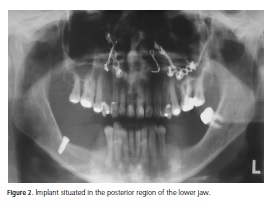
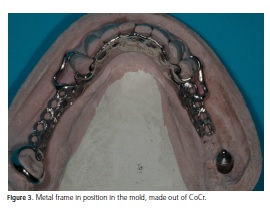
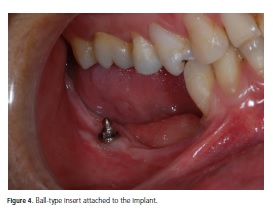
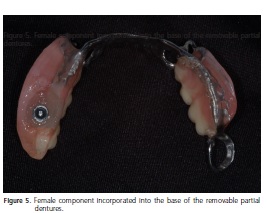
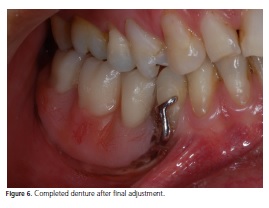
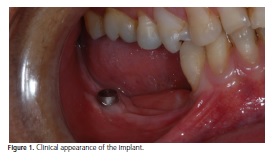
<body><![CDATA[<p>&nbsp;</p>     <p><font size="3" face="Verdana, Arial, Helvetica, sans-serif"><B> CASE REPORT</B></font></p>     <p><font size="2" face="Verdana, Arial, Helvetica, sans-serif">  Healthy female patient aged 41, with complete   maxillary arch in contrast to the partially edentulous   mandibular arch, classified as Kennedy class II, whose main   complaint was denture movement when chewing, by virtue   of the lack of retention and stability of her conventional   removable partial dentures. She was subjected to the   fitting of an osseointegrated implant 3.75 mm in diameter   by 7 mm long (Master Poruos&reg;, Conex&atilde;o Sistemas de   Pr&oacute;tese, S&atilde;o Paulo, Brazil) in the right posterior mandibular   region at the level of the second molar. After the period   of osseointegration (Figures <a href="#fig01">1</a> and <a href="#fig02">2</a>), the prosthetic   procedures could begin.</font></p>     <p><font size="2" face="Verdana, Arial, Helvetica, sans-serif">  In the bottom study mold, an analysis was   performed on the delineator in order to determine the   insertion trajectory, pillar preparation planning (guide   planes, retentive areas, adjustment of the prosthetic   equator and recesses) and fabrication of the respective transfer guides in accordance with the pre-planning.   Next, the preparations of the pillars and the molding were   carried out to obtain the master mold for the fabrication of   the metal frame. Once the CoCr metal frame was obtained   (<a href="#fig03">Figure 3</a>), the next step was to produce the working mold   via the bipartite mold technique. After obtaining the top   mold and the altered bottom mold with the metal frame   and the guide plan in the edentulate area, the recording   of the maxillo-mandibular ratios was performed and the   fitting into a semi-adjustable articulator with the assistance   of the facial arch, allowing the fitting of the artificial teeth,   the clinical test with wax and the acrylization.</font></p>     <p><font size="2" face="Verdana, Arial, Helvetica, sans-serif">  After the processing of the denture, this was   installed and subsequently checked after 24 hours and then   at 7 days after installation of the denture, the moment for   capturing the ball-type retention system (Conex&atilde;o Sistema   de Pr&oacute;tese, S&atilde;o Paulo, Brazil).</font></p>     <p><font size="2" face="Verdana, Arial, Helvetica, sans-serif">  The ball-type insert was placed on to the implant   (the male part), at a torque of 20 N/cm, calibrated by means   of a manual torque wrench (Ratchet Head with Conex&atilde;o&reg;  torque reference, Conex&atilde;o Sistemas de Pr&oacute;tese, S&atilde;o Paulo,   Brazil) to guarantee proper seating and resistance to   movement (<a href="#fig04">Figure 4</a>). A rubber sheet between the female   and male was used to prevent the acrylic resin for chemical   polymerization penetrating the retentive areas during the   locking of the female on to the denture base. For the   locking procedure it is important to wait for the complete   polymerization of the resin, holding the denture in the   position of maximum intercuspation. Next a check was   performed on the position of the female component on   the base of the denture (<a href="#fig05">Figure 5</a>), the length of the edges   and the adjustments. The denture was then positioned and   the patient was instructed about the importance of oral   hygiene to maintenance of health and about the methods   for cleaning the insert and denture system, emphasizing   the need for periodic return visits for preservation and   check-up. In <a href="#fig06">Figure 6</a>, the final appearance of the denture   in position can be observed. The patient authorized the   publication of this case by way of a free and informed   consent form.</font></p>     <p>&nbsp;</p>     <p><a name="fig01"></a></p>     <p>&nbsp; </p>     <p align="center"><img src="/img/revistas/rgo/v61n1/a17fig01.jpg">     ]]></body>
<body><![CDATA[<p>&nbsp;</p>     <p><a name="fig02"></a></p>     <p>&nbsp; </p>     <p align="center"><img src="/img/revistas/rgo/v61n1/a17fig02.jpg">     <p>&nbsp;</p>     <p><a name="fig03"></a></p>     <p>&nbsp; </p>     <p align="center"><img src="/img/revistas/rgo/v61n1/a17fig03.jpg">     <p>&nbsp;</p>     <p><a name="fig04"></a></p>     ]]></body>
<body><![CDATA[<p>&nbsp; </p>     <p align="center"><img src="/img/revistas/rgo/v61n1/a17fig04.jpg">     <p>&nbsp;</p>     <p><a name="fig05"></a></p>     <p>&nbsp; </p>     <p align="center"><img src="/img/revistas/rgo/v61n1/a17fig05.jpg">     <p>&nbsp;</p>     <p><a name="fig06"></a></p>     <p>&nbsp; </p>     <p align="center"><img src="/img/revistas/rgo/v61n1/a17fig06.jpg">     ]]></body>
<body><![CDATA[<p>&nbsp;</p>      <p><font size="3" face="Verdana, Arial, Helvetica, sans-serif"><B> DISCUSSION</B></font></p>     <p><font size="2" face="Verdana, Arial, Helvetica, sans-serif">The distal extension removable partial denture   creates problems due to the absence of a dental path in   the posterior region, using as simultaneous support the   mucosal fiber and tooth. Due to the difference in the   behavior of these two load transmission paths to the bone   tissue, even when the removable partial denture is properly   planned, a leverage force is always present and could result   in the inclination of the pillar tooth in the direction of the   prosthetic space when a force is applied to the free end   of the saddle<sup>1</sup>. This situation could result in compression   and stretching of the periodontal fibers, tooth movement,   bone loss, periodontal pockets and even the loss of the tooth.</font></p>     <p><font size="2" face="Verdana, Arial, Helvetica, sans-serif">  Besides the problems mentioned above, the   main complaints associated with free-end removable   partial prostheses are stability defects, minimal retention,   unfavorable esthetics on account of the appearance of clips and discomfort when chewing<sup>14,16</sup>.</font></p>     <p><font size="2" face="Verdana, Arial, Helvetica, sans-serif">  At the present time, dental implants are being   used to support distal extension removable partial dentures   and offer many advantages over tooth-mucosa-supported   removable dentures as not only do they serve as anchorage   for the denture, but they also preserve and maintain the   alveolar bone<sup>4</sup>.</font></p>     <p><font size="2" face="Verdana, Arial, Helvetica, sans-serif">  The use of implants as an element to support   and retain removable dentures is already widely employed   with full dentures<sup>17</sup>. Timmerman et al.<sup>16</sup> evaluated implantsupported   overdentures as a treatment strategy to resolve   the main complaints such as poor retention and stability   of the full mandibular denture and, as a result, obtained   a high level of patient satisfaction with the dentures, and   functionally a better retention and stability of the denture.   The author also suggested that the overdenture supported   by 2 implants connected by a bar is the best treatment   strategy for providing stability over a longer period.</font></p>     <p><font size="2" face="Verdana, Arial, Helvetica, sans-serif">  As for the overdenture connection system, Naert   et al.<sup>18</sup> studied the use of magnets, ball-type inserts   and straight bars with clips. The results did not indicate   any differences between them, despite the bar-retained   overdentures being functionally better, it did not have an   impact on the level of patient satisfaction.</font></p>     <p><font size="2" face="Verdana, Arial, Helvetica, sans-serif">  As far as the combined implant and RPD planning   is concerned, there have been few studies reported in the   literature, with the majority being reports of clinical cases   related to this treatment option.</font></p>     <p><font size="2" face="Verdana, Arial, Helvetica, sans-serif">  According to Verri<sup>1</sup>, the principal objective in the   planning of distal extension removable partial dentures   is to balance the distribution of forces to maintain the   alveolar rim and the remaining healthy teeth and provide   comfort and better function for the patient. Implants   have been incorporated into removable partial dentures   to better distribute these forces, preserving the integrity   of the support structures and providing greater retention,   stability and support to the denture.</font></p>     <p><font size="2" face="Verdana, Arial, Helvetica, sans-serif">  Keltjens et al.<sup>7</sup> also stated that the fitting of implants   under the distal extension of the base of the removable   partial dentures results in better occlusal stability. Two   clinical cases were reported combining the use of implants   with removable partial dentures providing occlusal stability   and comfort to the patient. Moreover, for cases similar to   the one reported, as for the most part they deal with type   II bone quality, which affords relatively good initial stability   and good bone-implant contact and optimized through   the use of a treated surface, short implants may be used.</font></p>     ]]></body>
<body><![CDATA[<p><font size="2" face="Verdana, Arial, Helvetica, sans-serif">  According to Kuzmanovic et al.<sup>10</sup>, the implant   fitted in the posterior region could convert a distal   extension removable partial denture from a tooth-mucosasupported   to a tooth-implant-supported denture, thereby   modifying the Kennedy classification from class I to class II   and providing stability.</font></p>     <p><font size="2" face="Verdana, Arial, Helvetica, sans-serif">  Removable partial dentures supported by   a combination of implants and the remaining teeth   contribute to the preservation of the soft tissue<sup>15</sup> and the   remaining hard tissue, increase patient satisfaction, there   is a minimum of wear and tear on components, bone   loss within normal limits and stability of peri-implant soft   tissue<sup>14</sup>.</font></p>     <p><font size="2" face="Verdana, Arial, Helvetica, sans-serif">  Moreover, this treatment combination could be a   good option in cases where it is not possible to perform   conventional implant insertion due to the proximity of the   alveolar nerve or when the fitting of short implants in the   area will have an adverse effect on longevity due to the   insufficient crown-to-implant ratio.</font></p>     <p><font size="2" face="Verdana, Arial, Helvetica, sans-serif">  According to Mijiritski et al.<sup>8</sup>, the removable   partial denture on top of the implant has advantages over   the conventional removable partial denture, such as the   increased retention and stability and the improvement in   patient satisfaction, preservation and maintenance of the   hard and soft tissue and it provides esthetics and function,   overcoming the difficulties of extensive edentulism.</font></p>     <p><font size="2" face="Verdana, Arial, Helvetica, sans-serif">  As for the biomechanics of the removable partial   denture supported on the implant in the distal region and   the abutments, Lacerda<sup>11</sup> stated that the greater the area   of contact between the mucosal fiber and the removable   partial denture, the greater the demands on the mucosal   fiber and lower tensions will be transmitted to all the   remaining support structures and that the presence of a   metal frame inside the plastic saddle causes this to undergo   less deflection and compresses the mucosal fiber to a lesser   degree, demanding more of the following supports: tooth   support and implant.</font></p>     <p><font size="2" face="Verdana, Arial, Helvetica, sans-serif">  Another treatment alternative to solve free-end   problems is the planning with conventional cantilever   fixed dentures, however this option produces a highly   unfavorable biomechanical behavior and requires   preparation for the total crown of pillars adjacent to the   free-end, thereby limiting its application.</font></p>     <p><font size="2" face="Verdana, Arial, Helvetica, sans-serif">  The option also exists for a fixed denture on the   implants, however, according to Misch<sup>4</sup>, the removable   denture on top of the implant has advantages over the   fixed denture, such as the lower risk of caries in the pillar teeth and tooth pulp, ease of cleaning of the surfaces and   maintenance of the bone in the edentulous region.</font></p>     <p><font size="2" face="Verdana, Arial, Helvetica, sans-serif">  For Uludag &amp; &Ccedil;elik<sup>17</sup>, the advantages of the   overdenture over fixed dentures on the implant are that   fewer implants are needed, cleaning is performed more   easily and the esthetics due to bone loss are more easily   reproduced. He also mentions that atrophied mandibles   are treated better with RPD because the fixed denture   requires a more favorable crown-to-root ratio.</font></p>     <p><font size="2" face="Verdana, Arial, Helvetica, sans-serif">  For Asvanud &amp; Morgano<sup>19</sup>, the fixed denture   screwed on to the implant improves the esthetic results   as it incorporates the labial flange, but it has an adverse   impact on oral hygiene. He adds that implant-supported   overdentures could restore reabsorbed edges and, as they   are removable, it helps with cleaning.</font></p>     <p><font size="2" face="Verdana, Arial, Helvetica, sans-serif">  However Bassi et al.<sup>20</sup> pointed out the advantages   of the fixed denture on the implants versus the removable   partial dentures, such as not needing to prepare natural   teeth, lower induction of forces on the pillar elements and   the frequent biomechanical problems and, as it is fixed, it   tends to be more acceptable to the patient.</font></p>     ]]></body>
<body><![CDATA[<p><font size="2" face="Verdana, Arial, Helvetica, sans-serif">  Pellechia et al.<sup>12</sup> quote another treatment option   which is the implant-supported fixed denture with bilateral   distal cantilevers that offer the advantage of being fixed   in relation to the overdenture, but which could present   functional and biomechanical disadvantages. Another   option would be the removable partial denture anchored   to a fixed denture supported by implants with stress   directors close to the connection with the fixed denture,   whose advantages consist of lower compression on the   rim during function and development of stability during   chewing, permitting a functional activity similar to that of   an overdenture.</font></p>     <p><font size="2" face="Verdana, Arial, Helvetica, sans-serif">  Considering the planning of the oral rehabilitation   of partially edentulate arches with free ends, it is noted   that, compared with the other treatment options with the   removable partial dentures supported and retained by   distal implants, this provides adequate retention, stability   and support which provides comfort, allowing the patient   to perform the functions of the stomatognathic system. It is   also found that, when compared with the denture fixed on   top of implants, the removable partial denture and implant   combination is less expensive, with shorter treatment time   and the possibility of fitting shorter implants, since there   will be no lever arm in the crown portion<sup>19</sup>.</font></p>     <p><font size="2" face="Verdana, Arial, Helvetica, sans-serif">  In spite of all the advantages of prosthetic   rehabilitation with implants, more long-term, controlled   studies are required to evaluate the durability of implants   in combination with the removable partial denture and   thereby enable the validation of this technique with   broad indication<sup>7</sup>. Watson<sup>21</sup> reports that a severe occlusal   load in the cases of implant-supported dentures, mainly   at the free-end, could induce mechanical failure or bone   reabsorption around the implant.</font></p>     <p>&nbsp;</p>     <p><font size="3" face="Verdana, Arial, Helvetica, sans-serif"><B> CONCLUSION</B></font></p>     <p><font size="2" face="Verdana, Arial, Helvetica, sans-serif">The fabrication of the removable partial denture   retained via implant gave the patient better retention,   stability, support and better occlusal stability when compared to the conventional removable partial denture.</font></p>     <p><font size="2" face="Verdana, Arial, Helvetica, sans-serif"><B> Collaborators</B></font></p>       <p><font size="2" face="Verdana, Arial, Helvetica, sans-serif">ARL AQUINO, SA SOUSA and AFP CARREIRO took   part in the fabrication of the denture on the implant and   in the composition of the article. AR GERMANO was the   surgeon responsible for the dental implant and took part   in the composition of the article. SL MENDON&Ccedil;A took part   in the surgical stage of the dental implant and composition   of the article. DVM HOLANDA was responsible for the revision and composition of the article. </font></p>     <p>&nbsp;</p>     <p><font size="3" face="Verdana, Arial, Helvetica, sans-serif"><B>REFERENCES </B></font></p>     ]]></body>
<body><![CDATA[<!-- ref --><p><font size="2" face="Verdana, Arial, Helvetica, sans-serif">1. Verri FR, Pellizzer EP, Rocha EP, Pereira JA. Influence of length and   diameter of implants associated with distal extension removable partial dentures. Implant Dent. 2007;16(3):270-9. doi: 10.1097/ID.0b013e31805007aa.    &nbsp;&nbsp;&nbsp;&nbsp;&nbsp;&nbsp;&nbsp;&nbsp;[&#160;<a href="javascript:void(0);" onclick="javascript: window.open('/scielo.php?script=sci_nlinks&ref=207564&pid=S1981-8637201300010001700001&lng=','','width=640,height=500,resizable=yes,scrollbars=1,menubar=yes,');">Links</a>&#160;]<!-- end-ref --></font></p>     <!-- ref --><p><font size="2" face="Verdana, Arial, Helvetica, sans-serif"> 2. Mensor Mc Jr. The rationale of resilient hinge-action   stressbreakers. J Prosthet Dent. 1968;1968;20(3):204-15.10.1016/j.prosdent.2004.04.010.    &nbsp;&nbsp;&nbsp;&nbsp;&nbsp;&nbsp;&nbsp;&nbsp;[&#160;<a href="javascript:void(0);" onclick="javascript: window.open('/scielo.php?script=sci_nlinks&ref=207566&pid=S1981-8637201300010001700002&lng=','','width=640,height=500,resizable=yes,scrollbars=1,menubar=yes,');">Links</a>&#160;]<!-- end-ref --></font></p>     <!-- ref --><p><font size="2" face="Verdana, Arial, Helvetica, sans-serif"> 3. Kuboki T, Okamoto S, Suzuki H, Kanyama M, Arakawa H, Sonoyama   W, et al. Quality of life assessment of bone-anchored fixed partial   denture patients unilateral mandibular distal-extension edentulism.   J Prosthet Dent. 1999;82(2):182-7. doi: doi.org/10.1016/S0022-3913(99)70154-X.    &nbsp;&nbsp;&nbsp;&nbsp;&nbsp;&nbsp;&nbsp;&nbsp;[&#160;<a href="javascript:void(0);" onclick="javascript: window.open('/scielo.php?script=sci_nlinks&ref=207568&pid=S1981-8637201300010001700003&lng=','','width=640,height=500,resizable=yes,scrollbars=1,menubar=yes,');">Links</a>&#160;]<!-- end-ref --></font></p>     <!-- ref --><p><font size="2" face="Verdana, Arial, Helvetica, sans-serif"> 4. Misch CE. The importance of dental implants. Gen Dent.   2001;49(1):38-45.    &nbsp;&nbsp;&nbsp;&nbsp;&nbsp;&nbsp;&nbsp;&nbsp;[&#160;<a href="javascript:void(0);" onclick="javascript: window.open('/scielo.php?script=sci_nlinks&ref=207570&pid=S1981-8637201300010001700004&lng=','','width=640,height=500,resizable=yes,scrollbars=1,menubar=yes,');">Links</a>&#160;]<!-- end-ref --></font></p>     <!-- ref --><p><font size="2" face="Verdana, Arial, Helvetica, sans-serif"> 5. Albrektsson T, Jansson T, Lekholm U. Osseointegrated dental implants. Dent Clin North Am. 1986;30(1):151-74.    &nbsp;&nbsp;&nbsp;&nbsp;&nbsp;&nbsp;&nbsp;&nbsp;[&#160;<a href="javascript:void(0);" onclick="javascript: window.open('/scielo.php?script=sci_nlinks&ref=207572&pid=S1981-8637201300010001700005&lng=','','width=640,height=500,resizable=yes,scrollbars=1,menubar=yes,');">Links</a>&#160;]<!-- end-ref --></font></p>     ]]></body>
<body><![CDATA[<!-- ref --><p><font size="2" face="Verdana, Arial, Helvetica, sans-serif"> 6. Budtz-J&ouml;rgensen E. Restoration of the partially edentulous   mouth: a comparison of overdentures, removable partial   dentures, fixed partial dentures and implant treatment. J Oral   Dent. 1996;24(4):237-44.    &nbsp;&nbsp;&nbsp;&nbsp;&nbsp;&nbsp;&nbsp;&nbsp;[&#160;<a href="javascript:void(0);" onclick="javascript: window.open('/scielo.php?script=sci_nlinks&ref=207574&pid=S1981-8637201300010001700006&lng=','','width=640,height=500,resizable=yes,scrollbars=1,menubar=yes,');">Links</a>&#160;]<!-- end-ref --></font></p>     <p><font size="2" face="Verdana, Arial, Helvetica, sans-serif"> 7. Keltjens HM, Kayser AF, Hertel R, Battistuzzi PG. Distal extension   removable partial dentures supported by implants and residual   teeth: considerations and case reports. Int J Oral Maxillofac    <!-- ref --><br>   Implants. 1993;8(2):208-13.    &nbsp;&nbsp;&nbsp;&nbsp;&nbsp;&nbsp;&nbsp;&nbsp;[&#160;<a href="javascript:void(0);" onclick="javascript: window.open('/scielo.php?script=sci_nlinks&ref=207577&pid=S1981-8637201300010001700007&lng=','','width=640,height=500,resizable=yes,scrollbars=1,menubar=yes,');">Links</a>&#160;]<!-- end-ref --></font></p>     <!-- ref --><p><font size="2" face="Verdana, Arial, Helvetica, sans-serif"> 8. Mifiritsky E, Karas S. Removable partial denture design involving   teeth and implants as an alternative to unsuccessful fixed   implant therapy: a case report. Implant Dent. 2004;13(3):218-22.    &nbsp;&nbsp;&nbsp;&nbsp;&nbsp;&nbsp;&nbsp;&nbsp;[&#160;<a href="javascript:void(0);" onclick="javascript: window.open('/scielo.php?script=sci_nlinks&ref=207579&pid=S1981-8637201300010001700008&lng=','','width=640,height=500,resizable=yes,scrollbars=1,menubar=yes,');">Links</a>&#160;]<!-- end-ref --></font></p>     <!-- ref --><p><font size="2" face="Verdana, Arial, Helvetica, sans-serif"> 9. Giffin KM. Solving the distal extension removable partial denture   base movement dilemma: a clinical report. J Prosthet Dent.   1996;76(4):347-9. doi: 10.1016/S0022-3913(96)90536-3.    &nbsp;&nbsp;&nbsp;&nbsp;&nbsp;&nbsp;&nbsp;&nbsp;[&#160;<a href="javascript:void(0);" onclick="javascript: window.open('/scielo.php?script=sci_nlinks&ref=207581&pid=S1981-8637201300010001700009&lng=','','width=640,height=500,resizable=yes,scrollbars=1,menubar=yes,');">Links</a>&#160;]<!-- end-ref --></font></p>     <p><font size="2" face="Verdana, Arial, Helvetica, sans-serif"> 10. Kuzmanovic DV, Payne AGT, Purton DG. Distal implants to   modify the Kennedy classification of a removable partial   denture: a clinical report. J Prosthet Dent. 2004;92(1):8-11. doi:    ]]></body>
<body><![CDATA[<!-- ref --><br>   10.1016/j.prosdent.2004.04.010.    &nbsp;&nbsp;&nbsp;&nbsp;&nbsp;&nbsp;&nbsp;&nbsp;[&#160;<a href="javascript:void(0);" onclick="javascript: window.open('/scielo.php?script=sci_nlinks&ref=207584&pid=S1981-8637201300010001700010&lng=','','width=640,height=500,resizable=yes,scrollbars=1,menubar=yes,');">Links</a>&#160;]<!-- end-ref --></font></p>     <!-- ref --><p><font size="2" face="Verdana, Arial, Helvetica, sans-serif"> 11. Lacerda TS, Laguna DC, Goz&aacute;lez-Lima R, Zanetti AL. Contribution   to the planning of implant-supported RPD in the distal region.   RPG Rev Post-Grad. 2005;12(3):293-300</font>&nbsp;&nbsp;&nbsp;&nbsp;&nbsp;&nbsp;&nbsp;&nbsp;[&#160;<a href="javascript:void(0);" onclick="javascript: window.open('/scielo.php?script=sci_nlinks&ref=207586&pid=S1981-8637201300010001700011&lng=','','width=640,height=500,resizable=yes,scrollbars=1,menubar=yes,');">Links</a>&#160;]<!-- end-ref --><!-- ref --><p><font size="2" face="Verdana, Arial, Helvetica, sans-serif"> 12. Pellecchia M, Pellecchia R, Emtiaz S. Distal extension mandibular   removable partial denture connected to an anterior fixed   implant-supported prosthesis: a clinical report. J Prosthet Dent.   2000;83(6):607-12.    &nbsp;&nbsp;&nbsp;&nbsp;&nbsp;&nbsp;&nbsp;&nbsp;[&#160;<a href="javascript:void(0);" onclick="javascript: window.open('/scielo.php?script=sci_nlinks&ref=207587&pid=S1981-8637201300010001700012&lng=','','width=640,height=500,resizable=yes,scrollbars=1,menubar=yes,');">Links</a>&#160;]<!-- end-ref --></font></p>     <!-- ref --><p><font size="2" face="Verdana, Arial, Helvetica, sans-serif"> 13. Cunha VPP, Marchini L, Ribeiro NR, Santos JFF, Cunha MOPP,   Pr&oacute;tese parcial remov&iacute;vel retida por implantes: relato de caso   cl&iacute;nico. BCI. 2001;8(31):236-8.    &nbsp;&nbsp;&nbsp;&nbsp;&nbsp;&nbsp;&nbsp;&nbsp;[&#160;<a href="javascript:void(0);" onclick="javascript: window.open('/scielo.php?script=sci_nlinks&ref=207589&pid=S1981-8637201300010001700013&lng=','','width=640,height=500,resizable=yes,scrollbars=1,menubar=yes,');">Links</a>&#160;]<!-- end-ref --></font></p>     <!-- ref --><p><font size="2" face="Verdana, Arial, Helvetica, sans-serif"> 14. Mitrani R, Brudvik JS. Posterior implants for distal extension   removable prostheses: A retrospective study. Int J Periodontics   Restorative Dent. 2003;23(4):353-9.    &nbsp;&nbsp;&nbsp;&nbsp;&nbsp;&nbsp;&nbsp;&nbsp;[&#160;<a href="javascript:void(0);" onclick="javascript: window.open('/scielo.php?script=sci_nlinks&ref=207591&pid=S1981-8637201300010001700014&lng=','','width=640,height=500,resizable=yes,scrollbars=1,menubar=yes,');">Links</a>&#160;]<!-- end-ref --></font></p>     <!-- ref --><p><font size="2" face="Verdana, Arial, Helvetica, sans-serif"> 15. Halterman SM, Rivers JA, Keith JD, Nelson DR. Implant support   for removable partial overdentures: a case report. Implant Dent.   1999;8(1):74-8.    &nbsp;&nbsp;&nbsp;&nbsp;&nbsp;&nbsp;&nbsp;&nbsp;[&#160;<a href="javascript:void(0);" onclick="javascript: window.open('/scielo.php?script=sci_nlinks&ref=207593&pid=S1981-8637201300010001700015&lng=','','width=640,height=500,resizable=yes,scrollbars=1,menubar=yes,');">Links</a>&#160;]<!-- end-ref --></font></p>     <!-- ref --><p><font size="2" face="Verdana, Arial, Helvetica, sans-serif"> 16. Timmerman R, Stoker GT, Wismeijer D, Oosterveld P, Vermeeren   JI, van Waas MA. An eight-year follow-up to a randomized clinical   trial of participant satisfaction with three types of mandibular   implant-retained overdentures. J Dent Res. 2004;83(8):630-3.   doi: 10.1177/154405910408300809.    &nbsp;&nbsp;&nbsp;&nbsp;&nbsp;&nbsp;&nbsp;&nbsp;[&#160;<a href="javascript:void(0);" onclick="javascript: window.open('/scielo.php?script=sci_nlinks&ref=207595&pid=S1981-8637201300010001700016&lng=','','width=640,height=500,resizable=yes,scrollbars=1,menubar=yes,');">Links</a>&#160;]<!-- end-ref --></font></p>     <!-- ref --><p><font size="2" face="Verdana, Arial, Helvetica, sans-serif"> 17. Uludag B, Celik G. Fabrication of a maxillary implant-supported   removable partial denture: a clinical report. J Prosthet Dent.   2006;95(1):19-21. doi: 10.1016/j.prosdent.2005.10.021.    &nbsp;&nbsp;&nbsp;&nbsp;&nbsp;&nbsp;&nbsp;&nbsp;[&#160;<a href="javascript:void(0);" onclick="javascript: window.open('/scielo.php?script=sci_nlinks&ref=207597&pid=S1981-8637201300010001700017&lng=','','width=640,height=500,resizable=yes,scrollbars=1,menubar=yes,');">Links</a>&#160;]<!-- end-ref --></font></p>     <!-- ref --><p><font size="2" face="Verdana, Arial, Helvetica, sans-serif"> 18. Naert I, Quirynen M, Hooghe M, van Steenberghe D. A   comparative prospective study of splinted and unsplinted   Branemark implants in mandibular overdenture therapy: a   preliminary report. J Prosthet Dent. 1994;71(5):486-92. doi:   10.1016/0022-3913(94)90188-0.    &nbsp;&nbsp;&nbsp;&nbsp;&nbsp;&nbsp;&nbsp;&nbsp;[&#160;<a href="javascript:void(0);" onclick="javascript: window.open('/scielo.php?script=sci_nlinks&ref=207599&pid=S1981-8637201300010001700018&lng=','','width=640,height=500,resizable=yes,scrollbars=1,menubar=yes,');">Links</a>&#160;]<!-- end-ref --></font></p>     <!-- ref --><p><font size="2" face="Verdana, Arial, Helvetica, sans-serif"> 19. Asvanud C, Morgano SM. Restoration of unfavorably   positioned implants for a partially edentulous patient by using   an overdenture retained with a milled bar and attachments: a   clinical report. J Prosthet Dent. 2004;91(1):6-10. doi: 10.1016/j.   prosdent.2003.09.009.    &nbsp;&nbsp;&nbsp;&nbsp;&nbsp;&nbsp;&nbsp;&nbsp;[&#160;<a href="javascript:void(0);" onclick="javascript: window.open('/scielo.php?script=sci_nlinks&ref=207601&pid=S1981-8637201300010001700019&lng=','','width=640,height=500,resizable=yes,scrollbars=1,menubar=yes,');">Links</a>&#160;]<!-- end-ref --></font></p>     <!-- ref --><p><font size="2" face="Verdana, Arial, Helvetica, sans-serif"> 20. Bassi F, Schierano G, Lorenzetti M, Preti G. Oral conditions and   aptitude to receive implants with removable partial denture:   a cross-sectional study. Part II. Aptitude. J Oral Rehabil.   1996;23(3):175-8. doi: 10.1111/j.1365-2842.1996.tb01230.x.    &nbsp;&nbsp;&nbsp;&nbsp;&nbsp;&nbsp;&nbsp;&nbsp;[&#160;<a href="javascript:void(0);" onclick="javascript: window.open('/scielo.php?script=sci_nlinks&ref=207603&pid=S1981-8637201300010001700020&lng=','','width=640,height=500,resizable=yes,scrollbars=1,menubar=yes,');">Links</a>&#160;]<!-- end-ref --></font></p>     <!-- ref --><p><font size="2" face="Verdana, Arial, Helvetica, sans-serif"> 21. Watson RM. The role of removable prostheses and implants in   the restoration of the worn dentition. Eur J Prosthodont Restor   Dent. 1997;5(4):181-6.    &nbsp;&nbsp;&nbsp;&nbsp;&nbsp;&nbsp;&nbsp;&nbsp;[&#160;<a href="javascript:void(0);" onclick="javascript: window.open('/scielo.php?script=sci_nlinks&ref=207605&pid=S1981-8637201300010001700021&lng=','','width=640,height=500,resizable=yes,scrollbars=1,menubar=yes,');">Links</a>&#160;]<!-- end-ref --></font></p>     <p>&nbsp;</p>     <p>&nbsp;</p>     <p><font size="2" face="Verdana, Arial, Helvetica, sans-serif"><a name="back"/></a><a href="#top"><img src="/img/revistas/rgo/v61n1/seta.jpg" border="0" align="absmiddle"/></a><b>Correspondence to:</b>    <br>   </font><font size="2" face="Verdana, Arial, Helvetica, sans-serif">ARL AQUINO    <br>   Rua Almino Afonso, 478, Centro, 59610-210, Mossor&oacute;, RN, Brasil</font><font size="2" face="Verdana, Arial, Helvetica, sans-serif">    <br>   e-mail: </font><font size="2" face="Verdana, Arial, Helvetica, sans-serif"><a href="mailto:mcserra@foar.unesp.br" target="_blank">anarafaela.luz@terra.com.br</a></font></p>     <p>&nbsp;</p>       ]]></body>
<body><![CDATA[<p><font face="Verdana, Arial, Helvetica, sans-serif" size="2"><b>Received on:</b> 27/6/2008<br/> <b>Final version resubmitted on:</b> 24/9/2009<br/> <b>Approved on:</b> 21/10/2009</font></p>     <p>&nbsp;</p>      ]]></body>
<back>
<ref-list>
<ref id="B1">
<label>1</label><nlm-citation citation-type="journal">
<person-group person-group-type="author">
<name>
<surname><![CDATA[Verri]]></surname>
<given-names><![CDATA[FR]]></given-names>
</name>
<name>
<surname><![CDATA[Pellizzer]]></surname>
<given-names><![CDATA[EP]]></given-names>
</name>
<name>
<surname><![CDATA[Rocha]]></surname>
<given-names><![CDATA[EP]]></given-names>
</name>
<name>
<surname><![CDATA[Pereira]]></surname>
<given-names><![CDATA[JA.]]></given-names>
</name>
</person-group>
<article-title xml:lang="en"><![CDATA[Influence of length and diameter of implants associated with distal extension removable partial dentures]]></article-title>
<source><![CDATA[Implant Dent.]]></source>
<year>2007</year>
<volume>16</volume>
<numero>3</numero>
<issue>3</issue>
<page-range>270-9</page-range></nlm-citation>
</ref>
<ref id="B2">
<label>2</label><nlm-citation citation-type="journal">
<person-group person-group-type="author">
<name>
<surname><![CDATA[Mensor]]></surname>
<given-names><![CDATA[Mc Jr.]]></given-names>
</name>
</person-group>
<article-title xml:lang="en"><![CDATA[The rationale of resilient hinge-action stressbreakers.]]></article-title>
<source><![CDATA[J Prosthet Dent.]]></source>
<year>1968</year>
<volume>20</volume>
<numero>3</numero>
<issue>3</issue>
<page-range>204</page-range></nlm-citation>
</ref>
<ref id="B3">
<label>3</label><nlm-citation citation-type="journal">
<person-group person-group-type="author">
<name>
<surname><![CDATA[Kuboki]]></surname>
<given-names><![CDATA[T]]></given-names>
</name>
<name>
<surname><![CDATA[Okamoto]]></surname>
<given-names><![CDATA[S]]></given-names>
</name>
<name>
<surname><![CDATA[Suzuki]]></surname>
<given-names><![CDATA[H]]></given-names>
</name>
<name>
<surname><![CDATA[Kanyama]]></surname>
<given-names><![CDATA[M]]></given-names>
</name>
<name>
<surname><![CDATA[Arakawa]]></surname>
<given-names><![CDATA[H]]></given-names>
</name>
<name>
<surname><![CDATA[Sonoyama]]></surname>
<given-names><![CDATA[W]]></given-names>
</name>
</person-group>
<article-title xml:lang="en"><![CDATA[Quality of life assessment of bone-anchored fixed partial denture patients unilateral mandibular distal-extension edentulism.]]></article-title>
<source><![CDATA[J Prosthet Dent.]]></source>
<year>1999</year>
<volume>82</volume>
<numero>2</numero>
<issue>2</issue>
<page-range>182-7</page-range></nlm-citation>
</ref>
<ref id="B4">
<label>4</label><nlm-citation citation-type="journal">
<person-group person-group-type="author">
<name>
<surname><![CDATA[Misch]]></surname>
<given-names><![CDATA[CE.]]></given-names>
</name>
</person-group>
<article-title xml:lang="en"><![CDATA[The importance of dental implants.]]></article-title>
<source><![CDATA[Gen Dent.]]></source>
<year>2001</year>
<volume>49</volume>
<numero>1</numero>
<issue>1</issue>
<page-range>38-45</page-range></nlm-citation>
</ref>
<ref id="B5">
<label>5</label><nlm-citation citation-type="journal">
<person-group person-group-type="author">
<name>
<surname><![CDATA[Albrektsson]]></surname>
<given-names><![CDATA[T]]></given-names>
</name>
<name>
<surname><![CDATA[Jansson]]></surname>
<given-names><![CDATA[T]]></given-names>
</name>
<name>
<surname><![CDATA[Lekholm]]></surname>
<given-names><![CDATA[U]]></given-names>
</name>
</person-group>
<article-title xml:lang="en"><![CDATA[Osseointegrated dental implants.]]></article-title>
<source><![CDATA[Dent Clin North Am.]]></source>
<year>1986</year>
<volume>30</volume>
<numero>1</numero>
<issue>1</issue>
<page-range>151-74</page-range></nlm-citation>
</ref>
<ref id="B6">
<label>6</label><nlm-citation citation-type="journal">
<person-group person-group-type="author">
<name>
<surname><![CDATA[Budtz-Jörgensen]]></surname>
<given-names><![CDATA[E]]></given-names>
</name>
</person-group>
<article-title xml:lang="en"><![CDATA[Restoration of the partially edentulous mouth: a comparison of overdentures, removable partial dentures, fixed partial dentures and implant treatment.]]></article-title>
<source><![CDATA[J Oral Dent.]]></source>
<year>1996</year>
<volume>24</volume>
<numero>4</numero>
<issue>4</issue>
<page-range>237-44</page-range></nlm-citation>
</ref>
<ref id="B7">
<label>7</label><nlm-citation citation-type="journal">
<person-group person-group-type="author">
<name>
<surname><![CDATA[Keltjens]]></surname>
<given-names><![CDATA[HM]]></given-names>
</name>
<name>
<surname><![CDATA[Kayser]]></surname>
<given-names><![CDATA[AF]]></given-names>
</name>
<name>
<surname><![CDATA[Hertel]]></surname>
<given-names><![CDATA[R]]></given-names>
</name>
<name>
<surname><![CDATA[Battistuzzi]]></surname>
<given-names><![CDATA[PG.]]></given-names>
</name>
</person-group>
<article-title xml:lang="en"><![CDATA[Distal extension removable partial dentures supported by implants and residual teeth: considerations and case reports.]]></article-title>
<source><![CDATA[Int J Oral Maxillofac Implants.]]></source>
<year>1993</year>
<volume>8</volume>
<numero>2</numero>
<issue>2</issue>
<page-range>208-13</page-range></nlm-citation>
</ref>
<ref id="B8">
<label>8</label><nlm-citation citation-type="journal">
<person-group person-group-type="author">
<name>
<surname><![CDATA[Mifiritsky]]></surname>
<given-names><![CDATA[E]]></given-names>
</name>
<name>
<surname><![CDATA[Karas]]></surname>
<given-names><![CDATA[S.]]></given-names>
</name>
</person-group>
<article-title xml:lang="en"><![CDATA[Removable partial denture design involving teeth and implants as an alternative to unsuccessful fixed implant therapy: a case report.]]></article-title>
<source><![CDATA[Implant Dent.]]></source>
<year>2004</year>
<volume>13</volume>
<numero>3</numero>
<issue>3</issue>
<page-range>218-22</page-range></nlm-citation>
</ref>
<ref id="B9">
<label>9</label><nlm-citation citation-type="journal">
<person-group person-group-type="author">
<name>
<surname><![CDATA[Giffin]]></surname>
<given-names><![CDATA[KM.]]></given-names>
</name>
</person-group>
<article-title xml:lang="en"><![CDATA[Solving the distal extension removable partial denture base movement dilemma: a clinical report.]]></article-title>
<source><![CDATA[J Prosthet Dent.]]></source>
<year>1996</year>
<volume>76</volume><volume>4</volume>
<page-range>347-9</page-range></nlm-citation>
</ref>
<ref id="B10">
<label>10</label><nlm-citation citation-type="journal">
<person-group person-group-type="author">
<name>
<surname><![CDATA[Kuzmanovic]]></surname>
<given-names><![CDATA[DV]]></given-names>
</name>
<name>
<surname><![CDATA[Payne]]></surname>
<given-names><![CDATA[AGT]]></given-names>
</name>
<name>
<surname><![CDATA[Purton]]></surname>
<given-names><![CDATA[DG.]]></given-names>
</name>
</person-group>
<article-title xml:lang="en"><![CDATA[Distal implants to modify the Kennedy classification of a removable partial denture: a clinical report.]]></article-title>
<source><![CDATA[J Prosthet Dent.]]></source>
<year>2004</year>
<volume>92</volume>
<numero>1</numero>
<issue>1</issue>
<page-range>8-11</page-range></nlm-citation>
</ref>
<ref id="B11">
<label>11</label><nlm-citation citation-type="journal">
<person-group person-group-type="author">
<name>
<surname><![CDATA[Lacerda]]></surname>
<given-names><![CDATA[TS]]></given-names>
</name>
<name>
<surname><![CDATA[Laguna]]></surname>
<given-names><![CDATA[DC]]></given-names>
</name>
<name>
<surname><![CDATA[Gozález-Lima]]></surname>
<given-names><![CDATA[R]]></given-names>
</name>
<name>
<surname><![CDATA[Zanetti]]></surname>
<given-names><![CDATA[AL.]]></given-names>
</name>
</person-group>
<article-title xml:lang="en"><![CDATA[Contribution to the planning of implant-supported RPD in the distal region.]]></article-title>
<source><![CDATA[RPG Rev Post-Grad.]]></source>
<year>2005</year>
<volume>12</volume>
<numero>3</numero>
<issue>3</issue>
<page-range>293-300</page-range></nlm-citation>
</ref>
<ref id="B12">
<label>12</label><nlm-citation citation-type="journal">
<person-group person-group-type="author">
<name>
<surname><![CDATA[Pellecchia]]></surname>
<given-names><![CDATA[M]]></given-names>
</name>
<name>
<surname><![CDATA[Pellecchia]]></surname>
<given-names><![CDATA[R]]></given-names>
</name>
<name>
<surname><![CDATA[Emtiaz]]></surname>
<given-names><![CDATA[S.]]></given-names>
</name>
</person-group>
<article-title xml:lang="en"><![CDATA[Distal extension mandibular removable partial denture connected to an anterior fixed implant-supported prosthesis: a clinical report]]></article-title>
<source><![CDATA[J Prosthet Dent.]]></source>
<year>2000</year>
<volume>83</volume>
<numero>6</numero>
<issue>6</issue>
<page-range>607-12</page-range></nlm-citation>
</ref>
<ref id="B13">
<label>13.</label><nlm-citation citation-type="journal">
<person-group person-group-type="author">
<name>
<surname><![CDATA[Cunha]]></surname>
<given-names><![CDATA[VPP]]></given-names>
</name>
<name>
<surname><![CDATA[Marchini]]></surname>
<given-names><![CDATA[L]]></given-names>
</name>
<name>
<surname><![CDATA[Ribeiro]]></surname>
<given-names><![CDATA[NR]]></given-names>
</name>
<name>
<surname><![CDATA[Santos]]></surname>
<given-names><![CDATA[JFF]]></given-names>
</name>
<name>
<surname><![CDATA[Cunha]]></surname>
<given-names><![CDATA[MOPP]]></given-names>
</name>
</person-group>
<article-title xml:lang="pt"><![CDATA[Prótese parcial removível retida por implantes: relato de caso clínico.]]></article-title>
<source><![CDATA[BCI.]]></source>
<year>2001</year>
<volume>8</volume>
<numero>31</numero>
<issue>31</issue>
<page-range>236-8</page-range></nlm-citation>
</ref>
<ref id="B14">
<label>14</label><nlm-citation citation-type="journal">
<person-group person-group-type="author">
<name>
<surname><![CDATA[Mitrani]]></surname>
<given-names><![CDATA[R]]></given-names>
</name>
<name>
<surname><![CDATA[Brudvik]]></surname>
<given-names><![CDATA[JS.]]></given-names>
</name>
</person-group>
<article-title xml:lang="en"><![CDATA[Posterior implants for distal extension removable prostheses: A retrospective study.]]></article-title>
<source><![CDATA[Int J Periodontics Restorative Dent.]]></source>
<year>2003</year>
<volume>23</volume>
<numero>4</numero>
<issue>4</issue>
<page-range>353-9</page-range></nlm-citation>
</ref>
<ref id="B15">
<label>15</label><nlm-citation citation-type="journal">
<person-group person-group-type="author">
<name>
<surname><![CDATA[Halterman]]></surname>
<given-names><![CDATA[SM]]></given-names>
</name>
<name>
<surname><![CDATA[Rivers]]></surname>
<given-names><![CDATA[JA]]></given-names>
</name>
<name>
<surname><![CDATA[Keith]]></surname>
<given-names><![CDATA[JD]]></given-names>
</name>
<name>
<surname><![CDATA[Nelson]]></surname>
<given-names><![CDATA[DR.]]></given-names>
</name>
</person-group>
<article-title xml:lang="en"><![CDATA[Implant support for removable partial overdentures: a case report.]]></article-title>
<source><![CDATA[Implant Dent.]]></source>
<year>1999</year>
<volume>8</volume>
<numero>1</numero>
<issue>1</issue>
<page-range>74-8</page-range></nlm-citation>
</ref>
<ref id="B16">
<label>16</label><nlm-citation citation-type="journal">
<person-group person-group-type="author">
<name>
<surname><![CDATA[Timmerman]]></surname>
<given-names><![CDATA[R]]></given-names>
</name>
<name>
<surname><![CDATA[Stoker]]></surname>
<given-names><![CDATA[GT]]></given-names>
</name>
<name>
<surname><![CDATA[Wismeijer]]></surname>
<given-names><![CDATA[D]]></given-names>
</name>
<name>
<surname><![CDATA[Oosterveld]]></surname>
<given-names><![CDATA[P]]></given-names>
</name>
<name>
<surname><![CDATA[Vermeeren]]></surname>
<given-names><![CDATA[JI]]></given-names>
</name>
<name>
<surname><![CDATA[van Waas]]></surname>
<given-names><![CDATA[MA.]]></given-names>
</name>
</person-group>
<article-title xml:lang="en"><![CDATA[An eight-year follow-up to a randomized clinical trial of participant satisfaction with three types of mandibular implant-retained overdentures.]]></article-title>
<source><![CDATA[J Dent Res.]]></source>
<year>2004</year>
<volume>83</volume>
<numero>8</numero>
<issue>8</issue>
<page-range>630-3</page-range></nlm-citation>
</ref>
<ref id="B17">
<label>17</label><nlm-citation citation-type="journal">
<person-group person-group-type="author">
<name>
<surname><![CDATA[Uludag]]></surname>
<given-names><![CDATA[B]]></given-names>
</name>
<name>
<surname><![CDATA[Celik]]></surname>
<given-names><![CDATA[G.]]></given-names>
</name>
</person-group>
<article-title xml:lang="en"><![CDATA[Fabrication of a maxillary implant-supported removable partial denture: a clinical report.]]></article-title>
<source><![CDATA[J Prosthet Dent.]]></source>
<year>2006</year>
<volume>95</volume>
<numero>1</numero>
<issue>1</issue>
<page-range>19-21</page-range></nlm-citation>
</ref>
<ref id="B18">
<label>18</label><nlm-citation citation-type="journal">
<person-group person-group-type="author">
<name>
<surname><![CDATA[Naert]]></surname>
<given-names><![CDATA[I]]></given-names>
</name>
<name>
<surname><![CDATA[Quirynen]]></surname>
<given-names><![CDATA[M]]></given-names>
</name>
<name>
<surname><![CDATA[Hooghe]]></surname>
<given-names><![CDATA[M]]></given-names>
</name>
<name>
<surname><![CDATA[van Steenberghe]]></surname>
<given-names><![CDATA[D.]]></given-names>
</name>
</person-group>
<article-title xml:lang="en"><![CDATA[A comparative prospective study of splinted and unsplinted Branemark implants in mandibular overdenture therapy: a preliminary report.]]></article-title>
<source><![CDATA[J Prosthet Dent.]]></source>
<year>1994</year>
<volume>71</volume>
<numero>5</numero>
<issue>5</issue>
<page-range>486-92</page-range></nlm-citation>
</ref>
<ref id="B19">
<label>19</label><nlm-citation citation-type="journal">
<person-group person-group-type="author">
<name>
<surname><![CDATA[Asvanud]]></surname>
<given-names><![CDATA[C]]></given-names>
</name>
<name>
<surname><![CDATA[Morgano]]></surname>
<given-names><![CDATA[SM.]]></given-names>
</name>
</person-group>
<article-title xml:lang="en"><![CDATA[Restoration of unfavorably positioned implants for a partially edentulous patient by using an overdenture retained with a milled bar and attachments: a clinical report.]]></article-title>
<source><![CDATA[J Prosthet Dent.]]></source>
<year>2004</year>
<volume>91</volume>
<numero>1</numero>
<issue>1</issue>
<page-range>6-10</page-range></nlm-citation>
</ref>
<ref id="B20">
<label>20</label><nlm-citation citation-type="journal">
<person-group person-group-type="author">
<name>
<surname><![CDATA[Bassi]]></surname>
<given-names><![CDATA[F]]></given-names>
</name>
<name>
<surname><![CDATA[Schierano]]></surname>
<given-names><![CDATA[G]]></given-names>
</name>
<name>
<surname><![CDATA[Lorenzetti]]></surname>
<given-names><![CDATA[M]]></given-names>
</name>
<name>
<surname><![CDATA[Preti]]></surname>
<given-names><![CDATA[G.]]></given-names>
</name>
</person-group>
<article-title xml:lang="en"><![CDATA[Oral conditions and aptitude to receive implants with removable partial denture: a cross-sectional study.: Part II. Aptitude.]]></article-title>
<source><![CDATA[J Oral Rehabil.]]></source>
<year>1996</year>
<volume>23</volume>
<numero>3</numero>
<issue>3</issue>
<page-range>175-8</page-range></nlm-citation>
</ref>
<ref id="B21">
<label>21</label><nlm-citation citation-type="journal">
<person-group person-group-type="author">
<name>
<surname><![CDATA[Watson]]></surname>
<given-names><![CDATA[RM.]]></given-names>
</name>
</person-group>
<article-title xml:lang="en"><![CDATA[The role of removable prostheses and implants in the restoration of the worn dentition.]]></article-title>
<source><![CDATA[Eur J Prosthodont Restor Dent.]]></source>
<year>1997</year>
<volume>5</volume>
<numero>4</numero>
<issue>4</issue>
<page-range>181-6</page-range></nlm-citation>
</ref>
</ref-list>
</back>
</article>