<?xml version="1.0" encoding="ISO-8859-1"?><article xmlns:mml="http://www.w3.org/1998/Math/MathML" xmlns:xlink="http://www.w3.org/1999/xlink" xmlns:xsi="http://www.w3.org/2001/XMLSchema-instance">
<front>
<journal-meta>
<journal-id>1981-8637</journal-id>
<journal-title><![CDATA[RGO.Revista Gaúcha de Odontologia (Online)]]></journal-title>
<abbrev-journal-title><![CDATA[RGO, Rev. gaúch. odontol. (Online)]]></abbrev-journal-title>
<issn>1981-8637</issn>
<publisher>
<publisher-name><![CDATA[Mundi Brasil Gráfica e Editora Ltda.]]></publisher-name>
</publisher>
</journal-meta>
<article-meta>
<article-id>S1981-86372016000100007</article-id>
<title-group>
<article-title xml:lang="en"><![CDATA[Surface roughness of a resin composite]]></article-title>
<article-title xml:lang="pt"><![CDATA[Rugosidade superficial de resina composta]]></article-title>
</title-group>
<contrib-group>
<contrib contrib-type="author">
<name>
<surname><![CDATA[ISABEL]]></surname>
<given-names><![CDATA[Carlos Alberto Camargo]]></given-names>
</name>
<xref ref-type="aff" rid="A01"/>
</contrib>
<contrib contrib-type="author">
<name>
<surname><![CDATA[DOMINGUETTE]]></surname>
<given-names><![CDATA[Alexandre Augusto Sarto]]></given-names>
</name>
<xref ref-type="aff" rid="A01"/>
</contrib>
<contrib contrib-type="author">
<name>
<surname><![CDATA[SANTOS]]></surname>
<given-names><![CDATA[Saulo Galvão dos]]></given-names>
</name>
<xref ref-type="aff" rid="A02"/>
</contrib>
<contrib contrib-type="author">
<name>
<surname><![CDATA[RIBEIRO]]></surname>
<given-names><![CDATA[José Carlos Rabelo]]></given-names>
</name>
<xref ref-type="aff" rid="A01"/>
</contrib>
<contrib contrib-type="author">
<name>
<surname><![CDATA[MOYSÉS]]></surname>
<given-names><![CDATA[Marcos Ribeiro]]></given-names>
</name>
<xref ref-type="aff" rid="A01"/>
</contrib>
</contrib-group>
<aff id="A01">
<institution><![CDATA[,Universidade do Vale do Rio Verde Departamento de Odontologia ]]></institution>
<addr-line><![CDATA[Três Corações MG]]></addr-line>
<country>Brasil</country>
</aff>
<aff id="A02">
<institution><![CDATA[,Universidade Estadual Paulista Júlio de Mesquita Filho Faculdade de Odontologia ]]></institution>
<addr-line><![CDATA[Araraquara SP]]></addr-line>
<country>Brasil</country>
</aff>
<pub-date pub-type="pub">
<day>00</day>
<month>03</month>
<year>2016</year>
</pub-date>
<pub-date pub-type="epub">
<day>00</day>
<month>03</month>
<year>2016</year>
</pub-date>
<volume>64</volume>
<numero>1</numero>
<fpage>50</fpage>
<lpage>55</lpage>
<copyright-statement/>
<copyright-year/>
<self-uri xlink:href="http://revodonto.bvsalud.org/scielo.php?script=sci_arttext&amp;pid=S1981-86372016000100007&amp;lng=en&amp;nrm=iso"></self-uri><self-uri xlink:href="http://revodonto.bvsalud.org/scielo.php?script=sci_abstract&amp;pid=S1981-86372016000100007&amp;lng=en&amp;nrm=iso"></self-uri><self-uri xlink:href="http://revodonto.bvsalud.org/scielo.php?script=sci_pdf&amp;pid=S1981-86372016000100007&amp;lng=en&amp;nrm=iso"></self-uri><abstract abstract-type="short" xml:lang="en"><p><![CDATA[Objective The aim of the present study was to evaluate the surface roughness (Ra) of the Z-350 resin composite following immersion in different media (distilled water, coca-cola, coffee, black tea and red wine). Methods Fifty specimens of resin composite measuring 10 mm x 2 mm were prepared. Polymerization was performed using the conventional method (40 s). Each specimen was immersed for one hour per day. Evaluations were performed at baseline as well as after three, six, nine and 12 months. Three Ra readings were taken in opposite directions at each evaluation using a roughness meter. Mean Ra values were subjected to analysis of variance (ANOVA) followed by Tukey's test (p < 0.05). Results A significant increase in Ra was found in the specimens submitted to coffee, coca-cola® and black tea between baseline and the three-month evaluation. Variance was also found among the remaining evaluation times (3 months to 12 months), but the differences did not achieve statistical significance. No statistically significant differences in Ra were found among evaluation times in the specimens submitted to red wine or distilled water. Conclusion Based on the present findings, coca-cola, coffee and black tea exert an influence on the surface roughness of resin composites.]]></p></abstract>
<abstract abstract-type="short" xml:lang="pt"><p><![CDATA[Objetivo Avaliar a rugosidade da superfície (Ra) do Z-350 resina composta após imersão em diferentes meios (água destilada, coca-cola, café, chá preto e vinho tinto). Métodos Foram preparados cinquenta espécimes de resina composta medindo 10 mm x 2 mm. A polimerização foi realizada através do método convencional (40 s). Cada espécime foi imerso durante uma hora por dia. As avaliações foram realizadas na linha de base, bem como após três, seis, nove e 12 meses. Três leituras Ra foram levados em direções opostas em cada avaliação, utilizando um medidor de rugosidade. Os valores médios de Ra foram submetidos a análise de variância (ANOVA) seguido pelo teste de Tukey (p <0,05). Resultados Um aumento significativo na Ra foi encontrada nas amostras submetidas ao café, coca-Cola® e chá preto entre o início e a avaliação de três meses. Variância também foi encontrado entre as épocas de avaliação restantes (3 meses a 12 meses), mas as diferenças não atingiram significância estatística. Não houve diferenças estatisticamente significativas na Ra encontrados entre os momentos de avaliação nos casos submetidos ao vinho tinto ou água destilada. Conclusão Com base nos achados, coca-cola, café e chá preto exercem uma influência sobre a rugosidade superficial de resinas compostas.]]></p></abstract>
<kwd-group>
<kwd lng="en"><![CDATA[Beverages.]]></kwd>
<kwd lng="en"><![CDATA[Immersion.]]></kwd>
<kwd lng="en"><![CDATA[Resin composite.]]></kwd>
<kwd lng="en"><![CDATA[Tooth erosion.]]></kwd>
<kwd lng="pt"><![CDATA[Bebidas.]]></kwd>
<kwd lng="pt"><![CDATA[Imersão.]]></kwd>
<kwd lng="pt"><![CDATA[Resinas compostas.]]></kwd>
<kwd lng="pt"><![CDATA[Erosão dentária.]]></kwd>
</kwd-group>
</article-meta>
</front><body><![CDATA[ <p align="right"><font size="2" face="Verdana, Arial, Helvetica, sans-serif"><b>ORIGINAL</b> / ORIGINAL</font></p>     <p>&nbsp;</p>     <p><font size="4" face="Verdana, Arial, Helvetica, sans-serif"><a name="top"/></a><B>Surface roughness of a resin composite</B></font></p>     <p>&nbsp;</p>     <p><font size="3" face="Verdana, Arial, Helvetica, sans-serif"><b>Rugosidade superficial de resina composta</b> </font></p>     <p>&nbsp;</p>     <p>&nbsp;</p>     <p><font size="2" face="Verdana, Arial, Helvetica, sans-serif"><b>Carlos Alberto Camargo ISABEL<sup>I</sup></b>;   <b></b></font><font size="2" face="Verdana, Arial, Helvetica, sans-serif"><b>Alexandre Augusto Sarto DOMINGUETTE<sup>I</sup></b></font><font size="2" face="Verdana, Arial, Helvetica, sans-serif">; <b></b></font><font size="2" face="Verdana, Arial, Helvetica, sans-serif"><b>Saulo Galv&atilde;o dos SANTOS<sup>II</sup></b></font><font size="2" face="Verdana, Arial, Helvetica, sans-serif">; <b></b></font><font size="2" face="Verdana, Arial, Helvetica, sans-serif"><b>Jos&eacute; Carlos Rabelo RIBEIRO<sup>I</sup></b></font><font size="2" face="Verdana, Arial, Helvetica, sans-serif">; </font><font size="2" face="Verdana, Arial, Helvetica, sans-serif"><b>Marcos Ribeiro MOYS&Eacute;S<sup>I</sup></b></font></p>     <p>&nbsp;</p>     <p><font size="2" face="Verdana, Arial, Helvetica, sans-serif"><sup>I</sup> </font><font size="2" face="Verdana, Arial, Helvetica, sans-serif">Universidade do Vale do Rio Verde, Campus Tr&ecirc;s Cora&ccedil;&otilde;es, Departamento de Odontologia.     ]]></body>
<body><![CDATA[<br> </font><font size="2" face="Verdana, Arial, Helvetica, sans-serif"><sup>II</sup></font><font size="2" face="Verdana, Arial, Helvetica, sans-serif"> Universidade Estadual Paulista J&uacute;lio de Mesquita Filho, Faculdade de Odontologia. Araraquara, SP, Brasil</font></p>     <p><font size="2" face="Verdana, Arial, Helvetica, sans-serif"><a href="#back">Correspondence:</a></font></p>     <p>&nbsp;</p>     <p>&nbsp;</p> <hr size="1" noshade>     <p><font size="3" face="Verdana, Arial, Helvetica, sans-serif"><b>ABSTRACT</b> </font></p>     <p><font size="2" face="Verdana, Arial, Helvetica, sans-serif"><b>Objective</b>    <br>    The aim of the present study was to evaluate the surface roughness (Ra) of the Z-350 resin composite following immersion in different media (distilled water, coca-cola, coffee, black tea and red wine).</font></p>     <p><font size="2" face="Verdana, Arial, Helvetica, sans-serif"><b>Methods</b>    <br>    Fifty specimens of resin composite measuring 10 mm x 2 mm were prepared. Polymerization was performed using the conventional method (40 s). Each specimen was immersed for one hour per day. Evaluations were performed at baseline as well as after three, six, nine and 12 months. Three Ra readings were taken in opposite directions at each evaluation using a roughness meter. Mean Ra values were subjected to analysis of variance (ANOVA) followed by Tukey's test (p &lt; 0.05).</font> </p>     <p><font size="2" face="Verdana, Arial, Helvetica, sans-serif"><b>Results</b></font>    ]]></body>
<body><![CDATA[<br>   <font size="2" face="Verdana, Arial, Helvetica, sans-serif"></font><font size="2" face="Verdana, Arial, Helvetica, sans-serif">A significant increase in Ra was found in the specimens submitted to coffee, coca-cola&reg; and black tea between baseline and the three-month evaluation. Variance was also found among the remaining evaluation times (3 months to 12 months), but the differences did not achieve statistical significance. No statistically significant differences in Ra were found among evaluation times in the specimens submitted to red wine or distilled water.</font></p>     <p><font size="2" face="Verdana, Arial, Helvetica, sans-serif"><b>Conclusion</b>    <br>  Based on the present findings, coca-cola, coffee and black tea exert an influence on the surface roughness of resin composites.</font></p>     <p><font size="2" face="Verdana, Arial, Helvetica, sans-serif"><B>Indexing terms: </B>Beverages. Immersion. Resin composite. Tooth erosion.</font></p> <hr size="1" noshade>     <p><font size="3" face="Verdana, Arial, Helvetica, sans-serif"><B>RESUMO</B> </font></p>     <p><font size="2" face="Verdana, Arial, Helvetica, sans-serif"><b>Objetivo</b>    <br>  </font><font size="2" face="Verdana, Arial, Helvetica, sans-serif">Avaliar a rugosidade da superf&iacute;cie (Ra) do Z-350 resina composta ap&oacute;s imers&atilde;o em diferentes meios (&aacute;gua destilada, coca-cola, caf&eacute;, ch&aacute; preto e vinho tinto). </font></p>     <p><font size="2" face="Verdana, Arial, Helvetica, sans-serif"><b>M&eacute;todos</b>    <br>  </font><font size="2" face="Verdana, Arial, Helvetica, sans-serif">Foram preparados cinquenta esp&eacute;cimes de resina composta medindo 10 mm x 2 mm. A polimeriza&ccedil;&atilde;o foi realizada atrav&eacute;s do m&eacute;todo convencional (40 s). Cada esp&eacute;cime foi imerso durante uma hora por dia. As avalia&ccedil;&otilde;es foram realizadas na linha de base, bem como ap&oacute;s tr&ecirc;s, seis, nove e 12 meses. Tr&ecirc;s leituras Ra foram levados em dire&ccedil;&otilde;es opostas em cada avalia&ccedil;&atilde;o, utilizando um medidor de rugosidade. Os valores m&eacute;dios de Ra foram submetidos a an&aacute;lise de vari&acirc;ncia (ANOVA) seguido pelo teste de Tukey (p &lt;0,05).</font></p>     <p><font size="2" face="Verdana, Arial, Helvetica, sans-serif"><b>Resultados</b>    ]]></body>
<body><![CDATA[<br>  </font><font size="2" face="Verdana, Arial, Helvetica, sans-serif">Um aumento significativo na Ra foi encontrada nas amostras submetidas ao caf&eacute;, coca-Cola&reg; e ch&aacute; preto entre o in&iacute;cio e a avalia&ccedil;&atilde;o de tr&ecirc;s meses. Vari&acirc;ncia tamb&eacute;m foi encontrado entre as &eacute;pocas de avalia&ccedil;&atilde;o restantes (3 meses a 12 meses), mas as diferen&ccedil;as n&atilde;o atingiram signific&acirc;ncia estat&iacute;stica. N&atilde;o houve diferen&ccedil;as estatisticamente significativas na Ra encontrados entre os momentos de avalia&ccedil;&atilde;o nos casos submetidos ao vinho tinto ou &aacute;gua destilada.</font></p>     <p><font size="2" face="Verdana, Arial, Helvetica, sans-serif"><b>Conclus&atilde;o</b>    <br>  </font><font size="2" face="Verdana, Arial, Helvetica, sans-serif">Com base nos achados, coca-cola, caf&eacute; e ch&aacute; preto exercem uma influ&ecirc;ncia sobre a rugosidade superficial de resinas compostas.</font></p>     <p><font size="2" face="Verdana, Arial, Helvetica, sans-serif"><B>Termos de indexa&ccedil;&atilde;o: </B>Bebidas. Imers&atilde;o. Resinas compostas. Eros&atilde;o dent&aacute;ria.</font></p> <hr noshade size="1">     <p>&nbsp;</p>     <p><font size="3" face="Verdana, Arial, Helvetica, sans-serif"><B> INTRODUCTION</B></font></p>     <p><font size="2" face="Verdana, Arial, Helvetica, sans-serif">The durability of restorative materials in the oral cavity is related to their resistance to dissolution and disintegration<sup>1-4</sup>. Resin composites are frequently subjected to harm in the oral cavity in the form of abrasion (brushing), attrition (diet and parafunctional habits) and erosion (citrus drinks, fruit, soft drinks)<sup>5-7</sup>. </font></p>     <p><font size="2" face="Verdana, Arial, Helvetica, sans-serif">The erosive activity of beverages affects the composite restorations, leaving a rough surface that influences the optical properties of the material<sup>8-9</sup>, and facilitates the buildup of bacterial plaque and degradation of the surface of the restoration<sup>10-11</sup>. Erosion leads to a reduction in hardness and wear resistance<sup>1-4</sup>. Moreover, surface roughness can cause gingival irritation and increases the risk of secondary caries<sup>8-10</sup>. Thus, the surface characteristics of a resin composite contribute to the clinical longevity of a restoration<sup>12</sup>. </font></p>     <p><font size="2" face="Verdana, Arial, Helvetica, sans-serif">Although a number of studies have addressed the effects of different solutions on the surface of resin composites<sup>13-15</sup>, few have performed longterm evaluations. Thus, the aim of the present study was to evaluate the surface roughness (Ra) of a resin composite submitted to immersion in different beverages one hour per day for three, six, nine and 12 months.</font></p>     <p>&nbsp;</p>     ]]></body>
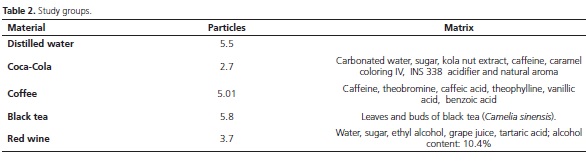
<body><![CDATA[<p><font size="3" face="Verdana, Arial, Helvetica, sans-serif"><B> METHODS</B></font></p>     <p><font size="2" face="Verdana, Arial, Helvetica, sans-serif">Fifty specimens were prepared with the Z-350&reg; resin composite (3M ESPE, Saint Paul, USA) their technical specifications are displayed in <a href="#tab01">Table 1</a>. Each specimen measured 10 mm x 2 mm. After inserting the material, a strip of polyester (Fava, Pirituba, Brazil) was placed over the matrix and the tip of the curing light was pressed against the assembly to form a flat surface on the specimens. Polymerization was performed using the conventional method (Elipar Free Light II / 3M Espe, Seefeld, Germany, 1200 mW/cm2 for 40s). The specimens were submitted to immersion in different media distilled water (Asfer, S&atilde;o Caetano do Sul, Brazil), coca-cola&reg; (Coca-Cola&reg;, Petr&oacute;polis, Brazil), coffee (Tr&ecirc;s Cora&ccedil;&otilde;es, Santa Luzia, Brazil), black tea (Moinhos Unidos, Curitiba, Brazil) and red wine (Can&ccedil;&atilde;o, Flores da Cunha, Brazil), for one hour per day and their technical specifications are displayed in <a href="#tab02">Table 2</a>. The specimens were subsequently washed and returned to their recipients with distilled water at 37 &plusmn; 1 &deg;C for 23 hours. </font></p>     <p><font size="2" face="Verdana, Arial, Helvetica, sans-serif">At predetermined times &#91;baseline (T1), 3 months (T2), 6 months (T3), 9 months (T4) and 12 months (T5)&#93;, three Ra readings were taken in opposite directions using a roughness meter (Surftest SJ-301 Mitutoyo, Kanagawa, Japan). Statistical analysis was performed using Statistical Package for Social Sciences (SPSS for Windows, version 18.0, SPSS Inc, Chicago, USA), mean Ra values were subjected to analysis of variance (ANOVA) followed by Tukey's test (p &lt; 0.05). </font></p>     <p>&nbsp;</p>     <p><a name="tab01"></a></p>     <p>&nbsp; </p>     <p align="center"><img src="/img/revistas/rgo/v64n1/a07tab01.jpg">     <p>&nbsp;</p>     <p><a name="tab02"></a></p>     <p>&nbsp; </p>     ]]></body>
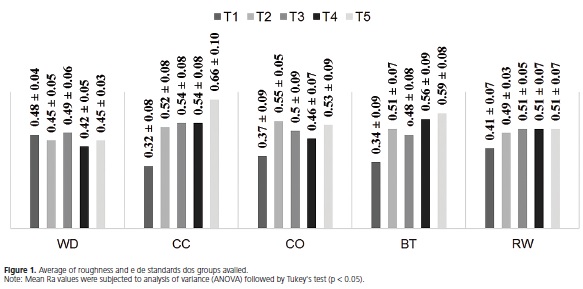
<body><![CDATA[<p align="center"><img src="/img/revistas/rgo/v64n1/a07tab02.jpg">     <p>&nbsp;</p>     <p><font size="3" face="Verdana, Arial, Helvetica, sans-serif"><B> RESULTS</B></font></p>     <p><font size="2" face="Verdana, Arial, Helvetica, sans-serif"><a href="#fig01">Figure 1</a> displays the mean Ra and standard deviation values. A significant increase in Ra was found in the specimens submitted to coffee, cocacola &reg; and black tea between baseline and the threemonth evaluation. Variance was also found among the remaining evaluation times (3 months to 12 months), but the differences did not achieve statistical significance. No statistically significant differences in Ra were found among evaluation times in the specimens submitted to red wine or distilled water.</font></p>     <p>&nbsp;</p>     <p><a name="fig01"></a></p>     <p>&nbsp; </p>     <p align="center"><img src="/img/revistas/rgo/v64n1/a07fig01.jpg">     <p>&nbsp;</p>     <p><font size="3" face="Verdana, Arial, Helvetica, sans-serif"><B>DISCUSSION</B></font></p>     ]]></body>
<body><![CDATA[<p><font size="2" face="Verdana, Arial, Helvetica, sans-serif">It is important to maintain a smooth surface on dental restorations to avoid problems such as changes in color and brightness and minimize the risk of secondary caries<sup>9,11</sup>. A rough surface facilitates the buildup of bacterial plaque and can affect periodontal health<sup>16</sup>. It is therefore ideal to make the surface of a composite resin as smooth as possible to obtain optimum clinical performance. However, the frequent ingestion certain substances can lead to an increase in surface roughness, as demonstrated in the present investigation. </font></p>     <p><font size="2" face="Verdana, Arial, Helvetica, sans-serif">A number of studies have evaluated the effect of different beverages on the surface of resin composites<sup>13,15,17-19</sup>, but few have performed long-term evaluations, likely due to the difficulties such as daily changes of the immersion media. </font></p>     <p><font size="2" face="Verdana, Arial, Helvetica, sans-serif">In the present study, no statistically significant differences among evaluation times were found for the samples submitted to red wine, despite the low pH (3.7) and alcohol content (10.4%) of this medium. Alcohol is a great solvent of polymer chains and high concentrations of this substance (50 to 75%) soften the surface of a resin composite, leading to increased roughness<sup>1,20-24</sup>. The lack of a significant difference in this group was likely due to the low concentration of alcohol in red wine. </font></p>     <p><font size="2" face="Verdana, Arial, Helvetica, sans-serif">The significant difference found in the specimens submitted to coca-cola&reg; (pH 2.7) was likely due to the phosphoric acid and sugars in the chemical composition of this beverage, causing erosion to the surface of the resin composite<sup>17,19</sup>. Significant differences in Ra were also found in the specimens submitted to coffee and black tea beginning at three months. While the respective pH values are 5.0 and 5.8, the composition of these beverages may have been the cause of erosion, as these natural substances have different long-chain organic acids<sup>18</sup> that can dissolve and erode restorative materials<sup>17-18,25</sup>. </font></p>     <p><font size="2" face="Verdana, Arial, Helvetica, sans-serif">Differences in pH did not influence the results as much as the presence of acids in the substances evaluated. Indeed, a more acidic pH does not appear indicate greater erosive potential<sup>26</sup>. Erosion depends on the combined effect of physicochemical properties, total amount of acid, mineral content and titratable acidity<sup>26-27</sup>.</font><font size="2" face="Verdana, Arial, Helvetica, sans-serif"> </font></p>     <p><font size="2" face="Verdana, Arial, Helvetica, sans-serif">Further investigations should be performed addressing the frequency of intake as well as the physicochemical characteristics of these beverages, which can influence changes in the surface roughness of resin composites. Although the present in vitro findings do not allow the prediction of clinical performance, the data serve as a warning to dentists regarding problems involving rough surfaces on resin composites, which can be caused by different beverages.</font></p>     <p>&nbsp;</p>     <p><font size="3" face="Verdana, Arial, Helvetica, sans-serif"><B> CONCLUSION</B></font></p>     <p><font size="2" face="Verdana, Arial, Helvetica, sans-serif">Based on the present findings, coca-cola&reg;, coffee and black tea exert an influence on the surface roughness of resin composites.</font><font size="2" face="Verdana, Arial, Helvetica, sans-serif"> </font></p>     <p>&nbsp;</p>     ]]></body>
<body><![CDATA[<p><font size="3" face="Verdana, Arial, Helvetica, sans-serif"><B>Acknowledgements</B></font></p>     <p><font size="2" face="Verdana, Arial, Helvetica, sans-serif">The authors thank FAPEMIG and CAPES for the support.</font></p>     <p>&nbsp;</p>     <p><font size="3" face="Verdana, Arial, Helvetica, sans-serif"><B>Collaborators</B></font></p>       <p><font size="2" face="Verdana, Arial, Helvetica, sans-serif">   CAC ISABEL test runner in rugosimeter, exchanges of immersion media, and wording of article. AAS DOMINGUETTE it was responsible for handling test bodies and wording of article. SG SANTOS e JCR RIBEIRO they were responsible for statistical analysis and writing of the article. MR MOYS&Eacute;S he supervised the research and participated in the writing of the article.</font></p>     <p>&nbsp;</p>     <p><font size="3" face="Verdana, Arial, Helvetica, sans-serif"><B>REFERENCES </B></font></p>     <!-- ref --><p><font size="2" face="Verdana, Arial, Helvetica, sans-serif">1. Ferracane JL. Effects hygroscopic and hydrolytic in dental polymer networks. Dent Mater. 2006;22(3):211-22. doi:10.1016/j.dental.2005.05.005 </font>&nbsp;&nbsp;&nbsp;&nbsp;&nbsp;&nbsp;&nbsp;&nbsp;[&#160;<a href="javascript:void(0);" onclick="javascript: window.open('/scielo.php?script=sci_nlinks&ref=251562&pid=S1981-8637201600010000700001&lng=','','width=640,height=500,resizable=yes,scrollbars=1,menubar=yes,');">Links</a>&#160;]<!-- end-ref --><p><font size="2" face="Verdana, Arial, Helvetica, sans-serif">2. Silva MA, Fardin AB, Vasconcellos RC, Santos LM, Tonholo J, Silva JG Jr,et al. Analysis of surface roughness and surface hardness of a dental composite using atomic force microscopy and hardness testing. Microsc Microanal. 2011;17(3):446-51. doi: 10.1017/S1431927611000250 </font></p>     <p><font size="2" face="Verdana, Arial, Helvetica, sans-serif">3. Soares-Geraldo D, Scaramucci T, Steagall-Jr W, Braga SR, Sobral MA. Interaction between staining and degradation of a composite resin in contact with colored foods. Braz Oral Res. 2011;25(4):369-75. doi.org/10.1590/S1806- 83242011000400015 </font></p>     ]]></body>
<body><![CDATA[<p><font size="2" face="Verdana, Arial, Helvetica, sans-serif">4. Miranda DA, Bertoldo CE, Aguiar FH, Lima DA, Lovadino JR. Effects of mouthwashes on Knoop hardness and surface roughness of dental composites after different immersion times. Braz Oral Res. 2011;25(2):168-73. doi: 10.1590/S1806- 83242011000200012 </font></p>     <p><font size="2" face="Verdana, Arial, Helvetica, sans-serif">5. Gohring TN, Besek MJ, Schmidlin PR. Attricional wear and abrasive surface alternations of composite resin materials in vitro. J Dent. 2002;30(2-3):119-27. doi: 10.1016/S0300- 5712(02)00007-6 </font></p>     <p><font size="2" face="Verdana, Arial, Helvetica, sans-serif">6. Briso AL, Caruzo LP, Guedes AP, Catelan A, Santos PH. In vitro evaluation of surface roughness and microhardness of restorative materials submitted to erosive challenges. Oper Dent. 2011;36(4):397-402. doi: 10.2341/10-356-L </font></p>     <p><font size="2" face="Verdana, Arial, Helvetica, sans-serif">7. Kooi TJ, Tan QZ, Yap AU, Guo W, Tay KJ, Soh MS. Effects of foodsimulating liquids on surface properties of giomer restoratives. Oper Dent. 2012;37(6):665-71. doi: 10.2341/11-419-L</font></p>     <p><font size="2" face="Verdana, Arial, Helvetica, sans-serif"> 8. Yesil ZD, Alapati S, Johnston W, Seqhi RR. Evaluation of the wear resistance of new nanocomposite resin restorative materials. J Prosthet Dent. 2008;99(6):435-43. doi: 10.1016/ S0022-3913(08)60105-5 </font></p>     <p><font size="2" face="Verdana, Arial, Helvetica, sans-serif">9. Azer SS, Hague AL, Johnston WM. Effect of bleaching on tooth discolouration from food colourant in vitro. J Dent. 2011;39(Suppl 3):e52-6. doi: 10.1016/j.jdent.2011.09.006 </font></p>     <p><font size="2" face="Verdana, Arial, Helvetica, sans-serif">10. Paravina RD, Roeder L, Lu H, Vogel K, Powers JM. Effect of finishing and polishing procedures for the surface roughness, brightness and color of the resin based composites. J Am Dent. 2004;17:262-66.</font></p>     <p><font size="2" face="Verdana, Arial, Helvetica, sans-serif"> 11. Murakami JT, Umetsubo LS, Valera MC, Ara&uacute;jo MAM. Rugosidade superficial de resinas compostas ap&oacute;s utiliza&ccedil;&atilde;o de jato de bicarbonato ou pasta de pedra-pomes. RGO, Rev Ga&uacute;ch Odontol. 2006;54(1):7-10. </font></p>     <p><font size="2" face="Verdana, Arial, Helvetica, sans-serif">12. Lin CY, Lee SY, Huang HM, Keh ES, Lin CT. Stability of dental composites in organic solutions simulating oral environment. J Dent Res. 1997;76:321. </font></p>     <p><font size="2" face="Verdana, Arial, Helvetica, sans-serif">13. Yanikoglu N, Duymus ZY, Yilmaz B. Effects of different solutions on the surface hardness of composite materials. Dent Mater. 2009;28(3):344-51. doi: 10.4012/dmj.28.344 </font></p>     ]]></body>
<body><![CDATA[<p><font size="2" face="Verdana, Arial, Helvetica, sans-serif">14. Mundim FM, Garcia Lda F, Pires-de-Souza FC. Effect of staining solutions and repolishing on color stability of direct composites. J Appl Oral Sci. 2010;18(3):249-54. doi: 10.1590/S1678- 77572010000300009 </font></p>     <p><font size="2" face="Verdana, Arial, Helvetica, sans-serif">15. Hamouda IM. Effects of different drinks on the hardness, roughness and solubility of esthetic restorative materials. J Esthet Restor Dent. 2011;23(5):315-22. doi: 10.1111/j.1708- 8240.2011.00453.x </font></p>     <p><font size="2" face="Verdana, Arial, Helvetica, sans-serif">16. Kawai K, Urano M. Adherence of plaque components to different restorative materials. Oper Dent. 2001;26(4):396-400. </font></p>     <p><font size="2" face="Verdana, Arial, Helvetica, sans-serif">17. Bansal K, Acharya SR, Saraswathi V. Effect of alcoholic and nonalcoholic beverages on color stability and surface roughness of resin composites: An in vitro study. J Conserv Dent. 2012;15(3):283-8. doi: 10.4103/0972-0707.97961 </font></p>     <p><font size="2" face="Verdana, Arial, Helvetica, sans-serif">18. Gouvea CV, Bedran LM, Faria MA, Cunha-Ferreira N. Surface roughness and translucency of resin composites after immersion in coffee and soft drink. Acta Odontol Latinoam. 2011;24(1):3- 7. </font></p>     <p><font size="2" face="Verdana, Arial, Helvetica, sans-serif">19. Tuncer D, Karaman E, Firat E. Does the temperature of beverages affect the surface roughness, hardness, and color stability of a composite resin? Eur J Dent. 2013;7(2):165-71. doi: 10.4103/1305-7456.110161 </font></p>     <p><font size="2" face="Verdana, Arial, Helvetica, sans-serif">20. Cavalcanti AN, Mitsui FH, Ambrosano GM, Mathias P, Marchi GM. Effect of different mouthrinses on Knoop hardness of a restorative composite. Am J Dent. 2005;18(6):338-40. </font></p>     <p><font size="2" face="Verdana, Arial, Helvetica, sans-serif">21. Sarret DC, Coletti DP, Peluso AR. The effect of alcoholic beverages on composite wear. Dent Mater. 2000;16(1):62-7. doi: 10.1016/S0109-5641(99)00088-3 </font></p>     <p><font size="2" face="Verdana, Arial, Helvetica, sans-serif">22. Alencar E Silva Leite ML, Cunha Medeiros E Silva FD, Meireles SS, Duarte RM, Andrade AK. The effect of drinks on color stability and surface roughness of nanocomposites. Eur J Dent. 2014;8(3):330-6. doi: 10.4103/1305-7456.137640 </font></p>     <p><font size="2" face="Verdana, Arial, Helvetica, sans-serif">23. Festuccia MSCC, Garcia LFR, Cruvinel DR, Pires-De-Souza FCP. Color stability, surface roughness and microhardness of composites submitted to mouthrinsing action. J Appl Oral Sci. 2012;20(2):200-5. doi: 10.1590/S1678- 77572012000200013 </font></p>     ]]></body>
<body><![CDATA[<p><font size="2" face="Verdana, Arial, Helvetica, sans-serif">24. Wongkhantee S, Patanapiradej V, Maneenut C, Tantbirojn D. Effect of acidic food and drinks on surface hardness of enamel, dentine, and tooth-coloured filling materials. J Dent. 2006;34(3):214&ndash;20. doi: 10.1016/j.jdent.2005.06.003 </font></p>     <p><font size="2" face="Verdana, Arial, Helvetica, sans-serif">25. Gon&ccedil;alves GK, Guglielmi CA, Corr&ecirc;a FN, Raggio DP, Corr&ecirc;a MS. Erosive potential of different types of grape juices. Braz Oral Res. 2012;26(5):457-63. doi: 10.1590/S1806- 83242012005000015 </font></p>     <p><font size="2" face="Verdana, Arial, Helvetica, sans-serif">26. Lussi A, Jaeggi T. Erosion - diagnosis and risk factors. Clin Oral Investig. 2008;12(Suppl 1):S5-13. doi: 10.1007/s00784-007- 0179-z </font></p>     <p><font size="2" face="Verdana, Arial, Helvetica, sans-serif">27. Featherstone JD, Lussi A. Understanding the chemistry of dental erosion. Monogra Oral Sci. 2006;20:66-76. doi: 10.1159/000093351</font></p>     <p>&nbsp;</p>     <p>&nbsp;</p>     <p><font size="2" face="Verdana, Arial, Helvetica, sans-serif"><a name="back"/></a><a href="#top"><img src="/img/revistas/rgo/v64n1/seta.jpg" border="0" align="absmiddle"/></a><b>Correspondence to:</b>    <br>   MR MOYS&Eacute;S    <br>Av. Castelo Branco, 82, Chácara das Rosas, 37410-000    <br> Três Corações, MG, Brasil    ]]></body>
<body><![CDATA[<br>   e-mail: <a href="mailto:marcos.ribeiro.moise@terra.com.br" target="_blank">marcos.ribeiro.moise@terra.com.br</a></font></p>     <p>&nbsp;</p>       <p><font face="Verdana, Arial, Helvetica, sans-serif" size="2"><b>Received on:</b> 16/11/2014<br/> <b>Final version resubmitted on:</b> 10/12/2014<br/> <b>Approved on:</b> 14/5/2015</font></p>     <p>&nbsp;</p>      ]]></body>
<back>
<ref-list>
<ref id="B1">
<label>1</label><nlm-citation citation-type="journal">
<person-group person-group-type="author">
<name>
<surname><![CDATA[Ferracane]]></surname>
<given-names><![CDATA[JL.]]></given-names>
</name>
</person-group>
<article-title xml:lang="en"><![CDATA[Effects hygroscopic and hydrolytic in dental polymer networks.]]></article-title>
<source><![CDATA[Dent Mater.]]></source>
<year>2006</year>
<volume>22</volume>
<numero>3</numero>
<issue>3</issue>
<page-range>211-22.</page-range></nlm-citation>
</ref>
</ref-list>
</back>
</article>