Malocclusion in schoolhildren aged 7-12 years old in Minas Gerais, Brazil
Má Oclusão em escolares de 7 a 12 anos de idade em Minas Gerais, Brasil
Carlos Henrique de MORAIS I; Luciane ZANIN I; Viviane Veroni DEGAN I; Heloísa Cristina VALDRIGHI I; Giovana Cherubini VENEZIAN I; Silvia Amélia Scudeler VEDOVELLO I
I Fundação Hermínio Ometto – UNIARARAS, Curso de Odontologia, Pós-Graduação em Ortodontia ]]>
ABSTRACT
Objective
The aim of the study was to determine prevalence of malocclusion and the inter- and intra-arch relations in schoolchildren of 7-12 years of Vazante, Minas Gerais, Brazil.
Methods ]]> In the inter-arch relations the sagittal, vertical and transverse aspects were evaluated, and in the intra-arch relations, diastemas, crowding and tooth losses were determined in 670 children. The maloclussion was classified as Class I , II and III according to Angle, based on the position of the first molars. For this study, the sample was divided into two age groups: children from 7 to 9 years and children from 10 to 12 years old.
Results
A similar percentage of individuals with Class I and II was found in the two age groups evaluated. A higher percentage of Class III individuals was observed in the age group from 10 to 12 years. The presence of cross bite, anterior open bite, diastemas, crowding and early primary tooth loss was prevalent in the age groups of 7 and 9 years. Deep bite, posterior cross bite and early loss of permanent teeth prevailed in the age from 10 to 12 years.
Conclusion
It could be concluded that there was a high rate of malocclusion in children and the sagittal relation was maintained in the two periods evaluated. A larger number of manifestations of anterior open bite were observed in the age group of 7 to 9 years, and overbite in the Group from 10 to 12 years. In the transverse relation there was an increase in cross bite from the first to second transitory period.
Indexing terms: Dentition mixed. Malocclusion. Orthodontics.
RESUMO
Objetivo
Determinar a prevalência de má oclusão e as relações inter e intra-arco em escolares de 7 a 12 anos de Vazante, Minas Gerais, Brasil.
Métodos ]]> Nas relações inter-arco os aspectos no plano sagital, verticais e transversais foram avaliados e, no intra-arco, as relações de diastemas, apinhamento e perdas dentárias foram determinadas em 670 escolares. A má oclusão foi classificada em classe I, II e III de acordo com Angle, baseada na posição dos primeiros molares. Para este estudo, a amostra foi dividida em dois grupos etários: crianças 7-9 anos e crianças dos 10 aos 12 anos de idade.
Resultados
Uma percentagem semelhante de indivíduos com má oclusão de Classe I e II foi encontrado nos dois grupos etários avaliados. A maior percentagem de indivíduos com má oclusão de Classe III foi observada na faixa etária dos 10 aos 12 anos. A presença de mordida cruzada, mordida aberta anterior, diastemas, apinhamento e perda dentária precoce primária foi prevalente nas faixas etárias de 7 e 9 anos. Sobremordida profunda, mordida cruzada posterior e perda precoce dos dentes permanentes prevaleceram na faixa etária de 10-12 anos.
Conclusão
Pode-se concluir que houve uma alta taxa de má oclusão em crianças e a relação sagital foi mantido nos dois períodos avaliados. Foi observado um maior número de mordida aberta anterior na faixa etária de 7 a 9 anos, e sobremordida profunda no grupo dos 10 aos 12 anos. Na relação transversal, houve um aumento da mordida cruzada do primeiro para o segundo período de transição.
Termos de indexação: Dentição mista. Má oclusão. Ortodontia.
INTRODUCTION
Malocclusion is defined as a change in craniofacial growth and/or development with esthetic impact, and consequent psychosocial implication in children and adults1. It is ranked as the third greatest oral health problem worldwide, being outranked by caries and periodontal disease2. In addition, it is of a multifactorial nature, with hereditary, congenital, functional, environmental, nutritional, socioeconomic and educational influences3. Deleterious habits, among them finger and pacifier sucking, are described in the literature as the main etiologic factors of malocclusion in the primary and mixed stages of dentition4-6.
]]> Epidemiological studies on oral health and prevalence of malocclusion in a certain region provide important data to enable planning of the measures necessary for a reduction in the incidence of unfavorable factors, in addition to interception of the skeletal problems at a suitable age7. Early diagnosis and treatment may present different levels of severity, which consequently must receive different treatment priorities. In addition, early diagnosis and treatment favor the growth and good development of the individual6.In order to enable measures of prevention and health promotion to be effected, it is necessary to know the prevalence of malocclusions, by means of epidemiological surveys, which are an important instrument for evaluation the present situation and future oral health care needs in a population8. The Northeast of the State of Minas Gerais has shown to be lacking as regards this type of study, thus, within this context the aim of the present study was to determine the prevalence de malocclusion and the inter- and intra-arch relations in school children at the stage of mixed dentition, from the public teaching network of the city of Vazante, MG, Brazil.
METHODS
After obtaining approval from the Research Ethics Committee, Report no. 424.917/2013, this study was conducted in the city of Vazante, located on the Northeastern region of the State of Minas Gerais, with an estimated population of 19.723 inhabitants9. The city has five public schools in urban areas, with a contingent of 1850 students from 7 to 12 years of age, that were invited to participate. The exclusion criteria were presence of orthodontic appliances and/ or previous orthodontic treatment and those who were not authorized by their parents to participate in the study. The response rate was 36.8%, thus the total sample examinated was of 670 children.
The examinations were performed by a professional calibrated and analyzed by the Kappa test. The results achieved substantial score for the acceptable parameters of reproducibility of this method (0.86).
With the purpose of evaluating schoolchildren, considering the first transitory period marked by the presence of the incisors and first permanent molars only; and the second transitory period, which starts between 9.5 and 10 years of age, the period of changing the posterior teeth. Therefore, for this study, the sample was divided into two age groups: Age Group 1 (children from 7 to 9 years and 11 months old) and Age Group 2 (children from 10 to 12 years and 11 months old). The data collected were analyzed in a descriptive manner by means of distribution tables of absolute and relative frequencies.
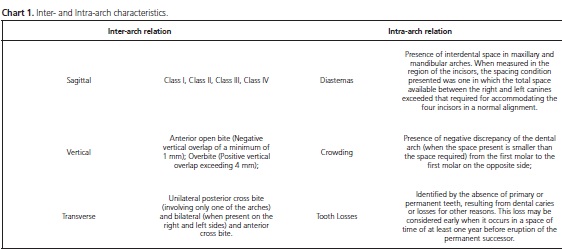
The exams were performed on the premises of the school itself, with the child seated on a chair, facing the examiner, a specialist in orthodontics. The aspects of the inter- and intra-arch relations were examined in accordance with the description in Chart 1 below
The inter-arch relation is with respect to the aspects established in the relationship between the maxillary and mandibular dental arches, and is evaluated in the sagittal, vertical and transverse directions. The inter-arch relation determined the isolated relationship between the maxillary and mandibular arch, with regard to the perimeter of the arch.
Occlusion is considered clinically normal when the child has a Class I molar relation, vertical overlap of around 3mm, maxillary arch with transverse dimensions compatible with those of the mandibular arch, aligned teeth in the dental arch, and absence of tooth losses, considering the stage of development. Children who presented any of the characteristics outside of those of normality were diagnosed with malocclusion.
]]> The examinations were performed by a single examiner, orthodontics specialist, at school, under natural light, with the child sitting in a chair in front of the examiner.
RESULTS
A total of 670 children were examined, 340 (51.30%) were of the male, and 330 (48.70%) of the female gender. For the age group from 7 to 9 years, were evaluated 326 and 344 for the age 10-12 years.
The response rate was 36,8% of all children invited. Non-participation was mainly due to children who were absent in the day scheduled for the examination, no parental consent or forgot to bring the term of consent signed by their parents. As a result of the calibration process, the examiner obtained intra-examiner reliability values of Kappa agreement of 0,94 for malocclusion.
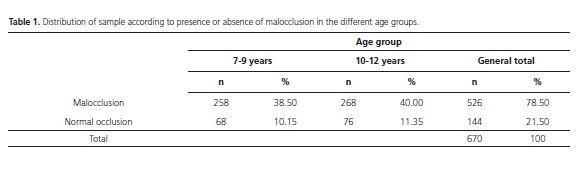
Table 1 shows a very close distribution of individuals with and without malocclusion at the ages evaluated, with a discrete increase in the age group from 10 to 12 years.
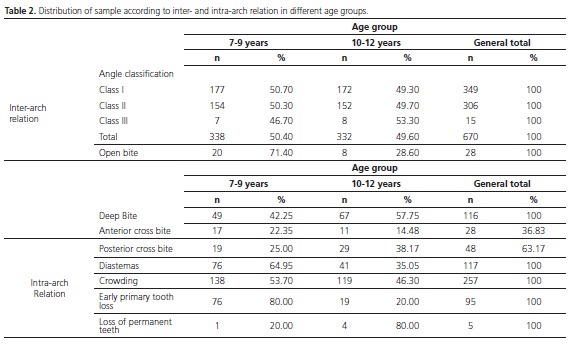
]]> Table 2 shows great similarity in the percentage of Class I and II individuals in the two age groups evaluated; a higher percentage of Class III individuals were observed in the age Group from 10 to 12. The presence of cross bite, anterior open bite, diastemas, crowding and early primary tooth loss was prevalent in the age groups of 7 and 9 years. Deep bite, posterior cross bite and early loss of permanent teeth prevailed in the age from from 10 to 12 years.
]]> DISCUSSION
The existent epidemiological studies conducted in Brazil have indicated that the larger portion of children in the mixed dentition stage present some type of morphological deviation in occlusion that varies between 66.00% and 96.80%1,4,6-8,10,12-19 and are defined as malocclusion. High rates are expected in this age group, since the intense occlusal changes and exchanges of teeth occur in this period1.
In this study, the prevalence of malocclusions was verified in 78.50% of the schoolchildren, which corroborates with the data in other studies, conducted in different regions of Brazil8,12-19. Data from epidemiological studies have shown that malocclusion is maintained with predominance in the three stages of development of occlusion, primary, mixed and permanent dentition1.
The results showed that in the inter-arch relation, Class I malocclusion prevailed over Class II and Class III, in agreement with the majority of the studies in the literature researched12-15,17-20. Some studies were observed to draw attention to the high number of molar relationships in Class I12-15,17-20, and on the other hand, authors12,21,22 emphasized the predominance of Class II, in comparison with relation Class I and Class III. This may be explained by the diversity of methodology used, and by the regional differences, age and sample size, or by the fact of considering normal occlusion as being Class I.
With regard to Class III malocclusion, the findings of this research presented a relative equivalence when compared with the studies in the literature13. However, higher results have also been found8,16,18,20.
As regards Angle's classification23, when analyzed by age group, it was shown in this study that the percentage relations of the three Classes I, II and III of the first transitory stage (7 to 9 years) were maintained when compared with those of the second transitory period (10 to 12 years).
From the vertical aspect, a small percentage of the sample of the children presented deep overbite, a result similar to that of studies found in the literature1,19,24-25. Higher values have been seen by other authors18-19. It is important to observe that the manifestation of overbite was higher in the age group from 10 to 12 years, and was associated with skeletal factors that were manifested during the craniofacial growth period26.
The presence of anterior open bite was observed in 4.20% of the sample, a much lower rate than those found in the literature1,8,18-19. A reduction in open bite was shown from the first transitory period to the second, which may be justified by the fact that this malocclusion is related to oral sucking habits and atypical tongue pressure. As sucking habits are more present in early childhood, there tends to be a higher incidence of these habits at this stage. During normal development, this open bite is frequently of a temporary nature, and may self-correct as the habit is overcome25.
From the transverse aspect the results showed less significant than those found in other works1,18. There was more frequent posterior cross bite, presenting a higher rate in the age group from 10 to 12 years, showing that this occlusal abnormality in particular, does not tend to selfcorrect as the child gets older. It may also be related to skeletal27 and environmental factors that interfere directly in the development of occlusion26.
Furthermore, it is pointed out that studies have shown that posterior cross bite is always more frequent than the anterior type in children in this age group1,4,8,14-15, and that unilateral posterior cross bite has been more frequent than the bilateral type16,18. Cross bites must be treated as soon as they are detected, because a purely dental malocclusion may lead to problems of skeletal growth and deviations, in addition to causing occlusal traumas, adverse periodontal problems, mobility or even fractures27-28.
]]> Dental abnormalities, in addition to compromising the inter-arch relation, may cause alterations restricted to the dental arch itself (intra-arch) as is the case with diastemas, crowding and tooth losses. The prevalence of diastemas in children was lower than the value found in other studies1,18. The literature has shown that there is higher prevalence of primary crowding and malocclusion than the other types of problems, due to the discrepancy between the perimeter of the dental arch and the tooth mass, and this is either of an environmental or genetic nature. It is known that crowding in mixed dentition, known as temporary primary crowding, is spontaneously corrected during this stage11.Data for the diastema showed a difference in manifestation between the two age groups, the percentage of 7-9 years of age was almost twice the age 10-12 years. The presence of diastema at the beginning of mixed dentition is justified by the proximity of the canines in eruption to the apices of the lateral incisors18.
With regard to tooth losses, the results showed that there are tooth losses of 14.18% in primary dentition, and 0.75% in permanent dentition. Lower results were found by1-18.
Caries and premature losses of primary molars result in a reduction in arch length of approximately 2 to 4mm per quadrant. Tooth loss and the reduction in interdental contacts represent one of the etiological (environmental) factors responsible for the appearance of malocclusion29.
With the development of diagnostic techniques and malocclusion treatments, Orthodontics in general tends to be moving in the direction towards the preventive aspects of primary and mixed occlusion.
The measurement of malocclusion using the Angle classification can be identified as a limitation of these study because is based only on the positioning of teeth, not evaluating bone and muscular aspects.
Epidemiological surveys are an important tool for evaluating the current situation and future needs of treatments. This evaluation of the occlusal problems that affect the population in this age group makes it possible to act as early as possible, in addition to making the problems easier, faster and less expensive to treat. Moreover, public health preventive programs will become feasible and more efficient.
CONCLUSION
From the results obtained, it was concluded that the sagittal aspect evaluated in the inter-arch relation was maintained in the two periods studied. There were a larger number of manifestations of anterior open bite observed in the age group of 7 to 9 years, and deep overbite in the Group from 10 to 12 years.
]]> In the transverse relation there was an increase in cross bite from the first to second transitory period. In the intra-arc relation, a reduction in crowding and diastema was observed in the transition stage between age groups.
Collaborators
CH MORAIS AND HC VALDRIGHI conducted the study. SAS VEDOVELLO analysis and prepared the study design. VV DEGAN data analysis. GC VENEZIAN prepared and conducted the study design and work.
REFERENCES
1. Almeida MR, Pereira ALP, Almeida RR, Almeida-Pedrin RR, Silva Filho OG. Prevalência de má oclusão em crianças de 7 a 12 anos de idade. Dental Press J Orthod. 2011;16(4):123-31. doi: 10.1590/S2176-94512011000400019 [ Links ]
2. World Health Organization-WHO. Geneva. The world oral health report 2003: continuous improvement of oral health in the 21st century-the approach of the WHO Global Oral Health Programme. 2003 [cited 2014 Mar 20]. Disponível: <http:// www.who.int/oral_health/media/en/orh_report03_en.pdf>.
3. Janson G, Barros SEC, Simão TM, Freitas MR. Variáveis relevantes no tratamento da má oclusão de Classe II. Rev Dental Press Ortodon Ortop Facial. 2009; 14(1):149-157. doi: 10.1590/S1415-54192009000400016
4. Sousa RV, Pinto-Monteiro AKA, Martins CC, Granville-Garcia AF, Paiva SM. Maloclusion and socioeconomic indicators in primay dentition. Braz Oral Res. 2014;28(1):54-60. doi: 10.1590/S1806-83242013005000032
]]> 5. Carvalho CM, Carvalho LFPC, Forte FDS, Aragão MS, Costa LJ. Prevalência de mordida aberta anterior em crianças de 3 a 5 anos em Cabedelo/PB e relação com hábitos bucais deletérios. Pesq Bras Odontoped Clin Integr. 2009;9(2):205-10.6. Sousa RV, Clementino MA, Gomes MC, Martins CC, Graville- Garcia AF, Paiva SM. Maloclusion and quality of life in Brazilian preschoolers. Eur J Oral Sci. 2014;122(3):223-229. doi: 10.1111/eos.12130
7. Bittencourt MA, Machado AW. Prevalência de má oclusão em crianças entre 6 e 10 anos: um panorama brasileiro. Dental Press J Orthod. 2010;15(6):113-22. doi: 10.1590/S2176- 94512010000600015
8. Brasil. Ministério da Saúde. Secretaria de Atenção à saúde. Departamento de Atenção Básica. Projeto SB Brasil 2010: Pesquisa Nacional de Saúde Bucal. Brasília: Ministério da Saúde, 2010 [citado 2014 Mar 20]. Disponível em: < http://bvsms. saude.gov.br/bvs/publicacoes/pesquisa_nacional_saude_bucal. pdf>.
9. IBGE. Instituto Brasileiro de Geografia e Estatística. População de Vazante [citado 2014 Maio 22]. Disponível em: <http:// www.ibge.gov.br>.
10. Góis EG, Vale MP, Paiva SM, Abreu MH, Serra-Negra JM, Pordeus IA. Incidence of malocclusion between primary and mixed dentitions among Brazilian children A 5-year longitudinal study. Angle Orthod. 2012;82(3):495-500. doi: 10.2319/033011-230.1
11. Silva Filho OG, Garib DG, Lara TS. Ortodontia interceptiva: protocolo de tratamento em duas fases. São Paulo: Artes Médicas; 2013.
12. Almeida MEC, Vedovello Filho M, Vedovello SA, Lucatto A, Torrezan AT. Prevalência da má oclusão em escolares da rede estadual do município de Manaus, AM - Brasil. RGO, Rev Gaúch Odontol. 2007;55(4):389-394.
13. Boeck EM, Pizzol KEDC, Navarro N, Chiozzini NM, Foschini ALR. Prevalência de maloclusão em escolares de 5 a 12 anos de Rede Municipal de Ensino de Araraquara. Rev CEFAC. 2013;15(5):1270-1280. doi: 10.1590/S1516- 18462012005000090
14. Romano FL, Magnani MBBA, Ferreira JTL, Matos DS, Valério RA, Silva RAB, et al. Prevalence of malocclusions in schoolchildren with mixed dentition in the city of Piracicaba, Brazil. Rev Odontol Univ Cid São Paulo. 2012;24(2):96-104
]]> 15. Brito DI, Dias PF, Gleiser R. Prevalência de más oclusões em crianças de 9 a 12 anos de idade da cidade de Nova Friburgo (Rio de Janeiro). Dental Press Ortodon Ortoped Facial. 2009;14(6):118-124. doi: 10.1590/S1415- 5419200900060001416. Schwetner A, Nouer PRA, Garbui IU, Kuramae M. Prevalência de má oclusão em crianças entre 07 e 11 anos em Foz do Iguaçu-PR. RGO, Rev Gaúch Odontol. 2007;55(2):155-61.
17. Biázio RC, Costaq GC, Virgens Filho JS. Prevalência de máoclusão na dentadura decídua e mista no distrito de Entre Rios, Guarapuava-PR. Publ UEPG Cienc Biol Saúde. 2005;11(1):29- 38.
18. Almeida-Pedrin RR, Silva EE, Ferreira FPC, Almeida MR. Prevalência das más-oclusões em jovens de seis a 12 anos de idade na cidade de Miranda/MS. Ortodontia. 2008;41(4):384- 92.
19. Sousa JP, Sousa SA. Prevalência de má oclusão em escolares de 7 a 9 anos de idade do Polo 1 da Rede Municipal de Ensino em João Pessoa-PB. Rev Odontol UNESP. 2013;42(2):117-123.
20. Silva Filho OG, Freitas SF, Cavassan AO. Prevalência de oclusão e má oclusão na dentadura mista em escolares da cidade de Bauru (SP). Rev Assoc Paul Cir Dent. 1989;43(2):287-90.
21. Gonçalves LPV, Toledo AO, Otero SAM. Relação entre bruxismo, fatores oclusais e hábitos bucais. Dental Press J Orthod. 2010;15(2):97-104.
22. Freitas CV, Souza JGS, Mendes DS, Pordeus IA, Jones KM, Martins AMEBL. Necessidade de tratamento ortodôntico em adolescentes brasileiros: avaliação com base na saúde pública. Rev Paul Pediatr. 2015;33(2):204-10. doi: http://dx.doi. org/10.1016/j.rpped.2014.04.006
23. Dimberg L, Lennartsson B, Arnrup K, Bondemark L. Prevalence and change of malocclusions from primary to early permanent dentition: a longitudinal study. Angle Orthod. 2015;85(5):728- 34. doi: 10.2319/080414-542.1
24. Bittencourt MAV, Machado AW. Prevalência de má oclusão em crianças entre 6 e 10 anos: um panorama Brasileiro. Dental Press J Orthod. 2010;15(6):113-22. doi: 10.1590/S2176- 94512010000600015
]]> 25. Boeck EM, Pizzol KEDC, Barbosa EGP, Pires NCA, Lunardi N. Prevalência de má oclusão em crianças de 3 a 6 anos portadoras de hábito de sucção de dedo e/ou chupeta. Rev Odontol UNESP. 2013;42(2):110-6. doi: 10.1590/S1807-2577201300020000826. Silva Filho OG, Silva PRB, Rego MN, Capelozza Filho L. Epidemiologia da mordida cruzada posterior na dentadura decídua. JBP, J Bras Odontopediatr Odontol Bebê. 2003;6(29):61-8.
27. Karaiskos N, Wiltshire WA, Odlum O, Brothwell D, Hassard TH. Preventive and interceptive orthodontic treatment needs of an inner-city group of 6 and 9 year-old canadian children. J Can Dent Assoc. 2005;71(9):649.
28. Silva Filho OG, Silva P, Rego M, Silva F, Cavassan A. Epidemiologia da má oclusão na dentadura decídua. Ortodontia. 2002;5(1):22-33.
29. Cavalcanti AL, Menezes AS, Granville-Garcia AF, Fontes LBC. Prevalência de perda precoce de molares decíduos: estudo retrospectivo. Acta Sci Health Sci. 2008;30(2):139-143.
 Correspondence to:
CH MORAIS
Av. dos Trabalhadores, 2991, Jd Jacira
Mogi Guaçu, SP, Brasil. ]]>
e-mail: carlosvazante@terra.com.br
Received on: 2/4/2015
Final version resubmitted on: 6/11/2015
Approved on: 28/11/2015
]]>