Evaluation of the effectiveness of the tooth whitening treatment associated with the immersion in coloring solutions
Fabiano Carlos Marson I ; Karina Maria Salvatore de Freitas I ; Giovani de Oliveira Correa I ; Camila Paula Tonin Bressan I ; Cléverson O. Silva I,II
II State University of Maringá – Maringá – PR – Brazil
ABSTRACT
Introduction: Tooth whitening or dental bleaching is a cosmetic procedure that has established itself in Dentistry; however, the staining because of the ingestion of some types of food may cause several factors leading to the failure of this treatment. Objective: This study aimed to evaluate in vitro the influence of the immersion of whitened teeth in solutions with a high degree of pigmentation on the efficacy of the bleaching performed with 16% hydrogen peroxide. Material and methods: Fifty-six human teeth were selected, bleached for 4 hours a day during 14 days and randomly divided into 7 groups (n = 8). The groups G1/G2 and G3 were immersed in coloring solutions immediately (IM) after bleaching (AP): G1 – tooth whitening + coffee (IM), G2 – tooth whitening + cola-based soft drink (IM) and G3 – tooth whitening + red wine (IM); G4/and G6 were immersed in the solutions for 2 hours (AP), G4 – tooth whitening + coffee (AP), G5 – tooth whitening + cola based soft drink (AP), G6 – tooth whitening + red wine and (AP) G7 – control. After bleaching with an immersion time of 5 minutes, with the aid of a digital spectrophotometer, the final color (FC) was measured 24 hours after the end of the bleaching treatment (day 15). Results: The results for ANOVA showed no statistical differences in all groups. Conclusion: There was no influence on the effectiveness of tooth whitening immersed in coloring solutions.
Keywords: tooth whitening; coloring; immersion.
Introduction
The beauty standards presented by the media, based on white and well aligned smiles with the need to look good for acceptance in society, are causing that the cosmetic procedures are the most requested procedures in the dental office, and functional procedures end up getting on low priority 3,13. Among these procedures, tooth whitening, which besides providing fast results and being easily implemented, is considered minimally invasive 12.
]]> To succeed in the bleaching treatment is necessary to identify the etiologic factor of the darkening. The natural color of the teeth is altered by extrinsic and intrinsic agents. As extrinsic agents, it can be cited: excessive consumption of tobacco, certain medications, chromogenic bacteria and dyes from the diet, such as coffee, tea, wine, mate and some soft drinks 21. Intrinsic alterations have several causing sources, such as malformation of dental tissues, dental trauma, certain systemic medications (tetracycline) and iatrogenic procedures 19.The bleaching for vital teeth can be accomplished by using two techniques: home bleaching and inoffice whitening. Basically, what differs one technique from another is the time of whitening and the concentration of the bleaching agents 13. In the home technique, low concentrations of the bleaching agent are used, among which one can opt by the carbamide peroxide or hydrogen peroxide. In the in-office technique, highest concentrations of the bleaching agent are used, and consequently, there is a smaller time interval. The home bleaching technique has been well accepted since it was described by Haywood and Heymann, in 1989 8.
In the bleaching process, the bleaching agents act by releasing the oxygen into the dental structures in a reaction so-called oxidation-reduction. This process is directly related to the concentration of the bleaching agent and the time in which the enamel is in contact with the agent 1. The dental permeability associated with the low molecular weight allows the oxygen to diffuse through the enamel and dentin. On the other hand, the pigments have a high molecular weight and longer chains that in the bleaching process are broken into smaller molecular chains 4,9.
By starting the bleaching treatment, the patients receive several recommendations, including dietary restrictions, because there is not a given space of time after the end of treatment so that we can introduce a diet rich in foods and beverages with high potential of pigmentation without any interference in the result. Therefore, the aim of this study was to assess the efficacy of the bleaching treatment associated with the immersion in coloring solution.
Material and methods
This project was submitted and approved by the Ethical Committee in Research of the Ingá School under protocol number 0217.0.362.000-11.
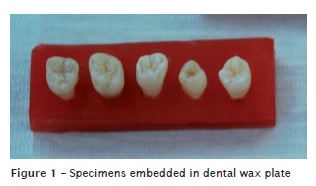
Seventy-three human teeth, premolars and molars free of caries and restorations, were stored into 37% formaldehyde solution just after their extraction. Next, the teeth underwent crown and root scaling and planing through Robinson brush and pumice. With the use of a spectrophotometer (VITA Easyshade Compact), 56 teeth were selected to meet the inclusion criteria: shade A3 or higher saturation. The specimens were randomly selected in six experimental groups and one control groups (figure 1):
]]>
After the assignment of the groups, an impression with alginate of each wax plate with the respective teeth embedded was taken to obtain a dental cast to construct an acetate tray in a vacuum laminator (VH Equipamentos, Araraquara, Brazil). To make the process easier, each tray was identified with the number of the group it was assigned. The color was determined through the parameters of the international CIElab system (L* a* b*), in which L* indicates the luminosity (its mean ranged from 0 – black to 100 – white), and a* and b* correspond to the shade: a* represents the saturation at the red-green axis and b* at the blue-yellow axis, enabling the specificity of any color. With the use of the digital spectrophotometer the initial values of L*, a* and b* were determined through three readings in the medium third of the buccal surface of each tooth to obtain the mean of the initial color of each tooth to be evaluated (CI).
After these separations, the teeth were submitted to the bleaching process for 14 consecutive days. They were in touch with the bleaching agent for 4 hours per day. This was accomplished by the 16% carbamide peroxide gel (Whitegold Home, Dentsply, Petrópolis, Brazil), applied through the tray onto the buccal surface. After the determined period, the trays were removed from the plates and washed under running water.
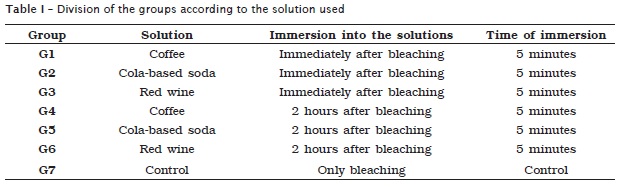
The groups were divided according to the coloring solution and the moment of the bleaching immersion, as follows (table I):
 ]]>
]]>
The samples were immersed into the coloring solutions during 5 minutes (once per day), through vibrating movements, with the aid of a vibrator device (VH Equipamentos, Araraquara, Brazil). Next, the samples were removed and carefully washed in running water and immersed in artificial saliva (Medfórmula, Maringá, Paraná, Brazil). The saliva composition was as follows: KH2PO4 (25 mM) 100 ml + Na2HPO4 (24 mM) 100 ml + KHCO3 (150 mM) 100 ml + NaCl (1.0 mM) 100 ml + MgCl2 (0.15 mM) 100 ml + CaCl2 (1.5 mM) 100 ml + Citric acid (0,002 mM) 6 ml.
At every 24 hours, the bleaching procedures and the immersion in the solutions were performed. The exposure to the coloring solutions occurred during 5 minutes only once per day always after the tooth bleaching.
Elapsed 24 hours after the treatment ending, a new color analysis was performed at the same place of the first analysis to determine the final color (CF). The difference between CI and CF (ΔE) was calculated according to the follow equation: ΔE = [(Δa)² + (Δb)² + (ΔL)²]1/2. The values obtained from ΔE were statistically evaluated by ANOVA and Tukey test, with a level of significance of 5%.
Results
The color alteration was statistically analyzed through the coordinates of L*, a* and b*, in all groups. In graphs 1, 2 and 3 are shown the means of each coordinate for each group evaluated. All the groups were bleached and compared regarding to the initial and final results.
]]>
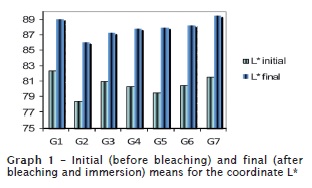
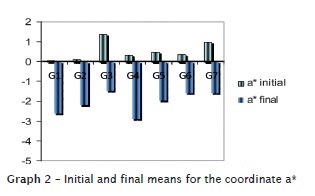
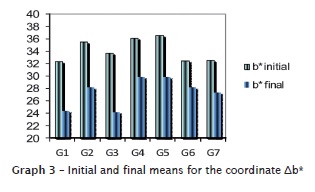
]]> The values of ΔL*=L*final- L*initial, Δa*=a*finala* initial and Δb*=b*final-b*initial were converted to obtain ΔE*= [(ΔL*)2 + (Δa*)2 + (Δb*)2] 0.5. ANOVA was applied to observe if there was statistical significance among the analyzed groups. There was no statistical differences among groups ΔE (p = 0.2332) (table II). Also, there is no significant statistically difference when the values were individually analyzed ΔL (0.3026), Δa (0.3709) and Δb (0.0747).
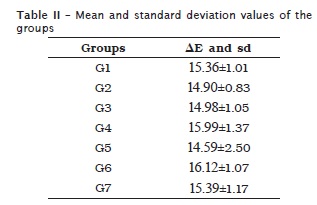
Thus, based on the results presented, the coloring solutions had no significant influence on the process of tooth whitening.
Discussion
The aim of this study was to investigate in vitro if the contact of the tooth after being whitened through the home technique with 16%carbamide peroxide with high potential coloring solutions jeopardize the results of the bleaching treatment. It is highlighted that for this procedure, the intake of food and/or beverages that have a high content of dye should be avoided. The use of food dye is contraindicated during the bleaching treatment. However, most patients ultimately did not follow this recommendation.
]]> In the literature there are few studies related to this subject, most studies used bovine teeth for analysis. Bovine teeth have lower permeability compared to human teeth. According to Schmalz et al. 18, the permeability of bovine teeth becomes half of that found in human teeth. One possible explanation is that the density of the bovine dentinal tubules is greater 17. Therefore, in this study, human teeth were used for clinical simulation. For this study, we selected three solutions with a high degree of pigmentation: coffee, red wine and cola-based soda. These solutions are among the most cited drinks in the literature as the causes of extrinsic staining, however, they can become as intrinsic stains when they penetrate into the enamel microporosities 3. Caneppele et al. 5 conducted a study with the same solutions, and Teo et al. 20 also included black tea. Cardoso et al. 6 used only coffee, Attin et al. 2 used only black tea and in the study of Ley et al. 11, they used red wine.In this process, the immersion time in the coloring solution was 5 minutes to simulate the time consumption in the general population. In the study of Caneppele et al. 5 the immersion totalized10 minutes daily, divided into two moments. In the study of Cardoso et al. 6 the specimens were immersed into coffee, 5 times per day during 60 seconds. Attin et al. 2 left the specimens immersed into black tea for 10 minutes. These aforementioned authors corroborate this study by the fact that no significant statistically differences were found between the color of the specimens. However, further studies are necessary, since in the studies cited the immersion time was relatively low. A longer immersion time means, in practice, larger or excessive consumption of substances containing coloring agents, which can be a determining factor in tooth staining. One observation is the work of Téo et al. 20: the samples remained in contact with the coloring solutions for about 1 hour. However, this does not occur in practice, and as a result, all substances showed high potential for staining. The immersion in artificial saliva containing calcium and phosphate ions after bleaching and immersion procedures was done to simulate the oral environment and thereby remineralize the teeth 16, likely to several other studies 2,5,6,11.
The measurement of the color of the teeth was carried out by the spectrophotometry method which provides accurate data, compared to visual evaluation, which is executed by comparing the color of the tooth with resin or porcelain scales. The color determination was carried out through the CIE lab system (L*a*b*), in which L* means luminosity and a* and b* indicates the color and the saturation 7; the mean of these measurements is ∆E, in which the statistical test was performed.
The medium third was used as a parameter for the color reading because it best represents the color of the teeth; the cervical third is more darkened and the incisal third more translucent. Differences in color among these regions are clinically and statistically significant 20.
Although the results of this study show that the dyes from the diet influenced on the results obtained at the end of the bleaching treatment, it is necessary to observe that the dietary restrictions still must be recommended by the dentists so that there is not an intake excess of this type of diet by the patients, since in this study we used a minimum time of 5 minutes and these pigments were part of extrinsic changes of the color of the teeth.
Conclusion
The staining solutions in this present study did not interfere in the bleaching treatment.
References
]]>1. Antón ARS, Lima MJP, Araújo RPC. Dentifrício peróxido de hidrogênio: ação clareadora? Rev OdontoCiênc. 2009 Apr-Jun;24(2):161-7. [ Links ]
2. Attin T, Manolakis A, Buchalla W, Hannig C. Inf luence of tea on intrinsic colour of previously bleached enamel. J Oral Rehabil. 2003 May;30(5):488-94.
3. Baratieri LN, Maia E, Andrada MAC, Araújo E. Caderno de dentística: clareamento dental. 1. ed. São Paulo: Santos; 2005.
4. Ben-Amar A, Liberman R, Gorfil C, Bernstein Y. Effect of mouthguard bleaching on enamel surface. Am J Dent. 1995 Feb;8(1):29-32.
5. Caneppele TMF, Souza AC, Valera MC, Pagani C. Influência da embebição dental em substâncias com corantes na eficácia do clareamento dental com peróxido de carbamida a 16%. Arq Odontol. 2009 Oct-Dec;45(4):171-7.
6. Cardoso PC, Ferreira IA, Gondo R, Vieira LCC, Baratieri LN. Influence of coffee on the resulting shade of tooth bleaching. J Dent Res. 2005 Mar;84:9-12.
7. Cardoso PC, Godoy FS, Oliveira MT, Baratieri LN. Influência do tempo de aplicação de um gel clareador à base de peróxido de carbamida a 10% na cor dos dentes – um estudo in vitro. Ciênc Odontol Bras. 2007 Jan-Mar;10(1):78-83.
8. Haywood VB, Heymann HO. Nightguard vital bleaching. Quintessence Int. 1989;20(3):173-6.
9. Haywood VB, Heymann HO. Nightguard vital bleaching: how safe is it? Quintessence Int. 1991 Jul;22(7):515-23.
]]> 10. Joiner A. Tooth colour: a review of the literature. J Dent. 2004;32:3-12.11. Ley M, Wagner T, Bizhang M. The effect of different fluoridation methods on the red wine staining potential on intensively bleached enamel in vitro. Am J Dent. 2006 Apr;19(2):80-4.
12. Marson FC, Sensi LG. Clareação de dentes vitalizados através da técnica de consultório. Rev Dental Press Estét. 2007 Apr;4(2):60-71.
13. Marson FC, Sensi LG, Araújo FO, Andrada MAC, Araújo E. Na era do clareamento dentário a laser ainda existe espaço para o clareamento caseiro? Rev Dental Press Estét. 2006 Jan;3(1):89-98.
14. Marson FC, Sensi LG, Arruda T. Efeito do clareamento dental sobre a resistência adesiva do esmalte. RGO. 2008 Jan-Mar;56(1):33-7.
15. O'Brien WJ, Hemmendinger H, Boenke KM, Linger JB, Groh CL. Color distribution of three regions of extracted human teeth. Dent Mater. 1997 May;13(3):179-85.
16. Rodrigues JA, Basting RT, Serra MC, Rodrigues Jr AL. Effects of 10% carbamide peroxide bleaching materials on enamel microhardness. Am J Dent. 2001 Apr;14(2):67-71.
17. Schilke R, Lisson JA, Bauss O, Geurtsen W. Comparison of the number and diameter of dentinal tubules in human and bovine dentine by scanning electron microscopic investigation. Arch Oral Biol. 2000 May;45(5):355-61.
18. Schmalz G, Hiller KA, Nunez LJ, Stoll J, Weis K. Permeability characteristics of bovine and human dentin under different pretreatment conditions. J Endod. 2001 Jan;27(1):23-30.
19. Sulieman MA. An overview of tooth-bleaching techniques: chemistry, safety and efficacy. Periodontol 2000. 2008 Oct;48(1):148-69.
]]> 20. Téo TB, Takahashi MK, Gonzaga CC, Lopes MGK. Avaliação, após clareamento, da alteração de cor de dentes bovinos imersos em soluções com elevado potencial de pigmentação. RSBO. 2010 Oct-Dec;7(4):401-5.21. Touati B, Nathanson D, Miara P. Odontologia estética e restaurações cerâmicas. São Paulo: Santos; 2001.
 Correspondence:
Fabiano Carlos Marson
Av. São Paulo, n. 172, sala 721
CEP 87030-040 – Maringá – PR – Brasil
E-mail: marsonfabiano@hotmail.com
]]>